REVIEW 3 major objections 6 minor 25 references
Low-Data Classification of Historical Music Manuscripts: A Few-Shot Learning Approach
T0 review · 3 major / 6 minor · reviewed 2026-08-12 · deepseek-v4-flash
Pith's one-line read A five-layer MLP on VICReg self-supervised features achieves 87.66% accuracy in few-shot classification of historical music symbols, surpassing the kNN baseline by 5.66 points.
desk verdict A modest, honest extension of Alfaro-Contreras et al. that swaps in new classifiers and tunes augmentations, but the headline comparison to the published baseline is not clean and the result lacks error bars. read the letter →
The pith
A machine-rendered reading of the paper's core claim, the machinery that carries it, and where it could break.
The reading
What carries the argument
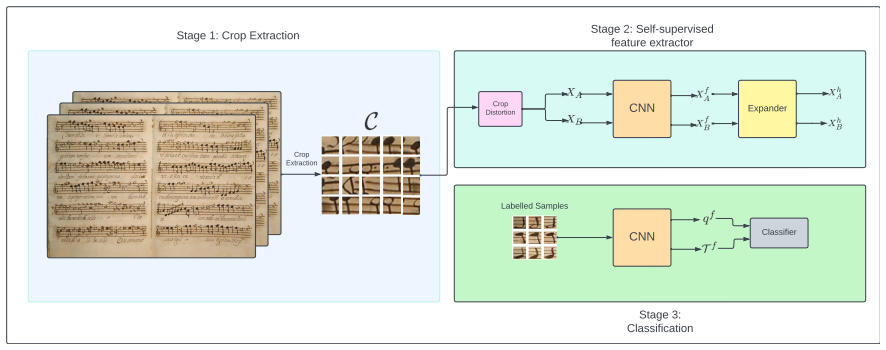
The key machinery is a two-stage pipeline. First, a convolutional neural network is trained with VICReg, a self-supervised method that distorts each crop twice and enforces variance, invariance, and covariance regularization so the distortions map to a shared feature-space point; this yields a 1600-dimensional feature vector per crop without using labels. Second, a five-layer MLP with batch normalization and dropout maps those features to the output classes. Around the pipeline sit crop preprocessing steps (Sauvola adaptive binarization, sliding-window extraction, entropy filtering) and a curated set of data augmentations that simulate historical degradation.
What would settle it
Run the MLP classifier under the exact evaluation protocol of the baseline study—same crops, same train/test splits, same augmentation settings—and compare its accuracy to the baseline's 82.0% kNN result, and to the paper's own reproduced kNN accuracy of 79.8% at K=5; if the margins shrink or reverse, the claimed improvement is an artifact of protocol differences.
Extended reading notes
Core claim
The paper's central claim is that a five-layer MLP trained on VICReg self-supervised features classifies musical symbols in the Capitan dataset at 87.66% mean accuracy with five samples per class, beating the 82.0% kNN baseline it compares against. The authors also report that moderate augmentation at the classification stage helps, and that the MLP scales better than prototypical networks as the number of samples per class grows.
Load-bearing premise
The comparison assumes that the way crops were extracted, features were trained, and test data were split in this study matches the baseline study's protocol well enough that the 5.66-point accuracy difference is caused by the classifier choice.
Editorial extensions
If this is right
- A lightweight classifier on self-supervised features can serve as a strong baseline for few-shot optical music recognition, reducing the need for large annotated corpora.
- The reported accuracy gap suggests that non-linear classifiers are preferable to kNN in the high-dimensional feature spaces produced by VICReg.
- The reduced augmentation set during classification offers a practical recipe: use degradation-simulating transformations for self-supervised pretraining, but a smaller set when training the head to avoid overfitting.
- The approach could be transferred to other historical document recognition tasks with scarce labels, such as ciphered manuscripts or early printed scores.
Reading between the lines
- A like-for-like comparison using the paper's own reproduced kNN values (79.8% at K=5) would show a larger margin for the MLP than the 5.66 points claimed against the cited baseline, suggesting the classifier's advantage may be understated rather than overstated.
- The persistent confusion among beamed notes hints that the feature extractor captures global shape but may miss fine structural cues; augmentations that specifically perturb beam connections could test whether the bottleneck is the features or the classifier.
- The reduced augmentation set for classification (random resized crop, colour jitter, Gaussian blur) offers a transferable heuristic: pretrain with heavy degradation simulation, but fine-tune the head with mild augmentations to avoid overfitting.
Editorial analysis
A structured set of objections, weighed in public.
Referee Report
Summary. The paper proposes a three-stage pipeline for few-shot classification of musical symbols in historical manuscripts: sliding-window crop extraction with binarization and entropy filtering, a VICReg self-supervised CNN feature extractor trained on unlabeled crops, and a downstream classifier (kNN, SVM, MLP, or prototypical network). Using the Capitan dataset with 28 symbol classes, the authors evaluate accuracy for 1, 3, 5, and 10 samples per class and augmentation counts from 0 to 20. The headline result is an MLP accuracy of 87.66% at five samples per class, claimed to surpass the kNN baseline of Alfaro-Contreras et al. [15] by 5.66 percentage points. The paper also reports preprocessing choices and confusion-matrix analyses of difficult symbol classes.
Significance. If the headline comparison were clean, the result would be a useful applied contribution: it would show that a simple MLP trained on self-supervised VICReg features outperforms a nearest-neighbor baseline for low-data historical music symbol classification, with practical implications for digitizing cultural heritage. The paper's strengths are its use of an established historical-music benchmark (Capitan), its systematic sweep over classifiers and augmentation levels, and its inclusion of class-level diagnostics. The contribution is incremental rather than conceptual, and the current evidence is not yet sufficient to establish the claimed improvement because the baseline comparison is uncontrolled and no uncertainty quantification is provided.
major comments (3)
- [§V, Table I(a)] The central claim that the MLP surpasses the Alfaro-Contreras et al. baseline by 5.66% is not supported as stated, because the comparison does not isolate the classifier. Table I(a) reports the authors' own kNN reproduction at K=5 with no augmentation as 79.8%, whereas the baseline column cites 82.0% from [15]; similar gaps appear at K=1 (60.7 vs 67.2) and K=10 (86.1 vs 86.9). These gaps are of the same magnitude as many classifier differences in Table I, so the advertised 5.66% improvement may reflect differences in crop extraction, feature training, evaluation splits, or other pipeline details rather than the MLP. The authors should reproduce the [15] baseline in their own pipeline or compare the MLP against their own kNN under identical conditions, and they should report the number of classes N in the N-way-K-shot evaluation and the support/query construction used for kNN, SVM, and MLP.
- [Table I, §V] All accuracy numbers are reported only as means, with no standard deviation, number of runs or seeds, or statistical tests. In a few-shot benchmark the support set is usually resampled, and Figure 4 indicates that bootstrapping was used at least for the confusion matrix; without uncertainty estimates the reader cannot judge whether the differences between MLP values (e.g., 86.79 at A=0 vs 87.66 at A=10 for K=5) or between MLP and SVM are real. Please report mean ± std over multiple seeds or resampled support/query splits, and provide a paired test or interval for the main comparisons.
- [§IV-B, Table I(c)] The augmentation policy and the best augmentation count are selected using test-set information. Section IV-B states that the authors observed during testing that the full transformation set 'led to overfitting' and therefore switched to a reduced set, and the headline result of 87.66% is the best A=10 entry in Table I(c). Selecting the augmentation type and count on the test set makes the reported accuracy an optimistic selection result. The authors should make these choices on a validation split derived from the labelled training data, or present the full grid of results without designating the best test entry as the expected performance.
minor comments (6)
- [§IV-A, Table I] The text says K values of 1, 2, 5, and 10 were used, but Table I and Figure 3 show rows for 1, 3, 5, and 10; please correct the text or the table.
- [§III-C, Fig. 2] Section III-C states that horizontal flipping was excluded, but Figure 2 lists 'Random horizontal flip' among the transformations used prior to training; clarify which transformations were used in self-supervised pretraining and which in classification-stage augmentation.
- [References] References [16] and [17] are the same paper; [1], [3], [4], [5], [7], [10], [11], [13], and [14] are not cited in the text; and Section II's discussion of Reptile cites [6] (MAML) rather than [7] (Nichol et al.).
- [§V] The notation for the number of samples per class switches between K (Table I, Figure 3) and L (Section V, 'L > 3'); please use one symbol throughout.
- [Table I, Fig. 4] Figure 4 reports an average over five bootstraps, but Table I's means are not described as bootstrapped; state the averaging procedure for all results.
- [§III-B, §IV-A] The CNN architecture and training details for VICReg (depth, width, epochs, batch size, optimizer, learning rate) and the MLP hyperparameters (optimizer, learning rate, dropout rate) are not specified; add these for reproducibility.
Circularity Check
No circularity: the central result is an external empirical benchmark comparison, not a derivation from fitted premises.
full rationale
The paper's central claim is an evaluated accuracy (87.66% MLP vs 82.0% kNN from Alfaro-Contreras et al. [15]) on the external Capitan dataset. The pipeline is inherited from [15], not from the authors' own prior results; the self-supervised VICReg extractor and its regularisation parameters cite external work [21] (with [16] apparently mis-cited, though that does not supply a load-bearing premise). The authors' self-citations [19], [22], [23] are background/survey or related OMR datasets/segmentation work, and none is used to justify the classification result. The legitimate concern—that the authors' own kNN reproduction (79.8%) differs from the published [15] baseline (82.0%), and that augmentation level A=10 appears selected from the tested grid—is a soundness/external-validity issue about whether the 5.66% margin is caused by the MLP rather than by pipeline differences; it is not a circularity in which an output is equivalent by construction to an input. No equation, fitted parameter, or renamed quantity is presented as a prediction, so no circular step is identifiable.
Assumptions & free parameters
free parameters (6)
- Augmentation set reduction =
random resized crop, colour jitter, Gaussian blur
- Augmentation count A =
5 for the best MLP result (87.66%)
- Classifier choice =
MLP
- VICReg hyperparameters lambda, mu, phi =
10, 10, 1
- MLP architecture =
five layers, 1600 to 128
- Entropy threshold and sliding-window size =
0.8, 64 pixels
assumptions (5)
- domain assumption Sliding-window crops mostly contain a single music symbol after entropy filtering and Sauvola binarisation.
- domain assumption VICReg self-supervised pretraining on unlabeled crops yields features that transfer to symbol classification.
- domain assumption The evaluation protocol is comparable to that of Alfaro-Contreras et al. [15].
- domain assumption The Capitan dataset labels are correct and the 28 classes are balanced enough for mean accuracy to be meaningful.
- standard math Standard results for VICReg, SVM, MLP, and prototypical networks are assumed.
Cite this review
Pith. "Pith review of Low-Data Classification of Historical Music Manuscripts: A Few-Shot Learning Approach." pith.science (2026). https://pith.science/paper/K7YXNOBJ
@misc{pith2026241116408,
  author       = {Pith},
  title        = {Pith review of: Low-Data Classification of Historical Music Manuscripts: A Few-Shot Learning Approach},
  year         = {2026},
  howpublished = {\url{https://pith.science/paper/K7YXNOBJ}},
  note         = {Machine review of arXiv:2411.16408}
}
read the original abstract
In this paper, we explore the intersection of technology and cultural preservation by developing a self-supervised learning framework for the classification of musical symbols in historical manuscripts. Optical Music Recognition (OMR) plays a vital role in digitising and preserving musical heritage, but historical documents often lack the labelled data required by traditional methods. We overcome this challenge by training a neural-based feature extractor on unlabelled data, enabling effective classification with minimal samples. Key contributions include optimising crop preprocessing for a self-supervised Convolutional Neural Network and evaluating classification methods, including SVM, multilayer perceptrons, and prototypical networks. Our experiments yield an accuracy of 87.66\%, showcasing the potential of AI-driven methods to ensure the survival of historical music for future generations through advanced digital archiving techniques.
Figures


Figures from the paper (2 more)


Reference graph
Works this paper leans on
-
[15]
Few-shot symbol classification via self-supervised learning and nearest neighbor
Alfaro-Contreras M, R ´ıos-Vila A, Valero-Mas JJ, Calvo-Zaragoza J. Few-shot symbol classification via self-supervised learning and nearest neighbor. Pattern Recognition Letters. 2023 Mar 1;167:1-8
work page 2023
-
[1]
The Challenge of Optical Music Recogni- tion,
D. Bainbridge and T. Bell, “The Challenge of Optical Music Recogni- tion,” Computers and the Humanities, vol. 35, no. 2, pp. 95–121, May
-
[2]
A Preliminary Study of Few- shot Learning for Layout Analysis of Music Scores
Castellanos FJ, Gallego AJ, Fujinaga I. A Preliminary Study of Few- shot Learning for Layout Analysis of Music Scores. In5 th International Workshop on Reading Music Systems 2023 Nov (p. 44)
work page 2023
-
[3]
Two (Note) Heads Are Bet- ter Than One: Pen-Based Multimodal Interaction with Music Scores
Calvo-Zaragoza J, Rizo D, Quereda JM. Two (Note) Heads Are Bet- ter Than One: Pen-Based Multimodal Interaction with Music Scores. InISMIR 2016 Aug 7 (pp. 509-514)
work page 2016
-
[4]
Beyer K, Goldstein J, Ramakrishnan R, Shaft U. When is “nearest neighbor” meaningful?. InDatabase Theory—ICDT’99: 7th International Conference Jerusalem, Israel, January 10–12, 1999 Proceedings 7 1999 (pp. 217-235). Springer Berlin Heidelberg. (a) MLP with K = 10, A = 2 (b) Prototypical classifier with S = 6, Q = 4, A = 2 Fig. 5: Confusion matrices for (a...
work page 1999
-
[5]
Ding S, Chen L. Intelligent optimization methods for high-dimensional data classification for support vector machines
-
[6]
Model-agnostic meta-learning for fast adap- tation of deep networks
Finn C, Abbeel P, Levine S. Model-agnostic meta-learning for fast adap- tation of deep networks. International conference on machine learning 2017 Jul 17 (pp. 1126-1135). PMLR
work page 2017
-
[7]
On first-order meta-learning algo- rithms
Nichol A, Achiam J, Schulman J. On first-order meta-learning algo- rithms. arXiv preprint arXiv:1803.02999. 2018 Mar 8
arXiv 2018
Show all 25 references
-
[8]
Meta-learning in neural networks: A survey
Hospedales T, Antoniou A, Micaelli P, Storkey A. Meta-learning in neural networks: A survey. IEEE transactions on pattern analysis and machine intelligence. 2021 May 11;44(9):5149-69
2021
-
[9]
Prototypical networks for few-shot learning
Snell J, Swersky K, Zemel R. Prototypical networks for few-shot learning. Advances in neural information processing systems. 2017;30
2017
-
[10]
SSL-ProtoNet: Self-supervised Learning Prototypical Networks for few-shot learning
Lim JY , Lim KM, Lee CP, Tan YX. SSL-ProtoNet: Self-supervised Learning Prototypical Networks for few-shot learning. Expert Systems with Applications. 2024 Mar 15;238:122173
2024
-
[11]
A baseline for few-shot image classification
Dhillon GS, Chaudhari P, Ravichandran A, Soatto S. A baseline for few-shot image classification. arXiv preprint arXiv:1909.02729. 2019 Sep 6
1909 arXiv
-
[12]
A survey on image data augmentation for deep learning
Shorten C, Khoshgoftaar TM. A survey on image data augmentation for deep learning. Journal of big data. 2019 Dec;6(1):1-48
2019
-
[13]
Few-shot image clas- sification: Just use a library of pre-trained feature extractors and a simple classifier
Chowdhury A, Jiang M, Chaudhuri S, Jermaine C. Few-shot image clas- sification: Just use a library of pre-trained feature extractors and a simple classifier. InProceedings of the IEEE/CVF International Conference on Computer Vision 2021 (pp. 9445-9454)
2021
-
[14]
A few-shot learning approach for historical ciphered manuscript recognition
Souibgui MA, Forn ´es A, Kessentini Y , Tudor C. A few-shot learning approach for historical ciphered manuscript recognition. In2020 25th International Conference on Pattern Recognition (ICPR) 2021 Jan 10 (pp. 5413-5420). IEEE
2021
-
[17]
Glyph and position classification of music symbols in early music manuscripts
Nu ˜nez-Alcover A, de Le ´on PJ, Calvo-Zaragoza J. Glyph and position classification of music symbols in early music manuscripts. InPattern Recognition and Image Analysis: 9th Iberian Conference, IbPRIA 2019, Madrid, Spain, July 1–4, 2019, Proceedings, Part II 9 2019 (pp. 159-...
2019
-
[18]
A comprehensive survey of few-shot learning: Evolution, applications, challenges, and opportunities
Song Y , Wang T, Cai P, Mondal SK, Sahoo JP. A comprehensive survey of few-shot learning: Evolution, applications, challenges, and opportunities. ACM Computing Surveys. 2023 Jul 13;55(13s):1-40
2023
-
[19]
Optical music recognition: State of the art and major challenges
Shatri E, Fazekas G. Optical music recognition: State of the art and major challenges. TENOR Conference 2020, Hamburg, Germany. arXiv preprint arXiv:2006.07885. 2020 Jun 14
2020 arXiv
-
[20]
Adaptive docu- ment binarization
Sauvola J, Seppanen T, Haapakoski S, Pietikainen M. Adaptive docu- ment binarization. In Proceedings of the fourth international conference on document analysis and recognition 1997 Aug 18 (V ol. 1, pp. 147- 152). IEEE
1997
-
[21]
Vicreg: Variance-invariance- covariance regularization for self-supervised learning
Bardes A, Ponce J, LeCun Y . Vicreg: Variance-invariance- covariance regularization for self-supervised learning. arXiv preprint arXiv:2105.04906. 2021 May 11
2021 arXiv
-
[22]
DoReMi: First glance at a universal OMR dataset
Shatri E, Fazekas G. DoReMi: First glance at a universal OMR dataset. arXiv preprint arXiv:2107.07786. 2021 Jul 16
2021 arXiv
-
[23]
Shatri, E., Fazekas, G. (2024). Knowledge Discovery in Optical Music Recognition: Enhancing Information Retrieval with Instance Segmen- tation. In 2024 International Conference in Knowledge Discovery and Information Retrieval (KDIR)
2024
-
[24]
Handwritten music recognition for mensural notation with convolutional recurrent neural networks
Calvo-Zaragoza J, Toselli AH, Vidal E. Handwritten music recognition for mensural notation with convolutional recurrent neural networks. Pattern Recognition Letters. 2019 Dec 1;128:115-21
2019
-
[25]
(2024, August)
R ´ıos-Vila, A., Calvo-Zaragoza, J., Paquet, T. (2024, August). Sheet music transformer: End-to-end optical music recognition beyond mono- phonic transcription. In International Conference on Document Analysis and Recognition (pp. 20-37). Cham: Springer Nature Switzerland
2024
-
[2001]
Available: https://doi.org/10.1023/A:1002485918032
[Online]. Available: https://doi.org/10.1023/A:1002485918032
Reviewed August 12, 2026 · model on record in the stance chip above.
Discussion (0). Continue with ORCID to comment.