REVIEW 3 major objections 4 minor 42 references
Unsupervised Event Outlier Detection in Continuous Time
T0 review · 3 major / 4 minor · reviewed 2026-08-12 · deepseek-v4-flash
Pith's one-line read The paper claims an unsupervised GAN-RL loop detects event outliers more accurately than the semi-supervised PPOD baseline, with no clean training data.
desk verdict A clever first attempt at fully unsupervised point-level outlier detection, but the label-tuned hyperparameters and additive-only action space mean the 'unsupervised' and 'absence of events' claims are ahead of the evidence. read the letter →
The pith
A machine-rendered reading of the paper's core claim, the machinery that carries it, and where it could break.
The reading
What carries the argument
The load-bearing machinery is the adversarial correction loop. A continuous-time LSTM encoder with a causally masked attention layer and layer normalization turns each event history into states; a PPO-based RL agent reads those states and samples a keep/remove action per point, so its policy is a per-point outlier probability; a spectrally normalized discriminator scores the whole corrected sequence against real sequences. The identity that carries the argument is the correction contrast: if the generator removes true outliers, the corrected sequence is statistically indistinguishable from the clean majority, but if it removes a normal point, the discriminator can detect the artifact, and that contrast supplies the reward signal for training the otherwise non-differentiable deletion policy.
What would settle it
Train GAN-RL on sequences whose anomalies are missing events rather than added points — delete a fraction of normal events from otherwise clean histories and ask the detector to flag those positions — and check whether the AUROC stays above chance; if it does not, the claim that the method detects both abnormal occurrences and absences of events is refuted.
Extended reading notes
Core claim
The central discovery, stated on the paper's own terms, is that an adversarial loop can be turned from a sequence-generation tool into an unsupervised outlier detector: the RL generator's deletion policy directly estimates the probability that each event point is an outlier, and the discriminator's ability to separate corrected sequences from real, mostly clean sequences acts as the reward that shapes that policy. The authors position this as the first unsupervised approach for abnormal-event detection in continuous time and report that it outperforms the state-of-the-art semi-supervised baseline PPOD, which assumes clean training data. On 100 test sequences unseen during training, GAN-RL achieves AUROC 0.631 versus 0.55 on Poisson, 0.610 versus 0.512 on Hawkes, 0.778 versus 0.583 on MIMIC, and 0.647 versus 0.548 on Taxi under the paper's additive-outlier injection protocol.
Load-bearing premise
The load-bearing premise is that every anomaly is an extra event point that should be removed, and that clean sequences are the majority of the data; anything else — missing events, altered timestamps, substituted events — is outside what the generator can represent or detect.
Editorial extensions
If this is right
- Event-forecasting pipelines could train directly on polluted sequences and use the learned deletion policy as an automated cleaning step, removing the need for a separate outlier-free corpus.
- Because all attention is causally masked, the trained generator can be deployed online on streaming data, flagging each new event before the next one arrives.
- The method replaces the semi-supervised assumption of clean training data with a weaker majority-clean assumption; the ablation suggests performance is preserved down to roughly 60% clean sequences.
- The discriminator supplies a learned, data-dependent reward, so the detector does not require a hand-specified intensity model of normal behavior as likelihood-based baselines do.
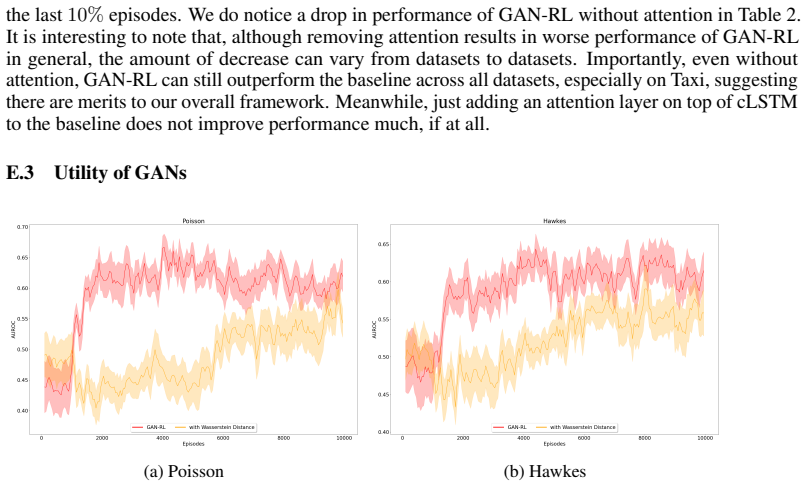
- At the other extreme, when no clean sequences remain ($\beta = 0$), the learned AUROC falls to about 0.5, confirming that the method's signal is the contrast between corrected and majority-clean real data.
Reading between the lines
- A reader should not generalize the reported accuracy to anomaly types outside the remove-only action space: missing events, substituted events, and shifted timestamps are not representable by this generator, so new experiments would be needed before claiming detection of 'absence of events'.
- The same correction-contrast principle could be extended to richer editing actions, such as inserting missing points or nudging timestamps, which would turn the framework into a general unsupervised data-repair model.
- The learned deletion probability could double as a per-point anomaly score and, aggregated, as a sequence-level score, linking this work to sequence-level anomaly detection benchmarks.
- Because the paper evaluates only injected additive outliers with ground-truth labels, a natural stress test is deployment on naturally occurring anomalies in real event logs, where the outlier-generating mechanism is unknown.
Editorial analysis
A structured set of objections, weighed in public.
Referee Report
Summary. The paper proposes GAN-RL, an unsupervised method for detecting outlier events in continuous-time event sequences. A generator, trained with PPO, sequentially decides for each event whether to remove it, producing a 'corrected' sequence; a discriminator tries to distinguish corrected sequences from real (possibly corrupted) sequences, and its real-class probability is used as the reward for the generator. After training, the generator's removal probabilities are used as an online per-event outlier score. The method is evaluated on two synthetic datasets (Poisson and Hawkes) and two real-world datasets (MIMIC, Taxi), with outliers injected as additional Poisson points. Reported test AUROC values (Table 1) show GAN-RL outperforming PPOD, RND, and LEN, and the appendix provides ablations on corruption level, attention, the GAN reward, and end-to-end training.
Significance. If the central empirical claim holds, the paper would be the first to demonstrate unsupervised, online detection of individual event outliers in continuous-time event streams, a practically useful extension of the semi-supervised PPOD method. The paper has clear strengths: evaluation on four datasets with multiple seeds, ablations that isolate the contributions of attention and the adversarial reward, a causal attention mechanism that preserves online applicability, and a comparison against a relevant state-of-the-art baseline. However, the unsupervised claim is not yet fully established because hyperparameters are selected using ground-truth labels, and the anomaly model covers only additive point outliers rather than the broader class of anomalies mentioned in the text. These issues are fixable but currently limit what the experiments demonstrate.
major comments (3)
- [Appendix G] The statement that 'For all the experiments, the hyper-parameters were tuned on final AUROC scores on the training set' is in tension with the unsupervised claim. AUROC is computed with ground-truth outlier labels, which Section 3.1 explicitly says are not accessible during training. This makes model selection a supervised procedure, so the advantage over PPOD in Table 1 may be a selection artifact rather than a property of unsupervised training. The issue is consequential: Figure 8 shows strong sensitivity to learning rates. Please report results with a label-free selection rule (e.g., fixed defaults, or model selection using only unsupervised criteria), or explicitly reposition the contribution as unsupervised training with supervised hyperparameter selection.
- [Section 2.3 and Appendix C.2] The anomaly model covers only additive point outliers. The generator's action space is binary keep/remove, and all experiments inject outliers by generating extra Poisson points that are merged with clean sequences. The abstract and Related Work claim that the method detects 'abnormal occurrences and absence of events', but the proposed action space cannot represent missing events or altered timestamps; it can only delete existing points. Please either narrow the claim to additive point outliers or extend the action space and evaluation to include missing or shifted events.
- [Section 3 (baseline setup)] PPOD is the main baseline in Table 1, but the paper does not describe how PPOD was trained for these experiments, which hyperparameters were used, or whether its hyperparameters were tuned under the same protocol (label-based or label-free) as GAN-RL. Without this information, the statement that GAN-RL 'can detect event outliers more accurately than the state-of-the-art approaches' is not fully supported. Please report the PPOD training protocol and ensure the baseline is tuned under comparable conditions.
minor comments (4)
- [Appendix F] The sentence about learning-rate sensitivity refers to 'Fig 8 (a) & (b)', but the generator learning rate is shown in panel (c); also 'discrimiantor' is misspelled.
- [References] Reference [23] contains a stray space in 'V olodymyr'; please correct it.
- [Table 2] The heading 'Comparison of asymptotic training performance' is vague; specify the number of episodes used and whether the numbers correspond to the same random seeds as Table 1.
- [Appendix G] The row 'Maximum Time Length=10' in Table 3 needs units and a statement of how longer sequences are handled (truncation, splitting, or padding).
Circularity Check
No derivation-level circularity; label-based hyperparameter tuning and a same-author baseline are the only concerns.
full rationale
No equation-level circularity is present: GAN-RL is an empirical pipeline trained with a discriminator reward and evaluated on held-out test sequences with injected outliers; the generator's policy is not derived from the AUROC labels it is scored against, and no fitted parameter is renamed as a prediction. The load-bearing comparison to PPOD is an external baseline, and although [15] shares an author with this paper, it is not used to justify the method. The only substantive concern is in Appendix G: hyperparameters were tuned on final AUROC on the training set, and AUROC uses ground-truth labels that Section 3.1 says are 'not accessible by any of the methods during training.' This is label leakage into model selection and weakens the 'unsupervised' claim, but it does not make the central detection result reduce to its inputs by construction. Score 2 reflects this mild leakage and the same-author baseline, not derivation-level circularity.
Assumptions & free parameters
free parameters (2)
- Hyperparameter set (learning rates, update frequency, hidden size, PPO clip, etc.) =
See Appendix G; e.g., generator learning rate 0.00001, discriminator learning rate 0.001, update frequency 1000…
- Outlier injection intensity alpha per dataset =
Poisson alpha=0.5, Hawkes alpha=0.5, MIMIC alpha=0.1, Taxi alpha=0.3
assumptions (3)
- domain assumption The majority of sampled sequences are normal, so the discriminator's 'real' class can represent clean data.
- domain assumption Outliers are extra points generated by an independent Poisson process and can be corrected by removal.
- domain assumption The GAN-style adversarial loop and PPO training converge to a useful detector.
Cite this review
Pith. "Pith review of Unsupervised Event Outlier Detection in Continuous Time." pith.science (2026). https://pith.science/paper/TUUA3QPF
@misc{pith2026241116427,
  author       = {Pith},
  title        = {Pith review of: Unsupervised Event Outlier Detection in Continuous Time},
  year         = {2026},
  howpublished = {\url{https://pith.science/paper/TUUA3QPF}},
  note         = {Machine review of arXiv:2411.16427}
}
read the original abstract
Event sequence data record the occurrences of events in continuous time. Event sequence forecasting based on temporal point processes (TPPs) has been extensively studied, but outlier or anomaly detection, especially without any supervision from humans, is still underexplored. In this work, we develop, to the best our knowledge, the first unsupervised outlier detection approach to detecting abnormal events. Our novel unsupervised outlier detection framework is based on ideas from generative adversarial networks (GANs) and reinforcement learning (RL). We train a 'generator' that corrects outliers in the data with a 'discriminator' that learns to discriminate the corrected data from the real data, which may contain outliers. A key insight is that if the generator made a mistake in the correction, it would generate anomalies that are different from the anomalies in the real data, so it serves as data augmentation for the discriminator learning. Different from typical GAN-based outlier detection approaches, our method employs the generator to detect outliers in an online manner. The experimental results show that our method can detect event outliers more accurately than the state-of-the-art approaches.
Figures


Figures from the paper (5 more)




Reference graph
Works this paper leans on
-
[1]
Samet Akcay, Amir Atapour-Abarghouei, and Toby P. Breckon. GANomaly: Semi-supervised anomaly detection via adversarial training. In Computer Vision – ACCV 2018, Lecture Notes in Computer Science, pp. 622–637, 2019
work page 2018
-
[2]
Jimmy Lei Ba, Jamie Ryan Kiros, and Geoffrey E. Hinton. Layer normalization, 2016
2016
- [3]
-
[4]
Neural Machine Translation by Jointly Learning to Align and Translate, May 2016
Dzmitry Bahdanau, Kyunghyun Cho, and Yoshua Bengio. Neural Machine Translation by Jointly Learning to Align and Translate, May 2016
work page 2016
-
[5]
Bayesian nonparamet- ric Poisson-process allocation for time-sequence modeling
Hongyi Ding, Mohammad Khan, Issei Sato, and Masashi Sugiyama. Bayesian nonparamet- ric Poisson-process allocation for time-sequence modeling. In International Conference on Artificial Intelligence and Statistics, pp. 1108–1116, 2018
work page 2018
-
[6]
Recurrent marked temporal point processes: Embedding event history to vector
Nan Du, Hanjun Dai, Rakshit Trivedi, Utkarsh Upadhyay, Manuel Gomez-Rodriguez, and Le Song. Recurrent marked temporal point processes: Embedding event history to vector. In Proceedings of the 22nd ACM SIGKDD International Conference on Knowledge Discovery and Data Mining, pp. 1555–1564. ACM, 2016
work page 2016
-
[7]
Ian Goodfellow, Jean Pouget-Abadie, Mehdi Mirza, Bing Xu, David Warde-Farley, Sherjil Ozair, Aaron Courville, and Yoshua Bengio. Generative adversarial nets. In Advances in Neural Information Processing Systems, pp. 2672–2680, 2014
work page 2014
-
[8]
Categorical reparameterization with gumbel-softmax
Eric Jang, Shixiang Gu, and Ben Poole. Categorical reparameterization with gumbel-softmax. arXiv preprint arXiv:1611.01144, 2016
arXiv 2016
Show all 42 references
-
[9]
Markov modulated Gaussian Cox processes for semi-stationary intensity modeling of events data
Minyoung Kim. Markov modulated Gaussian Cox processes for semi-stationary intensity modeling of events data. In International Conference on Machine Learning, pp. 2640–2648, July 2018
2018
-
[10]
Generative cooperative networks for natural language generation
Sylvain Lamprier, Thomas Scialom, Antoine Chaffin, Vincent Claveau, Ewa Kijak, Jacopo Staiano, and Benjamin Piwowarski. Generative cooperative networks for natural language generation. In International Conference on Machine Learning, pp. 11891–11905. PMLR, 2022
2022
-
[11]
Hawkes processes with stochastic excitations
Young Lee, Kar Wai Lim, and Cheng Soon Ong. Hawkes processes with stochastic excitations. In International Conference on Machine Learning, pp. 79–88, 2016
2016
-
[12]
MAD- GAN: Multivariate anomaly detection for time series data with generative adversarial networks
Dan Li, Dacheng Chen, Lei Shi, Baihong Jin, Jonathan Goh, and See-Kiong Ng. MAD- GAN: Multivariate anomaly detection for time series data with generative adversarial networks. arXiv:1901.04997 [cs, stat], January 2019
1901 arXiv
-
[13]
Learning temporal point processes via reinforcement learning
Shuang Li, Shuai Xiao, Shixiang Zhu, Nan Du, Yao Xie, and Le Song. Learning temporal point processes via reinforcement learning. In Advances in Neural Information Processing Systems, pp. 10781–10791, 2018
2018
-
[14]
Nonparametric regressive point processes based on conditional Gaussian processes
Siqi Liu and Milos Hauskrecht. Nonparametric regressive point processes based on conditional Gaussian processes. In Advances in Neural Information Processing Systems, pp. 1062–1072, 2019
2019
-
[15]
Event outlier detection in continuous time
Siqi Liu and Milos Hauskrecht. Event outlier detection in continuous time. In International Conference on Machine Learning, pp. 6793–6803. PMLR, July 2021
2021
-
[16]
Variational inference for Gaussian process modulated Poisson processes
Chris Lloyd, Tom Gunter, Michael Osborne, and Stephen Roberts. Variational inference for Gaussian process modulated Poisson processes. In International Conference on Machine Learning, pp. 1814–1822, 2015
2015
-
[17]
Latent point process allocation
Chris Lloyd, Tom Gunter, Michael Osborne, Stephen Roberts, and Tom Nickson. Latent point process allocation. In Artificial Intelligence and Statistics, pp. 389–397, May 2016
2016
-
[18]
Cot: Cooperative training for generative modeling of discrete data
Sidi Lu, Lantao Yu, Siyuan Feng, Yaoming Zhu, and Weinan Zhang. Cot: Cooperative training for generative modeling of discrete data. In International Conference on Machine Learning, pp. 4164–4172. PMLR, 2019
2019
-
[19]
Hongyuan Mei and Jason M. Eisner. The neural Hawkes process: A neurally self-modulating multivariate point process. In Advances in Neural Information Processing Systems, pp. 6757– 6767, 2017. 5
2017
-
[20]
Imputing missing events in continuous-time event streams
Hongyuan Mei, Guanghui Qin, and Jason Eisner. Imputing missing events in continuous-time event streams. In International Conference on Machine Learning, pp. 4475–4485. PMLR, May 2019
2019
-
[21]
Which training methods for gans do actually converge? In International conference on machine learning, pp
Lars Mescheder, Andreas Geiger, and Sebastian Nowozin. Which training methods for gans do actually converge? In International conference on machine learning, pp. 3481–3490. PMLR, 2018
2018
-
[22]
Spectral normalization for generative adversarial networks, 2018
Takeru Miyato, Toshiki Kataoka, Masanori Koyama, and Yuichi Yoshida. Spectral normalization for generative adversarial networks, 2018
2018
-
[23]
Lillicrap, Tim Harley, David Silver, and Koray Kavukcuoglu
V olodymyr Mnih, Adrià Puigdomènech Badia, Mehdi Mirza, Alex Graves, Timothy P. Lillicrap, Tim Harley, David Silver, and Koray Kavukcuoglu. Asynchronous methods for deep reinforce- ment learning. CoRR, abs/1602.01783, 2016. URL http://arxiv.org/abs/1602.01783
2016 arXiv
-
[24]
Fully neural network based model for general temporal point processes
Takahiro Omi, Naonori Ueda, and Kazuyuki Aihara. Fully neural network based model for general temporal point processes. In Advances in Neural Information Processing Systems, pp. 2120–2129, 2019
2019
-
[25]
Vinayak Rao and Yee W. Teh. Gaussian process modulated renewal processes. In Advances in Neural Information Processing Systems, pp. 2474–2482, 2011
2011
-
[26]
Waldstein, Ursula Schmidt-Erfurth, and Georg Langs
Thomas Schlegl, Philipp Seeböck, Sebastian M. Waldstein, Ursula Schmidt-Erfurth, and Georg Langs. Unsupervised anomaly detection with generative adversarial networks to guide marker discovery. In Information Processing in Medical Imaging, Lecture Notes in Computer Science, pp....
2017
-
[27]
Proximal policy optimization algorithms
John Schulman, Filip Wolski, Prafulla Dhariwal, Alec Radford, and Oleg Klimov. Proximal policy optimization algorithms. CoRR, abs/1707.06347, 2017. URL http://arxiv.org/ abs/1707.06347
2017 arXiv
-
[28]
Detecting anomalous event sequences with temporal point processes
Oleksandr Shchur, Ali Caner Turkmen, Tim Januschowski, Jan Gasthaus, and Stephan Günne- mann. Detecting anomalous event sequences with temporal point processes. In Advances in Neural Information Processing Systems, volume 34, pp. 13419–13431, 2021
2021
-
[29]
Isotonic Hawkes processes
Yichen Wang, Bo Xie, Nan Du, and Le Song. Isotonic Hawkes processes. In International Conference on Machine Learning, pp. 2226–2234, 2016
2016
-
[30]
Foiling nyc’s taxi trip data, 2014
C Whong. Foiling nyc’s taxi trip data, 2014. URL https://chriswhong.com/open-data/ foil_nyc_taxi/
2014
-
[31]
Williams
Ronald J. Williams. Simple statistical gradient-following algorithms for connectionist re- inforcement learning. Mach. Learn., 8(3–4):229–256, may 1992. ISSN 0885-6125. doi: 10.1007/BF00992696. URL https://doi.org/10.1007/BF00992696
1992 doi
-
[32]
Wasser- stein learning of deep generative point process models
Shuai Xiao, Mehrdad Farajtabar, Xiaojing Ye, Junchi Yan, Le Song, and Hongyuan Zha. Wasser- stein learning of deep generative point process models. In Advances in Neural Information Processing Systems, pp. 3247–3257, 2017
2017
-
[33]
Shuai Xiao, Junchi Yan, Xiaokang Yang, Hongyuan Zha, and Stephen M. Chu. Modeling the intensity function of point process via recurrent neural networks. In AAAI, pp. 1597–1603, 2017
2017
-
[34]
Learning Granger causality for Hawkes processes
Hongteng Xu, Mehrdad Farajtabar, and Hongyuan Zha. Learning Granger causality for Hawkes processes. In International Conference on Machine Learning, pp. 1717–1726, 2016
2016
-
[35]
HYPRO: A hybridly normalized probabilistic model for long-horizon prediction of event sequences
Siqiao Xue, Xiaoming Shi, James Zhang, and Hongyuan Mei. HYPRO: A hybridly normalized probabilistic model for long-horizon prediction of event sequences. Advances in Neural Information Processing Systems, 35:34641–34650, 2022
2022
-
[36]
Arik, and Tomas Pfister
Jinsung Yoon, Sercan O. Arik, and Tomas Pfister. Data valuation using reinforcement learning, 2019
2019
-
[37]
Learning to select exogenous events for marked temporal point process
Ping Zhang, Rishabh Iyer, Ashish Tendulkar, Gaurav Aggarwal, and Abir De. Learning to select exogenous events for marked temporal point process. In Advances in Neural Information Processing Systems, volume 34, pp. 347–361. Curran Associates, Inc., 2021
2021
-
[38]
Self-attentive Hawkes process
Qiang Zhang, Aldo Lipani, Omer Kirnap, and Emine Yilmaz. Self-attentive Hawkes process. In Proceedings of the 37th International Conference on Machine Learning, pp. 11183–11193. PMLR, November 2020. 6
2020
-
[39]
Learning triggering kernels for multi-dimensional Hawkes processes
Ke Zhou, Hongyuan Zha, and Le Song. Learning triggering kernels for multi-dimensional Hawkes processes. In International Conference on Machine Learning, pp. 1301–1309, 2013
2013
-
[40]
Sequential Adversarial Anomaly Detection for One-Class Event Data, April 2023
Shixiang Zhu, Henry Shaowu Yuchi, Minghe Zhang, and Yao Xie. Sequential Adversarial Anomaly Detection for One-Class Event Data, April 2023
2023
-
[41]
Transformer Hawkes process
Simiao Zuo, Haoming Jiang, Zichong Li, Tuo Zhao, and Hongyuan Zha. Transformer Hawkes process. In International Conference on Machine Learning, pp. 11692–11702. PMLR, Novem- ber 2020. A Related Work Generative model based outlier detection Although outlier detection methods us...
2020
-
[42]
cleanness
This output is repurposed as a reward signal that propels the RL agent to optimize its approach. This interplay between the RL agent and the discriminator creates a dynamic wherein the generated sequences evolve to closely mimic the clean sequences, blurring the boundaries bet...
2000
Reviewed August 12, 2026 · model on record in the stance chip above.
Discussion (0). Continue with ORCID to comment.