REVIEW 3 major objections 4 minor 65 references
Stacking-dependent electronic structure of ultrathin perovskite bilayers
T0 review · 3 major / 4 minor · reviewed 2026-08-12 · deepseek-v4-flash
Pith's one-line read A stacking-dependent tight-binding model captures the valence bands of perovskite bilayers and supplies the foundation for twisted oxide layers.
desk verdict Solid four-stacking tight-binding models for RP1 perovskites, but the claimed pathway to twisted-layer models is missing the arbitrary-shift parameters. read the letter →
The pith
A machine-rendered reading of the paper's core claim, the machinery that carries it, and where it could break.
The reading
What carries the argument
The load-bearing object is the mirror-odd sector of the oxygen-p/titanium-d valence manifold. Symmetry under reflection through the mid-plane of the BO6 octahedron separates the 17 atomic orbitals into states that couple between layers and states that do not; keeping only the five mirror-odd combinations reduces the valence manifold to a manageable tight-binding basis. The monolayer Hamiltonian is written with functions fk(a)=2cos(k·a) and gk(a)=2i sin(k·a), and the interlayer coupling at each stacking is a matrix whose entries are sums over neighbor atoms weighted by Gaussian decay in in-plane distance and interlayer separation. The minimal model is obtained by a Schur-complement reduction of the lower two bands, leaving a three-band-per-layer Hamiltonian with renormalized parameters. This construction is what makes twistronics tractable: the same shift-dependent coupling matrices can be evaluated at every local stacking in a twisted moiré cell.
What would settle it
Calculate the valence bands of a small-angle twisted Sr2TiO4 bilayer with full ionic relaxation and compare them band-by-band with the model's prediction built from these shift-dependent couplings; if the low-energy bands differ by more than a few tens of meV, or if relaxed AAx and AAy stackings produce materially different interlayer couplings, the configuration-space foundation is falsified.
Extended reading notes
Core claim
The paper's central discovery is that the entire interlayer physics of ultrathin perovskite bilayers lives in five mirror-odd valence states: the hybrids ψ1,z and φ1,ℓ formed from apical oxygen p orbitals and the titanium dz2 orbital, together with the in-plane oxygen pz combinations χ±1,z. A 15-parameter tight-binding Hamiltonian in this basis reproduces the DFT valence bands of the monolayer essentially exactly for STO and well for CTO and BTO. For bilayers, the paper writes the interlayer coupling as explicit matrices at the four special shifts r00 (AA), r11 (AB), r10 (DWx), and r01 (DWy), with momentum dependence in cosine and sine combinations of the shift, and shows that the resulting bands match the DFT bilayer bands. The full 10-band model can be reduced to three bands per layer by integrating out the lower two mirror-odd states, producing a minimal model that retains the stacking-dependent valence-band maximum away from Γ. The authors state that this shift-dependent parametrization provides the necessary ingredients for full-scale tight-binding and continuum models of twisted perovskite bilayers.
Load-bearing premise
The derivation depends on the premise that every local environment in a twisted bilayer is faithfully represented by the untilted, unrelaxed stackings computed here, and specifically that the four AA-type stackings have nearly identical electronic effects.
Editorial extensions
If this is right
- The tabulated monolayer and interlayer parameters are directly usable to build tight-binding models of twisted RP1 oxide bilayers in arbitrary commensurate moiré cells.
- The shift-dependent interlayer couplings provide the moiré potential for continuum models of twisted perovskite oxides, following the same route used for graphene and transition-metal dichalcogenides.
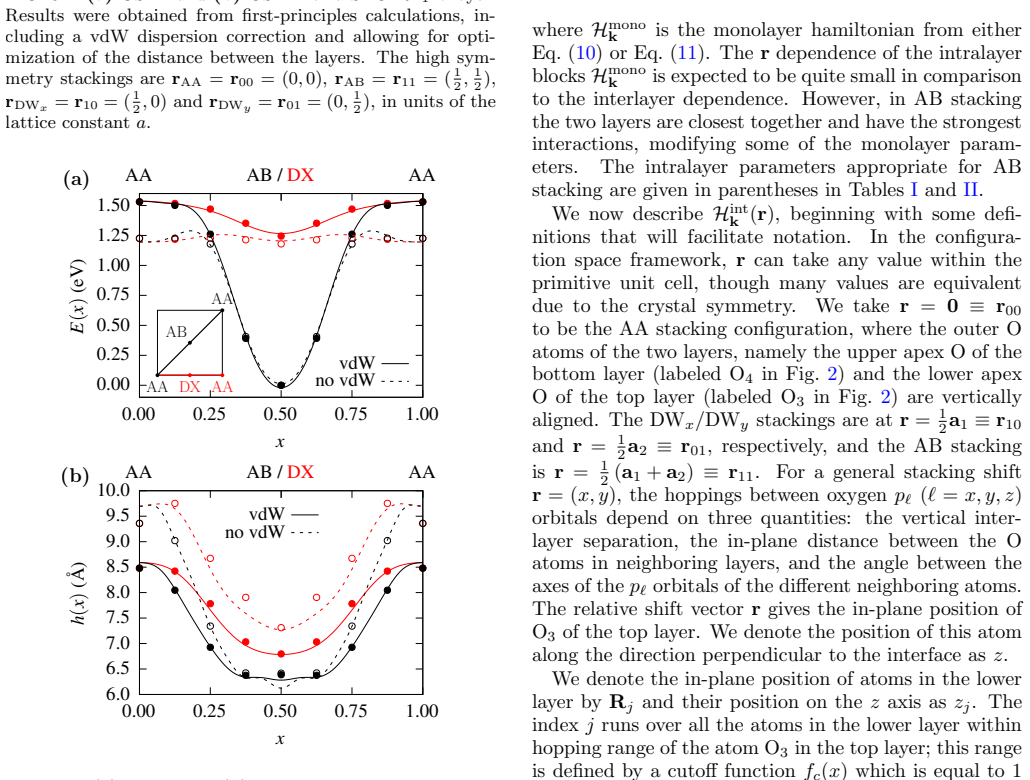
- Because the AA stacking is more than 1 eV per unit cell higher in energy than AB and has nearly twice the interlayer separation, local regions of a moiré cell will have sharply different interlayer coupling, so stacking domains should be electronically distinct.
- In all four stackings the interlayer interaction moves the valence-band maximum into mirror-odd states away from Γ, so hole-doped twisted perovskite bilayers should show strongly stacking-sensitive transport and optical response.
Reading between the lines
- If ionic relaxation inside a moiré cell is strong, the paper's assumption that the four AA-type stackings behave equivalently may fail; computing interlayer couplings for relaxed bilayers at AAx and AAy would test this directly, since the paper explicitly leaves relaxation to future work.
- The same symmetry decomposition could be applied to the conduction band, which the paper notes is dominated by Ti dxy orbitals and is not modeled here; a paired valence and conduction model would open electron-doped twisted oxides.
- The large stacking-energy differences suggest that twisted oxide bilayers could develop reconstructed stacking domains whose electronic properties differ more sharply than in van der Waals moirés; this is an inference, not a result of the paper.
- The reported near-independence of the AA stacking's electronic states, combined with large interlayer separation, implies that AA regions in a moiré cell act almost like decoupled monolayers; a continuum model built from these couplings would predict strong spatial modulation of band hybridization across the moiré cell.
Editorial analysis
A structured set of objections, weighed in public.
Referee Report
Summary. The manuscript develops tight-binding models for the valence bands of monolayer and bilayer Ruddlesden-Popper (RP1) perovskite oxides, specifically Ca2TiO4, Sr2TiO4, and Ba2TiO4. A five-band maximally localized Wannier function (MLWF) model is constructed for the mirror-odd valence states, and a reduced three-band effective model is fitted to the top of the valence band. For bilayers, the authors compute generalized stacking fault energies and heights, derive interlayer coupling Hamiltonians for four high-symmetry stackings (AA, AB, DWx, DWy) in both the five-band and three-band forms, and compare the resulting band structures with DFT. They then propose a configuration-space parametrization of the interlayer hopping as a function of relative layer shift, intended as the foundation for future twisted-bilayer models. The direct four-stacking results are presented as the main technical achievement, with the configuration-space extension framed as the route to full moiré Hamiltonians.
Significance. If the results hold, this is a valuable step toward extending twistronics beyond van der Waals materials to strongly bonded oxide layers. The paper's concrete strengths are the direct DFT-based construction of MLWF tight-binding models for three materials, the explicit stacking-dependent interlayer Hamiltonians for the four high-symmetry stackings, and the GSFE/GSFH fits. The comparison between the MLWF bands and DFT bands is close (Fig. 3b for STO; Figs. S4-S7 for CTO/BTO), and the paper makes falsifiable predictions for the stacking-dependent valence band structure that can be tested by future experiments or calculations. However, the claimed pathway to twisted-bilayer models rests on an arbitrary-shift interpolation whose parameters are not fully specified, which limits the transferability of the model as presented.
major comments (3)
- [§IV.C, Eqs. (26)-(29) and Appendix C] The general interlayer hopping parametrization for arbitrary shifts depends on the decay constants ξ and κ and the cutoff function fc(x), but no numerical values or explicit functional form for these quantities are provided anywhere in the manuscript or supplement. Appendix C only fixes combinations: from Eq. (C2), u2 = t0 e^{-κ} and u3 = t0 e^{-κ} e^{-ξ}, so e^{-ξ} = u3/u2 is determined, but t0 and κ remain undetermined because t0 is never specified. Since the stated deliverable in Section V is "the necessary ingredients for full-scale tight-binding models of twisted layers," these missing constants make the arbitrary-shift model not actionable. The authors should provide explicit values (or a fitting procedure) for ξ, κ, and fc, and should test the exponential-plus-cutoff interpolation against DFT or MLWF calculations at intermediate shifts.
- [§IV.A] The assumption that the four AA-type stackings are essentially equivalent is stated but never tested. AAx, AAy, and the unit-cell-center AA stacking are never computed, even though they are identified as distinct in Fig. 4(b) and the moiré cell reduction relies on their equivalence. A single DFT or MLWF calculation for the AAx or AAy stacking would directly test this load-bearing assumption; without it, the configuration-space model may misrepresent the actual moiré potential.
- [§III and §IV.C, Table IV] The simplified three-band model is numerically fitted to DFT bands (Section III) and its interlayer parameters are described as "optimized by hand" (Section IV.C), rather than derived from the MLWF model or from the general interpolation. This means the three-band model has no independent predictive content beyond the fitted stackings; its agreement with DFT in Fig. 7 is a fitting result, not a validation. The manuscript should clarify the status of these parameters and ideally show that they are consistent with the general shift-dependent expressions in Eqs. (26)-(29), or with a Schur-complement reduction of the five-band model.
minor comments (4)
- [§II, Fig. 1] The caption for Fig. 1 lists panels (d) and (e) as bulk cubic SrTiO3 and bulk RP1 Sr2TiO4 band structures, but the text in Section II does not explicitly reference these panels; adding a pointer would improve readability.
- [§IV.C, Eq. (24)] The convention {r = 0, Rj = 0} ⇒ xj = 0, yj = 0 is stated, but similar care is needed for the other atoms j that may also produce zero denominators (e.g., when rj = 0 for nonzero r due to symmetry); the current text only mentions the r = 0, Rj = 0 case.
- [§IV.C, Table III] The table lists λD = w7/w6, but w7 and w6 are positive for all materials, while λD is presumably a signed ratio that can affect the band structure; a brief note on the allowed range or physical meaning of λD would be useful.
- [§IV.B, Fig. 6] The line-cut labels in Fig. 6 use "AB / DX" and "AA" in the x-axis ticks, but the text defines DWx and DWy; using consistent notation (DWx/DWy) would avoid confusion.
Circularity Check
No significant circularity: the tight-binding models are openly fitted to DFT bands and no fitted parameter is relabeled as a prediction.
full rationale
The paper's central products are tight-binding Hamiltonians whose parameters are obtained by fitting to DFT band structures (Tables I-IV, with Wannier fits described in Appendix A), and the subsequent band plots compare the models against the same DFT data. This is model construction and fidelity checking, not prediction: the paper never claims these bands are independent of the fitting data, and no fitted parameter is renamed as a predicted quantity. The configuration-space approach is cited from prior work that includes some of the present authors, but it is used as a methodological framework for classifying local stackings and for the form of the interlayer hopping; the stacking classifications and the interlayer matrix elements themselves are computed here from DFT and MLWFs rather than imported as an unexamined theorem. The statement in Sec. IV A that the four AA-type stackings have very similar electronic effects is an explicit physical assumption, not a derived result, so it cannot be circular. Appendix C shows that the general hopping ansatz of Eqs. (26)-(29) reduces, with identifying relations such as u2 = t0 e^{-kappa} and u3 = t0 e^{-kappa} e^{-xi}, to the MLWF-fitted special-case parameters; this consistency is not circular because those special-case values are independent inputs and no intermediate-shift prediction is actually made. In fact, xi, kappa, and fc are never specified and no intermediate-shift DFT check is reported, which limits the completeness of the claimed pathway to twisted-layer models but is an underdetermination issue, not circularity. No self-referential uniqueness theorem is invoked, and no result in the paper is equivalent by definition to its own input. The derivation chain is therefore self-contained in the sense required here: the fitted models are presented as fits, and the only forward-looking claim, the availability of ingredients for twisted-layer models, is an extrapolation that is untested rather than circular.
Assumptions & free parameters
free parameters (7)
- MLWF intralayer TB parameters (15 per material, Table I) =
CTO/STO/BTO values in Table I
- Simplified 3-band intralayer parameters (Table II) =
Values in Table II, with λxy set to -1/3
- MLWF interlayer parameters (Table III) =
u, v, w values per material
- Simplified interlayer parameters (Table IV) =
Values in Table IV
- Gaussian decay constants ξ and κ =
Not reported
- Cutoff function fc(x) =
Not specified
- GSFE and GSFH Fourier coefficients (Tables V and VI) =
Coefficients per material
assumptions (6)
- domain assumption PBE + DFT-D3 and PAW pseudopotentials give accurate band structures and energies for these titanates.
- ad hoc to paper The relevant low-energy interlayer physics is captured by the five M-odd states built from O p and Ti d_z2 orbitals, while M-even valence states can be neglected.
- ad hoc to paper The anti-bonding ψ2,z and bonding ψ0,z states can be removed from the basis because they are far from the valence band top.
- ad hoc to paper Interlayer hopping is dominated by σ-type bonding between O3 of the top layer and O4 of the bottom layer; π-type bonding and O4(top)-O3(bottom) hopping are negligible.
- domain assumption The configuration-space approximation applies to twisted bilayers: local stacking environments are equivalent to untwisted shifted bilayers with only vertical relaxation.
- ad hoc to paper The four AA-type stacking regions have very similar electronic effects and can be treated as equivalent.
Cite this review
Pith. "Pith review of Stacking-dependent electronic structure of ultrathin perovskite bilayers." pith.science (2026). https://pith.science/paper/5WH5F2KI
@misc{pith2026241116497,
  author       = {Pith},
  title        = {Pith review of: Stacking-dependent electronic structure of ultrathin perovskite bilayers},
  year         = {2026},
  howpublished = {\url{https://pith.science/paper/5WH5F2KI}},
  note         = {Machine review of arXiv:2411.16497}
}
abstract
Twistronics has received much attention as a new method to manipulate the properties of 2D van der Waals structures by introducing moir\'e patterns through a relative rotation between two layers. Here we begin a theoretical exploration of twistronics beyond the realm of van der Waals materials by developing a first-principles description of the electronic structure and interlayer interactions of ultrathin perovskite bilayers. We construct both an ab initio tight-binding model as well as a minimal 3-band effective model for the valence bands of monolayers and bilayers of oxides derived from the Ruddlesden-Popper phase of perovskites, which is amenable to thin-layer formation. We illustrate the approach with the specific example of Sr$_2$TiO$_4$ layers but also provide model parameters for Ca$_2$TiO$_4$ and Ba$_2$TiO$_4$ .
Figures


Figures from the paper (4 more)



Reference graph
Works this paper leans on
-
[1]
A. K. Geim and I. V. Grigorieva, Van der Waals het- erostructures, Nature 499, 419 (2013)
2013
-
[2]
0 0 t2j(2) k (a2, a1,ν 2,ν′ 2) t1j(1) k (a1, a2,ν 1) t1j(1) k (a2, a1,ν 1) . (13) The momentum dependence in Hk is described by the functions fk and gk[52]: fk(a) =eik·a +e−ik·a = 2 cos(k· a) (14) gk(a) =eik·a−e−ik·a = 2i sin(k· a), (15) as well as the combinations: hk(a, a′,λ,µ ) =fk(a) +λfk(a′) +µfk(a)fk(a′) (16) j(1) k (a, a′,ν ) = [1 +νfk(a′)]fk (...
-
[3]
E. Y. Andrei, D. K. Efetov, P. Jarillo-Herrero, A. H. MacDonald, K. F. Mak, T. Senthil, E. Tutuc, A. Yazdani, and A. F. Young, The marvels of moir´ e materials, Nat. Rev. Mater. 6, 3 (2021)
work page 2021
-
[4]
Y. Xie, A. T. Pierce, J. M. Park, D. E. Parker, E. Khalaf, P. Ledwith, Y. Cao, S. H. Lee, S. Chen, P. R. Forrester, et al. , Fractional chern insulators in magic-angle twisted bilayer graphene, Nature 600, 439 (2021)
work page 2021
-
[5]
Y. Zeng, Z. Xia, K. Kang, J. Zhu, P. Kn¨ uppel, C. Vaswani, K. Watanabe, T. Taniguchi, K. F. Mak, and J. Shan, Thermodynamic evidence of fractional chern in- sulator in moir´ e MoTe2, Nature 622, 69 (2023)
2023
-
[6]
H. Park, J. Cai, E. Anderson, Y. Zhang, J. Zhu, X. Liu, C. Wang, W. Holtzmann, C. Hu, Z. Liu, et al. , Observa- tion of fractionally quantized anomalous hall effect, Na- ture 622, 74 (2023)
work page 2023
-
[7]
K. P. Nuckolls, M. Oh, D. Wong, B. Lian, K. Watanabe, T. Taniguchi, B. A. Bernevig, and A. Yazdani, Strongly correlated chern insulators in magic-angle twisted bilayer graphene, Nature 588, 610 (2020)
2020
-
[8]
S. Wu, Z. Zhang, K. Watanabe, T. Taniguchi, and E. Y. Andrei, Chern insulators, van Hove singularities and topological flat bands in magic-angle twisted bilayer graphene, Nat. Mater. 20, 488 (2021)
work page 2021
Show all 65 references
-
[9]
Y. Cao, V. Fatemi, S. Fang, K. Watanabe, T. Taniguchi, E. Kaxiras, and P. Jarillo-Herrero, Unconventional super- conductivity in magic-angle graphene superlattices, Na- ture 556, 43 (2018)
2018
-
[10]
X. Lu, P. Stepanov, W. Yang, M. Xie, M. A. Aamir, I. Das, C. Urgell, K. Watanabe, T. Taniguchi, G. Zhang, et al. , Superconductors, orbital magnets and correlated states in magic-angle bilayer graphene, Nature 574, 653 (2019)
2019
-
[11]
G. Chen, A. L. Sharpe, P. Gallagher, I. T. Rosen, E. J. Fox, L. Jiang, B. Lyu, H. Li, K. Watanabe, T. Taniguchi, et al. , Signatures of tunable superconduc- tivity in a trilayer graphene moir´ e superlattice, Nature 572, 215 (2019)
2019
-
[12]
J. M. Park, Y. Cao, K. Watanabe, T. Taniguchi, and P. Jarillo-Herrero, Tunable strongly coupled supercon- ductivity in magic-angle twisted trilayer graphene, Na- ture 590, 249 (2021)
2021
-
[13]
J. M. Park, Y. Cao, L.-Q. Xia, S. Sun, K. Watanabe, T. Taniguchi, and P. Jarillo-Herrero, Robust supercon- ductivity in magic-angle multilayer graphene family, Nat. Mater. 21, 877 (2022)
2022
-
[14]
Y. Cao, V. Fatemi, A. Demir, S. Fang, S. L. Tomarken, J. Y. Luo, J. D. Sanchez-Yamagishi, K. Watanabe, T. Taniguchi, E. Kaxiras, et al. , Correlated insulator be- haviour at half-filling in magic-angle graphene superlat- tices, Nature 556, 80 (2018)
2018
-
[15]
K. P. Nuckolls, R. L. Lee, M. Oh, D. Wong, T. Soe- jima, J. P. Hong, D. C˘ alug˘ aru, J. Herzog-Arbeitman, B. A. Bernevig, K. Watanabe, T. Taniguchi, N. Regnault, M. P. Zaletel, and A. Yazdani, Quantum textures of the many-body wavefunctions in magic-angle graphene, Na- ture 6...
2023
-
[16]
Yasuda, X
K. Yasuda, X. Wang, K. Watanabe, T. Taniguchi, and P. Jarillo-Herrero, Stacking-engineered ferroelectricity in bilayer boron nitride, Science 372, 1458 (2021)
2021
-
[17]
Bennett and B
D. Bennett and B. Remez, On electrically tunable stack- ing domains and ferroelectricity in moir´ e superlattices, npj 2D Mater. Appl. 6, 1 (2022)
2022
-
[18]
Bennett, Theory of polar domains in moir´ e het- erostructures, Phys
D. Bennett, Theory of polar domains in moir´ e het- erostructures, Phys. Rev. B 105, 235445 (2022)
2022
-
[19]
K. Ko, A. Yuk, R. Engelke, S. Carr, J. Kim, D. Park, H. Heo, H.-M. Kim, S.-G. Kim, H. Kim, et al., Operando electron microscopy investigation of polar domain dy- namics in twisted van der Waals homobilayers, Nat. Mater. , 1 (2023)
2023
-
[20]
Bennett, G
D. Bennett, G. Chaudhary, R.-J. Slager, E. Bous- quet, and P. Ghosez, Polar meron-antimeron networks in strained and twisted bilayers, Nat. Commun. 14, 1629 (2023)
2023
-
[21]
Van Winkle, N
M. Van Winkle, N. Dowlatshahi, N. Khaloo, M. Iyer, I. M. Craig, R. Dhall, T. Taniguchi, K. Watanabe, and D. K. Bediako, Engineering interfacial polarization switching in van der Waals multilayers, Nat. Nanotech- 14 nol. , 1 (2024)
2024
-
[22]
Yasuda, E
K. Yasuda, E. Zalys-Geller, X. Wang, D. Bennett, S. S. Cheema, K. Watanabe, T. Taniguchi, E. Kaxi- ras, P. Jarillo-Herrero, and R. Ashoori, Ultrafast high- endurance memory based on sliding ferroelectrics, Sci- ence , eadp3575 (2024)
2024
-
[23]
Q. Tong, F. Liu, J. Xiao, and W. Yao, Skyrmions in the moir´ e of van der Waals 2D magnets, Nano Lett.18, 7194 (2018)
2018
-
[24]
Hejazi, Z.-X
K. Hejazi, Z.-X. Luo, and L. Balents, Noncollinear phases in moir´ e magnets, PNAS117, 10721 (2020)
2020
-
[25]
Song, Q.-C
T. Song, Q.-C. Sun, E. Anderson, C. Wang, J. Qian, T. Taniguchi, K. Watanabe, M. A. McGuire, R. St¨ ohr, D. Xiao, et al. , Direct visualization of magnetic domains and moir´ e magnetism in twisted 2D magnets, Science 374, 1140 (2021)
2021
-
[26]
Bennett, G
D. Bennett, G. Mart´ ınez-Carracedo, X. He, J. Fer- rer, P. Ghosez, R. Comin, and E. Kaxiras, Stacking- engineered ferroelectricty and multiferroic order in van der Waals magnets, arXiv:2405.20069 (2024)
2024 arXiv
-
[27]
S. Carr, D. Massatt, S. Fang, P. Cazeaux, M. Luskin, and E. Kaxiras, Twistronics: manipulating the electronic properties of two-dimensional layered structures through their twist angle, Phys. Rev. B 95, 075420 (2017)
2017
-
[28]
H. Yoo, R. Engelke, S. Carr, S. Fang, K. Zhang, P. Cazeaux, S. H. Sung, R. Hovden, A. W. Tsen, T. Taniguchi, et al. , Atomic and electronic reconstruc- tion at the van der Waals interface in twisted bilayer graphene, Nat. Mater. 18, 448 (2019)
2019
-
[29]
Dagotto, Complexity in strongly correlated electronic systems, Science 309, 257 (2005)
E. Dagotto, Complexity in strongly correlated electronic systems, Science 309, 257 (2005)
2005
-
[30]
D. Ji, S. Cai, T. R. Paudel, H. Sun, C. Zhang, L. Han, Y. Wei, Y. Zang, M. Gu, Y. Zhang, et al. , Freestanding crystalline oxide perovskites down to the monolayer limit, Nature 570, 87 (2019)
2019
-
[31]
M. Beno, L. Soderholm, D. Capone, D. Hinks, J. Jor- gensen, J. Grace, I. K. Schuller, C. Segre, and K. Zhang, Structure of the single-phase high-temperature supercon- ductor YBa2Cu3O7−δ, Appl. Phys. Lett. 51, 57 (1987)
1987
-
[32]
Schneemeyer, J
L. Schneemeyer, J. V. Waszczak, T. Siegrist, R. B. van Dover, L. Rupp, B. Batlogg, R. J. Cava, and D. W. Murphy, Superconductivity in YBa 2Cu3O7 single crys- tals, Nature 328, 601 (1987)
1987
-
[33]
Massidda, J
S. Massidda, J. Yu, and A. Freeman, Electronic struc- ture and properties of Bi2Sr2CaCu2O8, the third high-Tc superconductor, Physica C: Supercond. 152, 251 (1988)
1988
-
[34]
Krishana, N
K. Krishana, N. Ong, Q. Li, G. Gu, and N. Koshizuka, Plateaus observed in the field profile of thermal con- ductivity in the superconductor Bi2Sr2CaCu2O8, Science 277, 83 (1997)
1997
-
[35]
Logvenov, A
G. Logvenov, A. Gozar, and I. Bozovic, High- temperature superconductivity in a single copper-oxygen plane, Science 326, 699 (2009)
2009
-
[36]
Ruddlesden and P
S. Ruddlesden and P. Popper, The compound Sr 3Ti2O7 and its structure, Acta Crystallogr. 11, 54 (1958)
1958
-
[37]
R. E. Schaak and T. E. Mallouk, Prying apart Ruddlesden-Popper phases: exfoliation into sheets and nanotubes for assembly of perovskite thin films, Chem. Mater. 12, 3427 (2000)
2000
-
[38]
C. C. Stoumpos, D. H. Cao, D. J. Clark, J. Young, J. M. Rondinelli, J. I. Jang, J. T. Hupp, and M. G. Kanatzidis, Ruddlesden-Popper hybrid lead iodide perovskite 2D ho- mologous semiconductors, Chem. Mater.28, 2852 (2016)
2016
-
[39]
D. Lu, D. J. Baek, S. S. Hong, L. F. Kourkoutis, Y. Hikita, and H. Y. Hwang, Synthesis of freestanding single-crystal perovskite films and heterostructures by etching of sacrificial water-soluble layers, Nat. Mater.15, 1255 (2016)
2016
-
[40]
S. S. Hong, M. Gu, M. Verma, V. Harbola, B. Y. Wang, D. Lu, A. Vailionis, Y. Hikita, R. Pentcheva, J. M. Rondinelli, et al. , Extreme tensile strain states in La0.7Ca0.3MnO3 membranes, Science 368, 71 (2020)
2020
-
[41]
D. Pan, Y. Fu, N. Spitha, Y. Zhao, C. R. Roy, D. J. Mor- row, D. D. Kohler, J. C. Wright, and S. Jin, Deterministic fabrication of arbitrary vertical heterostructures of two- dimensional Ruddlesden–Popper halide perovskites, Nat. Nanotechnol. 16, 159 (2021)
2021
-
[42]
J. Shen, Z. Dong, M. Qi, Y. Zhang, C. Zhu, Z. Wu, and D. Li, Observation of moir´ e patterns in twisted stacks of bilayer perovskite oxide nanomembranes with various lat- tice symmetries, ACS Appl. Mater. Interfaces 14, 50386 (2022)
2022
-
[43]
S´ anchez-Santolino, V
G. S´ anchez-Santolino, V. Rouco, S. Puebla, H. Aram- berri, V. Zamora, M. Cabero, F. Cuellar, C. Munuera, F. Mompean, M. Garcia-Hernandez, et al. , A 2D ferro- electric vortex pattern in twisted BaTiO 3 freestanding layers, Nature 626, 529 (2024)
2024
-
[44]
Y. Wang, Y. Lan, Q. Song, F. Vogelbacher, T. Xu, Y. Zhan, M. Li, W. E. Sha, and Y. Song, Colorful efficient moir´ e-perovskite solar cells, Adv. Mater. 33, 2008091 (2021)
2021
-
[45]
Zhang, L
S. Zhang, L. Jin, Y. Lu, L. Zhang, J. Yang, Q. Zhao, D. Sun, J. J. Thompson, B. Yuan, K. Ma, et al. , Square moir´ e superlattices in twisted two-dimensional halide perovskites, arXiv:2312.16679 (2023)
2023 arXiv
-
[46]
S. Lee, D. J. P. de Sousa, B. Jalan, and T. Low, Moir´ e polar vortex, flat bands and Lieb lattice in twisted bilayer BaTiO3, Sci. Adv. 10, eadq0293 (2024)
2024
-
[47]
S. Carr, S. Fang, H. C. Po, A. Vishwanath, and E. Kaxi- ras, Derivation of Wannier orbitals and minimal-basis tight-binding Hamiltonians for twisted bilayer graphene: first-principles approach, Phys. Rev. Res. 1, 033072 (2019)
2019
-
[48]
S. Carr, S. Fang, Z. Zhu, and E. Kaxiras, Exact con- tinuum model for low-energy electronic states of twisted bilayer graphene, Phys. Rev. Res. 1, 013001 (2019)
2019
-
[49]
Bennett, D
D. Bennett, D. T. Larson, L. Sharma, S. Carr, and E. Kaxiras, Twisted bilayer graphene revisited: Minimal two-band model for low-energy bands, Phys. Rev. B109, 155422 (2024)
2024
-
[50]
Fang and E
S. Fang and E. Kaxiras, Electronic structure theory of weakly interacting bilayers, Phys. Rev. B 93, 235153 (2016)
2016
-
[51]
S. Fang, S. Carr, Z. Zhu, D. Massatt, and E. Kaxi- ras, Angle-dependent ab initio low-energy hamiltonians for a relaxed twisted bilayer graphene heterostructure, arXiv:1908.00058 (2019)
2019 arXiv
-
[52]
A. A. Mostofi, J. R. Yates, Y.-S. Lee, I. Souza, D. Van- derbilt, and N. Marzari, wannier90: A tool for obtaining maximally-localised Wannier functions, Comput. Phys. Commun. 178, 685 (2008)
2008
-
[53]
The arguments to these functions, such as a1, a2, µ, ν, etc., are understood as discrete parameters, with k the only independent variable
-
[54]
Bistritzer and A
R. Bistritzer and A. H. MacDonald, Moire bands in twisted double-layer graphene, PNAS 108, 12233 (2011). 15
2011
-
[55]
Massatt, M
D. Massatt, M. Luskin, and C. Ortner, Electronic density of states for incommensurate layers, Multiscale Model. Simul. 15, 476 (2017)
2017
-
[56]
Cazeaux, M
P. Cazeaux, M. Luskin, and D. Massatt, Energy minimization of two dimensional incommensurate het- ererostructures, Arch. Ration. Mech. Anal. 235, 1289 (2020)
2020
-
[57]
For half of the commensurate angles a smaller supercell can be formed which is rotated by 45◦ and contains only two distinct AA regions
-
[58]
Kaxiras and M
E. Kaxiras and M. S. Duesbery, Free energies of general- ized stacking faults in si and implications for the brittle- ductile transition, Phys. Rev. Lett. 70, 3752 (1993)
1993
-
[59]
S. Fang, R. Kuate Defo, S. N. Shirodkar, S. Lieu, G. A. Tritsaris, and E. Kaxiras, Ab initio tight-binding hamil- tonian for transition metal dichalcogenides, Phys. Rev. B 92, 205108 (2015)
2015
-
[60]
Angeli and A
M. Angeli and A. H. MacDonald, Γ valley transi- tion metal dichalcogenide moir´ e bands, PNAS 118, e2021826118 (2021)
2021
-
[61]
Angeli, G
M. Angeli, G. R. Schleder, and E. Kaxiras, Twistronics of janus transition metal dichalcogenide bilayers, Phys. Rev. B 106, 235159 (2022)
2022
-
[62]
Kresse and J
G. Kresse and J. Furthm¨ uller, Efficient iterative schemes for ab initio total-energy calculations using a plane-wave basis set, Phys. Rev. B 54, 11169 (1996)
1996
-
[63]
Kresse and J
G. Kresse and J. Furthm¨ uller, Efficiency of ab-initio total energy calculations for metals and semiconductors using a plane-wave basis set, Comput. Mater. Sci. 6, 15 (1996)
1996
-
[64]
J. P. Perdew, K. Burke, and M. Ernzerhof, Generalized gradient approximation made simple, Phys. Rev. Lett. 77, 3865 (1996)
1996
-
[65]
Grimme, J
S. Grimme, J. Antony, S. Ehrlich, and H. Krieg, A con- sistent and accurate ab initio parametrization of density functional dispersion correction (DFT-D) for the 94 ele- ments H-Pu, J. Chem. Phys. 132, 154104 (2010). Supplementary Material: Stacking-dependent electronic struct...
2010 arXiv
Reviewed August 12, 2026 · model on record in the stance chip above.
Discussion (0). Continue with ORCID to comment.