REVIEW 4 major objections 5 minor 41 references
Enhancement of magnetic spin Hall angle by extrinsic surface roughness
T0 review · 4 major / 5 minor · reviewed 2026-08-12 · deepseek-v4-flash
Pith's one-line read Extrinsic surface roughness at a non-collinear antiferromagnet/ferromagnet interface enhances the effective magnetic spin Hall angle by a factor 1 + (δ/d)^2, so the angle can double when roughness and thickness are comparable.
desk verdict A proposal that roughness doubles the magnetic spin Hall angle, but the enhancement is inserted by hand in Eq. (9), making the central result circular and unsupported. read the letter →
The pith
A machine-rendered reading of the paper's core claim, the machinery that carries it, and where it could break.
The reading
What carries the argument
The central object is the effective magnetic spin Hall angle θ_eff^MSHA, and the identity that carries the argument is Eq. (16), θ_eff^MSHA = -θ_MSHA (1 + (δ/d)^2), where δ is the root-mean-square roughness and d the average film thickness. The machinery is the Landau-Lifshitz-Gilbert equation extended with a spin-current torque; the roughness-induced relaxation time of Eq. (8) enters as an anti-damping term α_S^R, and when summed with the spin-pumping and MSHE terms it produces the enhancement factor.
What would settle it
Fabricate two series of IrMn3/Ni80Fe20 samples with identical thickness d but systematically varied roughness δ, then measure the ferromagnetic-resonance linewidth as a function of DC current. If the anti-damping linewidth contribution does not scale as (δ/d)^2, or if θ_eff^MSHA does not follow θ_MSHA (1 + (δ/d)^2) with a doubling near δ/d = 1, the central claim is falsified.
Extended reading notes
Core claim
The paper claims that extrinsic surface roughness at a non-collinear antiferromagnet/ferromagnet interface increases the effective magnetic spin Hall angle instead of only adding scattering. It obtains θ_eff^MSHA = -θ_MSHA (1 + (δ/d)^2), where δ is the thickness-deviation variance and d the average thickness. Because the correction is quadratic, δ/d ≈ 1 doubles the angle; starting from a ~32% MSHA for IrMn3/Py, the model reaches ~64%. The author presents this as a new extrinsic mechanism and identifies the balance between d and δ as the design condition for maximizing spin-charge conversion.
Load-bearing premise
The whole enhancement rests on the equality in Eq. (9) between a roughness scattering rate and a spin-current anti-damping term; the paper asserts this equality without derivation or reference, and if it is not exact the (δ/d)^2 boost has no foundation.
Editorial extensions
If this is right
- The effective magnetic spin Hall angle grows as 1 + (δ/d)^2, so a roughness-to-thickness ratio of one doubles the spin-charge conversion efficiency.
- Multistep deposition of the antiferromagnet, which creates interfacial roughness, becomes a practical route to larger magnetic spin Hall angles in devices.
- The total ferromagnetic-resonance linewidth picks up an anti-damping contribution proportional to the roughness, so DC-current-dependent linewidth measurements can directly test the mechanism.
- Device design must balance the average thickness d and the roughness variance δ to maximize the enhancement.
Reading between the lines
- Because the enhancement is quadratic, even mild roughness (δ/d around 0.3) would give about a 9% increase, a regime the paper does not quantify and which may be easier to realize without degrading transport.
- If the usual symmetry between forward and reverse processes holds, the same (δ/d)^2 factor should also enhance the magnetic inverse spin Hall effect, improving spin-to-charge conversion in the reverse direction; the paper only presents the forward angle.
- Roughness will also change magnetic anisotropy and the effective magnetization M_eff in real films; testing whether the predicted gain survives after accounting for those changes would strengthen the proposal.
- A natural experimental extension is to vary deposition temperature or seed-layer roughness to tune δ while keeping d fixed, giving a continuous curve of θ_eff^MSHA versus δ/d.
Editorial analysis
A structured set of objections, weighed in public.
Referee Report
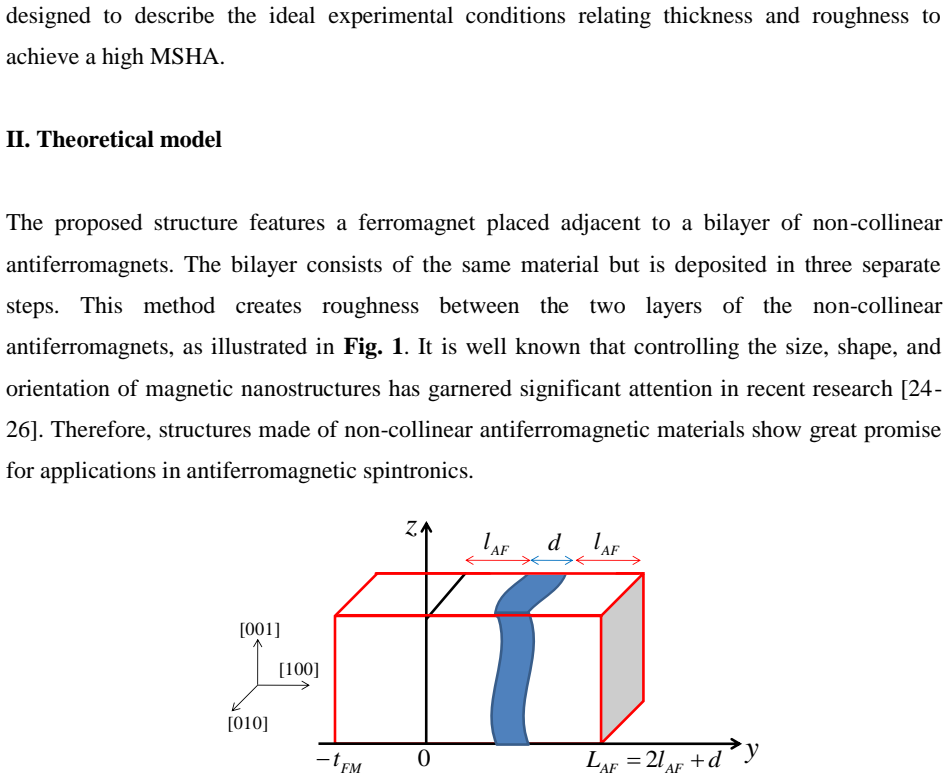
Summary. The paper proposes that extrinsic surface roughness at an antiferromagnet/ferromagnet interface enhances the magnetic spin Hall angle (MSHA). The author derives an expression for the effective MSHA, θ_eff^MSHA = -θ_MSHA (1 + (δ/d)^2), where δ is the roughness and d is the film thickness, and claims that controlled roughening can double the spin-charge conversion efficiency. The derivation introduces a roughness-induced relaxation time (Eq. 8) and equates it to a spin-current anti-damping term (Eq. 9) to arrive at the enhancement factor. The paper includes schematic figures and a heuristic discussion, but no experimental data or microscopic derivation.
Significance. If the central claim were valid, the proposed mechanism would offer a simple experimental knob—surface roughness—for enhancing spin-to-charge conversion, which is of practical relevance for spintronic devices. The paper also makes a falsifiable prediction that the enhancement factor is (1 + (δ/d)^2), nearly doubling the MSHA when δ/d ~ 1. However, the derivation of this prediction rests entirely on an unjustified equality in Eq. (9), and the manuscript presents no experimental validation. The idea is interesting, but in its current form the scientific foundation is not sound enough to support the claimed result.
major comments (4)
- [Section II, Eq. (9)] The equality 1/τ'' = -(δ/a)^2 (4S/(3 n_C^3)) E_F/ℏ ≅ -(δ/d)^2 (γ/M_eff) (J_H/t_FM) J_S^z(0) is asserted without derivation. The left-hand side is a transport relaxation rate associated with surface roughness scattering, while the right-hand side has the form of a spin-transfer-torque anti-damping rate. These are physically distinct quantities; roughness scattering does not automatically produce a torque on the magnetization. No derivation or reference supports this equality. Since Eq. (16), the central claim, is obtained by combining this equality with Eqs. (14) and (15), the entire result collapses if Eq. (9) is not justified.
- [Section II, Eqs. (8) and (9)] The definitions leading to Eq. (9) are not sufficient for the reader to verify the equality. In particular, n_C = k_F d/π and S ≈ 1 are introduced, but the numerical prefactors connecting the two sides of Eq. (9) are not tracked. The conversion from (δ/a)^2 to (δ/d)^2 uses a ~ k_F^{-1}, yet the factors of k_F and d are not shown to cancel consistently. The equality appears to be chosen to introduce the (δ/d)^2 factor that later appears in the final result, rather than being derived from a microscopic model.
- [Section II, Eqs. (12) and (16)] The damping parameter α_S^R is defined in Eq. (12) as -(δ/d)^2 (γ/ω M_eff) (J_H/t_FM) J_S^z(0), thereby already containing the roughness enhancement factor. The subsequent derivation of θ_eff^MSHA in Eq. (16) essentially restates this input assumption. Without an independent microscopic calculation of the roughness-induced torque, the result is circular: the enhancement factor is inserted rather than predicted.
- [Section III] The manuscript presents no experimental data to validate the model. The only quantitative statement is a reference to a 32% MSHA for IrMn3/Py interfaces, but the prediction in Fig. 2(b) is simply the function (1 + (δ/d)^2) plotted for an assumed 32% bare value, with no error bars, measurements, or comparison to experiment. A central claim that is not tested against any data cannot be evaluated as a scientific prediction in its current form.
minor comments (5)
- [Abstract] There is a typo in the abstract: "In theis work" should be "In this work".
- [Section I and Figure 2 caption] Unusual spellings and typos appear throughout, such as "magne tic" in the introduction, "Linewidht" in the Figure 2 caption, and an unclear expression "Area = 0.2X20X10-7 cm^2". These should be corrected to meet editorial standards.
- [Section II, Eqs. (2) and (3)] The notation for the antiferromagnetic thickness and diffusion length is inconsistent: Eq. (2) uses l_AF and λ_AF, while Eq. (3) uses l_N and λ_N. Please use uniform notation throughout.
- [Section II, Eq. (8)] The symbol δ is described as the "variance of thickness deviation," but it is used as a length in the ratio (δ/d)^2. Please clarify whether δ denotes a standard deviation, a root-mean-square roughness, or a variance, and adjust the notation accordingly.
- [Conclusion] The conclusion contains an incomplete sentence and a broken citation: "such as IrMn3/Py [16, 23, 25 ." The closing bracket is missing.
Circularity Check
The (δ/d)^2 enhancement in Eq. (16) is inserted by the unsupported equality in Eq. (9), so the central prediction reduces to its own input assumption.
-
self definitional
[Section II, Eq. (9), between Eqs. (8) and (10)]
"The equation (8) can be rewritten as 1/τ′′ =− (δ/a)^2 4S/3n_C^3 E_F/ℏ ≅ − (δ/d)^2 γ/M_eff J_H/t_FM J_S^z(0)."
Eq. (8) is presented as a roughness-induced relaxation rate, while the right-hand side of Eq. (9) is a spin-current antidamping torque rate. The paper calls this a rewriting, but no derivation or cited result establishes the equality. The factor (δ/d)^2 enters the derivation at exactly this point, so it is an input assumption rather than a derived consequence. Every later quantity—α_S^R, ΔH_Anti, and finally θ_eff^MSHA—inherits this factor unchanged.
-
fitted input called prediction
[Section II, Eqs. (12) and (16)]
"α_S^R =− (δ/d)^2 γ/ωM_eff J_H/t_FM J_S^z(0) ... θ_eff^MSHA =−θ_MSHA (1 + (δ/d)^2)."
The roughness antidamping parameter α_S^R is defined in Eq. (12) with exactly the (δ/d)^2 prefactor multiplying the conventional antidamping expression. Combining this definition with the conventional term in Eqs. (13)–(15) necessarily yields Eq. (16). Thus the predicted enhancement factor is not a new result; it is a restatement of the definition introduced in Eq. (12), which itself rests on the assumed equality in Eq. (9).
full rationale
The central claim is Eq. (16), θ_eff^MSHA = −θ_MSHA (1 + (δ/d)^2). Tracing the derivation, the only place the roughness ratio (δ/d)^2 enters is Eq. (9), where the paper asserts that a roughness relaxation rate equals a spin-torque antidamping rate with that prefactor. Eq. (9) is called a rewriting of Eq. (8), but Eq. (8) is a proposed scattering rate formula and the right side is a spin-current torque expression; the equality is not derived, and the cited roughness/transport references [35–42] are used only for a~k_F^−1, not for this equality. From Eq. (9), α_S^R is defined in Eq. (12) with the same (δ/d)^2 factor, and the final angle in Eq. (16) is then just the sum of the conventional and roughness antidamping terms. The enhancement is therefore built into the input assumption, making the headline prediction a restatement of the model's own definition rather than an independent first-principles result. The paper's baseline experimental value θ_MSHA ≈ 32% is cited from prior work, but that only sets the prefactor and does not rescue the derivation of the (δ/d)^2 dependence. No machine-checked proof, independent numerical simulation, or external benchmark is provided to support Eq. (9). The circularity is high because the paper's unique contribution—the roughness enhancement—is exactly the term that was assumed in Eq. (9).
Assumptions & free parameters
free parameters (4)
- roughness enhancement factor (delta/d)^2 =
not fitted, chosen as the scaling for alpha_S^R
- bare magnetic spin Hall angle theta_MSHA =
e.g., 32% for IrMn3/Py from [16,23,25]
- S =
S = 3(n'/n_C)^2, approximated as 1 for n'=1 to n_C
- J_H^0 =
unspecified amplitude of facet-dependent spin parameter
assumptions (6)
- standard math Landau-Lifshitz-Gilbert equation describes magnetization dynamics
- domain assumption Spin pumping formula for spin current in AFM/FM bilayer is valid (Eq (2))
- ad hoc to paper The equality in Eq (9) between the roughness relaxation rate and the spin-current anti-damping expression
- domain assumption a approximately k_F^{-1} approximation
- domain assumption J_S^z(0) = theta_MSHA hbar/(2e) P J_C with P as in Eq (14)
- domain assumption The non-collinear antiferromagnet exhibits a magnetic spin Hall effect describable by these linear response functions
Cite this review
Pith. "Pith review of Enhancement of magnetic spin Hall angle by extrinsic surface roughness." pith.science (2026). https://pith.science/paper/CFGZNV5I
@misc{pith2026241116708,
  author       = {Pith},
  title        = {Pith review of: Enhancement of magnetic spin Hall angle by extrinsic surface roughness},
  year         = {2026},
  howpublished = {\url{https://pith.science/paper/CFGZNV5I}},
  note         = {Machine review of arXiv:2411.16708}
}
read the original abstract
The magnetic spin Hall effect arises from a reactive counterpart of the dissipative spin response that is responsible for the ordinary spin Hall effect. This interpretation is supported by the dependence of spin Hall effect signals on the reversal of magnetic order parameters and can be explained in terms of the symmetries of well-defined linear response functions. This proposal has enabled the generation and manipulation of spin currents electrically. In terms of conversion efficiency, the spin Hall angle is a key parameter used to characterize a material's ability to convert spin currents to charge currents and vice versa. Consequently, there is an ongoing effort to identify mechanisms that can increase the spin Hall angle. In theis work, it is proposed a mechanism based on extrinsic surface roughness, which enhances the magnetic spin Hall angle when the ratio of roughness to thickness is high. This mechanism represents an important discovery that will advance the development of charge-to-spin devices.
Figures
Reference graph
Works this paper leans on
-
[39]
L. Zhou, V. L. Grigoryan, S. Maekawa, X. Wang, and J. Xiao. Spin Hall effect by surface roughness. Phys. Rev. B 91, 045407 (2015)
work page 2015
-
[2]
M. I. Dyakonov, and V. I. Perel. Possibility of Orienting Electron Spins with Current. Sov. Phys. JETP Let., 13, 467 (1971)
work page 1971
-
[3]
M. I. Dyakonov, V. I. Perel. Current -induced spin orientation of electrons in semiconductors. Physics Letters A 35, 459 (1971)
work page 1971
-
[4]
Y. Tserkovnyak, A. Brataas, and G. E. W. Bauer. Enhanced Gilbert Damping in Thin Ferromagnetic Films. Phys. Rev. Lett. 88, 117601 (2002)
work page 2002
- [5]
- [6]
-
[7]
B. F. Miao, S. Y. Huang, D. Qu, and C. L. Chien. Inverse Spin Hall Effect in a Ferromagnetic Metal. Phys. Rev. Lett. 111, 066602 (2013)
work page 2013
-
[8]
A. Azevedo, O. Alves Santos, G. A. Fonseca Guerra, R. O. Cunha, R. Rodr iguez-Suarez, and S. M. Rezende. Competing spin pumping effects in magnetic hybrid structures. Appl. Phys. Lett. 104, 052402 (2014)
work page 2014
Show all 41 references
-
[9]
V. M. T. S. Barthem, C. V. Colin, H. Mayaffre, M. -H. Julien, and D. Givord. Revealing the properties of Mn2Au for antiferromagnetic spintronics. Nat. Commun. 4, 2892 (2013)
2013
-
[10]
Holanda, O
J. Holanda, O. Alves Santos, J. B. S. Mendes, S. M. Rezende. Spin-to-charge conversion and interface -induced spin Hall magnetoresistance in yttrium iron garnet/metallic bilayers. Journal of Physics: Condensed Matter 33, 435803 (2021)
2021
-
[11]
Shindou and N
R. Shindou and N. Nagaosa. Orbital Ferromagnetism and Anomalous Hall Effect in Antiferromagnets on the Distorted fcc Lattice. Phys. Rev. Lett. 87, 116801 (2001)
2001
-
[12]
H. Chen, Q. Niu, and A. H. MacDonald. Anomalous Hall Effect Arising from Noncollinear Antiferromagnetism. Phys. Rev. Lett. 112, 017205 (2014)
2014
-
[13]
J. B. S. Mendes, A. S. Vieira, R. O. Cunha, S. O. Ferreira, R. D. dos Reis, M. Schmidt, M. Nicklas, S. M Rezende, A. Azevedo. Efficient Spin‐to‐Charge Interconversion in Weyl Semimetal TaP at Room Temperature. Advanced Materials Interfaces 9 (36), 2201716 (2022)
2022
-
[14]
Swain, K
A. Swain, K. S. Rathore, P. Gupta, A. Mishra, Y. H. Lee, J. Lim, A. Hoffmann, R. Mahendiran, S. Bedanta. Enhanced spin pumping in heterostructures of coupled ferrimagnetic garnets. Appl. Phys. Lett. 125, 012406 (2024)
2024
-
[15]
Holanda, D
J. Holanda, D. S. Maior, O. Alves Santos, A. O. Azevedo, and S. M. Rezende, Evidence of phonon pumping by magnonic spin currents. Appl. Phys. Lett. 118, 022409 (2021)
2021
-
[16]
Zhang, W
W. Zhang, W. Han, S.-H. Yang, Y. Sun, Y. Zhang , B. Yan, and S. S. P. Parkin. Giant facet- dependent spin-orbit torque and spin Hall conductivity in the triangular antiferromagnet IrMn 3. Sci. Adv. 2, e1600759 (2016)
2016
-
[17]
Szunyogh, B
L. Szunyogh, B. Lazarovits, L. Udvardi, J. Jackson, and U. Nowak . Giant magnetic anisotropy of the bulk antiferromagnets IrMn and IrMn3 from first principles. Phys. Rev. B 79, 020403(R) (2009)
2009
-
[18]
A. Kohn, A. Kovács, R. Fan, G. J. McIntyre, R. C. C. Ward , and J. P. Goff, The antiferromagnetic structures of IrMn 3 and their influence on exchange -bias. Sci Rep 3, 2412 (2013)
2013
-
[19]
Zelezny, P
J. Zelezny, P. Wadley, K. Olejnik, A. Hoffmann, H. Ohno. Spin transport and spin torque in antiferromagnetic devices. Nat. Phys. 14, 220 (2018)
2018
-
[20]
A. K. Nayak, J. E. Fischer, Y. Sun, B. Yan, J. Karel, A. C. Komarek, C. Shekhar, N. Kumar, W. Schenelle, J. Kubler, S. S. P. Parkin, and C. Felser, Large anomalous Hall effect driven by a nonvanishing Berry curvature in the noncollinear antiferromagnet Mn3Ge. Sci. Adv. 2, e150...
2016
-
[21]
Němec, M
P. Němec, M. Fiebig, T. Kampfrath, A. V. Kimel. Antiferromagnetic o pto-spintronics. Nature Physics 14, 229 (2018)
2018
-
[22]
Kimata, H
M. Kimata, H. Chen, K. Kondou, S. Sugimoto, P. K. Muduli, M. Ikhlas, Y. Omori, T. Tomita, A. H. MacDonald, S. Nakatsuji, and Y. Otani. Magnetic and magnetic inverse spin Hall effects in a non-collinear antiferromagnet, Nature (London) 565, 627 (2019)
2019
-
[23]
Holanda, H
J. Holanda, H. Saglam, V. Karakas, Z. Zang, Y. Li, R. Divan, Y. Liu, O. Ozatay, V. Novosad, J. E. Pearson, and A. Hoffmann, Magnetic damping modulation in IrMn3/Ni80Fe20 via the magnetic spin Hall effect, Phys. Rev. Lett. 124, 087204 (2020)
2020
-
[24]
C. A. França, Y. Guerra, D. R. B. Valadão, J. Holanda, E. Padrón -Hernándeza, Transmission electron microscopy as a realistic data source for the micromagnetic simulation of polycrystalline nickel nanowires. Computational Materials Science, 128, 42, (2017)
2017
-
[25]
W. W. G. Silva, S. V. B. Degiorgi, J. Holanda. Experimental Observation of a Magnetic Interfacial Effect. Advanced Materials Interfaces 10, 202143 (2023)
2023
-
[26]
J. Holanda. Analyzing the magnetic interactions in nanostructures that are candidates for applications in spintronics. Journal of Physics D: Applied Physics 54 (24), 245004 (2021)
2021
-
[27]
J. C. Slonczewski. Current-driven excitation of magnetic multilayers. J. Magn. and Magn. Mater. 159, L1-L7, (1996)
1996
-
[28]
L. D. Landau, E. M. Lifshitz. On the t heory of the dispersion of magnetic permeability in ferromagnetic bodies. Phys. Z. Sowietunion 8, 153 (1935)
1935
-
[29]
L. D. Landau, E. M. Lifshitz. Electrodynamics of continuous media, MIR, Moskow (1986)
1986
-
[30]
T. L. Gilbert. A Lagrangian formulation of the gyromagnetic equation of the magnetization field, Phys. Rev., 100, 1243 (1955)
1955
-
[31]
Ciccarelli, K
C. Ciccarelli, K. M. D. Hals, A. Irvine, V. Novak, Y. Tserkovnyak, H. Kurebayashi, A. Brataas, and A. Ferguson. Magnonic charge pumping via spin-orbit coupling, Nat. Nanotech. 10, 50 (2015)
2015
-
[32]
Azevedo, R
A. Azevedo, R. O. Cunha, F. Estrada, O. Alves Santos, J. B. S. Mendes, L. H. Vilela -Leão. R. L. Rodríguez -Suárez, and S. M. Rezende, Electrical detection of ferromagnetic resonance in single layers of permalloy: Evidence of magnonic charge pumping . Phys. Rev. B 92 , 024402 (2015)
2015
-
[33]
M. V. Costache, M. Sladkov, S. M. Watts, C. H. van der Wal, and B. J. van Wees. Electrical detection of spin pumping due to the precessing magnetization of a single ferromagnet. Phys. Rev. Lett. 97, 216603 (2006)
2006
-
[34]
Azevedo, L
A. Azevedo, L. H. Vilela-Leão, R. L. Rodríguez-Suárez, A. F. Lacerda Santos, and S. M. Rezende. Spin pumping and anisotropic magnetoresistance voltages in magnetic bilayers: Theory and experiment. Phys Rev B 83, 144402 (2011)
2011
-
[35]
S. O. Valenzuela, M. Tinkham. Direct electronic measurement of the spin Hall effect. Nature 442,176 (2006)
2006
-
[36]
Jungwirth, J
T. Jungwirth, J. Wunderlich, K. Olejník. Spin Hall effect devices. Nature Materials 11, 382 (2012)
2012
-
[37]
Manchon and S
A. Manchon and S. Zhang. Theory of non equilibrium intrinsic spin torque in a single nanomagnet. Phys. Rev. B 78, 212405 (2008)
2008
-
[38]
J. E. Hirsch. Spin Hall Effect. Phys. Rev. Lett. 83, 1834 (1999)
1999
-
[40]
Tešanović, M
Z. Tešanović, M. V. Jarić, and S. Maekawa. Quantum Transport and Surface Scattering. Phys. Rev. Lett. 57, 2760 (1986)
1986
-
[41]
Trivedi and N
N. Trivedi and N. W. Ashcroft. Quantum size effects in transport properties of metallic films. Phys. Rev. B 38, 12298 (1988)
1988
-
[42]
Hamadeh, O
A. Hamadeh, O. d Allivy Kelly, C. Hahn, H. Meley, R. Bernard, A.H. Molpeceres, V. V. Naletov, M. Viret, A. Anane, V. Cros, S. O. Demokritov, J. L. Prieto, M. Munoz, G. de Loubens, O. Klein. Full Control of the Spin -Wave Damping in a Magnetic Insulator Usin g Spin -Orbit Torqu...
2014
Reviewed August 12, 2026 · model on record in the stance chip above.
Discussion (0). Continue with ORCID to comment.