REVIEW 3 major objections 5 minor 62 references
On the Hidden Transient Interphase in Metal Anodes: Dynamic Precipitation Controls Electrochemical Interfaces in Batteries
T0 review · 3 major / 5 minor · reviewed 2026-08-12 · deepseek-v4-flash
Pith's one-line read A transient salt skin that forms during fast discharge changes how metal anodes re-grow on the next charge.
desk verdict Worth a serious look: the transient salt film on dissolving Zn is real and well-evidenced, but the claim that it controls redeposition morphology needs a cleaner control experiment. read the letter →
The pith
A machine-rendered reading of the paper's core claim, the machinery that carries it, and where it could break.
The reading
What carries the argument
The central object is the Transient Solid-Electrolyte Interphase (T-SEI), a salt precipitate (e.g., ZnSO$_4$) formed at the electrode surface when the local cation concentration exceeds the salt solubility limit during fast dissolution. The modified Sand equation (eq. 2) governs its incubation time, relating the critical discharged capacity to the inverse current density; the interphase relaxes with a characteristic timescale $\tau_{R,SEI}$ once the current stops. It does the work of creating a self-limiting dissolution front and a clean, flat surface whose subsequent redeposition is epitaxial-like.
What would settle it
Run the same high-rate dissolution on a rotating-disk electrode at high rotation speed, which suppresses local supersaturation (and thus T-SEI) while maintaining high overpotential; then redeposit and check whether the deposit still shows compact grain growth, which would show the effect is not specific to T-SEI.
Extended reading notes
Core claim
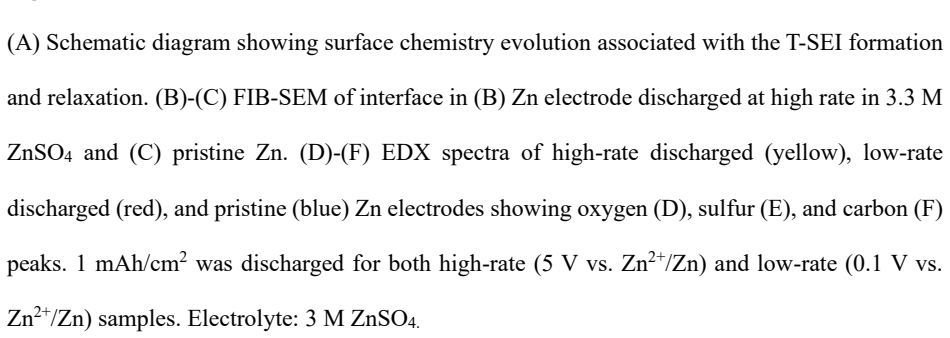
In its own terms: fast electro-dissolution of a metal anode in concentrated electrolyte drives the local salt concentration past saturation, precipitating a salt-based interphase (T-SEI) that is distinct from classical SEI. The T-SEI forms almost instantly once supersaturation is reached (incubation time follows a modified Sand equation, $J\sqrt{t_{inc}} \propto (c_{sat} - c_{\infty})$), and dissolves completely within roughly 300 milliseconds of current removal. Its presence is marked by a voltage spike in chronopotentiometry, a sharp rise in charge-transfer resistance, and a drop in double-layer capacitance consistent with a thicker salt film. Once relaxed, the electrode is chemically cleaned and, on subsequent recharge, metal deposition proceeds by compact growth of existing coarse grains (~15–20 µm) rather than independent particulate nucleation, a regime that can be re-armed periodically by deliberate fast-discharge pulses.
Load-bearing premise
The causal claim that T-SEI formation, rather than the high current or overpotential itself, is responsible for the improved redeposition morphology is not isolated by a control experiment that suppresses T-SEI while keeping the high dissolution rate.
Editorial extensions
If this is right
- Rapid discharge in concentrated electrolytes will routinely hit a T-SEI regime, so voltage spikes during battery cycling at high rates may be caused by transient salt precipitation rather than by classical ion-depletion effects.
- A fully relaxed T-SEI surface changes the subsequent redeposition from independent nucleation to compact grain growth, which is a step toward flat, rechargeable metal anodes.
- Because T-SEI relaxes on a sub-second timescale, ordinary post-mortem characterization will miss it; detecting it requires in-operando electroanalytical and optical methods with higher temporal resolution.
- Periodic fast-discharge pulses can re-establish the T-SEI 'cleaning' effect, reducing surface roughness by 42% in a proof-of-concept symmetric-cell test, suggesting a practical protocol knob for battery management.
- Any electrode process that produces cations at a high rate, such as fast cathode charging, is in principle susceptible to T-SEI formation, extending the relevance beyond metal anodes.
Reading between the lines
- Extension: the same supersaturation argument should apply to other cation-releasing interfaces, such as alkali-metal stripping in localized high-concentration electrolytes, where the solubility limit is closer to operating concentrations; the paper demonstrates the effect in zinc but does not test these cases.
- Extension: the ~300 ms relaxation time implies that a practical diagnostic for T-SEI could be the linear $Q_c$ versus $J^{-1}$ signature and the accompanying voltage spike, which might be recognized in full-cell cycling data without special instrumentation.
- Extension: the paper shows the improved morphology degrades at large capacities, so a natural follow-up is to test whether an optimal frequency and intensity of T-SEI pulses can sustain epitaxial growth over hundreds of cycles.
Editorial analysis
A structured set of objections, weighed in public.
Referee Report
Summary. The paper reports the discovery of a Transient Solid-Electrolyte Interphase (T-SEI) formed during fast anodic dissolution of Zn in concentrated ZnSO4 and ZnCl2 electrolytes. The authors argue that rapid dissolution produces local supersaturation, causing salt precipitation that passivates the electrode, leads to a self-limiting flat dissolution morphology, and fully dissolves upon rest. They further claim that, after relaxation, the T-SEI-modified surface promotes compact, grain-growth-dominated redeposition instead of the isolated particulate nucleation seen on pristine or low-rate-discharged electrodes. Evidence includes J-V deviations under stagnant vs. rotating conditions, constant-current chronopotentiometry voltage spikes and in-operando optical imaging, EIS showing increased charge-transfer resistance and decreased double-layer capacitance, post-mortem FIB-SEM/EDX showing no residual interphase, and SEM/EBSD/profilometry of dissolution and redeposition morphologies. The paper also derives a Sand-type relation Q_c ∝ J^-1 and demonstrates a proof-of-concept cycling protocol with periodic T-SEI formation.
Significance. If the central claim holds, the paper identifies a previously overlooked, purely transient passivating phase that controls both dissolution kinetics and the morphology of the subsequent plating step in concentrated battery electrolytes. The study's strength is its multi-modal approach: RDE voltammetry, chronopotentiometry, operando optical visualization, EIS, FIB-SEM/EDX, EBSD, and profilometry all point consistently toward the existence of a transient interfacial precipitate. The relaxation experiments and post-mortem absence of the interphase are particularly convincing for the transient character. The derivation of Eq. (3) is parameter-free in that it contains no fitted constants, and it yields a falsifiable linear relation; however, the predicted slope is not tested against measured transport properties. The main weakness is that the causal link between T-SEI formation and the improved redeposition morphology is not isolated from other consequences of high-rate anodic polarization, so the third pillar of the central claim is not yet fully established.
major comments (3)
- [Fig. 6 and 'Unusual morphological evolution promoted by T-SEI'] The central causal claim—that T-SEI formation, rather than the high-rate dissolution history itself, causes the subsequent compact, grain-growth redeposition—is not isolated in the reported experiments. In Fig. 6, the low-rate (0.1 V vs. Zn2+/Zn) and high-rate (5 V) discharge conditions differ in applied overpotential, current density, total charge time, and extent of anodic cleaning/electropolishing, so the observed differences in redeposition morphology could in principle be produced by the high dissolution current or overpotential alone. The paper's 'cleaning' argument based on reduced C/S/O EDX signals (Fig. 5D-F) is similarly consistent with high anodic polarization removing adventitious carbon. Because the RDE setup enables forced convection, a control experiment with high rotation during dissolution (suppressing supersaturation and T-SEI while retaining a high dissolution current/overpotential) would directly test the attribution; without such a control, the third pillar of the paper's central claim remains confounded. The paper's own observation that the compact-growth mode is not self-sustainable over cycling (Fig. S22) further indicates that the long-term benefit rests on the periodic-enforcement protocol, making the control experiment necessary rather than cosmetic.
- [Eqs. (1)-(3) and Fig. 3B] The linear Q_c-versus-J^-1 relation in Eq. (3) is a direct rearrangement of the modified Sand equation with no fitted parameter; consequently, the good linear fit in Fig. 3B does not by itself validate the T-SEI mechanism or the assumption that the voltage spike is set by saturation. The predicted slope, πD_i[(c_sat - c_infty)nF]^2/4, is not compared with independently measured diffusion coefficients and saturation concentrations, and the application of a binary, dilute-solution Sand equation to 3 M ZnSO4 is questionable given migration, non-ideal activity, and speciation in concentrated electrolytes. A quantitative test using literature or measured transport parameters, or a direct measurement of the precipitate composition, is needed to confirm that the spike corresponds specifically to salt precipitation rather than to another transport-limited process.
- [Fig. S23 and proof-of-concept cycling] The headline quantitative benefit—a 42% reduction in surface roughness—is reported without error bars, replicate numbers, or statistical analysis, and the proof-of-concept protocol differs from the control not only by the periodic potentiostatic 5 V stripping step but also by the sequence of stripping capacities and rest times. As presented, this result supports only a qualitative proof of concept, not the quantitative claim in the abstract. Please provide replicate statistics or soften the quantitative claim accordingly.
minor comments (5)
- [Equation numbering throughout] The number (4) is used twice, once for Laplace's equation in the text and once for the S_dr formula in Materials and Methods; please renumber to avoid ambiguity.
- [Figure 6 caption] The caption uses panel label 'I' twice, once for the redeposition SEM image and once for the EBSD image; the panel references in the text and caption should be aligned.
- [Main text, paragraph on relaxation times] The text refers to 'Table 2' for definitions of t_inc, t_inc,2, τ_R,SEI, and τ_R,conc, but no Table 2 appears in the manuscript body or in the captured supporting information; please include the table or move the definitions into the text.
- [Materials and Methods] In the electrolyte preparation paragraph, 'by weighting certain amounts of salts' should read 'by weighing', and the sentence 'the total counts from the resulting Zn peak were compared' has a subject-verb agreement issue.
- [Abstract and main text] The term 'T -SEI' is typeset with inconsistent spacing in several places; please use a consistent unspaced 'T-SEI' throughout the manuscript.
Circularity Check
No circularity: Sand-equation derivation is externally grounded, and the only notable weakness (missing convection control for the morphology claim) is a confound, not a circular reduction.
full rationale
The paper's central quantitative derivation—Eq. (2) and Eq. (3), Q_C = J t_inc = π D_i ((c_sat−c_i^∞) n F)^2 / (4 J)—is a direct rearrangement of the classical Sand equation with the saturation concentration difference replacing the bulk concentration. It introduces no fitted parameter and is not used to extract a constant that is then relabeled as a prediction; the linear Q_C vs J^−1 plot is a test of externally established transport theory against measured incubation times. The transient character of T-SEI is supported by independent measurements: rest-time-dependent t_inc,2 (Fig. S6), post-relaxation FIB-SEM absence (Fig. 5B-C), and RDE convection dependence (Fig. 2), none of which presuppose T-SEI existence by definition. Self-citations (refs. 27, 28) appear only as background/contrast for deposit morphology and Zn-anode relevance; no load-bearing premise rests on an author-overlapping citation. The weakest point is the causal attribution in Fig. 6: high-rate dissolution differs from low-rate dissolution in current, overpotential, and surface cleaning, and no forced-convection control suppresses T-SEI while retaining high overpotential. That is an experimental confound or missing-control issue, not a circular reduction where an output equals an input by construction. The 42% roughness claim also lacks replicate statistics, but under-determination is not circularity. Hence no circularity; score 0.
Assumptions & free parameters
assumptions (5)
- standard math Fick's second law and the classical Sand equation for binary electrolyte diffusion apply to the dissolution geometry.
- domain assumption Mass transport near the dissolving electrode can be described by a single equivalent binary diffusion coefficient D_i, neglecting migration and convection in the quiescent chronopotentiometry tests.
- domain assumption The passivating layer that forms beyond the critical potential is precipitated ZnSO4 salt resulting from local supersaturation, not another solid phase.
- domain assumption The T-SEI fully dissolves when the local concentration gradient relaxes to bulk, leaving no permanent interphase.
- domain assumption The subsequent compact, grain-coherent deposition morphology is caused by the T-SEI's cleaning effect rather than by the high dissolution overpotential or current density itself.
invented entities (1)
-
Transient Solid-Electrolyte Interphase (T-SEI)
independent evidence
Cite this review
Pith. "Pith review of On the Hidden Transient Interphase in Metal Anodes: Dynamic Precipitation Controls Electrochemical Interfaces in Batteries." pith.science (2026). https://pith.science/paper/SFQ5ETML
@misc{pith2026241116741,
  author       = {Pith},
  title        = {Pith review of: On the Hidden Transient Interphase in Metal Anodes: Dynamic Precipitation Controls Electrochemical Interfaces in Batteries},
  year         = {2026},
  howpublished = {\url{https://pith.science/paper/SFQ5ETML}},
  note         = {Machine review of arXiv:2411.16741}
}
read the original abstract
The Solid-Electrolyte Interphase, SEI, formed on a battery electrode has been a central area of research for decades. This thin, complex layer profoundly impacts the electrochemical deposition morphology and stability of the metal in battery anodes. Departing from conventional approaches, we investigate metal dissolution, the reverse reaction of deposition, in battery environments using a state-of-the-art electroanalytical system combining a rotating-disk electrode and in-operando visualization. Our key finding is the presence of a Transient Solid-Electrolyte Interphase, T-SEI, that forms during fast discharging at high dissolution rates. We attribute T-SEI formation to transient local supersaturation and resultant electrolyte salt deposition. The T-SEI fundamentally alters the dissolution kinetics at the electrochemical interface, leading to a self-limiting morphological evolution and eventually yielding a flat, clean surface. Unlike a classical SEI formed due to electrolyte decomposition, the T-SEI is fully relaxable upon removal of the enforced dissolution current. The formation of T-SEI, surprisingly, plays a critical role in the subsequent electrodeposition. When the metal is redeposited on a fully relaxed T-SEI surface, the morphology is remarkably different from that deposited on pristine or low-rate discharged metal electrodes. Electron backscatter diffraction analysis suggests the deposition occurs via growth of the original grains. This is in stark contrast to the isolated, particulate nuclei seen on standard metal electrodes without T-SEI formation. Our findings provide important insights into the electrochemical kinetics at the metal-electrolyte interface, particularly in concentrated or water-in-salt electrolytes that are close to the salt saturation limit. The results suggest a new dimension for electrochemical engineering in batteries.
Figures


Figures from the paper (2 more)

Reference graph
Works this paper leans on
-
[1]
M. Roberts, On batteries. Journal of the Society of Telegraph Engineers 6, 257-273 (1877)
-
[2]
Q. Li, A. Chen, D. Wang, Z. Pei, C. Zhi, “Soft shorts” hidden in zinc metal anode research. Joule 6, 273-279 (2022)
work page 2022
-
[3]
Y . Zhu et al., Fast lithium growth and short circuit induced by localized-temperature hotspots in lithium batteries. Nature communications 10, 2067 (2019)
work page 2019
-
[4]
D. Lin, Y . Liu, Y . Cui, Reviving the lithium metal anode for high-energy batteries. Nature nanotechnology 12, 194-206 (2017)
work page 2017
-
[5]
X. Geng, X. Hou, X. He, H. J. Fan, Challenges and Strategies on Interphasial Regulation for Aqueous Rechargeable Batteries. Advanced Energy Materials 14, 2304094 (2024)
work page 2024
-
[6]
X. B. Cheng et al., A review of solid electrolyte interphases on lithium metal anode. Advanced science 3, 1500213 (2016)
work page 2016
-
[7]
M. Y . Yang et al., Characterization of the solid electrolyte interphase at the Li metal–ionic liquid interface. Advanced Energy Materials 13, 2202949 (2023)
work page 2023
-
[8]
M. J. Zachman, Z. Tu, S. Choudhury, L. A. Archer, L. F. Kourkoutis, Cryo-STEM mapping of solid–liquid interfaces and dendrites in lithium-metal batteries. Nature 560, 345-349 (2018)
work page 2018
Show all 62 references
-
[9]
Peled, S
E. Peled, S. Menkin, SEI: past, present and future. Journal of The Electrochemical Society 164, A1703 (2017)
2017
-
[10]
Dai et al., Unraveling chemical origins of dendrite formation in zinc-ion batteries via in situ/operando X-ray spectroscopy and imaging
H. Dai et al., Unraveling chemical origins of dendrite formation in zinc-ion batteries via in situ/operando X-ray spectroscopy and imaging. Nature Communications 15, 8577 (2024)
2024
-
[11]
Tan et al., Unravelling the convoluted and dynamic interphasial mechanisms on Li metal anodes
S. Tan et al., Unravelling the convoluted and dynamic interphasial mechanisms on Li metal anodes. Nature Nanotechnology 18, 243-249 (2023)
2023
-
[12]
Xu et al., Direct in situ measurements of electrical properties of solid–electrolyte interphase on lithium metal anodes
Y . Xu et al., Direct in situ measurements of electrical properties of solid–electrolyte interphase on lithium metal anodes. Nature energy 8, 1345-1354 (2023)
2023
-
[13]
Huang et al., Decoupling the origins of irreversible coulombic efficiency in anode- free lithium metal batteries
C.-J. Huang et al., Decoupling the origins of irreversible coulombic efficiency in anode- free lithium metal batteries. Nature Communications 12, 1452 (2021)
2021
-
[14]
Zhang et al., Recovery of isolated lithium through discharged state calendar ageing
W. Zhang et al., Recovery of isolated lithium through discharged state calendar ageing. Nature 626, 306-312 (2024)
2024
-
[15]
Zheng et al., Physical orphaning versus chemical instability: is dendritic electrodeposition of Li fatal? ACS Energy Letters 4, 1349-1355 (2019)
J. Zheng et al., Physical orphaning versus chemical instability: is dendritic electrodeposition of Li fatal? ACS Energy Letters 4, 1349-1355 (2019)
2019
-
[16]
Zheng, R
J. Zheng, R. Garcia-Mendez, L. A. Archer, Engineering Multiscale Coupled Electron/Ion Transport in Battery Electrodes. ACS nano 15, 19014-19025 (2021)
2021
-
[17]
Shi et al., Lithium metal stripping beneath the solid electrolyte interphase
F. Shi et al., Lithium metal stripping beneath the solid electrolyte interphase. Proceedings of the National Academy of Sciences 115, 8529-8534 (2018)
2018
-
[18]
D. Koo, B. Kwon, J. Lee, K. T. Lee, Asymmetric behaviour of Li/Li symmetric cells for Li metal batteries. Chemical Communications 55, 9637-9640 (2019)
2019
-
[19]
Gireaud, S
L. Gireaud, S. Grugeon, S. Laruelle, B. Yrieix, J.-M. Tarascon, Lithium metal stripping/plating mechanisms studies: A metallurgical approach. Electrochemistry communications 8, 1639-1649 (2006)
2006
-
[20]
H. J. Sand, III. On the concentration at the electrodes in a solution, with special reference to the liberation of hydrogen by electrolysis of a mixture of copper sulphate and sulphuric acid. The London, Edinburgh, and Dublin Philosophical Magazine and Journal of Science 1, 45...
1901
-
[21]
Wagner, Investigation on copper corrosion in thin films of sulfuric acid
R. Wagner, Investigation on copper corrosion in thin films of sulfuric acid. Journal of the Electrochemical Society 143, 139 (1996)
1996
-
[22]
Zhang, S
S. Zhang, S. Lyon, Anodic processes on iron covered by thin, dilute electrolyte layers (I)—Anodic polarisation. Corrosion science 36, 1289-1307 (1994)
1994
-
[23]
Tu et al., Trace Amount of High-Concentration Electrolyte for High-Performance Aqueous Zn Metal Anodes
X. Tu et al., Trace Amount of High-Concentration Electrolyte for High-Performance Aqueous Zn Metal Anodes. Energy & Fuels 38, 15789-15796 (2024)
2024
-
[24]
Chen et al., High‐voltage lithium‐metal batteries enabled by localized high‐ concentration electrolytes
S. Chen et al., High‐voltage lithium‐metal batteries enabled by localized high‐ concentration electrolytes. Advanced materials 30, 1706102 (2018)
2018
-
[25]
Cao et al., Enabling room temperature sodium metal batteries
R. Cao et al., Enabling room temperature sodium metal batteries. Nano Energy 30, 825- 830 (2016)
2016
-
[26]
Zheng et al., Extremely stable sodium metal batteries enabled by localized high- concentration electrolytes
J. Zheng et al., Extremely stable sodium metal batteries enabled by localized high- concentration electrolytes. ACS Energy Letters 3, 315-321 (2018)
2018
-
[27]
J. K. Zheng, J. Yin, T. Tang, L. A. Archer, Moss-like Growth of Metal Electrodes: On the Role of Competing Faradaic Reactions and Fast Charging. ACS Energy Letters 8, 2113- 2121 (2023)
2023
-
[28]
Zheng, L
J. Zheng, L. A. Archer, Controlling electrochemical growth of metallic zinc electrodes: Toward affordable rechargeable energy storage systems. Science Advances 7, eabe0219 (2021)
2021
-
[29]
Zhao et al., Turning the Inert Element Zinc into an Active Single‐Atom Catalyst for Efficient Fenton‐Like Chemistry
Z. Zhao et al., Turning the Inert Element Zinc into an Active Single‐Atom Catalyst for Efficient Fenton‐Like Chemistry. Angewandte Chemie 135, e202219178 (2023)
2023
-
[30]
Toloei, V
A. Toloei, V . Stoilov, D. Northwood (2013) The relationship between surface roughness and corrosion. in ASME International mechanical engineering congress and exposition (American Society of Mechanical Engineers), p V02BT02A054
2013
-
[31]
Walter, M
R. Walter, M. B. Kannan, Influence of surface roughness on the corrosion behaviour of magnesium alloy. Materials & Design 32, 2350-2354 (2011)
2011
-
[32]
Feliu Jr, C
S. Feliu Jr, C. Maffiotte, A. Samaniego, J. C. Galván, V . Barranco, Effect of the chemistry and structure of the native oxide surface film on the corrosion properties of commercial AZ31 and AZ61 alloys. Applied Surface Science 257, 8558-8568 (2011)
2011
-
[33]
T. F. Fuller, J. N. Harb, Electrochemical engineering (John Wiley & Sons, 2018)
2018
-
[34]
Powers, Film formation and hydrogen evolution on the alkaline zinc electrode
R. Powers, Film formation and hydrogen evolution on the alkaline zinc electrode. Journal of the Electrochemical Society 118, 685 (1971)
1971
-
[35]
L. M. Baugh, A. Higginson, Passivation of zinc in concentrated alkaline solution—I. Characteristics of active dissolution prior to passivation. Electrochimica Acta 30, 1163- 1172 (1985)
1985
-
[36]
L. M. Baugh, A. R. Baikie, Passivation of zinc in concentrated alkaline solution—II. Role of various experimental factors and the distinction between the solid-state and dissolution—precipitation mechanisms. Electrochimica Acta 30, 1173-1183 (1985)
1985
-
[37]
Mendez, R
J. Mendez, R. Akolkar, T. Andryushchenko, U. Landau, A mechanistic model for copper electropolishing in phosphoric acid. Journal of The Electrochemical Society 155, D27 (2007)
2007
-
[38]
Dong et al., Long-life zinc/vanadium pentoxide battery enabled by a concentrated aqueous ZnSO4 electrolyte with proton and zinc ion co-intercalation
Y . Dong et al., Long-life zinc/vanadium pentoxide battery enabled by a concentrated aqueous ZnSO4 electrolyte with proton and zinc ion co-intercalation. ACS Applied Energy Materials 3, 11183-11192 (2020)
2020
-
[39]
Wang et al., Establishing Ultralow Self‐Discharge Zn‐I2 Battery by Optimizing ZnSO4 Electrolyte Concentration
H. Wang et al., Establishing Ultralow Self‐Discharge Zn‐I2 Battery by Optimizing ZnSO4 Electrolyte Concentration. Small 20, 2306947 (2024)
2024
-
[40]
Zn (CH3SO3) 2
C. Sun et al., Green environmentally friendly “Zn (CH3SO3) 2” electrolyte for aqueous zinc-ion batteries. ACS Applied Materials & Interfaces 15, 20089-20099 (2023)
2023
-
[41]
Water‐in‐Salt
L. Zhang et al., ZnCl2 “Water‐in‐Salt” electrolyte transforms the performance of vanadium oxide as a Zn battery cathode. Advanced functional materials 29, 1902653 (2019)
2019
-
[42]
Zhang et al., Regulating the water molecular in the solvation structure for stable zinc metal batteries
Z. Zhang et al., Regulating the water molecular in the solvation structure for stable zinc metal batteries. Advanced Functional Materials 33, 2214648 (2023)
2023
-
[43]
P. Bai, J. Li, F. R. Brushett, M. Z. Bazant, Transition of lithium growth mechanisms in liquid electrolytes. Energy & Environmental Science 9, 3221-3229 (2016)
2016
-
[44]
Grimm, A
R. Grimm, A. West, D. Landolt, AC impedance study of anodically formed salt films on iron in chloride solution. Journal of the electrochemical society 139, 1622 (1992)
1992
-
[45]
W. H. Smyrl, J. Newman, Current distribution at electrode edges at high current densities. Journal of the Electrochemical Society 136, 132 (1989)
1989
-
[46]
A. C. Lazanas, M. I. Prodromidis, Electrochemical impedance spectroscopy─ a tutorial. ACS Measurement Science Au 3, 162-193 (2023)
2023
-
[47]
D. C. Grahame, The electrical double layer and the theory of electrocapillarity. Chemical reviews 41, 441-501 (1947)
1947
-
[48]
J. Huo, R. Solanki, J. McAndrew, Study of anodic layers and their effects on electropolishing of bulk and electroplated films of copper. Journal of applied electrochemistry 34, 305-314 (2004)
2004
-
[49]
Li et al., Cryo-based structural characterization and growth model of salt film on metal
T. Li et al., Cryo-based structural characterization and growth model of salt film on metal. Corrosion Science 174, 108812 (2020)
2020
-
[50]
W. G. Lim, X. Li, D. Reed, Understanding the role of zinc hydroxide sulfate and its analogues in mildly acidic aqueous zinc batteries: a review. Small Methods 8, 2300965 (2024)
2024
-
[51]
A. J. Sanchez et al., Plan-view operando video microscopy of Li metal anodes: identifying the coupled relationships among nucleation, morphology, and reversibility. ACS Energy Letters 5, 994-1004 (2020)
2020
-
[52]
Arulmozhi, T
N. Arulmozhi, T. J. Hersbach, M. T. Koper, Nanoscale morphological evolution of monocrystalline Pt surfaces during cathodic corrosion. Proceedings of the National Academy of Sciences 117, 32267-32277 (2020)
2020
-
[53]
R. Guo, F. Weinberg, D. Tromans, Pitting corrosion of passivated zinc monocrystals. Corrosion 51, 356-366 (1995)
1995
-
[54]
Baek et al., Naked metallic skin for homo-epitaxial deposition in lithium metal batteries
M. Baek et al., Naked metallic skin for homo-epitaxial deposition in lithium metal batteries. Nature Communications 14, 1296 (2023)
2023
-
[55]
Cao et al., De‐Passivation and Surface Crystal Plane Reconstruction via Chemical Polishing for Highly Reversible Zinc Anodes
J. Cao et al., De‐Passivation and Surface Crystal Plane Reconstruction via Chemical Polishing for Highly Reversible Zinc Anodes. Advanced Materials, 2410947 (2024)
2024
-
[56]
Zhang et al., Dendrite suppression by anode polishing in zinc-ion batteries
Z. Zhang et al., Dendrite suppression by anode polishing in zinc-ion batteries. Journal of Materials Chemistry A 9, 15355-15362 (2021)
2021
-
[57]
Wang et al., A chemically polished zinc metal electrode with a ridge-like structure for cycle-stable aqueous batteries
J. Wang et al., A chemically polished zinc metal electrode with a ridge-like structure for cycle-stable aqueous batteries. ACS applied materials & interfaces 12, 23028-23034 (2020)
2020
-
[58]
Eaglesham, Semiconductor molecular‐beam epitaxy at low temperatures
D. Eaglesham, Semiconductor molecular‐beam epitaxy at low temperatures. Journal of applied physics 77, 3597-3617 (1995)
1995
-
[59]
S. D. Sarma, P. Tamborenea, Limiting thickness versus epitaxial-growth temperature in molecular-beam epitaxy. Physical Review B 46, 1925 (1992)
1992
-
[60]
Eaglesham, H.-J
D. Eaglesham, H.-J. Gossmann, M. Cerullo, Limiting thickness h epi for epitaxial growth and room-temperature Si growth on Si (100). Physical review letters 65, 1227 (1990)
1990
-
[61]
Platen et al., Low-temperature epitaxial growth of Si by electron cyclotron resonance chemical vapor deposition
J. Platen et al., Low-temperature epitaxial growth of Si by electron cyclotron resonance chemical vapor deposition. Thin Solid Films 381, 22-30 (2001)
2001
-
[62]
C. E. Richardson, M. Mason, H. A. Atwater, Hot-wire CVD-grown epitaxial Si films on Si (100) substrates and a model of epitaxial breakdown. Thin Solid Films 501, 332-334 (2006)
2006
Reviewed August 12, 2026 · model on record in the stance chip above.
Discussion (0). Continue with ORCID to comment.