REVIEW 5 major objections 6 minor 28 references
Background-Aware Defect Generation for Robust Industrial Anomaly Detection
T0 review · 5 major / 6 minor · reviewed 2026-08-12 · deepseek-v4-flash
Pith's one-line read A disentanglement loss lets product backgrounds guide synthetic defects, improving industrial anomaly detection, especially for logical anomalies.
desk verdict Real empirical gains on MVTec-Loco, but the paper never acknowledges that every synthetic defect is generated with a ground-truth mask from the anomaly test fold, so the deployment claim is not tested. read the letter →
The pith
A machine-rendered reading of the paper's core claim, the machinery that carries it, and where it could break.
The reading
What carries the argument
The load-bearing object is the disentanglement loss $L(\theta)$ in Eq. 5, which splits denoising into a matching loss over the masked defect region, conditioned on a defect-plus-background text embedding $C_1$, and a regularizer over the background, conditioned on a background-only embedding $C_2$ and computed on the masked latent $z_t^m = (1-m)\odot z_t$. The masked noising scheme makes $(1-m)\odot z_t = z_t^m$ for every timestep, so the regularizer never sees defect content. The accompanying results carry the argument: Lemma 3.1 gives background reconstruction from background information alone, Theorem 3.2 shows the DDIM-inversion initialization leaves only mask noise in the defect region as $\alpha_t \to 0$, and Proposition 3.3 proves the background denoising path is unchanged when defect noise is added. Cross-attention masking, the mechanism that mixes text conditioning into image features, routes each text embedding to its intended region, and the attention map of the defect embedding refines the target mask at inference.
What would settle it
Run the released pipeline on MVTec-Loco with masks deliberately shifted outside the true defect region; if the attention-based mask refinement cannot keep generated defects inside the object and image AUROC falls back toward the 85.8 of AnomalyDiffusion, the background-disentanglement mechanism is not carrying the reported gain.
Extended reading notes
Core claim
The central claim is that a regularizer appended to the standard diffusion noise-prediction objective can decouple background and defect denoising. The loss matches noise only inside the target mask using a combined defect-and-background condition, while a regularizer matches background noise using only the background condition on a latent whose masked region has been zeroed. Lemma 3.1 shows that when this loss reaches zero, the background of the noised latent is reconstructed without any defect information; Theorem 3.2 shows that DDIM inversion followed by adding random noise in the mask initializes a valid defect latent; Proposition 3.3 shows the background's denoising path stays unchanged throughout. The paper argues that this preserves structural fidelity while making generated defects contextually consistent, and it reports that the resulting synthetic images, after attention-based mask refinement, improve both detection and pixel-level localization of a U-Net on MVTec-AD and MVTec-Loco.
Load-bearing premise
The method requires a ground-truth defect mask for every target normal image at inference, and the experiments provide those masks by splitting the anomaly test set, so the claimed robustness advantage is not demonstrated for the mask-free setting found on real industrial lines.
Editorial extensions
If this is right
- Background-aware synthetic defects improve pixel-level anomaly localization on logical anomaly benchmarks, not just image-level detection.
- One normal image can be reused to produce many diverse defects with a preserved background, making scarce anomaly data go further in supervised training.
- Attention-based mask refinement removes poorly localized synthetic defects from the training set, which the ablation links to higher AUPRO for the downstream detector.
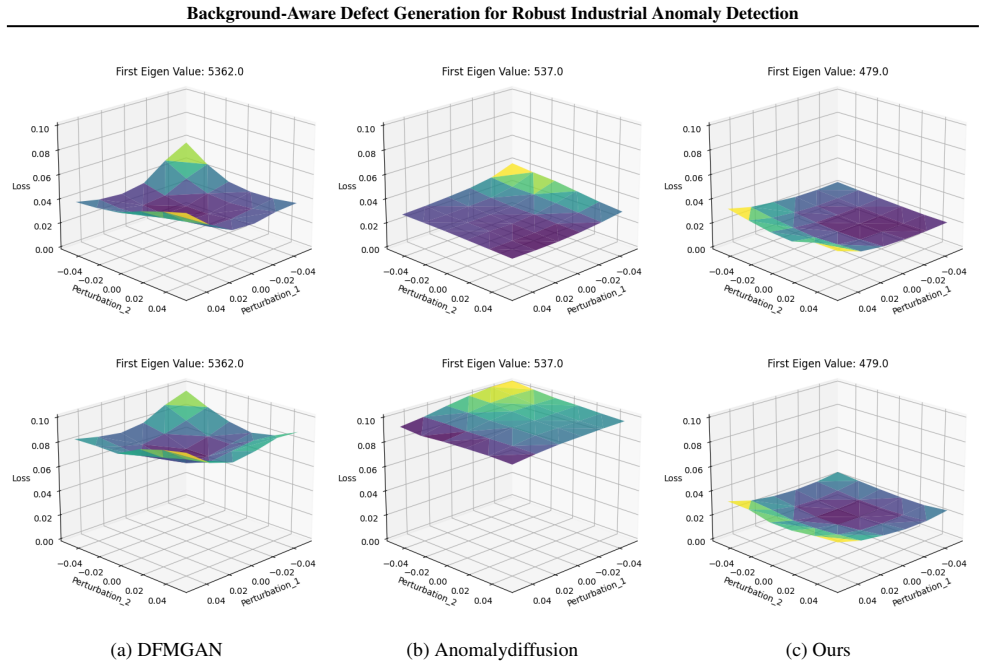
- Training on these synthetic anomalies flattens the detector's loss landscape, a signal of better generalization to unseen defects.
- The gap over prior generators is largest on MVTec-Loco, where logical consistency with the background is the defining difficulty.
Reading between the lines
- Editorial extension: a natural next step the paper does not evaluate is replacing the ground-truth mask with masks predicted by a segmentation model on normal images; success there would make the pipeline usable on real production lines.
- Editorial extension: the same disentanglement should transfer to other conditional-generation tasks that require inserting an object into a scene without disturbing the rest of the image, such as medical image or document synthesis.
- Editorial extension: the large pixel-AP jump on MVTec-Loco (79.8 vs 59.0) suggests context modeling rather than raw image fidelity drives the downstream gain; correlating per-category FID with detection metrics would test that directly.
Editorial analysis
A structured set of objections, weighed in public.
Referee Report
Summary. The paper proposes a background-aware defect generation framework for industrial anomaly detection. The method uses a disentanglement loss that lets background context influence defect denoising while preventing defects from influencing background denoising, plus DDIM-inversion-based masked initialization and attention-based mask refinement. On MVTec-AD and MVTec-Loco, the authors report improved FID/LPIPS generation quality and improved downstream anomaly detection (e.g., MVTec-Loco image AUROC 89.9 vs. 85.8 for AnomalyDiffusion, pixel AP 79.8 vs. 59.0). The paper also presents theoretical results (Lemma 3.1, Theorem 3.2, Proposition 3.3) intended to justify background fidelity and latent initialization.
Significance. If the empirical gains hold under realistic deployment conditions, the method offers a practical data-centric approach to anomaly detection, especially for logical anomalies where contextual consistency matters. Strengths of the manuscript include a clearly described framework, evaluations on two standard benchmarks with both generation-quality and detection metrics, ablation studies for the regularizer and mask refinement, and an explicit—if flawed—theoretical section. The reported MVTec-Loco pixel-level gains are substantial and, if not an artifact of the evaluation protocol, would be a meaningful advance. However, the central claim of robustness for industrial deployment is currently supported only under an oracle-mask setup, and the theoretical demonstrations rely on idealized assumptions that are not connected to the actual trained models.
major comments (5)
- [Appendix A.1, Algorithm 1, Section 3.3.2] The method requires a ground-truth defect mask for every normal image at inference time, but the evaluation always supplies such a mask: Appendix A.1 states that the model generates anomalies with a ground-truth mask from one fold of the anomaly test set, and Algorithm 1 takes mask m as input. In an industrial setting, defect locations on normal products are unknown. The reported improvements on MVTec-Loco (image AUROC 89.9 vs. 85.8, pixel AP 79.8 vs. 59.0) could therefore stem from access to test-set defect geometry rather than from the background-aware disentanglement mechanism. No experiment varies the source of the mask, so the robustness advantage is not demonstrated in the mask-free scenario the title promises. Please either evaluate with automatically predicted masks on normal images, or clearly restrict the claim to settings where a mask is available, and discuss how such masks are obtained in practice.
- [Appendix A.3 (Theorem 3.2)] The proof of Theorem 3.2 uses the step 'From Theorem.1 of (Song et al., 2021a), m ⊙ ϵθ∗(˜z_{t−1}, t−1, C1) = m ⊙ ϵ'. Theorem 1 of the DDIM paper concerns the consistency of the generative process with the forward process under an optimal noise predictor; it does not state that the predicted noise on a masked inverted latent equals the original noise on the mask. This equality is essentially the conclusion being proved, so the theorem is not established. Additionally, all three theoretical results (Lemma 3.1, Theorem 3.2, Proposition 3.3) are conditioned on L(θ*)=0, an unattainable condition for a finite-capacity network; the paper should state this idealization explicitly and, ideally, provide a bound or empirical check showing the results degrade gracefully when the loss is merely small.
- [Appendix A.4 (Proposition 3.3)] Proposition 3.3 is true by construction: Eq. 9 explicitly defines the background update of z* using (1−m) ⊙ ϵθ(z^m_t, t, C2), and (1−m) ⊙ z*_T = z^m_T holds by the initialization z*_T = z̃^m_T + m ⊙ ϵ. Therefore the equality ||(1−m)⊙(z^m_t−z̃^m_t)|| = ||(1−m)⊙(z*_t−z̃^m_t)|| simply restates the definition of the algorithm rather than providing independent evidence of background fidelity. The paper should present Proposition 3.3 as an algebraic identity or remove it from the theoretical contributions.
- [Table 4 (Ablation study for loss function)] The ablation comparing L'(θ) with L(θ) varies two factors simultaneously: the loss function and the initialization (random noise z_T ∼ N(0,I) for L' vs. DDIM-inversion-based initialization for L). The text acknowledges that initialization matters, but the design cannot separate the contribution of the disentanglement loss from that of the initialization. Please provide a 2x2 ablation (L' with inversion, L with random initialization) so the effect of the regularizer in Eq. 5 is isolated.
- [Section 3.1 and Experiments] The text embeddings C1 = [C_def, C_bg] and C2 = [C_m, C_bg] are defined symbolically, but the actual prompt strings are never specified. Since the method fine-tunes Stable Diffusion with these embeddings, the missing prompts make the experiments impossible to reproduce. Please provide the exact text prompts (or a reference to a supplementary file) for the defect, background, and mask concepts used on each dataset.
minor comments (6)
- [Abstract] There is a typo in the abstract: 'mehtod' should be 'method'.
- [Tables 1, 3, 4, 5] No error bars or standard deviations are reported for any of the generation-quality or detection metrics, even though the experiments use two-fold splits. Please report mean ± std over folds (or multiple random seeds) to allow readers to judge the significance of the differences, especially where margins are small (e.g., MVTec-AD image AUROC 99.3 vs. 99.1).
- [Table 5] The mask refinement ablation is reported with mixed results: pixel AP decreases from 80.6 to 80.0 while AUPRO increases from 91.7 to 94.1. The text highlights only the favorable AUPRO difference; please discuss the pixel AP trade-off explicitly.
- [Section 4.3.2] The loss-landscape analysis is qualitative: the text claims a 'lower first eigenvalue of the loss Hessian' but Figure 4 does not report eigenvalues or any quantitative flatness measure. Please either provide the numeric eigenvalue comparison or soften the claim to a qualitative observation.
- [Section 4.3.1] The sentence 'we trained naive U-Net with both real and synthetic defect datasets' does not specify the number of synthetic samples per class or whether the same count is used for all synthetic-based baselines. Please clarify the dataset sizes used for fair comparison.
- [Appendix A.7] Figures 5–10 are not referenced in the main text; please add explicit references (e.g., in the discussion of Figure 3) so readers know where the additional qualitative examples are discussed.
Circularity Check
The theoretical lemmas restate the loss and sampling construction, so the formal 'demonstrations' are partly self-definitional, while the empirical AD gains are independent; the oracle-mask setup is a boundary condition, not circularity.
-
self definitional
[Section 3.1, Eq. 5 and Lemma 3.1]
"L(θ) := Ez0,ϵ,t ||m ⊙ (ϵ − ϵθ(zt, t, C1))||2 2| {z } Matching Loss + ||(1 − m) ⊙ (ϵ − ϵθ(zm t , t, C2))||2 2| {z } Regularizer ... Lemma 3.1. Suppose that L(θ∗) = 0, then background of zt is reconstructed as follows: (1 − m) ⊙ z0 = (1 − m) ⊙ q 1 αt [zm t − √1 − αtϵθ∗ (zm t , t, C2)]"
The loss L(θ) in Eq. 5 is defined as a defect-region matching loss plus a background regularizer, so L(θ*)=0 already states that (1−m)⊙ϵ = (1−m)⊙ϵθ*(zm_t,t,C2). Substituting this equality into Eq. 6 yields the lemma's formula verbatim. The lemma therefore does not derive background fidelity from independent assumptions; it restates the loss construction. The claimed 'theoretical demonstration' is the definition of the disentanglement loss.
-
self definitional
[Section 3.2, Eq. 9 and Proposition 3.3]
"z∗ t−1 = √αt−1[ q 1 αt z∗ t + ( q 1 αt−1 − 1 − q 1 αt − 1) × ((1 − m) ⊙ ϵθ(zm t , t, C2) + m ⊙ ϵθ(z∗ t , t, C1))] ... Proposition 3.3. Suppose that L(θ∗) = 0 and DDIM Inversion Path follows Eq.8 then ||(1 − m) ⊙ (zm t − ˜zm t )||2 2 = ||(1 − m) ⊙ (z∗ t − ˜zm t )||2 2"
Eq. 9 is constructed so that the background component of the sampling update uses only the masked latent zm_t, and z*_T is defined as zm_T + m⊙ϵ. Multiplying Eq. 9 by (1−m) removes the defect term and gives exactly the zm update, so Proposition 3.3's equality is true by construction of the update rule. It is a consistency check of the algorithm's definition rather than an independent prediction about the denoising process.
full rationale
The paper's central empirical claim—that background-aware synthetic defects improve downstream anomaly detection—is not circular: Table 2 compares held-out folds and real anomaly labels, and the FID/LPIPS numbers are measured against real image distributions. The theoretical portion, however, is partly self-definitional. Lemma 3.1 assumes L(θ*)=0 and then rearranges Eqs. 5–6 to conclude the background is reconstructed from the masked latent; that conclusion is exactly what the background regularizer in Eq. 5 enforces, so it is a restatement of the loss definition rather than a derived prediction. Proposition 3.3 is similarly a bookkeeping consequence of defining z*_T = zm_T + m⊙ϵ and defining the background part of Eq. 9 to use only zm_t. Theorem 3.2 additionally imports an external DDIM inversion theorem (Song et al., 2021a) to assert the masked noise-prediction equality; that is an external citation, not a self-citation, though its application to the masked component is an approximation. No load-bearing self-citations were found: the masked-attention design cites Park et al. (2024), a different author group, and the DDIM theorem is external. The oracle-mask evaluation (Appendix A.1: 'generate anomalies with a ground-truth mask in one-fold') is a deployment boundary condition, not a circular reduction: the mask is an input, not a fitted parameter renamed as a prediction. Overall, the empirical results carry independent content, so the circularity burden is moderate.
Assumptions & free parameters
free parameters (1)
- mask refinement threshold =
0.5
assumptions (4)
- ad hoc to paper The denoiser is optimal, L(theta*)=0, for all theoretical results.
- standard math DDIM Inversion accurately approximates the ODE path so that predicted noise on the mask equals the injected noise.
- domain assumption Ground-truth defect masks are available for every normal target image at inference.
- domain assumption Text embeddings C_def, C_m, C_bg and masked cross-attention can independently control defect and background denoising.
Cite this review
Pith. "Pith review of Background-Aware Defect Generation for Robust Industrial Anomaly Detection." pith.science (2026). https://pith.science/paper/MDW7T34V
@misc{pith2026241116767,
  author       = {Pith},
  title        = {Pith review of: Background-Aware Defect Generation for Robust Industrial Anomaly Detection},
  year         = {2026},
  howpublished = {\url{https://pith.science/paper/MDW7T34V}},
  note         = {Machine review of arXiv:2411.16767}
}
read the original abstract
Detecting anomalies in industrial settings is challenging due to the scarcity of labeled anomalous data. Generative models can mitigate this issue by synthesizing realistic defect samples, but existing approaches often fail to model the crucial interplay between defects and their background. This oversight leads to unrealistic anomalies, especially in scenarios where contextual consistency is essential (i.e., logical anomaly). To address this, we propose a novel background-aware defect generation framework, where the background influences defect denoising without affecting the background itself by ensuring realistic synthesis while preserving structural integrity. Our method leverages a disentanglement loss to separate the background' s denoising process from the defect, enabling controlled defect synthesis through DDIM Inversion. We theoretically demonstrate that our approach maintains background fidelity while generating contextually accurate defects. Extensive experiments on MVTec AD and MVTec Loco benchmarks validate our mehtod's superiority over existing techniques in both defect generation quality and anomaly detection performance.
Figures


Figures from the paper (7 more)


Reference graph
Works this paper leans on
-
[1]
write newline
" write newline "" before.all 'output.state := FUNCTION n.dashify 't := "" t empty not t #1 #1 substring "-" = t #1 #2 substring "--" = not "--" * t #2 global.max substring 't := t #1 #1 substring "-" = "-" * t #2 global.max substring 't := while if t #1 #1 substring * t #2 global.max substring 't := if while FUNCTION format.date year duplicate empty "emp...
-
[2]
Mvtec ad--a comprehensive real-world dataset for unsupervised anomaly detection
Paul Bergmann, Michael Fauser, David Sattlegger, and Carsten Steger. Mvtec ad--a comprehensive real-world dataset for unsupervised anomaly detection. In Proceedings of the IEEE/CVF conference on computer vision and pattern recognition, pages 9592--9600, 2019
2019
-
[3]
Beyond dents and scratches: Logical constraints in unsupervised anomaly detection and localization
Paul Bergmann, Kilian Batzner, Michael Fauser, David Sattlegger, and Carsten Steger. Beyond dents and scratches: Logical constraints in unsupervised anomaly detection and localization. International Journal of Computer Vision, 130 0 (4): 0 947--969, 2022
work page 2022
-
[4]
Sub-image anomaly detection with deep pyramid correspondences
Niv Cohen and Yedid Hoshen. Sub-image anomaly detection with deep pyramid correspondences. arXiv preprint arXiv:2005.02357, 2020
arXiv 2005
-
[5]
Padim: a patch distribution modeling framework for anomaly detection and localization
Thomas Defard, Aleksandr Setkov, Angelique Loesch, and Romaric Audigier. Padim: a patch distribution modeling framework for anomaly detection and localization. In International Conference on Pattern Recognition, pages 475--489. Springer, 2021
work page 2021
-
[6]
Anomaly detection via reverse distillation from one-class embedding
Hanqiu Deng and Xingyu Li. Anomaly detection via reverse distillation from one-class embedding. In Proceedings of the IEEE/CVF conference on computer vision and pattern recognition, pages 9737--9746, 2022
work page 2022
-
[7]
Few-shot defect image generation via defect-aware feature manipulation
Yuxuan Duan, Yan Hong, Li Niu, and Liqing Zhang. Few-shot defect image generation via defect-aware feature manipulation. In Proceedings of the AAAI Conference on Artificial Intelligence, pages 571--578, 2023
work page 2023
-
[8]
Prompt-to-prompt image editing with cross-attention control
Amir Hertz, Ron Mokady, Jay Tenenbaum, Kfir Aberman, Yael Pritch, and Daniel Cohen-or. Prompt-to-prompt image editing with cross-attention control. In The Eleventh International Conference on Learning Representations, 2023
work page 2023
Show all 28 references
-
[9]
Gans trained by a two time-scale update rule converge to a local nash equilibrium
Martin Heusel, Hubert Ramsauer, Thomas Unterthiner, Bernhard Nessler, and Sepp Hochreiter. Gans trained by a two time-scale update rule converge to a local nash equilibrium. Advances in neural information processing systems, 30, 2017
2017
-
[10]
Denoising diffusion probabilistic models, 2020
Jonathan Ho, Ajay Jain, and Pieter Abbeel. Denoising diffusion probabilistic models, 2020
2020
-
[11]
Anomalydiffusion: Few-shot anomaly image generation with diffusion model
Teng Hu, Jiangning Zhang, Ran Yi, Yuzhen Du, Xu Chen, Liang Liu, Yabiao Wang, and Chengjie Wang. Anomalydiffusion: Few-shot anomaly image generation with diffusion model. In Proceedings of the AAAI Conference on Artificial Intelligence, pages 8526--8534, 2024
2024
-
[12]
Fantastic generalization measures and where to find them
Yiding Jiang, Behnam Neyshabur, Hossein Mobahi, Dilip Krishnan, and Samy Bengio. Fantastic generalization measures and where to find them. arXiv preprint arXiv:1912.02178, 2019
1912 arXiv
-
[13]
Analyzing and improving the image quality of stylegan
Tero Karras, Samuli Laine, Miika Aittala, Janne Hellsten, Jaakko Lehtinen, and Timo Aila. Analyzing and improving the image quality of stylegan. In Proceedings of the IEEE/CVF Conference on Computer Vision and Pattern Recognition (CVPR), 2020
2020
-
[14]
Saal: sharpness-aware active learning
Yoon-Yeong Kim, Youngjae Cho, JoonHo Jang, Byeonghu Na, Yeongmin Kim, Kyungwoo Song, Wanmo Kang, and Il-Chul Moon. Saal: sharpness-aware active learning. In International Conference on Machine Learning, pages 16424--16440. PMLR, 2023
2023
-
[15]
Cutpaste: Self-supervised learning for anomaly detection and localization
Chun-Liang Li, Kihyuk Sohn, Jinsung Yoon, and Tomas Pfister. Cutpaste: Self-supervised learning for anomaly detection and localization. In Proceedings of the IEEE/CVF conference on computer vision and pattern recognition, pages 9664--9674, 2021
2021
-
[16]
Visualizing the loss landscape of neural nets
Hao Li, Zheng Xu, Gavin Taylor, Christoph Studer, and Tom Goldstein. Visualizing the loss landscape of neural nets. Advances in neural information processing systems, 31, 2018
2018
-
[17]
Few-shot defect segmentation leveraging abundant normal training samples through normal background regularization and crop-and-paste operation
Dongyun Lin, Yanpeng Cao, Wenbing Zhu, and Yiqun Li. Few-shot defect segmentation leveraging abundant normal training samples through normal background regularization and crop-and-paste operation. arXiv preprint arXiv:2007.09438, 2020
2007 arXiv
-
[18]
Simplenet: A simple network for image anomaly detection and localization
Zhikang Liu, Yiming Zhou, Yuansheng Xu, and Zilei Wang. Simplenet: A simple network for image anomaly detection and localization. In Proceedings of the IEEE/CVF Conference on Computer Vision and Pattern Recognition, pages 20402--20411, 2023
2023
-
[19]
Null-text inversion for editing real images using guided diffusion models
Ron Mokady, Amir Hertz, Kfir Aberman, Yael Pritch, and Daniel Cohen-Or. Null-text inversion for editing real images using guided diffusion models. In Proceedings of the IEEE/CVF Conference on Computer Vision and Pattern Recognition (CVPR), pages 6038--6047, 2023
2023
-
[20]
Shape-guided diffusion with inside-outside attention
Dong Huk Park, Grace Luo, Clayton Toste, Samaneh Azadi, Xihui Liu, Maka Karalashvili, Anna Rohrbach, and Trevor Darrell. Shape-guided diffusion with inside-outside attention. In Proceedings of the IEEE/CVF Winter Conference on Applications of Computer Vision, pages 4198--4207, 2024
2024
-
[21]
High-resolution image synthesis with latent diffusion models
Robin Rombach, Andreas Blattmann, Dominik Lorenz, Patrick Esser, and Bj\"orn Ommer. High-resolution image synthesis with latent diffusion models. In Proceedings of the IEEE/CVF Conference on Computer Vision and Pattern Recognition (CVPR), pages 10684--10695, 2022 a
2022
-
[22]
High-resolution image synthesis with latent diffusion models
Robin Rombach, Andreas Blattmann, Dominik Lorenz, Patrick Esser, and Bj \"o rn Ommer. High-resolution image synthesis with latent diffusion models. In Proceedings of the IEEE/CVF conference on computer vision and pattern recognition, pages 10684--10695, 2022 b
2022
-
[23]
U-net: Convolutional networks for biomedical image segmentation
Olaf Ronneberger, Philipp Fischer, and Thomas Brox. U-net: Convolutional networks for biomedical image segmentation. In Medical image computing and computer-assisted intervention--MICCAI 2015: 18th international conference, Munich, Germany, October 5-9, 2015, proceedings, part...
2015
-
[24]
Towards total recall in industrial anomaly detection
Karsten Roth, Latha Pemula, Joaquin Zepeda, Bernhard Sch \"o lkopf, Thomas Brox, and Peter Gehler. Towards total recall in industrial anomaly detection. In Proceedings of the IEEE/CVF conference on computer vision and pattern recognition, pages 14318--14328, 2022
2022
-
[25]
Dreambooth: Fine tuning text-to-image diffusion models for subject-driven generation
Nataniel Ruiz, Yuanzhen Li, Varun Jampani, Yael Pritch, Michael Rubinstein, and Kfir Aberman. Dreambooth: Fine tuning text-to-image diffusion models for subject-driven generation. In Proceedings of the IEEE/CVF Conference on Computer Vision and Pattern Recognition (CVPR), page...
2023
-
[26]
Denoising diffusion implicit models
Jiaming Song, Chenlin Meng, and Stefano Ermon. Denoising diffusion implicit models. In International Conference on Learning Representations, 2021 a
2021
-
[27]
Score-based generative modeling through stochastic differential equations
Yang Song, Jascha Sohl-Dickstein, Diederik P Kingma, Abhishek Kumar, Stefano Ermon, and Ben Poole. Score-based generative modeling through stochastic differential equations. In International Conference on Learning Representations, 2021 b
2021
-
[28]
The unreasonable effectiveness of deep features as a perceptual metric
Richard Zhang, Phillip Isola, Alexei A Efros, Eli Shechtman, and Oliver Wang. The unreasonable effectiveness of deep features as a perceptual metric. In Proceedings of the IEEE conference on computer vision and pattern recognition, pages 586--595, 2018
2018
Reviewed August 12, 2026 · model on record in the stance chip above.
Discussion (0). Continue with ORCID to comment.