REVIEW 4 major objections 5 minor 2 cited by
NovelGS: Consistent Novel-view Denoising via Large Gaussian Reconstruction Model
T0 review · 4 major / 5 minor · reviewed 2026-08-12 · deepseek-v4-flash
Pith's one-line read NovelGS claims that sparse-view 3D reconstruction improves when the network denoises novel views through a transformer that predicts pixel-aligned Gaussians, rather than mapping input pixels straight to 3D.
desk verdict A useful new combination of denoising and pixel-aligned Gaussians, but the evaluation protocol needs to be nailed down before believing the SOTA numbers. read the letter →
The pith
A machine-rendered reading of the paper's core claim, the machinery that carries it, and where it could break.
The reading
What carries the argument
The load-bearing mechanism is an iterative novel-view denoising loop built on a transformer. The denoiser tokenizes each posed image by concatenating RGB pixels with Plücker ray embeddings, ray origin cross direction plus direction, into a nine-channel feature map, adds positional encodings, and passes all view tokens through stacked cross-view self-attention blocks with adaLN-Zero timestep conditioning. From the contextualized tokens it decodes Gaussian attribute maps by transposed convolution and separate linear heads; each pixel becomes one 3D Gaussian, unprojected along its ray using a sigmoid-mapped depth clipped to the unit cube, with scale clamped to [0.005, 0.02] and a unit-normalized rotation quaternion. The same Gaussians are rendered at arbitrary viewpoints with splatting, which produces the target and supervision images used in the loss and also re-renders the noisy view for the next diffusion step.
What would settle it
Render a set of objects chosen for thin and concave geometry, such as wire baskets, open umbrellas, and chairs with gaps, feed four fixed input views to NovelGS, and compare novel-view PSNR and reconstructed mesh completeness against a triplane or NeRF baseline; if the fixed-scale pixel-aligned Gaussians cap the detail, NovelGS should lose on exactly those objects even though it wins on the paper's average benchmarks.
Extended reading notes
Core claim
The central claim is that pixel-aligned Gaussian reconstruction is not the bottleneck; the bottleneck is that existing models are purely feed-forward and therefore cannot generate content for views they have never seen. NovelGS makes the reconstruction itself a denoising process: at each training step, four clean condition views and one noisy target view, along with camera ray embeddings, go into a transformer-based denoiser, which outputs per-pixel Gaussian attribute maps, namely depth, scale, rotation, opacity, and color, for every input view. The predicted Gaussians are rendered at the target view and at extra supervision views, and the model is trained with an L2 plus LPIPS image loss and a mask loss. At inference, target views start as pure noise and are rendered and re-noised through successive diffusion steps until step zero, at which point the final Gaussians define the 3D asset. The paper argues that this explicit iterative generation of unseen regions is what produces consistent geometry and sharp textures where feed-forward baselines collapse, and reports the largest gains on exactly those uncovered parts.
Load-bearing premise
The argument assumes that one Gaussian per pixel, with depth read from a sigmoid and scale clamped between 0.005 and 0.02, can represent whatever unseen geometry the denoising loop is supposed to create; if thin structures, concavities, or complex topologies cannot be expressed this way, no diffusion refinement can recover them.
Editorial extensions
If this is right
- Sparse-view reconstruction of objects with large unseen regions becomes feasible: the back side is generated consistently from surrounding views instead of being missing or blurred.
- Adding more clean views keeps improving quality, with PSNR climbing from 21.7 with 1 view to 34.3 with 8 views on GSO in the paper's supplementary tables, at a predictable GPU-memory cost.
- The position of the noisy view acts as a controllable attention budget: placing it opposite the clean views gives the best reconstruction, so users can aim the generative effort at the least-covered side of an object.
- NovelGS can be composed with text-to-image and image-to-multi-view diffusion models, giving a text-to-3D and image-to-3D pipeline whose final reconstruction step is this Gaussian denoiser.
- On the perceptual metric LPIPS, NovelGS trails one baseline while leading PSNR and SSIM, and the authors argue this is the price of generating plausible details that are consistent across views rather than smoothing toward the ground truth.
Reading between the lines
- The paper does not test this, but its view-position results suggest that the noisy view is effectively a user-specified hallucination target: choosing where to place it controls which unseen parts of the object get generated, which could be used to interactively repair or complete specific regions.
- Because the architecture accepts any number of clean and noisy view tokens, the same weights should generalize to unbalanced camera configurations, such as more views of the front than the back, which the paper's framing implies but does not quantify.
- A stress test that would isolate the representation ceiling is to evaluate on thin or topologically complex objects; the fixed per-pixel depth and clamped scale [0.005, 0.02] may limit how much detail the denoising loop can add even when the diffusion prior is right.
- The gain from denoising might transfer to other pixel-aligned predictors: the paper's comparison of with versus without a noisy view, 31.303 versus 29.985 PSNR on GSO, indicates that adding an iterative denoising stage to an existing feed-forward Gaussian model could be a general recipe, though NovelGS couples the two from the start.
Editorial analysis
A structured set of objections, weighed in public.
Referee Report
Summary. NovelGS proposes a diffusion-based reconstruction model that, given several clean input views plus one or more noisy target views, iteratively denoises those target views through a transformer that predicts pixel-aligned 3D Gaussians; the Gaussians are rendered and supervised with image, mask, and LPIPS losses. The method is trained on a filtered subset of Objaverse and evaluated on GSO and Omni3D, reporting large PSNR/SSIM gains over feed-forward baselines such as LaRa, LGM, GeoLRM, and InstantMesh, with additional ablations on the number and placement of noisy views and on integration with text-to-3D and image-to-3D pipelines.
Significance. If the reported numbers withstand scrutiny, the paper offers a conceptually clean combination of diffusion-based novel-view denoising with pixel-aligned Gaussian reconstruction, and the ablations support the claim that the noisy-view supervision is the key ingredient: removing it costs about 1.3 PSNR on GSO and 2.0 PSNR on Omni3D (Tables 3-4). The model also scales gracefully with more input views (Supplementary Table 11). These are nontrivial empirical gains on public benchmarks, and the release of code is promised. However, the central quantitative claim currently rests on an incompletely specified evaluation protocol, and one data table contains an apparent copy-paste error, so the significance is conditional on those issues being resolved.
major comments (4)
- [§4.1-4.3, Tables 1-2, 7-8] The evaluation protocol is not apples-to-apples as reported. Section 4.1 states that each GSO/Omni3D object is rendered into 21 orbit views, Section 4.2 uses 4 clean views and 1 noisy view as default, but the paper never states which of the 21 views is the noisy one, nor whether that view is excluded from the reported PSNR/SSIM/LPIPS metrics. If the noisy view is among the 21 evaluated views, then NovelGS is scored on a view it is explicitly conditioned to denoise, while LGM, LaRa, GeoLRM, and InstantMesh are not given a denoising target at that pose. The position study in Section 4.3 (Tables 7-8) additionally searches over noisy-view positions on the same GSO and Omni3D evaluation sets without any validation/test split, so the best position (index 15) may be selected after seeing the test set. Please specify the default noisy-view index, exclude that view from the reported metrics for all methods, and either fix the noisy-view position a priori or report results averaged over positions with a validation-based selection.
- [Table 6 (Omni3D)] The row for 4 clean views and 1 noisy view in Table 6 repeats the GSO values 31.303 PSNR, 0.946 SSIM, 0.065 LPIPS instead of the Omni3D main results from Table 2 (31.195, 0.945, 0.067). This is a copy-paste error that affects the comparison in the 'Number of noisy and clean views' ablation; it must be corrected and all downstream claims re-checked against the corrected table.
- [§4.2, Tables 1-2] The text claims that 'the LPIPS of NovelGS is marginally lower than that of the top-performing baseline,' but the tables show the opposite: InstantMesh has the best LPIPS on both datasets (0.059 on GSO, 0.053 on Omni3D), while NovelGS achieves 0.065 and 0.067, respectively. The claim should be corrected to state that NovelGS has slightly worse LPIPS than the best baseline, and the perceptual tradeoff (better PSNR/SSIM, slightly worse LPIPS) should be discussed honestly in relation to the 'dreaming' behavior of the denoiser.
- [§8, Eqs. (5)-(8)] The pixel-aligned Gaussian parameterization restricts each Gaussian's scale to [0.005, 0.02] and its center depth to [0.1, 4.5] via a sigmoid. Since the paper's central claim is that novel-view denoising reconstructs unseen geometry and thin structures, the paper should demonstrate that this parameterization is expressive enough for the geometries it claims to recover. At minimum, provide an analysis or an ablation on scale/depth bounds, or temper the claim that unseen geometry is 'reconstructed' rather than hallucinated within a constrained depth slab.
minor comments (5)
- [§4.2] The heading 'Quantitative results' appears twice in Section 4.2; the second occurrence should be 'Qualitative results.'
- [Abstract and §4.3] There are several typos: 'asserts' should be 'assets', 'limation' should be 'limitation', 'Visulation' should be 'Visualization', and 'contacted' should be 'concatenated'.
- [§3.1, Eq. (1)] The spacing and glyph for the Plücker ray embedding are inconsistent ('Pl ¨ucker' appears with a stray space); please use a consistent 'Plücker' spelling in the text and equations.
- [Supplementary Table 10] For Omni3D benchmark views, the text says results 'demonstrate the superiority' of NovelGS, but SSIM (0.889) is only marginally above InstantMesh (0.888) and LPIPS is tied (0.136); please characterize these results more precisely.
- [§3.3] The loss in Eq. (2) omits the LPIPS weight λ from the displayed formula, and Eq. (3) is written as if λ multiplies the LPIPS term; please make the notation consistent, e.g., L_img = ||I - I_hat||^2 + λ LPIPS.
Circularity Check
No derivation-level circularity; the noisy-view position is selected on the evaluation set, a protocol risk that does not reduce the central claim to its inputs.
full rationale
Walking the derivation chain, NovelGS makes no closed-form claim that could reduce to its own definition. The denoiser is trained with ground-truth L2/LPIPS/mask losses (Eqs. 2-4) on Objaverse renderings and evaluated on disjoint GSO/Omni3D splits; the reported inference starts from pure noise, so no target image is reintroduced as input. The pixel-aligned Gaussian parameterization (Sec. 3.1, Sec. 8) is an architectural choice from prior work (splatter image, LGM, GRM), not an equation that entails the evaluation numbers. The closest concern is in Sec. 4.3 / Tables 7-8, where the noisy-view position is varied and "When choosing 15th as the noisy view position, the model gets the best metric" on what appears to be the same orbit-rendered evaluation sets described in Sec. 4.1; this is test-set-informed configuration selection and the paper does not state whether the noisy view is excluded from the reported quantitative tables. That is a protocol-transparency risk, but the main Table 1 number (31.303) is not the Table 7 maximum (32.038), and the supplementary Omni3D benchmark-view evaluation (Table 10) supplies a second protocol where NovelGS still leads, so the central SOTA claim does not reduce to the selected configuration. The same-author citation to InstantMesh [57] for the evaluation protocol is a minor self-citation, but the datasets are public and independently rendered, so it is not load-bearing. No equation-level circularity is present; the score reflects only the minor protocol and self-citation concern.
Assumptions & free parameters
free parameters (4)
- Scale clamp bounds =
s_min = 0.005, s_max = 0.02
- Depth bounds =
z_near = 0.1, z_far = 4.5
- LPIPS loss weight λ =
not reported
- Noisy view position =
position 15 in a 21-view orbit (Table 7-8)
assumptions (5)
- standard math Gaussian splatting rendering (Kerbl et al. [16]) is differentiable and provides a faithful image formation model for the predicted 3D Gaussians.
- standard math The transformer denoiser with cross-view attention is capable of learning multi-view consistency from RGB plus Plücker ray embeddings.
- domain assumption The filtered Objaverse subset (about 270k instances) is diverse enough to generalize to real scans in GSO and Omni3D.
- domain assumption Camera poses of all input and evaluation views are known exactly.
- domain assumption The evaluation protocol (21 orbiting views, elevations 30, 0, -30) and metrics (PSNR, SSIM, LPIPS) provide a fair measure of reconstruction quality for unseen regions.
Cite this review
Pith. "Pith review of NovelGS: Consistent Novel-view Denoising via Large Gaussian Reconstruction Model." pith.science (2026). https://pith.science/paper/655KM6QF
@misc{pith2026241116779,
  author       = {Pith},
  title        = {Pith review of: NovelGS: Consistent Novel-view Denoising via Large Gaussian Reconstruction Model},
  year         = {2026},
  howpublished = {\url{https://pith.science/paper/655KM6QF}},
  note         = {Machine review of arXiv:2411.16779}
}
read the original abstract
We introduce NovelGS, a diffusion model for Gaussian Splatting (GS) given sparse-view images. Recent works leverage feed-forward networks to generate pixel-aligned Gaussians, which could be fast rendered. Unfortunately, the method was unable to produce satisfactory results for areas not covered by the input images due to the formulation of these methods. In contrast, we leverage the novel view denoising through a transformer-based network to generate 3D Gaussians. Specifically, by incorporating both conditional views and noisy target views, the network predicts pixel-aligned Gaussians for each view. During training, the rendered target and some additional views of the Gaussians are supervised. During inference, the target views are iteratively rendered and denoised from pure noise. Our approach demonstrates state-of-the-art performance in addressing the multi-view image reconstruction challenge. Due to generative modeling of unseen regions, NovelGS effectively reconstructs 3D objects with consistent and sharp textures. Experimental results on publicly available datasets indicate that NovelGS substantially surpasses existing image-to-3D frameworks, both qualitatively and quantitatively. We also demonstrate the potential of NovelGS in generative tasks, such as text-to-3D and image-to-3D, by integrating it with existing multiview diffusion models. We will make the code publicly accessible.
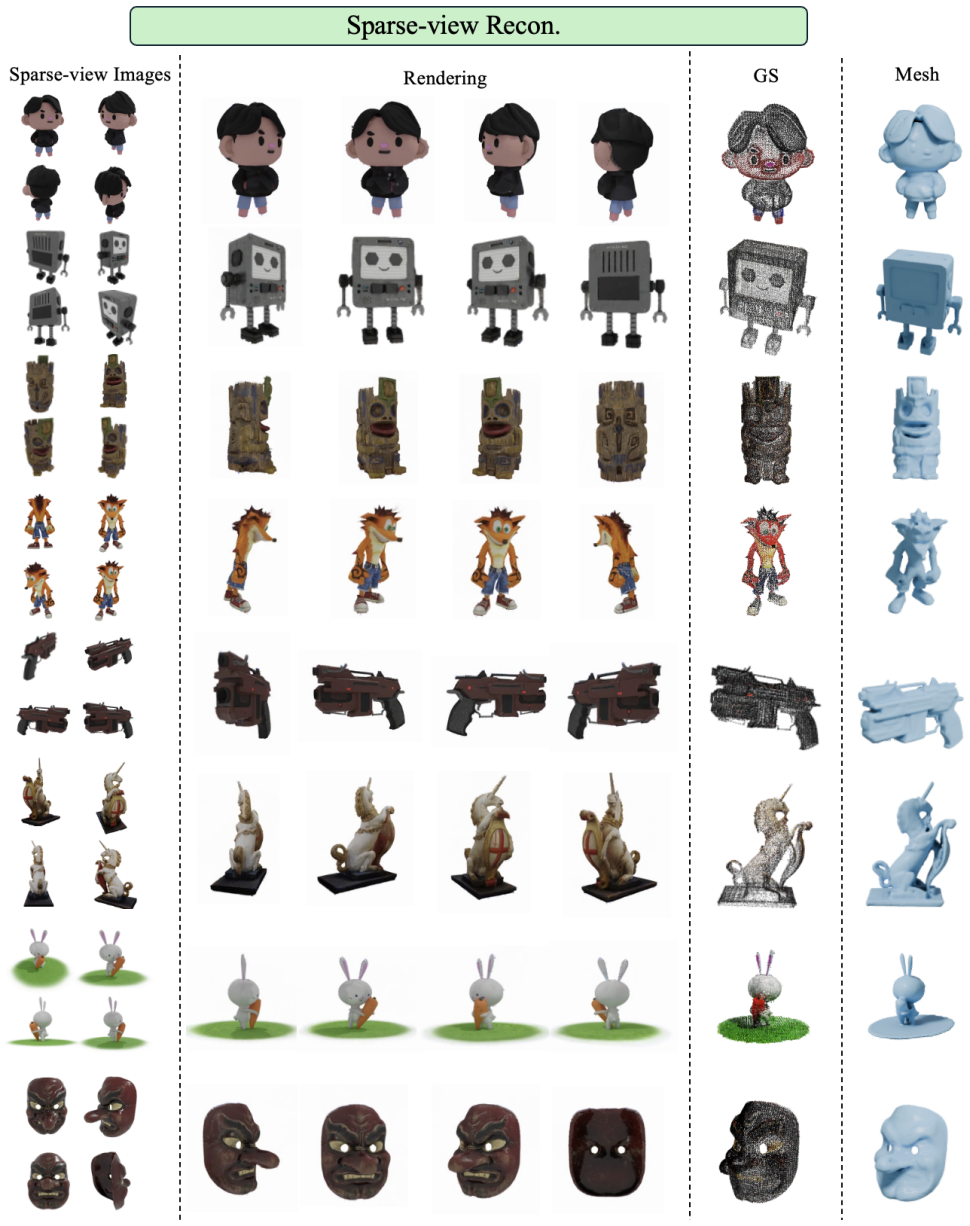
Figures


Figures from the paper (7 more)




Forward citations
Cited by 2 Pith papers
-
4DHumanDiff: Direct Text-to-4DGS Generation for Consistent 360-Degree Dynamic Humans
A diffusion model trained on 60,000 fitted 4D Gaussian Splatting human clips generates text-prompted, view-consistent dynamic humans directly in 4D, over 10x faster than video-first pipelines.
-
Momentum-GS: Momentum Gaussian Self-Distillation for High-Quality Large Scene Reconstruction
Momentum-GS improves large-scale 3D Gaussian splatting by using a momentum teacher decoder and reconstruction-guided block weighting to boost reconstruction quality and reduce memory use.
Reference graph
Works this paper leans on
-
[1]
Emerg- ing properties in self-supervised vision transformers
Mathilde Caron, Hugo Touvron, Ishan Misra, Herv ´e J´egou, Julien Mairal, Piotr Bojanowski, and Armand Joulin. Emerg- ing properties in self-supervised vision transformers. In ICCV, 2021. 4
work page 2021
-
[2]
pi-gan: Periodic implicit genera- tive adversarial networks for 3d-aware image synthesis
Eric R Chan, Marco Monteiro, Petr Kellnhofer, Jiajun Wu, and Gordon Wetzstein. pi-gan: Periodic implicit genera- tive adversarial networks for 3d-aware image synthesis. In CVPR, 2021. 3
2021
-
[3]
Effi- cient geometry-aware 3d generative adversarial networks
Eric R Chan, Connor Z Lin, Matthew A Chan, Koki Nagano, Boxiao Pan, Shalini De Mello, Orazio Gallo, Leonidas J Guibas, Jonathan Tremblay, Sameh Khamis, et al. Effi- cient geometry-aware 3d generative adversarial networks. In CVPR, 2022. 1, 3
work page 2022
-
[4]
Shapenet: An information-rich 3d model repository
Angel X Chang, Thomas Funkhouser, Leonidas Guibas, Pat Hanrahan, Qixing Huang, Zimo Li, Silvio Savarese, Manolis Savva, Shuran Song, Hao Su, et al. Shapenet: An information-rich 3d model repository. arXiv preprint arXiv:1512.03012, 2015. 3
arXiv 2015
-
[5]
pixelsplat: 3d gaussian splats from image pairs for scalable generalizable 3d reconstruction
David Charatan, Sizhe Lester Li, Andrea Tagliasacchi, and Vincent Sitzmann. pixelsplat: 3d gaussian splats from image pairs for scalable generalizable 3d reconstruction. In CVPR,
-
[6]
Lara: Efficient large-baseline radiance fields
Anpei Chen, Haofei Xu, Stefano Esposito, Siyu Tang, and Andreas Geiger. Lara: Efficient large-baseline radiance fields. In ECCV, 2024. 7, 13
work page 2024
-
[7]
Fan- tasia3d: Disentangling geometry and appearance for high- quality text-to-3d content creation
Rui Chen, Yongwei Chen, Ningxin Jiao, and Kui Jia. Fan- tasia3d: Disentangling geometry and appearance for high- quality text-to-3d content creation. In ICCV, 2023. 1
work page 2023
-
[8]
Objaverse: A universe of annotated 3d objects
Matt Deitke, Dustin Schwenk, Jordi Salvador, Luca Weihs, Oscar Michel, Eli VanderBilt, Ludwig Schmidt, Kiana Ehsani, Aniruddha Kembhavi, and Ali Farhadi. Objaverse: A universe of annotated 3d objects. In CVPR, 2023. 1, 3, 5, 12
work page 2023
Show all 76 references
-
[9]
Objaverse-xl: A universe of 10m+ 3d objects
Matt Deitke, Ruoshi Liu, Matthew Wallingford, Huong Ngo, Oscar Michel, Aditya Kusupati, Alan Fan, Christian Laforte, Vikram V oleti, Samir Yitzhak Gadre, et al. Objaverse-xl: A universe of 10m+ 3d objects. NeurIPS, 2024. 1, 3
2024
-
[10]
Google scanned objects: A high- quality dataset of 3d scanned household items
Laura Downs, Anthony Francis, Nate Koenig, Brandon Kin- man, Ryan Hickman, Krista Reymann, Thomas B McHugh, and Vincent Vanhoucke. Google scanned objects: A high- quality dataset of 3d scanned household items. In ICRA,
-
[11]
Taming transformers for high-resolution image synthesis
Patrick Esser, Robin Rombach, and Bjorn Ommer. Taming transformers for high-resolution image synthesis. In Pro- ceedings of the IEEE/CVF conference on computer vision and pattern recognition, pages 12873–12883, 2021. 3
2021
-
[12]
Generative adversarial nets
Ian Goodfellow, Jean Pouget-Abadie, Mehdi Mirza, Bing Xu, David Warde-Farley, Sherjil Ozair, Aaron Courville, and Yoshua Bengio. Generative adversarial nets. NeurIPS, 2014. 3
2014
-
[13]
3dgen: Triplane latent diffusion for textured mesh generation
Anchit Gupta, Wenhan Xiong, Yixin Nie, Ian Jones, and Bar- las O˘guz. 3dgen: Triplane latent diffusion for textured mesh generation. arXiv preprint arXiv:2303.05371, 2023. 3
2023 arXiv
-
[14]
Lrm: Large reconstruction model for single image to 3d
Yicong Hong, Kai Zhang, Jiuxiang Gu, Sai Bi, Yang Zhou, Difan Liu, Feng Liu, Kalyan Sunkavalli, Trung Bui, and Hao Tan. Lrm: Large reconstruction model for single image to 3d. In ICLR, 2024. 1, 3
2024
-
[15]
Shap-e: Generat- ing conditional 3d implicit functions
Heewoo Jun and Alex Nichol. Shap-e: Generat- ing conditional 3d implicit functions. arXiv preprint arXiv:2305.02463, 2023. 3
2023 arXiv
-
[16]
3d gaussian splatting for real-time radiance field rendering
Bernhard Kerbl, Georgios Kopanas, Thomas Leimk ¨uhler, and George Drettakis. 3d gaussian splatting for real-time radiance field rendering. ACM Trans. Graph., 2023. 1, 3, 4, 12
2023
-
[17]
xformers: A modular and hackable trans- former modelling library
Benjamin Lefaudeux, Francisco Massa, Diana Liskovich, Wenhan Xiong, Vittorio Caggiano, Sean Naren, Min Xu, Jieru Hu, Marta Tintore, Susan Zhang, Patrick Labatut, Daniel Haziza, Luca Wehrstedt, Jeremy Reizenstein, and Grigory Sizov. xformers: A modular and hackable trans- forme...
2022
-
[18]
Instant3d: Fast text-to-3d with sparse-view generation and large reconstruction model
Jiahao Li, Hao Tan, Kai Zhang, Zexiang Xu, Fujun Luan, Yinghao Xu, Yicong Hong, Kalyan Sunkavalli, Greg Shakhnarovich, and Sai Bi. Instant3d: Fast text-to-3d with sparse-view generation and large reconstruction model. In ICLR, 2024. 1, 3, 5
2024
-
[19]
Magic3d: High-resolution text-to-3d content creation
Chen-Hsuan Lin, Jun Gao, Luming Tang, Towaki Takikawa, Xiaohui Zeng, Xun Huang, Karsten Kreis, Sanja Fidler, Ming-Yu Liu, and Tsung-Yi Lin. Magic3d: High-resolution text-to-3d content creation. In CVPR, 2023. 1
2023
-
[20]
Wonder3d: Sin- gle image to 3d using cross-domain diffusion
Xiaoxiao Long, Yuan-Chen Guo, Cheng Lin, Yuan Liu, Zhiyang Dou, Lingjie Liu, Yuexin Ma, Song-Hai Zhang, Marc Habermann, Christian Theobalt, et al. Wonder3d: Sin- gle image to 3d using cross-domain diffusion. CVPR, 2024. 3
2024
-
[21]
Marching cubes: A high resolution 3d surface construction algorithm
William E Lorensen and Harvey E Cline. Marching cubes: A high resolution 3d surface construction algorithm. InSem- inal graphics: pioneering efforts that shaped the field, pages 347–353. 1998. 1
1998
-
[22]
Decoupled weight decay regularization
I Loshchilov. Decoupled weight decay regularization. arXiv preprint arXiv:1711.05101, 2017. 5, 6
2017 arXiv
-
[23]
Scalable 3d captioning with pretrained models
Tiange Luo, Chris Rockwell, Honglak Lee, and Justin Johnson. Scalable 3d captioning with pretrained models. NeurIPS, 2023. 12
2023
-
[24]
View selec- tion for 3d captioning via diffusion ranking
Tiange Luo, Justin Johnson, and Honglak Lee. View selec- tion for 3d captioning via diffusion ranking. arXiv preprint arXiv:2404.07984, 2024. 12
2024
-
[25]
Latent-nerf for shape-guided generation of 3d shapes and textures
Gal Metzer, Elad Richardson, Or Patashnik, Raja Giryes, and Daniel Cohen-Or. Latent-nerf for shape-guided generation of 3d shapes and textures. In CVPR, 2023. 1
2023
-
[26]
Srinivasan, Matthew Tancik, Jonathan T
Ben Mildenhall, Pratul P. Srinivasan, Matthew Tancik, Jonathan T. Barron, Ravi Ramamoorthi, and Ren Ng. Nerf: Representing scenes as neural radiance fields for view syn- thesis. In ECCV, 2020. 1, 3 9
2020
-
[27]
Hologan: Unsupervised learning of 3d representations from natural images
Thu Nguyen-Phuoc, Chuan Li, Lucas Theis, Christian Richardt, and Yong-Liang Yang. Hologan: Unsupervised learning of 3d representations from natural images. InCVPR,
-
[28]
Point-e: A system for generat- ing 3d point clouds from complex prompts
Alex Nichol, Heewoo Jun, Prafulla Dhariwal, Pamela Mishkin, and Mark Chen. Point-e: A system for generat- ing 3d point clouds from complex prompts. arXiv preprint arXiv:2212.08751, 2022. 3
2022 arXiv
-
[29]
Giraffe: Represent- ing scenes as compositional generative neural feature fields
Michael Niemeyer and Andreas Geiger. Giraffe: Represent- ing scenes as compositional generative neural feature fields. In CVPR, 2021. 3
2021
-
[30]
Au- todecoding latent 3d diffusion models
Evangelos Ntavelis, Aliaksandr Siarohin, Kyle Olszewski, Chaoyang Wang, Luc V Gool, and Sergey Tulyakov. Au- todecoding latent 3d diffusion models. NeurIPS, 2023. 3
2023
-
[31]
Scalable diffusion models with transformers
William Peebles and Saining Xie. Scalable diffusion models with transformers. In ICCV, 2023. 5
2023
-
[32]
Dreamfusion: Text-to-3d using 2d diffusion
Ben Poole, Ajay Jain, Jonathan T Barron, and Ben Milden- hall. Dreamfusion: Text-to-3d using 2d diffusion. arXiv preprint arXiv:2209.14988, 2022. 1
2022 arXiv
-
[33]
Improving language understanding by gener- ative pre-training
Alec Radford. Improving language understanding by gener- ative pre-training. 2018. 3
2018
-
[34]
High-resolution image syn- thesis with latent diffusion models, 2021
Robin Rombach, Andreas Blattmann, Dominik Lorenz, Patrick Esser, and Bj¨orn Ommer. High-resolution image syn- thesis with latent diffusion models, 2021. 2, 3, 5
2021
-
[35]
High-resolution image syn- thesis with latent diffusion models
Robin Rombach, Andreas Blattmann, Dominik Lorenz, Patrick Esser, and Bj¨orn Ommer. High-resolution image syn- thesis with latent diffusion models. In CVPR, 2022. 3
2022
-
[36]
Flexible isosurface extraction for gradient-based mesh optimization
Tianchang Shen, Jacob Munkberg, Jon Hasselgren, Kangxue Yin, Zian Wang, Wenzheng Chen, Zan Gojcic, Sanja Fidler, Nicholas Sharp, and Jun Gao. Flexible isosurface extraction for gradient-based mesh optimization. ACM Trans. Graph.,
-
[37]
Zero123++: a single image to consistent multi-view dif- fusion base model
Ruoxi Shi, Hansheng Chen, Zhuoyang Zhang, Minghua Liu, Chao Xu, Xinyue Wei, Linghao Chen, Chong Zeng, and Hao Su. Zero123++: a single image to consistent multi-view dif- fusion base model. 2, 3
-
[38]
3d neural field generation using triplane diffusion
J Ryan Shue, Eric Ryan Chan, Ryan Po, Zachary Ankner, Jiajun Wu, and Gordon Wetzstein. 3d neural field generation using triplane diffusion. In CVPR, 2023. 3
2023
-
[39]
Meshgpt: Generating triangle meshes with decoder-only transformers
Yawar Siddiqui, Antonio Alliegro, Alexey Artemov, Tatiana Tommasi, Daniele Sirigatti, Vladislav Rosov, Angela Dai, and Matthias Nießner. Meshgpt: Generating triangle meshes with decoder-only transformers. In CVPR, 2024. 3
2024
-
[40]
Make-a-video: Text-to-video generation without text-video data
Uriel Singer, Adam Polyak, Thomas Hayes, Xi Yin, Jie An, Songyang Zhang, Qiyuan Hu, Harry Yang, Oron Ashual, Oran Gafni, et al. Make-a-video: Text-to-video generation without text-video data. arXiv preprint arXiv:2209.14792 ,
-
[41]
Epigraf: Rethinking training of 3d gans
Ivan Skorokhodov, Sergey Tulyakov, Yiqun Wang, and Peter Wonka. Epigraf: Rethinking training of 3d gans. NeurIPS,
-
[42]
Deep unsupervised learning using nonequilibrium thermodynamics
Jascha Sohl-Dickstein, Eric Weiss, Niru Maheswaranathan, and Surya Ganguli. Deep unsupervised learning using nonequilibrium thermodynamics. In ICML. PMLR, 2015. 3
2015
-
[43]
Dreamcraft3d: Hierarchical 3d generation with bootstrapped diffusion prior
Jingxiang Sun, Bo Zhang, Ruizhi Shao, Lizhen Wang, Wen Liu, Zhenda Xie, and Yebin Liu. Dreamcraft3d: Hierarchical 3d generation with bootstrapped diffusion prior. In ICLR,
-
[44]
Viewset diffusion:(0-) image-conditioned 3d gener- ative models from 2d data
Stanislaw Szymanowicz, Christian Rupprecht, and Andrea Vedaldi. Viewset diffusion:(0-) image-conditioned 3d gener- ative models from 2d data. In ICCV, 2023. 4
2023
-
[45]
Splatter image: Ultra-fast single-view 3d recon- struction
Stanislaw Szymanowicz, Christian Rupprecht, and Andrea Vedaldi. Splatter image: Ultra-fast single-view 3d recon- struction. In CVPR, 2024. 4
2024
-
[46]
Lgm: Large multi-view gaussian model for high-resolution 3d content creation
Jiaxiang Tang, Zhaoxi Chen, Xiaokang Chen, Tengfei Wang, Gang Zeng, and Ziwei Liu. Lgm: Large multi-view gaussian model for high-resolution 3d content creation. ECCV, 2024. 1, 2, 3, 4, 7, 12, 13
2024
-
[47]
Dreamgaussian: Generative gaussian splatting for ef- ficient 3d content creation
Jiaxiang Tang, Jiawei Ren, Hang Zhou, Ziwei Liu, and Gang Zeng. Dreamgaussian: Generative gaussian splatting for ef- ficient 3d content creation. In ICLR, 2024. 1
2024
-
[48]
Triposr: Fast 3d object reconstruction from a single image
Dmitry Tochilkin, David Pankratz, Zexiang Liu, Zixuan Huang, , Adam Letts, Yangguang Li, Ding Liang, Christian Laforte, Varun Jampani, and Yan-Pei Cao. Triposr: Fast 3d object reconstruction from a single image. arXiv preprint arXiv:2403.02151, 2024. 3
2024 arXiv
-
[49]
Attention is all you need
A Vaswani. Attention is all you need. NeurIPS, 2017. 5
2017
-
[50]
Pf-lrm: Pose-free large reconstruction model for joint pose and shape prediction
Peng Wang, Hao Tan, Sai Bi, Yinghao Xu, Fujun Luan, Kalyan Sunkavalli, Wenping Wang, Zexiang Xu, and Kai Zhang. Pf-lrm: Pose-free large reconstruction model for joint pose and shape prediction. In ICLR, 2024. 3
2024
-
[51]
Image quality assessment: from error visibility to structural similarity
Zhou Wang, Alan C Bovik, Hamid R Sheikh, and Eero P Si- moncelli. Image quality assessment: from error visibility to structural similarity. IEEE transactions on image processing,
-
[52]
Prolificdreamer: High-fidelity and diverse text-to-3d generation with variational score distilla- tion
Zhengyi Wang, Cheng Lu, Yikai Wang, Fan Bao, Chongxuan Li, Hang Su, and Jun Zhu. Prolificdreamer: High-fidelity and diverse text-to-3d generation with variational score distilla- tion. In NeurIPS, 2023. 1
2023
-
[53]
Crm: Single image to 3d textured mesh with convolu- tional reconstruction model
Zhengyi Wang, Yikai Wang, Yifei Chen, Chendong Xiang, Shuo Chen, Dajiang Yu, Chongxuan Li, Hang Su, and Jun Zhu. Crm: Single image to 3d textured mesh with convolu- tional reconstruction model. In ECCV, 2024. 1, 3
2024
-
[54]
Meshlrm: Large reconstruction model for high- quality mesh
Xinyue Wei, Kai Zhang, Sai Bi, Hao Tan, Fujun Luan, Valentin Deschaintre, Kalyan Sunkavalli, Hao Su, and Zex- iang Xu. Meshlrm: Large reconstruction model for high- quality mesh. arXiv preprint arXiv:2404.12385, 2024. 1, 3, 4, 5, 12
2024 arXiv
-
[55]
Omniobject3d: Large-vocabulary 3d object dataset for realistic perception, reconstruction and generation
Tong Wu, Jiarui Zhang, Xiao Fu, Yuxin Wang, Jiawei Ren, Liang Pan, Wayne Wu, Lei Yang, Jiaqi Wang, Chen Qian, et al. Omniobject3d: Large-vocabulary 3d object dataset for realistic perception, reconstruction and generation. InCVPR,
-
[56]
Dream3d: Zero-shot text-to-3d synthesis using 3d shape prior and text-to-image diffusion models
Jiale Xu, Xintao Wang, Weihao Cheng, Yan-Pei Cao, Ying Shan, Xiaohu Qie, and Shenghua Gao. Dream3d: Zero-shot text-to-3d synthesis using 3d shape prior and text-to-image diffusion models. In CVPR, 2023. 1
2023
-
[57]
Instantmesh: Efficient 3d mesh generation from a single image with sparse-view large reconstruction models
Jiale Xu, Weihao Cheng, Yiming Gao, Xintao Wang, Shenghua Gao, and Ying Shan. Instantmesh: Efficient 3d mesh generation from a single image with sparse-view large reconstruction models. arXiv preprint arXiv:2404.07191 ,
-
[58]
3d-aware image synthesis via learning structural and textural representations
Yinghao Xu, Sida Peng, Ceyuan Yang, Yujun Shen, and Bolei Zhou. 3d-aware image synthesis via learning structural and textural representations. In CVPR, pages 18430–18439,
-
[59]
Grm: Large gaussian reconstruction model for ef- ficient 3d reconstruction and generation
Yinghao Xu, Zifan Shi, Wang Yifan, Hansheng Chen, Ceyuan Yang, Sida Peng, Yujun Shen, and Gordon Wet- zstein. Grm: Large gaussian reconstruction model for ef- ficient 3d reconstruction and generation. arXiv preprint arXiv:2403.14621, 2024. 1, 2, 3, 4, 12
2024 arXiv
-
[60]
Dmv3d: Denoising multi-view diffusion using 3d large reconstruction model
Yinghao Xu, Hao Tan, Fujun Luan, Sai Bi, Peng Wang, Ji- ahao Li, Zifan Shi, Kalyan Sunkavalli, Gordon Wetzstein, Zexiang Xu, et al. Dmv3d: Denoising multi-view diffusion using 3d large reconstruction model. ICLR, 2024. 1, 3
2024
-
[61]
Gaussiancube: Structuring gaussian splatting using opti- mal transport for 3d generative modeling
Bowen Zhang, Yiji Cheng, Jiaolong Yang, Chunyu Wang, Feng Zhao, Yansong Tang, Dong Chen, and Baining Guo. Gaussiancube: Structuring gaussian splatting using opti- mal transport for 3d generative modeling. arXiv preprint arXiv:2403.19655, 2024. 2
2024 arXiv
-
[62]
Geolrm: Geometry-aware large re- construction model for high-quality 3d gaussian generation
Chubin Zhang, Hongliang Song, Yi Wei, Yu Chen, Jiwen Lu, and Yansong Tang. Geolrm: Geometry-aware large re- construction model for high-quality 3d gaussian generation. arXiv preprint arXiv:2406.15333, 2024. 2, 3, 7, 13
2024 arXiv
-
[63]
Arf: Artistic radiance fields
Kai Zhang, Nick Kolkin, Sai Bi, Fujun Luan, Zexiang Xu, Eli Shechtman, and Noah Snavely. Arf: Artistic radiance fields. In ECCV, 2022. 6
2022
-
[64]
Gs-lrm: Large recon- struction model for 3d gaussian splatting
Kai Zhang, Sai Bi, Hao Tan, Yuanbo Xiangli, Nanxuan Zhao, Kalyan Sunkavalli, and Zexiang Xu. Gs-lrm: Large recon- struction model for 3d gaussian splatting. arXiv preprint arXiv:2404.19702, 2024. 1, 2, 3, 12
2024 arXiv
-
[65]
The unreasonable effectiveness of deep features as a perceptual metric
Richard Zhang, Phillip Isola, Alexei A Efros, Eli Shechtman, and Oliver Wang. The unreasonable effectiveness of deep features as a perceptual metric. In CVPR, 2018. 5, 6 11 NovelGS: Consistent Novel-view Denoising via Large Gaussian Reconstruction Model Supplementary Material ...
2018
-
[66]
We render images at a resolution of 512 × 512 pixels for each object, along with corresponding depth and normal maps, from 32 randomly selected viewpoints
Data Preparation The training dataset utilized in this study comprises multi- view images generated from the Objaverse [8] dataset. We render images at a resolution of 512 × 512 pixels for each object, along with corresponding depth and normal maps, from 32 randomly selected v...
-
[67]
Absence of texture maps
-
[68]
Rendered images that occupy less than 10% of the view from any perspective
-
[69]
Inclusion of multiple distinct objects
-
[70]
Lack of caption information as provided by the Cap3D dataset [23, 24]
-
[71]
low quality
Objects classified as low quality. The designation of “low quality” is based on the presence of specific tags, such as “lowpoly” and its variants (e.g., ”low poly”), within the metadata. By applying these filtering criteria, we successfully cu- rated approximately 270k high-qu...
-
[72]
Specifically, we initially pretrain our model using im- ages with a resolution of 256 × 256 pixels until convergence is achieved
Additional Model Details Inspired by [54, 64] which claim the two-stage training scheme cuts the computing cost significantly, we train our model in two stages, as explained in our training setting part. Specifically, we initially pretrain our model using im- ages with a resol...
-
[73]
3D Gaussian Parameterization As detailed explained in the previous work [46, 59, 64], 3D Gaussians represent an unstructured explicit form; in contrast to the structural implicit representation used in Triplane-NeRF, the way output parameters are parameter- ized can significan...
-
[74]
Additional Quantitative Results In this part, we report the performance of our model in a new setting of Omni3D [55] as shown in Table 10. Given that Omni3D incorporates benchmark views ran- domly sampled from the upper semi-sphere of each object, we randomly select 16 views t...
-
[75]
We could find the performance of the model improves as the number of input views increases; however, this also leads to an increase in the GPU memory requirements of the model
Exploration for More Input Views In this part, we explore the model’s performance and GPU inference memory with more input views. We could find the performance of the model improves as the number of input views increases; however, this also leads to an increase in the GPU memo...
-
[76]
13 Figure 8
Additional Visual Results As shown in Figure 8, Figure 9 and Figure 10, we show more high-fidelity 3D assets generated by our NovelGS. 13 Figure 8. High-fidelity 3D assets produced by NovelGS through sparse-view images. 14 Figure 9. High-fidelity 3D assets produced by NovelGS ...
Reviewed August 12, 2026 · model on record in the stance chip above.
Discussion (0). Continue with ORCID to comment.