REVIEW 5 major objections 5 minor 59 references
Curvature Informed Furthest Point Sampling
T0 review · 5 major / 5 minor · reviewed 2026-08-12 · deepseek-v4-flash
Pith's one-line read Curvature-informed furthest point sampling (CFPS) swaps low-curvature points out of the FPS core set and claims the swap lifts classification, segmentation, and shape completion without changing the downstream network.
desk verdict A promising sampling idea whose central algorithm is undefined in the write-up: the joint rank is C*S in one place and C+S in another, and the reported gains are not tied to a fixed procedure. read the letter →
The pith
A machine-rendered reading of the paper's core claim, the machinery that carries it, and where it could break.
The reading
What carries the argument
The load-bearing object is the joint rank J = C * S (stated in Section 3.2) or J = C + S (stated in Algorithm 2), which fuses the normalized FPS soft rank S = F/(N-1) with a pointwise mean-curvature estimate C obtained from learned normal and curvature estimators. The other piece is the exchange-ratio policy πφ: a small temporal convolutional network that reads the curvature values and outputs a Beta distribution over the swap fraction G in [0,1], trained by the REINFORCE policy-gradient rule with an exponential-moving-average baseline. Together they convert a fixed, non-differentiable FPS step into a module with a learned swap count, n_exchange = floor(G·N), that is updated end-to-end through the reward signal of the downstream task while the FPS core set itself is recomputed deterministically.
What would settle it
Re-running the ModelNet40 classification with several seeds and fixed, pre-registered hyperparameters would settle whether the reported 96.2% versus 94.8% gap over FPS is stable, since the paper reports single runs without a voting strategy. Separately, computing the joint rank on one cloud with both the product definition (Section 3.2) and the sum definition (Algorithm 2) would show whether the swapped set - and hence the claimed mechanism - is even uniquely defined.
Extended reading notes
Core claim
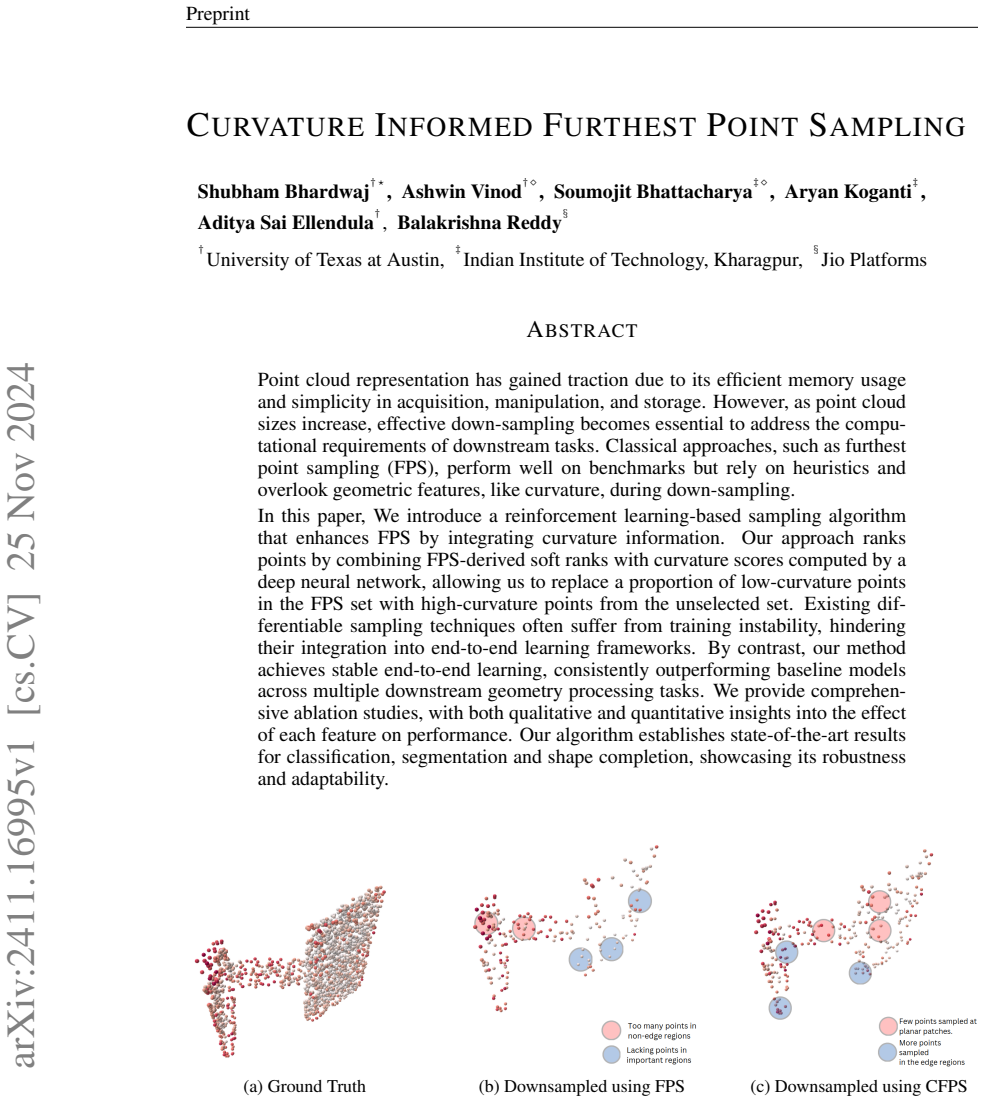
The central claim is that FPS's weakness is not its coverage heuristic but its blindness to local geometry, and that this blindness can be fixed without abandoning FPS. The algorithm runs FPS to obtain a soft rank S = F/(N-1) for each point, estimates pointwise mean curvature, forms a joint rank that combines the two, and swaps the lowest-ranked points inside the FPS set with the highest-ranked points outside it, where the number of swapped points is a learned fraction of the input size. The paper argues that points on flat regions are redundant, so trading them for high-curvature points preserves sharp features while FPS still supplies global coverage. On the MVP completion benchmark it reports that VRCNet+CFPS improves the F1-score from 0.50 to 0.52 and reduces the Chamfer distance from 5.96 to 5.60; on ModelNet40 classification it reports 96.2% overall accuracy against 94.8% for FPS; and on ShapeNetPart segmentation it reports higher mIoU than FPS and the APES baseline. The paper claims state-of-the-art results among end-to-end downsampling methods, noting that one-pass learned samplers such as SampleNet and Learning to Sample fall outside its comparison framework.
Load-bearing premise
The method rests on the combined curvature-and-FPS score reliably ranking which points to keep, but the curvature values are used unnormalized, the score is defined as a product in one place and a sum in another, and the learned swap count is not clamped to the core-set size - so the exchanged set can change with the curvature scale or exceed the available points.
Editorial extensions
If this is right
- Any FPS-based architecture can adopt CFPS without redesign: the reported gains on completion, classification, and segmentation come from swapping the sampling layer only.
- On the MVP benchmark, the swap improves completion fidelity: F1-score at the 1% threshold rises from 0.50 to 0.52 and Chamfer distance falls from 5.96 to 5.60.
- On ModelNet10 and ModelNet40, CFPS reports 0.996 and 0.983 accuracy versus 0.990 and 0.97 for FPS (Table 2), and 96.2% versus 94.8% in a separate comparison (Table 6).
- On ShapeNetPart segmentation, CFPS reports 84.5% category mIoU and 86.7% instance mIoU, above FPS (83.0% for both) and above both APES variants.
- The benefit concentrates on geometry with high curvature variation: for near-uniform objects such as sofas the ablation shows CFPS matches FPS, while beds, bookshelves, and tables gain most from larger exchange counts.
Reading between the lines
- Because curvature is computed on the fly and the downstream network is left unchanged, CFPS could plausibly be retrofitted to already-trained FPS pipelines as a test-time sampling choice; the paper demonstrates only end-to-end training, so this use is an untested extrapolation.
- A reader implementing from the text must pick between two different joint ranks (a product in Section 3.2 and a sum in Algorithm 2), and the paper does not say which definition produced the tables; checking both on one cloud would show whether the headline gains depend on that choice.
- The paper's state-of-the-art claim is scoped: it sets aside one-pass learned samplers such as SampleNet and Learning to Sample on the grounds that they sample once before the network, so the comparison covers only methods that downsample repeatedly inside the network.
- A reader of the appendix will find the training-strategy ablation hard to reconcile: CFPS-only is listed with F1-score 0.52 while the FPS+CFPS hybrid is listed at 0.507, yet the text describes the hybrid as the best configuration, leaving the configuration behind the headline numbers unclear.
Editorial analysis
A structured set of objections, weighed in public.
Referee Report
Summary. The paper proposes Curvature Informed Furthest Point Sampling (CFPS), a point-cloud downsampling method that replaces a fraction of the points chosen by furthest point sampling with high-curvature points from the unselected set, where the fraction is learned by a REINFORCE-based policy network. The authors claim state-of-the-art results on single-view partial point cloud completion (MVP), classification (ModelNet10/40), and part segmentation (ShapeNetPart), and they include ablations on the exchange ratio and on training strategies, plus a theoretical regret bound in the appendix.
Significance. If the empirical claims were reproducible, CFPS would be a practically valuable drop-in sampling module: it preserves FPS coverage while adding a learned geometric bias, and it is designed for end-to-end training. The paper also provides a useful comparison of FPS-based and learned sampling methods and reports computational overhead. However, the current manuscript does not establish the central claim because the algorithm is specified inconsistently (joint rank defined as both multiplication and addition, with unnormalized signed curvature), key quantitative results contradict each other, and the theoretical regret bound relies on invalid assumptions. The absence of released code and of error bars further prevents verification.
major comments (5)
- [Section 3.2, Algorithm 2] The core swap operation is not well-defined. Section 3.2 defines the joint rank as J = C * S, while Algorithm 2 line 7 computes J = C + S; these define different orderings. Moreover, C is a raw signed mean curvature with no normalization, so the relative weight of curvature and FPS rank depends on the scale and sign of C, and the lowest-C points are strongly concave points rather than flat points. Finally, Algorithm 2 does not clamp nexchange = floor(G * N) to the core-set size K; for the reported N=2048, K=256, and G=0.9, nexchange=1843 > K, which is not a valid exchange. Consequently, the results in Tables 1, 2, 6, and 8 cannot be attributed to a fixed, reproducible algorithm.
- [Tables 2 and 6] The classification results are mutually inconsistent. Table 2 reports CFPS achieving 0.983 overall accuracy on ModelNet40, whereas Table 6 reports 96.2% for the same method and dataset, and the FPS baseline likewise differs (0.97 vs. 94.8%). At most one of these sets of numbers can be correct, and without code or a clarification the claimed improvement over FPS cannot be taken at face value.
- [Appendix A.1, Table 5] The training-strategy ablation is internally contradictory. The text states that CFPS-only achieves an F1-Score of 0.52, 'slightly lower than FPS-only' (which is 0.50), and it describes the hybrid FPS+CFPS score of 0.507 as 'the best performance.' Numerically 0.52 > 0.50 and 0.507 < 0.52, so either the table values or the narrative are erroneous. This undermines the ablation conclusion about the benefit of the adaptive ratio.
- [Appendix C, Eqs. (5)-(9)] The theoretical regret bound is not valid. The quantity Xt = E_{pi*}[R] - E_{pi_phi}[R] is not zero-mean (it is nonnegative under an optimal policy) and is not i.i.d. because the policy parameters phi change over time. Additionally, the Hoeffding interval is misapplied: with |R| <= M, Xt lies in [-2M, 2M], not in [0, 2M] as implied by setting a = 2M and b = 0. Thus Eq. (9) does not follow and the claimed O(sqrt(T log(1/delta))) regret bound is unsupported.
- [Tables 1, 2, 3, 6, 8] All reported metrics are single numbers without variance or repeated-run statistics. Given the small reported margins (e.g., F1 from 0.50 to 0.52, accuracy from 94.8% to 96.2%), statistical significance cannot be assessed, and the absence of released code prevents independent verification. This is a load-bearing gap for the paper's central claim of consistent improvement.
minor comments (5)
- [Page 2, Introduction] The sentence 'In this paper, We introduce' has a capitalization error; 'we' should be lowercase. There are also typographical errors such as 'paramteres' (Table 4/7 caption) and 'establlishing' (Appendix C.3).
- [Tables 4 and 7] Tables 4 and 7 are identical and both present the same computational-complexity data; one should be removed or they should be differentiated.
- [Figure 2] Figure 2, the architecture diagram, is referenced but the text does not explain the legend for J, C, S, and G; adding a short description would improve readability.
- [References] The paper cites 'Supplymentary' for an architecture diagram; this should be corrected to 'Supplementary.'
- [Section 3.1] The curvature definition states H = (k1 + k2)/2 but does not specify how mean curvature is estimated from the MSECNet normals on a point cloud; a citation to the exact estimation method would help reproducibility.
Circularity Check
No circular derivation: the paper's claims are empirical comparisons against fixed benchmarks, and its learned exchange ratio is transparently optimized with the downstream loss as reward rather than disguised as an independent prediction.
full rationale
The paper's central claims are empirical: CFPS is compared against FPS, APES, and published methods on fixed benchmarks (MVP completion, ModelNet classification, ShapeNetPart segmentation). No load-bearing step reduces to its own input by construction. The curvature scores come from externally published networks (PCPNet, MSECNet), and the REINFORCE policy is explicitly trained with reward R = -L_theta(X, G), so the exchange ratio is a deliberately optimized component, not a fitted parameter renamed as a prediction. The paper contains no self-citations by the present authors and invokes no uniqueness theorem or ansatz from prior work by the same authors. The internal inconsistency between J = C * S in Section 3.2 and J = C + S in Algorithm 2, together with the unnormalized signed curvature and unclamped exchange count, are algorithmic correctness concerns, not circularity; they do not make the reported benchmark results equivalent to the method's inputs. Accordingly, the appropriate circularity score is 0.
Assumptions & free parameters
free parameters (2)
- Exchange ratio G =
learned in [0,1] via Beta policy
- Joint rank combination choice (multiplication vs addition) =
undefined; Section 3.2 uses C*S, Algorithm 2 uses C+S
assumptions (4)
- domain assumption Mean curvature estimated from MSECNet normals is an informative proxy for geometric importance in downsampling.
- domain assumption FPS soft rank S = F/(N-1) captures global structure and is compatible with curvature on a common scale.
- domain assumption The downstream task loss is a valid reward signal and its non-stationarity does not invalidate the REINFORCE updates.
- ad hoc to paper Hoeffding's inequality applies to the regret sequence with E[Xt] = 0 and i.i.d. samples.
Cite this review
Pith. "Pith review of Curvature Informed Furthest Point Sampling." pith.science (2026). https://pith.science/paper/NRNKFGOV
@misc{pith2026241116995,
  author       = {Pith},
  title        = {Pith review of: Curvature Informed Furthest Point Sampling},
  year         = {2026},
  howpublished = {\url{https://pith.science/paper/NRNKFGOV}},
  note         = {Machine review of arXiv:2411.16995}
}
read the original abstract
Point cloud representation has gained traction due to its efficient memory usage and simplicity in acquisition, manipulation, and storage. However, as point cloud sizes increase, effective down-sampling becomes essential to address the computational requirements of downstream tasks. Classical approaches, such as furthest point sampling (FPS), perform well on benchmarks but rely on heuristics and overlook geometric features, like curvature, during down-sampling. In this paper, We introduce a reinforcement learning-based sampling algorithm that enhances FPS by integrating curvature information. Our approach ranks points by combining FPS-derived soft ranks with curvature scores computed by a deep neural network, allowing us to replace a proportion of low-curvature points in the FPS set with high-curvature points from the unselected set. Existing differentiable sampling techniques often suffer from training instability, hindering their integration into end-to-end learning frameworks. By contrast, our method achieves stable end-to-end learning, consistently outperforming baseline models across multiple downstream geometry processing tasks. We provide comprehensive ablation studies, with both qualitative and quantitative insights into the effect of each feature on performance. Our algorithm establishes state-of-the-art results for classification, segmentation and shape completion, showcasing its robustness and adaptability.
Figures


Figures from the paper (2 more)


Reference graph
Works this paper leans on
-
[1]
Baranowski, R., Chen, Y ., and Fryzlewicz, P. (2020). Ranking-based variable selection for high-dimensional data. Statistica Sinica, 30(3):1485–1516
work page 2020
-
[2]
Cheng, S., Chen, X., He, X., Liu, Z., and Bai, X. (2021). Pra-net: Point relation-aware network for 3d point cloud analysis. IEEE Transactions on Image Processing, 30:4436–4448
work page 2021
-
[3]
Dovrat, O., Lang, I., and Avidan, S. (2019). Learning to sample. In Proceedings of the IEEE/CVF Conference on Computer Vision and Pattern Recognition, pages 2760–2769
work page 2019
-
[4]
Eldar, Y ., Lindenbaum, M., Porat, M., and Zeevi, Y . Y . (1997). The farthest point strategy for progressive image sampling. IEEE Transactions on Image Processing, 6(9):1305–1315
work page 1997
-
[5]
Engel, N., Belagiannis, V ., and Dietmayer, K. (2021). Point transformer. IEEE Access , 9:134826–134840
work page 2021
-
[6]
Fan, H., Su, H., and Guibas, L. J. (2017). A point set generation network for 3d object recon- struction from a single image. In Proceedings of the IEEE conference on computer vision and pattern recognition, pages 605–613
work page 2017
-
[7]
Gouk, H., Frank, E., Pfahringer, B., and Cree, M. J. (2021). Regularisation of neural networks by enforcing lipschitz continuity. Machine Learning, 110:393–416
work page 2021
-
[8]
Guerrero, P., Kleiman, Y ., Ovsjanikov, M., and Mitra, N. J. (2018). Pcpnet learning local shape properties from raw point clouds. In Computer Graphics Forum, volume 37, pages 75–85. Wiley Online Library
work page 2018
Show all 59 references
-
[9]
R., and Hu, S.-M
Guo, M.-H., Cai, J.-X., Liu, Z.-N., Mu, T.-J., Martin, R. R., and Hu, S.-M. (2021). Pct: Point cloud transformer. Computational Visual Media, 7:187–199
2021
-
[10]
Hoeffding, W. (1994). Probability inequalities for sums of bounded random variables. The collected works of Wassily Hoeffding, pages 409–426
1994
-
[11]
Knapitsch, A., Park, J., Zhou, Q.-Y ., and Koltun, V . (2017). Tanks and temples: Benchmarking large-scale scene reconstruction. ACM Transactions on Graphics (ToG), 36(4):1–13
2017
-
[12]
Lai, X., Liu, J., Jiang, L., Wang, L., Zhao, H., Liu, S., Qi, X., and Jia, J. (2022). Stratified transformer for 3d point cloud segmentation. In Proceedings of the IEEE/CVF conference on computer vision and pattern recognition, pages 8500–8509
2022
-
[13]
H., V ora, S., Caesar, H., Zhou, L., Yang, J., and Beijbom, O
Lang, A. H., V ora, S., Caesar, H., Zhou, L., Yang, J., and Beijbom, O. (2019). Pointpillars: Fast encoders for object detection from point clouds. In Proceedings of the IEEE/CVF Conference on Computer Vision and Pattern Recognition, pages 12697–12705
2019
-
[14]
Lang, I., Manor, A., and Avidan, S. (2020). Samplenet: Differentiable point cloud sampling. In Proceedings of the IEEE/CVF Conference on Computer Vision and Pattern Recognition, pages 7578–7588
2020
-
[15]
Li, Y ., Bu, R., Sun, M., Wu, W., Di, X., and Chen, B. (2018). Pointcnn: Convolution on x-transformed points. Advances in neural information processing systems, 31
2018
-
[16]
Liu, W., Sun, J., Li, W., Hu, T., and Wang, P. (2019a). Deep learning on point clouds and its application: A survey. Sensors, 19(19):4188. 11 Preprint
2019
-
[17]
Liu, Z., Tang, H., Lin, Y ., and Han, S. (2019b). Point-voxel cnn for efficient 3d deep learn- ing. In Wallach, H., Larochelle, H., Beygelzimer, A., d'Alch ´e-Buc, F., Fox, E., and Garnett, R., editors, Advances in Neural Information Processing Systems, volume 32. Curran Assoc...
2019
-
[18]
Metzer, G., Hanocka, R., Giryes, R., and Cohen-Or, D. (2021). Self-sampling for neural point cloud consolidation. ACM Transactions on Graphics (TOG), 40(5):1–14
2021
-
[19]
Mohamed, S., Rosca, M., Figurnov, M., and Mnih, A. (2020). Monte carlo gradient estimation in machine learning. Journal of Machine Learning Research, 21(132):1–62
2020
-
[20]
Muzahid, A., Wan, W., Sohel, F., Wu, L., and Hou, L. (2020). Curvenet: Curvature-based multitask learning deep networks for 3d object recognition. IEEE/CAA Journal of Automatica Sinica, 8(6):1177–1187
2020
-
[21]
Nezhadarya, E., Taghavi, E., Razani, R., Liu, B., and Luo, J. (2020). Adaptive hierarchical down-sampling for point cloud classification. In Proceedings of the IEEE/CVF Conference on Computer Vision and Pattern Recognition, pages 12956–12964
2020
-
[22]
Pan, L. (2020). Ecg: Edge-aware point cloud completion with graph convolution. IEEE Robotics and Automation Letters, 5(3):4392–4398
2020
-
[23]
Pan, L., Chen, X., Cai, Z., Zhang, J., Zhao, H., Yi, S., and Liu, Z. (2021a). Variational relational point completion network. In Proceedings of the IEEE/CVF Conference on Computer Vision and Pattern Recognition, pages 8524–8533
2021
-
[24]
Pan, L., Chew, C.-M., and Lee, G. H. (2020). Pointatrousgraph: Deep hierarchical encoder- decoder with point atrous convolution for unorganized 3d points. In 2020 IEEE International Conference on Robotics and Automation (ICRA), pages 1113–1120. IEEE
2020
-
[25]
Pan, L., Wu, T., Cai, Z., Liu, Z., Yu, X., Rao, Y ., Lu, J., Zhou, J., Xu, M., Luo, X., et al. (2021b). Multi-view partial (mvp) point cloud challenge 2021 on completion and registration: Methods and results. arXiv preprint arXiv:2112.12053
2021 arXiv
-
[26]
R., Su, H., Mo, K., and Guibas, L
Qi, C. R., Su, H., Mo, K., and Guibas, L. J. (2017a). Pointnet: Deep learning on point sets for 3d classification and segmentation. In Proceedings of the IEEE conference on computer vision and pattern recognition, pages 652–660
2017
-
[27]
R., Yi, L., Su, H., and Guibas, L
Qi, C. R., Yi, L., Su, H., and Guibas, L. J. (2017b). Pointnet++: Deep hierarchical feature learning on point sets in a metric space. Advances in neural information processing systems, 30
2017
-
[28]
Rusinkiewicz, S. (2004). Estimating curvatures and their derivatives on triangle meshes. In Proceedings. 2nd International Symposium on 3D Data Processing, Visualization and Transmis- sion, 2004. 3DPVT 2004., pages 486–493. IEEE
2004
-
[29]
and Ben-David, S
Shalev-Shwartz, S. and Ben-David, S. (2014). Understanding machine learning: From theory to algorithms. Cambridge university press
2014
-
[30]
Su, H., Jampani, V ., Sun, D., Maji, S., Kalogerakis, E., Yang, M.-H., and Kautz, J. (2018). Splatnet: Sparse lattice networks for point cloud processing. In Proceedings of the IEEE confer- ence on computer vision and pattern recognition, pages 2530–2539
2018
-
[31]
Sutton, R. S. (2018). Reinforcement learning: An introduction. A Bradford Book
2018
-
[32]
R., Ranftl, R., Li, Z., Koltun, V ., and Brox, T
Tatarchenko, M., Richter, S. R., Ranftl, R., Li, Z., Koltun, V ., and Brox, T. (2019). What do single-view 3d reconstruction networks learn? In Proceedings of the IEEE/CVF Conference on Computer Vision and Pattern Recognition, pages 3405–3414
2019
-
[33]
P., Kosaraju, V ., Rezatofighi, H., Reid, I., and Savarese, S
Tchapmi, L. P., Kosaraju, V ., Rezatofighi, H., Reid, I., and Savarese, S. (2019). Topnet: Struc- tural point cloud decoder. In Proceedings of the IEEE/CVF Conference on Computer Vision and Pattern Recognition, pages 383–392
2019
-
[34]
R., Deschaud, J.-E., Marcotegui, B., Goulette, F., and Guibas, L
Thomas, H., Qi, C. R., Deschaud, J.-E., Marcotegui, B., Goulette, F., and Guibas, L. J. (2019). Kpconv: Flexible and deformable convolution for point clouds. In Proceedings of the IEEE/CVF international conference on computer vision, pages 6411–6420
2019
-
[35]
Velickovic, P., Cucurull, G., Casanova, A., Romero, A., Lio, P., and Bengio, Y . (2017). Graph attention networks. stat, 1050:20
2017
-
[36]
and Scaman, K
Virmaux, A. and Scaman, K. (2018). Lipschitz regularity of deep neural networks: analysis and efficient estimation. Advances in Neural Information Processing Systems, 31. 12 Preprint
2018
-
[37]
H., and Lee, G
Wang, X., Ang, M. H., and Lee, G. H. (2021a). V oxel-based network for shape completion by leveraging edge generation. In Proceedings of the IEEE/CVF International Conference on Computer Vision, pages 13189–13198
2021
-
[38]
H., and Lee, G
Wang, X., Ang Jr, M. H., and Lee, G. H. (2020). Cascaded refinement network for point cloud completion. In Proceedings of the IEEE/CVF Conference on Computer Vision and Pattern Recognition, pages 790–799
2020
-
[39]
Wang, X., Jin, Y ., Cen, Y ., Wang, T., and Li, Y . (2021b). Attention models for point clouds in deep learning: a survey. arXiv preprint arXiv:2102.10788
2021 arXiv
-
[40]
E., Bronstein, M
Wang, Y ., Sun, Y ., Liu, Z., Sarma, S. E., Bronstein, M. M., and Solomon, J. M. (2019). Dy- namic graph cnn for learning on point clouds
2019
-
[41]
Wiersma, R., Nasikun, A., Eisemann, E., and Hildebrandt, K. (2022). Deltaconv: anisotropic operators for geometric deep learning on point clouds. ACM Transactions on Graphics (TOG), 41(4):1–10
2022
-
[42]
Williams, R. J. (1992). Simple statistical gradient-following algorithms for connectionist rein- forcement learning. Machine learning, 8:229–256
1992
-
[43]
Wu, C., Zheng, J., Pfrommer, J., and Beyerer, J. (2023). Attention-based point cloud edge sam- pling. In Proceedings of the IEEE/CVF Conference on Computer Vision and Pattern Recognition (CVPR)
2023
-
[44]
Wu, W., Qi, Z., and Fuxin, L. (2019). Pointconv: Deep convolutional networks on 3d point clouds. In Proceedings of the IEEE/CVF Conference on Computer Vision and Pattern Recogni- tion (CVPR)
2019
-
[45]
Wu, W., Qi, Z., and Fuxin, L. (2020). Pointconv: Deep convolutional networks on 3d point clouds
2020
-
[46]
Wu, Z. (2015). 3d shapenets: A deep representation for volumetric shapes
2015
-
[47]
Wu, Z., Song, S., Khosla, A., Yu, F., Zhang, L., Tang, X., and Xiao, J. (2015). 3d shapenets: A deep representation for volumetric shapes. In Proceedings of the IEEE conference on computer vision and pattern recognition, pages 1912–1920
2015
-
[48]
Xiu, H., Liu, X., Wang, W., Kim, K.-S., and Matsuoka, M. (2023). Msecnet: Accurate and ro- bust normal estimation for 3d point clouds by multi-scale edge conditioning. arXiv:2308.02237
2023 arXiv
-
[49]
Xu, M., Ding, R., Zhao, H., and Qi, X. (2021). Paconv: Position adaptive convolution with dynamic kernel assembling on point clouds. In Proceedings of the IEEE/CVF conference on computer vision and pattern recognition, pages 3173–3182
2021
-
[50]
Xu, Y ., Fan, T., Xu, M., Zeng, L., and Qiao, Y . (2018). Spidercnn: Deep learning on point sets with parameterized convolutional filters. In Proceedings of the European Conference on Computer Vision (ECCV)
2018
-
[51]
C., and Savarese, S
Xue, L., Gao, M., Xing, C., Mart ´ın-Mart´ın, R., Wu, J., Xiong, C., Xu, R., Niebles, J. C., and Savarese, S. (2023). Ulip: Learning a unified representation of language, images, and point clouds for 3d understanding. In Proceedings of the IEEE/CVF conference on computer visio...
2023
-
[52]
Yang, H., Shi, J., and Carlone, L. (2020). Teaser: Fast and certifiable point cloud registration. IEEE Transactions on Robotics, 37(2):314–333
2020
-
[53]
G., Ceylan, D., Shen, I.-C., Yan, M., Su, H., Lu, C., Huang, Q., Sheffer, A., and Guibas, L
Yi, L., Kim, V . G., Ceylan, D., Shen, I.-C., Yan, M., Su, H., Lu, C., Huang, Q., Sheffer, A., and Guibas, L. (2016). A scalable active framework for region annotation in 3d shape collections. ACM Transactions on Graphics (ToG), 35(6):1–12
2016
-
[54]
Yu, L., Li, X., Fu, C.-W., Cohen-Or, D., and Heng, P.-A. (2018). Pu-net: Point cloud upsam- pling network. In Proceedings of the IEEE conference on computer vision and pattern recogni- tion, pages 2790–2799
2018
-
[55]
Yuan, W., Khot, T., Held, D., Mertz, C., and Hebert, M. (2018). Pcn: Point completion network. In 2018 International Conference on 3D Vision (3DV), pages 728–737. IEEE
2018
-
[56]
H., and Koltun, V
Zhao, H., Jiang, L., Jia, J., Torr, P. H., and Koltun, V . (2021). Point transformer. InProceedings of the IEEE/CVF International Conference on Computer Vision (ICCV), pages 16259–16268. 13 Preprint APPENDIX A T RAINING STRATEGIES A.1 A BLATION ON TRAINING STRATEGIES Training ...
2021
-
[57]
Weight norms: If the weights of the neural network are bounded, local Lipschitz continuity holds for the current parameters
-
[58]
Gradient control: By establlishing the gradient norms during training, we can ensure that updates to the policy parameters do not lead to drastic changes in the output probabilities, which satisfies a local Lipschitz condition [7]. 15 Preprint Method Overall Accuracy PointNet ...
-
[59]
C.4 H OEFFDING ’S BOUNDS : Hoeffding’s inequality [10] for bounded random variables X1,
Finally, We use a simple MLP architecture which is more conducive to achieving tighter regret bounds in our problem. C.4 H OEFFDING ’S BOUNDS : Hoeffding’s inequality [10] for bounded random variables X1, . . . , XT implies: P TX t=1 (Xt − E[Xt]) ≥ ϵ ! ≤ exp −2ϵ2 T (b − a)2 (5...
Reviewed August 12, 2026 · model on record in the stance chip above.
Discussion (0). Continue with ORCID to comment.