REVIEW 3 major objections 4 minor 13 references
Dynamic Programming-Based Offline Redundancy Resolution of Redundant Manipulators Along Prescribed Paths with Real-Time Adjustment
T0 review · 3 major / 4 minor · reviewed 2026-08-12 · deepseek-v4-flash
Pith's one-line read A precomputed bound lets robot arms adjust paths in real time
desk verdict The DP core is a genuinely useful extension of the Ferrentino framework, but the paper stops short of proving the guarantee survives contact with the actual robot. read the letter →
The pith
A machine-rendered reading of the paper's core claim, the machinery that carries it, and where it could break.
The reading
What carries the argument
The load-bearing object is the dynamic programming table $L(i,j,k)$ together with the mapping $f^{-1}(\hat{\mathbf{T}}_{EE_i}(b_k), \mathbf{q}_{i-1})$. The adjustment parameter $y$ (a signed shift of each waypoint along the end-effector z-axis) is discretized into $2o+1$ values $b_{-o},...,b_o$, and the seventh joint angle $q_7$ is discretized into $m$ values $a_1,...,a_m$ to make the 7-DOF inverse kinematics a finite, closed-form branch. $L(i,j,k)$ is built backward from the last sampling point: at each state it is the maximum $d$ such that both extreme next-step adjustments $k \pm d$ have feasible inverse kinematic solutions and every intermediate successor state has $L(i+1, j', k+t) \ge d$. The recursion is what turns the global guarantee into a finite computation of complexity $O(m^2 n o^2)$.
What would settle it
Run the Franka arm on the circular test path with an adjustment sequence that respects $|c_i-c_{i-1}| \le d_{\max}$, but at one sampling point hold the arm briefly or apply an external disturbance so the actual joint state deviates from the planned $\mathbf{q}_{i-1}$ by more than the motion-compensation margin; if a later joint angle or velocity exceeds its limit, the transfer of the offline guarantee to real hardware fails. A purely simulated falsifier: evaluate the same DP but using the motion-compensation interpolated joint states instead of $\mathbf{q}_{i-1}$ as the recursion state, and check whether the bound $d$ still holds.
Extended reading notes
Core claim
The central claim is that redundancy resolution along a prescribed path can be solved once, offline, in a way that remains valid for a whole family of perturbed paths, not just the nominal one. By treating the previous sampling point's joint angles $\mathbf{q}_{i-1}$ as the redundancy parameter and writing the next joint solution as $\mathbf{q}_i = f^{-1}(\hat{\mathbf{T}}_{EE_i}(b_{c_i}), \mathbf{q}_{i-1})$, the paper reduces real-time adjustment to a lookup in a precomputed mapping. The dynamic programming recursion defines $L(i,j,k)$, the largest $d$ such that starting from joint state $\bar{\mathbf{q}}_{i,j,k}$ at sampling point $i$ with adjustment index $k$, every admissible continuation $|c_x - c_{x-1}| \le d$ stays inside joint limits. The global maximum is $d_{\max} = \max_j L(0,j,0)$, selected over discrete values of the seventh joint angle. The paper argues that this gives a theoretical worst-case bound: as long as the sensor-chosen adjustment indices satisfy the bound, the manipulator will complete the adjusted path without stopping.
Load-bearing premise
The hardware guarantee additionally relies on the motion-compensation step (Section 3.3) keeping the actual trajectory close enough to the planned one; the paper's conclusion acknowledges this step can produce errors and vibration on complex paths.
Editorial extensions
If this is right
- A robot can follow a prescribed path and simultaneously react to sensor feedback along the path normal, with the reaction amplitude bounded by a precomputed $d_{\max}$.
- The offline DP guarantees that every adjustment sequence within the bound completes without mid-path joint-limit stalls, a property online velocity-level methods cannot certify.
- The mapping $f^{-1}$ is defined for every admissible successor before motion starts, so real-time control reduces to reading the current adjustment index and evaluating a lookup, not solving an optimization online.
- Joint velocity limits are enforced in the DP; acceleration and jerk are handled afterward by a motion-compensation scheme with reduced velocity limits, so the practical trajectory stays close to the nominal adjusted path.
- The method applies to any redundant manipulator for which a parameterized closed-form inverse kinematics exists; increasing degrees of freedom would require additional parameters.
Reading between the lines
- The worst-case guarantee is intentionally conservative: $d$ must hold for every possible sequence, so the actual per-step adjustments allowed in practice could be larger if the sensor process is known to be smooth or band-limited. A distribution-aware variant of the DP could trade coverage for a larger $d$.
- The same DP structure could be reused to certify other one-parameter task variations, such as tool orientation changes or payload-dependent shifts, by redefining $\hat{\mathbf{T}}_{EE_i}(y)$.
- The motion-compensation step is where the strict guarantee is most likely to leak: the reduced velocity limit $\dot{q}_{\max2}$ is a heuristic, and a formal error bound linking compensation error back to the DP state would make the hardware claim rigorous.
- One could test the bound's tightness by computing the DP for random adjustment sequences at the claimed $d$ and checking how often a feasible inverse kinematic solution exists slightly beyond $d$; the gap measures how much conservatism the all-sequences requirement costs.
Editorial analysis
A structured set of objections, weighed in public.
Referee Report
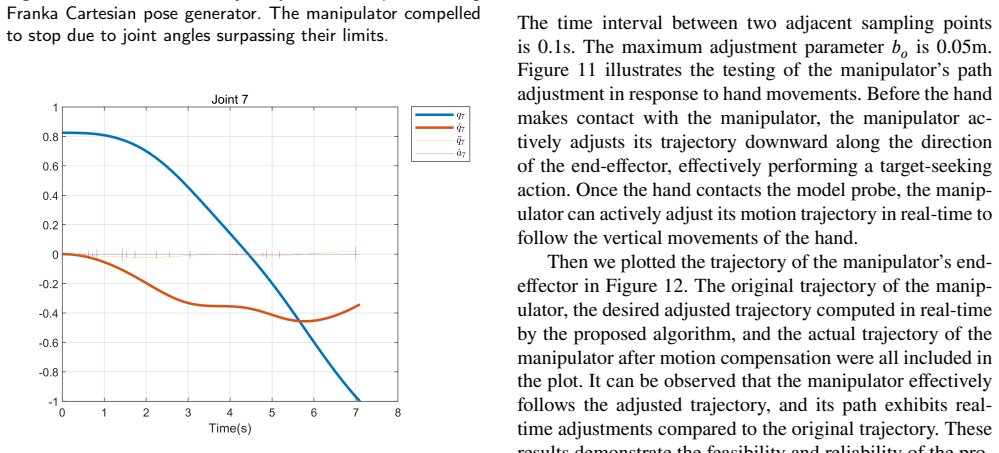
Summary. The paper proposes a dynamic-programming (DP) method for offline redundancy resolution of a 7-DOF Franka manipulator along a prescribed Cartesian path, while allowing real-time adjustment of a scalar parameter y that shifts the end-effector pose along the path normal. The adjustment parameter y and the redundancy parameter q7 are discretized, and the DP computes, for each discrete state, the maximum allowable index change d such that a precomputed inverse kinematic mapping f^{-1}(T_EE_i(b_{c_i}), q_{i-1}) keeps all joint angle and velocity constraints satisfied for every admissible adjustment-index sequence. Section 3.3 adds a motion compensation algorithm intended to enforce acceleration and jerk limits during actual hardware operation. Experiments compare the method with the Franka Cartesian pose generator and demonstrate real-time path adjustment in a probe-following task. The central theoretical claim is that the algorithm computes the global maximum d and guarantees completion of the adjusted path in real time.
Significance. If the closed-loop guarantee were established, the paper would make a useful contribution: it extends DP-based offline redundancy resolution with a real-time adjustment capability, which is genuinely missing from prior offline planners of the Ferrentino et al. type. The discrete DP recursion is a natural and mostly coherent formulation, and the real-hardware demonstration with the Franka robot is a concrete strength. However, the paper proves the guarantee only for an idealized discrete recursion, not for the actual physical closed-loop system, and the pseudocode of the DP step leaves one load-bearing selection rule implicit. These issues currently limit the significance of the claimed 'guaranteed completion' result.
major comments (3)
- [§3.3, Algorithm 2, Eq. (17)] The DP guarantee in §2 (Eqs. (3)–(4)) and §3.2 applies to the exact recursion q_i = f^{-1}(\hat T_EE_i(b_{c_i}), q_{i-1}) starting from \bar q_{0,j_0,0}. In Algorithm 2, however, the next target q_{i+1} is computed from the planned previous state, while the actual current state q_now, \dot q_now, \ddot q_now is read only afterwards, and the physical robot is then moved from q_now to q_{i+1} under acceleration and jerk clipping. Because q_now generally differs from the precomputed discrete state, the next f^{-1} call is evaluated at a state that is not one of the \bar q_{i,j,k} states, and the paper gives no proof that this perturbed state remains in the domain of f^{-1}, that the joint and velocity limits still hold, or that a feasible branch exists at the next sampling instant. The error bound in Eq. (17) is a single worst-case return-maneuver estimate, not a forward-invariance or completion guarantee, and the choice of the reduced velocity limit \dot q_max2 is left unspecified. The conclusion itself concedes errors and vibrations on complex paths. The headline claim of guaranteed real-time completion is therefore not established for the actual closed-loop system; either provide an invariant-tube or tracking-error proof, or revise the claims to refer to the discrete planned recursion only.
- [§3.2, Algorithm 1, lines 10–14] The recursive condition for L(i,j,k) requires that for every e with |e| <= d_i there exists a feasible next state \bar q_{i+1,j_e,k+e} satisfying the transition constraints and L(i+1,j_e,k+e) >= d_i. As written, Algorithm 1 checks transition feasibility only for the two extreme offsets e = ±d_i (line 11) and checks L for all |t| <= d_i (line 12). This is correct only if the j_t in line 12 are understood to be the fixed feasible states defined in Eq. (14) that maximize L for each t; the pseudocode does not state this, and the proof does not show that a state selected for its maximal L at a higher d still satisfies the transition constraints with \bar q_{i,j,k}. Please make the j_e selection explicit in Algorithm 1 and add the missing induction argument that the extreme feasibility checks plus the L-threshold checks for all interior t are equivalent to the full recursive condition.
- [§2, Eqs. (2)–(4); §4.2] The computed d_max is a bound on changes in the discrete index c_i of the adjustment parameter, but the real-time sensor signal y_i is a continuous quantity. The paper does not specify how a continuous sensor reading is converted to a discrete index c_i while ensuring both that |c_i - c_{i-1}| <= d and that the resulting adjusted pose achieves the intended contact-force behavior. If c_i is obtained by nearest-grid rounding, the induced adjustment error and the possibility of violating the variation bound need to be analyzed. This gap is distinct from the tracking-error issue in Algorithm 2 and also affects the practical real-time claim.
minor comments (4)
- [§3.3, Algorithm 2, line 22] Line 22 uses \dot q rather than the clipped \dot q_d when computing q_d; this appears to be a typo and should be corrected.
- [§3.2, complexity paragraph] The stated complexity O(m^2 n o^2) should be justified explicitly; the per-state work involves both a scan over the m possible q7 values and a check over O(o) indices, so the reported bound needs a short derivation or a more precise expression such as O(m n o (m + o)).
- [§4.2 and abstract] The abstract and Section 1.2 mention tests with 'randomly generated adjustment parameters', but Section 4.2 reports a hand-driven sensor adjustment; please align the wording with the actual experimental protocol.
- [§2, Eq. (13)] The notation max_j L(0,j,0) is clear, but the phrase 'global maximum' should be qualified as the global maximum on the adopted discrete grid of y and q7 values, since the result depends on the discretization resolutions o and m.
Circularity Check
No significant circularity: the DP bound and inverse mapping are constructed and verified by backward induction, with experimental checks against hardware.
full rationale
No load-bearing circular step found. The central quantity d_max is defined as max_j L(0,j,0) and computed by backward dynamic programming (Algorithm 1); the recursive property of L is proven in both directions from the definition of the feasible sub-path (Section 3.2), so Eq. 14 is a well-defined backward-induction construction rather than a fitted input. The inverse kinematics solver is imported from external, non-overlapping references (He and Liu 2021; Tittel 2021; Lee and Bejczy 1991), and the dynamic programming framework is attributed to Ferrentino et al., not to the present authors. No parameter is fitted to the experimental data; the experiments (Figures 6, 12, 13) check the constructed mapping against simulation and hardware. The admitted limitation that motion compensation can leave the actual joint state deviating from the planned discrete state (Section 3.3, Eq. 17; Section 5: 'errors and vibrations may occur') is a correctness and robustness gap for the closed-loop claim, not a circularity: the offline guarantee is explicitly for the recursion q_i = f^{-1}(T_EE_i(b_c_i), q_{i-1}) starting from qbar_0, and the paper does not claim the hardware perturbation is covered by that discrete guarantee. The result is therefore a self-contained construction rather than a prediction that reduces to its own inputs.
Assumptions & free parameters
free parameters (3)
- discretization resolution m for q7
- discretization resolution o for adjustment parameter y
- stricter velocity limit qdot_max2
assumptions (4)
- domain assumption Closed-form analytic inverse kinematics for the Franka arm with q7 as redundancy parameter is bijective in the reachable workspace (He and Liu 2021; Tittel 2021).
- domain assumption Joint angle and velocity limits from the Franka documentation are exact and time-invariant.
- ad hoc to paper Acceleration and jerk constraints can be enforced by the motion compensation algorithm plus a reduced velocity limit qdot_max2, without invalidating the DP guarantee.
- domain assumption The host can read sensor readings and compute the next adjustment parameter in real time, and y_i can be mapped exactly to one of the discrete levels b_k while respecting the index bound.
Cite this review
Pith. "Pith review of Dynamic Programming-Based Offline Redundancy Resolution of Redundant Manipulators Along Prescribed Paths with Real-Time Adjustment." pith.science (2026). https://pith.science/paper/2D5KXH2S
@misc{pith2026241117052,
  author       = {Pith},
  title        = {Pith review of: Dynamic Programming-Based Offline Redundancy Resolution of Redundant Manipulators Along Prescribed Paths with Real-Time Adjustment},
  year         = {2026},
  howpublished = {\url{https://pith.science/paper/2D5KXH2S}},
  note         = {Machine review of arXiv:2411.17052}
}
read the original abstract
Traditional offline redundancy resolution of trajectories for redundant manipulators involves computing inverse kinematic solutions for Cartesian space paths, constraining the manipulator to a fixed path without real-time adjustments. Online redundancy resolution can achieve real-time adjustment of paths, but it cannot consider subsequent path points, leading to the possibility of the manipulator being forced to stop mid-motion due to joint constraints. To address this, this paper introduces a dynamic programming-based offline redundancy resolution for redundant manipulators along prescribed paths with real-time adjustment. The proposed method allows the manipulator to move along a prescribed path while implementing real-time adjustment along the normal to the path. Using Dynamic Programming, the proposed approach computes a global maximum for the variation of adjustment coefficients. As long as the coefficient variation between adjacent sampling path points does not exceed this limit, the algorithm provides the next path point's joint angles based on the current joint angles, enabling the end-effector to achieve the adjusted Cartesian pose. The main innovation of this paper lies in augmenting traditional offline optimal planning with real-time adjustment capabilities, achieving a fusion of offline planning and online planning.
Figures


Figures from the paper (9 more)




Reference graph
Works this paper leans on
-
[7]
(Eds.), Informatics in Control, Automation and Robotics, Springer International Publishing, Cham
Pose optimization of task-redundant robots in second-order rest-to-rest motion with cascaded dynamic program- ming and nullspace projection, in: Gusikhin, O., Madani, K., Nijmeijer, H. (Eds.), Informatics in Control, Automation and Robotics, Springer International Publishing, Cham. pp. 106–131. Z. Yin et al.: Page 13 of 14 Shimizu,M.,Kakuya,H.,Yoon,W..,Ki...
work page 2008
-
[10]
IECON 2023- 49th Annual Conference of the IEEE Industrial Electronics Society , 1–7
A compliant robot-assisted mold polishing application using the franka emika robot. IECON 2023- 49th Annual Conference of the IEEE Industrial Electronics Society , 1–7. Xu, Q., Sun, X.,
work page 2023
-
[11]
2018 Tenth International Conference on Advanced Computational Intelligence (ICACI) , 358–
Adaptive operation-space control of redundant manipulators with joint limits avoidance. 2018 Tenth International Conference on Advanced Computational Intelligence (ICACI) , 358–
work page 2018
-
[12]
International journal of advanced manufacturing technology 125, 3981–4012
Surface pol- ishing by industrial robots: a review. International journal of advanced manufacturing technology 125, 3981–4012. Zhang,Y.,Li,S.,Zhou,X.,2019.Recurrent-neural-network-basedvelocity- levelredundancyresolutionformanipulatorssubjecttoajointaccelera- tion limit. IEEE transactions on industrial electronics (1982) 66, 3573–
work page 1982
-
[1984]
1984 American Control Conference , 304–313
Impedance control: An approach to manipulation. 1984 American Control Conference , 304–313. Huo, L., Baron, L.,
work page 1984
-
[1991]
Redundant arm kinematic control based on parameterization. Proceedings. 1991 IEEE International Conference on Robotics and Automation , 458–465 vol.1. Li,K.,Xu,Y.,Meng,M.Q..,2021. Anoverviewofsystemsandtechniques for autonomous robotic ultrasound acquisitions. IEEE transactions on medical robotics and bionics 3, 510–524. Lillo, P.D., Pierri, F., Caccavale...
work page 1991
-
[2016]
Springer Handbook of Robotics , 221–242
Redundant robots. Springer Handbook of Robotics , 221–242. Fahimi, F., 2008;. Autonomous Robots: Modeling, Path Planning, and Control
work page 2008
-
[2017]
2017 2nd International Conference on Cybernetics, Robotics and Control (CRC) , 51–55
Impedance control of robots: An overview. 2017 2nd International Conference on Cybernetics, Robotics and Control (CRC) , 51–55. Tittel, S.,
work page 2017
Show all 13 references
-
[2018]
Springer International Publish- ing, Cham
Redundancy Parametrization in Globally-Optimal Inverse Kinematics. Springer International Publish- ing, Cham. Advances in Robot Kinematics 2018, pp. 47–55. Ferrentino, E., Salvioli, F., Chiacchio, P.,
2018
-
[2020]
2020 IEEE/RSJ International Conference on Intelligent Robots and Systems (IROS) , 9096–9101
Experiments on whole-body control of a dual-arm mobile robot with the set-based task- priority inverse kinematics algorithm. 2020 IEEE/RSJ International Conference on Intelligent Robots and Systems (IROS) , 9096–9101. Ma,L.Z.,Yao,G.Y.,Ni,Q.L.,Zhu,Z.,2005.Studyofthetraditionalc...
2020
-
[2021]
2021 20th International Conference on Advanced Robotics (ICAR) , 1042–1047
Analytical solution for the inverse kinematics problem of the franka emika panda seven-dof light-weight robot arm. 2021 20th International Conference on Advanced Robotics (ICAR) , 1042–1047. Xenya, M.C., Cortesão, R.P.D.,
2021
-
[2023]
IEEEtransactionson automation science and engineering , 1–14
A dynamic programmingframeworkforoptimalplanningofredundantrobotsalong prescribedpathswithkineto-dynamicconstraints. IEEEtransactionson automation science and engineering , 1–14. Ficuciello,F.,Villani,L.,Siciliano,B.,2015.Variableimpedancecontrolof redundant manipulators for i...
2015
-
[3582]
Real- time solution of multi-constrained quadratic programming problem for redundant manipulator based on recurrent neural network
Zhong,L.,Zhang,X.,Zhai,X.,Li,Y.,Xu,Z.,Pan,J.,Zhou,X.,2023. Real- time solution of multi-constrained quadratic programming problem for redundant manipulator based on recurrent neural network. 2023 IEEE International Conference on Robotics and Biomimetics (ROBIO) , 1–6. Zietz, J.,
2023
Reviewed August 12, 2026 · model on record in the stance chip above.
Discussion (0). Continue with ORCID to comment.