REVIEW 5 major objections 6 minor 7 references
Rubber-to-glass adhesion between a rigid sphere and a shape memory polymer substrate of finite thickness
T0 review · 5 major / 6 minor · reviewed 2026-08-12 · deepseek-v4-flash
Pith's one-line read A rigid sphere pressed into a finite-thickness shape-memory polymer substrate can be modelled as an oblate spheroid on an infinite substrate, yielding closed-form formulas for contact radius and rubber-to-glass pull-off force.
desk verdict Useful engineering fits for finite-thickness SMP adhesion, but the central 'analytical solutions' are calibrated to the authors' own FE data, so the claims need to be reframed as empirical with clear domain limits. read the letter →
The pith
A machine-rendered reading of the paper's core claim, the machinery that carries it, and where it could break.
The reading
What carries the argument
The two load-bearing equivalences are the oblate spheroid equivalence (OSE) and the modified ball-and-socket (MBS) model. In the OSE, a spherical indenter on a finite-thickness substrate is replaced by an oblate spheroidal indenter on an infinite substrate, with the spheroid's flatness $R/L = 1 - 0.31\,e^{-0.48\,H/a}$ encoding the confinement. In the MBS, the frozen glassy contact is partitioned into independent radial springs whose stiffness comes from the thick-walled spherical vessel problem, with an empirical correction $\eta^2 = 1 + 28\,e^{-4.3\,a/H}$ for shear and normal stress gradients across the film. These two mappings convert a two-parameter numerical problem, thickness and sphere radius, into closed-form analytical expressions with fitted exponential forms as the quantitative link.
What would settle it
Take a rigid sphere of radius $R = 20$ mm and an epoxy SMP film of thickness $H = 3$ mm with the same constitutive and adhesion parameters used here, measure the contact radius versus indentation depth optically and the pull-off force with a load cell, and compare with Eqs. (25) and (27); a systematic mismatch beyond the scatter of the finite-element fits, especially for $H/a < 0.5$ or deeper indentations not used in fitting, would falsify the claimed universality.
Extended reading notes
Core claim
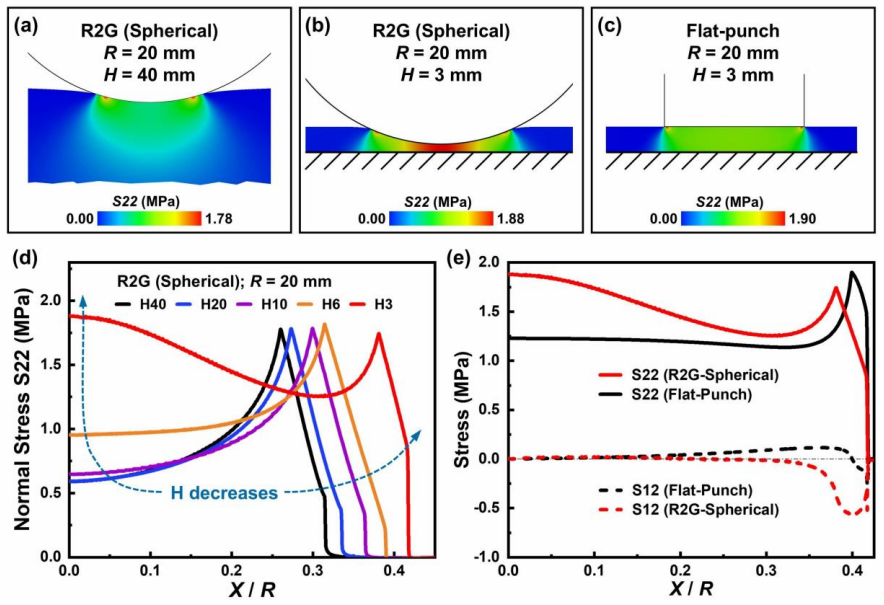
The paper's central claim is that finite substrate thickness can be absorbed into two equivalent contact geometries. During press-in, the sphere-on-finite-film system is treated as a rigid oblate spheroid of minor radius $R$ and major radius $L$ on an infinite substrate, with the shape ratio fitted to finite-element results as $R/L = 1 - 0.31\,e^{-0.48\,H/a}$. Inserting this into the known spheroid indentation relation gives Eq. (25), a single analytical $d$–$a$ relation covering all substrate thicknesses. For pull-off, the shape-locked glassy contact is modelled as a ball-and-socket system of independent springs, each with the stiffness of a thick-walled spherical vessel, and a fitted correction $\eta^2 = 1 + 28\,e^{-4.3\,a/H}$ accounts for stress gradients, leading to Eq. (27) for the R2G pull-off force. The paper reports that the thickness effect is negligible for $H/a > 5$, and that the model matches both fresh finite-element simulations and earlier experiments, including cases where flat-punch approximations fail.
Load-bearing premise
The whole calculation rests on the idea that a sphere pressing into a finite-thickness substrate behaves exactly like an oblate spheroid pressing into an infinite substrate, with the spheroid's flatness following the fitted exponential curve outside the fitted range.
Editorial extensions
If this is right
- For $H/a > 5$, designers can use infinite-substrate contact formulas: the thickness correction changes the equivalent spheroid's shape by less than about 5%, so ordinary Hertz-like contact predictions remain adequate.
- For thinner substrates, Eq. (25) predicts a larger contact radius at a fixed indentation depth, and Eq. (27) predicts a larger pull-off force, with both effects growing as the substrate gets thinner.
- The flat-punch approximation is only reliable in a restricted thickness range, whereas the MBS model gives a single formula that covers thin and thick substrates.
- In the very thin limit $a/H > 2$, the correction factor saturates and the pull-off force reduces to the uncorrected ball-and-socket expression, giving a simple thin-film asymptote.
Reading between the lines
- The constants $0.31$, $0.48$, $28$, and $4.3$ are fitted to the paper's own finite-element simulations, not derived from mechanics; an implicit testable extension is to recalibrate them for very thin films, deeper indentations, or different SMP constitutive parameters before trusting the formulas outside the fitted range.
- If the equivalence generalizes, the same oblate-spheroid trick could be applied to other axisymmetric indenters, such as cones or cylinders on finite-thickness adhesive layers, yielding analogous closed-form thickness corrections.
- The critical ratio $H/a \approx 5$ doubles as a practical design rule: back an SMP adhesive layer with more than about five contact radii of material to avoid confinement-dependent performance, or deliberately use thinner layers to exploit the enhanced pull-off force.
Editorial analysis
A structured set of objections, weighed in public.
Referee Report
Summary. The paper investigates the finite-thickness effect on rubber-to-glass (R2G) adhesion between a rigid sphere and a shape memory polymer substrate. It proposes two analytical models: an oblate spheroid equivalence (OSE) model for the press-in contact radius-indentation depth relation, and a modified ball-and-socket (MBS) model for the pull-off force. Both models introduce functional forms whose constants are fitted to the paper's own finite element (FE) simulations, and the resulting expressions are validated against a held-out FE case (R=20 mm) and two prior experimental datasets. The paper identifies a critical thickness-to-contact-radius ratio of about 5, below which thickness effects are significant.
Significance. If the proposed expressions were truly general, they would provide useful design tools for SMP-based adhesives of finite thickness. The paper is the first to analyze finite-thickness effects in R2G adhesion, and the systematic FE study across four sphere radii and several thicknesses, together with the held-out R=20 mm validation, are clear strengths. However, the central analytical claims currently rest on calibrated interpolation: the equivalence in Eq. (2) and the correction factor in Eq. (26) are fitted to the authors' own FE results, and the available out-of-sample checks share the same material, adhesion, and geometry ranges. The claimed universality in the abstract is therefore not yet supported.
major comments (5)
- [Section 2.1, Eq. (2)] The equivalence between a sphere indenting a finite-thickness substrate and an oblate spheroid indenting an infinite substrate is introduced as an assertion rather than derived from mechanics. The exponential form R/L = 1 - alpha exp(-beta H/a) is assumed a priori, and the constants alpha and beta are fitted to the FE d-a curves. Because the same FE data are then used to validate Eq. (25), the only true out-of-sample check is the R=20 mm case in Fig. 6b, which shares the same material and adhesion parameters and a similar range of H/a and d. This does not establish the universal scaling implied by the abstract; the model should be framed as an empirical fit, or additional validation with different Poisson's ratios, modulus contrasts, and adhesion parameters should be provided.
- [Section 2.2, Eq. (22)] As printed, Eq. (22) contains no dependence on the glassy modulus E or Poisson's ratio nu, yet the derivation via Eq. (13) using K from Eq. (20) should introduce a factor of sqrt(k), where k (Eq. (15)) depends on E and nu. This would imply that the pull-off force in the thin-film limit is independent of the substrate stiffness, contradicting the flat-punch models in Table I and physical intuition. If a cancellation specific to the ball-and-socket spring geometry removes this dependence, it should be shown explicitly; otherwise the equation likely contains a typographical omission. The same issue propagates to Eq. (27).
- [Section 4.3, Eqs. (20) and (26)] The correction function Psi(a/H) is introduced in Eq. (20) but never determined; instead, Eq. (26) directly fits the square of the correction function eta^2 to the FE pull-off forces. Consequently, the MBS model's pull-off prediction is an empirical fit to the authors' own FE simulations, and the held-out R=20 mm case is a within-parameter-space check. To support the claim of a 'practically useful analytical solution', the paper should either derive the correction function from mechanics or explicitly state that the model is calibrated to the epoxy SMP studied.
- [Section 2.1, Eq. (15) and Section 3] The stiffness expression in Eq. (15) diverges as nu approaches 0.5, and the SMP rubbery phase is near-incompressible, so the model's predictions should be sensitive to nu. However, no Poisson's ratio is reported for the FE simulations, and neither Eq. (2) nor Eq. (26) contains any nu-dependence. If the fitted constants alpha, beta, 28.0, and 4.3 are valid only for a specific value of nu (or for the specific epoxy SMP), the claimed analytical solutions are not general. Please report the value of nu used and test the sensitivity of the fitted parameters to nu and to the rubbery/glassy modulus ratio.
- [Section 4.2, Fig. 6a] The claimed critical ratio H/a approximately 5 is defined by an arbitrarily chosen 5% deviation criterion applied to the same fitted exponential curve of Eq. (24); it is not a mechanically intrinsic threshold. The text should state that this is a convention based on the 5% cutoff rather than a property of the system.
minor comments (6)
- [Section 2.1, Eq. (1)] Please define L and R explicitly as the major and minor semi-axes of the oblate spheroid before using them in Eq. (1).
- [Section 6, Appendix A] The reference to 'Hayers et. al.' should be 'Hayes et al.' (Hayes et al., 1972).
- [Section 4.3, last paragraph before Fig. 9] The statement '(R=10 mm, H=50 mm, H/R=0.24)' is internally inconsistent: for R=10 mm, H/R=0.24 would imply H=2.4 mm, while H=50 mm gives H/R=5. Based on the figure caption, the intended case is likely R=50 mm, H=12 mm; please correct.
- [Section 3] The FE simulations use a thermomechanical constitutive model for the SMP, but the paper does not report the Poisson's ratio or the rubbery and glassy moduli used. Please add these material parameters.
- [Section 2.2, Eq. (15)] The typeset expression for k appears garbled in the manuscript; please ensure the formula is rendered correctly.
- [Conclusions] The word 'derived' overstates the status of Eqs. (25) and (27), which are calibrated to FE results; consider using 'calibrated' or 'empirical' when describing their origin.
Circularity Check
Both central analytical expressions are FE-calibrated fits: Eq. (25) inserts fitted α,β into an exact spheroid formula, and Eq. (27) inserts a fitted η(a/H) into the MBS formula; held-out FE and previous experiments reduce but do not remove the circularity.
-
fitted input called prediction
[Section 2.1, Eq. (2); Section 4.2, Eqs. (24)-(25)]
"the ratio R/L of the oblate spheroid indenter can be approximated by an exponential function (as will be shown by the FE simulation results in Section 4) of the thickness-to-contact-radius ratio, H/a, as follows: ... By fitting the d-a relations for various thickness-to-contact-radius ratios (H/a) into Eqs. (3), the values of the parameters α=0.31 and β=0.48 are obtained."
Equation (25) is obtained by substituting Eq. (2) into the exact oblate-spheroid relation Eq. (1), and the two constants in Eq. (2) are fitted to the paper's own FE d-a curves. Therefore Eq. (25) is not a derivation of the d-a relation; it is the FE data re-expressed through Eq. (1) with two fitted parameters. The R=20 mm FE comparison is a genuinely held-out case, so this is partial rather than complete circularity, but the claimed general prediction for the contact radius is statistically forced by the fit for the fitted family.
-
fitted input called prediction
[Section 4.3, Eqs. (26)-(27)]
"To determine the functional forms in Eqs. (21), pull-off forces were extracted from FE simulations using four different indenter radii (R=5, 10, 50, 100 mm) on substrates of varying thicknesses, and fitted into Eq. (21). The FE simulation results (dots) indicate that the square of the correction function, [η(a/H)]^2, shows an exponential relationship with the reciprocal of the thickness-to-contact-radius ratio (a/H)."
The correction function η(a/H) is defined in Eq. (23) as P_c/P_c^0 and then fitted to FE pull-off forces; substituting that fitted expression into Eq. (21) gives Eq. (27). Thus the MBS prediction of the R2G pull-off force inherits its thickness dependence (28.0 and 4.3) from a fit to the same simulations it is later compared with. The comparison with independent previous experimental data provides external support, but the central analytical expression remains a calibrated empirical correction rather than a first-principles prediction.
full rationale
The paper is partially circular in its central predictive claims. The OSE contact-radius expression Eq. (25) is not an independent first-principles result: its defining element, Eq. (2), is an ansatz whose functional form and constants are fitted to the paper's own FE d-a curves, and Eq. (25) is just that ansatz inserted into the exact oblate-spheroid solution Eq. (1). Similarly, the MBS pull-off force Eq. (27) depends on an empirical correction η(a/H) that is fitted to the paper's own FE pull-off forces, so the claimed 'analytical solution' for the R2G adhesion force is essentially a calibrated interpolation for the tested epoxy SMP system. The paper does include genuine out-of-sample checks: the R=20 mm FE simulations were not used in fitting, and the previous experimental data from Linghu et al. come from physical measurements, not from the fitted FE set. Those validations are real and prevent a score of 8-10, but they share the same material, adhesion parameters, and geometry family, so they do not establish the universal predictive generality claimed for Eqs. (25) and (27). The critical H/a ≈ 5 threshold is also read off the same fitted curve. No separate self-citation load-bearing circularity was found: the cited prior FPA model and experimental data are used as comparisons and inputs, not as a substitute for the fit. Overall, the derivation chain reduces at its load-bearing points to fits renamed as predictions, giving partial circularity.
Assumptions & free parameters
free parameters (4)
- alpha in OSE model =
0.31
- beta in OSE model =
0.48
- amplitude 28.0 in MBS correction function =
28.0
- decay rate 4.3 in MBS correction function =
4.3
assumptions (6)
- domain assumption The oblate spheroid contact solution, Eq. (1) from Popov et al. (2019), relates indentation depth d to contact radius a for an oblate spheroid on an infinite substrate.
- ad hoc to paper A rigid sphere indenting a finite-thickness substrate is equivalent to an oblate spheroid indenting an infinite substrate, with R/L = 1 - alpha exp(-beta H/a).
- domain assumption The contact radius a formed during rubbery press-in remains frozen during the R2G transition and pull-off (shape-locking).
- domain assumption Detachment is energy-controlled: the total energy reaches a minimum at the critical pull-off condition (Eq. (12)).
- ad hoc to paper After shape-locking, the deformed substrate can be modeled as independent springs with stiffness from the thick-walled spherical vessel problem, multiplied by an unspecified correction function Psi(a/H).
- domain assumption The FE traction-separation law with sigma_th=1.893 MPa, tau_th=5 MPa, G_IC=1.61 J/m^2, and G_IIC=3.22 J/m^2 represents the real SMP adhesive interface.
invented entities (1)
-
Equivalent oblate spheroid indenter with major axis L and minor axis R, used to represent a finite-thickness substrate as an infinite-thickness contact problem
Cite this review
Pith. "Pith review of Rubber-to-glass adhesion between a rigid sphere and a shape memory polymer substrate of finite thickness." pith.science (2026). https://pith.science/paper/AIAB7UTE
@misc{pith2026241117053,
  author       = {Pith},
  title        = {Pith review of: Rubber-to-glass adhesion between a rigid sphere and a shape memory polymer substrate of finite thickness},
  year         = {2026},
  howpublished = {\url{https://pith.science/paper/AIAB7UTE}},
  note         = {Machine review of arXiv:2411.17053}
}
read the original abstract
Shape memory polymers (SMPs) are emerging as innovative smart adhesive materials with broad application potential. Compared to conventional elastomeric adhesives, SMP adhesives are distinguished by the so-called rubber-to-glass (R2G) adhesion, which involves contact in the rubbery state followed by detachment in the glassy state. This process, through a shape-locking effect, enhances adhesion strength by more than an order of magnitude compared to conventional adhesive contact. Here, we investigate the fundamental problem of a rigid sphere undergoing R2G adhesion with an SMP substrate of finite thickness through experiments, finite element (FE) simulations, and theoretical modeling. It is demonstrated that during press-in, the contact problem can be modeled as a rigid oblate spheroid contacting an infinite substrate, while the pull-off process can be described by a modified ball-and-socket model. These equivalent models yield practically useful analytical solutions for the contact radius during press-in and the R2G adhesion force during pull-off. A critical thickness-to-contact-radius ratio of around 5 is identified, below which the thickness effect becomes significant. These insights provide valuable guidance for the design and application of SMP-based smart adhesives.
Figures


Figures from the paper (2 more)

Reference graph
Works this paper leans on
-
[1]
Introduction Strong and on-demand adhesives (Jin et al., 2016; Wu et al., 2023; Yin et al., 2022) are crucial in many applications, including robotics (Gu et al., 2018; Jiang et al., 2017; Levine et al., 2022; Li et al., 2022a; Li et al., 2022b; Linghu et al., 2023a; Luo et al., 2022; Ruotolo et al., 2021), wearables (Gao et al., 2019; Li et al., 2019; Li...
work page 2016
-
[2]
Theoretical modeling 2.1. Modeling of the press-in process As reported in the literature (Linghu et al., 2023c; Linghu et al., 2020), SMP R2G adhesion is strongly dependent on the indentation depth d, in contrast to the adhesive contact behavior of elastic bodies where adhesion forces are independent of the indentation depth. This dependence of SMP R2G ad...
work page 2020
-
[3]
(3) from the oblate spheroid equivalence (OSE) model and the R2G pull-off force in Eq
FE simulation setup To determine the specific functional forms for the contact radius in Eq. (3) from the oblate spheroid equivalence (OSE) model and the R2G pull-off force in Eq. (21) from the MBS model, FE simulations of the R2G adhesion of a rigid sphere on SMP substrates with varying thicknesses and sphere radii were conducted using ABAQUS/Standard (D...
work page 2016
-
[4]
Results and discussion 4.1. Mechanisms influencing the adhesion Figures 5a and 5b compare the FE simulation results of the normal (S22) stress distribution in the sphere contact system with an SMP substrate of infinite thickness (H=40 mm, H/a > 5) and finite thickness (H=3 mm) at the pull-off point, respectively. The radius of the indenter (R=20 mm) and t...
work page 2023
-
[5]
Conclusions In this paper, we have investigated the finite-thickness effects on SMP R2G adhesion using theoretical modeling and FE simulations, and the model predictions are validated by experimental results from the literature. 21 Unlike the contact behavior under infinite-thickness conditions, the effect of finite substrate thickness increases the conta...
-
[6]
Appendixes 6.1. Appendix A. Existing flat-punch models considering the effect of substrate thickness There are several models that consider the effect of substrate thickness on the flat -punch problem. The key challenge lies in determining the contact stiffness between the flat punch and a finitely thick substrate. Deriving an analytical expression for co...
work page 1971
-
[7]
Reference Arzt, E., Quan, H., McMeeking, R.M., Hensel, R., 2021. Functional surface microstructures inspired by nature –From adhesion and wetting principles to sustainable new devices. Progress in Materials Science 120, 100823. Autumn, K., Liang, Y .A., Hsieh, S.T., Zesch, W., Chan, W.P., Kenny, T.W., Fearing, R., Full, R.J., 2000. Adhesive force of a sin...
work page 2021
Reviewed August 12, 2026 · model on record in the stance chip above.
Discussion (0). Continue with ORCID to comment.