REVIEW 4 major objections 6 minor 21 references
DexGrip: Multi-modal Soft Gripper with Dexterous Grasping and In-hand Manipulation Capacity
T0 review · 4 major / 6 minor · reviewed 2026-08-12 · deepseek-v4-flash
Pith's one-line read DexGrip, a nine-degree-of-freedom soft gripper, claims complete 360-degree in-hand rotation around all three principal axes by coordinating active belts, suction, and finger bending.
desk verdict The hardware integration is real and worth a look, but the paper claims 360-degree rotation about all three axes without reporting a single measured full rotation. read the letter →
The pith
A machine-rendered reading of the paper's core claim, the machinery that carries it, and where it could break.
The reading
What carries the argument
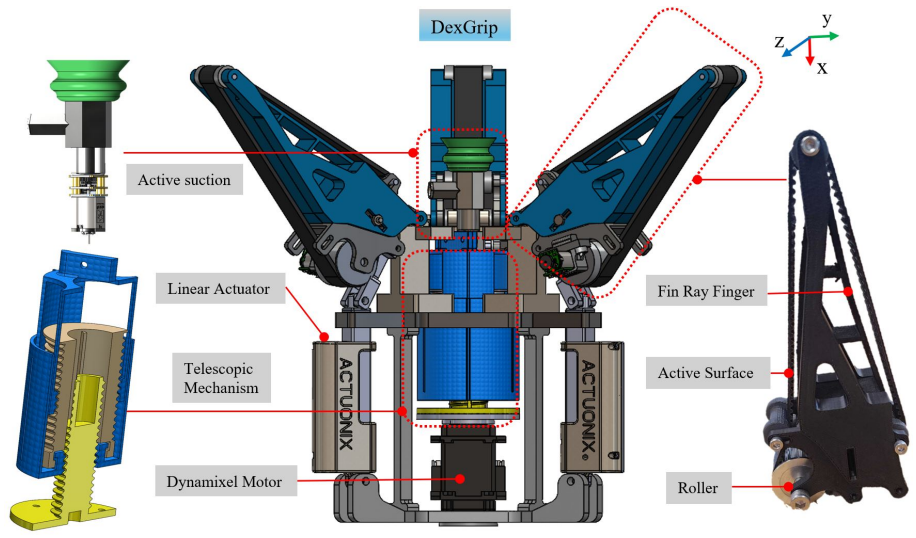
The central object is the DexGrip prototype: nine degrees of freedom in total, with three DoFs from finger bending, three from the active belts on the finger surfaces, and three from the active palm (extension/retraction, suction, and twisting). The Fin Ray fingers provide passive conformability for stable grasping, the belts act as active conveyor surfaces that move the object, and the suction cup on the telescopic palm adheres to the object and adds a rotational DoF. The key mechanism is the synchronized engagement of all three subsystems: belts reposition the object against the palm, the palm twists it around the gripper's axis, and finger actuation adjusts the grasp pattern. This collaboration is what, according to the paper, enables rotation about all three principal axes rather than only a single axis.
What would settle it
Run an automated trial in which the gripper must rotate an object a full 360 degrees about each of its three principal axes using only pre-programmed belt and palm commands, with no manual adjustment of finger bending during the trial; if any axis falls short of a complete revolution or the object slips out of the grasp, the central claim is disproved.
Extended reading notes
Core claim
DexGrip's core discovery is that adding active, independently controllable surfaces to compliant fingers, together with an active suction palm, creates a soft gripper whose manipulation workspace spans all three principal axes. The three rotating belts on the Fin Ray fingers drive objects along the belts, the telescopic suction palm provides adhesion and a twisting degree of freedom, and coordinated motion of both subsystems lets a held object be re-positioned and re-oriented without ever being released. The authors demonstrate this with a pear rotated from a pinch grasp to a power grasp, a deformable object re-positioned by driving all belts inward, and a Rubik's cube flipped from one face to another by synchronizing palm extension, suction rotation, and belt motion. In their account, this is the first soft gripper to offer simultaneous multi-modal grasping and multi-axis in-hand rotation, where previous soft grippers could rotate mainly in one plane or sacrificed stability for controllability.
Load-bearing premise
The manipulation demonstrations depend on a human manually closing the fingers and setting the bending angles, so the gripper's dexterity is shown as a hardware possibility rather than an autonomous, repeatable capability.
Editorial extensions
If this is right
- Objects can be re-oriented and re-positioned in hand without re-grasping, eliminating the need for additional motion planning and collision avoidance for regrasps.
- A soft gripper can transition from a pinch grasp to a more stable power grasp while holding an object, by driving the belts to pull the object deeper into the fingers.
- The active palm alone can pick up, telescope, twist, and withdraw a range of objects, with roughly 75 percent of the tested objects adhering successfully under about -80 kPa vacuum.
- Coordinated palm-and-belt motion can flip a flat-faced object such as a Rubik's cube between faces, demonstrating manipulation of objects that challenge existing soft grippers.
Reading between the lines
- The demonstrations rely on manual closure of the fingers and manually adjusted bending angles, so the claimed 'capacity' is a hardware-level capability; the paper itself lists automating the control scheme as future work.
- If the same design principle — compliant fingers plus active surfaces and an active palm — were paired with an autonomous policy, it could generalize to tasks like picking and packing where object orientation must be corrected before placement.
- The complete 360-degree rotation claim is supported by qualitative demonstrations on selected objects rather than a quantitative workspace analysis; measuring the achievable rotation range across axis, object size, and surface friction would be a natural next test.
Editorial analysis
A structured set of objections, weighed in public.
Referee Report
Summary. The paper presents DexGrip, a three-finger soft gripper in which each Fin Ray finger is augmented with a motorized belt, combined with an active palm that can extend/retract, apply suction, and twist about one axis. The authors claim that this combination enables complete 360-degree in-hand rotation about all three principal axes. The manuscript reports FEM stiffness analysis of Fin Ray finger variants, a single active-surface manipulation demonstration, an active-palm suction experiment over 12 objects (Table II), whole-gripper grasping demonstrations, a pinch-to-power manipulation of a pear, a deformable-object repositioning, and a coordinated belt-plus-palm manipulation that flips a Rubik's cube from one face to another. The conclusion lists automating the control scheme as future work.
Significance. If the headline capability were demonstrated quantitatively, the integration of active belts on compliant fingers with a twisting suction palm would be a distinctive hardware contribution to soft in-hand manipulation, and the suction-load equations in Sec. III-B2 are standard, parameter-free physics. The paper's current value is as a proof-of-concept hardware demonstration of some in-hand reorientation without regrasping. However, the key claimed capability—full 360-degree rotation about all three principal axes—is not measured anywhere in Sec. IV, so the significance as stated is not yet supported.
major comments (4)
- [Abstract; Sec. I; Sec. IV] The abstract and introduction assert that DexGrip enables 'complete 360 degree rotation in all three principal axes,' but no experiment in Sec. IV measures a full revolution about any axis. The evidence shown is: active-palm twisting only about the x-axis with no angle readout (Sec. IV-B), a pear 'rotated' only until its stem points upward, at most a 90-degree reorientation (Sec. IV-C), and a Rubik's cube flipped from yellow to orange, a single 90-degree face flip (Sec. IV-D). Without quantitative orientation data or a trial demonstrating continuous 360-degree motion, the central claim is unsupported.
- [Sec. IV-C; Sec. IV-D] The manipulation demonstrations are executed with substantial human intervention: objects are placed by hand, fingers are closed manually, and in the collaborative-motion experiment the finger bending angles 'were manually adjusted' to tune contact and friction. The conclusion itself lists 'automating the control scheme' as future work. As a result, the paper demonstrates hand-choreographed manipulation, not an autonomous hardware capability, and the statement that DexGrip can 'perform in-hand object manipulation' overstates what is shown.
- [Table II; Sec. IV-C] The quantitative evidence is limited to binary checkmarks in Table II with no success criteria, no repetition counts, and no confidence intervals; the 'approximately 75%' adherence rate appears to reflect a single pass over 12 objects. Grasping stability is judged by 'visually inspecting any movements of the object,' and rotation magnitudes are never measured. This level of evaluation is insufficient to support claims of reliable grasping or dexterous manipulation capacity.
- [Sec. III-B] The design description provides no kinematic or analytical model showing how the belt-driven contacts on three fingers combine with the single-axis suction-cup twist to generate continuous rotation about all three principal axes. Equations (1)-(5) characterize suction force only; they do not connect the individual actuator capabilities to the claimed omnidirectional rotation. Thus the 'uniquely... complete 360 degree rotation' statement is a conjecture rather than a demonstrated or modeled property.
minor comments (6)
- [Sec. III-B1] 'Complaint finger surface' should be 'compliant finger surface.'
- [Sec. III-B2] Equations (3)-(5) use 'az' and 'ah' without defining the positive direction conventions, and the three loading cases in Fig. 2(a) should be labeled in the caption.
- [Sec. IV-B] The phrase 'approximately 75% of the objects' is vague; Table II actually shows 9 of 12 objects achieving overall success, so the fraction could be stated exactly.
- [Sec. IV-C] The sentence 'One deformable 3D printed object, which has a shore hardness of 40A' is grammatically incomplete, and 'shore' should be capitalized as 'Shore.'
- [Fig. 3(c) caption] 'Note fruits are fake artifacts' would be clearer as 'Note that the fruit items are artificial objects.'
- [Table I] The related-work comparison in Table I reports qualitative capabilities with a 'DoFs' column, but no citation numbers are given for each row, making the comparison hard to verify.
Circularity Check
No circularity; the manipulation capability claims are empirical demonstrations rather than derived predictions, and the main weakness is overclaiming (360-degree rotation in all axes is not fully demonstrated), not circular reasoning.
full rationale
The paper contains no fitted-parameter-then-predicted chain. The suction force equation (Eq. 1-2) and the load-case mass equations (Eq. 3-5) are standard physics derived from geometry, vacuum pressure, gravity, acceleration, and friction, with no parameters fit to the experimental outcomes. The FEM stiffness evaluation in Sec. IV-A is a numerical simulation using prescribed displacements, and the selection of the two-ribbed finger is a design choice, not a prediction that is later used as evidence of success. The manipulation capacity claims rest on direct demonstrations in Secs. IV-B to IV-D rather than on a model that reduces to its inputs. Self-citations, such as [13] and [20], appear as background on soft grippers and Fin Ray optimization and are not load-bearing for the central claim; they are not used to forbid alternatives or to supply a uniqueness theorem. The paper's real weakness is that the abstract's 'complete 360 degree rotation in all three principal axes' is not supported by the reported trials, which show partial, manually controlled rotations without quantitative orientation data; this is an overclaiming or evidence gap, not circularity. There is no equation that is equivalent to its own inputs by construction, and no fitted input renamed as a prediction. Therefore the circularity score is 0.
Assumptions & free parameters
free parameters (1)
- Vacuum pressure =
-80 kPa
assumptions (3)
- domain assumption Active belts drive the object only under no-slip contact ('drives the objects towards the direction of rotation if there is no slippage', Sec. III.A).
- domain assumption Manual closure and manual adjustment of finger bending angles are adequate to demonstrate the gripper's manipulation capacity (Sec. IV.C-D).
- standard math Standard suction statics (Eq. 1-5): pressure-area force, rigid-body equilibrium, Coulomb friction.
Cite this review
Pith. "Pith review of DexGrip: Multi-modal Soft Gripper with Dexterous Grasping and In-hand Manipulation Capacity." pith.science (2026). https://pith.science/paper/PRD4NYG7
@misc{pith2026241117124,
  author       = {Pith},
  title        = {Pith review of: DexGrip: Multi-modal Soft Gripper with Dexterous Grasping and In-hand Manipulation Capacity},
  year         = {2026},
  howpublished = {\url{https://pith.science/paper/PRD4NYG7}},
  note         = {Machine review of arXiv:2411.17124}
}
read the original abstract
The ability of robotic grippers to not only grasp but also re-position and re-orient objects in-hand is crucial for achieving versatile, general-purpose manipulation. While recent advances in soft robotic grasping has greatly improved grasp quality and stability, their manipulation capabilities remain under-explored. This paper presents the DexGrip, a multi-modal soft robotic gripper for in-hand grasping, re-orientation and manipulation. DexGrip features a 3 Degrees of Freedom (DoFs) active suction palm and 3 active (rotating) grasping surfaces, enabling soft, stable, and dexterous grasping and manipulation without ever needing to re-grasp an object. Uniquely, these features enable complete 360 degree rotation in all three principal axes. We experimentally demonstrate these capabilities across a diverse set of objects and tasks. DexGrip successfully grasped, re-positioned, and re-oriented objects with widely varying stiffnesses, sizes, weights, and surface textures; and effectively manipulated objects that presented significant challenges for existing robotic grippers.
Figures


Figures from the paper (2 more)


Reference graph
Works this paper leans on
-
[1]
Soft robotics: Technolo- gies and systems pushing the boundaries of robot abilities,
C. Laschi, B. Mazzolai, and M. Cianchetti, “Soft robotics: Technolo- gies and systems pushing the boundaries of robot abilities,” Science robotics, vol. 1, no. 1, p. eaah3690, 2016
work page 2016
-
[2]
Intelligent robots for fruit harvesting: Recent developments and future challenges,
H. Zhou, X. Wang, W. Au, H. Kang, and C. Chen, “Intelligent robots for fruit harvesting: Recent developments and future challenges,” Precision Agriculture, vol. 23, no. 5, pp. 1856–1907, 2022
1907
-
[3]
Z. Gong, X. Fang, X. Chen, J. Cheng, Z. Xie, J. Liu, B. Chen, H. Yang, S. Kong, Y . Hao et al. , “A soft manipulator for efficient delicate grasping in shallow water: Modeling, control, and real-world experiments,” The International Journal of Robotics Research , vol. 40, no. 1, pp. 449–469, 2021
work page 2021
-
[4]
Dynamic regrasping by in-hand orienting of grasped objects using non-dexterous robotic grippers,
A. Sintov and A. Shapiro, “Dynamic regrasping by in-hand orienting of grasped objects using non-dexterous robotic grippers,” Robotics and computer-integrated manufacturing, vol. 50, pp. 114–131, 2018
work page 2018
-
[5]
Development and evaluation of a robust soft robotic gripper for apple harvesting,
X. Wang, H. Kang, H. Zhou, W. Au, M. Y . Wang, and C. Chen, “Development and evaluation of a robust soft robotic gripper for apple harvesting,” Computers and Electronics in Agriculture , vol. 204, p. 107552, 2023
work page 2023
-
[6]
Contact-based in-hand package pose estimation using a collaborative robot,
A. Saccuti, R. Monica, and J. Aleotti, “Contact-based in-hand package pose estimation using a collaborative robot,” in 2024 IEEE 29th International Conference on Emerging Technologies and Factory Au- tomation (ETF A). IEEE, 2024, pp. 1–8
work page 2024
-
[7]
Design, fabrication and control of soft robots,
D. Rus and M. T. Tolley, “Design, fabrication and control of soft robots,” Nature, vol. 521, no. 7553, pp. 467–475, 2015
2015
-
[8]
M. A. Graule, T. P. McCarthy, C. B. Teeple, J. Werfel, and R. J. Wood, “Somogym: A toolkit for developing and evaluating controllers and reinforcement learning algorithms for soft robots,” IEEE Robotics and Automation Letters , vol. 7, no. 2, pp. 4071–4078, 2022
work page 2022
Show all 21 references
-
[9]
In-hand manipulation in power grasp: Design of an adaptive robot hand with active surfaces,
Y . Cai and S. Yuan, “In-hand manipulation in power grasp: Design of an adaptive robot hand with active surfaces,” in 2023 IEEE International Conference on Robotics and Automation (ICRA) , 2023, pp. 10 296–10 302
2023
-
[10]
Learning dexterous in-hand manipulation,
O. M. Andrychowicz, B. Baker, M. Chociej, R. Jozefowicz, B. Mc- Grew, J. Pachocki, A. Petron, M. Plappert, G. Powell, A. Ray et al. , “Learning dexterous in-hand manipulation,” The International Journal of Robotics Research , vol. 39, no. 1, pp. 3–20, 2020
2020
-
[11]
One-shot 3d-printed multimaterial soft robotic jamming grippers,
G. D. Howard, J. Brett, J. O’Connor, J. Letchford, and G. W. Delaney, “One-shot 3d-printed multimaterial soft robotic jamming grippers,” Soft Robotics , vol. 9, no. 3, pp. 497–508, 2022
2022
-
[12]
The jamming donut: a free-space gripper based on granular jamming,
T. Joseph, S. Baldwin, L. Guan, J. Brett, and D. Howard, “The jamming donut: a free-space gripper based on granular jamming,” in 2023 IEEE International Conference on Soft Robotics (RoboSoft) . IEEE, 2023, pp. 1–6
2023
-
[13]
Diversity-based topology optimization of soft robotic grippers,
J. Pinskier, X. Wang, L. Liow, Y . Xie, P. Kumar, M. Langelaar, and D. Howard, “Diversity-based topology optimization of soft robotic grippers,” Advanced Intelligent Systems , p. 2300505, 2024
2024
-
[14]
A soft robotic gripper with an active palm and reconfigurable fingers for fully dexterous in-hand manipulation,
A. Pagoli, F. Chapelle, J. A. Corrales, Y . Mezouar, and Y . Lapusta, “A soft robotic gripper with an active palm and reconfigurable fingers for fully dexterous in-hand manipulation,” IEEE Robotics and Automation Letters, vol. 6, no. 4, pp. 7706–7713, 2021
2021
-
[15]
The role of digit arrangement in soft robotic in-hand manipulation,
C. B. Teeple, R. C. S. Louis, M. A. Graule, and R. J. Wood, “The role of digit arrangement in soft robotic in-hand manipulation,” in 2021 IEEE/RSJ International Conference on Intelligent Robots and Systems (IROS). IEEE, 2021, pp. 7201–7208
2021
-
[16]
Bcl-13: A 13-dof soft robotic hand for dexterous grasping and in-hand manipulation,
J. Zhou, J. Yi, X. Chen, Z. Liu, and Z. Wang, “Bcl-13: A 13-dof soft robotic hand for dexterous grasping and in-hand manipulation,” IEEE Robotics and Automation Letters , vol. 3, no. 4, pp. 3379–3386, 2018
2018
-
[17]
Adaptive wrapping with active elastic band-based gripper for stable in-hand manipulation,
S. Xiang, J. Li, Y . Zhang, Y . Yang, J. Liu, and Z. Liu, “Adaptive wrapping with active elastic band-based gripper for stable in-hand manipulation,” Sensors and Actuators A: Physical , vol. 377, p. 115743, 2024
2024
-
[18]
Design and control of roller grasper v2 for in-hand manipulation,
S. Yuan, L. Shao, C. L. Yako, A. Gruebele, and J. K. Salisbury, “Design and control of roller grasper v2 for in-hand manipulation,” in 2020 IEEE/RSJ International Conference on Intelligent Robots and Systems (IROS), 2020, pp. 9151–9158
2020
-
[19]
Modeling and analysis of soft robotic fingers using the fin ray effect,
X. Shan and L. Birglen, “Modeling and analysis of soft robotic fingers using the fin ray effect,” The International journal of robotics research, vol. 39, no. 14, pp. 1686–1705, 2020
2020
-
[20]
Fin-bayes: A multi-objective bayesian optimization framework for soft robotic fingers,
X. Wang, B. Wang, J. Pinskier, Y . Xie, J. Brett, R. Scalzo, and D. Howard, “Fin-bayes: A multi-objective bayesian optimization framework for soft robotic fingers,” Soft Robotics , 2024
2024
-
[21]
Structural opti- mization of adaptive soft fin ray fingers with variable stiffening capa- bility,
K. Elgeneidy, A. Fansa, I. Hussain, and K. Goher, “Structural opti- mization of adaptive soft fin ray fingers with variable stiffening capa- bility,” in 2020 3rd IEEE International Conference on Soft Robotics (RoboSoft). IEEE, 2020, pp. 779–784
2020
Reviewed August 12, 2026 · model on record in the stance chip above.
Discussion (0). Continue with ORCID to comment.