REVIEW 3 major objections 5 minor 1 references
Generator of Neural Network Potential for Molecular Dynamics: Constructing Robust and Accurate Potentials with Active Learning for Nanosecond-scale Simulations
T0 review · 3 major / 5 minor · reviewed 2026-08-12 · deepseek-v4-flash
Pith's one-line read By deliberately training neural network potentials on compressed structures with very short interatomic distances, the authors achieve stable 20-nanosecond molecular dynamics simulations of liquids and polymers with more than 10,000 atoms.
desk verdict A practical AL recipe for stabilizing NNP-MD by deliberately sampling short interatomic distances, with a load-bearing but not fully resolved distance-matching question and an overstated diffusion agreement. read the letter →
The pith
A machine-rendered reading of the paper's core claim, the machinery that carries it, and where it could break.
The reading
What carries the argument
The load-bearing mechanism is an active-learning loop with a two-stage filter. Candidate structures are collected from NNP-driven molecular dynamics; a four-model committee computes the maximum standard deviation of atomic forces as an uncertainty score to reject both well-represented and catastrophically unrealistic frames; then a structural-feature screen projects NNP descriptor-layer features into a low-dimensional space, keeping diverse frames. For the final stability-fixing iteration, the feature space is extended from two dimensions to three by appending the normalized minimum interatomic distance of a user-chosen element pair, and the sampling is replaced by a nonequilibrium compression of the box to 70% of its original volume. The added distance coordinate ensures the labeled set contains many frames in the 0.87–0.9 Å O–H range that ordinary thermal sampling misses, which is what stabilizes the long runs.
What would settle it
Take a liquid system generated by this method, observe a 20-ns run that collapses despite the short O–H (or H–H) enrichment, and check whether the collapse is preceded by a different geometry, such as a C–C compression, a collective hydrogen-bond rearrangement, or a multi-atom mode that the 70% compression did not generate. Concrete evidence of any such non-contact collapse would show that the sampled short contacts are not the only missing region of the potential energy surface.
Extended reading notes
Core claim
The central discovery is that the instability of long NNP-MD trajectories is not primarily a matter of average force accuracy but of missing data in specific short-distance regions of the potential energy surface. In the authors' runs, collapse begins with unphysical forces (about 6 eV/Å on a hydrogen atom) when an intermolecular O–H distance reaches roughly 0.81 Å, or when H–H distances become extremely short, because the potential has not been trained there. Their generator addresses this with an extra active-learning iteration whose sampling is a nonequilibrium compression of the box and whose screening selects structures by both descriptor-feature diversity and a normalized minimum interatomic distance (O–H for PG, H–H for PEG). With this additional data, all four independently seeded potentials finish 20-ns production runs without a rise in the maximum model deviation, whereas the previous iteration collapsed in at least one trajectory. The paper claims this makes the workflow a general, largely automatic route to stable NNPs for organic materials, and transferable to inorganic systems.
Load-bearing premise
The argument rests on the premise that the crashes that end long NNP-MD runs are caused by under-represented short contacts of one chosen element pair, and that rapidly compressing the box to 70% of its volume produces enough of those contacts to patch the potential.
Editorial extensions
If this is right
- NNPs trained on small cells (130–155 atoms) can be made stable for production molecular dynamics on much larger cells (up to 10,530 atoms), once short-distance contacts are represented.
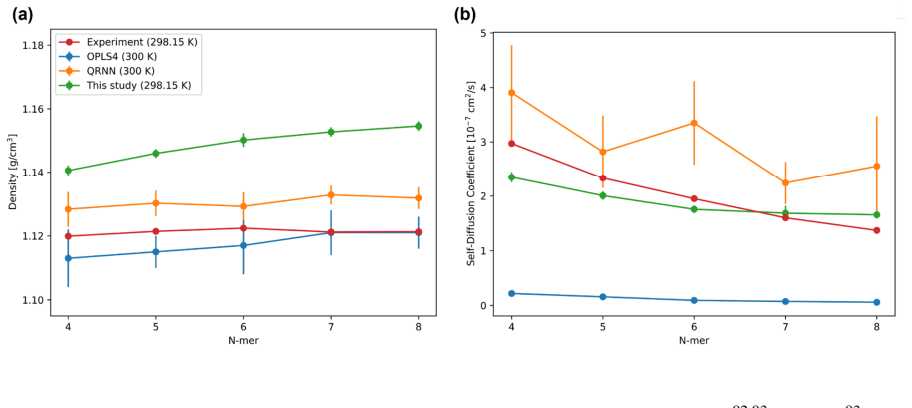
- For the tested liquids, the predicted density and self-diffusion coefficient match experiment to within a few percent, comparable to or better than classical force fields including one tuned specifically for propylene glycol.
- The 3D screening, not merely adding compressed structures, is decisive: the same iteration with 2D screening still produced collapses in some seeds, while 3D screening did not.
- Stability correlates with the count of short-distance training data rather than with lower force RMSE, reinforcing the view that dataset design matters more than architecture tweaks for long simulations.
- The generator's workflow is applicable to other chemical systems including inorganic ones, according to the authors.
Reading between the lines
- The choice of which element pair to watch is still manual; the same logic could be automated by scanning all element pairs for the shortest under-sampled contacts in collapsed trajectories, removing a user bottleneck the authors acknowledge.
- If the method generalizes, “squeeze then mine short contacts” could become a standard pre-flight test for any NNP before committing to expensive long simulations, because the 70% compression is an inexpensive probe of potential-energy-surface holes.
- A possible limitation not fully addressed is that compression to a fixed volume explores only one family of unstable configurations; collective rearrangements or slow diffusional modes could in principle trigger collapse without producing ultra-short pair contacts.
- The density overestimate for PEG chain lengths not present in the training set suggests that transferability across chain lengths may need additional training data, even though the overall experimental trend is reproduced.
Editorial analysis
A structured set of objections, weighed in public.
Referee Report
Summary. The paper describes an automatic active-learning (AL) generator for constructing neural network potentials (NNPs) for long nanosecond-scale molecular dynamics simulations. The generator iterates over NNP training, NNP-MD sampling, a two-step screening (query-by-committee ensemble followed by structural-feature-based selection), DFT labeling, and retraining. To address stability failures, the authors add an iteration that samples compressed structures via NNP-NEMD (compression to 70% volume) and uses a 3D structural-feature screening that explicitly incorporates a target interatomic distance (O-H for propylene glycol, H-H for polyethylene glycol). The method is demonstrated on liquid PG and PEG: after this added iteration, four independently seeded NNPs all complete 20-ns production runs (up to 10,530 atoms for a 150-mer PEG), without the collapses observed with earlier iterations. The predicted densities, thermal expansion coefficients, and isothermal compressibilities are within about 3-9% of experiment for PG; the predicted PG self-diffusion coefficient is 5.1 +/- 0.4 versus the experimental 2.6 x 10^-7 cm^2/s. The paper claims that the cause of instability was insufficient data with short O-H/H-H distances and that the NEMD+3D screening supplies this missing data.
Significance. If the stability mechanism is as claimed, this is a practically useful methodology contribution to automated NNP construction for organic molecular liquids and polymers. The work provides a reproducible pipeline built on open-source tools (DeePMD-kit, LAMMPS, CPMD, Quantum ESPRESSO), repeated stability tests with four random seeds per system, a direct comparison of 2D vs 3D screening, and validation of physical properties against independent experimental data. These strengths go beyond a single fitting exercise. The impact is, however, conditional: the central causal claim depends on the assumption that the 70%-compression sampling adequately covers the critical short-contact distance (0.81 A for PG), which the reported histogram does not clearly support, and the paper contains an internal ambiguity about whether intramolecular or intermolecular O-H distances are the screened and analyzed quantity. The overstatement of the PG self-diffusion agreement also needs correction.
major comments (3)
- [3.1.3, Figure 8 and text near Figure 6] The collapse is traced to an O-H distance 'between the molecules' of approximately 0.81 A (Section 3.1.3, text near Fig. 6), but Figure 8 reports the distribution of intramolecular O-H distances. Please clarify whether the 3D screening target was the global minimum O-H distance over all atom pairs (including intermolecular) or only intramolecular pairs. If the latter, the added training data may not contain the intermolecular failure geometry at all, and the claim that short O-H data fixed the collapse is unsupported. If the former, the figure label and the surrounding text need correction. In either case, report the count of labeled structures with O-H distances at or below 0.85 A and the minimum O-H distance in the iteration-11 set, so that the reader can verify whether the failure geometry was actually sampled.
- [3.1.4, Table 2, and Abstract] The PG self-diffusion coefficient reported in Table 2 is 5.1 +/- 0.4 x 10^-7 cm^2/s versus the experimental value of 2.6 x 10^-7 cm^2/s, i.e., a factor-of-two overestimate. The Abstract and Section 3.1.4 describe this as 'excellent agreement,' which is not supported by the data. Please either temper the wording or provide a quantitative discussion of the expected accuracy of BLYP-D2 for this property, along with any finite-size or block-averaging caveats. The same overstatement appears in the Conclusions.
- [3.1.3, Figure 5 and text] The text states that the observed stability trend is 'directly correlated with the number of short O-H distance structures in the data set,' but the only quantitative evidence in Figure 8 is for the 0.87-0.90 A bin, and no counts below 0.85 A are provided. Please report the full distribution of the minimum O-H distance for both the 2D- and 3D-screened iteration-11 labeled sets, including the number of structures below a physically appropriate threshold (e.g., 0.85 A) and the minimum value in each set. This is necessary to distinguish the proposed mechanism (adding the failure geometry) from an alternative mechanism (strengthening the repulsive wall at 0.87-0.90 A so that the trajectory never reaches 0.81 A).
minor comments (5)
- [Abstract] There is a typo in 'prop ylene glycol'; it should read 'propylene glycol.'
- [Section 2, Screening] The 3D structural-feature screening is described as incorporating 'normalized minimum O-H distance values,' but the normalization procedure is not specified. Please state the exact normalization used.
- [Section 3.1.1 and Table 1] The acceptable maximum-model-deviation range for the model ensemble-based screening is stated for iterations 1-10 (0.05-0.15 eV/A) but not for iteration 11. Please state the range used in iteration 11.
- [Section 3.1.3, Figure 5] The comment that model 3 in Figure 5(b) shows much lower performance than in Figure 5(a) due to 'the order of training data loading' is an important sensitivity caveat. It would be helpful to state explicitly in the main text that the 3D-screened data removed this sensitivity, rather than only in the discussion of that figure.
- [Supporting Information, Figure S6] The NVE energy-conservation check is performed for 1 ns only. Please state whether longer NVE runs were attempted and, if not, note that this is a necessary but not sufficient stability check for the 20-ns production scale.
Circularity Check
No significant circularity: stability and physical-property claims are validated against independent simulation outcomes and experimental data, not defined into existence.
full rationale
The paper's active-learning loop is empirical and iterative: train NNPs on DFT-labeled structures; run 20 ns NNP-MD; observe a collapse in PG at about 18 ps attributed to an unphysical short O-H contact near 0.81 A; add NNP-NEMD compressed structures and use 3D structural screening to enrich the training set with short O-H distances; retrain; then observe that the 20 ns runs no longer collapse. The stability improvement is not a mathematical consequence of the training objective, since no stability term is imposed during fitting. The 2D screening control also added NEMD data but still exhibited later collapses, showing that the 3D variant's success was not forced by construction. Physical properties are compared against independent experimental values and against classical force fields and other ML potentials. The paper's stated limitations (no automatic convergence criterion, no definitive stable/unstable data ratio, manual element-pair selection for 3D screening) are usability and generalization concerns, not evidence of circularity. The skeptic concern that the 0.81 A failure geometry is not explicitly shown to be enriched (Fig. 8 reports 0.87-0.90 A) is an empirical-adequacy question, not a circularity: the observed stability does not logically reduce to the choice of the screening target. Therefore no circular step can be exhibited.
Assumptions & free parameters
free parameters (5)
- QBC maximum model deviation range =
0.05 to 0.20 eV/angstrom (0.05 to 0.15 for PG)
- NNP-NEMD compression ratio =
70% of original volume
- 3D screening target element pair =
O-H for PG, H-H for PEG
- Labeled-structure maximum force filter =
not specified
- Number of labeled structures per iteration =
1000 for iterations 1 to 10, 500 for iteration 11
assumptions (5)
- domain assumption DFT energies and forces at BLYP-D2 (PG) or BLYP-D3 (PEG) are accurate references for the PES of these liquids.
- domain assumption The maximum model deviation over an ensemble of four NNPs is a reliable indicator of regions where the model is undertrained.
- domain assumption densMAP distances in the descriptor space reflect structural diversity relevant for NNP improvement.
- domain assumption DeepPot-SE with a 6 angstrom cutoff can represent the PES including the short O-H and H-H repulsive wall.
- domain assumption Roughly 10,000 labeled structures are sufficient for a converged model.
Cite this review
Pith. "Pith review of Generator of Neural Network Potential for Molecular Dynamics: Constructing Robust and Accurate Potentials with Active Learning for Nanosecond-scale Simulations." pith.science (2026). https://pith.science/paper/7ZOMRAOY
@misc{pith2026241117191,
  author       = {Pith},
  title        = {Pith review of: Generator of Neural Network Potential for Molecular Dynamics: Constructing Robust and Accurate Potentials with Active Learning for Nanosecond-scale Simulations},
  year         = {2026},
  howpublished = {\url{https://pith.science/paper/7ZOMRAOY}},
  note         = {Machine review of arXiv:2411.17191}
}
read the original abstract
Neural network potentials (NNPs) enable large-scale molecular dynamics (MD) simulations of systems containing >10,000 atoms with the accuracy comparable to ab initio methods and play a crucial role in material studies. Although NNPs are valuable for short-duration MD simulations, maintaining the stability of long-duration MD simulations remains challenging due to the uncharted regions of the potential energy surface (PES). Currently, there is no effective methodology to address this issue. To overcome this challenge, we developed an automatic generator of robust and accurate NNPs based on an active learning (AL) framework. This generator provides a fully integrated solution encompassing initial dataset creation, NNP training, evaluation, sampling of additional structures, screening, and labeling. Crucially, our approach uses a sampling strategy that focuses on generating unstable structures with short interatomic distances, combined with a screening strategy that efficiently samples these configurations based on interatomic distances and structural features. This approach greatly enhances the MD simulation stability, enabling nanosecond-scale simulations. We evaluated the performance of our NNP generator in terms of its MD simulation stability and physical properties by applying it to liquid propylene glycol (PG) and polyethylene glycol (PEG). The generated NNPs enable stable MD simulations of systems with >10,000 atoms for 20 ns. The predicted physical properties, such as the density and self-diffusion coefficient, show excellent agreement with the experimental values. This work represents a remarkable advance in the generation of robust and accurate NNPs for organic materials, paving the way for long-duration MD simulations of complex systems.
Figures


Figures from the paper (6 more)


Reference graph
Works this paper leans on
-
[1]
(1) Lu, C.; Wu, C.; Ghoreishi, D.; Chen, W.; Wang, L.; Damm, W.; Ross, G. A.; Dahlgren, M. K.; Russell, E.; Von Bargen, C. D.; Abel, R.; Fries ner, R. A.; Harder, E. D. OPLS4: Improving Force Field Accuracy on Challenging Regim es of Chemical Space. J. Chem. Theory Comput. 2021 , 17 (7), 4291–4300. https://doi.org/10.1021/acs.jctc.1c00302. (2) Mohanty, S....
Reviewed August 12, 2026 · model on record in the stance chip above.
Discussion (0). Continue with ORCID to comment.