REVIEW 5 major objections 5 minor 45 references
GraphSubDetector: Time Series Subsequence Anomaly Detection via Density-Aware Adaptive Graph Neural Network
T0 review · 5 major / 5 minor · reviewed 2026-08-12 · deepseek-v4-flash
Pith's one-line read By treating subsequences as nodes in a learned graph and passing messages through a density-aware adjacency matrix, GraphSubDetector reduces normal-data variance and claims consistent state-of-the-art results on subsequence anomaly…
desk verdict A useful empirical system for subsequence anomaly detection with a clever length-selection mechanism, but the theoretical guarantee is not established and should not be the basis for acceptance. read the letter →
The pith
A machine-rendered reading of the paper's core claim, the machinery that carries it, and where it could break.
The reading
What carries the argument
The load-bearing mechanism is the density-aware adaptive graph neural network (DAGNN), together with a multi-length feature encoder. The encoder runs a temporal convolutional network over each subsequence, pools statistics (mean, variance, max, min) at exponentially growing prefix lengths, and combines those views with a learnable length-selection embedding, so the network can pick the scale that best exposes normal versus anomalous patterns. DAGNN then builds a sparse $k$-nearest-neighbour prior graph from raw and z-normalized Euclidean distances at multiple lengths, learns an adaptive adjacency matrix that blends latent-space distance, data-space edge attributes, and periodic temporal distance, and refines that matrix with a node-similarity profile acting as a density proxy. Message passing through the normalized adjacency is the operation that the theorems connect to variance reduction, and the anomaly score is the mean distance from each node to its neighbours after passing, trained with a hypersphere-classifier objective over injected anomalies plus auto-encoding and length-embedding regularizations.
What would settle it
Train GraphSubDetector exactly as described but evaluate on a benchmark whose test anomalies are not among the six injected types, such as gradual level shifts or missing-segment anomalies; if the reported AUC/VUS margin over Matrix Profile collapses, the injection proxy is carrying the result rather than the graph machinery.
Extended reading notes
Core claim
The paper's central claim is that subsequence anomaly detection improves when each subsequence is first represented at multiple exponential length scales (via TCN embeddings and statistics pooling), blended by a learned per-subsequence length weight, and then refined by message passing on a graph of subsequence similarities. The theoretical part (Theorems 4.1 and 4.2) asserts that, when normal samples follow $\mathcal{N}(\boldsymbol{\mu}, \sigma^2)$ and anomalies are normal samples plus a fixed-norm deviation, message passing with a Gaussian-kernel adjacency shrinks the standard deviation of normal features more than it shrinks the anomalous-to-normal distance, and adding a density-dependent term enlarges the relative discrepancy further. Experimental results claim consistent improvements over matrix profile, one-class deep models, and reconstruction-based baselines, particularly on datasets with variable-length or recurring anomalies.
Load-bearing premise
The reported gains rest on the assumption that the six artificially injected anomaly types (spike/dip, resizing, warping, noise, reversal, upside-down) are a valid proxy for the anomalies that appear at test time; the paper's own ablation shows performance depends on which injection types are used.
Editorial extensions
If this is right
- A practitioner would no longer need to guess a single window length: the length-selection embedding learns per-subsequence weights, so anomalies of different durations can be caught in one model.
- Recurring similar anomalies, which defeat classic discord methods because each occurrence is the other's nearest neighbour, are scored by neighbourhood distance and therefore remain detectable.
- Because message passing acts as a learned variance-reduction step, the method should remain effective when normal data is noisy, which is exactly where raw-distance discords degrade.
- The reported near-linear complexity ($O(kN)$ with $k$ neighbours per node) makes the detector practical for long series, with under 45 seconds reported for 300k points.
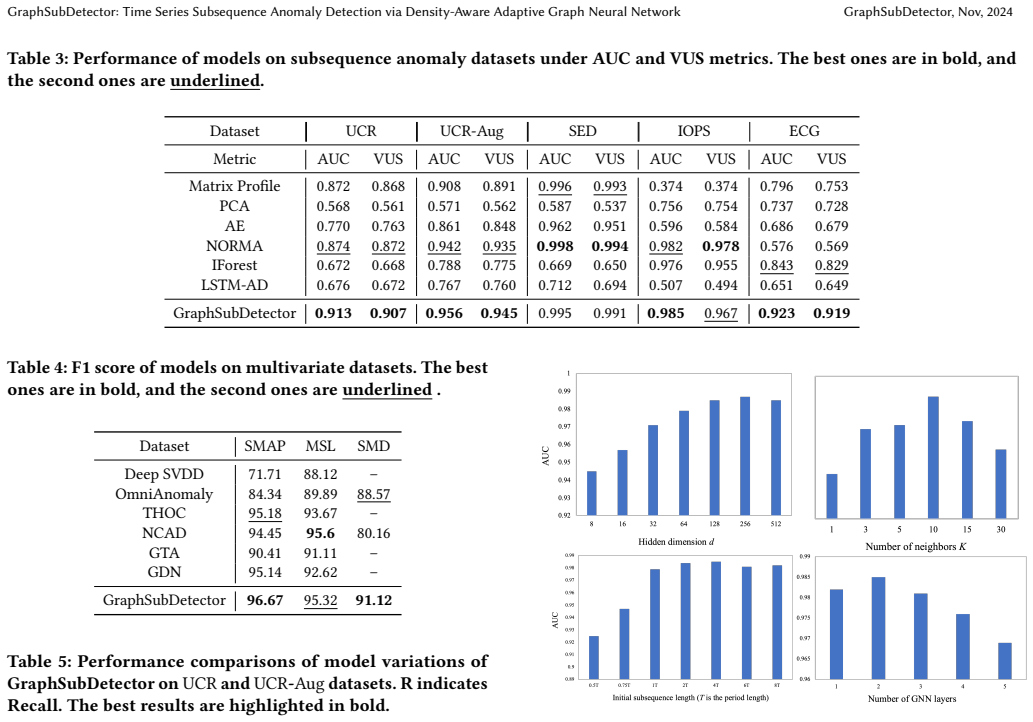
- On the eight benchmarks tested, the method reports top or second-best scores against matrix profile, NORMA, DeepSVDD, THOC, NCAD, and other baselines, with particularly large margins on UCR-Aug where multiple variable-length anomalies are injected.
Reading between the lines
- An extension the paper does not pursue: the variance-reduction theorems assume anomalies are additive normal deviations of independent normal samples; testing whether the effect survives autocorrelated or heavy-tailed normal processes would clarify how far the guarantee extends beyond the proof's assumptions.
- The ablation in Table 9 suggests injection mix matters (all-types injection outperforms any single type); a testable recipe is to choose injection types per application domain rather than using the same six everywhere.
- Because the adjacency matrix is a differentiable function of latent representations, DAGNN could be attached to other one-class objectives (for example a DeepSVDD-style hypersphere loss) to see whether the same relative-gain pattern appears.
- The learned length-selection weights are interpretable by construction: they could be exported as an estimate of the characteristic anomaly timescale for each series, which would give practitioners a diagnostic output beyond a binary alert.
Editorial analysis
A structured set of objections, weighed in public.
Referee Report
Summary. The paper proposes GraphSubDetector, a method for time series subsequence anomaly detection. It learns subsequence representations through a multi-length TCN-based encoder with a learned length-selection mechanism, builds a k-NN prior graph based on multi-length and z-normalized Euclidean distances, learns an adaptive adjacency matrix that combines data-space, latent-space, and periodic temporal distances, and refines this matrix with a local-density factor before performing GNN message passing. Anomaly scores are computed as the mean distance from a node to its graph neighbors, and training uses artificially injected anomalies with a Hypersphere-Classifier-style loss plus auto-encoding and length-selection regularizers. The authors claim theoretical guarantees (Theorems 4.1 and 4.2) that message passing with a Gaussian-kernel adjacency matrix reduces normal variance while enlarging the relative anomaly discrepancy, and report consistent improvements over several baselines on multiple benchmarks.
Significance. If the claims are substantiated, the method would be a useful, parameter-light tool for variable-length subsequence anomaly detection, with a plausible mechanism for handling recurring and context-dependent anomalies. The empirical study is broad: it covers eight datasets, several metrics, ablations, hyperparameter sensitivity, efficiency measurements, and a t-SNE visualization. The paper also makes a falsifiable architectural claim, namely that density-aware message passing improves detection by compacting normal representations. However, the theoretical core is not established as written: the proof in Appendix A.1 contains an unjustified high-dimensional approximation, an inconsistent inequality around Eq. (17), and does not derive the theorem statements. The empirical support is also weakened by tuning hyperparameters on an unspecified random selection of eight time series and by relying on injected anomaly types without evidence that they transfer to real test anomalies. These issues are load-bearing for the central claims.
major comments (5)
- [Appendix A.1, Eq. (16)] The approximation a_ano_j ≈ a_ref_j * exp(-(Kσ)^2/δ) assumes that the inner product ε^T(f_ref - f_j) is negligible, but this is not stated as a hypothesis in Theorem 4.1. For small dimension d or small K, the cross term can be comparable to ||ε||^2, and the proof gives no bound on the approximation error. Since the rest of the proof depends on this step, the theorem is not established.
- [Appendix A.1, surrounding Eq. (17)] The text immediately before Eq. (17) concludes ||f_ano_{*G} - f_ref_{*G}|| < ||f_ano - f_ref||, which is the opposite of the theorem's inequality. Moreover, the right-hand side of Eq. (17) can be negative or undefined for K ≲ 1 and large N, so no real δ > 0 satisfies the stated condition, contradicting the theorem's claim 'for any K > 0'. The derivation also jumps from a squared-norm inequality to a norm inequality without justification, and the proof mixes the notation G and Ĝ in a way that does not follow from the preceding formulas.
- [Theorem 4.2 and Appendix A.2] The proof of Theorem 4.2 is a single sentence asserting that variance is further reduced by moving samples toward μ; it does not show how the numerator ||f_ano_{*Ĝ} - f_ref_{*Ĝ}|| behaves relative to the denominator σ_{*Ĝ}. The density-aware factor actually implemented in Eq. (7) is exp(-MLP(A_i:)/δ_4), a row-wise function of similarities, whereas Theorem 4.2 analyzes exp(-||f_i - μ||^2/c). The analyzed object is therefore not the implemented model, so the theoretical motivation for DAGNN is not supported.
- [Section 5.2, Hyperparameters] The hyperparameters are tuned by grid search on a random selection of only 8 time series and then fixed for all datasets. The paper does not state which series were used, the grid ranges, or how the reported results vary with this choice. This weakens the claim of 'consistently outperforms' across benchmarks, because the reported gains may be biased by an accidentally favorable tuning set.
- [Section 4.3 and Table 9] The method trains on six artificially injected anomaly types, and Table 9 shows that detection performance is sensitive to which type is injected (e.g., noise injection benefits UCR-Aug more than resizing or up-side-down). The paper acknowledges that artificial anomalies 'may not coincide with real anomalies', but it provides no evidence that the injected types are a valid proxy for the anomalies in the test sets. This is structurally distinct from the architecture claim: even if the graph component helps, the reported margins may not transfer to real anomalies not represented among the injected types.
minor comments (5)
- [Theorem 4.2 and Appendix A.1] The notation for the adjacency matrix in Theorem 4.2 (Â) differs from the appendix's Theorem A.2, where it is written Â'; please unify the notation. Additionally, the appendix proof refers to G and Ĝ in a way that is confusing because the earlier derivation concerns G, while the concluding sentence refers to Ĝ.
- [Eq. (10)] The first term of the loss, -(1-y_i) s(X_i), is unbounded below as s(X_i) grows, unlike the Hypersphere Classifier loss in Eq. (3), which uses a log-probability term. Please clarify whether this unbounded term is intentional and how it is regularized in practice.
- [Section 5.6] The paper contains the typo 'GraphSubDectector' in two places; the correct spelling is 'GraphSubDetector'.
- [Section 5.9] The text refers to 'the initial maximum subsequence length T', but the notation L was introduced for the maximum subsequence length in Section 3.1; please align the notation.
- [Section 5.1] The UCR-Aug dataset is described as being included in an anonymous GitHub link in the Abstract, but the abstract text does not contain a URL; please provide the link in a footnote or data availability statement.
Circularity Check
No significant circularity: the empirical benchmark results are externally evaluated, and the theoretical motivation, while flawed in proof, is not used to fit the reported scores.
full rationale
GraphSubDetector's reported results come from training on benchmark training splits (with self-injected anomalies as data augmentation) and scoring held-out test subsequences; no test label or test metric enters the training objective except the disclosed best-threshold selection for multivariate F1, which follows prior work and does not change the ranking of detection scores. The anomaly-injection component is augmentation, not a fitted parameter renamed as a prediction: the model is evaluated on real anomalies in UCR, SED, IOPS, ECG, SMAP, MSL, and SMD, and baselines are run under the same protocol on UCR-Aug, so the comparison is not forced by construction. The theoretical claims in Section 4.2 and Appendix A.1 motivate the DAGNN architecture but are not used to compute any experimental number; the appendix proof is mathematically unsupported (it derives an inequality direction opposite to the theorem, relies on an unstated orthogonality assumption, gives a log condition in Eq. (17) that can be undefined for small K, and concludes Theorem A.1 from variance reduction without controlling the anomaly numerator), and the analyzed density term in Theorem 4.2 does not match the implemented row-wise MLP in Eq. (7). These are rigor/correctness defects, not circular derivations: the theorems are not assumed in the experiments, and the empirical claims stand or fall on the benchmark evaluation. Self-citations to the authors' prior work appear only in related-work context ([12], [33], [40]) and are not load-bearing. No equation in the paper reduces a predicted quantity to a fitted input by definition, so the circularity score is 0.
Assumptions & free parameters
free parameters (7)
- delta_base (indivisible segment length) =
0.125T for periodic, 10 for non-periodic
- stride tau =
2*delta_base
- max length scale P =
5
- neighbor count K
- smoothing scales delta_1..delta_4 =
d, 1.0, T, 1.0
- lambda (auto-encoding regularization) =
1.0
- mu (length selection regularization) =
0.2
assumptions (4)
- domain assumption Normal subsequences are independent samples from N(mu, sigma^2), and anomalies are rare (N >> M).
- ad hoc to paper In high-dimensional feature space, the anomaly error is orthogonal to normal differences: eps dot (f_ref - f_j) is approximately zero.
- domain assumption Message passing always reduces the variance of the feature distribution.
- domain assumption A TCN produces informative multi-scale embeddings for subsequences.
Cite this review
Pith. "Pith review of GraphSubDetector: Time Series Subsequence Anomaly Detection via Density-Aware Adaptive Graph Neural Network." pith.science (2026). https://pith.science/paper/FN52Q3Z4
@misc{pith2026241117218,
  author       = {Pith},
  title        = {Pith review of: GraphSubDetector: Time Series Subsequence Anomaly Detection via Density-Aware Adaptive Graph Neural Network},
  year         = {2026},
  howpublished = {\url{https://pith.science/paper/FN52Q3Z4}},
  note         = {Machine review of arXiv:2411.17218}
}
read the original abstract
Time series subsequence anomaly detection is an important task in a large variety of real-world applications ranging from health monitoring to AIOps, and is challenging due to the following reasons: 1) how to effectively learn complex dynamics and dependencies in time series; 2) diverse and complicated anomalous subsequences as well as the inherent variance and noise of normal patterns; 3) how to determine the proper subsequence length for effective detection, which is a required parameter for many existing algorithms. In this paper, we present a novel approach to subsequence anomaly detection, namely GraphSubDetector. First, it adaptively learns the appropriate subsequence length with a length selection mechanism that highlights the characteristics of both normal and anomalous patterns. Second, we propose a density-aware adaptive graph neural network (DAGNN), which can generate further robust representations against variance of normal data for anomaly detection by message passing between subsequences. The experimental results demonstrate the effectiveness of the proposed algorithm, which achieves superior performance on multiple time series anomaly benchmark datasets compared to state-of-the-art algorithms.
Figures


Figures from the paper (3 more)


Reference graph
Works this paper leans on
-
[1]
Charu C Aggarwal and Charu C Aggarwal. 2017. An introduction to outlier analysis. Springer
work page 2017
-
[2]
Shaojie Bai, J Zico Kolter, and Vladlen Koltun. 2018. An empirical evaluation of generic convolutional and recurrent networks for sequence modeling. arXiv preprint arXiv:1803.01271 (2018)
arXiv 2018
-
[3]
Paul Boniol, Michele Linardi, Federico Roncallo, Themis Palpanas, Mohammed Meftah, and Emmanuel Remy. 2021. Unsupervised and scalable subsequence anomaly detection in large data series. The VLDB Journal (2021), 1–23
work page 2021
-
[4]
Paul Boniol and Themis Palpanas. 2020. Series2Graph: Graph-based Subsequence Anomaly Detection for Time Series. PVLDB 13, 11 (2020)
work page 2020
-
[5]
Markus M Breunig, Hans-Peter Kriegel, Raymond T Ng, and Jörg Sander. 2000. LOF: identifying density-based local outliers. In Proceedings of the 2000 ACM SIGMOD international conference on Management of data . 93–104
2000
-
[6]
Carmona, François-Xavier Aubet, Valentin Flunkert, and Jan Gasthaus
Chris U. Carmona, François-Xavier Aubet, Valentin Flunkert, and Jan Gasthaus
-
[7]
Sucheta Chauhan and Lovekesh Vig. 2015. Anomaly detection in ECG time signals via deep long short-term memory networks. In 2015 IEEE International Conference on Data Science and Advanced Analytics (DSAA) . IEEE, 1–7
work page 2015
-
[8]
Zekai Chen, Dingshuo Chen, Xiao Zhang, Zixuan Yuan, and Xiuzhen Cheng
Show all 45 references
-
[9]
Andrew A Cook, Göksel Mısırlı, and Zhong Fan. 2019. Anomaly detection for IoT time-series data: A survey. IEEE Internet of Things Journal 7, 7 (2019), 6481–6494
2019
-
[10]
Ailin Deng and Bryan Hooi. 2021. Graph neural network-based anomaly detection in multivariate time series. In Proceedings of the AAAI conference on artificial intelligence, Vol. 35. 4027–4035
2021
-
[11]
Ada Wai-chee Fu, Oscar Tat-Wing Leung, Eamonn Keogh, and Jessica Lin. 2006. Finding Time Series Discords Based on Haar Transform. InAdvanced Data Mining and Applications, Xue Li, Osmar R. Zaïane, and Zhanhuai Li (Eds.). Springer Berlin Heidelberg, Berlin, Heidelberg, 31–41
2006
-
[12]
Jingkun Gao, Xiaomin Song, Qingsong Wen, Pichao Wang, Liang Sun, and Huan Xu. 2020. RobustTAD: Robust time series anomaly detection via decomposition and convolutional neural networks. KDD Workshop on Mining and Learning from Time Series (KDD-MileTS’20) (2020)
2020
-
[13]
Kyle Hundman, Valentino Constantinou, Christopher Laporte, Ian Colwell, and Tom Soderstrom. 2018. Detecting spacecraft anomalies using LSTMs and non- parametric dynamic thresholding. In Proceedings of the 24th ACM SIGKDD inter- national conference on knowledge discovery & data...
2018
-
[14]
Keogh, J
E. Keogh, J. Lin, and A. Fu. 2005. HOT SAX: efficiently finding the most unusual time series subsequence. In Fifth IEEE International Conference on Data Mining (ICDM’05). 8 pp.–
2005
-
[15]
Longyuan Li, Junchi Yan, Haiyang Wang, and Yaohui Jin. 2020. Anomaly detection of time series with smoothness-inducing sequential variational auto-encoder. IEEE transactions on neural networks and learning systems 32, 3 (2020), 1177–1191
2020
-
[16]
Zuluaga, and Eamonn Keogh
Yue Lu, Renjie Wu, Abdullah Mueen, Maria A. Zuluaga, and Eamonn Keogh
-
[17]
Junshui Ma and Simon Perkins. 2003. Time-series novelty detection using one- class support vector machines. In Proceedings of the International Joint Conference on Neural Networks, 2003. , Vol. 3. 1741–1745
2003
-
[18]
Pankaj Malhotra, Lovekesh Vig, Gautam Shroff, Puneet Agarwal, et al. 2015. Long Short Term Memory Networks for Anomaly Detection in Time Series.. InESANN, Vol. 2015. 89
2015
-
[19]
1173–1182
Matrix Profile XXIV: Scaling Time Series Anomaly Detection to Trillions of Datapoints and Ultra-Fast Arriving Data Streams (KDD ’22). 1173–1182
-
[20]
Takaaki Nakamura, Makoto Imamura, Ryan Mercer, and Eamonn Keogh. 2020. MERLIN: Parameter-free discovery of arbitrary length anomalies in massive time series archives. In 2020 IEEE international conference on data mining (ICDM) . 1190–1195
2020
-
[21]
John Paparrizos, Paul Boniol, Themis Palpanas, Ruey S Tsay, Aaron Elmore, and Michael J Franklin. 2022. Volume under the surface: a new accuracy evaluation measure for time-series anomaly detection. Proceedings of the VLDB Endowment 15, 11 (2022), 2774–2787
2022
-
[22]
George B Moody and Roger G Mark. 2001. The impact of the MIT-BIH arrhythmia database. IEEE engineering in medicine and biology magazine 20, 3 (2001), 45–50
2001
-
[23]
Daehyung Park, Yuuna Hoshi, and Charles C Kemp. 2018. A multimodal anomaly detector for robot-assisted feeding using an lstm-based variational autoencoder. IEEE Robotics and Automation Letters 3, 3 (2018), 1544–1551
2018
-
[24]
Lukas Ruff, Robert Vandermeulen, Nico Goernitz, Lucas Deecke, Shoaib Ahmed Siddiqui, Alexander Binder, Emmanuel Müller, and Marius Kloft. 2018. Deep one- class classification. In International conference on machine learning . 4393–4402
2018
-
[25]
John Paparrizos, Yuhao Kang, Paul Boniol, Ruey S Tsay, Themis Palpanas, and Michael J Franklin. 2022. TSB-UAD: an end-to-end benchmark suite for univariate time-series anomaly detection. Proceedings of the VLDB Endowment 15, 8 (2022), 1697–1711
2022
-
[26]
Mayu Sakurada and Takehisa Yairi. 2014. Anomaly detection using autoencoders with nonlinear dimensionality reduction. In Proceedings of the MLSDA 2014 2nd workshop on machine learning for sensory data analysis . 4–11
2014
-
[27]
Thomas Schlegl, Philipp Seeböck, Sebastian M Waldstein, Ursula Schmidt-Erfurth, and Georg Langs. 2017. Unsupervised anomaly detection with generative ad- versarial networks to guide marker discovery. In International conference on information processing in medical imaging . 146–157
2017
-
[28]
Lukas Ruff, Robert A Vandermeulen, Billy Joe Franks, Klaus-Robert Müller, and Marius Kloft. 2020. Rethinking assumptions in deep anomaly detection. arXiv preprint arXiv:2006.00339 (2020)
2020 arXiv
-
[29]
Lifeng Shen, Zhuocong Li, and James Kwok. 2020. Timeseries anomaly detection using temporal hierarchical one-class network. Advances in Neural Information Processing Systems (NeurIPS) 33 (2020), 13016–13026
2020
-
[30]
Ya Su, Youjian Zhao, Chenhao Niu, Rong Liu, Wei Sun, and Dan Pei. 2019. Robust anomaly detection for multivariate time series through stochastic recurrent GraphSubDetector: Time Series Subsequence Anomaly Detection via Density-Aware Adaptive Graph Neural Network GraphSubDetect...
2019
-
[31]
Bernhard Schölkopf, John C Platt, John Shawe-Taylor, Alex J Smola, and Robert C Williamson. 2001. Estimating the support of a high-dimensional distribution. Neural computation 13, 7 (2001), 1443–1471
2001
-
[32]
Laurens Van der Maaten and Geoffrey Hinton. 2008. Visualizing data using t-SNE. Journal of machine learning research 9, 11 (2008)
2008
-
[33]
Qingsong Wen, Linxiao Yang, Tian Zhou, and Liang Sun. 2022. Robust time series analysis and applications: An industrial perspective. In Proceedings of the 28th ACM SIGKDD Conference on Knowledge Discovery and Data Mining . 4836–4837
2022
-
[34]
David MJ Tax and Robert PW Duin. 2004. Support vector data description. Machine learning 54, 1 (2004), 45–66
2004
-
[35]
Jiehui Xu, Haixu Wu, Jianmin Wang, and Mingsheng Long. 2021. Anomaly Transformer: Time Series Anomaly Detection with Association Discrepancy. In International Conference on Learning Representations (ICLR)
2021
-
[36]
Dragomir Yankov, Eamonn Keogh, and Umaa Rebbapragada. 2007. Disk Aware Discord Discovery: Finding Unusual Time Series in Terabyte Sized Datasets. In Seventh IEEE International Conference on Data Mining (ICDM 2007) . 381–390
2007
-
[37]
Zonghan Wu, Shirui Pan, Fengwen Chen, Guodong Long, Chengqi Zhang, and Philip S. Yu. 2021. A Comprehensive Survey on Graph Neural Networks. IEEE Transactions on Neural Networks and Learning Systems 32, 1 (2021), 4–24
2021
-
[38]
Chin-Chia Michael Yeh, Yan Zhu, Liudmila Ulanova, Nurjahan Begum, Yifei Ding, Hoang Anh Dau, Diego Furtado Silva, Abdullah Mueen, and Eamonn Keogh. 2016. Matrix profile I: all pairs similarity joins for time series: a unifying view that includes motifs, discords and shapelets....
2016
-
[39]
Chuxu Zhang, Dongjin Song, Yuncong Chen, Xinyang Feng, Cristian Lumezanu, Wei Cheng, Jingchao Ni, Bo Zong, Haifeng Chen, and Nitesh V Chawla. 2019. A deep neural network for unsupervised anomaly detection and diagnosis in multivariate time series data. In Proceedings of the AA...
2019
-
[40]
Dragomir Yankov, Eamonn Keogh, and Umaa Rebbapragada. 2008. Disk aware dis- cord discovery: finding unusual time series in terabyte sized datasets. Knowledge and Information Systems 17, 2 (2008), 241–262
2008
-
[41]
Hang Zhao, Yujing Wang, Juanyong Duan, Congrui Huang, Defu Cao, Yunhai Tong, Bixiong Xu, Jing Bai, Jie Tong, and Qi Zhang. 2020. Multivariate time- series anomaly detection via graph attention network. In 2020 IEEE International Conference on Data Mining (ICDM) . 841–850
2020
-
[42]
Bo Zong, Qi Song, Martin Renqiang Min, Wei Cheng, Cristian Lumezanu, Daeki Cho, and Haifeng Chen. 2018. Deep autoencoding gaussian mixture model for unsupervised anomaly detection. In International conference on learning represen- tations (ICLR). GraphSubDetector, Nov, 2024 Ch...
2018
-
[43]
Yingying Zhang, Zhengxiong Guan, Huajie Qian, Leili Xu, Hengbo Liu, Qingsong Wen, Liang Sun, Junwei Jiang, Lunting Fan, and Min Ke. 2021. CloudRCA: A root cause analysis framework for cloud computing platforms. In Proceedings of the 30th ACM International Conference on Informa...
2021
-
[2021]
IEEE Internet of Things Journal 9, 12 (2021), 9179–9189
Learning graph structures with transformer for multivariate time-series anomaly detection in IoT. IEEE Internet of Things Journal 9, 12 (2021), 9179–9189
2021
-
[2022]
In Proceedings of the Thirty-First International Joint Conference on Artificial Intelligence (IJCAI)
Neural Contextual Anomaly Detection for Time Series. In Proceedings of the Thirty-First International Joint Conference on Artificial Intelligence (IJCAI) . 2843–2851
Reviewed August 12, 2026 · model on record in the stance chip above.
Discussion (0). Continue with ORCID to comment.