REVIEW 5 major objections 6 minor 37 references
Interpretable Dynamic Graph Neural Networks for Small Occluded Object Detection and Tracking
T0 review · 5 major / 6 minor · reviewed 2026-08-12 · deepseek-v4-flash
Pith's one-line read DGNN-YOLO claims that coupling YOLO11 with a dynamically updated graph of detections raises small, occluded traffic-object detection and tracking above current detectors while keeping the system real-time and interpretable.
desk verdict A reasonable engineering combo, but the reported numbers don't agree with each other, so the headline result is unverifiable as written. read the letter →
The pith
A machine-rendered reading of the paper's core claim, the machinery that carries it, and where it could break.
The reading
What carries the argument
The load-bearing mechanism is the dynamic graph construction and update loop. Each detected object becomes a node with feature vector $x_i=[F_s,F_t]$, and edges are inserted or removed by thresholds on distance, velocity difference, and appearance similarity; the adjacency matrix $A_t$ is recomputed every frame so the graph follows objects entering, leaving, occluding, and moving. A multi-layer graph convolution propagates information through neighboring nodes, refining embeddings that the paper says are used to assign tracking IDs. The second support is the combined loss, which explicitly ties detection to temporal identity consistency and is inspired by detection-plus-re-identification tracking losses.
What would settle it
Run the same DGNN-YOLO pipeline on MOTChallenge or KITTI with ground-truth track IDs and compute MOTA, IDF1, and HOTA against a simple baseline of YOLO11 detections matched by a nearest-neighbor tracker. If the graph module does not reduce identity switches relative to that baseline, or if removing the DGNN from the training loss leaves tracking metrics unchanged, the claimed tracking improvement is unsupported. A more direct check is to inspect gradient flow from $L_{\text{track}}$ back to graph construction, which the paper leaves unspecified.
Extended reading notes
Core claim
The central claim is that detection and tracking improve when they are coupled through a continuously updated graph rather than treated as separate frame-by-frame stages. DGNN-YOLO builds one graph per frame: nodes are YOLO11 detections carrying spatial, motion, and appearance features, and edges encode Euclidean proximity, velocity similarity, and cosine appearance similarity. At each frame the graph adds or removes nodes and edges, then a graph convolution layer $H^{(l+1)}=\sigma(A_t H^{(l)} W^{(l)})$ refines node embeddings and assigns stable tracking IDs. Training minimizes a combined loss $L=\lambda_{\text{det}}L_{\text{det}}+\lambda_{\text{track}}L_{\text{track}}$, where the tracking term penalizes inconsistency between connected nodes and between the same object across consecutive frames. The reported improvements are measured with detection metrics, and the paper presents the same pipeline as delivering tracking plus interpretability in real time.
Load-bearing premise
The load-bearing premise is that the DGNN module is genuinely trained to refine identity associations across frames, but the paper never specifies how the dynamic graph is built during training, how the tracking loss is backpropagated through threshold-based graph construction, how tracking IDs are assigned, or how the DGNN, trained from scratch, receives gradients from YOLO11 detections.
Editorial extensions
If this is right
- If the claims hold, detection and tracking can be handled by one graph-based pipeline instead of separate stages, since the per-frame graph supplies both detections and identity associations.
- Recall is the largest reported gain over plain YOLO11 (0.6875 versus 0.5248), so the main benefit would come from not missing small occluded objects rather than from avoiding false positives alone.
- The ablation results indicate that temporal features are the most critical component, so the framework's advantage depends on using frame-to-frame motion rather than appearance alone.
- At roughly 60 fps in the authors' setup, the framework stays within real-time operation for surveillance cameras on the hardware tested.
- The XAI heatmaps would allow operators to see which image regions drive each detection, supporting human review of automated traffic monitoring.
Reading between the lines
- Because the reported evaluation uses detection metrics (precision, recall, mAP) rather than tracking metrics such as MOTA, IDF1, or HOTA, the claimed tracking improvement is not yet directly measured; a fair test would require ground-truth track IDs and identity-switch counts.
- A clean way to isolate the graph module's contribution would be to hold YOLO11 fixed and vary only edge thresholds or edge features; if the precision and mAP shifts match the ablation trends, the graph module is responsible, and if not, the gains may come from the detector re-training.
- The reported training time for the full model is about seven times that of YOLO11 alone, so practical deployment would need to verify whether the gains survive pruning or quantization, which the authors list as future work.
- The conclusion concedes that visual-only input fails in heavy rain and fog; this implies the claimed robustness is bounded to clear-weather urban scenes, and sensor fusion would be the natural extension.
Editorial analysis
A structured set of objections, weighed in public.
Referee Report
Summary. The paper proposes DGNN-YOLO, a pipeline that combines YOLO11 object detection with a dynamic graph neural network for detecting and tracking small, occluded traffic objects, and adds Grad-CAM, Grad-CAM++, and Eigen-CAM for interpretability. The central claim is that DGNN-YOLO achieves precision 0.8382, recall 0.6875, and mAP@0.5:0.95 0.6476, "significantly outperforming existing methods," while running in real time. The experiments use the i2 Object Detection Dataset with an 80/20 train/validation split, and report detection metrics, an ablation study, FPS, error metrics, and qualitative XAI comparisons.
Significance. If the claims were supported, the paper would offer a practically relevant integration of dynamic graph reasoning with a real-time detector, plus an interpretability layer, for a realistic traffic-surveillance setting. The paper also contains useful elements: an explicit algorithm sketch, a defined combined loss, a quantified ablation, and a comparison of three XAI methods. However, the central performance claim is not verifiable from the manuscript as written. The reported numbers are mutually inconsistent, no held-out test set is used, tracking is never evaluated with multi-object-tracking metrics, and the DGNN training loop is not specified. These are load-bearing issues because the paper's headline contributions—significant outperformance and robust tracking—rest on exactly this evidence. The manuscript in its current form does not provide a sound basis for accepting those claims.
major comments (5)
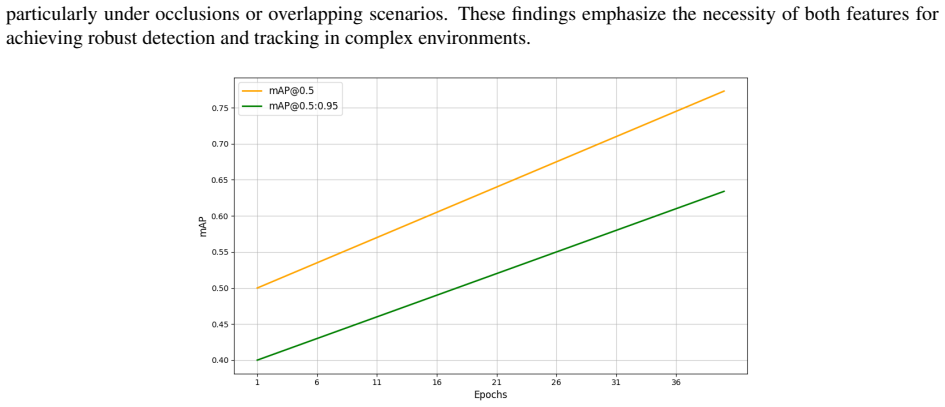
- [Section 4.4.1 (Table 2), Section 4.4.3, Section 4.4.5, Section 4.4.4 (Table 3)] The central numerical claim is internally inconsistent. Table 2 reports the final DGNN-YOLO as precision 0.8382, recall 0.6875, mAP@0.5 0.7830, and mAP@0.5:0.95 0.6476, and the abstract repeats these values. Section 4.4.5, however, states that the model reaches mAP@0.5 = 0.716 and mAP@0.5:0.95 = 0.575 by the final epoch. The ablation study in Table 3 gives the full framework mAP = 0.716, precision = 0.776, and recall = 0.636. A third set appears in Section 4.4.3, where the average mAP@0.5 is reported as 0.812. These numbers cannot all describe the same trained model on the same validation split. Because the headline claim of significant outperformance rests entirely on these metrics, the inconsistency is load-bearing: the reader cannot determine which result is real, and the claimed detection advantage is unverifiable without a single reproducible evaluation pass or released checkpoints.
- [Section 4.1 and Section 4.2] The experimental protocol does not support the reported generalization claim. Section 4.1 defines only an 80/20 train/validation split with no held-out test set, and Section 4.2 says training hyperparameters such as learning rate and batch size were "dynamically adjusted" during the experiment. This implies model selection was performed on the very split used to report the final numbers. With no separate test set and no fixed protocol, the reported precision/recall/mAP values cannot be interpreted as an unbiased estimate of performance on new data, and comparisons to baselines are confounded by whatever selection procedure was used.
- [Section 3.6 and Algorithm 1] The tracking component is not specified as a trainable system. Section 3.6 defines a tracking loss L_track, but the paper never explains how the dynamic graph is constructed during training, how L_track is backpropagated through the threshold-based edge insertion/removal in Algorithm 1 (lines 18–23), how tracking IDs are assigned and maintained, or how the "DGNN module trained from scratch" (Section 4.2) receives gradients from YOLO11 detections. Without this training loop, the claimed tracking improvement is unsupported. The paper must specify the full forward/backward path or clarify that the DGNN is used only as a post-processing association heuristic.
- [Section 4.3 and Section 4.4] Tracking is never evaluated with tracking metrics. The evaluation section defines precision, recall, mAP, and interpretability metrics, and the results tables report detection metrics, FPS, and error metrics. There is no MOTA, IDF1, HOTA, or identity-switch count. Since the abstract and introduction explicitly claim "adaptive and robust tracking" and the framework's contribution is presented as detection plus tracking, the absence of any standard multi-object-tracking evaluation makes the tracking claim untestable.
- [Section 4.4.1, Table 2] Baseline training details are missing. Table 2 compares Faster R-CNN, YOLO5, YOLO8, YOLO9, YOLO10, and YOLO11, but the paper does not state the training epochs, learning rates, batch sizes, input resolutions, data augmentation, or any other protocol for these baselines. Without matching training conditions, the reported margin of DGNN-YOLO over YOLO11 (for example, mAP@0.5 rising from 0.6107 to 0.7830) cannot be attributed to the proposed DGNN component rather than to different training choices.
minor comments (6)
- [Throughout] The model name is used inconsistently as YOLO11, YOLOv11, and YOLO11-DGNN; the same notation should be used throughout.
- [Equation (2)] The tracking loss uses f^{t+1}_i and f^t_i, but these feature vectors are not defined in Section 3.1.3; the notation should be introduced explicitly.
- [Section 2.3] The related work refers to "the approaches developed by Zhang et al." without a citation, and the description of the proposed graph pruning algorithm does not appear in the methodology.
- [Section 2.1] The sentence about YOLOv3 and YOLOv4 has an empty citation; the reference list should be completed.
- [Section 4.4.1, Table 2] The DGNN-YOLO training time of 118,344 seconds is roughly seven times larger than that of YOLO11 (17,040 seconds), but the paper still claims real-time operation based only on inference FPS; the distinction between training cost and inference speed should be stated explicitly.
- [Section 4.4.4 and Table 4] Table 4 uses a configuration "DGNN w/o Spatial," but Table 3's ablation removes appearance embeddings, velocity similarity, temporal features, or edge-weight adaptivity; the relationship between these ablations should be clarified.
Circularity Check
No circularity identified: the paper reports empirical performance measurements with no derived constants, no fitted-input-as-prediction step, and no load-bearing self-citation chain.
full rationale
The paper's central claims are empirical: DGNN-YOLO is trained on the i2 dataset and evaluated with precision, recall, and mAP metrics. There is no derivation chain in which an output quantity is shown to be equal, by construction, to an input quantity. The tracking loss L_track (Eq. 2) is defined as a training objective over graph node features and temporal feature differences; it is not presented as a prediction derived from fitted parameters. The framework adopts YOLO11 and DGNN components from cited prior work, but none of the load-bearing citations are self-citations by the authors, and no uniqueness theorem or ansatz is imported from the authors' own prior publications to force a result. The reported performance numbers are measurements on a validation split, not predictions generated from a fitted equation, so the 'fitted input called prediction' pattern does not apply. The manuscript does contain serious internal inconsistencies: Table 2 and the abstract report mAP@0.5:0.95 of 0.6476, Section 4.4.5 reports 0.575, and Table 3 reports the full framework mAP as 0.716. These inconsistencies undermine the verifiability of the headline outperformance claim, but they are a correctness or reproducibility problem, not circularity. Likewise, the underspecified DGNN training loop in Section 3.6 and Algorithm 1 raises a support concern for the tracking claims, but it does not make any result equivalent to its own input by definition. Therefore no circular step is established under the required standard of quoting a specific reduction, and the circularity score is 0.
Assumptions & free parameters
free parameters (6)
- lambda_det, lambda_track =
not reported
- Edge construction thresholds (distance and velocity difference) =
not reported
- Detection confidence threshold tau =
not reported
- ROI settings =
not reported
- DGNN architecture dimensions =
not reported
- Learning rate and batch size =
not reported
assumptions (4)
- domain assumption Validation set performance is an unbiased estimate of generalization.
- domain assumption YOLO11 detections provide sufficient node features for the DGNN to learn identity associations.
- ad hoc to paper The threshold-based edge heuristic captures meaningful object interactions.
- domain assumption The detection and tracking losses can be optimized jointly.
Cite this review
Pith. "Pith review of Interpretable Dynamic Graph Neural Networks for Small Occluded Object Detection and Tracking." pith.science (2026). https://pith.science/paper/5Q7RS2J3
@misc{pith2026241117251,
  author       = {Pith},
  title        = {Pith review of: Interpretable Dynamic Graph Neural Networks for Small Occluded Object Detection and Tracking},
  year         = {2026},
  howpublished = {\url{https://pith.science/paper/5Q7RS2J3}},
  note         = {Machine review of arXiv:2411.17251}
}
read the original abstract
The detection and tracking of small, occluded objects such as pedestrians, cyclists, and motorbikes pose significant challenges for traffic surveillance systems because of their erratic movement, frequent occlusion, and poor visibility in dynamic urban environments. Traditional methods like YOLO11, while proficient in spatial feature extraction for precise detection, often struggle with these small and dynamically moving objects, particularly in handling real-time data updates and resource efficiency. This paper introduces DGNN-YOLO, a novel framework that integrates dynamic graph neural networks (DGNNs) with YOLO11 to address these limitations. Unlike standard GNNs, DGNNs are chosen for their superior ability to dynamically update graph structures in real-time, which enables adaptive and robust tracking of objects in highly variable urban traffic scenarios. This framework constructs and regularly updates its graph representations, capturing objects as nodes and their interactions as edges, thus effectively responding to rapidly changing conditions. Additionally, DGNN-YOLO incorporates Grad-CAM, Grad-CAM++, and Eigen-CAM visualization techniques to enhance interpretability and foster trust, offering insights into the model's decision-making process. Extensive experiments validate the framework's performance, achieving a precision of 0.8382, recall of 0.6875, and mAP@0.5:0.95 of 0.6476, significantly outperforming existing methods. This study offers a scalable and interpretable solution for real-time traffic surveillance and significantly advances intelligent transportation systems' capabilities by addressing the critical challenge of detecting and tracking small, occluded objects.
Figures


Figures from the paper (7 more)




Reference graph
Works this paper leans on
-
[1]
Mujadded Al Rabbani Alif. YOLOv11 for Vehicle Detection : Advancements , Performance , and Applications in Intelligent Transportation Systems , October 2024. URL http://arxiv.org/abs/2410.22898. arXiv:2410.22898 [cs]
arXiv 2024
-
[2]
Sah Bin Haji Salam, Usman Ullah Sheikh, and Sara Ayub
Lubna Aziz, Md. Sah Bin Haji Salam, Usman Ullah Sheikh, and Sara Ayub. Exploring Deep Learning - Based Architecture , Strategies , Applications and Current Trends in Generic Object Detection : A Comprehensive Review . IEEE Access, 8: 0 170461--170495, 2020. ISSN 2169-3536. doi:10.1109/ACCESS.2020.3021508. URL https://ieeexplore.ieee.org/document/9186021/
-
[3]
Efficient Visual Tracking With Exemplar Transformers
Philippe Blatter, Menelaos Kanakis, Martin Danelljan, and Luc Van Gool. Efficient Visual Tracking With Exemplar Transformers . In Proceedings of the IEEE/CVF Winter Conference on Applications of Computer Vision, pages 1571--1581, 2023. doi:10.1109/WACV56688.2023.00162
arXiv 2023
-
[4]
Brais Bosquet, Manuel Mucientes, and Víctor M. Brea. Stdnet-st: Spatio-temporal convnet for small object detection. Pattern Recognition, 116: 0 107929, 2021. ISSN 0031-3203. doi:https://doi.org/10.1016/j.patcog.2021.107929. URL https://www.sciencedirect.com/science/article/pii/S0031320321001163
-
[5]
3d multi-object tracking using graph neural networks with cross-edge modality attention
Martin Büchner and Abhinav Valada. 3d multi-object tracking using graph neural networks with cross-edge modality attention. IEEE Robotics and Automation Letters, 7 0 (4): 0 9707--9714, 2022. doi:10.1109/LRA.2022.3191558
arXiv 2022
-
[6]
End-to-End Object Detection with Transformers
Nicolas Carion, Francisco Massa, Gabriel Synnaeve, Nicolas Usunier, Alexander Kirillov, and Sergey Zagoruyko. End-to-End Object Detection with Transformers . In Computer Vision – ECCV 2020: 16th European Conference, Glasgow, UK, August 23–28, 2020, Proceedings, Part I, page 213–229, Berlin, Heidelberg, 2020. Springer-Verlag. ISBN 978-3-030-58451-1. doi:10...
-
[7]
Object Detection in Remote Sensing Images Based on a Scene - Contextual Feature Pyramid Network
Chaoyue Chen, Weiguo Gong, Yongliang Chen, and Weihong Li. Object Detection in Remote Sensing Images Based on a Scene - Contextual Feature Pyramid Network . Remote Sensing, 11 0 (3): 0 339, February 2019. ISSN 2072-4292. doi:10.3390/rs11030339. URL https://www.mdpi.com/2072-4292/11/3/339
-
[8]
Kai Chen, Jiangmiao Wang, Shuo Yang, Xiangyu Zhang, and Jian Sun. Transformer Tracking . In 2021 IEEE/CVF Conference on Computer Vision and Pattern Recognition (CVPR), pages 8126--8135, Los Alamitos, CA, USA, June 2021. IEEE Computer Society. doi:10.1109/CVPR46437.2021.00803. URL https://doi.ieeecomputersociety.org/10.1109/CVPR46437.2021.00803
arXiv 2021
Show all 37 references
-
[9]
Online Multi - Object Tracking Using CNN - Based Single Object Tracker With Spatial - Temporal Attention Mechanism
Qi Chu, Wanli Ouyang, Hongsheng Li, Xiaogang Wang, Bin Liu, and Nenghai Yu. Online Multi - Object Tracking Using CNN - Based Single Object Tracker With Spatial - Temporal Attention Mechanism . In Proceedings of the IEEE International Conference on Computer Vision, pages 4836--...
2017
-
[10]
Histograms of oriented gradients for human detection
Navneet Dalal and Bill Triggs. Histograms of oriented gradients for human detection. In 2005 IEEE Computer Society Conference on Computer Vision and Pattern Recognition (CVPR'05), volume 1, pages 886--893. IEEE, 2005. doi:10.1109/CVPR.2005.177
2005 doi
-
[11]
A Survey on Artificial Intelligence ( AI ) and eXplainable AI in Air Traffic Management : Current Trends and Development with Future Research Trajectory
Augustin Degas, Mir Riyanul Islam, Christophe Hurter, Shaibal Barua, Hamidur Rahman, Minesh Poudel, Daniele Ruscio, Mobyen Uddin Ahmed, Shahina Begum, Md Aquif Rahman, Stefano Bonelli, Giulia Cartocci, Gianluca Di Flumeri, Gianluca Borghini, Fabio Babiloni, and Pietro Aricó. A...
2022
-
[12]
Bifpn-yolo: One-stage object detection integrating bi-directional feature pyramid networks
John Doherty, Bryan Gardiner, Emmett Kerr, and Nazmul Siddique. Bifpn-yolo: One-stage object detection integrating bi-directional feature pyramid networks. Pattern Recognition, 160: 0 111209, 2025. ISSN 0031-3203. doi:https://doi.org/10.1016/j.patcog.2024.111209. URL https://w...
2025
-
[13]
Intelligent transportation systems for sustainable smart cities
Mohamed Elassy, Mohammed Al-Hattab, Maen Takruri, and Sufian Badawi. Intelligent transportation systems for sustainable smart cities. Transportation Engineering, 16: 0 100252, June 2024. ISSN 2666-691X. doi:10.1016/j.treng.2024.100252. URL https://www.sciencedirect.com/science...
2024
-
[14]
Handcrafted and Deep Trackers : Recent Visual Object Tracking Approaches and Trends
Mustansar Fiaz, Arif Mahmood, Sajid Javed, and Soon Ki Jung. Handcrafted and Deep Trackers : Recent Visual Object Tracking Approaches and Trends . ACM Comput. Surv., 52 0 (2): 0 43:1--43:44, April 2019. ISSN 0360-0300. doi:10.1145/3309665. URL https://dl.acm.org/doi/10.1145/3309665
2019 doi
-
[15]
Enabling Safe Autonomous Driving in Real - World City Traffic Using Multiple Criteria Decision Making
Andrei Furda and Ljubo Vlacic. Enabling Safe Autonomous Driving in Real - World City Traffic Using Multiple Criteria Decision Making . IEEE Intelligent Transportation Systems Magazine, 3 0 (1): 0 4--17, 2011. doi:10.1109/MITS.2011.940472
2011
-
[16]
Graph neural based end-to-end data association framework for online multiple-object tracking
Xiaolong Jiang, Peizhao Li, Yanjing Li, and Xiantong Zhen. Graph neural based end-to-end data association framework for online multiple-object tracking. arXiv preprint arXiv:1907.05315, 2019. doi:10.48550/arXiv.1907.05315
-
[17]
Graph convolution neural network-based data association for online multi-object tracking
Jimi Lee, Mira Jeong, and Byoung Chul Ko. Graph convolution neural network-based data association for online multi-object tracking. IEEE Access, 9: 0 114535--114546, 2021. doi:10.1109/ACCESS.2021.3105118
2021
-
[18]
SwinTrack: A Simple and Strong Baseline for Transformer Tracking
Liting Lin, Heng Fan, Zhipeng Zhang, Yong Xu, and Haibin Ling. SwinTrack: A Simple and Strong Baseline for Transformer Tracking . In Proceedings of the 36th International Conference on Neural Information Processing Systems, volume 35 of NIPS '22, pages 16743--16754, Red Hook, ...
2022
-
[19]
Focal loss for dense object detection
Tsung-Yi Lin, Priya Goyal, Ross Girshick, Kaiming He, and Piotr Dollár. Focal loss for dense object detection. IEEE Transactions on Pattern Analysis and Machine Intelligence, 42 0 (2): 0 318--327, 2020. doi:10.1109/TPAMI.2018.2858826
2020
-
[20]
SSD : Single Shot MultiBox Detector
Wei Liu, Dragomir Anguelov, Dumitru Erhan, Christian Szegedy, Scott Reed, Cheng-Yang Fu, and Alexander C Berg. SSD : Single Shot MultiBox Detector . In European Conference on Computer Vision, pages 21--37, Cham, 2016. Springer International Publishing. doi:10.1007/978-3-319-46448-0_2
2016 doi
-
[21]
OD - XAI : Explainable AI - Based Semantic Object Detection for Autonomous Vehicles
Harsh Mankodiya, Dhairya Jadav, Rajesh Gupta, Sudeep Tanwar, Wei-Chiang Hong, and Ravi Sharma. OD - XAI : Explainable AI - Based Semantic Object Detection for Autonomous Vehicles . Applied Sciences, 12 0 (11): 0 5310, January 2022. ISSN 2076-3417. doi:10.3390/app12115310. URL ...
2022 doi
-
[22]
Deep Learning for Visual Tracking : A Comprehensive Survey
Seyed Mojtaba Marvasti-Zadeh, Li Cheng, Hossein Ghanei-Yakhdan, and Shohreh Kasaei. Deep Learning for Visual Tracking : A Comprehensive Survey . IEEE Transactions on Intelligent Transportation Systems, 23 0 (5): 0 3943--3968, May 2022. ISSN 1558-0016. doi:10.1109/TITS.2020.304...
2022
-
[23]
You Only Look Once: Unified, Real-Time Object Detection
Joseph Redmon, Santosh Divvala, Ross Girshick, and Ali Farhadi. You Only Look Once: Unified, Real-Time Object Detection . In 2016 IEEE Conference on Computer Vision and Pattern Recognition (CVPR), pages 779--788, Los Alamitos, CA, USA, June 2016. IEEE Computer Society. doi:10....
2016 doi
-
[24]
Faster R - CNN : Towards Real - Time Object Detection with Region Proposal Networks
Shaoqing Ren, Kaiming He, Ross Girshick, and Jian Sun. Faster R - CNN : Towards Real - Time Object Detection with Region Proposal Networks . IEEE Transactions on Pattern Analysis and Machine Intelligence, 39 0 (6): 0 1137--1149, June 2017. ISSN 1939-3539. doi:10.1109/TPAMI.201...
2017
-
[25]
Zezhi Shao, Zhao Zhang, Wei Wei, Fei Wang, Yongjun Xu, Xin Cao, and Christian S. Jensen. Decoupled dynamic spatial-temporal graph neural network for traffic forecasting. Proceedings of the VLDB Endowment, 15 0 (11): 0 2733–2746, July 2022. ISSN 2150-8097. doi:10.14778/3551793....
2022
-
[26]
RSOD : Real -time small object detection algorithm in UAV -based traffic monitoring
Wei Sun, Liang Dai, Xiaorui Zhang, Pengshuai Chang, and Xiaozheng He. RSOD : Real -time small object detection algorithm in UAV -based traffic monitoring. Applied Intelligence, 52 0 (8): 0 8448--8463, June 2022. ISSN 1573-7497. doi:10.1007/s10489-021-02893-3. URL https://doi.o...
2022 doi
-
[27]
Rapid object detection using a boosted cascade of simple features
Paul Viola and Michael Jones. Rapid object detection using a boosted cascade of simple features. In Proceedings of the 2001 IEEE Computer Society Conference on Computer Vision and Pattern Recognition. CVPR 2001, volume 1, pages I--I. IEEE, 2001. doi:10.1109/CVPR.2001.990517
2001
-
[28]
Yolo-anti: Yolo-based counterattack model for unseen congested object detection
Kun Wang and Maozhen Liu. Yolo-anti: Yolo-based counterattack model for unseen congested object detection. Pattern Recognition, 131: 0 108814, 2022. ISSN 0031-3203. doi:https://doi.org/10.1016/j.patcog.2022.108814. URL https://www.sciencedirect.com/science/article/pii/S0031320...
2022
-
[29]
Fast online object tracking and segmentation: A unifying approach
Qiang Wang, Li Zhang, Luca Bertinetto, Weiming Hu, and Philip HS Torr. Fast online object tracking and segmentation: A unifying approach. In Proceedings of the IEEE/CVF Conference on Computer Vision and Pattern Recognition, pages 1328--1338, 2019. doi:10.1109/CVPR.2019.00142
2019
-
[30]
Towards Real-Time Multi-Object Tracking
Zhongdao Wang, Liang Zheng, Yixuan Liu, Yali Li, and Shengjin Wang. Towards Real-Time Multi-Object Tracking . In Computer Vision – ECCV 2020: 16th European Conference, Glasgow, UK, August 23–28, 2020, Proceedings, Part XI, page 107–122, Berlin, Heidelberg, 2020. Springer-Verla...
2020 doi
-
[31]
Gnn3dmot: Graph neural network for 3d multi-object tracking with 2d-3d multi-feature learning
Xinshuo Weng, Yongxin Wang, Yunze Man, and Kris M Kitani. Gnn3dmot: Graph neural network for 3d multi-object tracking with 2d-3d multi-feature learning. In Proceedings of the IEEE/CVF Conference on Computer Vision and Pattern Recognition, pages 6499--6508, 2020. doi:10.1109/CV...
2020
-
[32]
Advances in Convolutional Neural Networks for Object Detection and Recognition
Dhananjay Kumar Yadav, Neeraj Kumari, and Syed Harron. Advances in Convolutional Neural Networks for Object Detection and Recognition . In 2024 International Conference on Optimization Computing and Wireless Communication (ICOCWC), pages 1--6, 2024. doi:10.1109/ICOCWC60930.202...
2024
-
[33]
Camouflaged Object Detection via Dual-branch Fusion and Dual Self-similarity constraints
Haozhe Yang, Yuan Zhu, Ke Sun, Haoyang Ding, and Xianming Lin. Camouflaged Object Detection via Dual-branch Fusion and Dual Self-similarity constraints . Pattern Recognition, 157: 0 110895, 2025. ISSN 0031-3203. doi:https://doi.org/10.1016/j.patcog.2024.110895
2025
-
[34]
Temporal dynamic graph lstm for action-driven video object detection
Yuan Yuan, Xiaodan Liang, Xiaolong Wang, Dit-Yan Yeung, and Abhinav Gupta. Temporal dynamic graph lstm for action-driven video object detection. In 2017 IEEE International Conference on Computer Vision (ICCV), pages 1819--1828, 2017. doi:10.1109/ICCV.2017.200
2017 doi
-
[35]
SCGTracker : Spatio-temporal correlation and graph neural networks for multiple object tracking
Yajuan Zhang, Yongquan Liang, Jiaxu Leng, and Zhihui Wang. SCGTracker : Spatio-temporal correlation and graph neural networks for multiple object tracking. Pattern Recognition, 149: 0 110249, 2024. ISSN 0031-3203. doi:10.1016/j.patcog.2023.110249. URL https://www.sciencedirect...
2024
-
[36]
Fairmot: On the fairness of detection and re-identification in multiple object tracking
Yifu Zhang, Chunyu Wang, Xinggang Wang, Wenjun Zeng, and Wenyu Liu. Fairmot: On the fairness of detection and re-identification in multiple object tracking. International Journal of Computer Vision, 129 0 (11): 0 3069--3087, 2021. doi:10.1007/s11263-021-01513-4
2021 doi
-
[37]
Dehazing & Reasoning YOLO: Prior knowledge-guided network for object detection in foggy weather
Fujin Zhong, Wenxin Shen, Hong Yu, Guoyin Wang, and Jun Hu. Dehazing & Reasoning YOLO: Prior knowledge-guided network for object detection in foggy weather . Pattern Recognition, 156: 0 110756, 2024. ISSN 0031-3203. doi:https://doi.org/10.1016/j.patcog.2024.110756
2024
Reviewed August 12, 2026 · model on record in the stance chip above.
Discussion (0). Continue with ORCID to comment.