REVIEW 4 major objections 6 minor 85 references
Initial Stages of Rejuvenation of Vapor-Deposited Glasses during Isothermal Annealing: Contrast Between Experiment and Simulation
T0 review · 4 major / 6 minor · reviewed 2026-08-12 · deepseek-v4-flash
Pith's one-line read Annealing stable glasses raises their dielectric storage without touching loss, a sign the boson peak recovers before the glass transforms.
desk verdict A real experimental observation with a provisional interpretation; the simulation contrast is clean but rests on an unverified boson-peak identification. read the letter →
The pith
A machine-rendered reading of the paper's core claim, the machinery that carries it, and where it could break.
The reading
What carries the argument
The central object is the complex dielectric susceptibility and the Kramers-Kronig relation that links a high-frequency absorption (the boson peak) to a flat contribution in the storage component chi' over a lower-frequency window, with negligible change in the loss component chi''. In the simulations, the mean-squared displacement of particles classified as glassy, decomposed from the liquid particles, serves as the probe of vibrational dynamics; the swap Monte Carlo algorithm generates the ultrastable configurations. The boson peak is defined as the excess in the vibrational density of states relative to the Debye crystal, appearing in dielectric spectra around 100 to 1000 GHz.
What would settle it
Directly measure the boson peak, for example by inelastic neutron or Brillouin light scattering, on a 0.80Tg MMT film before and after six hours of annealing at 0.98Tg; if the boson-peak intensity does not increase by roughly 7% while chi' rises 2%, the proposed mechanism fails.
Extended reading notes
Core claim
For highly stable MMT glasses deposited at 0.85Tg and 0.80Tg, annealing at 0.98Tg for six hours (about 2% of the estimated transformation time) leaves the onset temperature of the alpha relaxation unchanged, but raises the storage component of the dielectric susceptibility by roughly 20% of the way to the equilibrium value, uniformly across the measured spectrum, with no corresponding rise in the loss component. The authors argue from Kramers-Kronig relations that this pattern implies a high-frequency process above the experimental window is recovering, and they speculatively identify it as the boson peak. Using the boson peak spectral shape from glycerol and a 34% suppression from indomethacin, they reconstruct the dielectric response and find that a 7% recovery of the boson peak intensity reproduces the measured 2% increase in chi' at 20 Hz. In swap Monte Carlo simulations of a two-dimensional polydisperse system, the mean-squared displacement of particles that remain in the glass state is identical for waiting times corresponding to liquid fractions up to 5%, indicating no softening of the glass prior to transformation. The paper concludes that the boson peak recovers more quickly than the transformation of stable glass into supercooled liquid, and that the current simulations do not capture this early evolution of stable glass properties.
Load-bearing premise
The observed rise in the storage component without a corresponding rise in loss is caused by a partial recovery of the boson peak, with the boson peak's intensity and spectral shape estimated from other glass-formers (indomethacin and glycerol) rather than measured in methyl-m-toluate.
Editorial extensions
If this is right
- The alpha-relaxation onset temperature is not a complete measure of a stable glass's state; other properties can evolve while the onset stays fixed.
- The boson peak can serve as a sensitive early indicator of rejuvenation in vapor-deposited glasses, detectable through changes in dielectric storage.
- Swap Monte Carlo simulations of polydisperse disk glasses do not reproduce this early softening, suggesting that current coarse-grained models miss physics relevant to molecular glasses.
- The KWW and Tool-Narayanaswamy-Moynihan analysis provides a way to estimate extremely long structural relaxation times (up to 10^10 s) from short sub-Tg annealing experiments.
Reading between the lines
- If the boson peak interpretation holds, the early softening should be observable with direct high-frequency probes such as neutron or Brillouin light scattering on the same MMT films, before any shift in the onset temperature appears.
- The discrepancy between experiment and simulation may stem from the much larger temperature up-jump used in simulations (about threefold versus ten percent); simulations with smaller up-jumps, if computationally feasible, might reveal a slow softening that currently falls outside the numerical time window.
- The constant-background subtraction method assumes the substrate response does not drift over six hours; a control experiment with an uncoated electrode pair would confirm that the 2% rise is not an instrumental artifact.
Editorial analysis
A structured set of objections, weighed in public.
Referee Report
Summary. The manuscript describes isothermal annealing experiments on vapor-deposited glasses of methyl-m-toluate (MMT) at 0.98Tg for up to six hours, monitored by dielectric spectroscopy. Films deposited at 0.95Tg fully rejuvenate, while 0.90Tg films partially rejuvenate, as judged by changes in the dielectric susceptibility and in the onset temperature of the alpha relaxation measured on subsequent heating. For the most stable films (deposited at 0.80Tg and 0.85Tg), the onset temperature is essentially unchanged, but the storage component χ' increases by roughly 2% at 20 Hz (about 20% of the way to the equilibrium value) with no measurable change in the loss component χ''. The authors interpret this as a partial recovery of the boson peak, conclude that the boson peak recovers faster than the stable-glass-to-liquid transformation, and compare with swap Monte Carlo simulations of ultrastable two-dimensional glasses, which show no evolution of the vibrational dynamics of the glass particles before transformation. The paper also reports KWW fits to the onset-temperature evolution and a Tool-Narayanaswamy-Moynihan analysis to estimate the extremely long relaxation times of the stable glasses at their deposition temperatures.
Significance. If the experimental observation is robust and the assignment to the boson peak is correct, the result is significant: it would demonstrate that the vibrational properties of an ultrastable glass evolve on timescales orders of magnitude shorter than the alpha-rejuvenation time, with direct implications for models of stable-glass softening and for the physical picture of rejuvenation. The simulation part is a strength: the MSD and van Hove analyses are clearly presented and constitute a clean, reproducible null result that is a valuable point of comparison. The authors are also commendably explicit about the speculative nature of the boson-peak identification. However, the significance of the central claim is currently limited because the key experimental effect is small and lacks reported uncertainty and drift controls, and because the boson-peak recovery is reconstructed by fitting rather than measured independently; as a result, the claimed contrast between experiment and simulation is not yet on the same footing as the simulation evidence.
major comments (4)
- [IV.A and Figure 6] The central interpretation rests on a speculative identification of the high-frequency process as the boson peak. The text states that the process is 'speculatively identified' and that the authors have an 'inability to directly observe the boson peak in this work.' The quantitative reconstruction in Figure 6 imports the boson-peak line shape from glycerol (Ref. 59) and the 34% suppression in stable PVD indomethacin (Ref. 49), and then chooses a 7% recovery of the boson-peak intensity so that the Kramers-Kronig calculation reproduces the measured 2% rise in χ'. This is a fit, not a prediction; the agreement of Figure 6 with the data is built in by construction. The paper itself concedes that 'any process (not necessarily the boson peak) occurring at a frequency greater than 10^5 Hz would be a possible candidate.' Consequently, the abstract and conclusion claim that 'the boson peak recovers more quickly than the transformation of stable glass into supercooled liquid' is not established by the reported measurements.
- [II.A and Section III.A] The constant-background subtraction used in the isothermal annealing experiments assumes that the substrate contribution to the dielectric response is time-independent over the full six-hour anneal. The background is taken as the average of a ten-minute baseline measured at the annealing temperature before film deposition, and this constant value is subtracted from all data collected during the anneal. No live reference channel is used during isothermal measurements; the two-channel subtraction is applied only during temperature ramps. A slow drift of the substrate or instrument response over 10^4-10^5 s could produce a monotonic change in χ' of a few percent with negligible change in χ'', comparable to the reported effect. A control experiment without a film, or simultaneous monitoring of the covered electrode pair during the anneal, is needed to exclude this artifact.
- [Section III.A, Figure 2] The key experimental result—a roughly 2% increase in the normalized storage susceptibility at 20 Hz for the 0.80Tg and 0.85Tg glasses with no change in loss—is presented without error bars, replicate runs, or a statistical test. Figure 2 and Supplemental Figure 8 show single traces for each deposition temperature, and the text does not quantify the run-to-run scatter. Given the small magnitude of the effect, the reader cannot assess whether the reported 'significant' increases exceed experimental uncertainty. The same lack of uncertainty reporting applies to the null changes in χ'' and in the onset temperature, which are central to the interpretation.
- [IV.B and Figure 8] The simulation null result is not demonstrated to be sensitive to the small boson-peak recovery inferred in the experiment. The authors state that 'any modification of the glass would affect the peak near t ~ 0.5 or the height of the plateau' in the mean-squared displacement, but the MSD is an integral over the vibrational density of states, and a 7% recovery of the boson-peak intensity (the value used in the experimental reconstruction) would change the MSD plateau by an amount that may be far smaller than the scatter among the curves in Figure 8. Without a quantitative sensitivity estimate (for example, the expected change in the MSD plateau or the Debye-Waller factor for the experimental 7% boson-peak recovery, compared with the numerical noise), the simulation's 'no softening' conclusion does not directly contradict the experimental observation, and the paper's central 'contrast between experiment and simulation' is not established on the simulation side either.
minor comments (6)
- [Throughout] Equation numbering is duplicated: the TNM equation in Section IV.C is labeled Eq. (1), but Eq. (1) is already used for the mean-squared displacement in Section II.B. The later equation should be renumbered.
- [II.A] The spectral range '105 Hz to 100 Hz' should be written as 10^5 Hz to 10^2 Hz (or, if intended literally, '100 Hz to 10^5 Hz' with superscript notation); the current notation is ambiguous.
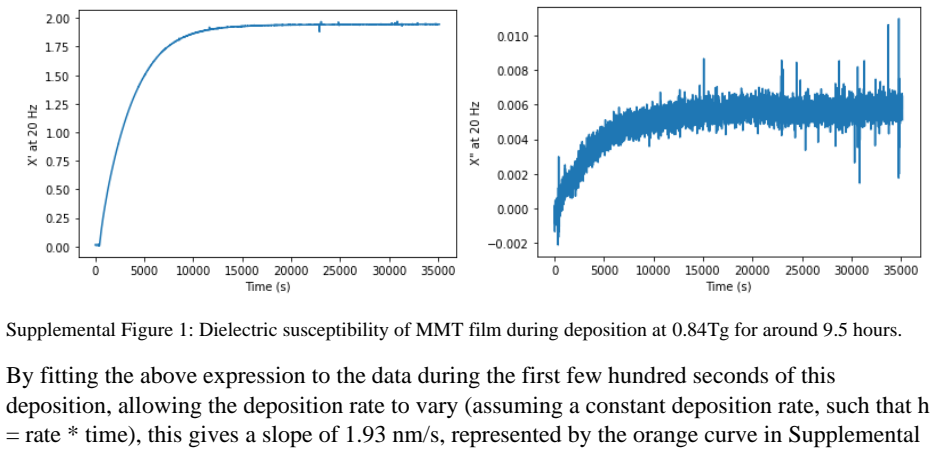
- [III.B and Supplemental Figure 9] The estimated transformation time of the 0.80Tg glass at 0.98Tg is quoted as roughly 10^6 s in the main text, while Supplemental Figure 9 states 'almost 250 ks'; these differ by a factor of four and should be reconciled.
- [IV.A and III.B] The supplemental-figure cross-references are inconsistent: Section IV.A cites Supplemental Figure 8 for the ~10^6 s rejuvenation time, but this estimate is presented with Supplemental Figure 9 in Section III.B; Supplemental Figure 8 contains the second-frequency annealing data.
- [IV.B] The experimental temperature upjump is described as 'roughly 10%', but the ratio 0.98Tg/0.80Tg corresponds to an increase of about 22%; the basis for the 10% figure should be stated.
- [SI, van Hove figure] The caption for the supplemental van Hove function is labeled 'Figure 1' instead of 'Supplemental Figure 10'.
Circularity Check
The boson-peak recovery amplitude is fitted to reproduce the measured χ′ rise, so the experimental interpretation is circular in its quantitative reconstruction.
-
fitted input called prediction
[Section IV.A, Figure 6 reconstruction paragraph]
"Using these values, we can recreate the 2% increase in the magnitude of χ’ observed at 20 Hz for the longest annealing time for the most stable glass (seen in Figure 2) as shown by the red-dashed “annealed” spectra in Figure 6. The annealed glass spectra has a boson peak intensity that has increased by 7% relative to the stable glass value."
The 7% boson-peak recovery is not independently measured or predicted; it is chosen so that the reconstructed Figure 6 spectra match the measured 2% increase in χ′. The agreement between the “annealed” reconstruction and experiment is therefore guaranteed by construction and cannot serve as evidence that a boson-peak recovery actually occurred. The paper itself concedes that “any process … occurring at a frequency greater than 105 Hz would be a possible candidate,” and that the boson peak is “speculatively identified.” The imported line shape from glycerol and the 34% suppression from indomethacin are external estimates, but the recovery amplitude—the key quantity—is tuned to the target data.
full rationale
The experimental measurement itself—an increase in χ′ with no corresponding increase in χ″ during annealing of the most stable MMT films—is an honest, self-contained observation, and the Kramers-Kronig inference that some high-frequency process strengthens is mathematically valid. The circular element arises when the paper goes further and identifies the process as boson-peak recovery: the boson-peak line shape is taken from glycerol, the 34% stable-glass suppression from indomethacin, and the 7% recovery is then selected so that the reconstructed spectra reproduce the measured 2% χ′ increase. The agreement is built in rather than predicted. The paper is unusually candid about this—it says it “can recreate” the increase, calls the identification speculative, and notes that any process above 10^5 Hz would produce the same signature—but candor does not remove the issue: the central experimental claim that the boson peak recovers before α rejuvenation rests on a fitted amplitude and imported spectral shapes, not on direct high-frequency data. The swap-Monte-Carlo simulation comparison is independent and non-circular: the MSD and van Hove analyses show no softening of glass-particle dynamics prior to transformation, and that result does not depend on the boson-peak reconstruction. Self-citations to the authors’ earlier simulation work are methodological rather than load-bearing for the new claim. Overall, the quantitative experimental interpretation is partially circular, so a score of 6 is appropriate.
Assumptions & free parameters
free parameters (7)
- tau_KWW_onset =
1e3 s (0.95Tg), 1e5 s (0.90Tg), 2e7 s (0.85Tg), 2e10 s (0.80Tg)
- tau_KWW_annealing_loss =
3.47e3 s, beta=1.1
- boson_peak_suppression =
34% for the stable glass
- boson_peak_recovery_fraction =
7% increase relative to stable glass (20% of the way to rejuvenated value)
- boson_peak_spectral_shape =
from glycerol (Ref 59)
- TNM_parameters =
x=0.32 (literature), tau0 fitted, deltaH_eff from VFT
- KWW_beta_onset_fixed =
0.5
assumptions (6)
- standard math Kramers-Kronig relations connect the real and imaginary parts of the dielectric susceptibility; a change in a process above the measurement window can increase chi' without affecting chi'' in the window.
- domain assumption The boson peak is suppressed in stable glasses relative to liquid-cooled glasses, and the degree of suppression in MMT is similar to indomethacin.
- domain assumption The 2D polydisperse swap Monte Carlo model is a valid proxy for experimental stable glasses.
- domain assumption The substrate contribution to the dielectric susceptibility is constant during the 6-hour annealing.
- domain assumption VFT extrapolation of alpha relaxation time to 0.98Tg is valid for estimating tau_alpha ~1000 s.
- domain assumption TNM model validity for extrapolating relaxation times down to deposition temperatures.
Cite this review
Pith. "Pith review of Initial Stages of Rejuvenation of Vapor-Deposited Glasses during Isothermal Annealing: Contrast Between Experiment and Simulation." pith.science (2026). https://pith.science/paper/L54PCXWN
@misc{pith2026241117540,
  author       = {Pith},
  title        = {Pith review of: Initial Stages of Rejuvenation of Vapor-Deposited Glasses during Isothermal Annealing: Contrast Between Experiment and Simulation},
  year         = {2026},
  howpublished = {\url{https://pith.science/paper/L54PCXWN}},
  note         = {Machine review of arXiv:2411.17540}
}
read the original abstract
Physical vapor deposition can prepare organic glasses with high kinetic stability. When heated, these glassy solids slowly transform into the supercooled liquid in a process known as rejuvenation. In this study, we anneal vapor-deposited glasses of methyl-m-toluate (MMT) for six hours at 0.98Tg to observe rejuvenation using dielectric spectroscopy. Glasses of moderate stability exhibited partial or full rejuvenation in six hours. For highly stable glasses, prepared at substrate temperatures of 0.85Tg and 0.80Tg, the six-hour annealing time is ~2% of the estimated transformation time, and no change in the onset temperature for the {\alpha} relaxation process was observed, as expected. Surprisingly, for these highly stable glasses, annealing resulted in significant increases in the storage component of the dielectric susceptibility, without corresponding increases in the loss component. These changes are interpreted to indicate that short-term annealing rejuvenates a high frequency relaxation (e.g., the boson peak) within the stable glass. We compare these results to computer simulations of the rejuvenation of highly stable glasses generated by the swap Monte Carlo algorithm. The in silico glasses, in contrast to the experiment, show no evidence of rejuvenation within the stable glass at times shorter than the alpha relaxation process.
Figures

Reference graph
Works this paper leans on
-
[1]
S.-J. Zou, Y. Shen, F.-M. Xie, J.-D. Chen, Y.-Q. Li and J.-X. Tang, Recent advances in organic light-emitting diodes: toward smart lighting and displays Materials Chemistry Frontiers 4, 788-820 (2020). DOI: 10.1039/c9qm00716d
-
[2]
P. G. Debenedetti and F. H. Stillinger, Supercooled liquids and the glass transition Nature 410, 259-67 (2001). DOI: 10.1038/35065704
doi:10.1038/35065704 2001
-
[3]
K. Bagchi, M. E. Fiori, C. Bishop, M. F. Toney and M. D. Ediger, Stable Glasses of Organic Semiconductor Resist Crystallization J Phys Chem B 125, 461-466 (2021). DOI: 10.1021/acs.jpcb.0c09925
-
[4]
G. J. Hedley, A. Ruseckas and I. D. Samuel, Light Harvesting for Organic Photovoltaics Chem Rev 117, 796-837 (2017). DOI: 10.1021/acs.chemrev.6b00215
-
[5]
M. Ashby and A. Greer, Metallic glasses as structural materials Scripta Materialia 54, 321-326 (2006). DOI: 10.1016/j.scriptamat.2005.09.051
-
[6]
W. H. Wang, Bulk Metallic Glasses with Functional Physical Properties Advanced Materials 21, 4524-4544 (2009). DOI: 10.1002/adma.200901053
-
[7]
P. Luo, C. R. Cao, F. Zhu, Y. M. Lv, Y. H. Liu, P. Wen, H. Y. Bai, G. Vaughan, M. di Michiel, B. Ruta and W. H. Wang, Ultrastable metallic glasses formed on cold substrates Nat Commun 9, 1389 (2018). DOI: 10.1038/s41467-018-03656-4
-
[8]
J. Q. Wang, Y. Shen, J. H. Perepezko and M. D. Ediger, Increasing the kinetic stability of bulk metallic glasses Acta Materialia 104, 25-32 (2016). DOI: 10.1016/j.actamat.2015.11.048
Show all 85 references
-
[9]
H. B. Yu, Y. Luo and K. Samwer, Ultrastable metallic glass Adv Mater 25, 5904-8 (2013). DOI: 10.1002/adma.201302700
2013 doi
-
[10]
Biroli and J
G. Biroli and J. P. Garrahan, Perspective: The glass transition J Chem Phys 138, 12A301 (2013). DOI: 10.1063/1.4795539
2013 doi
-
[11]
Casalini and C
R. Casalini and C. M. Roland, Aging of the secondary relaxation to probe structural relaxation in the glassy state Phys Rev Lett 102, 035701 (2009). DOI: 10.1103/PhysRevLett.102.035701
2009 doi
-
[12]
Duval, L
E. Duval, L. Saviot, L. David, S. Etienne and J. F. Jal, Effect of physical aging on the low-frequency vibrational density of states of a glassy polymer Europhysics Letters (EPL) 63, 778-784 (2003). DOI: 10.1209/epl/i2003-00573-x
2003 doi
-
[13]
T. D. Jaeger and D. S. Simmons, Temperature dependence of aging dynamics in highly non-equilibrium model polymer glasses J Chem Phys 156, 114504 (2022). DOI: 10.1063/5.0080717
2022 doi
-
[14]
Lubchenko and P
V. Lubchenko and P. G. Wolynes, Theory of aging in structural glasses J Chem Phys 121, 2852-65 (2004). DOI: 10.1063/1.1771633
2004 doi
-
[15]
Monnier, S
X. Monnier, S. Marina, X. Lopez de Pariza, H. Sardon, J. Martin and D. Cangialosi, Physical Aging Behavior of a Glassy Polyether Polymers (Basel) 13 (2021). DOI: 10.3390/polym13060954
2021 doi
-
[16]
Riechers, L
B. Riechers, L. A. Roed, S. Mehri, T. S. Ingebrigtsen, T. Hecksher, J. C. Dyre and K. Niss, Predicting nonlinear physical aging of glasses from equilibrium relaxation via the material time Sci Adv 8, eabl9809 (2022). DOI: 10.1126/sciadv.abl9809
2022 doi
-
[17]
Y. Zhao, B. Shang, B. Zhang, X. Tong, H. Ke, H. Bai and W. H. Wang, Ultrastable metallic glass by room temperature aging Sci Adv 8, eabn3623 (2022). DOI: 10.1126/sciadv.abn3623
2022 doi
-
[18]
M. D. Ediger, C. A. Angell and S. R. Nagel, Supercooled Liquids and Glasses The Journal of Physical Chemistry 100, 13200-13212 (1996). DOI: 10.1021/jp953538d. 23
1996 doi
-
[19]
Bruning and K
R. Bruning and K. Samwer, Glass transition on long time scales Phys Rev B Condens Matter 46, 11318-11322 (1992). DOI: 10.1103/physrevb.46.11318
1992 doi
-
[20]
C. T. Moynihan, A. J. Easteal, M. A. Bolt and J. Tucker, Dependence of the Fictive Temperature of Glass on Cooling Rate Journal of the American Ceramic Society 59, 12-16 (1976). DOI: 10.1111/j.1151-2916.1976.tb09376.x
1976
-
[21]
Kawakami, Ultraslow Cooling for the Stabilization of Pharmaceutical Glasses J Phys Chem B 123, 4996-5003 (2019)
K. Kawakami, Ultraslow Cooling for the Stabilization of Pharmaceutical Glasses J Phys Chem B 123, 4996-5003 (2019). DOI: 10.1021/acs.jpcb.9b02122
2019 doi
-
[22]
S. F. Swallen, K. L. Kearns, M. K. Mapes, Y. S. Kim, R. J. McMahon, M. D. Ediger, T. Wu, L. Yu and S. Satija, Organic glasses with exceptional thermodynamic and kinetic stability Science 315, 353-6 (2007). DOI: 10.1126/science.1135795
2007 doi
-
[23]
Berthier, P
L. Berthier, P. Charbonneau, E. Flenner and F. Zamponi, Origin of Ultrastability in Vapor-Deposited Glasses Phys Rev Lett 119, 188002 (2017). DOI: 10.1103/PhysRevLett.119.188002
2017 doi
-
[24]
Y. Chen, M. Zhu, A. Laventure, O. Lebel, M. D. Ediger and L. Yu, Influence of Hydrogen Bonding on the Surface Diffusion of Molecular Glasses: Comparison of Three Triazines J Phys Chem B 121, 7221-7227 (2017). DOI: 10.1021/acs.jpcb.7b05333
2017 doi
-
[25]
Laventure, A
A. Laventure, A. Gujral, O. Lebel, C. Pellerin and M. D. Ediger, Influence of Hydrogen Bonding on the Kinetic Stability of Vapor-Deposited Glasses of Triazine Derivatives J Phys Chem B 121, 2350-2358 (2017). DOI: 10.1021/acs.jpcb.6b12676
2017 doi
-
[26]
Luo and Z
P. Luo and Z. Fakhraai, Surface-Mediated Formation of Stable Glasses Annu Rev Phys Chem 74, 361-389 (2023). DOI: 10.1146/annurev-physchem-042018-052708
2023 doi
-
[27]
Tylinski, M
M. Tylinski, M. S. Beasley, Y. Z. Chua, C. Schick and M. D. Ediger, Limited surface mobility inhibits stable glass formation for 2-ethyl-1-hexanol J Chem Phys 146, 203317 (2017). DOI: 10.1063/1.4977787
2017 doi
-
[28]
Zhang and Z
Y. Zhang and Z. Fakhraai, Decoupling of surface diffusion and relaxation dynamics of molecular glasses Proc Natl Acad Sci U S A 114, 4915-4919 (2017). DOI: 10.1073/pnas.1701400114
2017 doi
-
[29]
Samanta, G
S. Samanta, G. Huang, G. Gao, Y. Zhang, A. Zhang, S. Wolf, C. N. Woods, Y. Jin, P. J. Walsh and Z. Fakhraai, Exploring the Importance of Surface Diffusion in Stability of Vapor- Deposited Organic Glasses J Phys Chem B 123, 4108-4117 (2019). DOI: 10.1021/acs.jpcb.9b01012
2019 doi
-
[30]
Thoms, J
E. Thoms, J. P. Gabriel, A. Guiseppi-Elie, M. D. Ediger and R. Richert, In situ observation of fast surface dynamics during the vapor-deposition of a stable organic glass Soft Matter 16, 10860-10864 (2020). DOI: 10.1039/d0sm01916j
2020 doi
-
[31]
S. S. Dalal, Z. Fakhraai and M. D. Ediger, High-throughput ellipsometric characterization of vapor-deposited indomethacin glasses J Phys Chem B 117, 15415-25 (2013). DOI: 10.1021/jp405005n
2013 doi
-
[32]
S. S. Dalal, D. M. Walters, I. Lyubimov, J. J. de Pablo and M. D. Ediger, Tunable molecular orientation and elevated thermal stability of vapor-deposited organic semiconductors Proc Natl Acad Sci U S A 112, 4227-32 (2015). DOI: 10.1073/pnas.1421042112
2015 doi
-
[33]
M. D. Ediger, Perspective: Highly stable vapor-deposited glasses J Chem Phys 147, 210901 (2017). DOI: 10.1063/1.5006265
2017 doi
-
[34]
B. J. Kasting, M. S. Beasley, A. Guiseppi-Elie, R. Richert and M. D. Ediger, Relationship between aged and vapor-deposited organic glasses: Secondary relaxations in methyl-m-toluate J Chem Phys 151, 144502 (2019). DOI: 10.1063/1.5123305. 24
2019 doi
-
[35]
K. J. Dawson, L. Zhu, L. Yu and M. D. Ediger, Anisotropic structure and transformation kinetics of vapor-deposited indomethacin glasses J Phys Chem B 115, 455-63 (2011). DOI: 10.1021/jp1092916
2011 doi
-
[36]
S. F. Swallen, K. Traynor, R. J. McMahon, M. D. Ediger and T. E. Mates, Stable glass transformation to supercooled liquid via surface-initiated growth front Phys Rev Lett 102, 065503 (2009). DOI: 10.1103/PhysRevLett.102.065503
2009 doi
-
[37]
Tylinski, A
M. Tylinski, A. Sepulveda, D. M. Walters, Y. Z. Chua, C. Schick and M. D. Ediger, Vapor-deposited glasses of methyl-m-toluate: How uniform is stable glass transformation? J Chem Phys 143, 244509 (2015). DOI: 10.1063/1.4938420
2015 doi
-
[38]
Sepulveda, S
A. Sepulveda, S. F. Swallen and M. D. Ediger, Manipulating the properties of stable organic glasses using kinetic facilitation J Chem Phys 138, 12A517 (2013). DOI: 10.1063/1.4772594
2013 doi
-
[39]
Herrero, C
C. Herrero, C. Scalliet, M. D. Ediger and L. Berthier, Two-step devitrification of ultrastable glasses Proc Natl Acad Sci U S A 120, e2220824120 (2023). DOI: 10.1073/pnas.2220824120
2023 doi
-
[40]
Ruiz-Ruiz, A
M. Ruiz-Ruiz, A. Vila-Costa, T. Bar, C. Rodríguez-Tinoco, M. Gonzalez-Silveira, J. A. Plaza, J. Alcalá, J. Fraxedas and J. Rodriguez-Viejo, Real-time microscopy of the relaxation of a glass Nature Physics (2023). DOI: 10.1038/s41567-023-02125-0
2023 doi
-
[41]
Vila-Costa, M
A. Vila-Costa, M. Gonzalez-Silveira, C. Rodríguez-Tinoco, M. Rodríguez-López and J. Rodriguez-Viejo, Emergence of equilibrated liquid regions within the glass Nature Physics 19, 114-119 (2022). DOI: 10.1038/s41567-022-01791-w
2022 doi
-
[42]
B. J. Kasting, J. P. Gabriel, M. E. Tracy, A. Guiseppi-Elie, R. Richert and M. D. Ediger, Unusual Transformation of Mixed Isomer Decahydroisoquinoline Stable Glasses J Phys Chem B (2023). DOI: 10.1021/acs.jpcb.3c00459
2023 doi
-
[43]
Herrero, M
C. Herrero, M. D. Ediger and L. Berthier, Front propagation in ultrastable glasses is dynamically heterogeneous J Chem Phys 159 (2023). DOI: 10.1063/5.0168506
2023 doi
-
[44]
Ninarello, L
A. Ninarello, L. Berthier and D. Coslovich, Models and Algorithms for the Next Generation of Glass Transition Studies Physical Review X 7 (2017). DOI: 10.1103/PhysRevX.7.021039
2017 doi
-
[45]
Scalliet, B
C. Scalliet, B. Guiselin and L. Berthier, Thirty Milliseconds in the Life of a Supercooled Liquid Physical Review X 12 (2022). DOI: 10.1103/PhysRevX.12.041028
2022 doi
-
[46]
Berthier, P
L. Berthier, P. Charbonneau, D. Coslovich, A. Ninarello, M. Ozawa and S. Yaida, Configurational entropy measurements in extremely supercooled liquids that break the glass ceiling Proc Natl Acad Sci U S A 114, 11356-11361 (2017). DOI: 10.1073/pnas.1706860114
2017 doi
-
[47]
H. B. Yu, M. Tylinski, A. Guiseppi-Elie, M. D. Ediger and R. Richert, Suppression of beta Relaxation in Vapor-Deposited Ultrastable Glasses Phys Rev Lett 115, 185501 (2015). DOI: 10.1103/PhysRevLett.115.185501
2015 doi
-
[48]
Rodriguez-Tinoco, K
C. Rodriguez-Tinoco, K. L. Ngai, M. Rams-Baron, J. Rodriguez-Viejo and M. Paluch, Distinguishing different classes of secondary relaxations from vapour deposited ultrastable glasses Phys Chem Chem Phys 20, 21925-21933 (2018). DOI: 10.1039/c8cp02341g
2018 doi
-
[49]
Perez-Castaneda, C
T. Perez-Castaneda, C. Rodriguez-Tinoco, J. Rodriguez-Viejo and M. A. Ramos, Suppression of tunneling two-level systems in ultrastable glasses of indomethacin Proc Natl Acad Sci U S A 111, 11275-80 (2014). DOI: 10.1073/pnas.1405545111
2014 doi
-
[50]
Khomenko, C
D. Khomenko, C. Scalliet, L. Berthier, D. R. Reichman and F. Zamponi, Depletion of Two-Level Systems in Ultrastable Computer-Generated Glasses Phys Rev Lett 124, 225901 (2020). DOI: 10.1103/PhysRevLett.124.225901. 25
2020 doi
-
[51]
Gonzalez-Jimenez, T
M. Gonzalez-Jimenez, T. Barnard, B. A. Russell, N. V. Tukachev, U. Javornik, L. A. Hayes, A. J. Farrell, S. Guinane, H. M. Senn, A. J. Smith, M. Wilding, G. Mali, M. Nakano, Y. Miyazaki, P. McMillan, G. C. Sosso and K. Wynne, Understanding the emergence of the boson peak in mo...
2023 doi
-
[52]
T. S. Grigera, V. Martin-Mayor, G. Parisi and P. Verrocchio, Phonon interpretation of the 'boson peak' in supercooled liquids Nature 422, 289-92 (2003). DOI: 10.1038/nature01475
2003 doi
-
[53]
Hu and H
Y.-C. Hu and H. Tanaka, Origin of the boson peak in amorphous solids Nature Physics 18, 669-677 (2022). DOI: 10.1038/s41567-022-01628-6
2022 doi
-
[54]
Shintani and H
H. Shintani and H. Tanaka, Universal link between the boson peak and transverse phonons in glass Nat Mater 7, 870-7 (2008). DOI: 10.1038/nmat2293
2008 doi
-
[55]
H. P. Zhang, B. B. Fan, J. Q. Wu, W. H. Wang and M. Z. Li, Universal relationship of boson peak with Debye level and Debye-Waller factor in disordered materials Physical Review Materials 4 (2020). DOI: 10.1103/PhysRevMaterials.4.095603
2020 doi
-
[56]
Perez-Castaneda, R
T. Perez-Castaneda, R. J. Jimenez-Rioboo and M. A. Ramos, Two-level systems and boson peak remain stable in 110-million-year-old amber glass Phys Rev Lett 112, 165901 (2014). DOI: 10.1103/PhysRevLett.112.165901
2014 doi
-
[57]
Pérez-Castañeda, R
T. Pérez-Castañeda, R. J. Jiménez-Riobóo and M. A. Ramos, Do two-level systems and boson peak persist or vanish in hyperaged geological glasses of amber? Philosophical Magazine 96, 774-787 (2015). DOI: 10.1080/14786435.2015.1111530
2015
-
[58]
M. A. Ramos, T. Pérez-Castañeda, R. J. Jiménez-Riobóo, C. Rodríguez-Tinoco and J. Rodríguez-Viejo, Do tunneling states and boson peak persist or disappear in extremely stabilized glasses? Low Temperature Physics 41, 412-418 (2015). DOI: 10.1063/1.4922089
2015 doi
-
[59]
Lunkenheimer and A
P. Lunkenheimer and A. Loidl, Dielectric spectroscopy of glass-forming materials: α- relaxation and excess wing Chemical Physics 284, 205-219 (2002). DOI: 10.1016/s0301- 0104(02)00549-9
2002 doi
-
[60]
B. Ruta, G. Baldi, V. M. Giordano, L. Orsingher, S. Rols, F. Scarponi and G. Monaco, Communication: High-frequency acoustic excitations and boson peak in glasses: A study of their temperature dependence J Chem Phys 133, 041101 (2010). DOI: 10.1063/1.3460815
2010 doi
-
[61]
K. Niss, B. Begen, B. Frick, J. Ollivier, A. Beraud, A. Sokolov, V. N. Novikov and C. Alba-Simionesco, Influence of pressure on the boson peak: stronger than elastic medium transformation Phys Rev Lett 99, 055502 (2007). DOI: 10.1103/PhysRevLett.99.055502
2007 doi
-
[62]
Monaco, A
A. Monaco, A. I. Chumakov, G. Monaco, W. A. Crichton, A. Meyer, L. Comez, D. Fioretto, J. Korecki and R. Ruffer, Effect of densification on the density of vibrational states of glasses Phys Rev Lett 97, 135501 (2006). DOI: 10.1103/PhysRevLett.97.135501
2006 doi
-
[63]
Calemczuk, R
R. Calemczuk, R. Lagnier and E. Bonjour, Specific heat of glycerol: Crystalline and glassy states Journal of Non-Crystalline Solids 34, 149-152 (1979). DOI: 10.1016/0022- 3093(79)90014-0
1979 doi
-
[64]
Y. Gao, C. Yang, G. Ding, L.-H. Dai and M.-Q. Jiang, Structural rejuvenation of a well- aged metallic glass Fundamental Research (2022). DOI: 10.1016/j.fmre.2022.12.004
2022 doi
-
[65]
Vila-Costa, J
A. Vila-Costa, J. Rafols-Ribe, M. Gonzalez-Silveira, A. F. Lopeandia, L. Abad-Munoz and J. Rodriguez-Viejo, Nucleation and Growth of the Supercooled Liquid Phase Control Glass Transition in Bulk Ultrastable Glasses Phys Rev Lett 124, 076002 (2020). DOI: 10.1103/PhysRevLett.124.076002
2020 doi
-
[66]
Richert, A simple current-to-voltage interface for dielectric relaxation measurements in the range 10−3 to 107 Hz Review of Scientific Instruments 67, 3217-3221 (1996)
R. Richert, A simple current-to-voltage interface for dielectric relaxation measurements in the range 10−3 to 107 Hz Review of Scientific Instruments 67, 3217-3221 (1996). DOI: 10.1063/1.1147445. 26
1996 doi
-
[67]
L. P. Singh and R. Richert, Two-channel impedance spectroscopy for the simultaneous measurement of two samples Rev Sci Instrum 83, 033903 (2012). DOI: 10.1063/1.3697732
2012 doi
-
[68]
Riechers, A
B. Riechers, A. Guiseppi-Elie, M. D. Ediger and R. Richert, Ultrastable and polyamorphic states of vapor-deposited 2-methyltetrahydrofuran J Chem Phys 150, 214502 (2019). DOI: 10.1063/1.5091796
2019 doi
-
[69]
A. J. Kovacs, Transition vitreuse dans les polymères amorphes. Etude phénoménologique. In Fortschritte der hochpolymeren-forschung, Springer: 2006; pp 394-507
2006
-
[70]
Cheng, Y
S. Cheng, Y. Lee, J. Yu, L. Yu and M. D. Ediger, Surface Equilibration Mechanism Controls the Stability of a Model Codeposited Glass Mixture of Organic Semiconductors J Phys Chem Lett 14, 4297-4303 (2023). DOI: 10.1021/acs.jpclett.3c00728
2023 doi
-
[71]
Rodríguez-Tinoco, M
C. Rodríguez-Tinoco, M. Gonzalez-Silveira, J. Ràfols-Ribé, G. Garcia and J. Rodríguez- Viejo, Highly stable glasses of celecoxib: Influence on thermo-kinetic properties, microstructure and response towards crystal growth Journal of Non-Crystalline Solids 407, 256-261 (2015). D...
2015 doi
-
[72]
Z. Chen, Y. Zhao and L. M. Wang, Enthalpy and dielectric relaxations in supercooled methyl m-toluate J Chem Phys 130, 204515 (2009). DOI: 10.1063/1.3142142
2009 doi
-
[73]
Sepulveda, M
A. Sepulveda, M. Tylinski, A. Guiseppi-Elie, R. Richert and M. D. Ediger, Role of fragility in the formation of highly stable organic glasses Phys Rev Lett 113, 045901 (2014). DOI: 10.1103/PhysRevLett.113.045901
2014 doi
-
[74]
C. J. Fullerton and L. Berthier, Density controls the kinetic stability of ultrastable glasses EPL (Europhysics Letters) 119 (2017). DOI: 10.1209/0295-5075/119/36003
2017 doi
-
[75]
Flenner, L
E. Flenner, L. Berthier, P. Charbonneau and C. J. Fullerton, Front-Mediated Melting of Isotropic Ultrastable Glasses Phys Rev Lett 123, 175501 (2019). DOI: 10.1103/PhysRevLett.123.175501
2019 doi
-
[76]
K. L. Ngai and M. Paluch, Classification of secondary relaxation in glass-formers based on dynamic properties J Chem Phys 120, 857-73 (2004). DOI: 10.1063/1.1630295
2004 doi
-
[77]
Paluch, S
M. Paluch, S. Pawlus, S. Hensel-Bielowka, E. Kaminska, D. Prevosto, S. Capaccioli, P. A. Rolla and K. L. Ngai, Two secondary modes in decahydroisoquinoline: which one is the true Johari Goldstein process? J Chem Phys 122, 234506 (2005). DOI: 10.1063/1.1931669
2005 doi
-
[78]
Wlodarczyk, B
P. Wlodarczyk, B. Czarnota, M. Paluch, S. Pawlus and J. Ziolo, Microscopic origin of secondary modes observed in decahydroisoquinoline Journal of Molecular Structure 975, 200- 204 (2010). DOI: 10.1016/j.molstruc.2010.04.023
2010 doi
-
[79]
Berthier and M
L. Berthier and M. D. Ediger, How to "measure" a structural relaxation time that is too long to be measured? J Chem Phys 153, 044501 (2020). DOI: 10.1063/5.0015227
2020 doi
-
[80]
G. B. McKenna, Diverging views on glass transition Nature Physics 4, 673-673 (2008). DOI: 10.1038/nphys1063
2008 doi
-
[81]
G. B. McKenna and J. Zhao, Accumulating evidence for non-diverging time-scales in glass-forming fluids Journal of Non-Crystalline Solids 407, 3-13 (2015). DOI: 10.1016/j.jnoncrysol.2014.08.012
2015 doi
-
[82]
D. Kong, Y. Meng and G. B. McKenna, Searching for the ideal glass transition: Going to yotta seconds and beyond Journal of Non-Crystalline Solids 606 (2023). DOI: 10.1016/j.jnoncrysol.2023.122186
2023
-
[83]
K. L. Kearns, S. F. Swallen, M. D. Ediger, T. Wu, Y. Sun and L. Yu, Hiking down the energy landscape: progress toward the Kauzmann temperature via vapor deposition J Phys Chem B 112, 4934-42 (2008). DOI: 10.1021/jp7113384. 27
2008 doi
-
[84]
O. S. Narayanaswamy, A Model of Structural Relaxation in Glass Journal of the American Ceramic Society 54, 491-498 (1971). DOI: 10.1111/j.1151-2916.1971.tb12186.x
1971
-
[85]
A. Q. Tool, Relation between Inelastic Deformability and Thermal Expansion of Glass in Its Annealing Range* Journal of the American Ceramic Society 29, 240-253 (1946). DOI: 10.1111/j.1151-2916.1946.tb11592.x. 1 Supplementary Material for Initial Stages of Rejuvenation of Vapor...
1946
Reviewed August 12, 2026 · model on record in the stance chip above.
Discussion (0). Continue with ORCID to comment.