REVIEW 4 major objections 6 minor 46 references
Automating Chapter-Level Classification for Electronic Theses and Dissertations
T0 review · 4 major / 6 minor · reviewed 2026-08-12 · deepseek-v4-flash
Pith's one-line read Fine-tuned language models can automatically classify individual thesis chapters by subject, outperforming traditional machine learning and generic pre-trained models.
desk verdict Solid classifier benchmark for ETD chapters, but the ground truth is department metadata, not chapter content, so the reported F1 numbers overstate the claim. read the letter →
The pith
A machine-rendered reading of the paper's core claim, the machinery that carries it, and where it could break.
The reading
What carries the argument
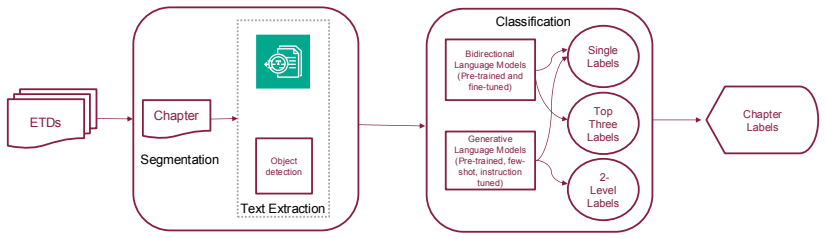
The load-bearing object is the classification benchmark ETD-CL: 9,400 documents from 47 departments, with each document's department metadata mapped to the three-level ProQuest subject taxonomy to form class labels. Around it sits a pipeline: manual chapter segmentation (ETD-SGT), text extraction that combines a commercial OCR service with an object-detection model to strip headers, footers, captions, figures, and equations, and supervised classifiers trained on the ProQuest label space. The decisive mechanism is fine-tuning: BERT and SciBERT are adapted on the FTD corpus of 8,200 born-digital ETDs, and this domain adaptation is what pushes the bidirectional models past both the traditional baselines and their own pre-trained versions. For multi-label output, the same models swap softmax for sigmoid and take the top three predictions.
What would settle it
Have two annotators read a random sample of, say, 200 ETD-CL chapters and assign ProQuest categories from content alone, then measure agreement with the department-derived labels; if agreement is near chance, the reported F1 scores mostly reflect departmental signal, not chapter-level content.
Extended reading notes
Core claim
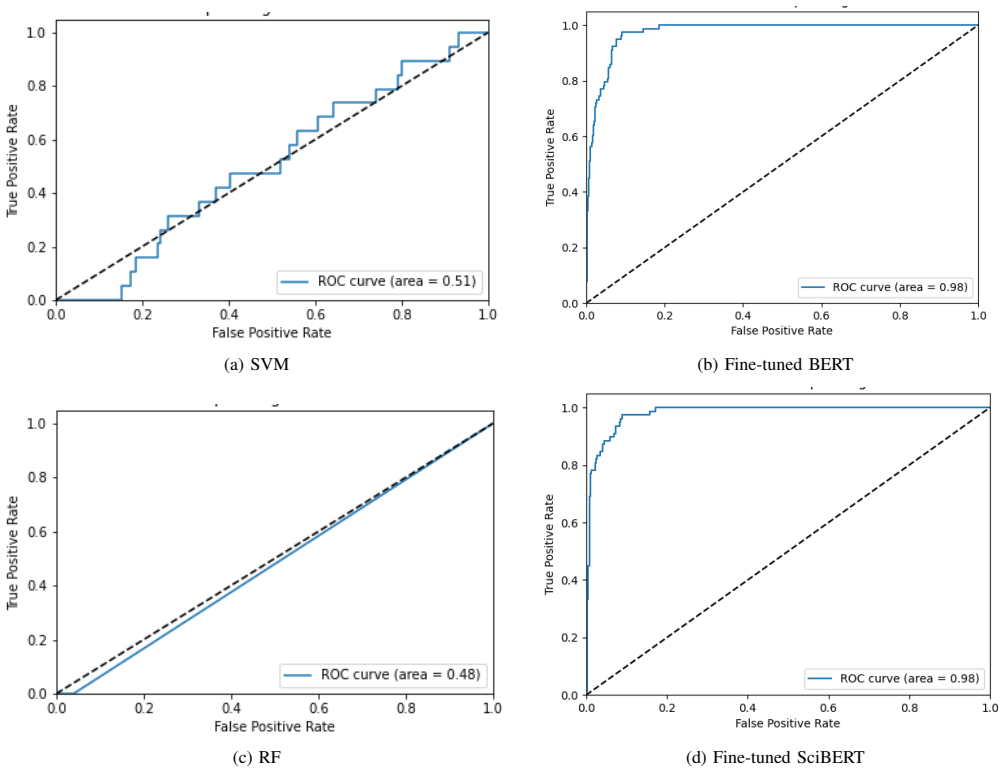
The central claim is that chapter-level classification of ETDs is not only feasible but best done by domain-adapted bidirectional language models. Fine-tuning BERT and SciBERT on born-digital ETD text improves both models on both test sets; SciBERT+ETD reaches $F_1 = 0.6666$ on the ETD-CL dataset, the best of any single-label classifier tested, versus $F_1 = 0.340$ for SVM and $F_1 = 0.228$ for random forest. When the task is relaxed to top-three multi-label prediction with a sigmoid output, the fine-tuned SciBERT model achieves 0.91 accuracy, and the paper reads this as evidence that multi-label prediction better captures the interdisciplinary nature of chapters. For generative LLMs, the paper reports best $F_1$ around 0.53, with instruction-tuned Llama-2 and few-shot Llama-3 producing labels that often fall outside the fixed 47-class set and require subject-matter expertise to map.
Load-bearing premise
The benchmark labels are derived from each document's department mapped to ProQuest categories, assuming that what a chapter says matches the department of the whole dissertation; the paper does not verify this against chapter content.
Editorial extensions
If this is right
- Once chapters are segmented, the classification step itself is fully automatic: chapter text plus a fixed label set is enough for the fine-tuned models to produce subject tags.
- Fine-tuning on ETD text is a worthwhile cost: BERT+ETD and SciBERT+ETD beat their pre-trained counterparts on both the PQDT and ETD-CL datasets.
- Multi-label top-three prediction is a better fit for interdisciplinary chapters than single-label classification, lifting accuracy from around 0.66 to 0.85–0.91 for the fine-tuned models.
- Generative LLMs are not yet reliable classifiers for this task: Llama-2 and Llama-3 underperform fine-tuned SciBERT and produce output that does not stay within the label set.
Reading between the lines
- The reported top-three accuracy is a relaxed hit-rate, not a full multi-label metric; a stricter evaluation would require predicting every relevant label per chapter, which would need content-based annotations.
- The ground-truth labels come from department metadata, so a content-based re-annotation of a random chapter sample would test whether the benchmark measures chapter content or departmental affiliation.
- A natural follow-up is a retrieval experiment: index chapters by these labels and measure whether scholars find relevant sections faster than with document-level metadata; the paper lists quantifying this improvement as future work.
Editorial analysis
A structured set of objections, weighed in public.
Referee Report
Summary. The paper addresses a real problem in digital libraries: ETDs lack chapter-level metadata, so the authors propose a pipeline that segments ETDs, extracts text, and classifies chapters into ProQuest subject categories. They compare random forests, SVM, BERT, SciBERT and their fine-tuned versions on two datasets (PQDT and the newly introduced ETD-CL), evaluate multi-label top-3 prediction, and experiment with Llama-2 and Llama-3 with zero-shot, few-shot, and instruction-tuned prompting. The main reported results are that language models outperform traditional classifiers, fine-tuning on an ETD corpus improves F1 (SciBERT+ETD reaches 0.6666 on ETD-CL), and top-3 multi-label accuracy reaches 0.91.
Significance. If the chapter-level claim were supported, this would be a useful contribution to computational archival science and ETD accessibility: the manual segmentation effort (ETD-SGT) and the systematic comparison across six classifiers plus two LLM families provide a useful reference point. The paper also deserves credit for including a concrete error analysis for LLM output (82 predicted classes versus 47 labels) and a reproducibility-conscious description of the experimental setup. However, the central evaluation is weakened by the construction of ETD-CL labels as department metadata mapped to ProQuest categories rather than as content-based chapter labels, and by several evaluation-design issues. The comparative ranking of models may be informative, but the headline chapter-level interpretation is not currently supported.
major comments (4)
- [Sec. III-E and Table I] The ETD-CL labels are not chapter-content labels. Section III-C says ETD-CL was built by selecting 200 documents per department, and Section III-E says labels are obtained by mapping department metadata to ProQuest categories; however, Table I describes ETD-CL as "Manually assigned labels." Because each chapter inherits the department's ProQuest category, the motivating example in the Introduction (an environmental-science dissertation with a statistics chapter) is mislabeled by construction. The F1 values in Table III therefore measure how well the classifier recovers a department-derived proxy, not whether chapter content is categorized correctly. The authors should either validate the mapping against human content-based annotations on a sample of chapters, or reframe the experiments explicitly as department-level classification. This is the central claim of the paper, so it must be addressed before the chapter-level results can be accepted.
- [Sec. III-A, III-C and Tables II-III] The relationship between the manually segmented ETD-SGT corpus (244 documents, 11 departments) and the ETD-CL corpus (9,400 documents, 47 departments) is never made explicit. Tables II and III are reported as classification results, but it is unclear whether the input units are chapters or whole documents, and whether ETD-CL is segmented at all. If the ETD-CL experiments use whole documents, then the "chapter-level classification" claim is not tested. Please specify the unit of analysis for every table and, if necessary, rerun the comparison on the segmented chapters in ETD-SGT.
- [Table VI and Sec. V-D1] The multi-label comparison is not apples-to-apples. Table VI compares multi-class top-1 accuracy (0.60–0.66) with sigmoid-based top-3 accuracy (0.85, 0.91), and "accuracy" is defined as whether the single ground-truth label appears among the top three predictions. Since the chance baseline differs between top-1 and top-3 (e.g., 1/47 versus 3/47 for random selection), these numbers are not directly comparable to the top-1 accuracies. To support the RQ3 conclusion that multi-label classification outperforms multi-class classification, the authors should report matched evaluation criteria (e.g., top-1 accuracy for both, or top-3 recall with the same number of allowed labels) and ideally precision/recall at the top-3 cutoff.
- [Sec. V-A and Tables II-III] No statistical significance or variance is reported for the core classifier comparison. The gap between SciBERT (F1=0.6592) and SciBERT+ETD (F1=0.6666) in Table III is small, and the paper does not state how the train/test splits were performed or whether repeated runs were averaged. Without confidence intervals or significance tests, the claims that fine-tuning helps (RQ2) and that language models outperform SVM/RF rest on point estimates that may not be stable. Please add standard deviations or significance tests, and describe the splitting procedure.
minor comments (6)
- [Sec. II] The term "Receiver Operative Characteristic" should be "Receiver Operating Characteristic."
- [Sec. V-C1] The sentence "Performance for instruction-tuned Llama-2 is compared with Llama-3 in Fig. IV" references a nonexistent figure; it should refer to Table IV.
- [Sec. V-C] The statement that setting the temperature to 0 would result in a division-by-zero error is not a general property of LLM sampling implementations; please clarify the specific framework behavior.
- [Table V] In the few-shot row, the standard deviation for F1 is reported as 0 while the standard deviation for recall is 0.0057; this inconsistency should be explained or corrected.
- [Sec. III-E] The paper says all three ProQuest category levels and the subject code are recorded, but it does not specify which level is used as the classification label in Tables II, III, and VI; please state this explicitly.
- [Sec. V-D2] The choice of 0.6 as the cosine-similarity threshold for "limited alignment" is not justified; please provide a rationale or use a more standard agreement measure.
Circularity Check
No significant circularity: classification results are empirical and not forced by construction; the department-derived-label concern is a validity issue, not a circular derivation.
full rationale
None of the paper's load-bearing steps reduces to its own inputs. The supervised comparisons (Tables II and III) evaluate classifier outputs against fixed ProQuest ground-truth labels; the fine-tuned models are trained on the FTD corpus (Section III-D) and tested on PQDT and ETD-CL, so the reported F1 values are empirical outcomes that could have favored either family. Self-citations (e.g., [35] for the ETD collection, [23] for exploratory analysis, [1] for the prototype) supply data and tooling but do not by themselves determine the classification ranking, and no 'uniqueness' theorem is imported. The skeptical concern is real but not circular: Section III-E states 'we map department information from the ETD-CL metadata to the corresponding ProQuest categories,' while Table I calls ETD-CL 'Manually assigned labels'; this means the benchmark may measure recovery of department-derived categories rather than true chapter content, and the introductory statistics-chapter-in-environmental-science example suggests such labels can mislabel interdisciplinary chapters. That is a construct-validity threat to the chapter-level claim, and it should be weighed as a correctness risk, but it is not a derivation that equals its inputs by construction: the model predictions are not fitted to or defined by those labels.
Assumptions & free parameters
free parameters (2)
- Temperature for Llama models =
0.001
- Number of top labels K in multi-label evaluation =
3
assumptions (4)
- domain assumption Department metadata is a reliable proxy for the subject content of each chapter
- domain assumption Manual segmentation of ETDs into chapters is accurate
- domain assumption ProQuest subject categories are an appropriate label scheme for chapters
- domain assumption AWS Textract and object detection extract clean chapter text
Cite this review
Pith. "Pith review of Automating Chapter-Level Classification for Electronic Theses and Dissertations." pith.science (2026). https://pith.science/paper/J5VEUETC
@misc{pith2026241117614,
  author       = {Pith},
  title        = {Pith review of: Automating Chapter-Level Classification for Electronic Theses and Dissertations},
  year         = {2026},
  howpublished = {\url{https://pith.science/paper/J5VEUETC}},
  note         = {Machine review of arXiv:2411.17614}
}
read the original abstract
Traditional archival practices for describing electronic theses and dissertations (ETDs) rely on broad, high-level metadata schemes that fail to capture the depth, complexity, and interdisciplinary nature of these long scholarly works. The lack of detailed, chapter-level content descriptions impedes researchers' ability to locate specific sections or themes, thereby reducing discoverability and overall accessibility. By providing chapter-level metadata information, we improve the effectiveness of ETDs as research resources. This makes it easier for scholars to navigate them efficiently and extract valuable insights. The absence of such metadata further obstructs interdisciplinary research by obscuring connections across fields, hindering new academic discoveries and collaboration. In this paper, we propose a machine learning and AI-driven solution to automatically categorize ETD chapters. This solution is intended to improve discoverability and promote understanding of chapters. Our approach enriches traditional archival practices by providing context-rich descriptions that facilitate targeted navigation and improved access. We aim to support interdisciplinary research and make ETDs more accessible. By providing chapter-level classification labels and using them to index in our developed prototype system, we make content in ETD chapters more discoverable and usable for a diverse range of scholarly needs. Implementing this AI-enhanced approach allows archives to serve researchers better, enabling efficient access to relevant information and supporting deeper engagement with ETDs. This will increase the impact of ETDs as research tools, foster interdisciplinary exploration, and reinforce the role of archives in scholarly communication within the data-intensive academic landscape.
Figures

Figures from the paper (2 more)


Reference graph
Works this paper leans on
-
[1]
Integrated digital library system for long documents and their elements,
S. Chekuri, P. Chandrasekar, B. Banerjee, S. H. Park, N. Masrourisaadat, A. Ahuja, W. A. Ingram, and E. A. Fox, “Integrated digital library system for long documents and their elements,” in 2023 ACM/IEEE Joint Conference on Digital Libraries (JCDL) . IEEE, 2023, pp. 13–24
work page 2023
-
[2]
What is Past is Prologue: A History of Archival Ideas Since 1898, and the Future Paradigm Shift,
T. Cook, “What is Past is Prologue: A History of Archival Ideas Since 1898, and the Future Paradigm Shift,” Archivaria, pp. 17–63, Feb. 1997. [Online]. Available: https://archivaria.ca/index.php/ archivaria/article/view/12175
work page 1997
-
[3]
M. Dougherty and E. T. Meyer, “Community, tools, and practices in web archiving: The state-of-the-art in relation to social science and humanities research needs,” Journal of the Association for Information Science and Technology , vol. 65, no. 11, pp. 2195–2209, 2014, eprint: https://onlinelibrary.wiley.com/doi/pdf/10.1002/asi.23099. [Online]. Available:...
-
[4]
Research data management services in academic research libraries and perceptions of librarians,
C. Tenopir, R. J. Sandusky, S. Allard, and B. Birch, “Research data management services in academic research libraries and perceptions of librarians,” Library & Information Science Research , vol. 36, no. 2, pp. 84–90, 2014. [Online]. Available: https: //www.sciencedirect.com/science/article/pii/S0740818814000255
work page 2014
-
[5]
Language Models are Unsupervised Multitask Learners,
A. Radford, J. Wu, R. Child, D. Luan, D. Amodei, and I. Sutskever, “Language Models are Unsupervised Multitask Learners,”
-
[6]
OpenAI, “Introducing ChatGPT.” [Online]. Available: https://openai. com/index/chatgpt/
-
[7]
A Neural Probabilistic Language Model,
Y . Bengio, R. Ducharme, and P. Vincent, “A Neural Probabilistic Language Model,” in Advances in Neural Information Processing Systems , vol. 13. MIT Press, 2000. [Online]. Available: https://proceedings.neurips.cc/paper/2000/hash/ 728f206c2a01bf572b5940d7d9a8fa4c-Abstract.html
work page 2000
-
[8]
A. Vaswani, N. Shazeer, N. Parmar, J. Uszkoreit, L. Jones, A. N. Gomez, L. Kaiser, and I. Polosukhin, “Attention is all you need,” in Advances in Neural Information Processing Systems ,
Show all 46 references
-
[9]
BERT: Pre-training of deep bidirectional transformers for language understanding,
J. Devlin, M.-W. Chang, K. Lee, and K. Toutanova, “BERT: Pre-training of deep bidirectional transformers for language understanding,” in Proceedings of the 2019 Conference of the North American Chapter of the Association for Computational Linguistics: Human Language Technologi...
2019
-
[10]
SciBERT: A pretrained language model for scientific text,
I. Beltagy, K. Lo, and A. Cohan, “SciBERT: A pretrained language model for scientific text,” in Proceedings of the 2019 Conference on Empirical Methods in Natural Language Processing and the 9th International Joint Conference on Natural Language Processing (EMNLP-IJCNLP) . Hon...
2019
-
[11]
Roberta: A robustly optimized bert pretraining approach,
Y . Liu, M. Ott, N. Goyal, J. Du, M. Joshi, D. Chen, O. Levy, M. Lewis, L. Zettlemoyer, and V . Stoyanov, “Roberta: A robustly optimized bert pretraining approach,” arXiv, vol. abs/1907.11692, 2019. [Online]. Available: https://doi.org/10.48550/arXiv.1907.11692
-
[12]
Big bird: Transformers for longer sequences,
M. Zaheer, G. Guruganesh, K. A. Dubey, J. Ainslie, C. Alberti, S. Onta ˜n´on, P. Pham, A. Ravula, Q. Wang, L. Yang, and A. Ahmed, “Big bird: Transformers for longer sequences,” in Advances in Neural Information Processing Systems 33: Annual Conference on Neural Information Pro...
2020
-
[13]
Longformer: The Long- Document Transformer,
I. Beltagy, M. E. Peters, and A. Cohan, “Longformer: The Long- Document Transformer,” arXiv:2004.05150 [cs] , Dec. 2020, arXiv: 2004.05150. [Online]. Available: http://arxiv.org/abs/2004.05150
2004 arXiv
-
[14]
Improving language understanding by generative pre-training,
A. Radford, K. Narasimhan, T. Salimans, I. Sutskever et al., “Improving language understanding by generative pre-training,” 2018. [Online]. Available: https://s3-us-west-2.amazonaws.com/openai-assets/research- covers/language-unsupervised/language understanding paper.pdf
2018
-
[15]
Llama 3 model card,
AI@Meta, “Llama 3 model card,” 2024. [Online]. Available: https://github.com/meta-llama/llama3/blob/main/MODEL CARD.md
2024
-
[16]
Phi-3 Technical Report: A Highly Capable Language Model Locally on Your Phone,
M. e. a. Abdin, “Phi-3 Technical Report: A Highly Capable Language Model Locally on Your Phone,” Aug. 2024, arXiv:2404.14219. [Online]. Available: http://arxiv.org/abs/2404.14219
2024 arXiv
-
[17]
Mistral 7B,
A. Q. Jiang, A. Sablayrolles, A. Mensch, C. Bamford, D. S. Chaplot, D. d. l. Casas, F. Bressand, G. Lengyel, G. Lample, L. Saulnier, L. R. Lavaud, M.-A. Lachaux, P. Stock, T. L. Scao, T. Lavril, T. Wang, T. Lacroix, and W. E. Sayed, “Mistral 7B,” Oct. 2023, arXiv:2310.06825. [...
2023 arXiv
-
[18]
Claude 2,
Anthropic, “Claude 2,” 2023. [Online]. Available: https://www. anthropic.com/index/claude-2
2023
-
[19]
A training algorithm for optimal margin classifiers,
B. E. Boser, I. M. Guyon, and V . N. Vapnik, “A training algorithm for optimal margin classifiers,” in Proceedings of the Fifth Annual Workshop on Computational Learning Theory , ser. COLT ’92. New York, NY , USA: Association for Computing Machinery, 1992, p. 144–152. [Online]...
1992
-
[20]
Random forests,
L. Breiman, “Random forests,” Machine Learning , vol. 45, no. 1, pp. 5–32, Oct 2001. [Online]. Available: https://doi.org/10.1023/A: 1010933404324
2001 doi
-
[21]
Increasing Accessibility of Electronic Theses and Disser- tations (ETDs) Through Chapter-level Classification,
P. M. Jude, “Increasing Accessibility of Electronic Theses and Disser- tations (ETDs) Through Chapter-level Classification,” http://hdl.handle. net/10919/99294, Blacksburg, V A, USA, 2020, [VTechWorks; VT MS Thesis; Online; accessed 25-September-2020]
2020
-
[22]
Subject Categories 2019-2020 Academic Year,
ProQuest, “Subject Categories 2019-2020 Academic Year,” 2002. [Online]. Available: https://about.proquest.com/globalassets/proquest/ files/pdf-files/subject-categories-academic.pdf
2019
-
[23]
Applications of data analysis on scholarly long documents,
B. Banerjee, W. A. Ingram, J. Wu, and E. A. Fox, “Applications of data analysis on scholarly long documents,” in 2022 IEEE International Conference on Big Data (Big Data) . Online: IEEE, 2022, pp. 2473–
2022
-
[24]
Improving Access to ETD Elements Through Chapter Categorization and Summarization,
B. Banerjee, “Improving Access to ETD Elements Through Chapter Categorization and Summarization,” Aug. 2024, publisher: Virginia Tech. [Online]. Available: https://hdl.handle.net/10919/120890
2024
-
[25]
What Is Instruction Tuning? | IBM,
IBM, “What Is Instruction Tuning? | IBM,” Apr. 2024. [Online]. Available: https://www.ibm.com/topics/instruction-tuning
2024
-
[26]
Language Models are Few-Shot Learners,
T. B. Brown, B. Mann, N. Ryder, M. Subbiah, J. Kaplan, P. Dhariwal, A. Neelakantan, P. Shyam, G. Sastry, A. Askell, S. Agarwal, A. Herbert-V oss, G. Krueger, T. Henighan, R. Child, A. Ramesh, D. M. Ziegler, J. Wu, C. Winter, C. Hesse, M. Chen, E. Sigler, M. Litwin, S. Gray, B....
2020 arXiv
-
[27]
Understanding Zero-Shot Learning — Mak- ing ML More Human,
E. Tiu, “Understanding Zero-Shot Learning — Mak- ing ML More Human,” Jul. 2021. [Online]. Avail- able: https://towardsdatascience.com/understanding-zero-shot-learning- making-ml-more-human-4653ac35ccab
2021
-
[28]
Zero-shot learning through cross-modal transfer,
R. Socher, M. Ganjoo, C. D. Manning, and A. Ng, “Zero-shot learning through cross-modal transfer,” in Advances in Neural Information Processing Systems , C. Burges, L. Bottou, M. Welling, Z. Ghahramani, and K. Weinberger, Eds., vol. 26. Curran Associates, Inc., 2013. [Online]....
2013
-
[29]
Prototypical Networks for Few-shot Learning,
J. Snell, K. Swersky, and R. S. Zemel, “Prototypical Networks for Few-shot Learning,” Jun. 2017, arXiv:1703.05175 [cs, stat]. [Online]. Available: http://arxiv.org/abs/1703.05175
2017 arXiv
-
[30]
Meta-Learning for Semi-Supervised Few-Shot Classification,
M. Ren, E. Triantafillou, S. Ravi, J. Snell, K. Swersky, J. B. Tenenbaum, H. Larochelle, and R. S. Zemel, “Meta-Learning for Semi-Supervised Few-Shot Classification,” Mar. 2018, arXiv:1803.00676 [cs, stat]. [Online]. Available: http://arxiv.org/abs/1803.00676
2018 arXiv
-
[31]
Chain-of-Thought Prompting Elicits Reasoning in Large Language Models,
J. Wei, X. Wang, D. Schuurmans, M. Bosma, B. Ichter, F. Xia, E. Chi, Q. Le, and D. Zhou, “Chain-of-Thought Prompting Elicits Reasoning in Large Language Models,” Jan. 2023, arXiv:2201.11903. [Online]. Available: http://arxiv.org/abs/2201.11903
2023 arXiv
-
[32]
A method of comparing the areas under receiver operating characteristic curves derived from the same cases
J. A. Hanley and B. J. McNeil, “A method of comparing the areas under receiver operating characteristic curves derived from the same cases.” Radiology, vol. 148, no. 3, pp. 839–843, Sep. 1983. [Online]. Available: http://pubs.rsna.org/doi/10.1148/radiology.148.3.6878708
1983 doi
-
[33]
Use and Misuse of the Receiver Operating Characteristic Curve in Risk Prediction,
N. R. Cook, “Use and Misuse of the Receiver Operating Characteristic Curve in Risk Prediction,” Circulation, vol. 115, no. 7, pp. 928–935, Feb 2007, publisher: American Heart Association. [Online]. Available: https://www.ahajournals.org/doi/full/ 10.1161/CIRCULATIONAHA.106.672402
2007 doi
-
[34]
The use of the area under the ROC curve in the evaluation of machine learning algorithms,
A. P. Bradley, “The use of the area under the ROC curve in the evaluation of machine learning algorithms,” Pattern Recognition , vol. 30, no. 7, pp. 1145–1159, July 1997. [Online]. Available: https://www.sciencedirect.com/science/article/pii/S0031320396001422
1997
-
[35]
Building A large collection of multi-domain electronic theses and dissertations,
S. Uddin, B. Banerjee, J. Wu, W. A. Ingram, and E. A. Fox, “Building A large collection of multi-domain electronic theses and dissertations,” in 2021 IEEE International Conference on Big Data (Big Data), Orlando, FL, USA, December 15-18, 2021 , Y . Chen, H. Ludwig, Y . Tu, U. ...
2021
-
[36]
OCR Software, Data Extraction Tool - Amazon Textract - AWS,
A. W. Services, “OCR Software, Data Extraction Tool - Amazon Textract - AWS,” 2019. [Online]. Available: https://aws.amazon.com/textract/
2019
-
[37]
Parsing Electronic Theses and Dissertations Using Object Detection,
A. Ahuja, A. Devera, and E. A. Fox, “Parsing Electronic Theses and Dissertations Using Object Detection,” in Proceedings of the first Workshop on Information Extraction from Scientific Publications . Online: Association for Computational Linguistics, Nov. 2022, pp. 121–130. [O...
2022
-
[38]
Segmenting Electronic Theses and Dissertations By Chapters,
J. A. Manzoor, “Segmenting Electronic Theses and Dissertations By Chapters,” Thesis, Virginia Tech, Jan. 2023, accepted: 2023-01- 19T09:00:28Z. [Online]. Available: https://hdl.handle.net/10919/113246
2023
-
[39]
Advanced Research Computing,
V . T. Advanced Research Computing, “Advanced Research Computing,”
-
[40]
meta-llama/Llama-2-13b-hf · Hugging Face,
AI@Meta, “meta-llama/Llama-2-13b-hf · Hugging Face,” jul 2023. [Online]. Available: https://huggingface.co/meta-llama/Llama-2-13b-hf
2023
-
[41]
meta-llama/Meta-Llama-3-8B-Instruct · Hugging Face,
A. I. @Meta, “meta-llama/Meta-Llama-3-8B-Instruct · Hugging Face,” Apr 2024. [Online]. Available: https://huggingface.co/meta-llama/Meta- Llama-3-8B-Instruct
2024
-
[42]
Sentence-BERT: Sentence Embeddings using Siamese BERT-Networks,
N. Reimers and I. Gurevych, “Sentence-BERT: Sentence Embeddings using Siamese BERT-Networks,” inProceedings of the 2019 Conference on Empirical Methods in Natural Language Processing . Association for Computational Linguistics, 11 2019. [Online]. Available: https: //arxiv.org/...
2019 arXiv
-
[2017]
Available: https://proceedings.neurips.cc/paper/2017/ file/3f5ee243547dee91fbd053c1c4a845aa-Paper.pdf
[Online]. Available: https://proceedings.neurips.cc/paper/2017/ file/3f5ee243547dee91fbd053c1c4a845aa-Paper.pdf
2017
-
[2019]
Available: https://www.semanticscholar.org/paper/ Language-Models-are-Unsupervised-Multitask-Learners-Radford- Wu/9405cc0d6169988371b2755e573cc28650d14dfe
[Online]. Available: https://www.semanticscholar.org/paper/ Language-Models-are-Unsupervised-Multitask-Learners-Radford- Wu/9405cc0d6169988371b2755e573cc28650d14dfe
-
[2024]
Available: https://arc.vt.edu/content/arc vt edu/en/ index.html
[Online]. Available: https://arc.vt.edu/content/arc vt edu/en/ index.html
-
[2481]
Available: doi:10.1109/BigData55660.2022.10020935
[Online]. Available: doi:10.1109/BigData55660.2022.10020935
2022
Reviewed August 12, 2026 · model on record in the stance chip above.
Discussion (0). Continue with ORCID to comment.