REVIEW 2 major objections 6 minor 2 cited by
CityWalker: Learning Embodied Urban Navigation from Web-Scale Videos
T0 review · 2 major / 6 minor · reviewed 2026-08-12 · deepseek-v4-flash
Pith's one-line read The paper claims that a navigation policy trained on 2,000+ hours of web walking and driving videos, labeled only by noisy visual odometry, reaches a 77.3% real-world success rate in urban navigation, beating fine-tuned baselines.
desk verdict CityWalker is a genuinely useful result in embodied urban navigation, with real-world quadruped trials and data-scaling evidence, but the training pipeline has a load-bearing gap: target waypoint and arrival labels for web videos are never specified. read the letter →
The pith
A machine-rendered reading of the paper's core claim, the machinery that carries it, and where it could break.
The reading
What carries the argument
The load-bearing mechanism is the conversion of raw web video into imitation-learning supervision: visual odometry (DPVO) gives relative poses between frames, and each action is normalized by the average step length of its trajectory, folding the scale ambiguity of monocular odometry and the different stride lengths of walking versus driving into one abstract action space. The learned policy is a transformer that ingests past frame tokens, a history of positions, and the target waypoint, and emits a five-step action horizon together with an arrival prediction. Its training combines an orientation loss (negative cosine similarity between predicted and ground-truth actions), an L1 action loss, a binary arrival loss, and a feature-hallucination loss that penalizes the gap between predicted future tokens and the actual future frame tokens, pressing the model to anticipate what it will see next. The design bet is that volume and diversity of data compensate for the noise in odometry-derived labels.
What would settle it
Reproduce the data pipeline on a subset of the sourced web videos: if target coordinates and arrival labels cannot be recovered from the visual-odometry trajectories alone (or from another described source), the training procedure as written cannot produce the reported policy. A complementary check is to rerun the real-world trials with more than the reported 8-14 runs per maneuver and with a more accurate position source, since the paper itself notes sensitivity to GPS noise; the claimed 20-point success gap over fine-tuned ViNT should survive those conditions.
Extended reading notes
Core claim
The paper's central claim is that noisy pseudo-labels from off-the-shelf visual odometry are sufficient supervision to learn urban navigation from in-the-wild video. Deep patch visual odometry (DPVO) extracts relative camera poses between nearby frames of 2,000+ hours of city walking and driving footage, and each action is normalized by the average step length of its trajectory so that scale differences between walking and driving disappear. The CityWalker policy is a transformer that consumes frozen DINOv2 features of past frames, past positions, and a target waypoint, and predicts five future actions plus an arrival flag; it is trained with an orientation loss, an L1 action loss, an arrival BCE loss, and a feature-hallucination loss that asks the transformer to predict future image tokens. Fine-tuned on six hours of teleoperated Unitree Go1 data in New York City, it reaches 77.3% real-world success versus 57.1% for fine-tuned ViNT and 42.9% for zero-shot NoMaD, with the largest gains in turns, crossings, crowds, and proximity situations; its own ablations attribute most of the gain to data scale and fine-tuning rather than the auxiliary losses. The paper's conclusion is that abundant online video can substitute for expensive expert teleoperation in building robust urban navigation policies.
Load-bearing premise
Every training sample requires a target waypoint coordinate and an arrival-status label, but the paper never explains where these come from for the unlabeled web videos, whose only extracted labels are camera-motion estimates.
Editorial extensions
If this is right
- A navigation policy fine-tuned with just six hours of expert data after web-video pretraining reaches 77.3% real-world success, versus 57.1% for fine-tuned ViNT and 42.9% for zero-shot NoMaD.
- The zero-shot web-trained model already matches or beats fine-tuned baselines on offline arrival accuracy (84.1% versus 70.7%), implying pretraining on diverse web video can substitute for in-domain expert data.
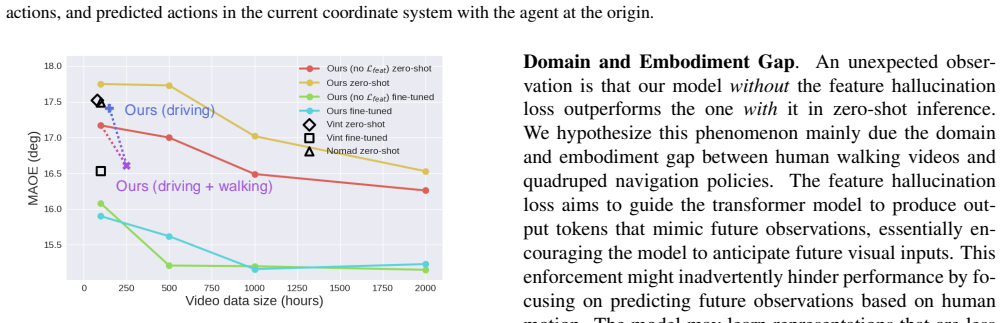
- Performance scales with data: beyond roughly 1,000 training hours the zero-shot model surpasses a fine-tuned ViNT, and 250 hours of mixed walking-plus-driving video nearly matches 1,000 hours of walking video alone.
- Because the label pipeline is parallelizable visual odometry rather than language-model prompting, scaling to larger video corpora is cheap, keeping the approach cost-effective.
- Driving video transfers to a quadruped roughly as well as zero-shot baselines, so cross-domain and cross-embodiment video is a usable source of navigation supervision.
Reading between the lines
- A natural reading of the pipeline is that target waypoints are future positions along the VO trajectory and arrival labels come from detecting when forward motion stops; if so, the whole training procedure is annotation-free, but the paper does not state this explicitly.
- If the scaling curve holds, training on a far larger mixed corpus (tens of thousands of hours across more cities) is a direct next experiment, and the saturation point of web-video imitation for urban navigation has yet to be found.
- The real-world result rests on 8-14 trials per maneuver type in a limited set of neighborhoods; a larger multi-city trial is the implied test of whether the 20-point success gap over ViNT persists.
- Since actions are stored in a step-length-normalized space, the same policy should transfer to other embodiments such as wheeled delivery robots by changing only the denormalization constant, an experiment the paper motivates but does not run.
Editorial analysis
A structured set of objections, weighed in public.
Referee Report
Summary. CityWalker proposes a waypoint-goal visual navigation policy trained via imitation learning on 2000+ hours of unlabeled city walking and driving videos. Action supervision is extracted from video with a visual odometry model (DPVO) that yields relative poses, normalized per trajectory. The model uses a frozen DINOv2 encoder, a coordinate encoder, and a transformer with action and arrival prediction heads; training combines L1, orientation, arrival (BCE), and feature-hallucination losses. Evaluation on held-out NYC teleoperation data and in real-world deployment on a Unitree Go1 quadruped reports 77.3% success versus 57.1% for fine-tuned ViNT and 42.9% for zero-shot NoMaD (Table 2). The paper also presents data-scaling experiments and ablations.
Significance. If the training pipeline is fully specified, this work would be a significant demonstration of scalable imitation learning from internet video for embodied urban navigation. The paper's strengths include the large-scale data collection, real-world deployment on a quadruped, and honest ablations that acknowledge the marginal contributions of the orientation and feature-hallucination losses. The main weakness is the underspecification of the target-waypoint and arrival labels, which is essential for reproducing the central claim of 'no costly annotations'.
major comments (2)
- [Sec. 3.4, Eq. (4), Fig. 2] The training pipeline requires a target waypoint coordinate and a binary arrival label for every sample, but the paper never specifies how these labels are derived for the unlabeled web videos. Section 3.3 describes only how action labels are obtained from VO relative poses and step-length normalization. Without a concrete rule (e.g., the target is the VO pose at a fixed distance ahead, and arrival is a distance threshold), Eq. (4) cannot be evaluated on the purported training data. This is load-bearing because the scalability claim rests on avoiding costly annotations; an unstated heuristic or manual step would weaken that claim. A precise description or code release would resolve this gap.
- [Sec. 4.2, Table 2] The real-world success rates are presented without the number of trials per condition and without confidence intervals or significance testing. The text says '8-14 trails for each cases,' which is ambiguous, and the total number of trials is not reported. Since Table 2 is the main evidence for the headline claim of outperforming existing methods, the paper should report trial counts per condition and ideally confidence intervals or a statistical test; otherwise the 77.3% versus 57.1% gap may not be robust given the small sample.
minor comments (6)
- [Sec. 4.2, Table 1] The 'Arrival (%)' metric is reported for all methods, but GNM, ViNT, and NoMaD do not have an arrival prediction head; the paper does not specify how arrival is determined for these baselines. Please clarify the protocol used to compute arrival for methods without an arrival head.
- [Sec. 4.2] The heading 'Depolyment' should be 'Deployment', and '8-14 trails' should be '8-14 trials'.
- [Sec. 4.4, Table 3] The ablation shows that orientation loss and feature hallucination loss provide only marginal improvements (17.03 to 17.00 and 17.00 to 17.02); the text does acknowledge this, but the caption and surrounding discussion could be more explicit about the lack of a statistically meaningful effect.
- [Appendix A, Table II] The hyperparameter table uses 'Cord.' and 'φ' while the main text uses 'Coord.' and 'ω'; please unify the notation across the paper and appendix.
- [Fig. 6] The figure legend and axis labels are hard to read; the text refers to markers (+) and (x) that are not clearly visible in the printed version. Larger fonts or a separate legend would help.
- [Sec. 4.1] The definition of 'Turn' via φaction > 20° appears to measure the action angle relative to a global axis, not the change in direction between consecutive actions; please clarify whether this is the intended operationalization.
Circularity Check
No significant circularity: training pseudo-labels are evaluated against independent LiDAR-SLAM ground truth and real-world success.
full rationale
The paper's central claim is that imitation learning on web videos with visual-odometry pseudo-labels improves urban navigation. The evaluation chain is independent of the training labels: offline metrics (Table 1) use teleoperation trajectories with ground-truth poses from LiDAR-SLAM (Section 4.1), and real-world success (Table 2) is measured by physical arrival at targets, with human interruptions treated as failures. The orientation loss in Eq. 3 is the same angular quantity as the MAOE metric, but this is a training objective, not a fitted parameter renamed as a prediction. The feature-hallucination and arrival heads are auxiliary; ablation (Table 3) shows their contribution is marginal, so no load-bearing claim reduces to them. The paper's self-citations ([23], [55]) are related-work and inspiration references, not used to justify the scaling result. The main reproducibility gap is that Section 3.4 and Eq. 4 require target-coordinate and arrival labels for web videos, but Section 3.3 only describes deriving action labels from VO; this is an omitted specification, not a circularity, because the reported evaluation does not reuse the training labels. The stated GPS-noise limitation (Section 5) is an acknowledged engineering caveat and does not affect the independence of the benchmarks. Overall, no derivation step reduces to its own inputs, so the circularity score is 0.
Assumptions & free parameters
free parameters (4)
- Orientation loss weight omega_ori =
5.0
- Feature hallucination loss weight omega_feat =
0.1
- Critical scenario thresholds (turn >20 degrees, detour angle deviation >45 degrees, proximity bbox >25 percent image… =
20, 45, 25, 5, 0.5
- Per-trajectory normalization step length =
Estimated per video from VO
assumptions (5)
- domain assumption DPVO visual odometry gives reliable local relative poses within short temporal windows, sufficient for action supervision.
- domain assumption Normalizing actions by average step length transfers across embodiments and domains, so human-walking actions are valid supervision for a quadruped.
- ad hoc to paper Target waypoint and arrival labels for unlabeled web videos are available or derivable.
- domain assumption Frozen DINOv2 features provide a sufficient visual representation for urban navigation.
- domain assumption The action space can be denormalized using the robot's step length during deployment.
Cite this review
Pith. "Pith review of CityWalker: Learning Embodied Urban Navigation from Web-Scale Videos." pith.science (2026). https://pith.science/paper/4C6DEMDM
@misc{pith2026241117820,
  author       = {Pith},
  title        = {Pith review of: CityWalker: Learning Embodied Urban Navigation from Web-Scale Videos},
  year         = {2026},
  howpublished = {\url{https://pith.science/paper/4C6DEMDM}},
  note         = {Machine review of arXiv:2411.17820}
}
read the original abstract
Navigating dynamic urban environments presents significant challenges for embodied agents, requiring advanced spatial reasoning and adherence to common-sense norms. Despite progress, existing visual navigation methods struggle in map-free or off-street settings, limiting the deployment of autonomous agents like last-mile delivery robots. To overcome these obstacles, we propose a scalable, data-driven approach for human-like urban navigation by training agents on thousands of hours of in-the-wild city walking and driving videos sourced from the web. We introduce a simple and scalable data processing pipeline that extracts action supervision from these videos, enabling large-scale imitation learning without costly annotations. Our model learns sophisticated navigation policies to handle diverse challenges and critical scenarios. Experimental results show that training on large-scale, diverse datasets significantly enhances navigation performance, surpassing current methods. This work shows the potential of using abundant online video data to develop robust navigation policies for embodied agents in dynamic urban settings. Project homepage is at https://ai4ce.github.io/CityWalker/.
Figures


Figures from the paper (3 more)


Forward citations
Cited by 2 Pith papers
-
Narrate2Nav: Real-Time Visual Navigation with Implicit Language Reasoning in Human-Centric Environments
Narrate2Nav uses Barlow Twins alignment to distill language-based reasoning from a large teacher into a small RGB-only navigation model, reporting lower trajectory error and higher goal-reaching success than four baselines.
-
From Seeing to Experiencing: Scaling Navigation Foundation Models with Reinforcement Learning
Pretraining a navigation foundation model on videos and then fine-tuning only a residual attention module with reinforcement learning improves success rate and collision avoidance compared to behavior cloning or super...
Reference graph
Works this paper leans on
-
[1]
Navigation through urban environments by visual perception and inter- action
Quirin Muhlbauer, Stefan Sosnowski, Tingting Xu, Tian- guang Zhang, Kolja Kuhnlenz, and Martin Buss. Navigation through urban environments by visual perception and inter- action. In ICRA, pages 3558–3564. IEEE, 2009. 1, 2
work page 2009
-
[2]
A navigation system for robots operating in crowded urban environments
Rainer K ¨ummerle, Michael Ruhnke, Bastian Steder, Cyrill Stachniss, and Wolfram Burgard. A navigation system for robots operating in crowded urban environments. In ICRA, pages 3225–3232. IEEE, 2013
work page 2013
-
[3]
Autonomous robot navigation in outdoor cluttered pedestrian walkways
Yoichi Morales, Alexander Carballo, Eijiro Takeuchi, At- sushi Aburadani, and Takashi Tsubouchi. Autonomous robot navigation in outdoor cluttered pedestrian walkways. Jour- nal of Field Robotics, 26(8):609–635, 2009. 1, 2
work page 2009
-
[4]
Habitat: A plat- form for embodied ai research
Manolis Savva, Abhishek Kadian, Oleksandr Maksymets, Yili Zhao, Erik Wijmans, Bhavana Jain, Julian Straub, Jia Liu, Vladlen Koltun, Jitendra Malik, et al. Habitat: A plat- form for embodied ai research. In CVPR, pages 9339–9347,
-
[5]
Gibson env: Real-world per- ception for embodied agents
Fei Xia, Amir R Zamir, Zhiyang He, Alexander Sax, Jiten- dra Malik, and Silvio Savarese. Gibson env: Real-world per- ception for embodied agents. In CVPR, pages 9068–9079, 2018
work page 2018
-
[6]
Ai2-thor: An interactive 3d environment for visual ai
Eric Kolve, Roozbeh Mottaghi, Winson Han, Eli VanderBilt, Luca Weihs, Alvaro Herrasti, Matt Deitke, Kiana Ehsani, Daniel Gordon, Yuke Zhu, et al. Ai2-thor: An interactive 3d environment for visual ai. arXiv preprint arXiv:1712.05474, 2017
arXiv 2017
-
[7]
Matterport3d: Learning from RGB- D data in indoor environments
Angel Chang, Angela Dai, Thomas Funkhouser, Maciej Hal- ber, Matthias Niessner, Manolis Savva, Shuran Song, Andy Zeng, and Yinda Zhang. Matterport3d: Learning from RGB- D data in indoor environments. 3DV, 2017. 2
work page 2017
-
[8]
Morcos, Stefan Lee, Irfan Essa, Devi Parikh, Manolis Savva, and Dhruv Batra
Erik Wijmans, Abhishek Kadian, Ari S. Morcos, Stefan Lee, Irfan Essa, Devi Parikh, Manolis Savva, and Dhruv Batra. Dd-ppo: Learning near-perfect pointgoal navigators from 2.5 billion frames. In ICLR, 2019. 2
work page 2019
Show all 65 references
-
[9]
Learning to navigate in cities without a map
Piotr Mirowski, Matt Grimes, Mateusz Malinowski, Karl Moritz Hermann, Keith Anderson, Denis Teplyashin, Karen Simonyan, Andrew Zisserman, Raia Hadsell, et al. Learning to navigate in cities without a map. NeurIPS, 31,
-
[10]
Cross-view policy learning for street navigation
Ang Li, Huiyi Hu, Piotr Mirowski, and Mehrdad Farajtabar. Cross-view policy learning for street navigation. In ICCV, pages 8100–8109, 2019
2019
-
[11]
Learning to follow directions in street view
Karl Moritz Hermann, Mateusz Malinowski, Piotr Mirowski, Andras Banki-Horvath, Keith Anderson, and Raia Hadsell. Learning to follow directions in street view. In AAAI, vol- ume 34, pages 11773–11781, 2020
2020
-
[12]
The streetlearn en- vironment and dataset
Piotr Mirowski, Andras Banki-Horvath, Keith Anderson, Denis Teplyashin, Karl Moritz Hermann, Mateusz Mali- nowski, Matthew Koichi Grimes, Karen Simonyan, Koray Kavukcuoglu, Andrew Zisserman, et al. The streetlearn en- vironment and dataset. arXiv preprint arXiv:1903.01292 ,
1903 arXiv
-
[13]
ViKiNG: Vision-Based Kilometer-Scale Navigation with Geographic Hints
Dhruv Shah and Sergey Levine. ViKiNG: Vision-Based Kilometer-Scale Navigation with Geographic Hints. In RSS,
-
[14]
Gnm: A general navigation model to drive any robot
Dhruv Shah, Ajay Sridhar, Arjun Bhorkar, Noriaki Hirose, and Sergey Levine. Gnm: A general navigation model to drive any robot. In ICRA, pages 7226–7233. IEEE, 2023. 2, 5, 6
2023
-
[15]
Metaurban: A simulation platform for embodied ai in urban spaces.arXiv preprint arXiv:2407.08725, 2024
Wayne Wu, Honglin He, Yiran Wang, Chenda Duan, Jack He, Zhizheng Liu, Quanyi Li, and Bolei Zhou. Metaurban: A simulation platform for embodied ai in urban spaces.arXiv preprint arXiv:2407.08725, 2024. 2
2024 arXiv
-
[16]
Comet: Modeling group cohesion for socially compliant robot navigation in crowded scenes
Adarsh Jagan Sathyamoorthy, Utsav Patel, Moumita Paul, Nithish K Sanjeev Kumar, Yash Savle, and Dinesh Manocha. Comet: Modeling group cohesion for socially compliant robot navigation in crowded scenes. IEEE Robotics and Au- tomation Letters, 7(2):1008–1015, 2021. 2
2021
-
[17]
Move beyond trajectories: Distribution space cou- pling for crowd navigation
Muchen Sun, Francesca Baldini, Peter Trautman, and Todd Murphey. Move beyond trajectories: Distribution space cou- pling for crowd navigation. In RSS, 2021
2021
-
[18]
Au- tonomous mobile robot navigation independent of road boundary using driving recommendation map
Yuya Onozuka, Ryosuke Matsumi, and Motoki Shino. Au- tonomous mobile robot navigation independent of road boundary using driving recommendation map. In IROS, pages 4501–4508. IEEE, 2021. 2
2021
-
[19]
Language models are few-shot learners
Tom B Brown. Language models are few-shot learners. arXiv preprint arXiv:2005.14165, 2020. 2, 3
2005 arXiv
-
[20]
Segment any- thing
Alexander Kirillov, Eric Mintun, Nikhila Ravi, Hanzi Mao, Chloe Rolland, Laura Gustafson, Tete Xiao, Spencer White- head, Alexander C Berg, Wan-Yen Lo, et al. Segment any- thing. In ICCV, pages 4015–4026, 2023
2023
-
[21]
Maxime Oquab, Timoth ´ee Darcet, Th´eo Moutakanni, Huy V . V o, Marc Szafraniec, Vasil Khalidov, Pierre Fernandez, Daniel HAZIZA, Francisco Massa, Alaaeldin El-Nouby, Mido Assran, Nicolas Ballas, Wojciech Galuba, Russell Howes, Po-Yao Huang, Shang-Wen Li, Ishan Misra, Michael ...
2024
-
[22]
Palm- e: An embodied multimodal language model
Danny Driess, Fei Xia, Mehdi SM Sajjadi, Corey Lynch, Aakanksha Chowdhery, Brian Ichter, Ayzaan Wahid, Jonathan Tompson, Quan Vuong, Tianhe Yu, et al. Palm- e: An embodied multimodal language model. arXiv preprint arXiv:2303.03378, 2023. 2
2023 arXiv
-
[23]
Vlm see, robot do: Human demo video to robot action plan via vision language model
Beichen Wang, Juexiao Zhang, Shuwen Dong, Irving Fang, and Chen Feng. Vlm see, robot do: Human demo video to robot action plan via vision language model. arXiv preprint arXiv:2410.08792, 2024. 2, 3, 5
2024
-
[24]
Lelan: Learning a language-conditioned navigation policy from in-the-wild videos
Noriaki Hirose, Catherine Glossop, Ajay Sridhar, Dhruv Shah, Oier Mees, and Sergey Levine. Lelan: Learning a language-conditioned navigation policy from in-the-wild videos. arXiv preprint arXiv:2410.03603, 2024. 2, 3, 5
2024 arXiv
-
[25]
Deep patch vi- sual odometry
Zachary Teed, Lahav Lipson, and Jia Deng. Deep patch vi- sual odometry. NeurIPS, 36, 2024. 2, 3, 4 9
2024
-
[26]
Reinforcement learning with unsupervised auxiliary tasks
Max Jaderberg, V olodymyr Mnih, Wojciech Marian Czar- necki, Tom Schaul, Joel Z Leibo, David Silver, and Koray Kavukcuoglu. Reinforcement learning with unsupervised auxiliary tasks. In ICLR, 2017. 2
2017
-
[27]
Cognitive mapping and plan- ning for visual navigation
Saurabh Gupta, James Davidson, Sergey Levine, Rahul Suk- thankar, and Jitendra Malik. Cognitive mapping and plan- ning for visual navigation. In CVPR, pages 2616–2625,
-
[28]
Semi-parametric topological memory for navigation
Nikolay Savinov, Alexey Dosovitskiy, and Vladlen Koltun. Semi-parametric topological memory for navigation. In ICLR, 2018. 2
2018
-
[29]
No rl, no simulation: Learning to navigate without navigating
Meera Hahn, Devendra Singh Chaplot, Shubham Tulsiani, Mustafa Mukadam, James M Rehg, and Abhinav Gupta. No rl, no simulation: Learning to navigate without navigating. NeurIPS, 34:26661–26673, 2021
2021
-
[30]
Visual graph memory with unsuper- vised representation for visual navigation
Obin Kwon, Nuri Kim, Yunho Choi, Hwiyeon Yoo, Jeongho Park, and Songhwai Oh. Visual graph memory with unsuper- vised representation for visual navigation. In CVPR, pages 15890–15899, 2021
2021
-
[31]
Nav- igating to objects specified by images
Jacob Krantz, Theophile Gervet, Karmesh Yadav, Austin Wang, Chris Paxton, Roozbeh Mottaghi, Dhruv Batra, Jiten- dra Malik, Stefan Lee, and Devendra Singh Chaplot. Nav- igating to objects specified by images. In CVPR, pages 10916–10925, 2023. 2
2023
-
[32]
Navigating to objects in the real world
Theophile Gervet, Soumith Chintala, Dhruv Batra, Jitendra Malik, and Devendra Singh Chaplot. Navigating to objects in the real world. Science Robotics, 8(79):eadf6991, 2023. 2
2023
-
[33]
Object goal nav- igation using goal-oriented semantic exploration
Devendra Singh Chaplot, Dhiraj Prakashchand Gandhi, Ab- hinav Gupta, and Russ R Salakhutdinov. Object goal nav- igation using goal-oriented semantic exploration. NeurIPS, 33:4247–4258, 2020
2020
-
[34]
Zson: Zero-shot object-goal navigation using multimodal goal embeddings
Arjun Majumdar, Gunjan Aggarwal, Bhavika Devnani, Judy Hoffman, and Dhruv Batra. Zson: Zero-shot object-goal navigation using multimodal goal embeddings. NeurIPS, 35:32340–32352, 2022. 2
2022
-
[35]
Embodied question answer- ing
Abhishek Das, Samyak Datta, Georgia Gkioxari, Stefan Lee, Devi Parikh, and Dhruv Batra. Embodied question answer- ing. In CVPR, pages 1–10, 2018. 2
2018
-
[36]
Learning to nav- igate unseen environments: Back translation with environ- mental dropout
Hao Tan, Licheng Yu, and Mohit Bansal. Learning to nav- igate unseen environments: Back translation with environ- mental dropout. arXiv preprint arXiv:1904.04195, 2019
1904 arXiv
-
[37]
Beyond the nav-graph: Vision-and- language navigation in continuous environments
Jacob Krantz, Erik Wijmans, Arjun Majumdar, Dhruv Ba- tra, and Stefan Lee. Beyond the nav-graph: Vision-and- language navigation in continuous environments. In ECCV, pages 104–120. Springer, 2020. 2
2020
-
[38]
Learn- ing to navigate sidewalks in outdoor environments
Maks Sorokin, Jie Tan, C Karen Liu, and Sehoon Ha. Learn- ing to navigate sidewalks in outdoor environments. IEEE Robotics and Automation Letters, 7(2):3906–3913, 2022. 2, 5
2022
-
[39]
Rethinking sim2real: Lower fidelity simulation leads to higher sim2real transfer in navigation
Joanne Truong, Max Rudolph, Naoki Harrison Yokoyama, Sonia Chernova, Dhruv Batra, and Akshara Rai. Rethinking sim2real: Lower fidelity simulation leads to higher sim2real transfer in navigation. In CoRL, pages 859–870. PMLR, 2023
2023
-
[40]
Learning navigation skills for legged robots with learned robot em- beddings
Joanne Truong, Denis Yarats, Tianyu Li, Franziska Meier, Sonia Chernova, Dhruv Batra, and Akshara Rai. Learning navigation skills for legged robots with learned robot em- beddings. In IROS, pages 484–491. IEEE, 2021
2021
-
[41]
X- mobility: End-to-end generalizable navigation via world modeling
Wei Liu, Huihua Zhao, Chenran Li, Joydeep Biswas, Billy Okal, Pulkit Goyal, Yan Chang, and Soha Pouya. X- mobility: End-to-end generalizable navigation via world modeling. arXiv preprint arXiv:2410.17491, 2024. 2
2024 arXiv
-
[42]
Badgr: An autonomous self-supervised learning-based navigation sys- tem
Gregory Kahn, Pieter Abbeel, and Sergey Levine. Badgr: An autonomous self-supervised learning-based navigation sys- tem. IEEE Robotics and Automation Letters , 6(2):1312– 1319, 2021. 2
2021
-
[43]
Land: Learning to navigate from disengagements
Gregory Kahn, Pieter Abbeel, and Sergey Levine. Land: Learning to navigate from disengagements. IEEE Robotics and Automation Letters, 6(2):1872–1879, 2021. 2
2021
-
[44]
ViNT: A foundation model for visual navigation
Dhruv Shah, Ajay Sridhar, Nitish Dashora, Kyle Stachowicz, Kevin Black, Noriaki Hirose, and Sergey Levine. ViNT: A foundation model for visual navigation. In CoRL, 2023. 2, 5, 6, 8, 1
2023
-
[45]
Nomad: Goal masked diffusion policies for navi- gation and exploration
Ajay Sridhar, Dhruv Shah, Catherine Glossop, and Sergey Levine. Nomad: Goal masked diffusion policies for navi- gation and exploration. In ICRA, pages 63–70, 2024. 2, 5, 6
2024
-
[46]
Learn- ing transferable visual models from natural language super- vision
Alec Radford, Jong Wook Kim, Chris Hallacy, Aditya Ramesh, Gabriel Goh, Sandhini Agarwal, Girish Sastry, Amanda Askell, Pamela Mishkin, Jack Clark, et al. Learn- ing transferable visual models from natural language super- vision. In ICML, pages 8748–8763. PMLR, 2021. 3
2021
-
[47]
Learning gener- alizable robotic reward functions from” in-the-wild” human videos
Annie S Chen, Suraj Nair, and Chelsea Finn. Learning gener- alizable robotic reward functions from” in-the-wild” human videos. arXiv preprint arXiv:2103.16817, 2021. 3
2021 arXiv
-
[48]
Human- to-robot imitation in the wild
Shikhar Bahl, Abhinav Gupta, and Deepak Pathak. Human- to-robot imitation in the wild. In RSS, 2022. 3
2022
-
[49]
Learning to imitate object interactions from internet videos
Austin Patel, Andrew Wang, Ilija Radosavovic, and Jitendra Malik. Learning to imitate object interactions from internet videos. arXiv preprint arXiv:2211.13225, 2022. 3
2022 arXiv
-
[50]
Selfd: Self-learning large-scale driving policies from the web
Jimuyang Zhang, Ruizhao Zhu, and Eshed Ohn-Bar. Selfd: Self-learning large-scale driving policies from the web. In CVPR, pages 17316–17326, 2022. 3
2022
-
[51]
Gpt-4v (ision) for robotics: Multimodal task planning from human demonstra- tion
Naoki Wake, Atsushi Kanehira, Kazuhiro Sasabuchi, Jun Takamatsu, and Katsushi Ikeuchi. Gpt-4v (ision) for robotics: Multimodal task planning from human demonstra- tion. IEEE Robotics and Automation Letters, 2024. 3
2024
-
[52]
Direct sparse odometry
Jakob Engel, Vladlen Koltun, and Daniel Cremers. Direct sparse odometry. TPAMI, 40(3):611–625, 2017. 4
2017
-
[53]
Orb-slam: a versatile and accurate monocular slam system
Raul Mur-Artal, Jose Maria Martinez Montiel, and Juan D Tardos. Orb-slam: a versatile and accurate monocular slam system. IEEE transactions on robotics , 31(5):1147–1163, 2015
2015
-
[54]
Droid-slam: Deep visual slam for monocular, stereo, and rgb-d cameras
Zachary Teed and Jia Deng. Droid-slam: Deep visual slam for monocular, stereo, and rgb-d cameras. NeurIPS, 34:16558–16569, 2021. 4
2021
-
[55]
Metric-Free Exploration for Topological Mapping by Task and Motion Imitation in Feature Space
Yuhang He, Irving Fang, Yiming Li, Rushi Bhavesh Shah, and Chen Feng. Metric-Free Exploration for Topological Mapping by Task and Motion Imitation in Feature Space. In RSS, July 2023. 5
2023
-
[56]
Self-supervised learning from images with a joint-embedding predictive architecture
Mahmoud Assran, Quentin Duval, Ishan Misra, Piotr Bo- janowski, Pascal Vincent, Michael Rabbat, Yann LeCun, and Nicolas Ballas. Self-supervised learning from images with a joint-embedding predictive architecture. In CVPR, pages 15619–15629, 2023. 10
2023
-
[57]
Revisiting feature prediction for learn- ing visual representations from video
Adrien Bardes, Quentin Garrido, Jean Ponce, Xinlei Chen, Michael Rabbat, Yann LeCun, Mahmoud Assran, and Nicolas Ballas. Revisiting feature prediction for learn- ing visual representations from video. arXiv preprint arXiv:2404.08471, 2024. 5
2024 arXiv
-
[58]
Convoi: Context-aware naviga- tion using vision language models in outdoor and indoor en- vironments
Adarsh Jagan Sathyamoorthy, Kasun Weerakoon, Mohamed Elnoor, Anuj Zore, Brian Ichter, Fei Xia, Jie Tan, Wenhao Yu, and Dinesh Manocha. Convoi: Context-aware naviga- tion using vision language models in outdoor and indoor en- vironments. arXiv preprint arXiv:2403.15637, 2024. 5
2024 arXiv
-
[59]
Fast-lio: A fast, robust lidar-inertial odometry package by tightly-coupled iterated kalman fil- ter
Wei Xu and Fu Zhang. Fast-lio: A fast, robust lidar-inertial odometry package by tightly-coupled iterated kalman fil- ter. IEEE Robotics and Automation Letters, 6(2):3317–3324,
-
[60]
Mask r-cnn
Kaiming He, Georgia Gkioxari, Piotr Doll ´ar, and Ross Gir- shick. Mask r-cnn. In Proceedings of the IEEE international conference on computer vision, pages 2961–2969, 2017. 5
2017
-
[61]
Sacson: Scalable autonomous control for social nav- igation
Noriaki Hirose, Dhruv Shah, Ajay Sridhar, and Sergey Levine. Sacson: Scalable autonomous control for social nav- igation. IEEE Robotics and Automation Letters, 2023. 6
2023
-
[62]
An image is worth 16x16 words: Transformers for image recognition at scale
Alexey Dosovitskiy. An image is worth 16x16 words: Transformers for image recognition at scale. arXiv preprint arXiv:2010.11929, 2020. 1
2010 arXiv
-
[63]
Gpt-4 technical report
Josh Achiam, Steven Adler, Sandhini Agarwal, Lama Ah- mad, Ilge Akkaya, Florencia Leoni Aleman, Diogo Almeida, Janko Altenschmidt, Sam Altman, Shyamal Anadkat, et al. Gpt-4 technical report. arXiv preprint arXiv:2303.08774 ,
-
[64]
Decoupled weight de- cay regularization
Ilya Loshchilov and Frank Hutter. Decoupled weight de- cay regularization. In International Conference on Learning Representations, 2019. 2
2019
-
[65]
Learning to drive by watching youtube videos: Action-conditioned contrastive policy pretraining
Qihang Zhang, Zhenghao Peng, and Bolei Zhou. Learning to drive by watching youtube videos: Action-conditioned contrastive policy pretraining. In ECCV, pages 111–128. Springer, 2022. 2 11 Appendix A. Details on Data, Model, and Training City Walking Videos. We source our traini...
2022
Reviewed August 12, 2026 · model on record in the stance chip above.
Discussion (0). Continue with ORCID to comment.