REVIEW 4 major objections 5 minor 17 references
Can LLMs plan paths in the real world?
T0 review · 4 major / 5 minor · reviewed 2026-08-12 · deepseek-v4-flash
Pith's one-line read All three LLMs failed every real-world route test in this study
desk verdict Real failure cases worth documenting; the 'fundamentally unsuitable' conclusion overstates what six zero-shot runs can show. read the letter →
The pith
A machine-rendered reading of the paper's core claim, the machinery that carries it, and where it could break.
The reading
What carries the argument
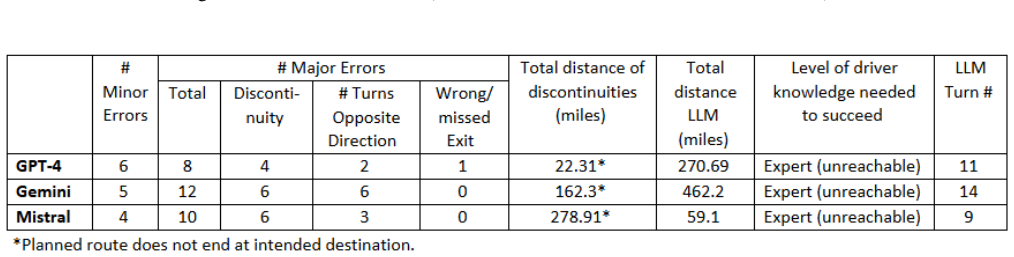
The load-bearing machinery is the six-scenario evaluation protocol paired with an explicit error taxonomy. Three turn-by-turn scenarios (urban, suburban, rural) ask the model for step-by-step GPS-style directions; three vision-and-language scenarios ask for landmark-based walking directions. Every LLM output is mapped onto a road or campus network and compared with the ground-truth route from the Waze navigation app. Errors are classified as major (route discontinuities, opposite-direction turns, wrong or missed exits, failure to reach the destination, nonexistent or wrongly described landmarks) or minor (small local misdirections), and the paper also records total discontinuous miles and number of turns to rank the models. This comparison is what supports the conclusion that all three models are unreliable.
What would settle it
Re-run the exact six scenarios with the same three models ten times each, using varied prompt phrasings, and map every output onto a road or campus network; if any model produces a fully connected route that reaches the destination with no wrong turns or invented landmarks on any trial, the paper's claim that none of the tested models can accurately plan any of the paths would be falsified.
Extended reading notes
Core claim
The central claim is that none of the tested LLMs—GPT-4, Gemini, and Mistral—could accurately plan any of the six paths. The paper demonstrates this by classifying errors into major and minor categories: discontinuities where the generated route skips road segments (the largest was 83.3 miles), directions that send drivers onto a highway in the opposite direction, wrong or missed exits, routes that never reach the destination, and visual landmarks that either do not exist or are described incorrectly. Even the best-performing model varied by scenario, and no model met the time-constraint requirement except GPT-4 on two of the three driving tasks. The authors conclude that the tested LLMs are 'fundamentally unsuitable for reliable path-planning applications' and should not be used to direct vehicle navigation.
Load-bearing premise
The conclusion that the tested LLMs are fundamentally unsuitable for path planning rests on the assumption that six routes in one U.S. region and one prompt style represent real-world path planning as a whole; the paper itself concedes this in its limitations section.
Editorial extensions
If this is right
- Car makers should not deploy current LLMs as standalone navigation planners; a route with an 83-mile discontinuity or an invented destination would strand or misdirect a driver.
- LLM-based assistants that touch navigation need an external verification layer—for example, checking every turn and waypoint against a map database—before any route is shown to a user.
- Model scale does not predict path-planning skill: the 7-billion-parameter Mistral sometimes outperformed the much larger GPT-4, and no model was consistently best.
- Prompt follow-ups did not fix the underlying failures; roughly 78% of driving prompts required follow-up questions, and major errors still appeared in the final answers.
- Future work should focus on mechanisms for reality checks, in-context transparency about limitations, and fine-tuned smaller models rather than ever-larger general-purpose models.
Reading between the lines
- The pattern of plausible-sounding but disconnected routes suggests these LLMs generate route-like text from associations rather than querying a consistent spatial model of the road network; if true, the same failure would appear in any unfamiliar geography, not just the tested region.
- A natural benchmark extension would sample dozens of routes across multiple cities, road types, and languages; if error rates drop sharply for fresh models, the 'fundamentally unsuitable' verdict may be limited to the specific models and prompt style tested here.
- The authors' 'reality check' suggestion could be operationalized as a separate route-verification module that validates start, end, and each turn against a map API before the LLM's answer is displayed; this would be a concrete testable extension of their proposal.
- Because all six routes start from the same university campus, the study does not test origin-point diversity; adding varied origins and destinations would test whether route-planning errors concentrate near the model's knowledge of a locale.
Editorial analysis
A structured set of objections, weighed in public.
Referee Report
Summary. The paper reports an empirical evaluation of three LLMs (GPT-4, Gemini, and Mistral) on six real-world path-planning scenarios around George Mason University: three turn-by-turn driving scenarios (urban, suburban, rural) with time constraints and three vision-and-language navigation scenarios on campus. For each scenario, the model was prompted once (with follow-ups when the initial response was unhelpful), and the outputs were compared against a Waze-derived ground-truth route and in-person landmark checks. The authors classify errors as major or minor, report discontinuity distances and turn counts, assign severity weights to error categories, and rank the models. They conclude that the tested LLMs are 'not capable of path planning in the real world' and are 'fundamentally unsuitable for reliable path-planning applications' (Sections 4.4 and 6). They also discuss directions for future work: reality checks, in-context transparency, and smaller models.
Significance. If the paper's sweeping conclusion were fully supported, it would be an important cautionary result for the automotive industry's recent integration of LLMs into vehicle voice assistants. The work has clear strengths: it moves beyond simulated environments to real roads and buildings, verifies landmark claims in person, and documents specific, concrete route errors (e.g., the 8.8-mile discontinuity in Gemini's suburban route, Mistral routing to Nevada instead of Virginia). These documented failures are a valuable case study of LLM limitations in high-stakes spatial tasks. However, the breadth of the conclusion exceeds what the experimental design can support: with one trial per model-scenario, no control for stochasticity, and prompts that mix factual retrieval with spatial reasoning, the evidence supports a more limited claim about unreliable zero-shot performance in a small set of instances. The significance is therefore conditional on the authors reframing the claim and strengthening the analysis.
major comments (4)
- [Sections 4.4 and 6] The conclusion that the LLMs are 'not capable of path planning in the real world' and 'fundamentally unsuitable for reliable path-planning applications' is not supported by the experimental design, which does not isolate spatial planning from other competencies. Several documented failures are attributable to missing knowledge rather than route-construction ability. For example, in the rural TbT scenario (Appendix A, Mistral), the model routes to Austin, NV because it misidentified the state; given the erroneous destination, the route sequence is internally plausible. Gemini's failure to identify the correct game date (Section 4.3) is a scheduling-information error, not a path-existence error. The authors themselves concede in Section 5.4 that the routes were local and may not generalize, and that real-time mapping access could be 'game-changing.' To make the categorical claim, the authors need either to disentangle knowledge failures from planning failures (e.g., by supplying the correct destination and schedule in the prompt), to compare against a model with browsing or mapping tools, or to temper the conclusion to 'unreliable as standalone zero-shot planners without tool access.'
- [Section 4.4] The performance rankings in Table 2 depend entirely on hand-assigned severity weights: TbT discontinuities and wrong directions receive 0.4, wrong exits 0.2; VLN discontinuities and failure to reach the destination receive 0.8, landmark errors 0.2. No justification is given for these weights, and no sensitivity analysis is reported. Because the rankings flip under alternative plausible weights (for example, weighting failure-to-reach as more severe than a discontinuity, or weighting landmark fabrication as more severe than a wrong exit), the comparative claims (e.g., 'Gemini performed the best' in all VLN, 'ChatGPT-4 had the weakest performance in urban') are not robust. I recommend either deriving the weights from a user-impact survey or rationale, testing a range of weight vectors, or reporting raw error counts and discontinuities without a single aggregate ranking.
- [Sections 3 and 4.3] Each model-scenario cell was run once, with no repeated sampling and no temperature control. The paper itself reports that approximately 77.8% of TbT scenarios required at least one follow-up question, and the follow-up wording varies across models and scenarios (e.g., Gemini was asked to avoid Google Map links, Mistral was asked to find federal holidays). Under these conditions, the differences in Table 2 (e.g., Gemini first vs. GPT-4 last in the short VLN scenario) cannot be distinguished from sampling noise or prompt-variation effects. This is load-bearing because Section 4.4 makes model-to-model comparisons. At minimum, the authors should either present the results as individual case studies without ranking claims, or add repeated trials with fixed prompts and report variance and inter-rater reliability for the error classification.
- [Section 4.1] The error taxonomy is defined qualitatively, but the quantitative discontinuity measurements (e.g., 8.8 miles, 83.3 miles) require a precise gap-filling protocol. The text states that 'we identify the shortest path to fill these substantial gaps,' but does not specify the algorithm, road network, or treatment of the 'shortest path' when no direct connection exists. Similarly, the threshold for a major VLN discontinuity ('three or more buildings') is not justified. Without a reproducible protocol, independent verification of the central quantitative results is impossible. I recommend including the full route transcripts, the gap-filling procedure, and the major/minor decision rules as supplemental material.
minor comments (5)
- [Section 4.3] The statement that Mistral 'could not search the internet in real-time' is presented without a citation or a description of the model interface; it is unclear whether this is a property of the model itself or of the experimental setup (e.g., no browsing tool enabled).
- [Figures 1 and 2] The figures are referenced but not embedded in the text, and the color scheme (red vs. green) is described only in captions. Please ensure the final version includes clearly legible figures with a legend explaining the route colors, and consider adding scale bars.
- [Section 4.2] The categories 'Beginner,' 'Intermediate,' and 'Expert' are defined qualitatively, but the assignment of a particular route to a category uses the phrase 'we believe,' which is too subjective. Please provide an explicit rubric (e.g., number of discontinuous miles, complexity of the local area) for assigning these ratings.
- [Appendix A, Mistral Suburban VLN prompt] The prompt labeled 'Suburban VLN' for Mistral appears to be a copy-paste of the TbT prompt: it asks for 'turn-by-turn driving instructions' to Garage C and mentions the paintball center, not visual landmarks. This inconsistency undermines reproducibility of the VLN results for Mistral and should be corrected.
- [Section 4.4] The claim that 'None of the models accurately planned any of the paths' lacks a definition of 'accurately planned.' Is a path with a single missing turn 'inaccurate'? Please specify the accuracy threshold (e.g., all turns correct, zero discontinuities, arrival at destination) before making the claim.
Circularity Check
No circularity: the evaluation is grounded in external ground-truth routes and independent in-person landmark checks, with no fitted parameters or self-citation chain driving the conclusion.
full rationale
The paper makes no derivation claim that reduces to its inputs. Its central conclusion—that the tested LLMs are unreliable real-world path planners—is supported by direct comparison of model outputs against an external ground-truth route from Waze (Section 4, 4.2) and by independent in-person validation of landmark existence and descriptions on the George Mason University campus (Section 4.1). There are no fitted parameters renamed as predictions, no uniqueness theorem imported from the authors' prior work, and no ansatz smuggled in via citation. The only self-referential element is the authors' own limitation statement in Section 5.4, which explicitly narrows the scope of generalization rather than providing load-bearing support for the result. Any concern that the prompt design conflates factual retrieval failures with spatial planning failures is a question of experimental validity and conclusion overreach, not circularity: even if the attribution is imperfect, the observed failures are external empirical findings, not consequences of an assumed premise. The paper is self-contained as an evaluation study, so the circularity score is 0.
Assumptions & free parameters
free parameters (3)
- Error severity weights (TbT) =
0.4 for discontinuities and incorrect directions; 0.2 for wrong or missed exits
- Error severity weights (VLN) =
0.8 for discontinuities or failure to reach destination; 0.2 for nonexistent or wrong landmark
- Major-error thresholds =
VLN discontinuity of three or more buildings counts as major; TbT route gap threshold unspecified
assumptions (3)
- domain assumption Waze routes are correct ground truth for path planning.
- domain assumption The authors' in-person landmark validations are accurate.
- domain assumption The six scenarios and three model instances are representative enough to support a general capability claim.
Cite this review
Pith. "Pith review of Can LLMs plan paths in the real world?." pith.science (2026). https://pith.science/paper/3GO6ZVEL
@misc{pith2026241117912,
  author       = {Pith},
  title        = {Pith review of: Can LLMs plan paths in the real world?},
  year         = {2026},
  howpublished = {\url{https://pith.science/paper/3GO6ZVEL}},
  note         = {Machine review of arXiv:2411.17912}
}
read the original abstract
As large language models (LLMs) increasingly integrate into vehicle navigation systems, understanding their path-planning capability is crucial. We tested three LLMs through six real-world path-planning scenarios in various settings and with various difficulties. Our experiments showed that all LLMs made numerous errors in all scenarios, revealing that they are unreliable path planners. We suggest that future work focus on implementing mechanisms for reality checks, enhancing model transparency, and developing smaller models.
Figures


Figures from the paper (5 more)




Reference graph
Works this paper leans on
-
[4]
https://www.theverge.com/2024/1/9/24028012/mercedes- benz-mbux-voice-assistant-ai-llm-mbos-ces
Mercedes-Benz’s best- in-class voice assistant is getting an AI boost. https://www.theverge.com/2024/1/9/24028012/mercedes- benz-mbux-voice-assistant-ai-llm-mbos-ces. Accessed: 2024-11-03. Kambhampati, S
work page 2024
-
[5]
In The 2024 ACM Conference on Fairness, Accountability, and Transparency, 822–835
” I’m Not Sure, But...”: Examining the Impact of Large Language Models’ Uncertainty Expression on User Reliance and Trust. In The 2024 ACM Conference on Fairness, Accountability, and Transparency, 822–835. Latif, E
work page 2024
-
[6]
arXiv preprint arXiv:2403.18778
3P-LLM: Probabilistic Path Planning using Large Language Model for Autonomous Robot Navigation. arXiv preprint arXiv:2403.18778. Leng, J.; Huang, C.; Zhu, B.; and Huang, J
-
[7]
arXiv preprint arXiv:2410.09724
Tam- ing Overconfidence in LLMs: Reward Calibration in RLHF. arXiv preprint arXiv:2410.09724. Meng, S.; Wang, Y .; Yang, C.-F.; Peng, N.; and Chang, K.- W
-
[8]
Schumann, R.; Zhu, W.; Feng, W.; Fu, T.-J.; Riezler, S.; and Wang, W
LLM-A*: Large Language Model Enhanced In- cremental Heuristic Search on Path Planning.arXiv preprint arXiv:2407.02511. Schumann, R.; Zhu, W.; Feng, W.; Fu, T.-J.; Riezler, S.; and Wang, W. Y
-
[9]
arXiv preprint arXiv:2302.06706
On the planning abilities of large language models (a critical investigation with a pro- posed benchmark). arXiv preprint arXiv:2302.06706. V olkswagen
-
[10]
World premiere at CES: V olkswagen integrates ChatGPT into its vehicles. https://www.volkswagen-newsroom.com/en/press- releases/world-premiere-at-ces-volkswagen-integrates- chatgpt-into-its-vehicles-18048. Accessed: 2024-11-03. Wen, B.; Xu, C.; Bin, H.; Wolfe, R.; Wang, L. L.; and Howe, B
work page 2024
-
[11]
In NeurIPS 2024 Workshop on Behavioral Machine Learning
From Human to Model Overconfidence: Evaluat- ing Confidence Dynamics in Large Language Models. In NeurIPS 2024 Workshop on Behavioral Machine Learning. Zhang, X.; and Gao, W
work page 2024
Show all 17 references
-
[12]
arXiv preprint arXiv:2310.00305
Towards llm-based fact ver- ification on news claims with a hierarchical step-by-step prompting method. arXiv preprint arXiv:2310.00305. Zhou, G.; Hong, Y .; and Wu, Q
-
[13]
If you don’t have the exact date yet, please provide an estimated time for planning purposes (e.g., an afternoon or evening game)
Response: To provide a detailed trip plan, I need the exact date and time of the game you plan to attend. If you don’t have the exact date yet, please provide an estimated time for planning purposes (e.g., an afternoon or evening game). This will help ensure you arrive 2 hours...
2024
-
[14]
Shenandoah Parking Deck
Their first home game in August is on Friday, August 2nd, at 7:15 PM. Here’s how to get from George Mason University Shenandoah Parking Deck to Garage C at Nationals Park with an estimated travel time of 1 hour and 15 minutes, arriving 2 hours before the game. Departure Point:...
2024
-
[15]
• Get on I-66 E from University Dr and V A-123 S/Chain Bridge Rd
Departure Point:George Mason University Shenandoah Parking Deck, 4400 University Dr, Fairfax, V A 22030Destination: Nationals Parking Garage C, 1100 Half St SW, Washington, DC 20024 Turn-by-Turn Directions: • Start at George Mason University Shenandoah Parking Deck. • Get on I...
2024
-
[16]
Please note that the exact date of the next federal holiday will depend on the current year, and you should verify that Hogsback Mountain Paintball Center is open on that day
Response: Sure, I’d be happy to help you plan this trip. Please note that the exact date of the next federal holiday will depend on the current year, and you should verify that Hogsback Mountain Paintball Center is open on that day. Also, remember to check their operating hour...
2024
-
[17]
Please note that the exact date of the next federal holiday will depend on the current year, and you should verify that Hogsback Mountain Paintball Center is open on that day
Response: Sure, I’d be happy to help you plan this trip. Please note that the exact date of the next federal holiday will depend on the current year, and you should verify that Hogsback Mountain Paintball Center is open on that day. Also, remember to check their operating hour...
2024
-
[2021]
Hassid, M.; Remez, T.; Gehring, J.; Schwartz, R.; and Adi, Y
On the dangers of stochastic par- rots: Can language models be too big? In Proceedings of the 2021 ACM conference on fairness, accountability, and transparency, 610–623. Hassid, M.; Remez, T.; Gehring, J.; Schwartz, R.; and Adi, Y
2021
-
[2023]
arXiv preprint arXiv:2310.03249
Can large lan- guage models be good path planners? a benchmark and in- vestigation on spatial-temporal reasoning. arXiv preprint arXiv:2310.03249. Augenstein, I.; Baldwin, T.; Cha, M.; Chakraborty, T.; Ciampaglia, G. L.; Corney, D.; DiResta, R.; Ferrara, E.; Hale, S.; Halevy, ...
-
[2024]
arXiv preprint arXiv:2404.00725
The Larger the Better? Improved LLM Code-Generation via Budget Reallocation. arXiv preprint arXiv:2404.00725. Hawkins, A. J
Reviewed August 12, 2026 · model on record in the stance chip above.
Discussion (0). Continue with ORCID to comment.