REVIEW 4 major objections 5 minor 42 references
Pixel-aligned RGB-NIR Stereo Imaging and Dataset for Robot Vision
T0 review · 4 major / 5 minor · reviewed 2026-08-12 · deepseek-v4-flash
Pith's one-line read Pixel-aligned RGB and near-infrared stereo data cuts depth error by a quarter and lifts detection in dark scenes.
desk verdict A genuinely useful pixel-aligned RGB-NIR stereo + LiDAR dataset for robotics, with reasonable fusion methods; the unmeasured alignment claim and a few reporting choices need attention, but this deserves a serious referee. read the letter →
The pith
A machine-rendered reading of the paper's core claim, the machinery that carries it, and where it could break.
The reading
What carries the argument
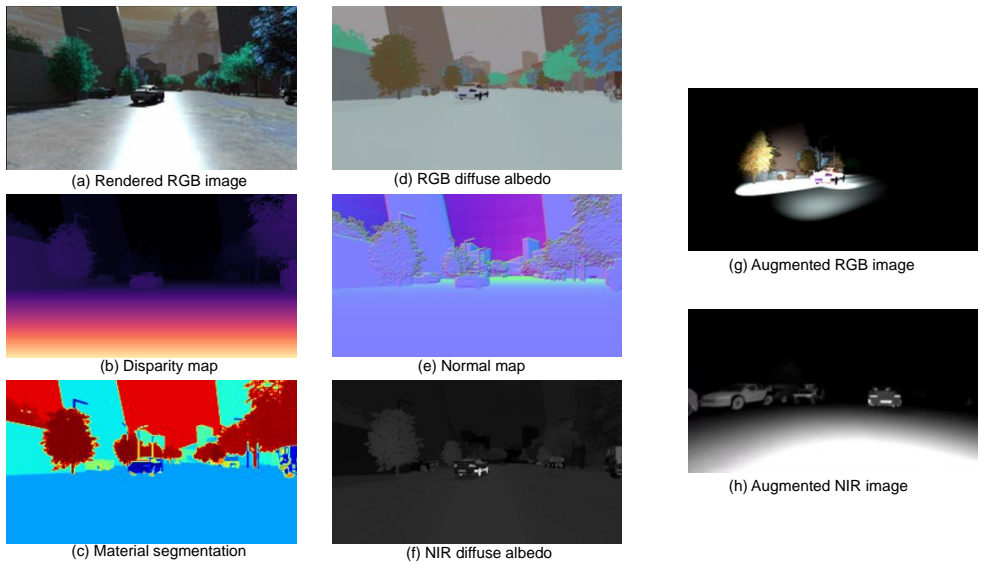
The load-bearing hardware is a pair of JAI FS-1600D-10GE cameras: a dichroic prism inside each one reflects NIR onto one CMOS sensor and lets RGB pass to another, so the two spectral images share one viewpoint and one lens. The central computational operator is a learned pair of spatially-varying weights $\alpha$ and $\beta$ that blend the HSV brightness channel with the NIR image before converting back to RGB, producing a three-channel fused image for pretrained models. The feature-level variant adds an attentional feature-fusion module and alternates between fused-feature and NIR correlation volumes inside the GRU updates of RAFT-Stereo, which the paper finds is the most accurate way to use both spectra.
What would settle it
Photograph a high-contrast checkerboard illuminated by both visible light and 850 nm NIR light with the same camera, and measure the per-corner offset between the RGB and NIR captures; if the median offset is even one pixel, the dataset's pixel-aligned premise and the attribution of the depth and detection gains to alignment would need to be revisited.
Extended reading notes
Core claim
The central discovery is that a single dichroic-prism camera can produce RGB and NIR frames that are pixel-aligned, so no registration or color-transform step is needed before fusion. With that alignment in place, the paper shows two ways to combine the spectra: fuse them at the image level with learned spatially-varying weights, which lets pretrained RGB-only models consume NIR data directly, or fuse them at the feature level inside a recurrent stereo network, which yields the largest accuracy gain. The reported numbers are a stereo depth RMSE of 6.747 m for feature fusion versus 8.943 m for RGB-only RAFT-Stereo, and detection mAP of 0.828 for the fused image versus 0.756 for RGB-only YOLO. These results support the paper's claim that pixel-aligned RGB-NIR data, rather than post-hoc registration, is what improves downstream vision in low-light and high-contrast scenes.
Load-bearing premise
Everything downstream rests on the claim that the JAI dichroic-prism cameras deliver true pixel-level RGB-NIR alignment, but the paper reports no measured registration error between the two spectral images.
Editorial extensions
If this is right
- Pretrained RGB-only stereo, detection, and structure-from-motion pipelines can exploit NIR information with zero fine-tuning when fed the learned fused image.
- Fine-tuned feature fusion beats image fusion and all compared cross-spectral baselines, with the largest gains appearing in nighttime scenes.
- The 80,000-frame real dataset plus LiDAR-derived dense depth gives other methods a directly comparable RGB-NIR stereo training and evaluation target.
- The alternating fused-NIR correlation volume result indicates that NIR features carry cues RGB features miss, especially under active NIR illumination.
Reading between the lines
- Pith inference (not a paper claim): the image-fusion module contains no geometry, so it may transfer to other prism-based RGB-NIR cameras without retraining; that transferability is a natural follow-up.
- Pith inference (not a paper claim): if residual RGB-NIR misregistration is actually subpixel, the fusion gains may partly come from the spectral content itself; an artificial-misalignment experiment would separate the two.
- Pith inference (not a paper claim): the dataset records separate exposure times for RGB and NIR sensors, so a future method could make fusion exposure-aware, which the current fixed-weight formulation does not exploit.
Editorial analysis
A structured set of objections, weighed in public.
Referee Report
Summary. The paper presents a robotic imaging system with two prism-based RGB-NIR cameras, active NIR illumination, and LiDAR, plus a dataset of synchronized pixel-aligned RGB-NIR stereo images and LiDAR depth for indoor/outdoor day/night scenes. It also proposes two fusion methods: an image-level fusion that lets pretrained RGB models consume RGB-NIR data without finetuning, and a feature-level fusion that extends RAFT-Stereo with attentional RGB-NIR feature fusion and alternating correlation volumes. Experiments report improvements over RGB-only, NIR-only, and several RGB-NIR fusion baselines on stereo depth estimation, object detection, and structure-from-motion.
Significance. If the main claims hold, the dataset and hardware design would be a useful community resource: the paper is among few to provide stereo RGB and NIR pairs with LiDAR ground truth, and the image-fusion method has practical value because it enables off-the-shelf RGB-pretrained models to exploit NIR without retraining. The paper is also stronger than a pure dataset paper because it includes controlled comparisons against single-modality baselines and several established fusion methods, and it states limitations explicitly. However, the central 'pixel-aligned' property is asserted from the camera datasheet rather than measured, and several ablation-based architecture choices are supported by only one metric while other metrics in the supplement point differently. These issues need to be resolved before the specific claims about alignment-driven gains and the proposed fusion designs can be accepted.
major comments (4)
- [Section 3 (Calibration)] The 'pixel-aligned' property is load-bearing for the dataset, the title, and the fusion equations (Eq. 3 and Eq. 7), but it is never verified quantitatively. Section 3 states that 'calibration between RGB and NIR images is unnecessary' and reports only stereo-pose and LiDAR calibration; the supplemental calibration section likewise contains no measured RGB-NIR registration error. Please report a measured alignment error (e.g., residual reprojection error of a checkerboard or dot pattern visible in both bands, or the epipolar error between RGB and NIR images) and, ideally, a sensitivity analysis showing that the reported downstream gains persist under small residual misregistration. Without this, the claimed advantage over pixel-misaligned datasets such as CS-Stereo is not established.
- [Section 4.2 and Table 3; Supplement Tables 15 and 16] The architecture choice of alternating Fusion-NIR correlation volumes is justified by Table 3, which reports only RMSE. However, Supplemental Table 16 shows that on MAE the 'Fusion-RGB-NIR' variant is better than the selected 'Fusion-NIR' variant (2.5238 m vs. 2.5886 m), and Supplemental Table 15 shows that simple feature multiplication yields better RMSE and MAE than the proposed attentional feature fusion. Because these ablations are used to justify the core feature-fusion design, the paper must report all evaluation metrics (MAE, RMSE, d1-d3) for every ablation and either justify the chosen metric or explain why the alternative is preferred despite worse quantitative results. As written, the claim in the Table 3 caption that the selected variant gives 'the highest depth-estimation accuracy' is not supported by the full set of reported metrics.
- [Supplemental Section 4.2.1 and Table 11 / Table 1] The real-world object-detection evaluation relies on pseudo-labels, but the manuscript gives no information about how these pseudo-labels were generated, whether they were manually verified, or what their accuracy is. The detection mAP numbers are also inconsistent between the main paper and the supplement: Table 1(b) reports Ours = 0.809, while Supplemental Table 11 reports Ours = 0.828 for the same task. Please clarify the labeling protocol, provide a verification procedure or error estimate for the pseudo-labels, and reconcile the two mAP values.
- [Section 5.2 / Table 2] It is not stated whether the test split was used to select among the correlation-volume variants in Table 3 and among the feature-fusion variants in Supplemental Table 15. If these architecture choices were made using the same test data on which final results are reported, the reported gains are potentially optimistic. Please specify the validation procedure (e.g., a held-out split used for model selection, or a statement that the test set was used only once) and, if no validation set was used, discuss the risk of selection on the test set.
minor comments (5)
- [Section 1, first paragraph] There is a typo: 'where where RGB imaging is inadequate' should have only one 'where'.
- [Section 3 (Calibration)] The main text says temporal synchronization is maintained to 'less than 1 microsecond', while the supplemental Section 1.1.4 says the cameras were aligned 'within 100 microseconds' and packets with differences exceeding 1 ms were discarded. Please reconcile these numbers.
- [Section 4.2] The sentence 'inspired by the cross-spectral time-of-flight imaging method [5]' is unexplained; please state what design element is borrowed from that method.
- [Table 2] The caption groups 'different RGB-NIR stereo depth estimation model [64]' with methods that were fine-tuned on the proposed dataset, but the text says only methods [16,51] were retrained. Please clarify whether CS-Stereo [64] was fine-tuned or used with its original checkpoint, since this affects fairness of the comparison.
- [Supplemental Section 2.1.2] The dense disparity labels are produced by a BPNet-based reconstruction with an occlusion threshold; the paper would benefit from a short validation of this pseudo-ground-truth against raw LiDAR, e.g., the median error of the densified depth at held-out LiDAR points.
Circularity Check
No significant circularity: the paper is an empirical dataset and fusion study whose headline results are evaluated on held-out real test videos against external baselines, with no load-bearing self-citation and no prediction that reduces to a fitted input by construction.
full rationale
This is an empirical systems/dataset paper rather than a derivation, so the circularity burden is modest and is not met. The central claims—that pixel-aligned RGB-NIR fusion improves depth estimation, object detection, and structure-from-motion—are supported by evaluations on a held-out test split (4 of 43 videos, 7000 frames) against external baselines including RGB-only and NIR-only inputs, CS-Stereo, CSPD, DPSNet, and several prior fusion methods. The learned fusion weights alpha and beta in Section 4.1 are trained on synthetic and real training data with photometric and disparity losses and then evaluated on test frames; the feature-fusion network in Section 4.2 is fine-tuned on training data and tested on the held-out split. No equation in the paper defines a predicted quantity in terms of the same measured quantity used to fit it. The choice of alternating Fusion-NIR correlation volumes was made by comparing test-set RMSE values (Table 3), which is a test-set selection concern and a validity risk, but it is not a circular reduction: the reported 6.747 m is the honest test result for that configuration, not a quantity forced by construction. Similarly, the unverified premise that the JAI FS-1600D-10GE dichroic-prism camera provides pixel-level RGB-NIR alignment with no residual error is an untested hardware assumption, not a circular argument. There are no load-bearing self-citations: the cited pretrained networks and fusion modules (RAFT-Stereo, attentional feature fusion, BPNet, Gated2Depth) are external, code-reproduced components, and the paper does not invoke any uniqueness theorem or prior work by the same authors to forbid alternatives. Overall, the empirical comparisons are self-contained against external benchmarks, so the appropriate circularity score is 0.
Assumptions & free parameters
free parameters (5)
- Image fusion weights alpha and beta =
learned spatially-varying maps
- Synthetic lighting parameters phi_j and phi_active =
randomized in simulation
- LiDAR densification thresholds alpha and beta =
0.75 and 0.85
- Occlusion mask threshold =
not specified
- Photometric and SSIM loss weights =
0.85 and 0.15
assumptions (5)
- domain assumption The JAI FS-1600D-10GE dichroic prism camera provides true pixel-level alignment between the RGB and NIR sensors with no residual misregistration.
- domain assumption The RGB-to-NIR color synthesis of Gated2depth [15] produces NIR reflectance maps realistic enough for synthetic training to transfer to real scenes.
- domain assumption BPNet-densified LiDAR disparity maps are sufficiently accurate to serve as ground truth for training and evaluation.
- ad hoc to paper Pseudo-labels created for real object-detection evaluation are accurate and unbiased.
- domain assumption Camera-to-LiDAR synchronization is adequate for moving scenes even though only the two cameras are formally synchronized.
Cite this review
Pith. "Pith review of Pixel-aligned RGB-NIR Stereo Imaging and Dataset for Robot Vision." pith.science (2026). https://pith.science/paper/LQASLQGG
@misc{pith2026241118025,
  author       = {Pith},
  title        = {Pith review of: Pixel-aligned RGB-NIR Stereo Imaging and Dataset for Robot Vision},
  year         = {2026},
  howpublished = {\url{https://pith.science/paper/LQASLQGG}},
  note         = {Machine review of arXiv:2411.18025}
}
read the original abstract
Integrating RGB and NIR stereo imaging provides complementary spectral information, potentially enhancing robotic 3D vision in challenging lighting conditions. However, existing datasets and imaging systems lack pixel-level alignment between RGB and NIR images, posing challenges for downstream vision tasks. In this paper, we introduce a robotic vision system equipped with pixel-aligned RGB-NIR stereo cameras and a LiDAR sensor mounted on a mobile robot. The system simultaneously captures pixel-aligned pairs of RGB stereo images, NIR stereo images, and temporally synchronized LiDAR points. Utilizing the mobility of the robot, we present a dataset containing continuous video frames under diverse lighting conditions. We then introduce two methods that utilize the pixel-aligned RGB-NIR images: an RGB-NIR image fusion method and a feature fusion method. The first approach enables existing RGB-pretrained vision models to directly utilize RGB-NIR information without fine-tuning. The second approach fine-tunes existing vision models to more effectively utilize RGB-NIR information. Experimental results demonstrate the effectiveness of using pixel-aligned RGB-NIR images across diverse lighting conditions.
Figures


Figures from the paper (19 more)




Reference graph
Works this paper leans on
-
[1]
Adaptive near-infrared and visible fusion for fast image enhancement
Mohamed Awad, Ahmed Elliethy, and Hussein A Aly. Adaptive near-infrared and visible fusion for fast image enhancement. IEEE Transactions on Computational Imaging, 6:408–418, 2019. 21, 22, 23, 24, 25, 27, 28
work page 2019
-
[2]
Camera calibration toolbox for matlab
Jean-Yves Bouguet. Camera calibration toolbox for matlab. http://www. vision. caltech. edu/bouguetj/calib doc/, 2004. 4
work page 2004
-
[3]
Agricultural robot dataset for plant classification, localization and mapping on sugar beet fields
Nived Chebrolu, Philipp Lottes, Alexander Schaefer, Wera Winterhalter, Wolfram Burgard, and Cyrill Stachniss. Agricultural robot dataset for plant classification, localization and mapping on sugar beet fields. The International Journal of Robotics Research , 36(10):1045–1052, 2017. 13, 14, 15
work page 2017
-
[4]
Ranus: Rgb and nir urban scene dataset for deep scene parsing
Gyeongmin Choe, Seong-Heum Kim, Sunghoon Im, Joon-Young Lee, Srinivasa G Narasimhan, and In So Kweon. Ranus: Rgb and nir urban scene dataset for deep scene parsing. IEEE Robotics and Automation Letters, 3(3):1808–1815, 2018. 13, 14
work page 2018
-
[5]
Kaist multi-spectral day/night data set for autonomous and assisted driving
Yukyung Choi, Namil Kim, Soonmin Hwang, Kibaek Park, Jae Shin Yoon, Kyounghwan An, and In So Kweon. Kaist multi-spectral day/night data set for autonomous and assisted driving. IEEE Transactions on Intelligent Transportation Systems , 19(3):934–948, Mar. 2018. 13, 14, 15
work page 2018
-
[6]
The cityscapes dataset for semantic urban scene understanding
Marius Cordts, Mohamed Omran, Sebastian Ramos, Timo Rehfeld, Markus Enzweiler, Rodrigo Benenson, Uwe Franke, Stefan Roth, and Bernt Schiele. The cityscapes dataset for semantic urban scene understanding. In 2016 IEEE Conference on Computer Vision and Pattern Recognition (CVPR), page 3213–3223, Las Vegas, NV , USA, June 2016. IEEE. 13, 14
work page 2016
-
[7]
Indoor semantic segmentation using depth information
Camille Couprie, Cl ´ement Farabet, Laurent Najman, and Yann Lecun. Indoor semantic segmentation using depth information. In First International Conference on Learning Representations (ICLR 2013), pages 1–8, 2013. 13, 14, 15
work page 2013
-
[8]
Scannet: Richly-annotated 3d reconstructions of indoor scenes
Angela Dai, Angel X Chang, Manolis Savva, Maciej Halber, Thomas Funkhouser, and Matthias Nießner. Scannet: Richly-annotated 3d reconstructions of indoor scenes. In Proceedings of the IEEE conference on computer vision and pattern recognition , pages 31 5828–5839, 2017. 13, 14, 15
work page 2017
Show all 42 references
-
[9]
Attentional feature fusion
Yimian Dai, Fabian Gieseke, Stefan Oehmcke, Yiquan Wu, and Kobus Barnard. Attentional feature fusion. In 2021 IEEE Winter Conference on Applications of Computer Vision (WACV), page 3559–3568, Waikoloa, HI, USA, Jan. 2021. IEEE. 16, 17, 19, 21, 30
2021
-
[10]
Colouring the near-infrared
Cl ´ement Fredembach and Sabine S ¨usstrunk. Colouring the near-infrared. In Color and imaging conference , volume 16, pages 176–182. Society of Imaging Science and Technology, 2008. 21, 22, 23, 24, 25, 27, 28
2008
-
[11]
Geiger, P
A. Geiger, P. Lenz, and R. Urtasun. Are we ready for autonomous driving? the kitti vision benchmark suite. In2012 IEEE Conference on Computer Vision and Pattern Recognition, page 3354–3361, Providence, RI, June 2012. IEEE. 13, 14, 15
2012
-
[12]
Gated2depth: Real-time dense lidar from gated images
Tobias Gruber, Frank Julca-Aguilar, Mario Bijelic, and Felix Heide. Gated2depth: Real-time dense lidar from gated images. In Proceedings of the IEEE/CVF International Conference on Computer Vision, pages 1506–1516, 2019. 10, 12
2019
-
[13]
Unsupervised cross-spectrum depth estimation by visible-light and thermal cameras
Yubin Guo, Xinlei Qi, Jin Xie, Cheng-Zhong Xu, and Hui Kong. Unsupervised cross-spectrum depth estimation by visible-light and thermal cameras. IEEE Transactions on Intelligent Transportation Systems, 24(10):10937–10947, Oct. 2023. 13, 14, 15, 25, 26, 27, 28
2023
-
[14]
Deep residual learning for image recognition
Kaiming He, Xiangyu Zhang, Shaoqing Ren, and Jian Sun. Deep residual learning for image recognition. In Proceedings of the IEEE conference on computer vision and pattern recognition, pages 770–778, 2016. 15
2016
-
[15]
Color outdoor image enhancement by v-nir fusion and weighted luminance
Mar ´ıa A Herrera-Arellano, Hayde Peregrina-Barreto, and Iv ´an Terol-Villalobos. Color outdoor image enhancement by v-nir fusion and weighted luminance. In 2019 IEEE International Autumn Meeting on Power, Electronics and Computing (ROPEC), pages 1–6. IEEE, 2019. 21, 22, 24, 2...
2019
-
[16]
Surface reconstruction from unorganized points
Hugues Hoppe, Tony DeRose, Tom Duchamp, John McDonald, and Werner Stuetzle. Surface reconstruction from unorganized points. In Proceedings of the 19th annual conference on computer graphics and interactive techniques, pages 71–78, 1992. 12
1992
-
[17]
Darkvisionnet: Low-light imaging via rgb-nir fusion with deep inconsistency prior
Shuangping Jin, Bingbing Yu, Minhao Jing, Yi Zhou, Jiajun Liang, and Renhe Ji. Darkvisionnet: Low-light imaging via rgb-nir fusion with deep inconsistency prior. InProceedings of the AAAI Conference on Artificial Intelligence, volume 36, pages 1104–1112,
-
[18]
CostDCNet: Cost Volume Based Depth Completion for a Single RGB-D Image, volume 13662 of Lecture Notes in Computer Science, page 257–274
Jaewon Kam, Jungeon Kim, Soongjin Kim, Jaesik Park, and Seungyong Lee. CostDCNet: Cost Volume Based Depth Completion for a Single RGB-D Image, volume 13662 of Lecture Notes in Computer Science, page 257–274. Springer Nature Switzerland, Cham,
-
[19]
3d gaussian splatting for real-time radiance field rendering
Bernhard Kerbl, Georgios Kopanas, Thomas Leimk ¨uhler, and George Drettakis. 3d gaussian splatting for real-time radiance field rendering. ACM Trans. Graph., 42(4):1–14, 2023. 9
2023
-
[20]
Vivid++: Vision for visibility dataset
Alex Junho Lee, Younggun Cho, Young-sik Shin, Ayoung Kim, and Hyun Myung. Vivid++: Vision for visibility dataset. IEEE Robotics and Automation Letters, 7(3):6282–6289, July 2022. 13, 14
2022
-
[21]
Infrared and visible image fusion using a deep learning framework
Hui Li, Xiao-Jun Wu, and Josef Kittler. Infrared and visible image fusion using a deep learning framework. In2018 24th international conference on pattern recognition (ICPR), pages 2705–2710. IEEE, 2018. 21, 22, 24, 25, 27, 28
2018
-
[22]
Practical stereo matching via cascaded recurrent network with adaptive correlation
Jiankun Li, Peisen Wang, Pengfei Xiong, Tao Cai, Ziwei Yan, Lei Yang, Jiangyu Liu, Haoqiang Fan, and Shuaicheng Liu. Practical stereo matching via cascaded recurrent network with adaptive correlation. In 2022 IEEE/CVF Conference on Computer Vision and Pattern Recognition (CVPR...
2022
-
[23]
Saputra, Zhuangzhuang Dai, and Chris Xiaoxuan Lu
Peize Li, Kaiwen Cai, Muhamad Risqi U. Saputra, Zhuangzhuang Dai, and Chris Xiaoxuan Lu. Odombeyondvision: An indoor multi-modal multi-platform odometry dataset beyond the visible spectrum. In2022 IEEE/RSJ International Conference on Intelligent Robots and Systems (IROS), page...
2022
-
[24]
Image fusion with guided filtering
Shutao Li, Xudong Kang, and Jianwen Hu. Image fusion with guided filtering. IEEE Transactions on Image Processing , 22(7):2864–2875, July 2013. 18
2013
-
[25]
Raft-stereo: Multilevel recurrent field transforms for stereo matching
Lahav Lipson, Zachary Teed, and Jia Deng. Raft-stereo: Multilevel recurrent field transforms for stereo matching. In 2021 Interna- tional Conference on 3D Vision (3DV), pages 218–227. IEEE, 2021. 7, 15, 17, 18, 20, 21, 25, 27, 28, 29
2021
-
[26]
Multispectral deep neural networks for pedestrian detection
Jingjing Liu, Shaoting Zhang, Shu Wang, and Dimitris N Metaxas. Multispectral deep neural networks for pedestrian detection. In 27th British Machine Vision Conference, BMVC 2016, 2016. 13, 14, 15
2016
-
[27]
A large dataset to train convolutional networks for disparity, optical flow, and scene flow estimation
Nikolaus Mayer, Eddy Ilg, Philip Hausser, Philipp Fischer, Daniel Cremers, Alexey Dosovitskiy, and Thomas Brox. A large dataset to train convolutional networks for disparity, optical flow, and scene flow estimation. In Proceedings of the IEEE conference on computer vision and ...
2016
-
[28]
The goose dataset for perception in unstructured environments
Peter Mortimer, Raphael Hagmanns, Miguel Granero, Thorsten Luettel, Janko Petereit, and Hans-Joachim Wuensche. The goose dataset for perception in unstructured environments. 2024. 13, 14, 15
2024
-
[29]
Linear n-point camera pose determination
Long Quan and Zhongdan Lan. Linear n-point camera pose determination. IEEE Transactions on pattern analysis and machine intelligence, 21(8):774–780, 1999. 5
1999
-
[30]
You only look once: Unified, real-time object detection
Joseph Redmon, Santosh Divvala, Ross Girshick, and Ali Farhadi. You only look once: Unified, real-time object detection. In 2016 IEEE Conference on Computer Vision and Pattern Recognition (CVPR), pages 779–788, 2016. 24
2016
-
[31]
High-resolution stereo datasets with subpixel-accurate ground truth
Daniel Scharstein, Heiko Hirschm ¨uller, York Kitajima, Greg Krathwohl, Nera Neˇsi´c, Xi Wang, and Porter Westling. High-resolution stereo datasets with subpixel-accurate ground truth. In Pattern Recognition: 36th German Conference, GCPR 2014, M ¨unster, Ger- many, September 2...
2014
-
[32]
Structure-from-motion revisited
Johannes L Schonberger and Jan-Michael Frahm. Structure-from-motion revisited. In Proceedings of the IEEE conference on computer vision and pattern recognition, pages 4104–4113, 2016. 9
2016
-
[33]
Bad slam: Bundle adjusted direct rgb-d slam
Thomas Schops, Torsten Sattler, and Marc Pollefeys. Bad slam: Bundle adjusted direct rgb-d slam. In Proceedings of the IEEE/CVF Conference on Computer Vision and Pattern Recognition, pages 134–144, 2019. 27, 28, 29
2019
-
[34]
Deep depth estimation from thermal image
Ukcheol Shin, Jinsun Park, and In So Kweon. Deep depth estimation from thermal image. In 2023 IEEE/CVF Conference on 32 Computer Vision and Pattern Recognition (CVPR), page 1043–1053, Vancouver, BC, Canada, June 2023. IEEE. 13, 14, 15
2023
-
[35]
Multispectral object detection for autonomous vehicles
Karasawa Takumi, Kohei Watanabe, Qishen Ha, Antonio Tejero-De-Pablos, Yoshitaka Ushiku, and Tatsuya Harada. Multispectral object detection for autonomous vehicles. In Proceedings of the on Thematic Workshops of ACM Multimedia 2017 , pages 35–43,
2017
-
[36]
Bilateral propagation network for depth completion
Jie Tang, Fei-Peng Tian, Boshi An, Jian Li, and Ping Tan. Bilateral propagation network for depth completion. In 2024 IEEE/CVF Conference on Computer Vision and Pattern Recognition (CVPR), page 9763–9772, Seattle, W A, USA, June 2024. IEEE. 6, 7, 8, 25
2024
-
[37]
Dps-net: Deep polarimetric stereo depth estimation
Chaoran Tian, Weihong Pan, Zimo Wang, Mao Mao, Guofeng Zhang, Hujun Bao, Ping Tan, and Zhaopeng Cui. Dps-net: Deep polarimetric stereo depth estimation. In Proceedings of the IEEE/CVF International Conference on Computer Vision , pages 3569– 3579, 2023. 25, 26, 27, 28
2023
-
[38]
The triclobs dynamic multi-band image data set for the development and evaluation of image fusion methods
Alexander Toet, Maarten A Hogervorst, and Alan R Pinkus. The triclobs dynamic multi-band image data set for the development and evaluation of image fusion methods. PloS one, 11(12):e0165016, 2016. 13, 14, 15
2016
-
[39]
Deep multispectral semantic scene understanding of forested environments using multimodal fusion
Abhinav Valada, Gabriel L Oliveira, Thomas Brox, and Wolfram Burgard. Deep multispectral semantic scene understanding of forested environments using multimodal fusion. In 2016 International Symposium on Experimental Robotics , pages 465–477. Springer, 2017. 13, 14, 15
2016
-
[40]
Bayesian fusion for infrared and visible images
Zixiang Zhao, Shuang Xu, Chunxia Zhang, Junmin Liu, and Jiangshe Zhang. Bayesian fusion for infrared and visible images. Signal Processing, 177:107734, 2020. 21, 22, 24, 25, 27, 28
2020
-
[41]
Deep material-aware cross-spectral stereo matching
Tiancheng Zhi, Bernardo R Pires, Martial Hebert, and Srinivasa G Narasimhan. Deep material-aware cross-spectral stereo matching. In Proceedings of the IEEE conference on computer vision and pattern recognition, pages 1916–1925, 2018. 13, 14, 25, 26, 27, 28 33
1916
-
[2022]
21, 22, 24, 25, 27, 28
Reviewed August 12, 2026 · model on record in the stance chip above.
Discussion (0). Continue with ORCID to comment.