REVIEW 5 major objections 6 minor 57 references
VLM-HOI: Vision Language Models for Interpretable Human-Object Interaction Analysis
T0 review · 5 major / 6 minor · reviewed 2026-08-12 · deepseek-v4-flash
Pith's one-line read A frozen vision-language model can serve as a training objective for HOI detection, beating CLIP-based knowledge transfer.
desk verdict A plausible VLM-distillation extension with a real practical upside, but the central loss is under-specified and the reported numbers don't line up; fixable, not trustworthy as written. read the letter →
The pith
A machine-rendered reading of the paper's core claim, the machinery that carries it, and where it could break.
The reading
What carries the argument
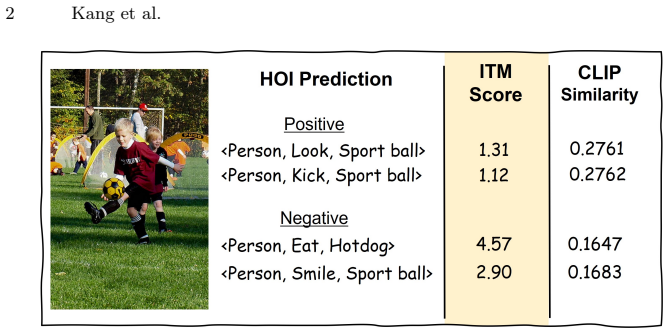
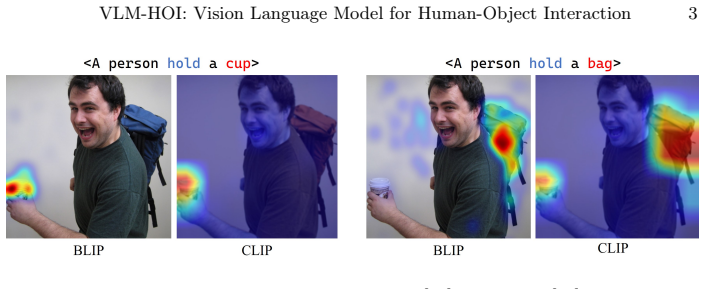
The key machinery is the image-text matching (ITM) score $\mathrm{sim}(I, S)$ of a frozen BLIP model, applied to template sentences "A person [verb] a [object]" constructed from predicted HOI triplets. These scores feed a contrastive loss $\mathcal{L}_{\mathrm{ITM}} = \sum_i \max(0, \alpha - \mathrm{sim}(I, s^+_i)) + \sum_j \mathrm{sim}(I, s^-_j)$, which regularizes a DETR-based HOI detector during training only. BLIP is chosen over CLIP because its object-centric, sub-word-level matching is claimed to separate positive from negative triplet sentences more sharply, as illustrated in the paper's comparison figures.
What would settle it
One concrete check would be to evaluate the frozen BLIP teacher alone on the HICO-DET test set: compute ITM scores for the ground-truth triplets (positive sentences) and for the same triplets with the verb randomly replaced (negative sentences), and measure the separation between the two score distributions. If the distributions overlap heavily, the contrastive loss cannot carry meaningful supervision, and the reported gains would not replicate. A second direct test is to replace the BLIP teacher with a randomly initialized BLIP of the same architecture; if VLM-HOI retains its advantage, the gains come from the extra loss term rather than from language priors.
Extended reading notes
Core claim
On the paper's terms, the discovery is that BLIP's image-text matching score, computed for short grounded template sentences describing predicted human-object-verb triplets, is a usable training signal for HOI detection. The score is turned into a contrastive loss with a positive margin that pulls matched triplets toward the image and pushes unmatched triplets away, and this loss is added to the standard HOI detection loss while the VLM stays frozen. Experiments on HICO-DET and V-COCO show improvements over prior methods, including the CLIP-based GEN-VLKT, with the largest gains on rare interaction categories. The authors argue this is the first use of a VLM's language abilities as an objective function for HOI detection.
Load-bearing premise
The load-bearing premise is that BLIP's image-text matching scores on short, grammatically awkward template sentences are reliable and discriminative enough to separate correct from incorrect HOI triplets, even though the sentences are unlike BLIP's natural-caption training data and the construction of negative sentences is left unspecified.
Editorial extensions
If this is right
- A frozen VLM can act as a training-time teacher for HOI detection, so the deployed model has the same parameter count and inference speed as the baseline.
- Object-centric VLMs such as BLIP may be better-suited teachers than CLIP for tasks that require localizing subjects and objects, not just global image-text alignment.
- Rare HOI categories stand to gain the most from the VLM's language priors, since the contrastive signal regularizes categories with few training examples.
- The template-based ITM objective could extend to other structured prediction tasks that can be expressed as (subject, verb, object) text.
- The choice of the positive margin $\alpha$ is tied to the scale of the teacher's scores, so a principled setting of $\alpha$ depends on the score distribution of the chosen VLM.
Reading between the lines
- Beyond the paper, the same training-time objective could be applied to video HOI detection, using a video-language model's matching scores across frames, if such scores are discriminative enough.
- Because the paper never specifies how negative sentences are built, an immediate test is whether hard negatives (verbs swapped among objects present in the image) give larger gains than random negatives; the contrastive loss's behavior will hinge on that choice.
- A natural extension would be to use a larger, instruction-tuned VLM as the teacher; the paper's own argument implies gains should scale with the teacher's language understanding, which is testable by replacing BLIP with a larger VLM.
- If BLIP's scores are sensitive to the awkward sentence template, then dataset-specific verb and object vocabulary changes could break the transfer, making prompt engineering part of the method's deployment cost.
Editorial analysis
A structured set of objections, weighed in public.
Referee Report
Summary. The paper proposes VLM-HOI, a method that uses a frozen BLIP image-text matching (ITM) model as an external objective for training a DETR-based HOI detector. Predicted HOI triplets are converted into template sentences, and BLIP's ITM scores for positive and negative sentences are combined into a contrastive loss. The authors report state-of-the-art results on HICO-DET and V-COCO. However, as written, the objective is underspecified and internally contradictory: Eq. (2) defines positive and negative sentences identically, Eq. (4) contradicts its own prose, and reported numbers disagree between text and tables. These issues prevent the reader from reproducing or verifying the claimed contribution.
Significance. The underlying idea--using a frozen, object-centric VLM as a training objective that is not needed at inference time--is of interest to the HOI community and is a natural extension of CLIP-based distillation methods. The qualitative evidence in Fig. 1 that BLIP ITM is more discriminative than CLIP for short, ungrammatical triplets is suggestive. If the objective were properly specified and the numbers reconciled, the method could be a useful baseline for future work. The current manuscript, however, does not yet provide a well-defined training loss, and the reported gains cannot be attributed to the proposed mechanism. No code is released, which further limits reproducibility.
major comments (5)
- [Section 3.3, Eq. (2)] The definition of positive and negative sentences is identical: s+_i and s-_i are both ["A person" + v_i + " a " + o_i], differing only in the condition T in H vs T not in H. Since no actual construction of Sneg is given--e.g., which verbs/objects are swapped, whether negatives are sampled from the dataset, or whether they are the same template with random labels--the loss in Eq. (4) is not a well-defined function of the model predictions. This must be specified before the reported gains can be attributed to the proposed objective.
- [Section 3.4, Eq. (4) and surrounding text] The text states that positive similarity scores should be "as close to zero as possible" and negative scores "as high as possible," which is the opposite of Eq. (4), where positive scores are pushed above margin alpha and negative scores are minimized. The direction of the objective must be corrected and made consistent with Figure 1, which shows positive scores as high. As written, the training objective is ambiguous and cannot be used to interpret the experimental results.
- [Section 4.4, Table 1 and text] The text reports 33.64% mAP on HICO-DET Default, while Table 1 reports 34.25; similarly, the V-COCO margins over GEN-VLKT are stated as 7.1 and 7.7 AP, whereas Table 2 implies 5.3 and 6.5 AP. These numeric inconsistencies affect the central claim of improvement over GEN-VLKT and must be reconciled before the results can be verified.
- [Section 4.4, Tables 1-2] The state-of-the-art claim is based on an incomplete baseline set. The tables omit RLIPv2 and HOICLIP, both of which are closely related language-supervised HOI methods cited in the text, and the exclusion of Swin-based models is stated only in the table caption while the abstract and title make an unqualified SOTA claim. The comparison should be completed or the claim narrowed to match the actual baselines.
- [Section 4.5, Table 3] The positive margin alpha is selected using V-COCO test performance, with no validation set described; the reported AP values in Table 3 are test-set numbers. This selection-on-test procedure can inflate the reported gains and should be clarified or replaced by validation-based hyperparameter selection, especially since alpha is a key component of the proposed loss.
minor comments (6)
- [Section 2.2 heading] The heading "Vision-Lauguage Model" contains a typo; it should read "Vision-Language Model."
- [Section 2.1] The sentence "Another content [16,18,26,34,47,52] recent work has focused on improving both branches of HOI detection" is ungrammatical and should be rephrased.
- [Section 3.3, Eq. (2)] The notation is inconsistent: the text defines object and interaction class names as o_i and v_i, but Eq. (2) uses hat v_i and hat o_i; unify the notation.
- [Figures 1 and 5] Figures 1 and 5 lack axis labels and score scales, so the claimed typical positive-score range of 1 to 2 in Section 4.5 cannot be verified.
- [Abstract] The claim of "first utilization of VLM language abilities for HOI detection" is too strong given the cited GEN-VLKT and RLIP works; the claim should be qualified, e.g., "first to use a frozen image-text matching VLM as a training objective for HOI detection."
- [Table 5] The parameter counts are confusing: the table lists 430M (DETR+BLIP) and 28M (Learnable), while the text says BLIP has 361M and the baseline has 41M DETR plus 28M decoder; clarify the composition of these numbers.
Circularity Check
No circularity: the BLIP ITM supervision is an external, frozen signal and the reported gains are not forced by construction.
full rationale
The paper's claimed derivation is: predicted HOI triplets are converted into grounded text prompts; a frozen, pretrained BLIP model computes image-text matching scores; these scores enter a contrastive loss that trains the HOI detector. None of these steps reduce to the paper's own outputs or conclusions. The BLIP model is external, pretrained on general image-text data, and kept frozen during training, so its scores are not a function of the HOI model's parameters or of the benchmark labels in a way that would make the reported mAP a tautology. The contrastive loss is a genuine training signal, even if, as written, Eq. (2) defines positive and negative sentences identically and Eq. (4)'s direction contradicts the surrounding prose; those are specification and reproducibility problems, not circular reasoning. The margin alpha is tuned on the validation split (Table 3), which is standard hyperparameter selection rather than a fitted input renamed as a prediction. There are no load-bearing self-citations: the cited BLIP work, GEN-VLKT, and baseline methods are external prior work by other authors. The paper's comparisons are against external benchmarks and prior methods, so the central claim is self-contained against outside evidence. The internal inconsistencies are serious correctness risks, but they do not constitute circularity under the definitions used here.
Assumptions & free parameters
free parameters (2)
- positive margin alpha =
1 (tuned on V-COCO)
- loss weighting coefficients lambda_i =
2.5, 1, 1, 1
assumptions (4)
- domain assumption BLIP's image-text matching scores on template HOI sentences provide a valid, transferable supervision signal for HOI detection.
- domain assumption The simple template 'A person [verb] a [object]' preserves enough semantics for the VLM to discriminate correct from incorrect interactions.
- domain assumption The negative sentences Sneg are sampled in a way that provides useful contrastive signal.
- domain assumption HOI annotations in HICO-DET and V-COCO are correct and complete for training and evaluation.
Cite this review
Pith. "Pith review of VLM-HOI: Vision Language Models for Interpretable Human-Object Interaction Analysis." pith.science (2026). https://pith.science/paper/MAA6EBNC
@misc{pith2026241118038,
  author       = {Pith},
  title        = {Pith review of: VLM-HOI: Vision Language Models for Interpretable Human-Object Interaction Analysis},
  year         = {2026},
  howpublished = {\url{https://pith.science/paper/MAA6EBNC}},
  note         = {Machine review of arXiv:2411.18038}
}
read the original abstract
The Large Vision Language Model (VLM) has recently addressed remarkable progress in bridging two fundamental modalities. VLM, trained by a sufficiently large dataset, exhibits a comprehensive understanding of both visual and linguistic to perform diverse tasks. To distill this knowledge accurately, in this paper, we introduce a novel approach that explicitly utilizes VLM as an objective function form for the Human-Object Interaction (HOI) detection task (\textbf{VLM-HOI}). Specifically, we propose a method that quantifies the similarity of the predicted HOI triplet using the Image-Text matching technique. We represent HOI triplets linguistically to fully utilize the language comprehension of VLMs, which are more suitable than CLIP models due to their localization and object-centric nature. This matching score is used as an objective for contrastive optimization. To our knowledge, this is the first utilization of VLM language abilities for HOI detection. Experiments demonstrate the effectiveness of our method, achieving state-of-the-art HOI detection accuracy on benchmarks. We believe integrating VLMs into HOI detection represents important progress towards more advanced and interpretable analysis of human-object interactions.
Figures

Figures from the paper (2 more)


Reference graph
Works this paper leans on
-
[1]
In: Proceedings of the IEEE conference on computer vision and pattern recognition
Anderson, P., He, X., Buehler, C., Teney, D., Johnson, M., Gould, S., Zhang, L.: Bottom-up and top-down attention for image captioning and visual question answering. In: Proceedings of the IEEE conference on computer vision and pattern recognition. pp. 6077–6086 (2018)
2018
-
[2]
In: Proceedings of the IEEE international conference on computer vision
Antol,S.,Agrawal,A.,Lu,J.,Mitchell,M.,Batra,D.,LawrenceZitnick,C.,Parikh, D.: Vqa: Visual question answering. In: Proceedings of the IEEE international conference on computer vision. pp. 2425–2433 (2015)
work page 2015
-
[3]
IEEE Transactions on Pattern Analysis and Machine Intelligence 41(2), 423–443 (2019)
Baltrušaitis, T., Ahuja, C., Morency, L.P.: Multimodal machine learning: A survey and taxonomy. IEEE Transactions on Pattern Analysis and Machine Intelligence 41(2), 423–443 (2019)
work page 2019
-
[4]
Advances in neural information processing systems33, 1877–1901 (2020)
Brown, T., Mann, B., Ryder, N., Subbiah, M., Kaplan, J.D., Dhariwal, P., Nee- lakantan, A., Shyam, P., Sastry, G., Askell, A., et al.: Language models are few-shot learners. Advances in neural information processing systems33, 1877–1901 (2020)
2020
-
[5]
In: European conference on computer vision
Carion, N., Massa, F., Synnaeve, G., Usunier, N., Kirillov, A., Zagoruyko, S.: End- to-end object detection with transformers. In: European conference on computer vision. pp. 213–229. Springer (2020)
2020
-
[6]
Chen, J., Yanai, K.: Qahoi: Query-based anchors for human-object interaction de- tection.In:202318thInternationalConferenceonMachineVisionandApplications (MVA). pp. 1–5. IEEE (2023)
work page 2023
-
[7]
arXiv preprint arXiv:1504.00325 (2015)
Chen, X., Fang, H., Lin, T.Y., Vedantam, R., Gupta, S., Dollar, P., Zitnick, C.L.: Microsoft coco captions: Data collection and evaluation server. arXiv preprint arXiv:1504.00325 (2015)
arXiv 2015
-
[8]
In: European conference on computer vision
Chen, Y.C., Li, L., Yu, L., El Kholy, A., Ahmed, F., Gan, Z., Cheng, Y., Liu, J.: Uniter: Universal image-text representation learning. In: European conference on computer vision. pp. 104–120. Springer (2020)
2020
Show all 57 references
-
[9]
arXiv preprint arXiv:2204.02311 (2022)
Chowdhery, A., Narang, S., Devlin, J., Bosma, M., Mishra, G., Roberts, A., Barham, P., Chung, H.W., Sutton, C., Gehrmann, S., et al.: Palm: Scaling lan- guage modeling with pathways. arXiv preprint arXiv:2204.02311 (2022)
2022 arXiv
-
[10]
Dai, W., Li, J., Li, D., Tiong, A.M.H., Zhao, J., Wang, W., Li, B., Fung, P., Hoi, S.: Instructblip: Towards general-purpose vision-language models with instruction tuning (2023)
2023
-
[11]
arXiv preprint arXiv:1810.04805 (2018)
Devlin,J.,Chang,M.W.,Lee,K.,Toutanova,K.:Bert:Pre-trainingofdeepbidirec- tional transformers for language understanding. arXiv preprint arXiv:1810.04805 (2018)
2018 arXiv
-
[12]
In: British Machine Vision Conference (2018) 16 Kang et al
Gao, C., Zou, Y., Huang, J.B.: ican: Instance-centric attention network for human- object interaction detection. In: British Machine Vision Conference (2018) 16 Kang et al
2018
-
[13]
Gupta,S.,Malik,J.:Visualsemanticrolelabeling.arXivpreprintarXiv:1505.04474 (2015)
2015 arXiv
-
[14]
In: Computer Vision–ECCV 2020: 16th European Conference, Glasgow, UK, August 23–28, 2020, Proceedings, Part XV 16
Hou, Z., Peng, X., Qiao, Y., Tao, D.: Visual compositional learning for human- object interaction detection. In: Computer Vision–ECCV 2020: 16th European Conference, Glasgow, UK, August 23–28, 2020, Proceedings, Part XV 16. pp. 584–
2020
-
[15]
In: Proceedings of the IEEE conference on computer vision and pattern recognition
Karpathy, A., Fei-Fei, L.: Deep visual-semantic alignments for generating image de- scriptions. In: Proceedings of the IEEE conference on computer vision and pattern recognition. pp. 3128–3137 (2015)
2015
-
[16]
In: Proceedings of the IEEE/CVF Con- ference on Computer Vision and Pattern Recognition
Kim, B., Lee, J., Kang, J., Kim, E.S., Kim, H.J.: Hotr: End-to-end human-object interaction detection with transformers. In: Proceedings of the IEEE/CVF Con- ference on Computer Vision and Pattern Recognition. pp. 74–83 (2021)
2021
-
[17]
In: Proceedings of the IEEE/CVF Conference on Computer Vision and Pattern Recognition
Kim, B., Mun, J., On, K.W., Shin, M., Lee, J., Kim, E.S.: Mstr: Multi-scale trans- former for end-to-end human-object interaction detection. In: Proceedings of the IEEE/CVF Conference on Computer Vision and Pattern Recognition. pp. 19578– 19587 (2022)
2022
-
[18]
In: Proceedings of the IEEE/CVF Conference on Computer Vision and Pattern Recognition
Kim, S., Jung, D., Cho, M.: Relational context learning for human-object interac- tion detection. In: Proceedings of the IEEE/CVF Conference on Computer Vision and Pattern Recognition. pp. 2925–2934 (2023)
2023
-
[19]
In: arXiv preprint arXiv:1411.2539 (2014)
Kiros, R., Salakhutdinov, R., Zemel, R.S.: Unifying visual-semantic embeddings with multimodal neural language models. In: arXiv preprint arXiv:1411.2539 (2014)
2014 arXiv
-
[20]
arXiv preprint arXiv:2301.12597 (2023)
Li, J., Li, D., Savarese, S., Hoi, S.: Blip-2: Bootstrapping language-image pre- training with frozen image encoders and large language models. arXiv preprint arXiv:2301.12597 (2023)
2023 arXiv
-
[21]
In: International Con- ference on Machine Learning
Li, J., Li, D., Xiong, C., Hoi, S.: Blip: Bootstrapping language-image pre-training for unified vision-language understanding and generation. In: International Con- ference on Machine Learning. pp. 12888–12900. PMLR (2022)
2022
-
[22]
Advances in neural information processing systems34, 9694–9705 (2021)
Li,J.,Selvaraju,R.,Gotmare,A.,Joty,S.,Xiong,C.,Hoi,S.C.H.:Alignbeforefuse: Vision and language representation learning with momentum distillation. Advances in neural information processing systems34, 9694–9705 (2021)
2021
-
[23]
arXiv preprint arXiv:1908.03557 (2019)
Li, L.H., Yatskar, M., Yin, D., Hsieh, C.J., Chang, K.W.: Visualbert: A simple and performant baseline for vision and language. arXiv preprint arXiv:1908.03557 (2019)
2019 arXiv
-
[24]
Advances in Neural Information Processing Systems33, 5011–5022 (2020)
Li, Y.L., Liu, X., Wu, X., Li, Y., Lu, C.: Hoi analysis: Integrating and decomposing human-object interaction. Advances in Neural Information Processing Systems33, 5011–5022 (2020)
2020
-
[25]
In: Pro- ceedings of the IEEE/CVF Conference on Computer Vision and Pattern Recogni- tion
Liao, Y., Liu, S., Wang, F., Chen, Y., Qian, C., Feng, J.: Ppdm: Parallel point detection and matching for real-time human-object interaction detection. In: Pro- ceedings of the IEEE/CVF Conference on Computer Vision and Pattern Recogni- tion. pp. 482–490 (2020)
2020
-
[26]
In: Proceedings of the IEEE/CVF Conference on Computer Vision and Pattern Recognition
Liao, Y., Zhang, A., Lu, M., Wang, Y., Li, X., Liu, S.: Gen-vlkt: Simplify asso- ciation and enhance interaction understanding for hoi detection. In: Proceedings of the IEEE/CVF Conference on Computer Vision and Pattern Recognition. pp. 20123–20132 (2022)
2022
-
[27]
In: Computer Vision– ECCV 2014: 13th European Conference, Zurich, Switzerland, September 6-12, 2014, Proceedings, Part V 13
Lin, T.Y., Maire, M., Belongie, S., Hays, J., Perona, P., Ramanan, D., Dollár, P., Zitnick, C.L.: Microsoft coco: Common objects in context. In: Computer Vision– ECCV 2014: 13th European Conference, Zurich, Switzerland, September 6-12, 2014, Proceedings, Part V 13. pp. 740–755...
2014
-
[28]
arXiv preprint arXiv:2304.08485 (2023) VLM-HOI: Vision Language Model for Human-Object Interaction 17
Liu, H., Li, C., Wu, Q., Lee, Y.J.: Visual instruction tuning. arXiv preprint arXiv:2304.08485 (2023) VLM-HOI: Vision Language Model for Human-Object Interaction 17
2023 arXiv
-
[29]
arXiv preprint arXiv:1711.05101 (2017)
Loshchilov, I., Hutter, F.: Decoupled weight decay regularization. arXiv preprint arXiv:1711.05101 (2017)
2017 arXiv
-
[30]
In: Proceedings of the IEEE/CVF Confer- ence on Computer Vision and Pattern Recognition
Lu, J., Goswami, V., Rohrbach, M., Parikh, D., Lee, S.: 12-in-1: Multi-task vision and language representation learning. In: Proceedings of the IEEE/CVF Confer- ence on Computer Vision and Pattern Recognition. pp. 10437–10446 (2019)
2019
-
[31]
arXiv preprint arXiv:2301.04019 (2023)
Ma, S., Wang, Y., Wang, S., Wei, Y.: Fgahoi: Fine-grained anchors for human- object interaction detection. arXiv preprint arXiv:2301.04019 (2023)
2023 arXiv
-
[32]
In: Proceedings of the IEEE/CVF Conference on Computer Vision and Pattern Recognition
Ning, S., Qiu, L., Liu, Y., He, X.: Hoiclip: Efficient knowledge transfer for hoi de- tection with vision-language models. In: Proceedings of the IEEE/CVF Conference on Computer Vision and Pattern Recognition. pp. 23507–23517 (2023)
2023
-
[33]
OpenAI: Gpt-4 technical report (2023)
2023
-
[34]
In: Proceedings of the IEEE/CVF Conference on Computer Vision and Pattern Recognition
Park, J., Park, J.W., Lee, J.S.: Viplo: Vision transformer based pose-conditioned self-loop graph for human-object interaction detection. In: Proceedings of the IEEE/CVF Conference on Computer Vision and Pattern Recognition. pp. 17152– 17162 (2023)
2023
-
[35]
In: International conference on machine learning
Radford, A., Kim, J.W., Hallacy, C., Ramesh, A., Goh, G., Agarwal, S., Sastry, G., Askell, A., Mishkin, P., Clark, J., et al.: Learning transferable visual models from natural language supervision. In: International conference on machine learning. pp. 8748–8763. PMLR (2021)
2021
-
[36]
arXiv preprint arXiv:1908.08530 (2019)
Su, W., Zhu, X., Cao, Y., Li, B., Lu, L., Wei, F., Dai, J.: Vl-bert: Pre-training of generic visual-linguistic representations. arXiv preprint arXiv:1908.08530 (2019)
2019 arXiv
-
[37]
In: Proceedings of the IEEE/CVF Conference on Computer Vision and Pattern Recognition
Tamura, M., Ohashi, H., Yoshinaga, T.: Qpic: Query-based pairwise human-object interaction detection with image-wide contextual information. In: Proceedings of the IEEE/CVF Conference on Computer Vision and Pattern Recognition. pp. 10410–10419 (2021)
2021
-
[38]
In: arXiv preprint arXiv:1908.07490 (2019)
Tan,H.,Bansal,M.:Lxmert:Learningcross-modalityencoderrepresentationsfrom transformers. In: arXiv preprint arXiv:1908.07490 (2019)
2019 arXiv
-
[39]
In: Proceedings of the IEEE conference on computer vision and pattern recognition
Vinyals, O., Toshev, A., Bengio, S., Erhan, D.: Show and tell: A neural image caption generator. In: Proceedings of the IEEE conference on computer vision and pattern recognition. pp. 3156–3164 (2015)
2015
-
[40]
In: Pro- ceedings of the IEEE/CVF Conference on Computer Vision and Pattern Recogni- tion
Wang, T., Yang, T., Danelljan, M., Khan, F.S., Zhang, X., Sun, J.: Ipnet. In: Pro- ceedings of the IEEE/CVF Conference on Computer Vision and Pattern Recogni- tion. pp. 4116–4125 (2020)
2020
-
[41]
In: Proceedings of the European conference on computer vision (ECCV)
Xiao, T., Liu, Y., Zhou, B., Jiang, Y., Sun, J.: Unified perceptual parsing for scene understanding. In: Proceedings of the European conference on computer vision (ECCV). pp. 418–434 (2018)
2018
-
[42]
In: Proceedings of the IEEE/CVF Conference on Computer Vision and Pattern Recognition
Xie, X., Bhatnagar, B.L., Pons-Moll, G.: Visibility aware human-object interaction tracking from single rgb camera. In: Proceedings of the IEEE/CVF Conference on Computer Vision and Pattern Recognition. pp. 4757–4768 (2023)
2023
-
[43]
In: International conference on machine learning
Xu, K., Ba, J., Kiros, R., Cho, K., Courville, A., Salakhudinov, R., Zemel, R., Bengio, Y.: Show, attend and tell: Neural image caption generation with visual attention. In: International conference on machine learning. pp. 2048–2057 (2015)
2015
-
[44]
In: Proceedings of the AAAI conference on ar- tificial intelligence
Yan, S., Xiong, Y., Lin, D.: Spatial temporal graph convolutional networks for skeleton-based action recognition. In: Proceedings of the AAAI conference on ar- tificial intelligence. vol. 32 (2018)
2018
-
[45]
In: Proceedings of the European conference on computer vision (ECCV)
Yao,T.,Pan,Y.,Li,Y.,Mei,T.:Exploringvisualrelationshipforimagecaptioning. In: Proceedings of the European conference on computer vision (ECCV). pp. 684– 699 (2018)
2018
-
[46]
arXiv preprint arXiv:2205.01917 (2022) 18 Kang et al
Yu, J., Wang, Z., Vasudevan, V., Yeung, L., Seyedhosseini, M., Wu, Y.: Coca: Contrastive captioners are image-text foundation models. arXiv preprint arXiv:2205.01917 (2022) 18 Kang et al
2022 arXiv
-
[47]
Ad- vances in Neural Information Processing Systems35, 37416–37431 (2022)
Yuan, H., Jiang, J., Albanie, S., Feng, T., Huang, Z., Ni, D., Tang, M.: Rlip: Re- lational language-image pre-training for human-object interaction detection. Ad- vances in Neural Information Processing Systems35, 37416–37431 (2022)
2022
-
[48]
In: Proceedings of the IEEE/CVF International Conference on Computer Vision
Yuan, H., Zhang, S., Wang, X., Albanie, S., Pan, Y., Feng, T., Jiang, J., Ni, D., Zhang, Y., Zhao, D.: Rlipv2: Fast scaling of relational language-image pre-training. In: Proceedings of the IEEE/CVF International Conference on Computer Vision. pp. 21649–21661 (2023)
2023
-
[49]
Advances in Neural Information Processing Systems 34, 17209–17220 (2021)
Zhang, A., Liao, Y., Liu, S., Lu, M., Wang, Y., Gao, C., Li, X.: Mining the ben- efits of two-stage and one-stage hoi detection. Advances in Neural Information Processing Systems 34, 17209–17220 (2021)
2021
-
[50]
In: Proceedings of the IEEE/CVF International Con- ference on Computer Vision
Zhang, F.Z., Campbell, D., Gould, S.: Spatially conditioned graphs for detecting human-object interactions. In: Proceedings of the IEEE/CVF International Con- ference on Computer Vision. pp. 13319–13327 (2021)
2021
-
[51]
In: Proceedings of the IEEE/CVF Conference on Computer Vision and Pattern Recognition
Zhang, F.Z., Campbell, D., Gould, S.: Efficient two-stage detection of human- object interactions with a novel unary-pairwise transformer. In: Proceedings of the IEEE/CVF Conference on Computer Vision and Pattern Recognition. pp. 20104– 20112 (2022)
2022
-
[52]
In: Proceedings of the IEEE/CVF International Conference on Computer Vision
Zhang, F.Z., Yuan, Y., Campbell, D., Zhong, Z., Gould, S.: Exploring predicate visual context in detecting of human-object interactions. In: Proceedings of the IEEE/CVF International Conference on Computer Vision. pp. 10411–10421 (2023)
2023
-
[53]
In: Proceedings of the IEEE/CVF Conference on Computer Vision and Pat- tern Recognition
Zhang, Y., Pan, Y., Yao, T., Huang, R., Mei, T., Chen, C.W.: Exploring structure- aware transformer over interaction proposals for human-object interaction detec- tion. In: Proceedings of the IEEE/CVF Conference on Computer Vision and Pat- tern Recognition. pp. 19548–19557 (2022)
2022
-
[54]
In: Proceedings of the IEEE/CVF Conference on Computer Vision and Pattern Recognition
Zhong, X., Qu, X., Ding, C., Tao, D.: Glance and gaze: Inferring action-aware points for one-stage human-object interaction detection. In: Proceedings of the IEEE/CVF Conference on Computer Vision and Pattern Recognition. pp. 13234– 13243 (2021)
2021
-
[55]
Zhou,D.,Liu,Z.,Wang,J.,Wang,L.,Hu,T.,Ding,E.,Wang,J.:Human-objectin- teractiondetectionviadisentangledtransformer.In:ProceedingsoftheIEEE/CVF Conference on Computer Vision and Pattern Recognition. pp. 19568–19577 (2022)
2022
-
[56]
In: Proceedings of the AAAI conference on artificial intelligence
Zhou, L., Palangi, H., Zhang, L., Hu, H., Corso, J., Gao, J.: Unified vision-language pre-training for image captioning and vqa. In: Proceedings of the AAAI conference on artificial intelligence. vol. 34, pp. 13041–13049 (2020)
2020
-
[57]
In: Proceedings of the IEEE/CVF conference on computer vision and pat- tern recognition
Zou, C., Wang, B., Hu, Y., Liu, J., Wu, Q., Zhao, Y., Li, B., Zhang, C., Zhang, C., Wei, Y., et al.: End-to-end human object interaction detection with hoi trans- former. In: Proceedings of the IEEE/CVF conference on computer vision and pat- tern recognition. pp. 11825–11834 (2021)
2021
Reviewed August 12, 2026 · model on record in the stance chip above.
Discussion (0). Continue with ORCID to comment.