REVIEW 4 major objections 8 minor 44 references
Structural and magnetic characterization of CeTa$_7$O$_{19}$ and YbTa$_7$O$_{19}$ with two-dimensional pseudospin-1/2 triangular lattice
T0 review · 4 major / 8 minor · reviewed 2026-08-12 · deepseek-v4-flash
Pith's one-line read CeTa7O19 and YbTa7O19 are disorder-free two-dimensional triangular-lattice magnets whose low-temperature magnetism is governed by effective spin-1/2 Kramers doublets, with very weak exchange and contrasting Ising versus easy-plane…
desk verdict New clean triangular-lattice candidates, but the headline exchange J≈0.22 K rests on a powder Curie-Weiss fit that the paper's own anisotropy makes hard to trust. read the letter →
The pith
A machine-rendered reading of the paper's core claim, the machinery that carries it, and where it could break.
The reading
What carries the argument
The central object is the crystal-electric-field Hamiltonian for the rare-earth ion, written in Stevens equivalent operators (angular-momentum operators that represent the crystal-field potential), which for Ce3+ with J=5/2 under local D3v symmetry reduces to $H_{\mathrm{CEF}} = B_2^0\hat{O}_2^0 + B_4^0\hat{O}_4^0 + B_4^3\hat{O}_4^3$. Fitted to the inelastic neutron scattering excitations at 42.9 and 67.1 meV, it fixes the three Kramers doublets, gives $g_z = 2.57$ and $g_{xy} = 0.86$, and turns the low-temperature Curie-Weiss temperature of $-0.22$ K into an estimate of the exchange constant $J\sim0.22$ K. For YbTa7O19, where no neutron crystal-field data are available, the load-bearing objects are the ESR-derived g-factors ($g_{xy}=3.45$, $g_z=2.30$) together with single-crystal magnetization anisotropies, which identify an easy-plane pseudospin-1/2 Kramers doublet.
What would settle it
For CeTa7O19, a low-energy neutron or muon-spin experiment below about 0.5 K could settle the claim: observing magnetic order or spin freezing above roughly 0.2 K would show the low-temperature Curie-Weiss fit was not measuring a purely isolated pseudospin-1/2 exchange, while the absence of static order would support the spin-liquid reading. For YbTa7O19, phase-pure powder neutron scattering could measure the crystal-field levels directly; a first excited level below a few kelvin would invalidate the effective spin-1/2 assumption.
Extended reading notes
Core claim
The paper claims that CeTa7O19 and YbTa7O19 are two new members of the rare-earth heptatantalate family with a disorder-free two-dimensional triangular lattice of magnetic rare-earth ions, and that both host effective spin-1/2 Kramers doublets at low temperature. For CeTa7O19, inelastic neutron scattering gives crystal-field levels at 42.9 and 67.1 meV above a mixed $|\pm1/2\rangle$/$|\mp5/2\rangle$ ground doublet, producing $g_z/g_{xy}\sim3$ and an Ising-like triangular antiferromagnet with exchange $J\sim0.22$ K. For YbTa7O19, millimeter-sized single crystals and ESR data show easy-plane anisotropy with $g_z/g_{xy}\sim0.67$, similar to YbMgGaO4. Neither compound orders magnetically down to 1.8 K, and the paper proposes that both are possible quantum spin liquid candidates or, because of their weak exchange, adiabatic demagnetization refrigerants; it explicitly leaves the definitive spin-liquid verdict to future ultra-low-temperature work.
Load-bearing premise
The load-bearing premise is that in the 1.8-5 K window the susceptibility is controlled only by the isolated pseudospin-1/2 moments and their weak mutual exchange, so the fitted interaction temperature of roughly -0.22 K is the true exchange energy, with no contribution from impurities, remaining crystal-field levels, or orbital (van Vleck) terms; for YbTa7O19 the same picture assumes a well-isolated ground doublet even though its crystal-field levels have not been measured.
Editorial extensions
If this is right
- CeTa7O19 becomes a disorder-free Ising triangular-lattice antiferromagnet with an exchange scale of about 0.22 K, roughly half that of NdTa7O19, and is therefore a candidate for a quantum spin liquid that would need ultra-low-temperature confirmation.
- YbTa7O19 becomes a disorder-free easy-plane pseudospin-1/2 triangular magnet with $g_z/g_{xy}\sim 0.67$, placing it in the same anisotropy class as YbMgGaO4 and suggesting a quantum XY description with a possible Berezinskii-Kosterlitz-Thouless scenario.
- Both materials show no magnetic order or glassy freezing down to 1.8 K, so any quantum spin liquid phenomenology in them would not be muddied by atomic-site disorder, addressing a known objection raised for YbMgGaO4.
- The very small exchange means modest applied fields can align the moments and remove entropy, making CeTa7O19 and YbTa7O19 candidates for adiabatic demagnetization refrigeration.
- For CeTa7O19, the consistency among crystal-field-derived g-factors, ESR, and magnetization indicates that the low-temperature Curie-Weiss temperature is a usable proxy for the exchange interaction.
Reading between the lines
- The paper leaves implicit that the near-zero in-plane Curie-Weiss temperature of YbTa7O19 could mean either a genuinely weak in-plane exchange or a cancellation between single-ion and exchange contributions; measuring the Yb crystal-field levels would settle which.
- Because the exchange scale is below one kelvin, an experimental search for a spin liquid in these compounds would require sub-milliKelvin cooling and low-energy probes, and the same weak coupling that makes them refrigerator candidates also makes that search demanding.
- The rare-earth heptatantalate family may now span Ising (Nd, Ce) and easy-plane (Yb) pseudospin-1/2 triangular lattices with the same structure, offering a controlled test of how single-ion anisotropy selects quantum phases; that tunability is not claimed in the paper itself.
- A dilute-substitution experiment replacing Ce or Yb with nonmagnetic ions could independently test whether the low-temperature Curie-Weiss temperature really measures the exchange interaction or is contaminated by impurity or van Vleck contributions.
Editorial analysis
A structured set of objections, weighed in public.
Referee Report
Summary. The paper reports synthesis, structure, magnetization, inelastic neutron scattering (INS), and electron spin resonance (ESR) of CeTa7O19 and YbTa7O19, two new members of the RETa7O19 family that are isostructural to the proposed quantum spin liquid candidate NdTa7O19. For CeTa7O19, INS reveals two CEF excitations at 42.9 and 67.1 meV, from which the authors determine three CEF parameters and derive an easy-axis effective spin-1/2 ground doublet with g_z/g_xy ≈ 3. A Curie-Weiss fit below 5 K yields θ_CW = -0.22 K, interpreted as the antiferromagnetic exchange J ≈ 0.22 K. For YbTa7O19, single-crystal magnetization and powder ESR indicate easy-plane anisotropy with g_xy/g_z ≈ 1.5; the authors argue for an effective spin-1/2 Kramers doublet and report contrasting θ_CW values for H||ab and H||c. Both compounds are proposed as potential QSL candidates or adiabatic demagnetization refrigerants, with the caveat that their exchange interactions are much weaker than in YbMgGaO4 and AYbX2.
Significance. The work extends the RETa7O19 triangular-lattice family to Ce and Yb, providing clean structural data and, for Ce, a direct CEF determination from INS with nonmagnetic background subtraction. The consistency among CEF-derived g-factors, ESR, and magnetization for Ce is a strength, as is the clear demonstration of contrasting single-ion anisotropies (Ising-like for Ce, easy-plane for Yb). If the quantitative exchange estimates are correct, these are useful new candidate materials for frustrated magnetism and magnetocaloric studies. However, the central quantitative result (J ≈ 0.22 K) rests on simplified Curie-Weiss fits, and the Yb effective spin-1/2 assignment lacks direct CEF evidence; these issues currently limit the support for the QSL and ADR claims.
major comments (4)
- [CeTa7O19: Fig. 2(d) and following paragraph] The identification of the exchange interaction J ≈ 0.22 K from a single isotropic Curie-Weiss fit below 5 K is not sufficiently supported. The fit window (1.8–5 K) is not far above θ_CW (θ/T ≈ 0.12 at 1.8 K), so paramagnetic impurity tails or residual van Vleck contributions can shift the fitted θ substantially; the paper reports a slight Ta2O5 impurity but no Curie-impurity correction. Moreover, because the paper itself derives a strongly anisotropic g-tensor (g_z/g_xy ≈ 3) and estimates J_z/J_xy ≈ g_z^2/g_xy^2 = 9, the powder susceptibility cannot be described by a single isotropic Curie-Weiss law; the extracted θ is a weighted average of θ_z and θ_xy rather than a scalar J. A re-analysis using the CEF ground doublet plus a molecular-field exchange tensor (and an impurity term) would place the J estimate on firmer ground. As written, the subsequent comparison with NdTa7O19 and the QSL/ADR discussion depend on an unvalidated identification.
- [YbTa7O19: paragraph after Fig. 6] The effective spin-1/2 assignment for YbTa7O19 is an assumption rather than a demonstrated result. The authors state that Yb CEF parameters are 'currently unavailable due to the lack of large amount of phase-pure YbTa7O19 powders.' Without CEF data, the g-factors obtained from ESR alone do not establish that the ground Kramers doublet is well isolated from excited CEF states; a low-lying excited doublet would modify both the susceptibility and the interpretation of θ_CW. The agreement between the calculated and measured moments is a consistency check within the doublet model, not independent confirmation. Please either provide CEF information (e.g., INS on a larger powder batch or dilute Yb in a nonmagnetic analogue) or explicitly present the Yb conclusions as conditional on a well-isolated doublet, and discuss how a low-lying CEF level would affect the low-temperature analysis.
- [CeTa7O19: Table I and Eq. (1)] The CEF parameters B02, B04, B34 and the derived g-factors are reported without uncertainties, as are the ESR g-factors. The statement that the CEF and ESR g-factors 'correspond well ... besides a maximum difference of 18%' cannot be quantitatively evaluated without error bars. Please provide uncertainties for the INS CEF fit (e.g., via covariance or bootstrap) and for the ESR fits, and show that the central qualitative conclusions (Ising anisotropy, g_z/g_xy ≈ 3) are robust.
- [YbTa7O19: Fig. 6(a,b)] The low-temperature Curie-Weiss fits for YbTa7O19 yield strongly anisotropic θ_CW values (≈0 for H||ab, -0.41 K for H||c), but the same concerns as for Ce apply: the fits are over a narrow temperature range (1.8–5 K), the θ values are not small compared with the lower bound of the fit window, and no impurity term is included. Since the paper also emphasizes the anisotropy of the g-tensor, a single isotropic CW law per field direction is an oversimplification; the interpretation that H||c θ_CW reflects the antiferromagnetic exchange strength is not established. Please analyze the data with a CEF-based model (or at least fit with an impurity contribution and state the fit-range dependence) before drawing conclusions about the exchange energy scale.
minor comments (8)
- [CeTa7O19: Eq. (1)] The notation |±ω_0⟩ is not defined; it should refer to the two states of the ground Kramers doublet, and the equation should display the standard angular-momentum matrix elements.
- [CeTa7O19: paragraph after Eq. (1)] The relation J_z/J_xy = g_z^2/g_xy^2 used to estimate exchange anisotropy is introduced without justification or reference; it presumes a specific microscopic coupling mechanism and should be discussed or cited.
- [CeTa7O19: Fig. 2(c)] The text says 'the data at above 120 K have linear temperature dependence'; this should read that 1/χ is linear above 120 K.
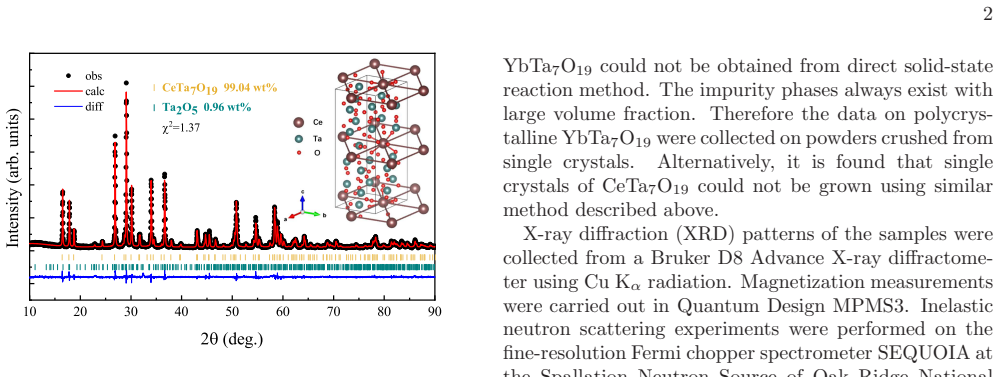
- [Results: Figs. 1 and 5] The statement 'no detectable structural disorder' is based on powder XRD; consider qualifying it as no detectable impurity phases or superstructure, since powder XRD is not sensitive to subtle local disorder.
- [CeTa7O19: Fig. 2] The inset of Fig. 2(d) is mentioned in the text but not visible in the figure as provided; ensure the callout and inset are clear.
- [References] Reference [26] is a placeholder; the Supplemental Material URL should be completed.
- [YbTa7O19: Methods] The powder XRD data are from crystals crushed from the single-crystal growth; please comment on possible preferred orientation in the crushed powder pattern.
- [Abstract and Conclusions] The abstract and conclusion use both 'pseudospin-1/2' and 'effective spin-1/2'; unify the terminology.
Circularity Check
No significant circularity: the CEF model is fitted to INS data and cross-validated against independent susceptibility, magnetization, and ESR data; equating low-temperature θCW with J is an interpretive assumption, not a circular reduction.
full rationale
The paper's derivation chain is not circular. For CeTa7O19, the CEF parameters (B02=-1.309 meV, B04=-0.020 meV, B34=3.335 meV) are obtained by fitting the INS spectra (Fig. 3 and surrounding text), and the g-factors (gz=2.57, gxy=0.86, Eq. 1), powder effective moment (1.42 µB), and the χ(T) and M(H) curves are then calculated from those INS-derived CEF parameters. The susceptibility, magnetization, and ESR data were not inputs to the CEF fit, so the agreement between the simulated curves and those data is a genuine cross-validation rather than a fit of the same data. The paper's phrase that susceptibility 'could be well fitted and explained' is consistent with this: the text says the χ(T) and M(H) curves are 'simulated' and 'calculated' from the CEF model, not that susceptibility was used to determine the CEF parameters. The exchange value J≈0.22 K for CeTa7O19 is taken directly from the low-temperature Curie-Weiss fit, and the Yb θc=-0.41 K is likewise a direct CW fit parameter; calling these exchange strengths is a standard mean-field identification, not a second quantity derived from the same fit and presented as an independent prediction. The paper explicitly acknowledges the limitation for YbTa7O19, stating that the Yb CEF parameters 'are currently unavailable due to the lack of large amount of phase-pure YbTa7O19 powders,' which removes any concern that the Yb g-factor calculation is being retrofitted to susceptibility. The only self-citation ([23], for DyOCl preparation) is a method recipe and is not load-bearing for any physical conclusion. No uniqueness theorem from the authors is invoked, and no fitted parameter is renamed as a prediction. The fragility of equating θCW with J for strongly anisotropic or impurity-affected powders is a scientific/modeling concern, not a circularity.
Assumptions & free parameters
free parameters (11)
- B02 (Ce CEF) =
-1.309 meV
- B04 (Ce CEF) =
-0.020 meV
- B34 (Ce CEF) =
3.335 meV
- theta_CW for CeTa7O19 below 5 K =
-0.22 ± 0.02 K
- mu_eff for CeTa7O19 below 5 K =
1.44 ± 0.11 μB
- theta_CW H||ab Yb =
0.0004 ± 0.01 K
- theta_CW H||c Yb =
-0.41 ± 0.02 K
- mu_eff H||ab Yb =
3.32 μB
- mu_eff H||c Yb =
2.17 μB
- ESR g-factors Ce =
g1=2.12, g2=0.96
- ESR g-factors Yb =
g1=3.45, g2=2.30
assumptions (5)
- domain assumption Ce3+ ground J=5/2 multiplet splits under D3v CEF into three Kramers doublets described by Stevens operators
- domain assumption Low-temperature susceptibility below 5 K is dominated by isolated pseudospin-1/2 moments with negligible CEF and impurity contributions
- domain assumption YbTa7O19 ground state is a well-isolated Kramers doublet with effective spin 1/2, without direct CEF measurement
- domain assumption LaTa7O19 is a valid non-magnetic phonon background for CeTa7O19 INS subtraction
- domain assumption Rietveld refinement of powder XRD can rule out detectable structural disorder
Cite this review
Pith. "Pith review of Structural and magnetic characterization of CeTa$_7$O$_{19}$ and YbTa$_7$O$_{19}$ with two-dimensional pseudospin-1/2 triangular lattice." pith.science (2026). https://pith.science/paper/RIT5MIXH
@misc{pith2026241118045,
  author       = {Pith},
  title        = {Pith review of: Structural and magnetic characterization of CeTa$_7$O$_19$ and YbTa$_7$O$_19$ with two-dimensional pseudospin-1/2 triangular lattice},
  year         = {2026},
  howpublished = {\url{https://pith.science/paper/RIT5MIXH}},
  note         = {Machine review of arXiv:2411.18045}
}
abstract
Triangular lattice antiferromagnets are prototypes for frustrated magnetism and may potentially realize novel quantum magnetic states such as a quantum spin liquid ground state. A recent work suggests NdTa$_7$O$_{19}$ with rare-earth triangular lattice is a quantum spin liquid candidate and highlights the large family of rare-earth heptatantalates as a framework for quantum magnetism investigation. In this paper, we report the structural and magnetic characterization of CeTa$_7$O$_{19}$ and YbTa$_7$O$_{19}$. Both compounds are isostructural to NdTa$_7$O$_{19}$ with no detectable structural disorder. For CeTa$_7$O$_{19}$, the crystal field energy levels and parameters are determined by inelastic neutron scattering measurements. Based on the crystal field result, the magnetic susceptibility data could be well fitted and explained, which reveals that CeTa$_7$O$_{19}$ is a highly anisotropic Ising triangular-lattice antiferromagnet ($g_z$/$g_{xy}$$\sim$3) with very weak exchange interaction (J$\sim$0.22~K). For YbTa$_7$O$_{19}$, millimeter sized single crystals could be grown. The anisotropic magnetization and electron spin resonance data show that YbTa$_7$O$_{19}$ has a contrasting in-plane magnetic anisotropy with $g_z$/$g_{xy}$$\sim$0.67 similar as that of YbMgGaO$_4$. The above results indicate that CeTa$_7$O$_{19}$ and YbTa$_7$O$_{19}$ with pseudospin-1/2 ground states might either be quantum spin liquid candidate materials or find applications in adiabatic demagnetization refrigeration due to the weak exchange interaction.
Figures


Figures from the paper (4 more)


Reference graph
Works this paper leans on
-
[1]
Y. Zhou, K. Kanoda, and T.-K. Ng, Quantum spin liquid states, Rev. Mod. Phys. 89, 025003 (2017)
2017
-
[2]
Broholm, R
C. Broholm, R. J. Cava, S. A. Kivelson, D. G. Nocera, M. R. Norman, and T. Senthil, Quantum spin liquids, Science 367, eaay0668 (2020)
2020
-
[3]
Xiang, C
J. Xiang, C. Zhang, Y. Gao, W. Schmidt, K. Schmalzl, C.-W. Wang, B. Li, N. Xi, X.-Y. Liu, H. Jin, G. Li, J. Shen, Z. Chen, Y. Qi, Y. Wan, W. Jin, W. Li, P. Sun, and G. Su, Giant magnetocaloric effect in spin supersolid candidate Na 2BaCo(PO4)2, Nature 625, 270 (2024)
2024
-
[4]
J. Sheng, L. Wang, A. Candini, W. Jiang, L. Huang, B. Xi, J. Zhao, H. Ge, N. Zhao, Y. Fu, J. Ren, J. Yang, P. Miao, X. Tong, D. Yu, S. Wang, Q. Liu, M. Kofu, R. Mole, G. Biasiol, D. Yu, I. A. Zal- iznyak, J.-W. Mei, and L. Wu, Two-dimensional quantum universality in the spin-1/2 triangular- lattice quantum antiferromagnet Na 2BaCo(PO4)2, Proc. Natl. Acad....
work page 2022
-
[5]
Y. Li, G. Chen, W. Tong, L. Pi, J. Liu, Z. Yang, X. Wang, and Q. Zhang, Rare-Earth Triangular Lat- tice Spin Liquid: A Single-Crystal Study of YbMgGaO 4, Phys. Rev. Lett. 115, 167203 (2015)
2015
-
[6]
W. Liu, Z. Zhang, J. Ji, Y. Liu, J. Li, X. Wang, H. Lei, G. Chen, and Q. Zhang, Rare-Earth Chalcogenides: A 8 Large Family of Triangular Lattice Spin Liquid Candi- dates, Chinese Physics Letters 35, 117501 (2018)
work page 2018
-
[7]
K. M. Ranjith, D. Dmytriieva, S. Khim, J. Sichelschmidt, S. Luther, D. Ehlers, H. Yasuoka, J. Wosnitza, A. A. Tsirlin, H. K¨ uhne, and M. Baenitz, Field-induced in- stability of the quantum spin liquid ground state in the Jeff = 1 2 triangular-lattice compound NaYbO 2, Phys. Rev. B 99, 180401 (2019)
work page 2019
-
[8]
M. M. Bordelon, E. Kenney, C. Liu, T. Hogan, L. Posthuma, M. Kavand, Y. Lyu, M. Sherwin, N. P. Butch, C. Brown, M. J. Graf, L. Balents, and S. D. Wilson, Field-tunable quantum disordered ground state in the triangular-lattice antiferromagnet NaYbO 2, Nature Physics 15, 1058 (2019)
2019
Show all 44 references
-
[9]
L. Ding, P. Manuel, S. Bachus, F. Grußler, P. Gegenwart, J. Singleton, R. D. Johnson, H. C. Walker, D. T. Adroja, A. D. Hillier, and A. A. Tsirlin, Gapless spin-liquid state in the structurally disorder-free triangular antiferroma g- net NaYbO 2, Phys. Rev. B 100, 144432 (2019)
2019
-
[10]
Baenitz, P
M. Baenitz, P. Schlender, J. Sichelschmidt, Y. A. Onyki - ienko, Z. Zangeneh, K. M. Ranjith, R. Sarkar, L. Hozoi, H. C. Walker, J.-C. Orain, H. Yasuoka, J. Van Den Brink, H. H. Klauss, D. S. Inosov, and T. Doert, NaYbS 2: A pla- nar spin- 1 2 triangular-lattice magnet and puta...
2018
-
[11]
K. M. Ranjith, S. Luther, T. Reimann, B. Schmidt, P. Schlender, J. Sichelschmidt, H. Yasuoka, A. M. Stry- dom, Y. Skourski, J. Wosnitza, H. K¨ uhne, T. Do- ert, and M. Baenitz, Anisotropic field-induced ordering in the triangular-lattice quantum spin liquid NaYbSe 2, Phys. Rev....
2019
-
[12]
Zhang, X
Z. Zhang, X. Ma, J. Li, G. Wang, D. T. Adroja, T. P. Per- ring, W. Liu, F. Jin, J. Ji, Y. Wang, Y. Kamiya, X. Wang, J. Ma, and Q. Zhang, Crystalline electric field excita- tions in the quantum spin liquid candidate NaYbSe 2, Phys. Rev. B 103, 035144 (2021)
2021
-
[13]
Zhang, J
Z. Zhang, J. Li, W. Liu, Z. Zhang, J. Ji, F. Jin, R. Chen, J. Wang, X. Wang, J. Ma, and Q. Zhang, Effective mag- netic Hamiltonian at finite temperatures for rare-earth chalcogenides, Phys. Rev. B 103, 184419 (2021)
2021
-
[14]
P.-L. Dai, G. Zhang, Y. Xie, C. Duan, Y. Gao, Z. Zhu, E. Feng, Z. Tao, C.-L. Huang, H. Cao, A. Podlesnyak, G. E. Granroth, M. S. Everett, J. C. Neuefeind, D. Voneshen, S. Wang, G. Tan, E. Mo- rosan, X. Wang, H.-Q. Lin, L. Shu, G. Chen, Y. Guo, X. Lu, and P. Dai, Spinon Fermi S...
2021
-
[15]
Zhang, J
Z. Zhang, J. Li, M. Xie, W. Zhuo, D. T. Adroja, P. J. Baker, T. G. Perring, A. Zhang, F. Jin, J. Ji, X. Wang, J. Ma, and Q. Zhang, Low-energy spin dy- namics of the quantum spin liquid candidate NaYbSe 2, Phys. Rev. B 106, 085115 (2022)
2022
-
[16]
J. Wu, J. Li, Z. Zhang, C. Liu, Y. H. Gao, E. Feng, G. Deng, Q. Ren, Z. Wang, R. Chen, J. Embs, F. Zhu, Q. Huang, Z. Xiang, L. Chen, Y. Wu, E. S. Choi, Z. Qu, L. Li, J. Wang, H. Zhou, Y. Su, X. Wang, G. Chen, Q. Zhang, and J. Ma, Magnetic field ef- fects on the quantum spin liq...
2022
-
[17]
Zhang, H
S. Zhang, H. J. Changlani, K. W. Plumb, O. Tch- ernyshyov, and R. Moessner, Dynamical Structure Factor of the Three-Dimensional Quantum Spin Liquid Candi- date NaCaNi 2F7, Phys. Rev. Lett. 122, 167203 (2019)
2019
-
[18]
Z. Zhu, P. A. Maksimov, S. R. White, and A. L. Cherny- shev, Disorder-Induced Mimicry of a Spin Liquid in YbMgGaO4, Phys. Rev. Lett. 119, 157201 (2017)
2017
-
[19]
Kimchi, A
I. Kimchi, A. Nahum, and T. Senthil, Valence Bonds in Random Quantum Magnets: Theory and Application to YbMgGaO4, Phys. Rev. X 8, 031028 (2018)
2018
-
[20]
Z. Ma, J. Wang, Z.-Y. Dong, J. Zhang, S. Li, S.-H. Zheng, Y. Yu, W. Wang, L. Che, K. Ran, S. Bao, Z. Cai, P. ˇCerm´ ak, A. Schneidewind, S. Yano, J. S. Gardner, X. Lu, S.-L. Yu, J.-M. Liu, S. Li, J.-X. Li, and J. Wen, Spin-Glass Ground State in a Triangular-Lattice Compound Yb...
2018
-
[21]
T. Arh, B. Sana, M. Pregelj, P. Khuntia, Z. Jagliˇ ci´ c, M. D. Le, P. K. Biswas, P. Manuel, L. Mangin- Thro, A. Ozarowski, and A. Zorko, The Ising triangular-lattice antiferromagnet neodymium hep- tatantalate as a quantum spin liquid candidate, Nature Materials 21, 416 (2022)
2022
-
[22]
L. Wang, Z. Ouyang, T. Xiao, Z. Li, and Z. Tian, Syn- thesis, structure and magnetism of RTa 7O19 (R = Pr, Sm, Eu, Gd, Dy, Ho) with perfect triangular lattice, Journal of Alloys and Compounds 937, 168390 (2023)
2023
-
[23]
C. Tian, F. Pan, L. Wang, D. Ye, J. Sheng, J. Wang, J. Liu, J. Huang, H. Zhang, D. Xu, J. Qin, L. Hao, Y. Xia, H. Li, X. Tong, L. Wu, J.-H. Chen, S. Jia, P. Cheng, J. Yang, and Y. Zheng, DyOCl: A rare-earth based two- dimensional van der Waals material with strong magnetic ani...
2021
-
[24]
G. E. Granroth, A. I. Kolesnikov, T. E. Sherline, J. P. Clancy, K. A. Ross, J. P. C. Ruff, B. D. Gaulin, and S. E. Nagler, SEQUOIA: A Newly Operating Chopper Spectrometer at the SNS, Journal of Physics: Conference Series 251, 012058 (2010)
2010
-
[25]
M. B. Stone, J. L. Niedziela, D. L. Abernathy, L. DeBeer- Schmitt, G. Ehlers, O. Garlea, G. E. Granroth, M. Graves-Brook, A. I. Kolesnikov, A. Podlesnyak, and B. Winn, A comparison of four direct geometry time-of- flight spectrometers at the Spallation Neutron Source, Review of...
2014
-
[26]
See Supplemental Material at [URL will be inserted by publisher] for the Rietveld refinement result of CeTa 7O19 and YbTa 7O19
-
[27]
B. Gao, T. Chen, D. W. Tam, C.-L. Huang, K. Sas- mal, D. T. Adroja, F. Ye, H. Cao, G. Sala, M. B. Stone, C. Baines, J. A. T. Verezhak, H. Hu, J.-H. Chung, X. Xu, S.-W. Cheong, M. Nallaiyan, S. Spagna, M. B. Maple, A. H. Nevidomskyy, E. Morosan, G. Chen, and P. Dai, Experimenta...
2019
-
[28]
Arnold, J
O. Arnold, J. Bilheux, J. Borreguero, A. Buts, S. Camp- bell, L. Chapon, M. Doucet, N. Draper, R. Ferraz Leal, M. Gigg, V. Lynch, A. Markvardsen, D. Mikkelson, R. Mikkelson, R. Miller, K. Palmen, P. Parker, G. Passos, T. Perring, P. Peterson, S. Ren, M. Reuter, A. Savici, J. T...
-
[29]
O. P. Uzoh, S. Kim, and E. Mun, Influence of crystalline electric field on the magnetic properties of CeCd 3X3 (X = P, As), Phys. Rev. Materials 7, 013402 (2023) . 9
2023
-
[30]
S. Shin, V. Pomjakushin, L. Keller, P. F. S. Rosa, U. Stuhr, C. Niedermayer, R. Sibille, S. Toth, J. Kim, H. Jang, S.-K. Son, H.-O. Lee, T. Shang, M. Medarde, E. D. Bauer, M. Kenzelmann, and T. Park, Magnetic structure and crystalline electric field ef- fects in the triangular ...
2020
-
[31]
Scheie, PyCrystalField : software for calculation, anal- ysis and fitting of crystal electric field Hamiltonians, Journal of Applied Crystallography 54, 356 (2021)
A. Scheie, PyCrystalField : software for calculation, anal- ysis and fitting of crystal electric field Hamiltonians, Journal of Applied Crystallography 54, 356 (2021)
2021
-
[32]
Stoll and A
S. Stoll and A. Schweiger, EasySpin, a comprehensive software package for spectral simulation and analysis in EPR, Journal of Magnetic Resonance 178, 42 (2006)
2006
-
[33]
Yunoki and S
S. Yunoki and S. Sorella, Two spin liquid phases in the spatially anisotropic triangular Heisenberg model, Phys. Rev. B 74, 014408 (2006)
2006
-
[34]
Yamamoto, G
D. Yamamoto, G. Marmorini, and I. Danshita, Quantum Phase Diagram of the Triangular-Lattice XXZ Model in a Magnetic Field, Phys. Rev. Lett. 112, 127203 (2014)
2014
-
[35]
P. A. Maksimov, Z. Zhu, S. R. White, and A. L. Cherny- shev, Anisotropic-Exchange Magnets on a Triangular Lattice: Spin Waves, Accidental Degeneracies, and Dual Spin Liquids, Phys. Rev. X 9, 021017 (2019)
2019
-
[36]
Fazekas and P
P. Fazekas and P. W. Anderson, On the ground state properties of the anisotropic triangular antiferromagnet , Philosophical Magazine 30, 423 (1974)
1974
-
[37]
Schaffrath and R
U. Schaffrath and R. Gruehn, Zum chemis- chen Transport von Verbindungen des Typs LnTa7O19 (Ln = La-Nd) mit einer Be- merkung zur Strukturverfeinerung von NdTa 7O19, Zeitschrift f¨ ur anorganische und allgemeine Chemie 588, 43 (1990)
1990
-
[38]
Cavalli, L
E. Cavalli, L. Leonyuk, and N. Leonyuk, Flux growth and optical spectra of NdTa 7O19 crystals, Journal of Crystal Growth 224, 67 (2001)
2001
-
[39]
Volkova, A
E. Volkova, A. Alekseev, and N. Leonyuk, Crystallizati on of neodymium heptatantalate from molybdate based flux systems, Journal of Crystal Growth 270, 145 (2004)
2004
-
[40]
G. C. Guo, J. N. Zhuang, Y. G. Wang, J. T. Chen, H. H. Zhuang, J. S. Huang, and Q. E. Zhang, Dysprosium Tantalum Oxide, DyTa 7O19, Acta Crystallographica Section C Crystal Structure Commun ications
-
[41]
Sichelschmidt, P
J. Sichelschmidt, P. Schlender, B. Schmidt, M. Baenitz, and T. Doert, Electron spin reso- nance on the spin-1/2 triangular magnet NaYbS 2, Journal of Physics: Condensed Matter 31, 205601 (2019)
2019
-
[42]
Grußler, M
F. Grußler, M. Hemmida, S. Bachus, Y. Skourski, H.-A. Krug Von Nidda, P. Gegenwart, and A. A. Tsirlin, Role of alkaline metal in the rare-earth triangular antiferro- magnet KYbO 2, Phys. Rev. B 107, 224416 (2023)
2023
-
[43]
W. Zhuo, Z. Zhang, M. Xie, A. Zhang, J. Ji, F. Jin, and Q. Zhang, Magnetism of NaYbS 2: From finite temperatures to ground state, Science China Physics, Mechanics & Astronomy 67, 107411 (2024)
2024
-
[44]
Tokiwa, S
Y. Tokiwa, S. Bachus, K. Kavita, A. Jesche, A. A. Tsir- lin, and P. Gegenwart, Frustrated magnet for adiabatic demagnetization cooling to milli-Kelvin temperatures, Communications Materials 2, 42 (2021)
2021
Reviewed August 12, 2026 · model on record in the stance chip above.
Discussion (0). Continue with ORCID to comment.