REVIEW 5 major objections 6 minor 12 references
IKUN: Initialization to Keep snn training and generalization great with sUrrogate-stable variaNce
T0 review · 5 major / 6 minor · reviewed 2026-08-12 · deepseek-v4-flash
Pith's one-line read A surrogate-aware weight initialization, IKUN, claims to stabilize signal and gradient variance in spiking neural networks, reaching accuracy thresholds in up to 59% fewer epochs.
desk verdict A genuinely new initialization formula, but the proof is missing and the experiments are too thin to carry the claim. read the letter →
The pith
A machine-rendered reading of the paper's core claim, the machinery that carries it, and where it could break.
The reading
What carries the argument
The load-bearing object is the surrogate-stable variance condition of Equation (8), an SNN analogue of Xavier and Kaiming initialization. The surrogate gradient $f'$ is the smooth derivative of the spiking activation used during backpropagation in place of the non-differentiable spike function. IKUN sets $\sigma_W^2 = \alpha / (\mathrm{fanin} \cdot \sigma_X^2 \cdot \mathbb{E}[f'(H)^2])$, so the scale of the random weights is inversely proportional to the expected squared surrogate gradient; IKUN v2 replaces $\mathrm{fanin}$ with $\mathrm{fanin}+\mathrm{fanout}$ in the denominator. This factor carries the argument: it converts the surrogate's effect on backward gradients into a per-layer variance-balance condition, exactly as ReLU's half-wave rectification enters Kaiming initialization.
What would settle it
Train the reported architecture at greater depth (say ten layers) or with random spike-train inputs, and measure the variance of the membrane potential at each layer and time step. IKUN predicts flat variance and bounded gradient norms; if variance grows or gradients vanish as depth or time steps increase, the balancing condition fails.
Extended reading notes
Core claim
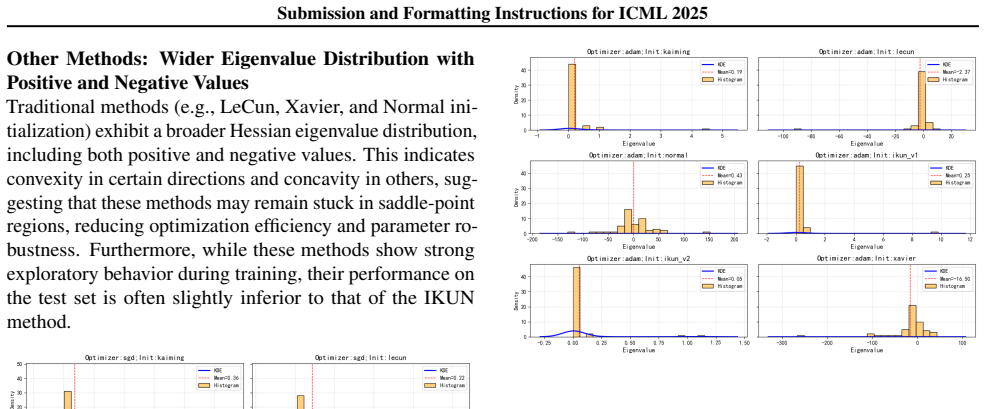
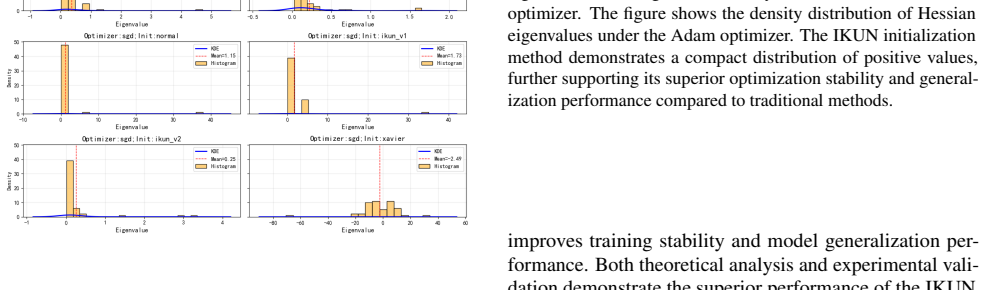
The paper's central claim is Theorem 1: in an SNN layer with membrane potential $H[t] = \tau V[t-1] + \sum_i w_i X_i[t]$ and weights $w_i \sim \mathcal{N}(0, \sigma_W^2)$, the condition $\sigma_W^2 = \alpha / (\mathrm{fanin} \cdot \sigma_X^2 \cdot \mathbb{E}[f'(H)^2])$ keeps signal variance stable during forward propagation and prevents gradient vanishing or explosion during backpropagation. A second version, IKUN v2, uses $\mathrm{fanin}+\mathrm{fanout}$ in the denominator to balance input and output dimensions. The authors support the theorem with experiments on a two-layer convolutional SNN trained on FashionMNIST, where IKUN reaches 95% training and 91% test accuracy in fewer epochs than Xavier, Kaiming, LeCun, and normal initialization, and where trained models show Hessian eigenvalues concentrated near zero on the positive side, which they interpret as convergence to flat minima with better generalization.
Load-bearing premise
The proof assumes each layer's weighted input is a zero-mean Gaussian whose variance factorizes as fanin times weight variance times input variance, so the only effect of spiking is the scalar $\mathbb{E}[f'(H)^2]$; if temporal accumulation or non-Gaussian inputs break that, the variance condition stops holding.
Editorial extensions
If this is right
- IKUN reaches accuracy thresholds in up to 59.38% fewer epochs under SGD and 42.31% fewer under Adam compared with standard initializations on the reported FashionMNIST setup.
- Trained models show a nearly all-positive Hessian spectrum close to zero, which the paper links to flat minima and improved generalization.
- The method is designed to work with any surrogate gradient (sigmoid, tanh, or linear), so the same initialization rule transfers across surrogate choices.
- IKUN v2's fanin+fanout variant explicitly accounts for both input and output dimensions, making it suitable for convolutional and other non-square layers.
- The gains appear under both SGD and Adam, whereas the baselines the paper tests do not dominate on both optimizers at once.
Reading between the lines
- Editorial inference: the variance-balance argument could be extended to deep or recurrent SNNs by replacing the static $\mathbb{E}[f'(H)^2]$ with a time-averaged or layer-dependent value, but the paper does not prove that extension.
- Editorial inference: if the condition holds at scale, SNN libraries could adopt an IKUN-style default instead of Kaiming, removing a common source of instability in deep spike-based models.
- Editorial inference: the flat-minima result hints that IKUN may combine well with sharpness-aware optimizers or pruning, though the paper does not test such combinations.
- Editorial inference: because the condition depends on $\sigma_X^2$, input encoding (rate vs. temporal) should change the optimal initialization; testing IKUN under temporal coding would be a natural next step.
Editorial analysis
A structured set of objections, weighed in public.
Referee Report
Summary. The paper proposes IKUN, a weight-initialization scheme for spiking neural networks trained with surrogate gradients. The central theoretical claim (Theorem 1, Section 3.2) is that setting the weight variance according to Eq. (8) stabilizes forward signal variance and prevents gradient vanishing or explosion for the LIF-type dynamics in Eq. (7). The authors report experiments on a two-layer convolutional SNN on Fashion-MNIST, claiming faster convergence and better generalization than Xavier, Kaiming, LeCun, and default initialization, and support this with Hessian eigenvalue and trace analyses. The proof of Theorem 1 is deferred to an appendix that is absent from the preprint.
Significance. If the theoretical result were correct, IKUN would be a useful plug-and-play initialization for surrogate-gradient SNN training, and the paper deserves credit for open-sourcing the code and for examining multiple surrogate-gradient compatibility questions. However, the mathematical core is unverified, the variance condition as stated omits the recurrent and spike-reset structure of the neuron model, and the empirical evidence is limited to a single small dataset with no error bars. The paper also contains an inconsistency between the reported epoch-reduction percentages and the numbers in Table 1. These issues are load-bearing for the paper's central claims.
major comments (5)
- [Section 3.2, Eqs. (7)-(8)] The variance condition is asserted for the recurrent dynamics H[t] = tau V[t-1] + sum_i w_i X_i[t], but Eq. (8) balances only the instantaneous input term. From Eq. (7), Var(H[t]) includes tau^2 Var(V[t-1]) and a covariance term with the input sum; neither appears in Eq. (8). The theorem also uses E[f'(H)^2], a surrogate-gradient quantity from the backward pass, to control forward variance, although the forward nonlinearity is a spike-and-reset operation whose output variance depends on the firing probability, not on f'. The proof is deferred to an appendix that is not present in the preprint, so these gaps cannot be checked.
- [Section 3.2, Eq. (8)] Equation (8) is not an explicit initialization rule. The expectation E[f'(H)^2] is over an unspecified distribution of H, and H depends on sigma_W through Eq. (7), making the equation a fixed-point condition. The threshold Vthreshold = mu H introduces an additional unspecified parameter mu, and alpha is described only as a given hyperparameter with no value reported in Section 4. Without specifying these quantities, Eq. (8) cannot be instantiated or reproduced.
- [Section 3.2, Theorem 1] The gradient-vanishing/explosion claim is not supported because backpropagation through time is ignored. The temporal recursion contributes products of the leakage factor tau, together with the reset mechanism, to the gradient Jacobian; any variance balance for gradients must account for these terms and the time horizon. Equation (8) contains no tau and no time dependence, so the theorem's conclusion about backpropagation does not follow from the forward-variance balance it states.
- [Section 4.3, Table 1] The paper reports a 59.38% training-epoch reduction under SGD, but the listed SGD epochs are IKUN v2 = 26, Normal = 29, and Xavier = 27; the largest reduction visible in the table is 10.3%. The Adam reduction of 42.31% is consistent with the table (26 to 15 epochs), but the SGD headline number is not derivable from the printed results and needs a stated baseline.
- [Section 5 and Section 4.1] The experimental evidence is too narrow for the general claims in the abstract. The model is a two-layer convolutional SNN, the data is a fixed subset of Fashion-MNIST, and no seeds, error bars, or repeated runs are reported; Section 5 explicitly concedes these limitations. This does not support broad statements about training efficiency and generalization, nor the Hessian-based generalization conclusions, without additional statistical validation.
minor comments (6)
- [Section 3.2] The symbol f in Eq. (8) is never defined; specify the surrogate activation function whose derivative is used.
- [Section 4.1] "LeCun Initialization (Bi & Poo, 1998)" cites the wrong reference; the correct source is LeCun et al. (2002).
- [Section 4.1] The "Normal" initialization is not described; specify the distribution and scale used.
- [Table 2 and Section 4.2] The text says lower absolute Hessian Trace values indicate flatter minima, but the table reports large negative traces for several methods; define the metric and its sign convention.
- [Abstract and Table 1] The abstract states "up to 50%" improvement in training efficiency, while Table 1 reports 59.38%; unify these numbers.
- [Eqs. (6)-(7)] Notation switches from V(t) to H[t] without defining the relationship; clarify whether H[t] is the pre-spike membrane potential and V[t] is the post-reset potential.
Circularity Check
No circular derivation: IKUN's variance condition is a standard variance-preservation construction, not an input renamed as a prediction.
full rationale
The paper's central step, Theorem 1 in Section 3.2, proposes the weight-variance condition sigma_W^2 = alpha / (fanin * sigma_X^2 * E[f'(H)^2]) and claims it stabilizes forward variance and avoids gradient vanishing/explosion. This is the standard variance-matching construction used by Xavier and Kaiming initialization: one writes the variance-propagation equation, imposes the stability goal, and solves for sigma_W. The condition is not by construction identical to the theorem's conclusion; the conclusion concerns the LIF recursion H[t] = tau V[t-1] + sum_i w_i X_i[t], which involves the recurrent term, reset, and threshold, none of which appear explicitly in Eq. 8. Thus the theorem would require a real proof, not a definitional rewriting. The proof is deferred to an appendix that is referenced but absent, and the expectation E[f'(H)^2] depends on H and hence on the weight distribution, making Eq. 8 an implicit self-consistency condition rather than a fitted parameter renamed as a prediction. Those are correctness and rigor concerns, not circularity. The paper contains no load-bearing self-citations: the cited prior initialization methods and datasets are external, and the experimental comparisons are against standard baselines rather than against values produced by the paper's own formulas. The limitation passage in Section 5, stating that experiments used a two-layer convolutional SNN on a fixed subset of Fashion-MNIST, is an honest scope restriction and does not smuggle any input into an output. Under the required standard of quoting a specific reduction, no circular step can be exhibited. Score 0.
Assumptions & free parameters
free parameters (3)
- alpha
- E[f'(H)^2]
- mu threshold coefficient (Vthreshold=mu H)
assumptions (4)
- standard math Layer inputs and weights are zero-mean and mutually independent so that Var(sum w_i X_i)=fan_in sigma_W^2 sigma_X^2.
- ad hoc to paper The recurrent membrane potential term tau V[t-1] can be ignored in the variance balance, so the network behaves like a memoryless feedforward layer.
- ad hoc to paper The effect of the spiking nonlinearity on gradient variance is fully captured by E[f'(H)^2].
- domain assumption A two-layer convolutional SNN on FashionMNIST is representative of SNN training behavior.
Cite this review
Pith. "Pith review of IKUN: Initialization to Keep snn training and generalization great with sUrrogate-stable variaNce." pith.science (2026). https://pith.science/paper/7LIEVVF2
@misc{pith2026241118250,
  author       = {Pith},
  title        = {Pith review of: IKUN: Initialization to Keep snn training and generalization great with sUrrogate-stable variaNce},
  year         = {2026},
  howpublished = {\url{https://pith.science/paper/7LIEVVF2}},
  note         = {Machine review of arXiv:2411.18250}
}
read the original abstract
Weight initialization significantly impacts the convergence and performance of neural networks. While traditional methods like Xavier and Kaiming initialization are widely used, they often fall short for spiking neural networks (SNNs), which have distinct requirements compared to artificial neural networks (ANNs). To address this, we introduce \textbf{IKUN}, a variance-stabilizing initialization method integrated with surrogate gradient functions, specifically designed for SNNs. \textbf{IKUN} stabilizes signal propagation, accelerates convergence, and enhances generalization. Experiments show \textbf{IKUN} improves training efficiency by up to \textbf{50\%}, achieving \textbf{95\%} training accuracy and \textbf{91\%} generalization accuracy. Hessian analysis reveals that \textbf{IKUN}-trained models converge to flatter minima, characterized by Hessian eigenvalues near zero on the positive side, promoting better generalization. The method is open-sourced for further exploration: \href{https://github.com/MaeChd/SurrogateVarStabe}{https://github.com/MaeChd/SurrogateVarStabe}.
Figures


Figures from the paper (6 more)


Reference graph
Works this paper leans on
-
[1]
Estimating or propagating gradients through stochastic neurons for con- ditional computation
Bengio, Y ., L´eonard, N., and Courville, A. Estimating or propagating gradients through stochastic neurons for con- ditional computation. arXiv preprint arXiv:1308.3432,
-
[9]
Spatio- temporal backpropagation for training high-performance spiking neural networks
10 Submission and Formatting Instructions for ICML 2025 Wu, Y ., Deng, L., Li, G., Zhu, J., and Shi, L. Spatio- temporal backpropagation for training high-performance spiking neural networks. Frontiers in neuroscience, 12: 331,
work page 2025
-
[10]
Fashion-mnist: a novel image dataset for benchmarking machine learning algorithms
Xiao, H., Rasul, K., and V ollgraf, R. Fashion-mnist: a novel image dataset for benchmarking machine learning algorithms. arXiv preprint arXiv:1708.07747,
-
[11]
Yao, Z., Gholami, A., Keutzer, K., and Mahoney, M. W. Py- hessian: Neural networks through the lens of the hessian. In 2020 IEEE international conference on big data (Big data), pp. 581–590. IEEE,
work page 2020
-
[2000]
M., Potempa, K., Versari, L., Fischbacher, T., Gesmundo, A., and Alakuijala, J
Comsa, I. M., Potempa, K., Versari, L., Fischbacher, T., Gesmundo, A., and Alakuijala, J. Temporal coding in spiking neural networks with alpha synaptic function. In ICASSP 2020-2020 IEEE International Conference on Acoustics, Speech and Signal Processing (ICASSP), pp. 8529–8533. IEEE,
work page 2020
-
[2002]
Training Deep Spiking Neural Networks
Ledinauskas, E., Ruseckas, J., Jurˇs˙enas, A., and Buraˇcas, G. Training deep spiking neural networks. arXiv preprint arXiv:2006.04436,
work page Pith review arXiv 2006
-
[2007]
Wang, H., Keskar, N. S., Xiong, C., and Socher, R. Identi- fying generalization properties in neural networks. arXiv preprint arXiv:1809.07402,
-
[2011]
Gygax, J. and Zenke, F. Elucidating the theoretical under- pinnings of surrogate gradient learning in spiking neural networks. arXiv preprint arXiv:2404.14964,
Show all 12 references
-
[2016]
Batch normalization: Accelerating deep net- work training by reducing internal covariate shift
Ioffe, S. Batch normalization: Accelerating deep net- work training by reducing internal covariate shift. arXiv preprint arXiv:1502.03167,
-
[2017]
Dropout: a simple way to prevent neural networks from overfitting
Srivastava, N., Hinton, G., Krizhevsky, A., Sutskever, I., and Salakhutdinov, R. Dropout: a simple way to prevent neural networks from overfitting. The journal of machine learning research, 15(1):1929–1958,
1929
-
[2018]
Kingma, D. P. Adam: A method for stochastic optimization. arXiv preprint arXiv:1412.6980,
-
[2020]
Understanding straight-through estimator in train- ing activation quantized neural nets
Yin, P., Lyu, J., Zhang, S., Osher, S., Qi, Y ., and Xin, J. Understanding straight-through estimator in train- ing activation quantized neural nets. arXiv preprint arXiv:1903.05662,
1903 arXiv
Reviewed August 12, 2026 · model on record in the stance chip above.
Discussion (0). Continue with ORCID to comment.