REVIEW 2 major objections 8 minor 102 references
Anisotropic, multiband, and strong-coupling superconductivity of the Pb0.64Bi0.36 alloy
T0 review · 2 major / 8 minor · reviewed 2026-08-12 · deepseek-v4-flash
Pith's one-line read Pb$_{0.64}$Bi$_{0.36}$ reaches $\lambda\approx 2$ because a cubic-to-hexagonal transition softens its phonons, and, unlike lead, it forms an overlapped three-gap superconducting state.
desk verdict Solid first-principles account of Pb-Bi's strong coupling; the structural-transition story is convincing, but the three-gap picture needs a disorder test. read the letter →
The pith
A machine-rendered reading of the paper's core claim, the machinery that carries it, and where it could break.
The reading
What carries the argument
The machinery at work is the decomposition of the electron-phonon coupling constant as $\lambda = 2I/\hat{\omega}^2$, where $I = \int \omega \alpha^2F(\omega)\,d\omega$ measures the electronic contribution through phonon linewidths and $\hat{\omega}^2$ is the average squared phonon frequency. Applied to a sequence of systems (fcc Pb, hexagonal Pb, and Pb$_{0.64}$Bi$_{0.36}$, each with and without spin-orbit coupling), this ratio isolates how the structural transition, electron doping, and relativistic effects each contribute to the enhancement of $\lambda$. The phonons and electron-phonon matrix elements are computed with density functional perturbation theory using a virtual crystal approximation for the alloy, validated against KKR-CPA electronic structure and the measured residual resistivity; the anisotropic superconducting gap is solved with density functional theory for superconductors (SCDFT). The same machinery also yields the key qualitative contrast: two well-separated Fermi-surface sheets in Pb give two distinct gap maxima, while three sheets with mixed sp character in the alloy give overlapping gap distributions.
What would settle it
Measure the phonon dispersion of hexagonal Pb$_{0.64}$Bi$_{0.36}$ by inelastic neutron or x-ray scattering and compare with the virtual-crystal calculation: if the low-frequency optical modes near the $\Gamma$ point are significantly harder than predicted (so that $\hat{\omega}^2$ does not drop below the fcc Pb value), the claimed structural-transition-driven enhancement of $\lambda$ would be refuted. Alternatively, high-resolution tunneling or specific-heat measurements that resolve only one gap, or two well-separated gaps, rather than the predicted overlapped three-gap structure, would also disprove the central claim.
Extended reading notes
Core claim
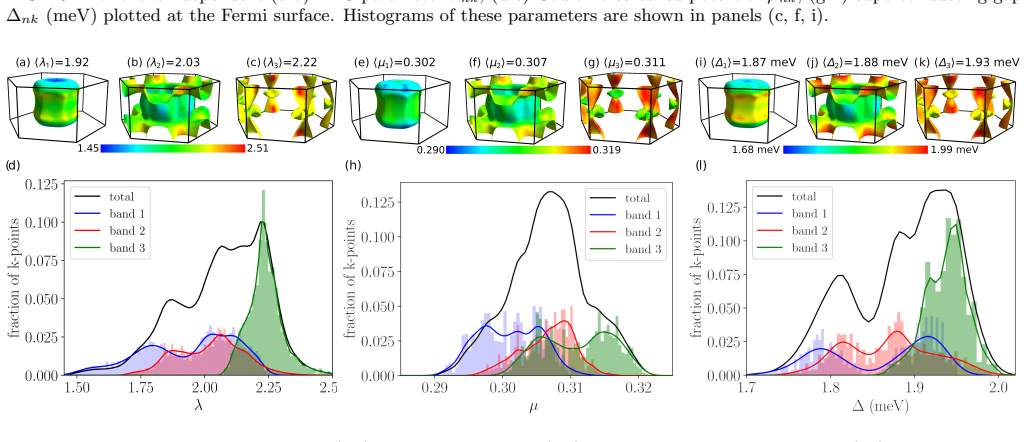
The central discovery is that the extraordinary electron-phonon coupling of the Pb-Bi alloy comes mainly from the structural transition from fcc to hexagonal (nearly hcp) coordination, and that the superconducting state is a strongly anisotropic, overlapped three-gap-like structure. By writing $\lambda = 2I/\hat{\omega}^2$, the authors separate the electronic factor $I$ (proportional to phonon linewidths) from the phononic factor $\hat{\omega}^2$ (average squared phonon frequency). Going from fcc Pb to a hypothetical hexagonal Pb, $\hat{\omega}^2$ drops from 1.79 to 1.35 THz$^2$ while $I$ rises slightly, producing a jump in $\lambda$ from 1.47 to 2.03; adding Bi electrons and spin-orbit coupling changes these factors further ($I$ to 1.45 THz$^2$, $\hat{\omega}^2$ to 1.43 THz$^2$), bringing the final $\lambda$ to 2.05 in the isotropic picture and 2.08 as the Fermi-surface average in SCDFT. On the gap structure, SCDFT solutions give bimodal and clearly separated gap values on the two Fermi surface sheets of Pb (averages 1.30 and 1.44 meV), while the three sheets of the alloy carry overlapping gap distributions (averages 1.84, 1.88, and 1.93 meV) whose spread narrows with temperature, consistent with the deviations from single-gap s-wave behavior seen in specific heat and critical fields. Finally, the short electron scattering time $\tau \approx 2.75$ fs extracted from the calculation is shown to lower $T_c$, moving the SCDFT value of 9.6 K toward the experimental 8.6 K.
Load-bearing premise
The central assumption is that the alloy can be represented as an ordered 'virtual crystal': atoms are replaced by an average pseudopotential and the average atomic mass, and the lattice vibrations and pairing are computed in that averaged medium; if real chemical disorder substantially changes the phonons or the pairing beyond what the averaged medium captures, the computed $\lambda \approx 2.05$ and the three-gap distribution would shift.
Editorial extensions
If this is right
- The fcc-to-hexagonal transition is the dominant factor in raising $\lambda$ from 1.47 in fcc Pb to 2.03 in the hexagonal structure, implying that phonon softening from a structural transition can outweigh electron-count effects in strong-coupling superconductors.
- The overlapped three-gap structure explains the experimentally observed deviations from single-gap BCS behavior in the temperature dependence of specific heat and of the lower and upper critical fields.
- Chemical disorder suppresses $T_c$: the clean-limit SCDFT value of 9.6 K is reduced toward the measured 8.6 K when scattering at $\tau \approx 2.75$ fs is included, suggesting that more ordered samples of the same composition could superconduct at higher temperatures.
- Spin-orbit coupling contributes significantly to $\lambda$ by lowering phonon frequencies (a 31% increase in the alloy relative to the scalar-relativistic case), so relativistic effects are essential for quantitative predictions in heavy-element superconductors.
- The computed Eliashberg function for Pb$_{0.64}$Bi$_{0.36}$ agrees with tunneling-derived data for Pb$_{0.65}$Bi$_{0.35}$, validating the virtual-crystal approach for electron-phonon properties of this alloy class.
Reading between the lines
- An editor's inference: the structural-transition mechanism identified here could serve as a search strategy for new strong-coupling superconductors, namely alloys that undergo symmetry-lowering transitions with an accompanying softening of the phonon spectrum.
- If disorder truly suppresses $T_c$, then reducing chemical disorder, through ordering, thin-film growth, or eliminating defects, might push Pb$_{0.64}$Bi$_{0.36}$ closer to its clean-limit $T_c$, a testable material-engineering route.
- The overlapped three-gap structure implies a strongly momentum-dependent order parameter; this could manifest in field-angle-dependent thermal conductivity or in the temperature dependence of the magnetic penetration depth, providing independent experimental checks.
- The two-step validation strategy (KKR-CPA for the electronic structure plus measured resistivity for the scattering time) may be transferable to predicting superconductivity in other disordered alloys where virtual-crystal phonons are used.
Editorial analysis
A structured set of objections, weighed in public.
Referee Report
Summary. The paper combines experimental measurements (magnetic susceptibility, resistivity, specific heat) with first-principles calculations (DFT, DFPT, isotropic Eliashberg, anisotropic SCDFT) to explain the strong-coupling superconductivity of Pb0.64Bi0.36. The authors report Tc = 8.6 K, λ ≈ 2.05, and propose that the fcc-to-hexagonal structural transition is the primary driver of the enhanced electron-phonon coupling, with additional contributions from Bi doping and spin-orbit coupling. They further argue that, unlike Pb which exhibits two well-separated superconducting gaps, the alloy shows an overlapped three-gap-like anisotropic structure, and that disorder-induced electron scattering (τ ≈ 3 fs) reduces Tc, partially explaining the difference between the SCDFT value (9.6 K) and experiment.
Significance. If the conclusions hold, this work provides a compelling microscopic explanation for the record-strong electron-phonon coupling in a bulk ambient-pressure superconductor and a rare theoretical account of multigap anisotropic superconductivity in a disordered alloy. The paper has clear strengths: parameter-free SCDFT calculations for both Pb and the alloy, careful validation of the VCA electronic structure against all-electron KKR-CPA, reproduction of the residual resistivity, and comparison of the computed α2F with tunneling data for a closely related alloy. The clean decomposition of the λ enhancement into structural, doping, and SOC contributions is a valuable conceptual result. The main weakness is that the central gap-structure claim rests on calculations performed in the ordered VCA medium, while the paper's own disorder analysis places the alloy in a strong-scattering regime where the robustness of the anisotropic gap distribution is not self-evident.
major comments (2)
- [Sec. IV.E.3, Figs. 19-20, Table V]
- [Sec. IV.E.5, Fig. 22]
minor comments (8)
- [Sec. IV.E.1 and SM IX] Equation numbering is inconsistent: the Eliashberg equations are numbered (22) in the main text but the text refers to "Equations (38)," and the Supplemental Material also numbers them (38). Please unify the numbering and cross-references.
- [Table IV and Eq. (21)] The table header says "I (THz) defined with Eq. 32," but Eq. (32) appears only in the Supplemental Material; in the main text I is defined in Eq. (21). Please correct the cross-reference.
- [Fig. 15] The axis labels in Fig. 15 contain garbled text (e.g., "BP/BF/BA/BC/BJ..."), apparently a font or encoding artifact. The horizontal axis should be T/Tc and the vertical axis should be ΔCe/(γTc).
- [Ref. [20]] Reference [20] is an empty placeholder. The pseudopotential details and the PSlibrary reference should be properly cited.
- [Sec. IV.E.2] The phrase "quite clerly overestimated" contains a typo; it should read "quite clearly overestimated."
- [Eq. (22) and SM Eq. (38)] The term "Heviside function" should be "Heaviside function."
- [Sec. IV.C and Sec. IV.E.5] The statement in Sec. IV.C that "electron scattering is not a dominating factor for the electronic structure" appears to be in tension with the later finding ℏ/τ = 240 meV ≫ ℏωD. Please clarify the distinction between the validity of the VCA band centers and the strong scattering regime relevant for superconductivity.
- [Fig. 13(h)] The agreement between the computed α2F and the tunneling-derived α2F of Pb0.65Bi0.35 is stated qualitatively. A quantitative measure (e.g., a logarithmic-average frequency comparison or a weighted residual) would strengthen the validation claim.
Circularity Check
No circularity found: the central EPC and gap-structure claims are parameter-free DFT/SCDFT results, and the one fitted parameter (mu*) is disclosed and not used for the main structural conclusions.
full rationale
The paper's derivation chain is not circular. The central claims, that lambda ~ 2.05 in Pb0.64Bi0.36 is driven primarily by the fcc-to-hexagonal transition and that the superconducting gap forms an overlapped three-gap-like anisotropic structure, come from parameter-free DFPT phonon/electron-phonon calculations and SCDFT gap calculations without an assumed mu*. The decomposition fcc-Pb -> hexagonal-Pb -> Pb0.64Bi0.36 is a controlled computational experiment, not a fit to the target result. The VCA electronic structure is separately validated against KKR-CPA near E_F, and the calculated alpha^2F is compared with independent tunneling data for Pb0.65Bi0.35. The isotropic Eliashberg section does fit mu* to reproduce the experimental Tc (mu* = 0.117 and 0.134), but this is explicitly disclosed as a standard procedure, and the resulting gap ratios and specific-heat jumps are nontrivial outputs of the Eliashberg equations rather than identities forced by construction. The disorder-suppression-of-Tc argument is also supported by a direct calculation: an Eliashberg Hc2 calculation with the disorder-derived tau = 2.75 fs reduces Tc from 9.6 K to 9.1 K, rather than merely citing prior work. Self-citations to earlier method papers [30,31,62,69] are implementation references and contextual analogies, not load-bearing uniqueness theorems or ansatz-smuggling citations. The main structural assumption, use of ordered-VCA phonons for a disordered alloy, is a physical approximation that could affect quantitative accuracy, but it is not circular: the paper explicitly validates the electronic part against KKR-CPA and compares the final alpha^2F against experiment. No step in the paper reduces, by the paper's own equations or by an unverified self-citation chain, to its own inputs.
Assumptions & free parameters
free parameters (3)
- mu* (retarded Coulomb pseudopotential) in isotropic Eliashberg calculations =
mu* = 0.117 (Pb), 0.134 (Pb-Bi); scaled values fmu* = 0.094, 0.105
- Exponent n in the Hc1(T) fit =
n = 4.2(1)
- Demagnetization factor N =
N = 0.58
assumptions (5)
- domain assumption Virtual crystal approximation (VCA) with a mixed Pb/Bi pseudopotential and average atomic mass adequately represents the disordered alloy for phonon and electron-phonon calculations.
- domain assumption Mass disorder between Pb and Bi is negligible for vibrational properties.
- standard math The SCDFT decoupling approximation and RPA-screened Coulomb interaction give reliable superconducting gaps and Tc.
- domain assumption The observed deviations from single-gap isotropic Eliashberg behavior in specific heat and critical fields are caused by multiband anisotropic gap structure rather than other strong-coupling effects.
- domain assumption GGA-PBE exchange-correlation functional is accurate for these heavy-metal systems.
Cite this review
Pith. "Pith review of Anisotropic, multiband, and strong-coupling superconductivity of the Pb0.64Bi0.36 alloy." pith.science (2026). https://pith.science/paper/GXBSFOWT
@misc{pith2026241118315,
  author       = {Pith},
  title        = {Pith review of: Anisotropic, multiband, and strong-coupling superconductivity of the Pb0.64Bi0.36 alloy},
  year         = {2026},
  howpublished = {\url{https://pith.science/paper/GXBSFOWT}},
  note         = {Machine review of arXiv:2411.18315}
}
abstract
This paper presents theoretical and experimental studies on the superconductivity of Pb${_{0.64}}$Bi$_{0.36}$ alloy, which is a prototype of strongly coupled superconductors and exhibits one of the strongest coupling under ambient pressure among the materials studied so far. The critical temperature, the specific heat in the superconducting state, and the magnetic critical fields are experimentally determined. Deviations from the single-gap s-wave BCS-like behavior are observed. The electronic structure, phonons and electron-phonon interactions are analyzed in relation to the metallic Pb, explaining why the Pb-Bi alloy exhibits such a large value of the electron-phonon coupling parameter $\lambda \simeq 2$. Superconductivity is studied using the isotropic Eliashberg formalism as well as the anisotropic density functional theory for superconductors. We find that while Pb is a two-gap superconductor with well-defined separate superconducting gaps, in the Pb-Bi alloy an overlapped three-gap-like structure is formed with a strong anisotropy. Furthermore, the chemical disorder, inherent to this alloy, leads to strong electron scattering, which is found to reduce the critical temperature.
Figures


Figures from the paper (15 more)




Reference graph
Works this paper leans on
-
[1]
Eliashberg formalism The isotropic Eliashberg equations, defined in the imaginary axis, are given by [29] Z(iωn) = 1 + πkBT ωn X n′ ωn′ R(iωn′) K(i(ωn − ωn′)) Z(iωn)∆(iωn) = πkBT X n′ ∆(iωn′) R(iωn′) × (22) [K(i(ωn − ωn′)) − µ∗θ(ωc − |ωn′|)], where Z(iωn) is the mass renormalization function, ∆(iωn) is the superconducting order parameter, iωn = i(2n+1)πkB...
-
[2]
Tc from SCDFT The density functional theory for superconductors (SCDFT) [32–35] as implemented in the Supercon- ducting Toolkit(SCTK) package [35] was applied to investigate the structure of the superconducting gap in 17 FIG. 18. Temperature dependence of superconducting gaps at each Fermi surface sheet (dashed lines) and averaged over the Fermi surface (...
-
[3]
Anisotropic two gaps were reported in Refs
Anisotropy of superconducting gap In recent years there has been a discussion on the struc- ture of the superconducting gap in Pb in both experi- mental and theoretical works. Anisotropic two gaps were reported in Refs. [75, 76]. The two pieces of the Fermi surface of Pb were proposed to give rise to separate gaps in the ranges of 1.16-1.28 meV (small gap...
-
[4]
The screened Coulomb interaction pa- rameter µ, as mentioned above, is computed from the electron-electron interaction kernel [35]
The retarded screened Coulomb interaction Before moving on to the effect of disorder on Tc, we discuss the Coulomb interaction parameters µ and µ∗ in more detail. The screened Coulomb interaction pa- rameter µ, as mentioned above, is computed from the electron-electron interaction kernel [35]. In the super- conducting state, the effect of Coulomb repulsiv...
-
[5]
According to Anderson’s theorem [84], conventional superconductivity remains unaffected by weak disorder caused by nonmag- netic impurities
Effect of disorder on Tc The final question we would like to address in this work is whether we observe the suppressing effect of disorder on the critical temperature in Pb-Bi alloy. According to Anderson’s theorem [84], conventional superconductivity remains unaffected by weak disorder caused by nonmag- netic impurities. However, in strongly disordered c...
2017
-
[6]
J. C. McLennan, A. C. Burton, A. Pitt, and J. O. Wil- helm, Further experiments on superconductivity with al- ternating currents of high frequency, Proceedings of the Royal Society of London. Series A, Containing Papers of a Mathematical and Physical Character 138, 245 (1932)
1932
-
[7]
H. King, C. Russell, and J. Hulbert, Superconducting transition temperatures in ϵ-phase Pb-Bi alloys, Physics Letters 20, 600 (1966)
1966
-
[8]
H. S. Strickler and H. Seltz, A Thermodynamic Study of the Lead-Bismuth System, Journal of the American Chemical Society 58, 2084 (1936), https://doi.org/10.1021/ja01302a003
Show all 102 references
-
[9]
Evetts and J
J. Evetts and J. Wade, Superconducting properties and the phase diagrams of the PbBi and PbIn alloy sys- tems, Journal of Physics and Chemistry of Solids 31, 973 (1970)
1970
-
[10]
R. C. Dynes and J. M. Rowell, Influence of electrons-per- atom ratio and phonon frequencies on the superconduct- ing transition temperature of lead alloys, Phys. Rev. B 11, 1884 (1975)
1975
-
[11]
H. G. Le Duc, W. J. Kaiser, and J. A. Stern, Energy- gap spectroscopy of superconductors using a tunneling microscope, Applied Physics Letters 50, 1921 (1987), https://doi.org/10.1063/1.97687
1987 doi
-
[12]
A. C. Gandhi, T. S. Chan, and S. Y. Wu, Phase dia- gram of PbBi alloys: structure-property relations and the superconducting coupling, Superconductor Science and Technology 30, 105010 (2017)
2017
-
[13]
A. C. Gandhi and S. Y. Wu, Strong superconducting strength in ϵ-PbBi microcubes, Journal of Magnetism and Magnetic Materials 407, 155 (2016)
2016
-
[14]
K. Xie, P. Li, L. Liu, R. Zhang, Y. Xia, H. Shi, D. Cai, Y. Gu, L. She, Y. Song, W. Zhang, Z. Zhang, Y. Jia, and S. Qin, Tuning superconductivity in highly crystalline Pb1−xBix alloy ultrathin films at atomic level, Phys. Rev. B 107, 104511 (2023)
2023
-
[15]
T. Chen, J. Leslie, and H. Smith, Electron tunneling study of amorphous Pb-Bi superconducting alloys, Phys- ica 55, 439 (1971)
1971
-
[16]
G. D. Brittles, T. Mousavi, C. R. M. Grovenor, C. Aksoy, and S. C. Speller, Persistent current joints between tech- nological superconductors, Superconductor Science and Technology 28, 093001 (2015)
2015
-
[17]
S. Liu, X. Jiang, G. Chai, and J. Chen, Superconducting Joint and Persistent Current Switch for a 7-T Animal MRI Magnet, IEEE Transactions on Applied Supercon- 22 ductivity 23, 4400504 (2013)
2013
-
[18]
Dietsche, Superconducting al-pbbi tunnel junction as a phonon spectrometer, Phys
W. Dietsche, Superconducting al-pbbi tunnel junction as a phonon spectrometer, Phys. Rev. Lett. 40, 786 (1978)
1978
-
[19]
Chang, K
J.-E. Chang, K. Y. Suh, and I. S. Hwang, Natural cir- culation capability of pb-bi cooled fast reactor: Peacer, Progress in Nuclear Energy 37, 211 (2000)
2000
-
[20]
C. F. Smith and L. Cinotti, Chapter 6 - lead-cooled fast reactors (lfrs), in Handbook of Generation IV Nuclear Reactors (Second Edition), Woodhead Publishing Series in Energy, edited by I. L. Pioro (Woodhead Publishing,
-
[21]
J. P. Perdew, K. Burke, and M. Ernzerhof, Generalized Gradient Approximation Made Simple, Phys. Rev. Lett. 77, 3865 (1996)
1996
-
[22]
Daams, J
J. Daams, J. Carbotte, and R. Baquero, Critical field and specific heat of superconducting Tl–Pb–Bi Alloys, Journal of Low Temperature Physics 35, 547 (1979)
1979
-
[23]
De la Pe˜ na Seaman, R
O. De la Pe˜ na Seaman, R. Heid, and K.-P. Bohnen, Electron-phonon interaction and superconductivity in tl- pb-bi alloys from first principles: Importance of spin- orbit coupling, Phys. Rev. B 86, 184507 (2012)
2012
-
[24]
Giannozzi, S
P. Giannozzi, S. Baroni, N. Bonini, M. Calandra, R. Car, C. Cavazzoni, D. Ceresoli, G. L. Chiarotti, M. Cococ- cioni, I. Dabo, A. Dal Corso, S. de Gironcoli, S. Fabris, G. Fratesi, R. Gebauer, U. Gerstmann, C. Gougoussis, A. Kokalj, M. Lazzeri, L. Martin-Samos, N. Marzari, F. ...
2009
-
[25]
Giannozzi, O
P. Giannozzi, O. Andreussi, T. Brumme, O. Bunau, M. B. Nardelli, M. Calandra, R. Car, C. Cavazzoni, D. Ceresoli, M. Cococcioni, N. Colonna, I. Carnimeo, A. D. Corso, S. de Gironcoli, P. Delugas, R. A. DiStasio, A. Ferretti, A. Floris, G. Fratesi, G. Fugallo, R. Gebauer, U. Ger...
2017
-
[26]
(), used pseudopotentials: Pb.rel-pbe- dn-rrkjus psl.1.0.0.UPF and Bi.rel-pbe-dn- rrkjus psl.1.0.0.UPF, which have been generated with the help of QE, using input files from PSlibrary package [90]
-
[27]
K¨ odderitzsch, S
D. K¨ odderitzsch, S. Lowitzer, J. B. Staunton, and H. Ebert, Electronic and transport properties of disor- dered transition-metal alloys, physica status solidi (b) 248, 2248 (2011)
2011
-
[28]
Ebert, D
H. Ebert, D. K¨ odderitzsch, and J. Min´ ar, Calculat- ing condensed matter properties using the KKR-Green’s function method—recent developments and applications, Reports on Progress in Physics 74, 096501 (2011)
2011
-
[29]
Ebert et al., The Munich SPR-KKR package, version 8.6 (2022)
H. Ebert et al., The Munich SPR-KKR package, version 8.6 (2022)
2022
-
[30]
Kubo, Statistical-Mechanical Theory of Irreversible Processes
R. Kubo, Statistical-Mechanical Theory of Irreversible Processes. I. General Theory and Simple Applications to Magnetic and Conduction Problems, Journal of the Physical Society of Japan 12, 570 (1957)
1957
-
[31]
D. A. Greenwood, The Boltzmann Equation in the The- ory of Electrical Conduction in Metals, Proceedings of the Physical Society 71, 585 (1958)
1958
-
[32]
W. H. Butler, Theory of electronic transport in random alloys: Korringa-Kohn-Rostoker coherent-potential ap- proximation, Phys. Rev. B 31, 3260 (1985)
1985
-
[33]
L¨ uders, M
M. L¨ uders, M. A. L. Marques, N. N. Lathiotakis, A. Floris, G. Profeta, L. Fast, A. Continenza, S. Mas- sidda, and E. K. U. Gross, Ab initio theory of supercon- ductivity. I. Density functional formalism and approxi- mate functionals, Phys. Rev. B 72, 024545 (2005)
2005
-
[34]
Baroni, S
S. Baroni, S. de Gironcoli, A. Dal Corso, and P. Gi- annozzi, Phonons and related crystal properties from density-functional perturbation theory, Rev. Mod. Phys. 73, 515 (2001)
2001
-
[35]
G. M. Eliashberg, Interactions between electrons and lat- tice vibrations in a superconductor, Soviet Physics-JETP 11, 696 (1960)
1960
-
[36]
Kuderowicz, P
G. Kuderowicz, P. W´ ojcik, and B. Wiendlocha, Pressure effects on the electronic structure, phonons, and super- conductivity of noncentrosymmetric ThCoC2, Phys. Rev. B 105, 214528 (2022)
2022
-
[37]
Kuderowicz, P
G. Kuderowicz, P. W´ ojcik, and B. Wiendlocha, Elec- tronic structure, electron-phonon coupling, and super- conductivity in noncentrosymmetric ThCoC 2 from ab initio calculations, Phys. Rev. B 104, 094502 (2021)
2021
-
[38]
L. N. Oliveira, E. K. U. Gross, and W. Kohn, Density- Functional Theory for Superconductors, Phys. Rev. Lett. 60, 2430 (1988)
1988
-
[39]
Umezawa, G
A. Umezawa, G. W. Crabtree, J. Z. Liu, T. J. Moran, S. K. Malik, L. H. Nunez, W. L. Kwok, and C. H. Sowers, Anisotropy of the lower critical field, magnetic penetra- tion depth, and equilibrium shielding current in single- crystal YBa 2Cu3O7−δ, Phys. Rev. B 38, 2843 (1988)
1988
-
[40]
Kawamura, R
M. Kawamura, R. Akashi, and S. Tsuneyuki, Anisotropic superconducting gaps in YNi 2B2C: A first-principles in- vestigation, Phys. Rev. B 95, 054506 (2017)
2017
-
[41]
Kawamura, Y
M. Kawamura, Y. Hizume, and T. Ozaki, Benchmark of density functional theory for superconductors in elemen- tal materials, Phys. Rev. B 101, 134511 (2020)
2020
-
[42]
(), in this case we used pseudopotentials generated using input files Bi.rel-pz-n-nc.UPF and Bi.rel-pz-n-nc.UPF.in from PSlibrary package [90]
-
[43]
S. E. Rasmussen and B. Lundtoft, Crystal Data for Pb7Bi3, a Superconducting ϵ-Phase in the Pb-Bi System, Powder Diffraction 2, 28–28 (1987)
1987
-
[44]
Klimczuk and R
T. Klimczuk and R. J. Cava, Carbon isotope effect in su- perconducting MgCNi3, Phys. Rev. B 70, 212514 (2004)
2004
-
[45]
D. L. Decker, D. E. Mapother, and R. W. Shaw, Critical Field Measurements on Superconducting Lead Isotopes, Phys. Rev. 112, 1888 (1958)
1958
-
[46]
A. C. Rose-Innes and E. H. Rhoderick, Introduction to superconductivity (Pergamon Press Ltd., Oxford, 1978)
1978
-
[47]
G´ ornicka, X
K. G´ ornicka, X. Gui, B. Wiendlocha, L. T. Nguyen, W. Xie, R. J. Cava, and T. Klimczuk, NbIr 2B2 and TaIr2B2 – New Low Symmetry Noncentrosymmetric Su- perconductors with Strong Spin–Orbit Coupling, Ad- vanced Functional Materials 31, 2007960 (2021)
2021
-
[48]
N. R. Werthamer, E. Helfand, and P. C. Hohenberg, Tem- perature and Purity Dependence of the Superconducting Critical Field, Hc2. III. Electron Spin and Spin-Orbit Ef- fects, Phys. Rev. 147, 295 (1966)
1966
-
[49]
Helfand and N
E. Helfand and N. R. Werthamer, Temperature and Pu- rity Dependence of the Superconducting Critical Field, Hc2. II, Phys. Rev. 147, 288 (1966). 23
1966
-
[50]
W. L. McMillan, Transition Temperature of Strong- Coupled Superconductors, Phys. Rev. 167, 331 (1968)
1968
-
[51]
Kittel, Introduction to Solid state physics (Wiley, 2004)
C. Kittel, Introduction to Solid state physics (Wiley, 2004)
2004
-
[52]
N. E. Phillips, M. H. Lambert, and W. R. Gardner, Lattice Heat Capacity of Superconducting Mercury and Lead, Rev. Mod. Phys. 36, 131 (1964)
1964
-
[53]
Chanin and J
G. Chanin and J. P. Torre, Critical-Field Curve of Su- perconducting Lead, Phys. Rev. B 5, 4357 (1972)
1972
-
[54]
Shiffman, J
C. Shiffman, J. Cochran, and M. Garber, The specific heat jump in superconducting lead, Journal of Physics and Chemistry of Solids 24, 1369 (1963)
1963
-
[55]
P. B. Allen and R. C. Dynes, Transition temperature of strong-coupled superconductors reanalyzed, Phys. Rev. B 12, 905 (1975)
1975
-
[56]
Marsiglio and J
F. Marsiglio and J. P. Carbotte, Strong-coupling correc- tions to Bardeen-Cooper-Schrieffer ratios, Phys. Rev. B 33, 6141 (1986)
1986
-
[57]
Wiendlocha, Fermi surface and electron dispersion of PbTe doped with resonant Tl impurity from KKR-CPA calculations, Phys
B. Wiendlocha, Fermi surface and electron dispersion of PbTe doped with resonant Tl impurity from KKR-CPA calculations, Phys. Rev. B 88, 205205 (2013)
2013
-
[58]
Jones, Applications of the Bloch theory to the study of alloys and of the properties of bismuth, Proceedings of the Royal Society of London
H. Jones, Applications of the Bloch theory to the study of alloys and of the properties of bismuth, Proceedings of the Royal Society of London. Series A-Mathematical and Physical Sciences 147, 396 (1934)
1934
-
[59]
J. K. Burdett and S. Lee, Peierls distortions in two and three dimensions and the structures of AB solids, Jour- nal of the American Chemical Society 105, 1079 (1983), https://doi.org/10.1021/ja00343a001
1983 doi
-
[60]
J.-P. Gaspard, Structure of covalently bonded materials: From the Peierls distortion to Phase-Change Materials, Comptes Rendus Physique 17, 389 (2016), physique de la mati` ere condens´ ee au XXIe si` ecle: l’h´ eritage de Jacques Friedel
2016
-
[61]
See Supplemental Materials at http://link.aps.org/ supplemental/ for the Band structure of Pb-Bi alloy with marked location of k-points used in Fig. 12 in the main text; Definition of the parameter I and definition of the electron-phonon parameter λ with the use of I; Anal- ys...
-
[62]
J. S. Faulkner and G. M. Stocks, Calculating properties with the coherent-potential approximation, Physical Re- view B 21, 3222 (1980)
1980
-
[63]
G. K. Madsen and D. J. Singh, BoltzTraP. A code for cal- culating band-structure dependent quantities, Computer Physics Communications 175, 67 (2006)
2006
-
[64]
B. E. A. Gordon, W. E. Temmerman, and B. L. Gyorffy, On the Fermi surfaces of paramagnetic Cu cNi1−c alloys, Journal of Physics F: Metal Physics 11, 821 (1981)
1981
-
[65]
Wiendlocha, Thermopower of thermoelectric materi- als with resonant levels: PbTe:Tl versus PbTe:Na and Cu1−xNix, Phys
B. Wiendlocha, Thermopower of thermoelectric materi- als with resonant levels: PbTe:Tl versus PbTe:Na and Cu1−xNix, Phys. Rev. B 97, 205203 (2018)
2018
-
[66]
Jasiewicz, B
K. Jasiewicz, B. Wiendlocha, P. Korbe´ n, S. Kaprzyk, and J. Tobola, Superconductivity of Ta 34Nb33Hf8Zr14Ti11 high entropy alloy from first principles calculations, Phys- ica Status Solidi (RRL) - Rapid Research Letters 10, 415 (2016)
2016
-
[67]
Jasiewicz, B
K. Jasiewicz, B. Wiendlocha, K. G´ ornicka, K. Gofryk, M. Gazda, T. Klimczuk, and J. Tobola, Pressure ef- fects on the electronic structure and superconductivity of (TaNb)0.67(HfZrTi)0.33 high entropy alloy, Phys. Rev. B 100, 184503 (2019)
2019
-
[68]
Gutowska, A
S. Gutowska, A. Kawala, and B. Wiendlocha, Super- conductivity near the Mott-Ioffe-Regel limit in the high- entropy alloy superconductor (ScZrNb)1−x(RhPd)x with a CsCl-type lattice, Phys. Rev. B 108, 064507 (2023)
2023
-
[69]
Gutowska, K
S. Gutowska, K. G´ ornicka, P. W´ ojcik, T. Klimczuk, and B. Wiendlocha, Strong-coupling superconductivity of SrIr 2 and SrRh 2: Phonon engineering of metallic Ir and Rh, Phys. Rev. B 104, 054505 (2021)
2021
-
[70]
Grimvall, The electron-phonon interaction in metals (North-Holland, Amsterdam, 1981)
G. Grimvall, The electron-phonon interaction in metals (North-Holland, Amsterdam, 1981)
1981
-
[71]
Wierzbowska, S
M. Wierzbowska, S. de Gironcoli, and P. Giannozzi, Ori- gins of low-and high-pressure discontinuities of Tc in nio- bium, arXiv preprint cond-mat/0504077 (2005)
2005 arXiv
-
[72]
R. Heid, K. Bohnen, I. Y. Sklyadneva, and E. V. Chulkov, Effect of spin-orbit coupling on the electron-phonon in- teraction of the superconductors Pb and Tl, Phys. Rev. B 81, 174527 (2010)
2010
-
[73]
Giustino, Electron-phonon interactions from first prin- ciples, Rev
F. Giustino, Electron-phonon interactions from first prin- ciples, Rev. Mod. Phys. 89, 015003 (2017)
2017
-
[74]
B. N. Brockhouse, T. Arase, G. Caglioti, K. R. Rao, and A. D. B. Woods, Crystal Dynamics of Lead. I. Dispersion Curves at 100°K, Phys. Rev. 128, 1099 (1962)
1962
-
[75]
T. G. Saunderson, J. F. Annett, B. ´Ujfalussy, G. Csire, and M. Gradhand, Gap anisotropy in multiband super- conductors based on multiple scattering theory, Phys. Rev. B 101, 064510 (2020)
2020
-
[76]
J. J. Hopfield, Angular Momentum and Transition-Metal Superconductivity, Phys. Rev. 186, 443 (1969)
1969
-
[77]
A. D. Corso, Ab initio phonon dispersions of face cen- tered cubic Pb: effects of spin–orbit coupling, Journal of Physics: Condensed Matter 20, 445202 (2008)
2008
-
[78]
W. E. Pickett, Generalization of the theory of the electron-phonon interaction: Thermodynamic formula- tion of superconducting- and normal-state properties, Phys. Rev. B 26, 1186 (1982)
1982
-
[79]
Moon, Y.-H
C.-Y. Moon, Y.-H. Kim, and K. J. Chang, Dielectric- screening properties and Coulomb pseudopotential µ∗ for MgB2, Phys. Rev. B 70, 104522 (2004)
2004
-
[80]
J. P. Carbotte, Properties of boson-exchange supercon- ductors, Review of Modern Physics 62, 1027 (1990)
1990
-
[81]
Morel and P
P. Morel and P. W. Anderson, Calculation of the Su- perconducting State Parameters with Retarded Electron- Phonon Interaction, Phys. Rev. 125, 1263 (1962)
1962
-
[82]
M. Ruby, B. W. Heinrich, J. I. Pascual, and K. J. Franke, Experimental Demonstration of a Two-Band Supercon- ducting State for Lead Using Scanning Tunneling Spec- troscopy, Phys. Rev. Lett. 114, 157001 (2015)
2015
-
[83]
Khasanov, D
R. Khasanov, D. Das, D. J. Gawryluk, R. Gupta, and C. Mielke, Isotropic single-gap superconductivity of ele- mental Pb, Phys. Rev. B 104, L100508 (2021)
2021
-
[84]
Floris, A
A. Floris, A. Sanna, S. Massidda, and E. K. U. Gross, Two-band superconductivity in Pb from ab initio calcu- lations, Phys. Rev. B 75, 054508 (2007)
2007
-
[85]
M. A. L. Marques, M. L¨ uders, N. N. Lathiotakis, G. Pro- feta, A. Floris, L. Fast, A. Continenza, E. K. U. Gross, and S. Massidda, Ab initio theory of superconductivity. II. Application to elemental metals, Phys. Rev. B 72, 024546 (2005)
2005
-
[86]
N. N. Bogoljubov, On a new method in the theory of superconductivity, Il Nuovo Cimento 7, 10.1007/BF02745585 (1958). 24
1958 doi
-
[87]
Imry and M
Y. Imry and M. Strongin, Destruction of superconductiv- ity in granular and highly disordered metals, Phys. Rev. B 24, 6353 (1981)
1981
-
[88]
Lee and K
K.-H. Lee and K. J. Chang, Linear-response calculation of the Coulomb pseudopotential µ∗ for Nb, Phys. Rev. B 54, 1419 (1996)
1996
-
[89]
Bauer, J
J. Bauer, J. E. Han, and O. Gunnarsson, Retardation effects and the Coulomb pseudopotential in the theory of superconductivity, Phys. Rev. B 87, 054507 (2013)
2013
-
[90]
Anderson, Theory of dirty superconductors, Journal of Physics and Chemistry of Solids 11, 26 (1959)
P. Anderson, Theory of dirty superconductors, Journal of Physics and Chemistry of Solids 11, 26 (1959)
1959
-
[91]
P. W. Anderson, K. A. Muttalib, and T. V. Ramakr- ishnan, Theory of the ”universal” degradation of Tc in high-temperature superconductors, Phys. Rev. B 28, 117 (1983)
1983
-
[92]
Fukuyama, H
H. Fukuyama, H. Ebisawa, and S. Maekawa, Bulk Super- conductivity in Weakly Localized Regime, Journal of the Physical Society of Japan 53, 3560 (1984)
1984
-
[94]
Strongin, R
M. Strongin, R. S. Thompson, O. F. Kammerer, and J. E. Crow, Destruction of Superconductivity in Disordered Near-Monolayer Films, Phys. Rev. B 1, 1078 (1970)
1970
-
[95]
T. M. Mishonov, E. S. Penev, J. O. Indekeu, and V. L. Pokrovsky, Specific-heat discontinuity in impure two- band superconductors, Phys. Rev. B 68, 104517 (2003)
2003
-
[96]
Dal Corso, Pseudopotentials periodic table: From H to Pu, Computational Materials Science 95, 337 (2014)
A. Dal Corso, Pseudopotentials periodic table: From H to Pu, Computational Materials Science 95, 337 (2014). SUPPLEMENT AL MA TERIAL Supplemental Material contains:
2014
-
[97]
12 in the main text
Band structure of Pb-Bi alloy with marked location of k-points used in Fig. 12 in the main text
-
[98]
Definition of the parameter I and definition of the electron-phonon parameter λ with the use of I
-
[99]
Analysis of the force constant values of Pb and Pb-Bi and its correspondence to atomic bonding
-
[100]
Additional description of the isotropic Eliashberg equations
-
[101]
Phonon and electron-phonon properties of Pb calculated in a scalar-relativistic way
-
[102]
Remarks on the Peierls distortion in Bi. VI. K-POINTS USED IN BSF ANAL YSIS Arrows in Fig. S1 show the location of k-points used in Fig. 12 in the main manuscript to plot the energy-dependent BSF: one point in A-H direction, two points in H-Γ and one point in A-M. VII. P ARAME...
-
[2023]
second edition ed., pp. 195–230
Reviewed August 12, 2026 · model on record in the stance chip above.
Discussion (0). Continue with ORCID to comment.