REVIEW 2 major objections 5 minor 3 references
Generative Visual Communication in the Era of Vision-Language Models
T0 review · 2 major / 5 minor · reviewed 2026-08-12 · deepseek-v4-flash
Pith's one-line read This dissertation claims that pretrained vision-language models, constrained to vector outputs and guided by task-specific regularizations, can automatically produce effective visual communication designs across sketches, typography…
desk verdict A PhD thesis that reprints five strong, well-evaluated papers; no new research results, but the compiled work is coherent and the human studies carry the evidence despite the CLIP-circularity concern. read the letter →
The pith
A machine-rendered reading of the paper's core claim, the machinery that carries it, and where it could break.
The reading
What carries the argument
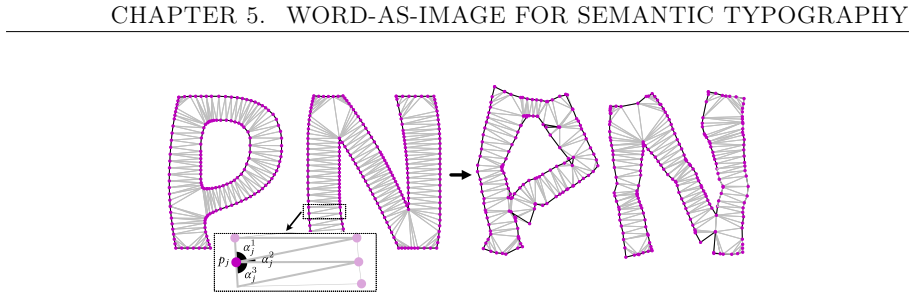
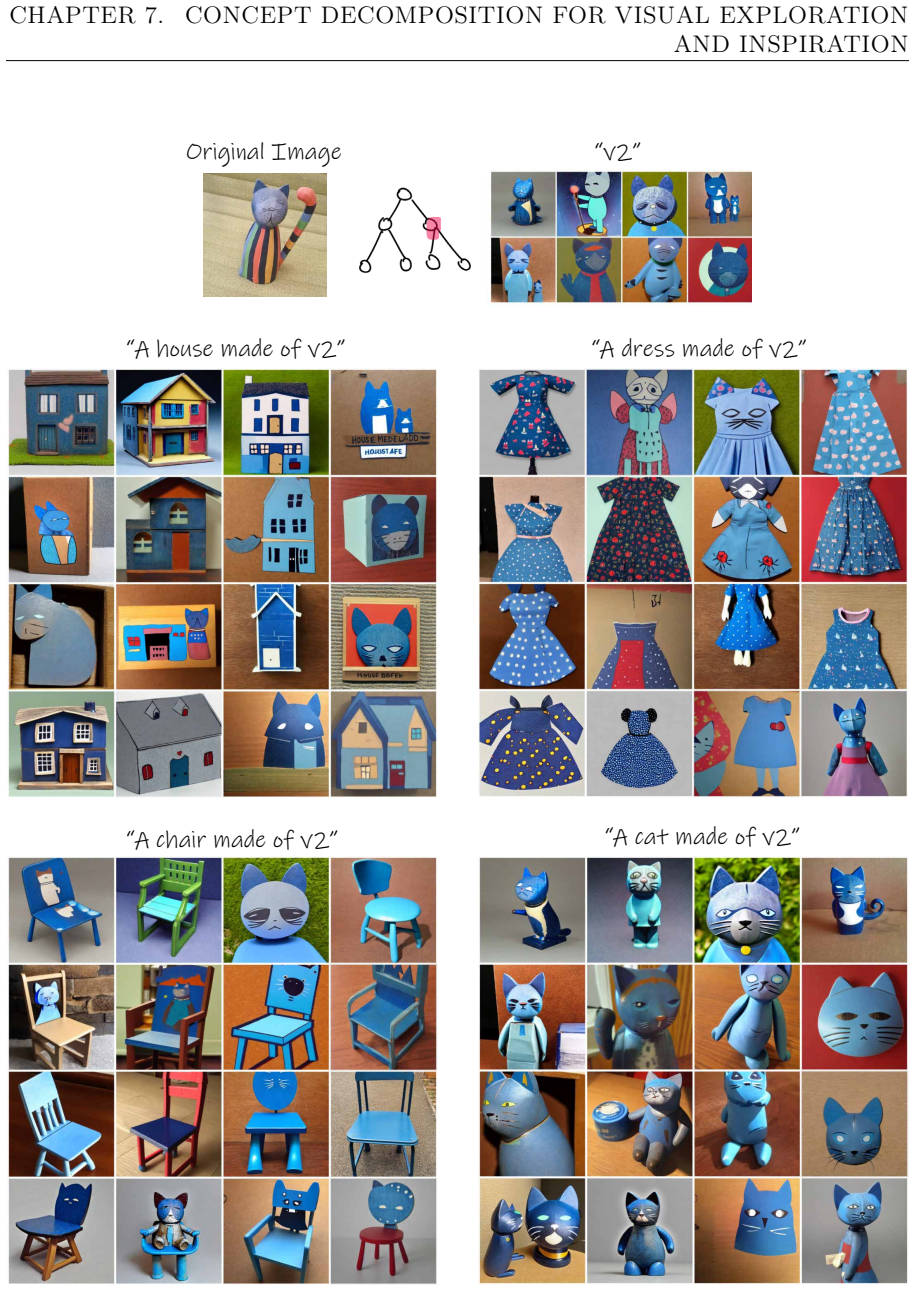
The load-bearing object is the frozen vision-language prior: CLIP's shared image-text embedding space for sketches, and the diffusion-model distribution captured by Stable Diffusion and text-to-video models for typography, animation, and inspiration. The connection to editable design output is made by a differentiable rasterizer that turns Bézier control points into pixels, so that semantic losses can be backpropagated directly into stroke or letter parameters. Three regularizers carry the domain-specific constraints: an as-conformal-as-possible deformation and a tone-preservation loss keep deformed letters legible and on-font; a learned stroke-probability vector with a sparsity loss produces smooth simplification along the simplicity axis; and a neural displacement field split into local and global motion predicts per-frame offsets that animate strokes while preserving the sketch's identity. For concept decomposition, the mechanism is a learned embedding vector per tree node that is injected into the text-to-image model's latent space and optimized to reconstruct the parent concept from its children.
What would settle it
Run the CLIPasso pipeline on a simple MNIST digit such as "3" with four or sixteen strokes: if the resulting strokes merely trace the digit's edges and cannot be recognized as a three by human viewers, the claim that CLIP's prior transfers semantic meaning to sparse vector renderings is falsified for that input class.
Extended reading notes
Core claim
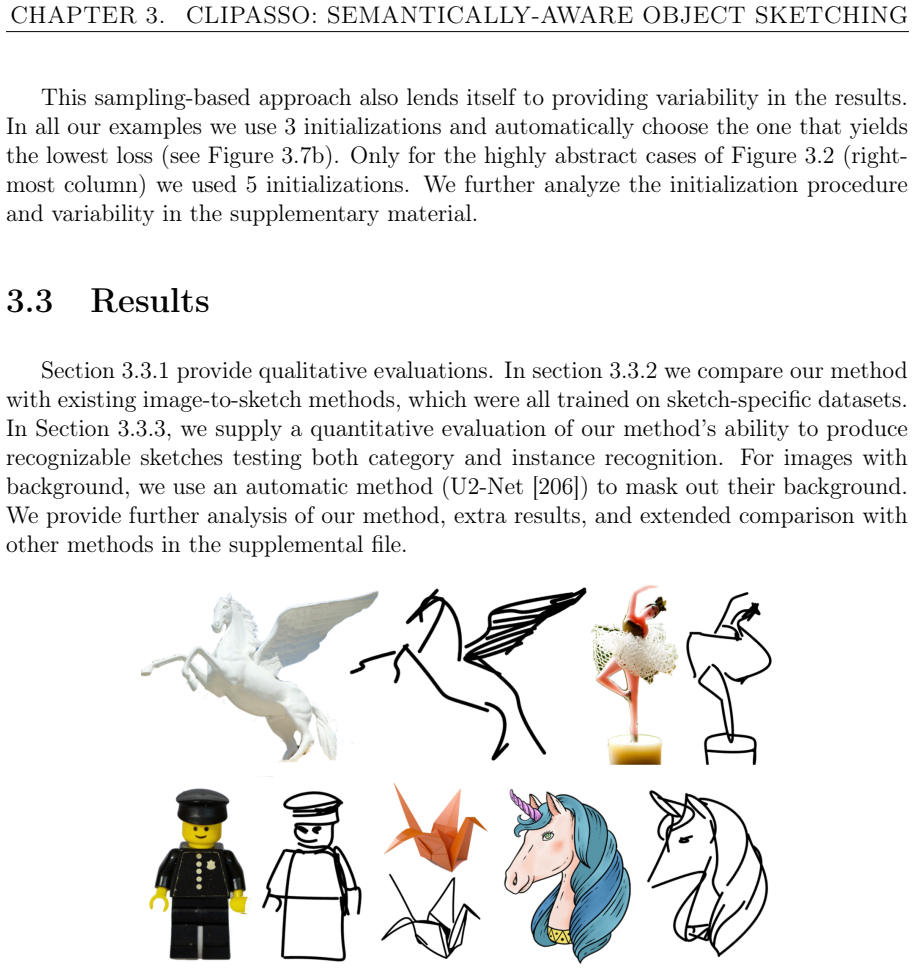
On the paper's own terms, the central discovery is that the semantic-visual knowledge inside pretrained vision-language models can substitute for human-drawn datasets in generative design tasks. CLIPasso and CLIPascene show that optimizing Bézier strokes under a CLIP-based loss produces recognizable object and scene sketches at multiple abstraction levels, where abstraction is controlled by stroke count or by two disentangled axes, fidelity and simplicity. Word-as-Image shows that deforming the vector outline of letters under a score-distillation loss from Stable Diffusion, with conformal and tone-preserving regularizers, yields legible typography that visually expresses a word's meaning. Breathing Life Into Sketches shows that a pretrained text-to-video model, again via score distillation sampling, can drive a neural displacement field that moves existing sketch strokes according to a text prompt. Concept Decomposition shows that textual-inversion-style embeddings can be optimized into a tree of sub-concepts that reconstruct a parent concept and recombine across concepts. The unifying claim is that large pretrained priors, combined with a differentiable vector renderer and domain-specific losses, are sufficient to generate concise, effective visual communication.
Load-bearing premise
The entire program assumes that CLIP and Stable Diffusion, trained mostly on natural images, align well enough with sparse black-and-white vector renderings that gradient descent against their embeddings yields human-meaningful abstraction; the thesis itself shows this assumption breaking on inputs like MNIST digits.
Editorial extensions
If this is right
- Designers can obtain editable vector sketches of arbitrary objects or scenes, with abstraction level set by stroke count or by the fidelity and simplicity axes.
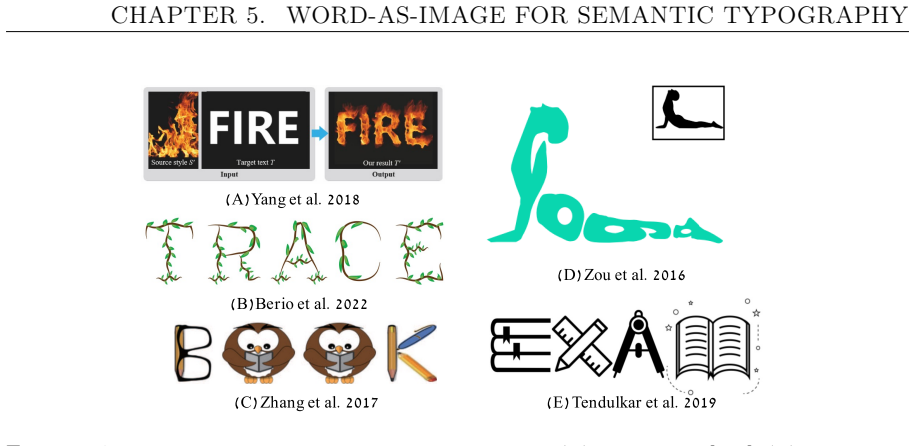
- Word-as-image typography can be generated automatically while keeping letters legible and the original font recognizable, producing usable logo and poster starting points.
- Static sketches can be turned into short vector animations by writing a text prompt, removing the need for skeletal rigs or reference motion capture.
- Visual inspiration can be structured: a concept can be decomposed into a tree of aspects, and aspects from different concepts can be recombined to generate novel designs.
- Because none of the tools requires task-specific datasets, the same algorithmic recipe can be applied to new categories and input types without retraining.
Reading between the lines
- Inference: the same constrained-optimization recipe, a frozen vision-language prior plus differentiable vector renderer plus structure regularizers, is likely portable to other design artifacts such as icons, pictograms, charts, and motion graphics, since the losses are not specific to the four studied mediums.
- Inference: as vision-language models improve their alignment on non-photographic renderings, the documented failure modes on digits and fine-grained attributes should shrink without any algorithmic change, which is a direct testable prediction.
- Inference: the fidelity and simplicity axes of CLIPascene offer a quantitative, controllable definition of "abstraction" that could be reused as a parameter in other generative design tools, letting users dial a visual from literal to iconic.
- Inference: combining the letter-deformation idea with the animation framework would yield semantic kinetic typography, where words deform into their meaning and then move, an extension that follows naturally from the dissertation's stated goal of editable, vector-based visual communication.
Editorial analysis
A structured set of objections, weighed in public.
Referee Report
Summary. This PhD dissertation investigates whether pretrained vision-language models (VLMs) such as CLIP, Stable Diffusion, and text-to-video models can automatically generate effective visual communication designs. The thesis is organized around four research directions: object and scene sketching with controllable abstraction (CLIPasso and CLIPascene), semantic typography in the form of word-as-image illustrations, text-driven animation of static sketches, and hierarchical concept decomposition for visual inspiration. Each chapter presents an optimization-based method that produces editable vector representations, guided by CLIP or diffusion-model priors, and includes qualitative results, comparisons to prior work, and human or automatic evaluations. The central claim is that these pretrained priors can be leveraged to simplify complex ideas into clear, concise, vector-based visuals that support designers' creative workflows.
Significance. If the claims hold, the dissertation makes a strong and timely contribution: it demonstrates that general-purpose vision-language priors, not task-specific sketch or typography datasets, can drive a range of design-oriented generative tasks while preserving vector editability. The individual methods have already been published in top venues (SIGGRAPH, ICCV, CVPR), several with best-paper or honorable-mention awards, and the thesis provides a coherent framing around visual communication. Strengths include the explicit use of human perceptual studies in every chapter, the honest documentation of failure modes inherited from CLIP (e.g., MNIST digits and fine-grained attributes in Fig. 3.17), and the release of project pages with code and results. The main risk is that some quantitative evaluations rely on CLIP-family metrics that share the same pretrained priors as the optimization objectives, so they do not independently measure human-perceived effectiveness; the human studies, while genuine, are narrow in coverage.
major comments (2)
- [§3.3.3 (Table 3.3), §4.3.3 (Table 4.2), §6.3 (Table 6.1)] The zero-shot CLIP classifiers used to measure sketch and video recognizability operate in the same embedding family as the losses being optimized (Eq. 3.3 with CLIP ResNet101; Eq. 4.2 with CLIP-ViT; and the SDS loss in Chapter 6 with text-to-video priors). Consequently, high quantitative scores may partially reflect the optimizer's success at satisfying CLIP's internally consistent representation rather than independent human-perceived effectiveness. The human studies are a genuine safeguard, but they are limited in breadth: 5 animal classes and 25 images in the CLIPasso perceptual study, 30 images in the CLIPascene user study, 10 letters in the Word-as-Image study, and a preference study for animation. To make the quantitative evaluations load-bearing for the thesis's central claim, the author should either provide a per-item calibration of CLIP scores against human judgments (e.g., correlation or confusion analysis by abstraction level) or explicitly label CLIP-based metrics as proxies and rest the effectiveness claim primarily on the human studies. Without this, statements such as 'we validate that our sketches accurately depict the input object' are stronger than the evidence supports.
- [§4.2.3 (Eq. 4.5–4.7)] The 'perceptually smooth simplification' of the simplicity axis is achieved by sampling the loss-ratio factor r exponentially, justified by appeal to the Weber-Fechner law. No perceptual experiment is reported to confirm that the resulting simplification steps are perceptually uniform for sketch abstraction; Figure 4.9 shows only two anecdotal sequences. Since the simplicity axis is a core claimed contribution of CLIPascene, the smoothness claim should be validated with a user study or softened to 'heuristically smooth' in the text.
minor comments (5)
- [Global] There are multiple typos and formatting inconsistencies: 'resterized' in the Figure 3.4 caption, 'interpertable' in Section 3.1, 'A viv University' on the title page, 'on the painting the cars' in the Figure 3.17b caption, and generally inconsistent hyphenation and spacing throughout the compiled text.
- [§3.3.3] In Table 3.3, the 'Human Sketches' baseline should be more precisely defined; it is not clear whether these are the human sketches from SketchyCOCO or from another source, and how they were selected.
- [§4.3.3] The CLIP zero-shot classification in Table 4.2 uses a set of 200 class names, but the source of this set is not specified, and the criterion 'at least 2 of the top 5 classes' should be justified or reported alongside alternative thresholds.
- [Notation] The thesis uses different CLIP variants (ResNet101, ViT-B/32, ViT-B/16) across chapters without a unified notation table; this makes it harder to track which pretrained model is used for optimization versus evaluation in each chapter.
- [§5.3.1] The Word-as-Image perceptual study in Table 5.1 is based on only 10 letters; while the qualitative results on 50 words are extensive, the quantitative claim of 'very high' concept recognizability should be qualified by the small sample size and the large standard deviations reported.
Circularity Check
CLIP-based evaluation metrics partially re-measure the optimization objective, but independent human studies keep the central claims non-circular.
-
other
[Section 3.3.3 (Quantitative Evaluation), Eq. (3.3) and Table 3.3]
"and a CLIP ViT-B/32 zero-shot classifier using text prompts defined as "A sketch of a(n)class-name". Note that this is not the CLIP model we use for training."
The optimization objective (Eq. 3.3) minimizes Lsemantic = dist(CLIP(I), CLIP(R({si}))), a cosine distance in CLIP embedding space. The CLIP ViT-B/32 zero-shot classifier then scores the sketch by the closeness of the same family of CLIP embedding to class text embeddings. A sketch driven toward the image's CLIP embedding is statistically forced to be classified by a CLIP model as the same class, so the CLIP column of Table 3.3 largely re-measures the training objective rather than providing independent evidence of human recognizability. The paper's human perceptual study (Table 3.2) is independent and mitigates this, so the circularity is partial.
-
other
[Section 4.3.3 (Quantitative Evaluation), Eq. (4.2) and Table 4.2]
"Using a pre-trained ViT-B/16 CLIP model (different than the one used for training), we performed zero-shot image classification over each input image and the corresponding resulting sketches from the different methods."
Training guides sketches with LCLIP(S, I, ℓk) = ||CLIP_l(S) − CLIP_l(I)||^2 (Eq. 4.2). Recognizability in Table 4.2 is then measured by zero-shot classification with a CLIP ViT-B/16 model, i.e., by whether the sketch's CLIP embedding is close to the input image's CLIP embedding and to class text embeddings. The evaluation therefore inherits the same embedding geometry that the loss optimizes; high scores partly reflect optimization success rather than human perception. The accompanying user study (Table 4.3) is an independent check and supports the central claim, so this is not a load-bearing circularity.
1 more flagged steps
-
other
[Section 6.3 (Results), Table 6.1]
"Quantitative metrics. (a) CLIP-based consistency and text-video alignment comparisons to open-source image-to-video baselines. (b) The same CLIP-metrics used for an ablation study."
The sketch animation is optimized with a score-distillation loss from a pretrained text-to-video diffusion model (Sec. 6.2.2), and the quantitative evaluation uses CLIP-based text-video alignment. Both rely on vision-language embedding similarities, so the metric is a partial re-measurement of the guiding prior rather than a fully independent test. The user study (Fig. 6.8) provides external evidence for the central claim, and the CLIP metric is secondary, so this is a minor issue.
full rationale
The dissertation is a compilation of five published methods, each built as an optimization against a frozen pretrained VLM (CLIP or Stable Diffusion). The derivations themselves are not circular: the losses (Eqs. 3.3, 4.2, 5.3, and the SDS losses in Chs. 5–6) define objectives, and the outputs are produced by optimization rather than by definition. The main circularity risk is confined to quantitative evaluation: the CLIP-based recognition and alignment scores in Chs. 3, 4, and 6 use the same family of embedding geometry as the training losses, so those tables partly re-measure the optimization objective rather than providing fully independent confirmation. However, the central claims are also supported by human perceptual studies (Tables 3.2, 4.3, 5.1; Fig. 6.8) and by qualitative comparisons to external baselines, so the methods are not forced by their inputs. Self-citations (e.g., CLIPasso as the basis of CLIPascene) are normal incremental extensions and are not used as an unverified uniqueness argument. Overall, there is partial evaluation circularity but no load-bearing derivation circularity, giving a score of 4.
Assumptions & free parameters
free parameters (6)
- ws semantic loss weight (CLIPasso) =
0.1
- CLIP geometric layers (CLIPasso) =
layers 3 and 4 of ResNet101 CLIP
- CLIP-ViT fidelity layers (CLIPascene) =
{2, 7, 8, 11}
- Initial stroke count (CLIPascene) =
64
- alpha ACAP weight (Word-as-Image) =
0.5
- beta_t schedule (Word-as-Image) =
a=100, b=300, c=30
assumptions (5)
- domain assumption CLIP embeddings capture semantic similarity between natural images and abstract vector sketches
- domain assumption Score distillation sampling (SDS) gradients from Stable Diffusion provide a meaningful signal for optimizing vector parameters
- standard math Differentiable rasterization (DiffVG) yields usable gradients for Bezier control point optimization
- ad hoc to paper The Weber-Fechner law justifies exponential sampling of simplification factors for perceptually smooth abstraction
- domain assumption U2-Net and LaMa provide sufficiently accurate foreground/background separation and inpainting for scene sketching
Cite this review
Pith. "Pith review of Generative Visual Communication in the Era of Vision-Language Models." pith.science (2026). https://pith.science/paper/5FHEAG7P
@misc{pith2026241118727,
  author       = {Pith},
  title        = {Pith review of: Generative Visual Communication in the Era of Vision-Language Models},
  year         = {2026},
  howpublished = {\url{https://pith.science/paper/5FHEAG7P}},
  note         = {Machine review of arXiv:2411.18727}
}
read the original abstract
Visual communication, dating back to prehistoric cave paintings, is the use of visual elements to convey ideas and information. In today's visually saturated world, effective design demands an understanding of graphic design principles, visual storytelling, human psychology, and the ability to distill complex information into clear visuals. This dissertation explores how recent advancements in vision-language models (VLMs) can be leveraged to automate the creation of effective visual communication designs. Although generative models have made great progress in generating images from text, they still struggle to simplify complex ideas into clear, abstract visuals and are constrained by pixel-based outputs, which lack flexibility for many design tasks. To address these challenges, we constrain the models' operational space and introduce task-specific regularizations. We explore various aspects of visual communication, namely, sketches and visual abstraction, typography, animation, and visual inspiration.
Figures


Figures from the paper (106 more)












Reference graph
Works this paper leans on
-
[318]
Unpaired Image- To-Image Translation Using Cycle-Consistent Adversarial Networks
Jun-Yan Zhu, Taesung Park, Phillip Isola, and Alexei A. Efros. “Unpaired Image- To-Image Translation Using Cycle-Consistent Adversarial Networks”. In:ICCV. 2017
work page 2017
-
[319]
Changqing Zou, Junjie Cao, Warunika Ranaweera, Ibraheem Alhashim, Ping Tan, Alla Sheffer, and Hao Zhang. “Legible Compact Calligrams”. In:ACM Transac- tions on Graphics 35.4 (July 2016), pp. 1–12. issn: 0730-0301, 1557-7368. doi: 10.1145/2897824.2925887
arXiv 2016
-
[320]
Shape skeletonization by identi- fying discrete local symmetries
Ju Jia Zou, Hung-Hsin Chang, and Hong Yan. “Shape skeletonization by identi- fying discrete local symmetries”. In:Pattern Recognition34.10 (2001), pp. 1895– 1905. 168
work page 2001
Reviewed August 12, 2026 · model on record in the stance chip above.
Discussion (0). Continue with ORCID to comment.