REVIEW 4 major objections 4 minor 32 references
CoVis: A Collaborative Framework for Fine-grained Graphic Visual Understanding
T0 review · 4 major / 4 minor · reviewed 2026-08-12 · deepseek-v4-flash
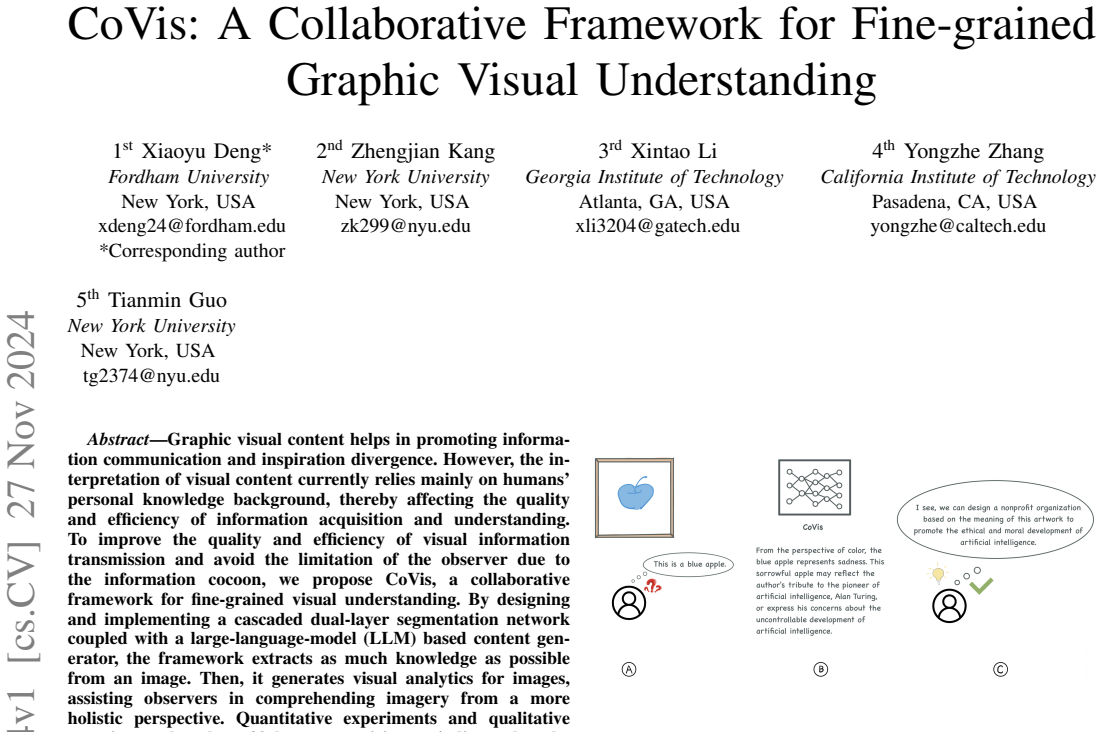
Pith's one-line read CoVis cascades two segmenters and an LLM to produce finer image descriptions than general-purpose models.
desk verdict The paper's own tables contradict its central segmentation claim; the qualitative study is too thin to rescue it. read the letter →
The pith
A machine-rendered reading of the paper's core claim, the machinery that carries it, and where it could break.
The reading
What carries the argument
The engine is the cascade $M_{\mathrm{fine}} = f_{\mathrm{U\text{-}Net}}(M_{\mathrm{group}})$, where FastSAM's coarse masks $M_{\mathrm{group}}$ become the input to a U-Net encoder-decoder that sharpens object boundaries. The refined masks are encoded as feature inputs to an LLM, and a prompt-engineering step adds structured dimensions -- color, composition, connotation -- so the generated text is image-grounded and multi-dimensional. The two-stage division of labor carries the argument: one fast segmenter proposes objects, a second network refines them, and the language model converts the sharpened masks into words.
What would settle it
Compare FastSAM alone, U-Net alone, and the full CoVis cascade on a held-out set of diverse images; if the cascade's average F_weighted and E-measure are not higher than the better single component across datasets, the segmentation claim is falsified. For the description claim, run a blind head-to-head in which the same LLM sees either the segmentation features or only raw image captions; if ratings do not favor the segmentation-conditioned prompts, the proposed mechanism is not supported.
Extended reading notes
Core claim
The paper establishes that a cascaded dual-layer segmentation network, in which FastSAM supplies coarse-grained masks and U-Net refines them, combined with an LLM-based content generator using hand-crafted prompts over color, composition, and connotation, can produce fine-grained visual understanding. As evidence, it reports segmentation improvements of 1.2%, 4.7%, 8.9%, 1.7%, and 1.0% in F_max, F_weighted, MAE, S_measure, and E_measure relative to the compared state-of-the-art algorithms, and human ratings in which CoVis scores 3.32 satisfaction, 3.25 accuracy, and 3.39 creativity against 2.43, 2.32, and 2.96 for GPT4-o. The paper also reports generalization results on DIS-VD, ImageNet-S, and PhenoBench, and positions the framework as a human-computer collaboration tool for visual analytics.
Load-bearing premise
The load-bearing premise is that passing FastSAM's coarse masks through a U-Net fine-segmentation stage reliably improves the segmentation metrics that the comparisons depend on.
Editorial extensions
If this is right
- Cascading a fast proposal segmenter with a refinement U-Net becomes a viable route to fine-grained segmentation without domain-specific training.
- Segmentation features, rather than raw pixels alone, can act as effective prompts for an LLM to produce structured image descriptions.
- Prompt dimensions such as color, composition, and connotation yield descriptions that human raters prefer over unguided outputs of general-purpose models.
- The same framework transfers across diverse datasets (DIS-VD, ImageNet-S, PhenoBench), suggesting it is not tied to a single benchmark.
- The approach can serve as an assistive visual-analysis tool, generating interpretive text for people who face barriers in reading images directly.
Reading between the lines
- The paper leaves implicit that the description-quality gains could come mostly from the LLM and prompt design rather than from the segmentation cascade; a direct test would compare the same prompts with and without the segmentation features.
- The qualitative result was obtained on six images rated by 32 participants, so the claim of more comprehensive and detailed descriptions remains to be confirmed on larger and more diverse samples.
- A natural extension is to learn the prompt dimensions automatically from the image content rather than fixing color, composition, and connotation by hand.
- The information-silo motivation suggests a human-in-the-loop experiment: measuring whether reading the generated descriptions actually changes an observer's interpretation of an image.
Editorial analysis
A structured set of objections, weighed in public.
Referee Report
Summary. The paper proposes CoVis, a framework that cascades FastSAM coarse segmentation with a U-Net fine-segmentation module and feeds the resulting features to a prompt-engineered GPT-4-based generator, aiming to produce fine-grained image segmentation and richer visual descriptions. The authors report quantitative segmentation evaluations against eight baselines, an ablation study, a human rating study with 32 participants, and a generalization experiment across three datasets. The central claims are that CoVis improves over state-of-the-art segmentation methods on five metrics and generates 'more comprehensive and detailed visual descriptions' than general-purpose large models.
Significance. If the claims were supported, the framework could be a useful contribution to visual analytics and human-computer collaborative image understanding. I also note that the circularity concern raised in the review does not land: the paper reports measurements of pretrained component outputs rather than fitting parameters to the evaluation data, so there is no circular derivation. However, the paper's own tables contradict the main quantitative claims, the qualitative evidence is methodologically thin, and no code or dataset is provided for verification. The central contribution is therefore not established as written.
major comments (4)
- [IV-B, Table I] The paragraph preceding Table I claims improvements of 1.2%, 4.7%, 8.9%, 1.7%, and 1.0% in F_max, F_weighted, MAE, S_measure, and E_measure over state-of-the-art algorithms, and the table caption says CoVis achieves the best performance in all metrics. This is contradicted by the table itself: MBV3 has E_measure 0.841 while CoVis has 0.831, so CoVis is not best on E_measure and the claimed 1.0% improvement on that metric is false on the manuscript's own data. Since this table is the entire quantitative evidence for the segmentation claim, the central claim is unsupported.
- [IV-C, Table II] The ablation study directly undercuts the assumption behind Eq. (5) that the U-Net refines FastSAM output to improve segmentation. Table II shows F_weighted = 0.687 for Ours versus 0.696 for No U-Net, so removing the fine-grained module improves that metric. The text in Section IV-C states that CoVis 'consistently outperformed' its counterparts with individual components removed, which is false on F_weighted. This is load-bearing because the cascade is the core methodological contribution.
- [IV-E, Table V] The generalization evaluation is not informative as presented. The DIS-VD row in Table V (0.757, 0.687, 0.082, 0.794, 0.831) is numerically identical to the CoVis row in Table I, which suggests either the same dataset and results were reused or the table was populated incorrectly. Without a clear specification of how the three datasets differ and how the model was adapted, the claim of broad generalization is not supported.
- [IV-D, Tables III and IV] The qualitative claim that CoVis produces better visual descriptions than GPT4-Mini and GPT4-o rests on ratings of only six randomly selected images by 32 participants, with no report of inter-rater agreement, no statistical significance testing, and no details about the prompts or the exact generation protocol for the baselines. The 1-to-4 rating differences could reflect prompt variation rather than framework superiority, so the conclusion that CoVis 'received the highest scores across all metrics' is not established at the claimed level of generality.
minor comments (4)
- [Abstract] The abstract contains the typo 'CoV ishas' for 'CoVis has'; the same spacing inconsistency ('CoV is') appears throughout the paper and should be fixed.
- [III-C, Eq. (5)] The sentence following Eq. (5) says 'Where Mgroup is the fine-grained segmentation result,' but Mgroup is the coarse-grained input and Mfine is the output; this appears to be a typo and should read 'Mfine'.
- [IV-B and Table I] The baseline name is inconsistent: the text refers to 'SDTC [28]' while Table I lists 'STDC', and reference [28] is titled 'Rethinking BiSeNet for Real-time Semantic Segmentation'; please clarify which model was actually evaluated and correct the citation.
- [IV-C, Table II] The 'No SAM' row in Table II (0.692, 0.586, 0.113, 0.745, 0.785) is identical to the 'UNet' row in Table I; if this is intentional, it should be stated explicitly, and if it is a copying error, the ablation results need to be recomputed.
Circularity Check
No circularity: CoVis is an empirical cascade of pretrained FastSAM, U-Net, and an LLM, with no fitted-parameter-as-prediction or self-citation chain.
full rationale
The paper's derivation chain is a pipeline: FastSAM produces coarse masks (Eqs. 1-4), U-Net refines them (Eq. 5), and an LLM with prompt engineering generates descriptive text (Eqs. 6-8). None of these equations defines a target quantity in terms of itself, and no parameter is fitted to a subset of the evaluation data and then reported as a prediction. The claimed improvements over state-of-the-art algorithms are arithmetic differences read from Table I, not quantities that reduce to the model's own inputs by construction. The paper contains no self-citations that carry the argument; its references, including FastSAM [12], U-Net [13], and the segmentation baselines [26]-[32], are all external prior works. No uniqueness theorem from the authors is invoked, and no known empirical pattern is renamed as a new result. There are internal numerical inconsistencies in the paper: Table I's caption claims best performance in all metrics while MBV3 has a higher E-measure (0.841 vs. 0.831), and Table II shows that removing U-Net raises F_weighted (0.696 vs. 0.687), but those are correctness concerns, not circularity. The qualitative evaluation relies on human ratings, and no blinding protocol is reported, but again that is a study-validity issue rather than a circular derivation. Therefore, no circular step meeting the required evidentiary standard is present.
Assumptions & free parameters
assumptions (4)
- domain assumption Pretrained FastSAM and U-Net models are applicable to the test images without domain-specific training.
- ad hoc to paper Segmentation features can be encoded and fed to ChatGPT-4 to produce accurate descriptive text.
- domain assumption The unnamed test dataset and metrics used for quantitative evaluation are appropriate to measure graphic visual understanding.
- domain assumption Participant ratings on a 1-4 scale over 6 images are sufficient to establish description quality.
Cite this review
Pith. "Pith review of CoVis: A Collaborative Framework for Fine-grained Graphic Visual Understanding." pith.science (2026). https://pith.science/paper/NUB6CQL7
@misc{pith2026241118764,
  author       = {Pith},
  title        = {Pith review of: CoVis: A Collaborative Framework for Fine-grained Graphic Visual Understanding},
  year         = {2026},
  howpublished = {\url{https://pith.science/paper/NUB6CQL7}},
  note         = {Machine review of arXiv:2411.18764}
}
read the original abstract
Graphic visual content helps in promoting information communication and inspiration divergence. However, the interpretation of visual content currently relies mainly on humans' personal knowledge background, thereby affecting the quality and efficiency of information acquisition and understanding. To improve the quality and efficiency of visual information transmission and avoid the limitation of the observer due to the information cocoon, we propose CoVis, a collaborative framework for fine-grained visual understanding. By designing and implementing a cascaded dual-layer segmentation network coupled with a large-language-model (LLM) based content generator, the framework extracts as much knowledge as possible from an image. Then, it generates visual analytics for images, assisting observers in comprehending imagery from a more holistic perspective. Quantitative experiments and qualitative experiments based on 32 human participants indicate that the CoVis has better performance than current methods in feature extraction and can generate more comprehensive and detailed visual descriptions than current general-purpose large models.
Figures

Reference graph
Works this paper leans on
-
[1]
Pettersson, Visual information
R. Pettersson, Visual information. Educational Technology, 1993
work page 1993
-
[2]
Strategic alliances and knowledge sharing: synergies or silos?
J. Connell and R. V oola, “Strategic alliances and knowledge sharing: synergies or silos?” Journal of Knowledge Management , vol. 11, no. 3, pp. 52–66, 2007
work page 2007
-
[3]
Worth, Studying visual communication
S. Worth, Studying visual communication . University of Pennsylvania Press, 2016
work page 2016
-
[4]
Seven challenges in image quality assessment: past, present, and future research,
D. M. Chandler, “Seven challenges in image quality assessment: past, present, and future research,” International Scholarly Research Notices , vol. 2013, no. 1, p. 905685, 2013
work page 2013
-
[5]
The evolution, challenges, and future of knowledge representation in product design systems,
S. K. Chandrasegaran, K. Ramani, R. D. Sriram, I. Horv ´ath, A. Bernard, R. F. Harik, and W. Gao, “The evolution, challenges, and future of knowledge representation in product design systems,” Computer-aided design, vol. 45, no. 2, pp. 204–228, 2013
work page 2013
-
[6]
D. Keim, J. Kohlhammer, G. Ellis, and F. Mansmann, Mastering the information age solving problems with visual analytics . Eurographics Association, 2010
2010
-
[7]
Deep convolutional neural networks for image classification: A comprehensive review,
W. Rawat and Z. Wang, “Deep convolutional neural networks for image classification: A comprehensive review,” Neural computation , vol. 29, no. 9, pp. 2352–2449, 2017
work page 2017
-
[8]
Meth- ods in quantitative image analysis,
M. Oberholzer, M. ¨Ostreicher, H. Christen, and M. Br ¨uhlmann, “Meth- ods in quantitative image analysis,” Histochemistry and cell biology , vol. 105, pp. 333–355, 1996
work page 1996
Show all 32 references
-
[9]
Image retrieval: Ideas, influences, and trends of the new age,
R. Datta, D. Joshi, J. Li, and J. Z. Wang, “Image retrieval: Ideas, influences, and trends of the new age,” ACM Computing Surveys (Csur) , vol. 40, no. 2, pp. 1–60, 2008
2008
-
[10]
Search for visual objects by request in the form of a cluster repre- sentation for the structural image description,
V . Gorokhovatskyi, I. Tvoroshenko, O. Kobylin, and N. Vlasenko, “Search for visual objects by request in the form of a cluster repre- sentation for the structural image description,” Advances in Electrical and Electronic Engineering , vol. 21, no. 1, pp. 19–27, 2023
2023
-
[11]
Cultural evolution of genetic heritability,
R. Uchiyama, R. Spicer, and M. Muthukrishna, “Cultural evolution of genetic heritability,” Behavioral and Brain Sciences , vol. 45, p. e152, 2022
2022
-
[12]
Fast segment anything,
X. Zhao, W. Ding, Y . An, Y . Du, T. Yu, M. Li, M. Tang, and J. Wang, “Fast segment anything,” arXiv preprint arXiv:2306.12156 , 2023
2023 arXiv
-
[13]
Unet 3+: A full-scale connected unet for medical image segmentation,
H. Huang, L. Lin, R. Tong, H. Hu, Q. Zhang, Y . Iwamoto, X. Han, Y .-W. Chen, and J. Wu, “Unet 3+: A full-scale connected unet for medical image segmentation,” in ICASSP 2020-2020 IEEE international conference on acoustics, speech and signal processing (ICASSP) . IEEE, 2020, p...
2020
-
[14]
Transfer learning for medical image classification: a literature review,
H. E. Kim, A. Cosa-Linan, N. Santhanam, M. Jannesari, M. E. Maros, and T. Ganslandt, “Transfer learning for medical image classification: a literature review,” BMC medical imaging , vol. 22, no. 1, p. 69, 2022
2022
-
[15]
Fruit image classification model based on mobilenetv2 with deep transfer learning technique,
Y . Gulzar, “Fruit image classification model based on mobilenetv2 with deep transfer learning technique,” Sustainability, vol. 15, no. 3, p. 1906, 2023
1906
-
[16]
An industrial-grade solution for agricultural image classification tasks,
Y . Peng and Y . Wang, “An industrial-grade solution for agricultural image classification tasks,” Computers and Electronics in Agriculture , vol. 187, p. 106253, 2021
2021
-
[17]
Wavelet integrated cnns for noise- robust image classification,
Q. Li, L. Shen, S. Guo, and Z. Lai, “Wavelet integrated cnns for noise- robust image classification,” in Proceedings of the IEEE/CVF conference on computer vision and pattern recognition , 2020, pp. 7245–7254
2020
-
[18]
Generalizing to unseen domains: A survey on domain generalization,
J. Wang, C. Lan, C. Liu, Y . Ouyang, T. Qin, W. Lu, Y . Chen, W. Zeng, and S. Y . Philip, “Generalizing to unseen domains: A survey on domain generalization,” IEEE transactions on knowledge and data engineering , vol. 35, no. 8, pp. 8052–8072, 2022
2022
-
[19]
Neural retrievers are biased towards llm-generated content,
S. Dai, Y . Zhou, L. Pang, W. Liu, X. Hu, Y . Liu, X. Zhang, G. Wang, and J. Xu, “Neural retrievers are biased towards llm-generated content,” in Proceedings of the 30th ACM SIGKDD Conference on Knowledge Discovery and Data Mining , 2024, pp. 526–537
2024
-
[20]
The evolution of man–machine interaction: The role of human in industry 4.0 paradigm,
M. Nardo, D. Forino, and T. Murino, “The evolution of man–machine interaction: The role of human in industry 4.0 paradigm,” Production & manufacturing research, vol. 8, no. 1, pp. 20–34, 2020
2020
-
[21]
A low-cost multispectral device for in-field fruit ripening assessment,
C. Lauretti, C. Tamantini, A. Zompanti, S. Cimini, L. De Gara, M. San- tonico, and L. Zollo, “A low-cost multispectral device for in-field fruit ripening assessment,” IEEE Sensors Journal , 2023
2023
-
[22]
Intelligent technologies for construction machinery using data-driven methods,
Z. Zheng, F. Wang, G. Gong, H. Yang, and D. Han, “Intelligent technologies for construction machinery using data-driven methods,” Automation in Construction , vol. 147, p. 104711, 2023
2023
-
[23]
Enhancing logical thinking among computer science students through cooperative learning,
M. Othman, F. M. Hussain, and K. Nikman, “Enhancing logical thinking among computer science students through cooperative learning,” Gading Journal for Social Sciences (e-ISSN 2600-7568) , vol. 14, no. 01, 2010
2010
-
[24]
Promptmagician: Interactive prompt engineering for text- to-image creation,
Y . Feng, X. Wang, K. K. Wong, S. Wang, Y . Lu, M. Zhu, B. Wang, and W. Chen, “Promptmagician: Interactive prompt engineering for text- to-image creation,” IEEE Transactions on Visualization and Computer Graphics, 2023
2023
-
[25]
Genui: interactive and extensible open source software platform for de novo molecular generation and cheminformatics,
M. S ´ıcho, X. Liu, D. Svozil, and G. J. van Westen, “Genui: interactive and extensible open source software platform for de novo molecular generation and cheminformatics,” Journal of Cheminformatics , vol. 13, no. 1, p. 73, 2021
2021
-
[26]
Pfnet: an unsupervised deep network for polarization image fusion,
J. Zhang, J. Shao, J. Chen, D. Yang, B. Liang, and R. Liang, “Pfnet: an unsupervised deep network for polarization image fusion,” Optics letters, vol. 45, no. 6, pp. 1507–1510, 2020
2020
-
[27]
U-net: Convolutional networks for biomedical image segmentation,
O. Ronneberger, P. Fischer, and T. Brox, “U-net: Convolutional networks for biomedical image segmentation,” in Medical image computing and computer-assisted intervention–MICCAI 2015: 18th international con- ference, Munich, Germany, October 5-9, 2015, proceedings, part III 18 ...
2015
-
[28]
Re- thinking bisenet for real-time semantic segmentation,
M. Fan, S. Lai, J. Huang, X. Wei, Z. Chai, J. Luo, and X. Wei, “Re- thinking bisenet for real-time semantic segmentation,” in Proceedings of the IEEE/CVF conference on computer vision and pattern recognition , 2021, pp. 9716–9725
2021
-
[29]
Searching for mobilenetv3,
A. Howard, M. Sandler, G. Chu, L.-C. Chen, B. Chen, M. Tan, W. Wang, Y . Zhu, R. Pang, V . Vasudevan et al. , “Searching for mobilenetv3,” in Proceedings of the IEEE/CVF international conference on computer vision, 2019, pp. 1314–1324
2019
-
[30]
Basnet: Boundary-aware salient object detection,
X. Qin, Z. Zhang, C. Huang, C. Gao, M. Dehghan, and M. Jagersand, “Basnet: Boundary-aware salient object detection,” in Proceedings of the IEEE/CVF conference on computer vision and pattern recognition , 2019, pp. 7479–7489
2019
-
[31]
Hyperseg: Patch-wise hypernetwork for real-time semantic segmentation,
Y . Nirkin, L. Wolf, and T. Hassner, “Hyperseg: Patch-wise hypernetwork for real-time semantic segmentation,” in Proceedings of the IEEE/CVF conference on computer vision and pattern recognition , 2021, pp. 4061– 4070
2021
-
[32]
U2-net: Going deeper with nested u-structure for salient object detection,
X. Qin, Z. Zhang, C. Huang, M. Dehghan, O. R. Zaiane, and M. Jager- sand, “U2-net: Going deeper with nested u-structure for salient object detection,” Pattern recognition, vol. 106, p. 107404, 2020
2020
Reviewed August 12, 2026 · model on record in the stance chip above.
Discussion (0). Continue with ORCID to comment.