REVIEW 3 major objections 5 minor 44 references
CrossTracker: Robust Multi-modal 3D Multi-Object Tracking via Cross Correction
T0 review · 3 major / 5 minor · reviewed 2026-08-12 · deepseek-v4-flash
Pith's one-line read CrossTracker claims the first online two-stage 3D tracker where camera and LiDAR streams correct each other's failures.
desk verdict A genuinely new two-stage design for multi-modal 3D MOT, but the headline ablation misses a control that blurs the source of the gains. read the letter →
The pith
A machine-rendered reading of the paper's core claim, the machinery that carries it, and where it could break.
The reading
What carries the argument
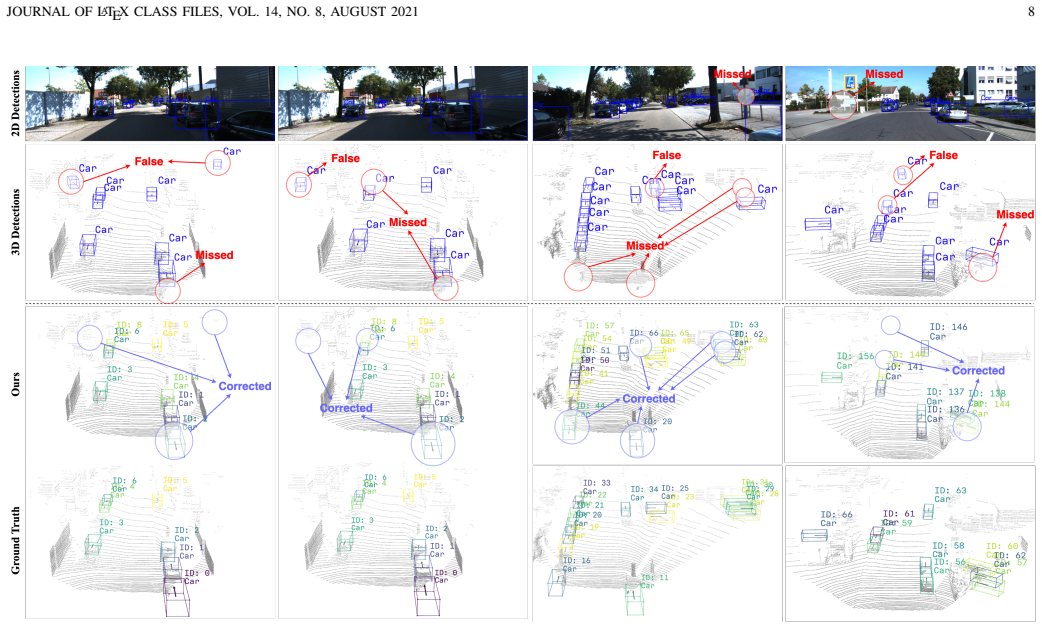
The load-bearing mechanism is the trajectory refinement (TR) module's five-case cross-correction procedure. The five cases are: new objects identified from unmatched LiDAR detections using camera tracks as reference; new objects from unmatched camera detections; recovery of unmatched LiDAR trajectories using camera tracks; recovery of unmatched camera trajectories using LiDAR tracks; and recovery when both modalities simultaneously miss an object, gated by an image-boundary check. Each pairing is done with a greedy 2D-IoU association at threshold $\theta_{iou}$, a minimum-hit requirement $\theta_{hits}$, and in the last case a boundary test, with unmatched items discarded after $N$ consecutive unobserved frames. The M3 network supplies the learned consistency probabilities used in stage one, but the cross-correction steps in stage two are geometric, which is the paper's main architectural departure.
What would settle it
Re-run CrossTracker on the KITTI validation split with the camera–LiDAR extrinsic calibration perturbed by a few degrees: if HOTA drops sharply, the 2D-IoU cross-modal pairing is the sensitive link. A second check is to count wrongly initialized trajectories in scenes where a car and a pedestrian project to strongly overlapping 2D boxes.
Extended reading notes
Core claim
The paper's central claim is that the two-stage coarse-to-fine scheme is what unlocks multi-modal robustness: stage one (C-TG) builds separate coarse trajectory sets for camera and LiDAR, and stage two (TR) performs cross correction, transferring newly appearing objects from unmatched detections into live tracks and reviving unmatched trajectories that the other modality still sees. The authors argue this bidirectional correction is exactly what distinguishes their method from prior single-stage fusion trackers, which only correct LiDAR failures using camera data. To support the scheme, the M3 module learns object-pair consistency probabilities from image patches, point-cloud patches, and pseudo-point patches sampled inside 2D boxes (plane geometry), which then feed the stage-one association cost along with spatial geometric constraints such as 2D IoU and 3D centroid distance. The reported results on KITTI show the full pipeline, with all five cross-correction cases active, outperforming all eighteen competitors, and the ablation attributes the largest single gains to cases (a), (c), and (e) — new-object discovery from unmatched LiDAR detections, camera-referenced recovery of unmatched LiDAR trajectories, and recovery when both modalities miss.
Load-bearing premise
The whole cross-correction hinges on 2D-IoU overlap between a LiDAR detection's projected box and a camera trajectory (or between two predicted trajectories) reliably indicating the same physical object, and on the rule that an object unmatched for N consecutive frames is a false detection or a terminated track.
Editorial extensions
If this is right
- The reported improvements over EagerMOT with identical detectors imply that adding a second refinement stage to an existing single-stage fusion tracker can recover most of the gains without changing detectors.
- The gap in ID switch counts (82 vs 239 on cars with the same detectors) suggests that cross correction chiefly stabilizes identity maintenance, which would matter for downstream prediction and planning.
- Because the TR module is geometric and detector-agnostic, the two-stage scheme should transfer to other detection pairs, such as radar and camera, in the same tracking-by-detection framework.
- The ablation numbers indicate that the largest contributions come from the new-object and single-modality-recovery cases, so future work can prioritize those steps when computation is limited.
Reading between the lines
- This paper's own ablation shows case (e) slightly reduces pedestrian HOTA, which suggests the boundary-check rule could be made class-dependent rather than global; that is an extension the authors did not explore.
- If the central claim is right, the 2D-IoU pairing rule creates a direct sensitivity to extrinsic calibration and to small, distant objects whose projected boxes barely overlap; a natural test is to measure HOTA versus calibration error.
- The same cross-correction logic could be extended to multi-camera setups by treating each camera as one stream and LiDAR as another, which would generalize the five cases to N-way correction.
- The separation of M3 and TR means the learned metric could be swapped for a cheaper appearance model in resource-constrained settings, isolating the contribution of the two-stage architecture.
Signed reviews
Editorial analysis
A structured set of objections, weighed in public.
Referee Report
Summary. CrossTracker proposes a two-stage online multi-modal 3D multi-object tracking pipeline for the KITTI benchmark. The first stage (C-TG) generates coarse camera and LiDAR trajectories using a multi-modal modeling (M3) module that fuses image, point-cloud, and plane-geometry features to estimate inter-object consistency probabilities. The second stage (TR) refines these coarse trajectories through five cross-correction cases that address false detections, missed detections in one modality, and missed detections in both modalities. On the KITTI test set, the method outperforms EagerMOT under identical detections and also surpasses CasTrack when sharing the same LiDAR detections, with reported HOTA gains of 2-4 points on the Car category and 5+ points on the Pedestrian category. Ablations on the validation set show monotonic HOTA improvements as cross-correction cases are enabled sequentially.
Significance. If the claimed results hold, the paper makes a useful contribution by identifying a concrete architectural limitation of existing single-stage sensor-fusion trackers and by proposing a modular two-stage design with cross correction. The comparison against EagerMOT using identical detections is a well-controlled benchmark, and the M3 classifier is evaluated on a held-out validation split. The method is compatible with several off-the-shelf detectors, which increases its practical relevance. However, the central attribution of the reported gains to the trajectory-refinement stage is not currently established by the ablation design, because the key control condition is missing.
major comments (3)
- [Section IV-F2, Table IV] The ablation does not include the critical control: a dual-stream run with all cross-correction cases disabled. The first row is single-stream (LiDAR only), while every dual-stream row enables at least case (a). The +5.70 HOTA improvement on Car between the first and last rows therefore conflates the addition of the camera stream (which affects the C-TG association and the final output selection by matching T^l_t against T^c_t, UD^c_t, and UT^c_t in Section III-D) with the effect of the TR cross-correction. To support the paper's central claim that trajectory refinement drives the gains, please add a dual-stream no-TR baseline and, if possible, enable each cross-correction case independently from that baseline.
- [Section III-D, Steps 1-3] The cross-correction logic relies on the assumptions that 2D-IoU overlap between a LiDAR detection and a camera trajectory, or between two predicted trajectories, indicates the same physical object, and that objects or trajectories unmatched for N consecutive frames are false detections or terminated tracks. These assumptions are not validated quantitatively; no appearance check is used in the greedy pairing, and the failure case in Fig. 7 is only a qualitative example. The paper should report how often cross-correction introduces false trajectories or revives already-terminated ones, for instance by comparing the current 2D-IoU-only pairing with a variant that also uses the M3 classifier in the cross-correction steps.
- [Section IV-D and IV-F] All reported numbers are single runs on one validation split, and the thresholds θS, θG, θiou, θhits, and N are selected on the same split. No sensitivity analysis or variance over runs is provided. Given that some incremental gains are small (e.g., 0.17% HOTA for case (d) in Table IV, and a 0.01% HOTA decrease for case (e) on Pedestrian), the reader cannot judge whether these differences are meaningful or artifacts of threshold choices. At minimum, please report the chosen hyperparameter values and a sensitivity study for the most sensitive thresholds, especially θiou and N.
minor comments (5)
- [Section V] The heading 'LIMILATION' should be 'LIMITATION', and in the second paragraph 'HOA' should be 'HOTA'.
- [Table I] The column header 'IDWS' should be 'IDSW' to match the standard metric name and the text in Section IV-C.
- [References] References [33] and [34] appear to be the same paper (same title, authors, and page range) and should be merged or one should be removed.
- [Section IV-F2] The text contains a LaTeX artifact 'textitCar' in the discussion of Table IV; it should simply read 'Car'.
- [Section III-B4] The phrase 'using Cross Entropy Loss' should be 'using a cross-entropy loss' for grammatical correctness.
Circularity Check
No circularity: the reported tracking gains are measured on a held-out benchmark, and no claimed result reduces to its input by construction; the main weakness is an ablation-confound in Table IV, which is a correctness concern rather than a circular step.
full rationale
CrossTracker is an empirical tracking system rather than a derivation from first principles, and I find no step in which a claimed result is equivalent to an input by construction. The central reported numbers are measured on the KITTI test benchmark using the official evaluation toolkit. The M3 consistency classifier is trained with cross-entropy on paired-object labels from the training/validation split (Section III-B4) and is never optimized on HOTA, IDSW, or any reported tracking metric; its quality is separately reported in Table II. The TR module is a fixed greedy procedure with thresholds (θiou, θhits, N) chosen on validation; tuning hyperparameters on validation and then measuring on the held-out test set is standard model selection, not a fitted-input-called-prediction pattern. The comparisons in Table I use identical detector outputs against EagerMOT/CasTrack and external KITTI benchmark results, so the gains are externally falsifiable measurements. The strongest non-circularity concern is Table IV: the first row is LiDAR-only, all dual-stream rows enable at least one cross-correction case, and no dual-stream TR-disabled control is included, so the +5.70 HOTA Car increment conflates the addition of the camera stream with the cross-correction steps. That is an attribution and ablation-design weakness, not a circular reduction: nothing in the paper redefines the target metric as the optimized quantity, and the Limitation section reports a case where the proposed correction slightly decreases Pedestrian HOTA, showing the effects are not forced by construction. There are no load-bearing self-citations or imported uniqueness theorems. Verdict: no significant circularity.
Assumptions & free parameters
free parameters (5)
- theta_S =
not reported
- theta_G =
not reported
- theta_iou =
not reported
- theta_hits =
not reported
- N =
not reported
assumptions (4)
- domain assumption The KITTI training/validation split used here is representative of the KITTI test benchmark distribution.
- domain assumption A 2D-IoU overlap between a projected LiDAR detection and a camera detection indicates the same physical object.
- ad hoc to paper Objects that remain unmatched for N consecutive frames are false detections or terminated trajectories.
- ad hoc to paper Randomly sampling 512 points inside a 2D bounding box produces a meaningful geometric representation of the object's image-plane extent.
Cite this review
Pith. "Pith review of CrossTracker: Robust Multi-modal 3D Multi-Object Tracking via Cross Correction." pith.science (2026). https://pith.science/paper/IO5JYMO4
@misc{pith2026241118850,
  author       = {Pith},
  title        = {Pith review of: CrossTracker: Robust Multi-modal 3D Multi-Object Tracking via Cross Correction},
  year         = {2026},
  howpublished = {\url{https://pith.science/paper/IO5JYMO4}},
  note         = {Machine review of arXiv:2411.18850}
}
read the original abstract
The fusion of camera- and LiDAR-based detections offers a promising solution to mitigate tracking failures in 3D multi-object tracking (MOT). However, existing methods predominantly exploit camera detections to correct tracking failures caused by potential LiDAR detection problems, neglecting the reciprocal benefit of refining camera detections using LiDAR data. This limitation is rooted in their single-stage architecture, akin to single-stage object detectors, lacking a dedicated trajectory refinement module to fully exploit the complementary multi-modal information. To this end, we introduce CrossTracker, a novel two-stage paradigm for online multi-modal 3D MOT. CrossTracker operates in a coarse-to-fine manner, initially generating coarse trajectories and subsequently refining them through an independent refinement process. Specifically, CrossTracker incorporates three essential modules: i) a multi-modal modeling (M^3) module that, by fusing multi-modal information (images, point clouds, and even plane geometry extracted from images), provides a robust metric for subsequent trajectory generation. ii) a coarse trajectory generation (C-TG) module that generates initial coarse dual-stream trajectories, and iii) a trajectory refinement (TR) module that refines coarse trajectories through cross correction between camera and LiDAR streams. Comprehensive experiments demonstrate the superior performance of our CrossTracker over its eighteen competitors, underscoring its effectiveness in harnessing the synergistic benefits of camera and LiDAR sensors for robust multi-modal 3D MOT.
Figures


Figures from the paper (4 more)



Reference graph
Works this paper leans on
-
[1]
VILENS: visual, inertial, lidar, and leg odometry for all-terrain legged robots,
D. Wisth, M. Camurri, and M. F. Fallon, “VILENS: visual, inertial, lidar, and leg odometry for all-terrain legged robots,” IEEE Trans. Robotics , vol. 39, no. 1, pp. 309–326, 2023
work page 2023
-
[2]
Optimization-based control for dynamic legged robots,
P. M. Wensing, M. Posa, Y . Hu, A. Escande, N. Mansard, and A. D. Prete, “Optimization-based control for dynamic legged robots,” IEEE Trans. Robotics, vol. 40, pp. 43–63, 2024
work page 2024
-
[3]
Unseen object instance segmentation for robotic environments,
C. Xie, Y . Xiang, A. Mousavian, and D. Fox, “Unseen object instance segmentation for robotic environments,” IEEE Trans. Robotics, vol. 37, no. 5, pp. 1343–1359, 2021
work page 2021
-
[4]
AB3DMOT: A baseline for 3d multi-object tracking and new evaluation metrics,
X. Weng, J. Wang, D. Held, and K. Kitani, “AB3DMOT: A baseline for 3d multi-object tracking and new evaluation metrics,” CoRR, vol. abs/2008.08063, 2020
arXiv 2008
-
[5]
X. Zhou, V . Koltun, and P. Kr ¨ahenb¨uhl, “Tracking objects as points,” in Computer Vision - ECCV 2020 - 16th European Conference , ser. Lecture Notes in Computer Science, A. Vedaldi, H. Bischof, T. Brox, and J. Frahm, Eds., vol. 12349, 2020, pp. 474–490
work page 2020
-
[6]
Center-based 3d object detection and tracking,
T. Yin, X. Zhou, and P. Kr ¨ahenb¨uhl, “Center-based 3d object detection and tracking,” in IEEE Conference on Computer Vision and Pattern Recognition, 2021, pp. 11 784–11 793
work page 2021
-
[7]
Exploring object- centric temporal modeling for efficient multi-view 3d object detection,
S. Wang, Y . Liu, T. Wang, Y . Li, and X. Zhang, “Exploring object- centric temporal modeling for efficient multi-view 3d object detection,” arXiv preprint arXiv:2303.11926 , 2023
arXiv 2023
-
[8]
Eagermot: 3d multi-object track- ing via sensor fusion,
A. Kim, A. Osep, and L. Leal-Taix ´e, “Eagermot: 3d multi-object track- ing via sensor fusion,” in IEEE International Conference on Robotics and Automation, ICRA 2021, Xi’an, China, May 30 - June 5, 2021 , 2021, pp. 11 315–11 321
work page 2021
Show all 44 references
-
[9]
Deepfusionmot: A 3d multi-object tracking framework based on camera-lidar fusion with deep association,
X. Wang, C. Fu, Z. Li, Y . Lai, and J. He, “Deepfusionmot: A 3d multi-object tracking framework based on camera-lidar fusion with deep association,” IEEE Robotics Autom. Lett. , vol. 7, no. 3, pp. 8260–8267, 2022
2022
-
[10]
Strongfusionmot: A multi-object tracking method based on lidar-camera fusion,
X. Wang, C. Fu, J. He, S. Wang, and J. Wang, “Strongfusionmot: A multi-object tracking method based on lidar-camera fusion,” IEEE Sensors Journal, 2022
2022
-
[11]
Ssd: Single shot multibox detector,
W. Liu, D. Anguelov, D. Erhan, C. Szegedy, S. Reed, C.-Y . Fu, and A. C. Berg, “Ssd: Single shot multibox detector,” in Computer Vision– ECCV 2016: 14th European Conference, Amsterdam, The Netherlands, October 11–14, 2016, Proceedings, Part I 14 , 2016, pp. 21–37
2016
-
[12]
Faster R-CNN: towards real-time object detection with region proposal networks,
S. Ren, K. He, R. B. Girshick, and J. Sun, “Faster R-CNN: towards real-time object detection with region proposal networks,” IEEE Trans. Pattern Anal. Mach. Intell. , vol. 39, no. 6, pp. 1137–1149, 2017
2017
-
[13]
Simple online and realtime tracking,
A. Bewley, Z. Ge, L. Ott, F. T. Ramos, and B. Upcroft, “Simple online and realtime tracking,” in 2016 IEEE International Conference on Image Processing, 2016, pp. 3464–3468
2016
-
[14]
Simple online and realtime tracking with a deep association metric,
N. Wojke, A. Bewley, and D. Paulus, “Simple online and realtime tracking with a deep association metric,” in 2017 IEEE International Conference on Image Processing , 2017, pp. 3645–3649
2017
-
[15]
Fantrack: 3d multi-object tracking with feature association network,
E. Baser, V . Balasubramanian, P. Bhattacharyya, and K. Czarnecki, “Fantrack: 3d multi-object tracking with feature association network,” in 2019 IEEE Intelligent Vehicles Symposium, IV 2019, Paris, France, June 9-12, 2019 , 2019, pp. 1426–1433
2019
-
[16]
Strongsort: Make deepsort great again,
Y . Du, Y . Song, B. Yang, and Y . Zhao, “Strongsort: Make deepsort great again,” CoRR, vol. abs/2202.13514, 2022
2022 arXiv
-
[17]
Fairmot: On the fairness of detection and re-identification in multiple object tracking,
Y . Zhang, C. Wang, X. Wang, W. Zeng, and W. Liu, “Fairmot: On the fairness of detection and re-identification in multiple object tracking,” Int. J. Comput. Vis. , vol. 129, no. 11, pp. 3069–3087, 2021
2021
-
[18]
JRMOT: A real-time 3d multi- object tracker and a new large-scale dataset,
A. Shenoi, M. Patel, J. Gwak, P. Goebel, A. Sadeghian, H. Rezatofighi, R. Mart ´ın-Mart´ın, and S. Savarese, “JRMOT: A real-time 3d multi- object tracker and a new large-scale dataset,” in IEEE/RSJ International Conference on Intelligent Robots and Systems, IROS 2020, Las Vega...
2020
-
[19]
Joint multi-object detection and tracking with camera-lidar fusion for autonomous driving,
K. Huang and Q. Hao, “Joint multi-object detection and tracking with camera-lidar fusion for autonomous driving,” in IEEE/RSJ International Conference on Intelligent Robots and Systems, IROS 2021, Prague, Czech Republic, September 27 - Oct. 1, 2021 , 2021, pp. 6983–6989
2021
-
[20]
Near-online multi-target tracking with aggregated local flow descriptor,
W. Choi, “Near-online multi-target tracking with aggregated local flow descriptor,” in 2015 IEEE International Conference on Computer Vision, 2015, pp. 3029–3037
2015
-
[21]
Robust multi-modality multi-object tracking,
W. Zhang, H. Zhou, S. Sun, Z. Wang, J. Shi, and C. C. Loy, “Robust multi-modality multi-object tracking,” in 2019 IEEE/CVF International Conference on Computer Vision, ICCV 2019, Seoul, Korea (South), October 27 - November 2, 2019 , 2019, pp. 2365–2374
2019
-
[22]
Seeing behind objects for 3d multi-object tracking in RGB-D sequences,
N. M ¨uller, Y . Wong, N. J. Mitra, A. Dai, and M. Nießner, “Seeing behind objects for 3d multi-object tracking in RGB-D sequences,” in IEEE Conference on Computer Vision and Pattern Recognition , 2021, pp. 6071–6080
2021
-
[23]
Cftrack: Center-based radar and camera fusion for 3d multi-object tracking,
R. Nabati, L. Harris, and H. Qi, “Cftrack: Center-based radar and camera fusion for 3d multi-object tracking,” in IEEE Intelligent Vehicles Symposium Workshops, 2021, pp. 243–248
2021
-
[24]
Deep residual learning for image recognition,
K. He, X. Zhang, S. Ren, and J. Sun, “Deep residual learning for image recognition,” in 2016 IEEE Conference on Computer Vision and Pattern Recognition, 2016, pp. 770–778
2016
-
[25]
Pointnet: Deep learning on point sets for 3d classification and segmentation,
C. R. Qi, H. Su, K. Mo, and L. J. Guibas, “Pointnet: Deep learning on point sets for 3d classification and segmentation,” in 2017 IEEE Conference on Computer Vision and Pattern Recognition, 2017, pp. 77– 85
2017
-
[26]
Pointrcnn: 3d object proposal generation and detection from point cloud,
S. Shi, X. Wang, and H. Li, “Pointrcnn: 3d object proposal generation and detection from point cloud,” in IEEE Conference on Computer Vision and Pattern Recognition , 2019, pp. 770–779
2019
-
[27]
Accurate single stage detector using recurrent rolling convolution,
J. S. J. Ren, X. Chen, J. Liu, W. Sun, J. Pang, Q. Yan, Y . Tai, and L. Xu, “Accurate single stage detector using recurrent rolling convolution,” in 2017 IEEE Conference on Computer Vision and Pattern Recognition, CVPR 2017, Honolulu, HI, USA, July 21-26, 2017 , 2017, pp. 752–760
2017
-
[28]
MOTS: multi-object tracking and segmentation,
P. V oigtlaender, M. Krause, A. Osep, J. Luiten, B. B. G. Sekar, A. Geiger, and B. Leibe, “MOTS: multi-object tracking and segmentation,” in IEEE Conference on Computer Vision and Pattern Recognition, CVPR 2019, Long Beach, CA, USA, June 16-20, 2019 , 2019, pp. 7942–7951
2019
-
[29]
Learning to track with object permanence,
P. Tokmakov, J. Li, W. Burgard, and A. Gaidon, “Learning to track with object permanence,” in Proceedings of the IEEE/CVF International Conference on Computer Vision , 2021, pp. 10 860–10 869
2021
-
[30]
Point-gnn: Graph neural network for 3d object detection in a point cloud,
W. Shi and R. Rajkumar, “Point-gnn: Graph neural network for 3d object detection in a point cloud,” in 2020 IEEE/CVF Conference on Computer Vision and Pattern Recognition, CVPR 2020, Seattle, WA, USA, June 13- 19, 2020, 2020, pp. 1708–1716
2020
-
[31]
Casa: A cascade attention network for 3-d object detection from lidar point clouds,
H. Wu, J. Deng, C. Wen, X. Li, C. Wang, and J. Li, “Casa: A cascade attention network for 3-d object detection from lidar point clouds,” IEEE Trans. Geosci. Remote. Sens. , vol. 60, pp. 1–11, 2022
2022
-
[32]
Virtual sparse convolution for multimodal 3d object detection,
H. Wu, C. Wen, S. Shi, X. Li, and C. Wang, “Virtual sparse convolution for multimodal 3d object detection,” in Proceedings of the IEEE/CVF Conference on Computer Vision and Pattern Recognition , 2023, pp. 21 653–21 662
2023
-
[33]
Track without appearance: Learn box and tracklet embedding with local and global motion patterns for vehicle tracking,
G. Wang, R. Gu, Z. Liu, W. Hu, M. Song, and J. Hwang, “Track without appearance: Learn box and tracklet embedding with local and global motion patterns for vehicle tracking,” in 2021 IEEE/CVF International Conference on Computer Vision , 2021, pp. 9856–9866
2021
-
[34]
Track without appearance: Learn box and tracklet embedding with local and global motion patterns for vehicle tracking,
——, “Track without appearance: Learn box and tracklet embedding with local and global motion patterns for vehicle tracking,” in 2021 IEEE/CVF International Conference on Computer Vision, ICCV 2021, Montreal, QC, Canada, October 10-17, 2021 , 2021, pp. 9856–9866
2021
-
[35]
Triplettrack: 3d object tracking using triplet embeddings and LSTM,
N. Marinello, M. Proesmans, and L. V . Gool, “Triplettrack: 3d object tracking using triplet embeddings and LSTM,” in IEEE/CVF Confer- ence on Computer Vision and Pattern Recognition Workshops, CVPR Workshops 2022, New Orleans, LA, USA, June 19-20, 2022 , 2022, pp. 4499–4509
2022
-
[36]
Polarmot: How far can geometric relations take us in 3d multi-object tracking?
A. Kim, G. Bras ´o, A. Osep, and L. Leal-Taix ´e, “Polarmot: How far can geometric relations take us in 3d multi-object tracking?” in Computer Vision - ECCV 2022 - 17th European Conference, Tel Aviv, Israel, October 23-27, 2022, Proceedings, Part XXII, S. Avidan, G. J. Brostow...
2022
-
[37]
Beyond pixels: Leveraging geometry and shape cues for online multi-object tracking,
S. Sharma, J. A. Ansari, J. K. Murthy, and K. M. Krishna, “Beyond pixels: Leveraging geometry and shape cues for online multi-object tracking,” in 2018 IEEE International Conference on Robotics and Automation, ICRA 2018, Brisbane, Australia, May 21-25, 2018 , 2018, pp. 3508–3515
2018
-
[38]
Track to reconstruct and reconstruct to track,
J. Luiten, T. Fischer, and B. Leibe, “Track to reconstruct and reconstruct to track,” IEEE Robotics Autom. Lett. , vol. 5, no. 2, pp. 1803–1810, 2020
2020
-
[39]
You only need two detectors to achieve multi-modal 3d multi-object tracking,
X. Wang, J. He, C. Fu, T. Meng, and M. Huang, “You only need two detectors to achieve multi-modal 3d multi-object tracking,” arXiv preprint arXiv:2304.08709, 2023
2023 arXiv
-
[40]
Boost correlation fea- tures with 3d-miiou-based camera-lidar fusion for modt in autonomous driving,
K. Zhang, Y . Liu, F. Mei, J. Jin, and Y . Wang, “Boost correlation fea- tures with 3d-miiou-based camera-lidar fusion for modt in autonomous driving,” Remote Sensing, vol. 15, no. 4, p. 874, 2023
2023
-
[41]
3d multi-object tracking in point clouds based on prediction confidence-guided data association,
H. Wu, W. Han, C. Wen, X. Li, and C. Wang, “3d multi-object tracking in point clouds based on prediction confidence-guided data association,” IEEE Trans. Intell. Transp. Syst. , vol. 23, no. 6, pp. 5668–5677, 2022
2022
-
[42]
Are we ready for autonomous driving? the KITTI vision benchmark suite,
A. Geiger, P. Lenz, and R. Urtasun, “Are we ready for autonomous driving? the KITTI vision benchmark suite,” in 2012 IEEE Conference on Computer Vision and Pattern Recognition, Providence, RI, USA, June 16-21, 2012, 2012, pp. 3354–3361. JOURNAL OF LATEX CLASS FILES, VOL. 14, N...
2012
-
[43]
Evaluating multiple object tracking performance: The CLEAR MOT metrics,
K. Bernardin and R. Stiefelhagen, “Evaluating multiple object tracking performance: The CLEAR MOT metrics,” EURASIP J. Image Video Process., vol. 2008, 2008
2008
-
[44]
HOTA: A higher order metric for evaluating multi-object tracking,
J. Luiten, A. Osep, P. Dendorfer, P. H. S. Torr, A. Geiger, L. Leal-Taix ´e, and B. Leibe, “HOTA: A higher order metric for evaluating multi-object tracking,” Int. J. Comput. Vis. , vol. 129, no. 2, pp. 548–578, 2021
2021
Reviewed August 12, 2026 · model on record in the stance chip above.
Discussion (0). Continue with ORCID to comment.