REVIEW 4 major objections 5 minor 1 cited by
Pilot Contamination Aware Transformer for Downlink Power Control in Cell-Free Massive MIMO Networks
T0 review · 4 major / 5 minor · reviewed 2026-08-12 · deepseek-v4-flash
Pith's one-line read This paper claims that a transformer whose attention scores are masked by pilot-reuse information matches the APG optimization benchmark for downlink power control in cell-free massive MIMO, while running nearly 1000 times faster in large…
desk verdict Useful transformer-based power control with a novel pilot mask, but the mask's contribution is unverified without an ablation. read the letter →
The pith
A machine-rendered reading of the paper's core claim, the machinery that carries it, and where it could break.
The reading
What carries the argument
The central object is the modified multi-head attention block: before the row-wise softmax, the attention scores are multiplied elementwise by the pilot-reuse matrix, giving $\bar{S}^{(h)} = S^{(h)} \odot \Phi$, where $\Phi$ is the $K \times K$ matrix of squared pilot correlations $|\psi_i^H \psi_j|^2$. This mask is what carries the pilot allocation into every transformer block and into postprocessing. Around it sit a preprocessing stage that log-transforms and linearly expands each user's row of the large-scale fading matrix, a layer normalization that normalizes all feature vectors together, and a postprocessing chain that linearly maps back to base-station dimension, bounds entries into $[0,1]$, multiplies by the diagonalized $\Phi$, and projects each base station's vector onto the power constraint set. The paper's complexity argument is that a forward pass costs $O(M^2K)$ while APG costs $O(M_I K^2)$, a factor-of-$K$ reduction for large networks.
What would settle it
Train PAPC on random pilot reuse as in the paper, then test on a structured reuse pattern such as users sharing pilots being placed close together or far apart, and compare the minimum spectral efficiency CDF against APG and against an FCN with the same inputs minus $\Phi$; if the gap to APG grows well beyond 0.08 bits/s/Hz, or PAPC no longer beats its FCN counterpart, the masking mechanism's claimed pilot-contamination awareness would be falsified.
Extended reading notes
Core claim
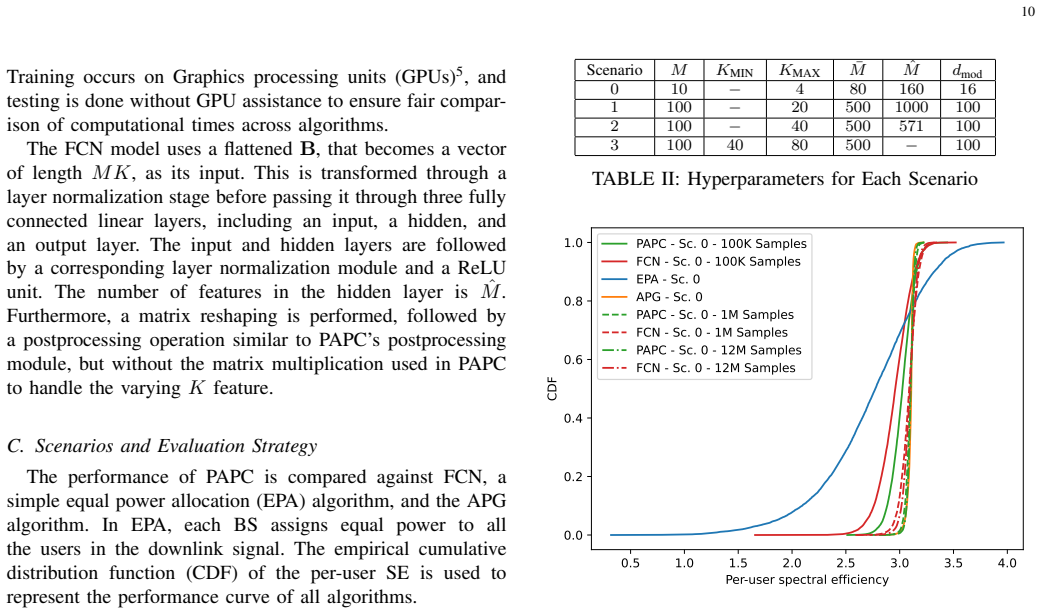
The paper's discovery is that pilot contamination can be fed into a transformer as a multiplicative attention mask rather than being handled by a separate optimization or estimation module. PAPC treats each user as a token, learns inter-user relationships from the large-scale fading coefficient matrix through multi-head self-attention, and injects the pilot allocation matrix by replacing the usual additive causal mask with an elementwise product of attention scores and the pilot correlation matrix. The authors observe that this works despite a counter-intuitive property: for users with orthogonal pilots the pre-softmax score is zero, but after softmax the attention weight is nonzero because softmax is shift-invariant. Unsupervised training maximizes the smoothed minimum spectral efficiency, and the evaluation shows the model's per-user spectral efficiency CDF nearly overlays APG's in scenarios with pilot reuse, while fully connected baselines that ignore pilot information fall behind.
Load-bearing premise
The design rests on the assumption that multiplying pre-softmax attention scores by the pilot-reuse matrix is a valid way to encode pilot contamination, a choice the paper justifies with simulations rather than an analytical argument; if this mask fails to generalize beyond the random pilot-reuse patterns used in training, the claim of APG-comparable performance loses its foundation.
Editorial extensions
If this is right
- Pilot allocation information can be treated as a first-class input to learned power control, not discarded as previous learning-based schemes did.
- A single PAPC model trained for variable user counts can maintain APG-comparable fairness when the number of users varies, because padding plus the diagonalized-$\Phi$ multiplication zeroes out nonexistent users.
- The unsupervised training objective, a smoothed soft-min spectral efficiency, is enough to reach the benchmark without requiring a dataset of solved APG power allocations.
- The complexity gap means that in large networks the inference-time bottleneck shifts from the optimization solver to the availability of trained models and data.
- PAPC's scalability to $MK=8000$ suggests the earlier small-scale limitation of learning-based cell-free massive MIMO power control was not fundamental but came from ignoring pilot structure.
Reading between the lines
- A natural ablation would replace $\Phi$ with random masks or with the identity matrix; if performance barely changes, the claimed pilot-contamination awareness would be an artefact of the attention mechanism rather than of the mask.
- The speed comparison tabulated for Scenario 3 is per inference pass on a CPU and does not count offline training; a deployment comparison would need to amortize training cost over the service lifetime.
- If the masking recipe transfers, the same elementwise-mask-before-softmax idea could encode other pairwise constraints in wireless resource allocation, such as interference graphs or clustering, without redesigning the architecture.
Signed reviews
Editorial analysis
A structured set of objections, weighed in public.
Referee Report
Summary. The paper proposes PAPC, a transformer-based neural network for downlink power control in cell-free massive MIMO systems. The network takes the large-scale fading matrix B and a pilot-allocation matrix Phi as inputs, and its multi-head attention uses a custom element-wise masking of attention scores by Phi before softmax. Training is unsupervised, maximizing an empirical smoothed-min spectral efficiency utility. The authors report that PAPC matches the accelerated proximal gradient (APG) benchmark within about 0.08 bits/s/Hz in contaminated scenarios while being nearly 1000 times faster, and that it outperforms an FCN baseline that does not use pilot information. The paper also describes padding and postprocessing mechanisms for handling a varying number of users without retraining.
Significance. If the claims hold, the paper makes a useful contribution to learning-based power control in cell-free massive MIMO: it is, to my knowledge, the first DNN-based downlink power control scheme that explicitly incorporates pilot allocation information, and it demonstrates scalability to M K = 8000, larger than prior learning-based studies. The authors provide a public GitHub implementation, which is a strength for reproducibility. The comparison against APG, a strong first-order optimization benchmark, is appropriate, and the use of an unsupervised objective that does not rely on labels from the iterative solver is methodologically sound. The main limitation is that the central novelty, the Phi-masking mechanism, is not validated by any ablation, and several simulation-reporting issues (swapped SNR values, single runtime measurement, absence of confidence intervals) weaken the quantitative claims as currently stated.
major comments (4)
- [IV-B3] The paper's central claim that PAPC is 'pilot contamination-aware' rests entirely on the element-wise multiplication of attention scores by Phi before softmax (\bar S = S \odot \Phi). Since zeros in Phi become zero logits rather than zero attention weights after softmax, the mechanism's behavior is, as the authors acknowledge, counter-intuitive. No ablation is reported that compares PAPC with the Phi-mask against PAPC with an all-ones mask or with a hard -infinity mask, so there is no evidence that the observed APG-comparable CDFs are due to the pilot information rather than to the transformer attention structure alone. An ablation isolating this component is load-bearing for the paper's novelty and should be added.
- [V.A / Table I] The transmit SNR values are inconsistent between the text and Table I. Section V.A states 'the transmit SNR for the uplink pilot and downlink data are zeta_p = 0.2/P_n and zeta_d = 1/P_n, respectively,' while Table I lists 'Transmit SNR of uplink pilot (zeta_p): 1/P_n' and 'Transmit SNR of downlink data (zeta_d): 0.2/P_n.' Since the spectral efficiency results depend directly on these SNRs, this ambiguity must be resolved for the simulations to be reproducible.
- [Table III / V.E] The computational efficiency claim ('nearly 1000 times faster than APG') is based on a single runtime measurement reported in Table III. No confidence intervals, multiple runs, or variation across seeds are given, and the APG runtime is not specified in terms of number of iterations or convergence tolerance. Given that runtime improvements are a central advertised advantage, the measurement should be repeated and reported with mean and spread, and the APG implementation details should be provided.
- [V.E / Fig. 9] The quantitative claim that PAPC lags behind APG by only 0.08 bits/s/Hz in Scenarios 2 and 3 is based on CDF curves for a single evaluation set of 2000 samples. There are no confidence intervals or seed variations for any of the CDF comparisons. Since the performance gap is small, an error bar or repeated-seed analysis is needed to establish that the gap is statistically meaningful.
minor comments (5)
- [II] Typo: 'It is sytaightforward to find' should read 'It is straightforward to find.'
- [III.C] The notation for the generated pilot-allocation matrices is inconsistent: the text says '{Phi[p] \in R^{M\times K}_+}' but Phi should be K-by-K as defined in Section III.B. Please correct to R^{K\times K}.
- [V.C] Typo: 'varyink K feature' should read 'varying K feature.' Similar typos appear in the discussion of the padding mechanism.
- [V.B / IV-B5] The FCN postprocessing is said to be 'similar to PAPC's postprocessing module, but without the matrix multiplication used in PAPC.' Since that matrix multiplication (multiplication by diagonalized Phi) is what enforces zero output for padded users, it would be helpful to state explicitly how the FCN handles the varying-K case, if it is used in the varying-K experiments.
- [IV-A] The overview of GPT is longer than needed for the paper's contribution. A concise description of the attention and masking concepts would suffice and would help the reader focus on the novel parts.
Circularity Check
No circularity: the PAPC derivation is self-contained, trained against an explicit unsupervised utility, and benchmarked against an external APG algorithm.
full rationale
The paper's central claim is that the PAPC transformer, trained unsupervised to maximize the smoothed minimum spectral efficiency utility in (7)-(9), approaches APG performance while being much faster. This is not circular: APG is an external first-order algorithm from reference [12], and no APG outputs are used as training labels or fitted constants. The training objective is an explicit utility function, not a disguised version of the evaluation metric or of the APG result. The pilot allocation matrix Phi is a genuine additional input derived from the system model, and the custom masking operation in Section IV-B3 is an architectural design choice justified empirically; although an ablation isolating the Phi-mask is absent, that is a robustness concern rather than a circular reduction. The only self-citations are the authors' earlier conference paper [39] and their GitHub repository [44], which are used descriptively and do not carry the load of the APG-comparison claim. No equation is defined in terms of the quantity it predicts, and no fitted parameter is renamed as a prediction. The derivation chain is therefore self-contained, with no significant circularity.
Assumptions & free parameters
free parameters (4)
- Soft-min smoothing parameter lambda =
3
- Transformer capacity hyperparameters =
L=3, H=5, Mbar=500 for Scenarios 1-3, Mbar=80 for Scenario 0, dmod=16 or 100
- Postprocessing exponent offset =
6
- Training sample count P =
12,000,000 unless stated otherwise
assumptions (5)
- domain assumption Use-and-then-forget SINR bound in Eq. (1) from [12, 14]
- domain assumption Large-scale fading coefficients B and pilot correlation matrix Phi are perfectly known to the central processor
- domain assumption Pilot allocation is performed before power control and Phi is a fixed input
- domain assumption I.i.d. Rayleigh fading and three-slope path loss with shadow fading following [5]
- domain assumption Soft-min utility approximates the max-min fairness objective
Cite this review
Pith. "Pith review of Pilot Contamination Aware Transformer for Downlink Power Control in Cell-Free Massive MIMO Networks." pith.science (2026). https://pith.science/paper/4EH7MZPD
@misc{pith2026241119020,
  author       = {Pith},
  title        = {Pith review of: Pilot Contamination Aware Transformer for Downlink Power Control in Cell-Free Massive MIMO Networks},
  year         = {2026},
  howpublished = {\url{https://pith.science/paper/4EH7MZPD}},
  note         = {Machine review of arXiv:2411.19020}
}
read the original abstract
Learning-based downlink power control in cell-free massive multiple-input multiple-output (CFmMIMO) systems offers a promising alternative to conventional iterative optimization algorithms, which are computationally intensive due to online iterative steps. Existing learning-based methods, however, often fail to exploit the intrinsic structure of channel data and neglect pilot allocation information, leading to suboptimal performance, especially in large-scale networks with many users. This paper introduces the pilot contamination-aware power control (PAPC) transformer neural network, a novel approach that integrates pilot allocation data into the network, effectively handling pilot contamination scenarios. PAPC employs the attention mechanism with a custom masking technique to utilize structural information and pilot data. The architecture includes tailored preprocessing and post-processing stages for efficient feature extraction and adherence to power constraints. Trained in an unsupervised learning framework, PAPC is evaluated against the accelerated proximal gradient (APG) algorithm, showing comparable spectral efficiency fairness performance while significantly improving computational efficiency. Simulations demonstrate PAPC's superior performance over fully connected networks (FCNs) that lack pilot information, its scalability to large-scale CFmMIMO networks, and its computational efficiency improvement over APG. Additionally, by employing padding techniques, PAPC adapts to the dynamically varying number of users without retraining.
Figures


Figures from the paper (8 more)




Forward citations
Cited by 1 Pith paper
-
Computationally Efficient Neural Receivers via Axial Self-Attention
Axial attention over time and frequency matches or beats global attention and CNN baselines in a neural OFDM receiver while using roughly 2.8x fewer FLOPs.
Reference graph
Works this paper leans on
-
[1]
Multiuser MIMO in Distributed Antenna Systems With Out- of-Cell Interference,
R. W. Heath Jr, T. Wu, Y . H. Kwon, and A. C. K. Soong, “Multiuser MIMO in Distributed Antenna Systems With Out- of-Cell Interference,” IEEE Trans. on Signal Process. , vol. 59, no. 10, pp. 4885–4899, 2011
work page 2011
-
[2]
A current perspective on distributed antenna systems for the downlink of cellular systems,
R. Heath, S. Peters, Y . Wang, and J. Zhang, “A current perspective on distributed antenna systems for the downlink of cellular systems,” IEEE Commun. Mag. , vol. 51, no. 4, pp. 161–167, 2013
work page 2013
-
[3]
Wire- less network cloud: Architecture and system requirements,
Y . Lin, L. Shao, Z. Zhu, Q. Wang, and R. K. Sabhikhi, “Wire- less network cloud: Architecture and system requirements,” IBM J. of Research and Development , vol. 54, no. 1, pp. 4:1– 4:12, 2010
work page 2010
-
[4]
Cloud radio access network (C-RAN): a primer,
J. Wu, Z. Zhang, Y . Hong, and Y . Wen, “Cloud radio access network (C-RAN): a primer,” IEEE Network, vol. 29, no. 1, pp. 35–41, 2015
work page 2015
-
[5]
Cell-Free Massive MIMO Versus Small Cells,
H. Q. Ngo, A. Ashikhmin, H. Yang, E. G. Larsson, and T. L. Marzetta, “Cell-Free Massive MIMO Versus Small Cells,”IEEE Trans. on Wireless Commun. , vol. 16, no. 3, pp. 1834–1850, 2017
work page 2017
-
[6]
Max–Min Rate of Cell-Free Massive MIMO Uplink With Optimal Uniform Quantization,
M. Bashar, K. Cumanan, A. G. Burr, H. Q. Ngo, M. Debbah, and P. Xiao, “Max–Min Rate of Cell-Free Massive MIMO Uplink With Optimal Uniform Quantization,” IEEE Trans. on Commun., vol. 67, no. 10, pp. 6796–6815, 2019
work page 2019
-
[7]
Making Cell-Free Massive MIMO Competitive With MMSE Processing and Centralized Implementation,
E. Bj ¨ornson and L. Sanguinetti, “Making Cell-Free Massive MIMO Competitive With MMSE Processing and Centralized Implementation,” IEEE Trans. on Wireless Commun. , vol. 19, no. 1, pp. 77–90, 2020
work page 2020
-
[8]
O. T. Demir, E. Bj ¨ornson, and L. Sanguinetti, Foundations of User-Centric Cell-Free Massive MIMO , 2021
work page 2021
Show all 44 references
-
[9]
Ubiquitous cell-free massive MIMO communica- 13 tions,
G. Interdonato, E. Bj ¨ornson, H. Q. Ngo, P. Frenger, and E. G. Larsson, “Ubiquitous cell-free massive MIMO communica- 13 tions,” EURASIP J. on Wireless Commun. and Networking, vol. 2019, no. 1, pp. 1–13, Dec 2019
2019
-
[10]
Cooperative Access Net- works: Optimum Fronthaul Quantization in Distributed Massive MIMO and Cloud RAN - Invited Paper,
A. Burr, M. Bashar, and D. Maryopi, “Cooperative Access Net- works: Optimum Fronthaul Quantization in Distributed Massive MIMO and Cloud RAN - Invited Paper,” in Proc. IEEE 87th Veh. Tech. Conf. (VTC Spring) , 2018, pp. 1–5
2018
-
[11]
Performance Analysis of Cell- Free Massive MIMO System With Limited Fronthaul Capacity and Hardware Impairments,
H. Masoumi and M. J. Emadi, “Performance Analysis of Cell- Free Massive MIMO System With Limited Fronthaul Capacity and Hardware Impairments,” IEEE Trans. on Wireless Com- mun., vol. 19, no. 2, pp. 1038–1053, 2020
2020
-
[12]
Utility Maxi- mization for Large-Scale Cell-Free Massive MIMO Downlink,
M. Farooq, H. Q. Ngo, E. Hong, and L. Tran, “Utility Maxi- mization for Large-Scale Cell-Free Massive MIMO Downlink,” IEEE Trans. on Commun., vol. 69, no. 10, pp. 7050–7062, 2021
2021
-
[13]
Energy Efficiency in Cell-Free Massive MIMO with Zero- Forcing Precoding Design,
L. D. Nguyen, T. Q. Duong, H. Q. Ngo, and K. Tourki, “Energy Efficiency in Cell-Free Massive MIMO with Zero- Forcing Precoding Design,” IEEE Commun. Lett., vol. 21, no. 8, pp. 1871–1874, 2017
2017
-
[14]
On the Total Energy Efficiency of Cell-Free Massive MIMO,
H. Q. Ngo, L. Tran, T. Q. Duong, M. Matthaiou, and E. G. Larsson, “On the Total Energy Efficiency of Cell-Free Massive MIMO,” IEEE Trans. on Green Commun. and Networking , vol. 2, no. 1, pp. 25–39, 2018
2018
-
[15]
Downlink Training in Cell-Free Massive MIMO: A Blessing in Disguise,
G. Interdonato, H. Q. Ngo, P. Frenger, and E. G. Larsson, “Downlink Training in Cell-Free Massive MIMO: A Blessing in Disguise,” IEEE Trans. on Wireless Commun. , vol. 18, no. 11, pp. 5153–5169, 2019
2019
-
[16]
Scalable Cell-Free Massive MIMO Systems,
E. Bj ¨ornson and L. Sanguinetti, “Scalable Cell-Free Massive MIMO Systems,” IEEE Trans. on Commun., vol. 68, no. 7, pp. 4247–4261, 2020
2020
-
[17]
Cell-Free Massive MIMO: User- Centric Approach,
S. Buzzi and C. D’Andrea, “Cell-Free Massive MIMO: User- Centric Approach,” IEEE Wireless Commun. Lett., vol. 6, no. 6, pp. 706–709, 2017
2017
-
[18]
Energy Efficiency Maximization in Large-Scale Cell-Free Massive MIMO: A Pro- jected Gradient Approach,
T. C. Mai, H. Q. Ngo, and L. Tran, “Energy Efficiency Maximization in Large-Scale Cell-Free Massive MIMO: A Pro- jected Gradient Approach,” IEEE Trans. on Wireless Commun., vol. 21, no. 8, pp. 6357–6371, 2022
2022
-
[19]
Deep Learning-based Power Control for Cell- Free Massive MIMO Networks,
N. Rajapaksha, K. B. Shashika Manosha, N. Rajatheva, and M. Latva-Aho, “Deep Learning-based Power Control for Cell- Free Massive MIMO Networks,” in Proc. IEEE Int. Conf. on Commun., 2021, pp. 1–7
2021
-
[20]
Unsupervised Learning-Based Joint Power Control and Fronthaul Capacity Allocation in Cell-Free Massive MIMO With Hardware Impairments,
N. Rajapaksha, K. B. S. Manosha, N. Rajatheva, and M. Latva- aho, “Unsupervised Learning-Based Joint Power Control and Fronthaul Capacity Allocation in Cell-Free Massive MIMO With Hardware Impairments,” IEEE Wireless Commun. Lett. , vol. 12, no. 7, pp. 1159–1163, 2023
2023
-
[21]
Unsupervised- Learning Power Control for Cell-Free Wireless Systems,
R. Nikbakht, A. Jonsson, and A. Lozano, “Unsupervised- Learning Power Control for Cell-Free Wireless Systems,” in Proc. IEEE 30th Annual Int. Symp. on Personal, Indoor and Mobile Radio Commun. (PIMRC) , 2019, pp. 1–5
2019
-
[22]
MAX- MIN Power Control of Cell Free Massive MIMO System employing Deep Learning,
A. Mazhari Saray and A. Ebrahimi, “MAX- MIN Power Control of Cell Free Massive MIMO System employing Deep Learning,” in Proc. 4th West Asian Symp. on Optical and Millimeter-wave Wireless Commun. (WASOWC), 2022, pp. 1–4
2022
-
[23]
Up- link Power Control in Cell-Free Massive MIMO via Deep Learning,
C. D’Andrea, A. Zappone, S. Buzzi, and M. Debbah, “Up- link Power Control in Cell-Free Massive MIMO via Deep Learning,” in Proc. IEEE 8th Int. Workshop on Computational Advances in Multi-Sensor Adaptive Process. (CAMSAP) , 2019, pp. 554–558
2019
-
[24]
Deep Learning- Based Power Control for Uplink Cell-Free Massive MIMO Sys- tems,
Y . Zhang, J. Zhang, Y . Jin, S. Buzzi, and B. Ai, “Deep Learning- Based Power Control for Uplink Cell-Free Massive MIMO Sys- tems,” in Proc. IEEE Global Commun. Conf. (GLOBECOM) , 2021, pp. 1–6
2021
-
[25]
User Cooperation with Power Control for Federated Learning in CFmMIMO Networks,
H. Bao, K. Xiong, R. Zhang, P. Fan, D. Niyato, and K. B. Letaief, “User Cooperation with Power Control for Federated Learning in CFmMIMO Networks,” in Proc. IEEE Int. Conf. on Commun. Workshops (ICC Workshops), 2023, pp. 122–127
2023
-
[26]
Decentralized Joint Pilot and Data Power Control Based on Deep Reinforcement Learning for the Uplink of Cell- Free Systems,
I. M. Braga, R. P. Antonioli, G. Fodor, Y . C. B. Silva, and W. C. Freitas, “Decentralized Joint Pilot and Data Power Control Based on Deep Reinforcement Learning for the Uplink of Cell- Free Systems,” IEEE Trans. on Veh. Tech. , vol. 72, no. 1, pp. 957–972, 2023
2023
-
[27]
Deep Reinforcement Learning-based Power Allocation in Uplink Cell-Free Massive MIMO,
M. Rahmani, M. Bashar, M. J. Dehghani, P. Xiao, R. Tafazolli, and M. Debbah, “Deep Reinforcement Learning-based Power Allocation in Uplink Cell-Free Massive MIMO,” in Proc. IEEE Wireless Commun. and Networking Conf. (WCNC) , 2022, pp. 459–464
2022
-
[28]
Deep Rein- forcement Learning-based Uplink Power Control in Cell-Free Massive MIMO,
X. Zhang, M. Kaneko, V . An Le, and Y . Ji, “Deep Rein- forcement Learning-based Uplink Power Control in Cell-Free Massive MIMO,” in Proc. IEEE 20th Consumer Commun. & Networking Conf. (CCNC) , 2023, pp. 567–572
2023
-
[29]
Learning Decentralized Power Control in Cell-Free Massive MIMO Networks,
D. Yu, H. Lee, S. Hong, and S. Park, “Learning Decentralized Power Control in Cell-Free Massive MIMO Networks,” IEEE Trans. on Veh. Tech., vol. 72, no. 7, pp. 9653–9658, 2023
2023
-
[30]
Unsupervised- Learning Power Allocation for the Cell-Free Downlink,
R. Nikbakht, A. Jonsson, and A. Lozano, “Unsupervised- Learning Power Allocation for the Cell-Free Downlink,” in Proc. IEEE Int. Conf. on Commun. Workshops (ICC Work- shops), 2020, pp. 1–5
2020
-
[31]
Downlink Power Control for Cell-Free Massive MIMO With Deep Reinforcement Learning,
L. Luo, J. Zhang, S. Chen, X. Zhang, B. Ai, and D. W. K. Ng, “Downlink Power Control for Cell-Free Massive MIMO With Deep Reinforcement Learning,” IEEE Trans. on Veh. Tech. , vol. 71, no. 6, pp. 6772–6777, 2022
2022
-
[32]
Unsupervised Learn- ing for C-RAN Power Control and Power Allocation,
R. Nikbakht, A. Jonsson, and A. Lozano, “Unsupervised Learn- ing for C-RAN Power Control and Power Allocation,” IEEE Commun. Lett., vol. 25, no. 3, pp. 687–691, 2021
2021
-
[33]
Deep Learning Based Power Control for Cell-Free Massive MIMO with MRT,
L. Sala ¨un and H. Yang, “Deep Learning Based Power Control for Cell-Free Massive MIMO with MRT,” inProc. IEEE Global Commun. Conf. (GLOBECOM) , 2021, pp. 01–07
2021
-
[34]
Joint User Association and Power Control for Cell-Free Massive MIMO,
C. Hao, T. T. Vu, H. Q. Ngo, M. N. Dao, X. Dang, C. Wang, and M. Matthaiou, “Joint User Association and Power Control for Cell-Free Massive MIMO,” IEEE Internet of Things J. , pp. 1–1, 2024
2024
-
[35]
A GNN Approach for Cell-Free Massive MIMO,
L. Sala ¨un, H. Yang, S. Mishra, and C. S. Chen, “A GNN Approach for Cell-Free Massive MIMO,” in Proc. IEEE Global Commun. Conf. (GLOBECOM) , 2022, pp. 3053–3058
2022
-
[36]
Learning- Based Downlink Power Allocation in Cell-Free Massive MIMO Systems,
M. Zaher, O. T. Demir, E. Bj ¨ornson, and M. Petrova, “Learning- Based Downlink Power Allocation in Cell-Free Massive MIMO Systems,” IEEE Trans. on Wireless Commun. , vol. 22, no. 1, pp. 174–188, 2023
2023
-
[37]
Unsuper- vised Deep Learning for Power Control of Cell-Free Massive MIMO Systems,
Y . Zhang, J. Zhang, S. Buzzi, H. Xiao, and B. Ai, “Unsuper- vised Deep Learning for Power Control of Cell-Free Massive MIMO Systems,” IEEE Trans. on Veh. Tech., vol. 72, no. 7, pp. 9585–9590, 2023
2023
-
[38]
Power Allocation in a Cell-Free MIMO System using Reinforcement Learning-Based Approach,
S. Chakraborty and B. R. Manoj, “Power Allocation in a Cell-Free MIMO System using Reinforcement Learning-Based Approach,” in Proc. National Conf. on Commun. (NCC) , 2023, pp. 1–6
2023
-
[39]
Atten- tion Neural Network for Downlink Cell-Free Massive MIMO Power Control,
A. K. Kocharlakota, S. A. V orobyov, and R. W. Heath, “Atten- tion Neural Network for Downlink Cell-Free Massive MIMO Power Control,” in Proc. 56th Asilomar Conf. on Signals, Systems, and Computers , 2022, pp. 738–743
2022
-
[40]
Attention is All you Need,
A. Vaswani, N. Shazeer, N. Parmar, J. Uszkoreit, L. Jones, A. N. Gomez, L. u. Kaiser, and I. Polosukhin, “Attention is All you Need,” in Proc. Advances in Neural Inf. Process. Systems , vol. 30. Curran Associates, Inc., 2017
2017
-
[41]
Improving language understanding by generative pre-training,
A. Radford, K. Narasimhan, T. Salimans, and I. Sutskever, “Improving language understanding by generative pre-training,” 2018, accessed: 2023-01-06
2018
-
[42]
Goodfellow, Y
I. Goodfellow, Y . Bengio, and A. Courville, Deep Learning . MIT Press, 2016
2016
-
[43]
BERT: Pre-training of Deep Bidirectional Transformers for Language Understanding,
J. Devlin, M.-W. Chang, K. Lee, and K. Toutanova, “BERT: Pre-training of Deep Bidirectional Transformers for Language Understanding,” 2019
2019
-
[44]
CFmMIMO PC,
A. K. Kocharlakota, S. A. V orobyov, and R. W. Heath, “CFmMIMO PC,” GitHub repository, 2024. [Online]. Available: https://github.com/kochark1/CFmMIMO PC
2024
Reviewed August 12, 2026 · model on record in the stance chip above.
Discussion (0). Continue with ORCID to comment.