REVIEW 4 major objections 6 minor 38 references
Bootstraping Clustering of Gaussians for View-consistent 3D Scene Understanding
T0 review · 4 major / 6 minor · reviewed 2026-08-12 · deepseek-v4-flash
Pith's one-line read FreeGS learns view-consistent 3D scene semantics from raw multi-view images alone, with no 2D labels, no SAM masks, and no preprocessing.
desk verdict Clever bootstrapping design that delivers competitive label-free 3D segmentation, but the clustering engine is unquantified and the view-consistency claim outruns the evidence. read the letter →
The pith
A machine-rendered reading of the paper's core claim, the machinery that carries it, and where it could break.
The reading
What carries the argument
The identity-coupled semantic field (IDSF) is the central object: each Gaussian stores a semantic vector $f_i \in \mathbb{R}^{128}$ and a scalar instance index $d_i$, so identity and semantics live on the same primitive. The engine is the alternating bootstrap. Union-space clustering runs HDBSCAN on the concatenation of normalized position, color, and PCA-reduced semantics ($S_{\text{union}} = S_{\text{pos}} \cup S_{\text{app}} \cup S_{\text{sem}}$) to produce instance indices; the indices are $\alpha$-blended and argmaxed into a 2D ID map, refined by DenseCRF, and used to form instance-level CLIP supervision. The multi-level distillation loss $L_F = \|F_{\text{pix}} - \hat{F}\|_1 + \gamma \|F_{\text{ins}} - F\|_1$ injects pixel- and instance-level semantics, and the 2D–3D joint contrastive loss $L_C$ re-merges fragments by treating similar groups as positive samples. Feature-field smoothing $L_S$ over $K$-nearest neighbors keeps the field continuous, and together these losses close the loop that lets clustering and semantics refine each other.
What would settle it
Take a scene with two visually near-identical, touching objects of the same category, and run FreeGS from unlabeled multi-view images. If the union-space clustering initially merges them into one instance and the bootstrapped distillation plus contrastive loss never separates them over the full 7k-iteration second phase, the central claim that clustering and semantics bootstrap toward view-consistent instances fails on that scene. A quantitative version: track cluster purity against ground-truth instance masks during training; the paper's claim predicts a monotone improvement, so a non-increasing or oscillating purity trajectory would contradict it.
Extended reading notes
Core claim
The central discovery is that cross-view instance consistency can be bootstrapped rather than imported from 2D models. FreeGS attaches to each Gaussian an identity-coupled semantic field: a view-independent semantic vector plus a scalar instance index. A clustering pass groups Gaussians in a union space of position, color, and PCA-reduced semantics, assigning each Gaussian an instance index; a distillation pass renders those indices to 2D, uses the resulting masks to extract CLIP features per instance, and aligns them with the rendered semantic field. A 2D–3D joint contrastive loss pulls features of the same clustered group together and pushes different groups apart. The paper argues that this alternating schedule yields view-consistent semantics without any label, because the 3D grouping regularizes the 2D semantic injection and the semantic field in turn improves the grouping.
Load-bearing premise
The load-bearing premise is that HDBSCAN clustering of position, color, and partially trained semantics produces correct object groupings, and that masks derived from those groupings give supervision that improves the semantics rather than locking in initial clustering errors.
Editorial extensions
If this is right
- On LERF-Mask and 3D-OVS, FreeGS matches the segmentation mIoU of SAM-supervised methods like Gaussian Grouping and LangSplat, without generating any SAM masks.
- The same trained field answers text and click prompts by matching in 3D, so novel-view segmentation, object selection, and detection share one inference pipeline.
- Removing preprocessing cuts the total pipeline from 92–246 minutes to about 62 minutes on the ramen scene, making the semantic field practical for quick 3D capture.
- Because instance indices are stored per Gaussian, 3D editing and prompt-based selection become direct manipulations of the cluster rather than pixel-space postprocessing.
- The contrastive loss stabilizes cluster assignments across training iterations, which is what the paper credits for avoiding fragmented objects in cluttered scenes.
Reading between the lines
- A natural stress test is a scene with two visually near-identical adjacent objects: the union-space clustering has no appearance or semantic signal to separate them initially, so whether the bootstrapping loop can ever split them is an open question not addressed by the chosen benchmarks.
- The union-space bootstrapping principle is not tied to Gaussian splatting; any explicit 3D representation with a differentiable renderer and a 2D feature extractor could in principle run the same alternating clustering–distillation loop.
- The paper fixes PCA dimension and HDBSCAN min_samples without a sensitivity study; measuring how cluster purity and downstream mIoU vary with those hyperparameters would directly test how much of the result rests on the clustering configuration.
- The authors acknowledge 3D detection accuracy has significant room for improvement, so the framework's most immediate practical value is likely segmentation and object selection, with precise 3D localization as the next target for the same bootstrapping idea.
Editorial analysis
A structured set of objections, weighed in public.
Referee Report
Summary. FreeGS proposes an unsupervised 3D Gaussian Splatting framework for view-consistent scene understanding. The core idea is an IDentity-coupled Semantic Field (IDSF) that augments each Gaussian with a semantic vector and a scalar instance index. Training alternates between HDBSCAN clustering of Gaussians in a position-color-semantics union space to obtain pseudo-instance indices, and multi-level 2D semantic distillation from frozen CLIP/MaskCLIP features guided by these indices; a 2D-3D contrastive loss is added to stabilize the loop. The paper evaluates on LERF-Mask, 3D-OVS, and ScanNet for novel-view segmentation, 3D detection, and interactive selection, reporting performance comparable to SAM-supervised baselines while eliminating SAM preprocessing.
Significance. If the bootstrapping mechanism is sound, FreeGS is a meaningful advance: it removes the SAM-mask preprocessing bottleneck, introduces an explicit view-consistent instance index in 3D, and unifies several tasks in one field. The paper ships code and includes ablations showing that each component contributes on the tested scenes. The significance is currently tempered by the absence of a direct view-consistency metric, the lack of clustering-quality analysis, and the small evaluation scale; these gaps leave the central claim only partially substantiated.
major comments (4)
- [Section 3.2, Eq. (5)] The handling of HDBSCAN noise labels is unspecified. HDBSCAN assigns a noise label to low-density points, but the paper never states how such Gaussians are treated when constructing the one-hot vector d'_i or when rendering the ID map in Eq. (5). If noise points are assigned a common index, they will appear as a spurious instance in the argmax map; if they are excluded, the definition of the rendered index and of the masks M_i in Eq. (6) is incomplete. This is not a cosmetic detail: Eq. (6) and Eq. (8) use these masks and indices directly, so the ambiguity affects the core bootstrapping loop.
- [Section 3.2 and Section 4 (Training)] The paper provides no evaluation of clustering quality or of bootstrap error propagation, despite the method's reliance on union-space clustering as the engine of the alternating optimization. At the start of the second training phase, the semantic features f_i are not yet trained, so the first clustering is driven almost entirely by position and color; the paper does not show that this initialization is sufficient, nor that the smoothing loss (Eq. 3) and contrastive loss (Eq. 8) improve rather than reinforce initial grouping errors. A quantitative analysis of cluster purity/accuracy and of how the pseudo-masks evolve over training iterations is needed to substantiate the claim that the two steps 'bootstrap view-consistent semantics.'
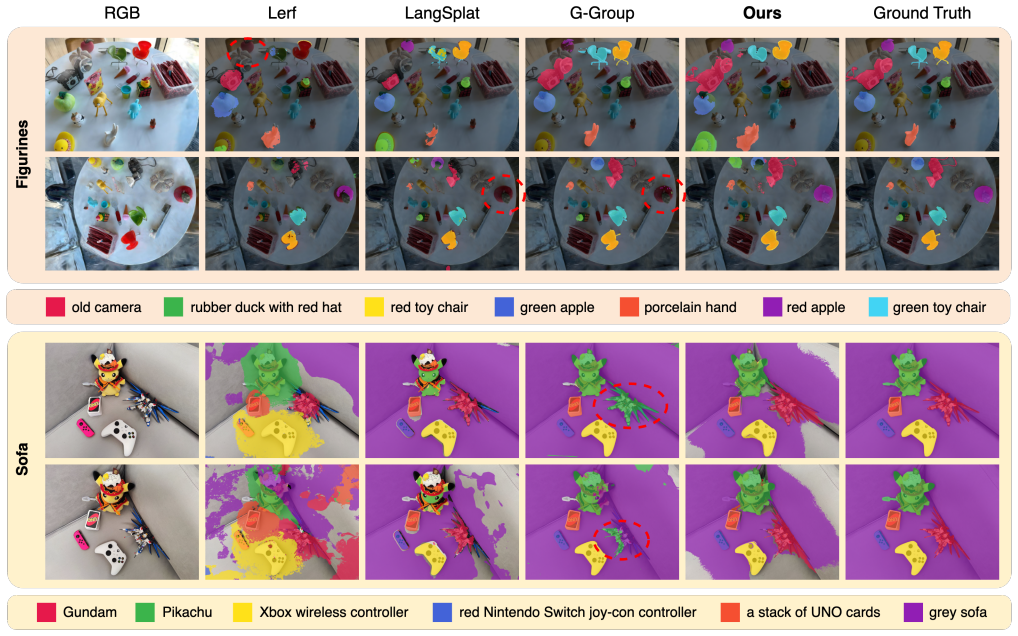
- [Section 4, Tables 1-3] The view-consistency claim is not directly measured. The reported metrics (per-frame mIoU for segmentation, 3D box mIoU and recall for detection) evaluate average accuracy, not the stability of instance identities across views. To support the title and abstract, the paper should report a direct consistency measure, for example the mean pairwise IoU of rendered ID maps across different viewpoints, or the fraction of Gaussians assigned to the same cluster when the process is repeated with different training seeds. Without such a measure, the qualitative claim of consistency (e.g., Fig. 3) is not quantified.
- [Section 4, Implementation Details and Tables 1-3] The evaluation is too small to support the strength of the comparisons, and no variance is reported. The benchmarks comprise 3, 5, and 3 scenes, and differences such as Table 1's 69.5 versus 72.8 and Table 2's 77.0 versus 77.0 are within the noise expected for this sample size. Moreover, the HDBSCAN min_samples hyperparameter is tuned per dataset (20 for LERF-Mask, 60 for 3D-OVS and ScanNet) with no sensitivity analysis, even though clustering is the load-bearing component of the method. At minimum, multiple runs with standard deviations and a sensitivity study for min_samples and the loss weights (lambda_C, lambda_S) should be reported.
minor comments (6)
- [Title and Section 3.3] 'Bootstraping' should be 'Bootstrapping' in the title and in the heading of Section 3.3.
- [Section 3.2] 'Sapp is the gather of view-independent color part c′' should read 'Sapp is the set of view-independent color components c′'.
- [Eq. (8)] The notation for the positive and negative sets (F Gi+ and F Gi-) is introduced as sets of mean features, but the overbar on F is not defined; please clarify the notation.
- [Table 2] The caption says the LERF results are taken from LangSplat, which conflicts with the text stating that methods were retrained on training views; please clarify the protocol.
- [Fig. 6] The interactive object selection task is presented qualitatively; a short protocol description or a small user study would strengthen the claim that the method supports this task.
- [Section 4] 'Gasussians' should be 'Gaussians'; also, 'min samples' should be 'min_samples' for consistency with the HDBSCAN library naming.
Circularity Check
No significant circularity: the semantic supervision comes from external CLIP/MaskCLIP features, and the alternating clustering/distillation loop is iterative bootstrapping, not a definitional reduction.
full rationale
The paper's derivation chain is self-contained with respect to external evidence. Union-space clustering (Sec. 3.2) groups Gaussians using position, color, and PCA-reduced semantic features, and the resulting instance indices are rendered into 2D masks via Eq. (5). These masks are then used only to select image patches for the frozen CLIP encoder in the instance-level distillation term (Eq. 6), while pixel-level distillation uses external MaskCLIP and FeatUP features. None of the losses is minimized toward a target that is, by construction, the same function of the predicted field; the mutual update of semantic features and instance indices is an explicit iterative bootstrap, not a fitted parameter renamed as a prediction. The paper also does not rely on self-citation chains or imported uniqueness theorems. The concern that HDBSCAN cluster quality is unevaluated and that errors could self-reinforce is an empirical robustness and correctness risk, not a circularity, because no equation reduces the claimed output to its own input by construction.
Assumptions & free parameters
free parameters (4)
- HDBSCAN min_samples =
20 (LERF-Mask); 60 (3D-OVS and ScanNet)
- loss weights =
lambda_C=0.05, lambda_S=0.1, gamma=0.3
- contrastive temperature tau =
0.1
- feature dimension D =
128
assumptions (4)
- domain assumption CLIP and MaskCLIP features carry semantically meaningful and view-independent visual representations.
- domain assumption Clustering in the union space of position, color, and PCA-reduced semantics yields object-level groups.
- domain assumption FeatUP super-resolution preserves feature semantics at higher resolution.
- ad hoc to paper The alternating optimization converges to a non-trivial fixed point rather than a degenerate grouping.
invented entities (1)
-
IDentity-coupled Semantic Field (IDSF)
Cite this review
Pith. "Pith review of Bootstraping Clustering of Gaussians for View-consistent 3D Scene Understanding." pith.science (2026). https://pith.science/paper/YT2RHEYZ
@misc{pith2026241119551,
  author       = {Pith},
  title        = {Pith review of: Bootstraping Clustering of Gaussians for View-consistent 3D Scene Understanding},
  year         = {2026},
  howpublished = {\url{https://pith.science/paper/YT2RHEYZ}},
  note         = {Machine review of arXiv:2411.19551}
}
read the original abstract
Injecting semantics into 3D Gaussian Splatting (3DGS) has recently garnered significant attention. While current approaches typically distill 3D semantic features from 2D foundational models (e.g., CLIP and SAM) to facilitate novel view segmentation and semantic understanding, their heavy reliance on 2D supervision can undermine cross-view semantic consistency and necessitate complex data preparation processes, therefore hindering view-consistent scene understanding. In this work, we present FreeGS, an unsupervised semantic-embedded 3DGS framework that achieves view-consistent 3D scene understanding without the need for 2D labels. Instead of directly learning semantic features, we introduce the IDentity-coupled Semantic Field (IDSF) into 3DGS, which captures both semantic representations and view-consistent instance indices for each Gaussian. We optimize IDSF with a two-step alternating strategy: semantics help to extract coherent instances in 3D space, while the resulting instances regularize the injection of stable semantics from 2D space. Additionally, we adopt a 2D-3D joint contrastive loss to enhance the complementarity between view-consistent 3D geometry and rich semantics during the bootstrapping process, enabling FreeGS to uniformly perform tasks such as novel-view semantic segmentation, object selection, and 3D object detection. Extensive experiments on LERF-Mask, 3D-OVS, and ScanNet datasets demonstrate that FreeGS performs comparably to state-of-the-art methods while avoiding the complex data preprocessing workload. Our code is publicly available at https://github.com/wb014/FreeGS.
Figures


Figures from the paper (2 more)


Reference graph
Works this paper leans on
-
[1]
, " * write output.state after.block = add.period write newline
ENTRY address archivePrefix author booktitle chapter edition editor eid eprint howpublished institution isbn journal key month note number organization pages publisher school series title type volume year label extra.label sort.label short.list INTEGERS output.state before.all mid.sentence after.sentence after.block FUNCTION init.state.consts #0 'before.a...
-
[2]
write newline
" write newline "" before.all 'output.state := FUNCTION n.dashify 't := "" t empty not t #1 #1 substring "-" = t #1 #2 substring "--" = not "--" * t #2 global.max substring 't := t #1 #1 substring "-" = "-" * t #2 global.max substring 't := while if t #1 #1 substring * t #2 global.max substring 't := if while FUNCTION word.in bbl.in capitalize " " * FUNCT...
-
[3]
Caron, M.; Touvron, H.; Misra, I.; J \'e gou, H.; Mairal, J.; Bojanowski, P.; and Joulin, A. 2021. Emerging properties in self-supervised vision transformers. In Proceedings of the IEEE/CVF international conference on computer vision, 9650--9660
2021
-
[4]
K.; Oh, S
Cheng, H. K.; Oh, S. W.; Price, B.; Schwing, A.; and Lee, J.-Y. 2023. Tracking anything with decoupled video segmentation. In Proceedings of the IEEE/CVF International Conference on Computer Vision, 1316--1326
2023
-
[5]
X.; Savva, M.; Halber, M.; Funkhouser, T.; and Nie ner, M
Dai, A.; Chang, A. X.; Savva, M.; Halber, M.; Funkhouser, T.; and Nie ner, M. 2017. Scannet: Richly-annotated 3d reconstructions of indoor scenes. In Proceedings of the IEEE conference on computer vision and pattern recognition, 5828--5839
2017
-
[6]
Dong, X.; Bao, J.; Zheng, Y.; Zhang, T.; Chen, D.; Yang, H.; Zeng, M.; Zhang, W.; Yuan, L.; Chen, D.; et al. 2023. Maskclip: Masked self-distillation advances contrastive language-image pretraining. In Proceedings of the IEEE/CVF Conference on Computer Vision and Pattern Recognition, 10995--11005
work page 2023
-
[7]
Fan, Z.; Wang, P.; Jiang, Y.; Gong, X.; Xu, D.; and Wang, Z. 2022. Nerf-sos: Any-view self-supervised object segmentation on complex scenes. arXiv preprint arXiv:2209.08776
arXiv 2022
-
[8]
Fang, G.; and Wang, B. 2024. Mini-Splatting: Representing Scenes with a Constrained Number of Gaussians. arXiv preprint arXiv:2403.14166
arXiv 2024
Show all 38 references
-
[9]
Fang, J.; Wang, J.; Zhang, X.; Xie, L.; and Tian, Q. 2024. GaussianEditor: Editing 3D Gaussians Delicately with Text Instructions. In CVPR
2024
-
[10]
Fu, S.; Hamilton, M.; Brandt, L.; Feldman, A.; Zhang, Z.; and Freeman, W. T. 2024. Featup: A model-agnostic framework for features at any resolution. arXiv preprint arXiv:2403.10516
2024 arXiv
-
[11]
Hu, X.; Wang, Y.; Fan, L.; Fan, J.; Peng, J.; Lei, Z.; Li, Q.; and Zhang, Z. 2024. Semantic Anything in 3D Gaussians. arXiv preprint arXiv:2401.17857
2024 arXiv
-
[12]
Huang, J.; and Yu, H. 2023. Point'n Move: Interactive Scene Object Manipulation on Gaussian Splatting Radiance Fields. arXiv preprint arXiv:2311.16737
2023 arXiv
-
[13]
Kerbl, B.; Kopanas, G.; Leimk \"u hler, T.; and Drettakis, G. 2023. 3d gaussian splatting for real-time radiance field rendering. ACM Transactions on Graphics, 42(4): 1--14
2023
-
[14]
M.; Goldberg, K.; Kanazawa, A.; and Tancik, M
Kerr, J.; Kim, C. M.; Goldberg, K.; Kanazawa, A.; and Tancik, M. 2023. Lerf: Language embedded radiance fields. In ICCV, 19729--19739
2023
-
[15]
C.; Lo, W.-Y.; et al
Kirillov, A.; Mintun, E.; Ravi, N.; Mao, H.; Rolland, C.; Gustafson, L.; Xiao, T.; Whitehead, S.; Berg, A. C.; Lo, W.-Y.; et al. 2023. Segment anything. In ICCV, 4015--4026
2023
-
[16]
Kobayashi, S.; Matsumoto, E.; and Sitzmann, V. 2022. Decomposing nerf for editing via feature field distillation. Advances in Neural Information Processing Systems, 35: 23311--23330
2022
-
[17]
Kopanas, G.; Philip, J.; Leimk \"u hler, T.; and Drettakis, G. 2021. Point-Based Neural Rendering with Per-View Optimization. In Computer Graphics Forum, volume 40, 29--43. Wiley Online Library
2021
-
[18]
Lan, K.; Li, H.; Shi, H.; Wu, W.; Liao, Y.; Wang, L.; and Zhou, P. 2023. 2d-guided 3d gaussian segmentation. arXiv preprint arXiv:2312.16047
2023 arXiv
-
[19]
Q.; Belongie, S.; Koltun, V.; and Ranftl, R
Li, B.; Weinberger, K. Q.; Belongie, S.; Koltun, V.; and Ranftl, R. 2022. Language-driven semantic segmentation. arXiv preprint arXiv:2201.03546
2022 arXiv
-
[20]
Liao, G.; Li, J.; Bao, Z.; Ye, X.; Wang, J.; Li, Q.; and Liu, K. 2024. CLIP-GS: CLIP-Informed Gaussian Splatting for Real-time and View-consistent 3D Semantic Understanding. arXiv preprint arXiv:2404.14249
2024 arXiv
-
[21]
Liu, K.; Zhan, F.; Zhang, J.; Xu, M.; Yu, Y.; El Saddik, A.; Theobalt, C.; Xing, E.; and Lu, S. 2023. Weakly supervised 3d open-vocabulary segmentation. NeurIPS, 36: 53433--53456
2023
-
[22]
McInnes, L.; Healy, J.; Astels, S.; et al. 2017. hdbscan: Hierarchical density based clustering. J. Open Source Softw., 2(11): 205
2017
-
[23]
P.; Tancik, M.; Barron, J
Mildenhall, B.; Srinivasan, P. P.; Tancik, M.; Barron, J. T.; Ramamoorthi, R.; and Ng, R. 2021. Nerf: Representing scenes as neural radiance fields for view synthesis. Communications of the ACM, 65(1): 99--106
2021
-
[24]
Qin, M.; Li, W.; Zhou, J.; Wang, H.; and Pfister, H. 2023. LangSplat: 3D Language Gaussian Splatting. arXiv preprint arXiv:2312.16084
2023 arXiv
-
[25]
W.; Hallacy, C.; Ramesh, A.; Goh, G.; Agarwal, S.; Sastry, G.; Askell, A.; Mishkin, P.; Clark, J.; et al
Radford, A.; Kim, J. W.; Hallacy, C.; Ramesh, A.; Goh, G.; Agarwal, S.; Sastry, G.; Askell, A.; Mishkin, P.; Clark, J.; et al. 2021. Learning transferable visual models from natural language supervision. In International conference on machine learning, 8748--8763. PMLR
2021
-
[26]
Ren, J.; Pan, L.; Tang, J.; Zhang, C.; Cao, A.; Zeng, G.; and Liu, Z. 2023. Dreamgaussian4d: Generative 4d gaussian splatting. arXiv preprint arXiv:2312.17142
2023 arXiv
-
[27]
C.; Dahaghin, M.; Toso, M.; and Del Bue, A
Silva, M. C.; Dahaghin, M.; Toso, M.; and Del Bue, A. 2024. Contrastive Gaussian Clustering: Weakly Supervised 3D Scene Segmentation. arXiv preprint arXiv:2404.12784
2024 arXiv
-
[28]
M.; and Szeliski, R
Snavely, N.; Seitz, S. M.; and Szeliski, R. 2006. Photo tourism: exploring photo collections in 3D. In ACM siggraph 2006 papers, 835--846
2006
-
[29]
Tang, J.; Chen, Z.; Chen, X.; Wang, T.; Zeng, G.; and Liu, Z. 2024 a . LGM: Large Multi-View Gaussian Model for High-Resolution 3D Content Creation. arXiv preprint arXiv:2402.05054
2024 arXiv
-
[30]
Tang, J.; Ren, J.; Zhou, H.; Liu, Z.; and Zeng, G. 2024 b . Dreamgaussian: Generative gaussian splatting for efficient 3d content creation. ICLR
2024
-
[31]
Tschernezki, V.; Laina, I.; Larlus, D.; and Vedaldi, A. 2022. Neural feature fusion fields: 3d distillation of self-supervised 2d image representations. In 2022 International Conference on 3D Vision (3DV), 443--453. IEEE
2022
-
[32]
Wu, Z.; Yu, C.; Jiang, Y.; Cao, C.; Wang, F.; and Bai, X. 2024. SC4D: Sparse-Controlled Video-to-4D Generation and Motion Transfer. arXiv preprint arXiv:2404.03736
2024 arXiv
-
[33]
Yang, C.; Li, S.; Fang, J.; Liang, R.; Xie, L.; Zhang, X.; Shen, W.; and Tian, Q. 2024. GaussianObject: Just Taking Four Images to Get A High-Quality 3D Object with Gaussian Splatting. arXiv preprint arXiv:2402.10259
2024 arXiv
-
[34]
Ye, M.; Danelljan, M.; Yu, F.; and Ke, L. 2023. Gaussian grouping: Segment and edit anything in 3d scenes. arXiv preprint arXiv:2312.00732
2023 arXiv
-
[35]
Yi, T.; Fang, J.; Wang, J.; Wu, G.; Xie, L.; Zhang, X.; Liu, W.; Tian, Q.; and Wang, X. 2024. GaussianDreamer: Fast Generation from Text to 3D Gaussians by Bridging 2D and 3D Diffusion Models. In CVPR
2024
-
[36]
Zeng, Y.; Jiang, Y.; Zhu, S.; Lu, Y.; Lin, Y.; Zhu, H.; Hu, W.; Cao, X.; and Yao, Y. 2024. Stag4d: Spatial-temporal anchored generative 4d gaussians. arXiv preprint arXiv:2403.14939
2024 arXiv
-
[37]
Zhi, S.; Laidlow, T.; Leutenegger, S.; and Davison, A. J. 2021. In-Place Scene Labelling and Understanding with Implicit Scene Representation. In 2021 IEEE/CVF International Conference on Computer Vision (ICCV)
2021
-
[38]
Zhou, S.; Chang, H.; Jiang, S.; Fan, Z.; Zhu, Z.; Xu, D.; Chari, P.; You, S.; Wang, Z.; and Kadambi, A. 2024. Feature 3dgs: Supercharging 3d gaussian splatting to enable distilled feature fields. CVPR
2024
Reviewed August 12, 2026 · model on record in the stance chip above.
Discussion (0). Continue with ORCID to comment.