REVIEW 3 major objections 4 minor 48 references
LDA-AQU: Adaptive Query-guided Upsampling via Local Deformable Attention
T0 review · 3 major / 4 minor · reviewed 2026-08-12 · deepseek-v4-flash
Pith's one-line read The paper argues that feature upsampling is best understood as local self-attention, and that adding query-guided neighbor deformation yields an upsampler that outperforms prior methods on four dense prediction tasks.
desk verdict A sensible upsampling module with solid engineering, but the claimed margins over DySample sit inside the paper's own hyperparameter sensitivity, so the central 'consistently outperforms' claim needs a stricter experimental protocol before I'd trust it. read the letter →
The pith
A machine-rendered reading of the paper's core claim, the machinery that carries it, and where it could break.
The reading
What carries the argument
Local deformable attention used as an upsampler. The upsampled point acts as a query; its features are used twice: once, after bilinear upsampling, to attend over keys and values sampled from the input feature map, and once to predict deformation offsets for the neighbor sampling grid through a small sub-network made of a depthwise convolution and a k_e by k_e convolution, with outputs bounded by tanh and scaled by a deformation range theta. This combines the LA-AQU formulation, in which existing upsamplers are special cases of softmax-weighted local feature reassembly, with deformable sampling that makes the kernel adaptive to object shape and context.
What would settle it
Run LDA-AQU against DySample and CARAFE with a fixed default hyperparameter setting, such as theta chosen once on a small validation subset, using multiple seeds and a held-out test split; if the mean gains over DySample fall to within seed noise, roughly plus or minus 0.2 to 0.5 AP, PQ, or mIoU, the central performance claim would not survive.
Extended reading notes
Core claim
The central claim is that most existing upsamplers, including nearest and bilinear interpolation, CARAFE, DySample, and SAPA, are special cases of a single upsampler built on local self-attention: the output at an upsampled point is a softmax-weighted sum of features in a local neighborhood, with the weights determined by the query point's features. Because softmax weights sum to one, this is exactly feature reassembly, which is what upsampling does. The paper then adds a deformation branch that predicts, from query features, per-neighbor offsets, letting the model sample from non-uniform, object-aware locations instead of a fixed grid. The resulting LDA-AQU is a single-layer, query-guided, deformable dynamic kernel that needs no high-resolution feature maps and can upsample by any factor. Across object detection, instance segmentation, panoptic segmentation, and semantic segmentation, the paper reports consistent gains over the previous best upsampler, with the largest margins against the original nearest or bilinear baselines.
Load-bearing premise
The load-bearing premise is that the reported gains reflect the method itself rather than favorable tuning choices: the deformation range theta, offset-group count, and channel-reduction factor were tuned on the same COCO, VOC, and ADE20K splits used for final evaluation, and the margins over the strongest prior upsampler are as small as 0.2 to 0.7 points.
Editorial extensions
If this is right
- Replacing the upsampler in feature pyramid networks or segmentation heads with LDA-AQU yields accuracy gains across four dense prediction tasks without changing the rest of the model.
- Because it avoids PixelShuffle, the same module supports arbitrary upsampling factors rather than only powers of two.
- The unification of existing upsamplers as special cases of local self-attention provides a common vocabulary for comparing interpolation, content-aware reassembly, and sampling-based methods.
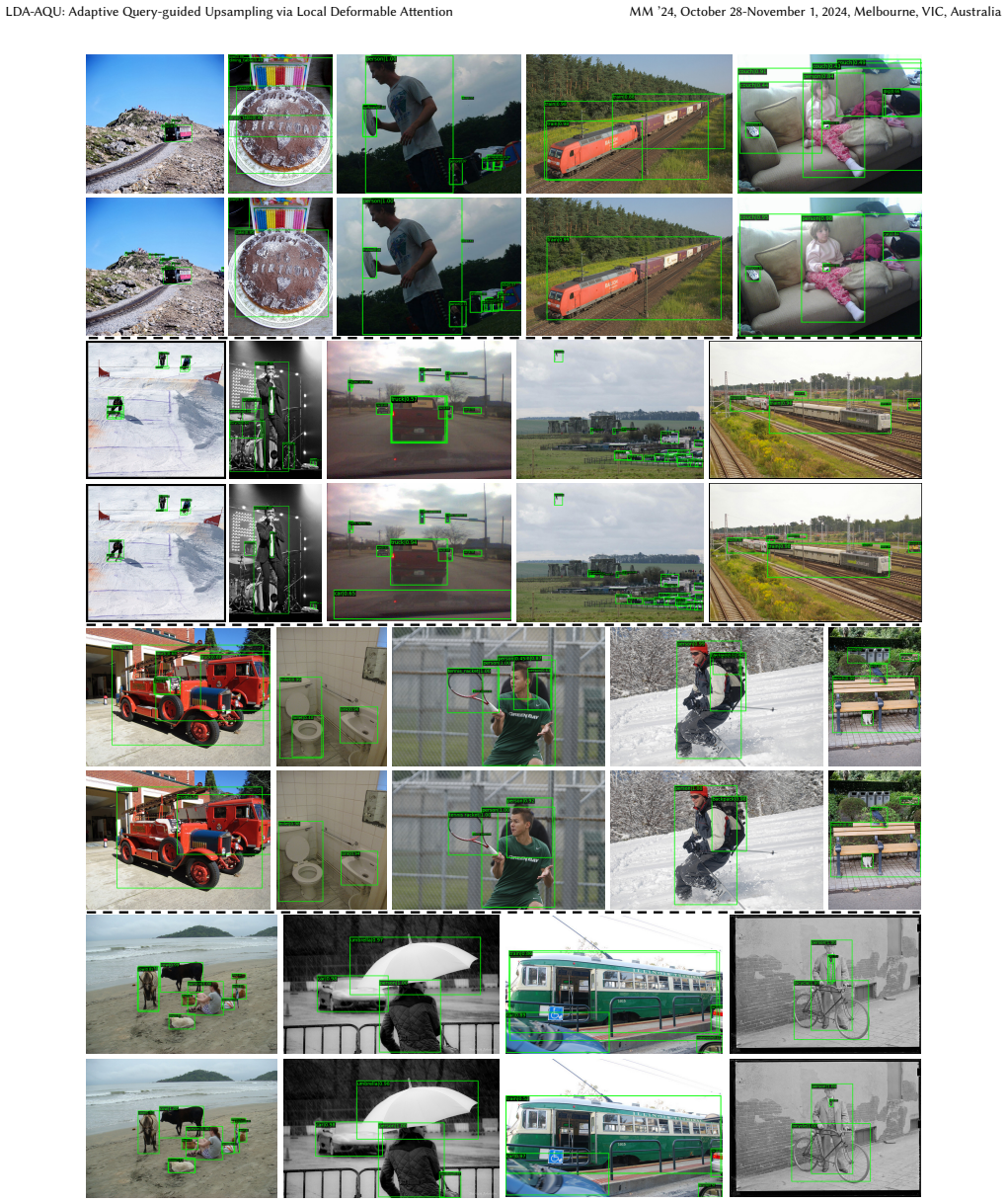
- The learned deformation lets neighboring points track object boundaries and ignore occluders, which the paper's visualizations show and which is consistent with the larger gains on segmentation tasks.
- LDA-AQU adds roughly 0.2M parameters and about 1.7G FLOPs in the largest tested setting, making it a practical drop-in replacement.
Reading between the lines
- The paper's own ablations indicate that the deformation range theta, not the attention weights, is the main driver of the gains; a natural test is to freeze the offsets to zero and measure how much of the margin over plain LA-AQU remains.
- If the unification view is correct, its practical significance may be architectural: instead of inventing new upsamplers, future work could tune the query-guidance and deformation components of one attention-based operator, a direction the paper leaves implicit.
- The margins over the strongest competitor DySample are only 0.2 to 0.7 points, so the practical value depends on whether the advantage survives retuning and multiple seeds; the paper does not report variance or seed statistics.
- A testable extension is applying LDA-AQU to image restoration and inpainting, which the paper lists as future work, where deformation may help or hurt depending on whether object boundaries are well defined.
Editorial analysis
A structured set of objections, weighed in public.
Referee Report
Summary. The paper proposes LDA-AQU, a learnable feature upsampling operator that extends local self-attention with query-guided deformable neighbor sampling. The method is evaluated by swapping the upsampler in FPN, mask heads, and semantic decoder of Faster R-CNN, Mask R-CNN, Panoptic FPN, and UperNet on COCO, ADE20K, and VOC. The authors report gains over the nearest/bilinear baseline of 1.7 AP, 1.5 AP, 2.0 PQ, and 2.5 mIoU, and smaller but consistent gains over DySample, together with low added parameters and FLOPs. The paper also claims that many existing upsamplers can be regarded as special cases of a local-self-attention upsampler.
Significance. If the reported results are reliable, LDA-AQU would be a practically useful drop-in upsampler: it improves detection and segmentation by modest but consistent margins over the previous state of the art at negligible parameter cost, and the authors provide code and standard-benchmark comparisons. The main value is empirical rather than theoretical; the 'special cases' discussion is suggestive but not a formal contribution. The decisive issue is whether the claimed margins are real or are an artifact of hyperparameter selection on the same test sets.
major comments (3)
- [§4.1, §4.6, Appendix C] The central claim of consistent improvement over DySample is not supported by the experimental protocol as reported. The decisive margins in Tables 1–4 (0.2–0.7 points over DySample) are the same size as the hyperparameter sensitivity in the paper's own ablations: in Table 5, changing only the deformation range θ in FPN moves Faster R-CNN AP from 38.7 (θ=5) to 39.2 (θ=11), exactly the reported gain over DySample; in Table 8, changing the channel reduction factor from 16 to 2 moves AP from 38.9 to 39.4; in Table 7, moving from 1 to 2 offset groups moves AP from 38.9 to 39.2; and Appendix C selects θ=19 on the VOC test split after a sweep shown in Figure 7. No held-out validation split is described and every table reports a single seed. With no error bars, the 0.2–0.7 point advantages over DySample cannot be distinguished from selection noise. The authors should provide multiple-seed results with means and variances, use a separate validation split for all hyperparameter choices, or substantially temper the 'consistently outperforms' claim.
- [§3.3] The statement that 'LDA-AQU avoids using the PixelShuffle operator, in contrast to CARAFE and DySample' is inaccurate for DySample: the DySample approach cited as [25] performs upsampling by learning sampling points and uses bilinear grid sampling (grid_sample), not PixelShuffle. This mischaracterization matters because the paper uses the absence of PixelShuffle to claim architectural flexibility ('any desired multiple of feature upsampling'); for the cited DySample method that limitation is not present. Please correct the comparison and restate the flexibility claim.
- [§3.3, Eqs. (8)–(15)] The assertion that 'the majority of existing upsamplers can be regarded as special cases of upsamplers based on local self-attention' is not demonstrated. For bilinear interpolation, the text says that LA-AQU degrades to bilinear 'when the aggregate weight of points ... equals zero' and when 'the computation results are based on distance'; however, Eq. (8) has no mechanism for zeroing individual neighbor weights, and softmax weights of the form exp(Q(p')·K(s))/Σ are not shown to be able to reproduce the distance kernel w(x',s_x)w(y',s_y) for every query. A formal construction of W_Q and W_K, or a stated set of conditions under which the equivalence holds, is needed to support the 'special cases' claim that appears in the abstract and introduction.
minor comments (4)
- [§3.1.2, Eq. (5)] Equation (5) uses \tilde{v}_i on the right-hand side, but the summation is over neighborhood indices j; this appears to be a typo for \tilde{v}_j.
- [§3.2.2, Eq. (11)] Equation (11) writes R' = R + ζ(Q), but Q has shape H×W×C while ΔR has shape αH×αW×k_u²×2; the offset predictor should be applied to the upsampled query features Q', matching the architecture description and Figure 4.
- [Throughout] There are several typos that should be corrected in a revision: 'predcition' in the introduction, 'funcion' in §3.1.2, 'alyer' in §3.3, and 'featrues' in §4.7.
- [Figure 1] The text labels in Figure 1 appear as raw Unicode escape sequences in the provided manuscript; the final rendered figure should be checked for readable labels.
Circularity Check
No significant circularity: LDA-AQU is an empirically evaluated architecture whose gains are measured against external benchmarks, and the 'special cases' discussion is a post-hoc mathematical comparison rather than a self-referential derivation.
full rationale
The paper derives no predicted quantity from its own inputs by construction. LDA-AQU is defined by explicit equations (Eqs. 6-13) for query-guided deformable local attention, and its reported gains (1.7 AP, 1.5 AP, 2.0 PQ, 2.5 mIoU) are measured on external benchmarks (MS COCO, ADE20K, Pascal VOC) against published upsamplers such as CARAFE, DySample, FADE, and SAPA. The Section 3.3 claim that bilinear and nearest-neighbor interpolation are special cases of LA-AQU is a mathematical comparison of weighting schemes, not a circular derivation of the empirical results. The choice of hyperparameters (theta, offset groups, channel reduction factor) is disclosed via ablations in Section 4.6 and Appendix C; tuning such choices on the evaluation benchmark is a statistical robustness concern, not a definitional equivalence between input and output. There are no load-bearing self-citations: the reference list contains no author-overlapping prior work invoked to justify the core claim, no uniqueness theorem is imported, and no fitted parameter is renamed as a prediction. The skeptical concern that reported margins are comparable to internal hyperparameter sensitivity is a legitimate correctness/overfitting risk, but under the stated rubric it is not circularity.
Assumptions & free parameters
free parameters (4)
- local deformation range theta =
11 (FPN), 5 (mask head), 19 (VOC)
- offset groups =
2
- channel size reduction factor =
4
- kernel sizes k_e, k_u =
3
assumptions (3)
- domain assumption Local self-attention with query guidance is an appropriate inductive bias for feature upsampling.
- standard math Bilinear sampling is differentiable and adequate for sampling features at non-integer coordinates.
- domain assumption The semantic gap between upsampled points and fixed uniform neighbors is best handled by predicting per-query deformation offsets.
Cite this review
Pith. "Pith review of LDA-AQU: Adaptive Query-guided Upsampling via Local Deformable Attention." pith.science (2026). https://pith.science/paper/XV4437M7
@misc{pith2026241119585,
  author       = {Pith},
  title        = {Pith review of: LDA-AQU: Adaptive Query-guided Upsampling via Local Deformable Attention},
  year         = {2026},
  howpublished = {\url{https://pith.science/paper/XV4437M7}},
  note         = {Machine review of arXiv:2411.19585}
}
read the original abstract
Feature upsampling is an essential operation in constructing deep convolutional neural networks. However, existing upsamplers either lack specific feature guidance or necessitate the utilization of high-resolution feature maps, resulting in a loss of performance and flexibility. In this paper, we find that the local self-attention naturally has the feature guidance capability, and its computational paradigm aligns closely with the essence of feature upsampling (\ie feature reassembly of neighboring points). Therefore, we introduce local self-attention into the upsampling task and demonstrate that the majority of existing upsamplers can be regarded as special cases of upsamplers based on local self-attention. Considering the potential semantic gap between upsampled points and their neighboring points, we further introduce the deformation mechanism into the upsampler based on local self-attention, thereby proposing LDA-AQU. As a novel dynamic kernel-based upsampler, LDA-AQU utilizes the feature of queries to guide the model in adaptively adjusting the position and aggregation weight of neighboring points, thereby meeting the upsampling requirements across various complex scenarios. In addition, LDA-AQU is lightweight and can be easily integrated into various model architectures. We evaluate the effectiveness of LDA-AQU across four dense prediction tasks: object detection, instance segmentation, panoptic segmentation, and semantic segmentation. LDA-AQU consistently outperforms previous state-of-the-art upsamplers, achieving performance enhancements of 1.7 AP, 1.5 AP, 2.0 PQ, and 2.5 mIoU compared to the baseline models in the aforementioned four tasks, respectively. Code is available at \url{https://github.com/duzw9311/LDA-AQU}.
Figures


Figures from the paper (9 more)




Reference graph
Works this paper leans on
-
[25]
Wenze Liu, Hao Lu, Hongtao Fu, and Zhiguo Cao. 2023. Learning to Upsample by Learning to Sample. In Proceedings of the IEEE/CVF International Conference on Computer Vision. 6027–6037
work page 2023
-
[1]
Daniel Bolya, Chong Zhou, Fanyi Xiao, and Yong Jae Lee. 2019. Yolact: Real-time instance segmentation. In Proceedings of the IEEE/CVF International Conference on Computer Vision. 9157–9166
work page 2019
-
[2]
Kai Chen, Jiangmiao Pang, Jiaqi Wang, Yu Xiong, Xiaoxiao Li, Shuyang Sun, Wansen Feng, Ziwei Liu, Jianping Shi, Wanli Ouyang, et al. 2019. Hybrid task cascade for instance segmentation. In Proceedings of the IEEE/CVF Conference on Computer Vision and Pattern Recognition . 4974–4983
work page 2019
-
[3]
Kai Chen, Jiaqi Wang, Jiangmiao Pang, Yuhang Cao, Yu Xiong, Xiaoxiao Li, Shuyang Sun, Wansen Feng, Ziwei Liu, Jiarui Xu, et al. 2019. MMDetection: Open mmlab detection toolbox and benchmark. arXiv preprint arXiv:1906.07155 (2019)
arXiv 2019
-
[4]
Yinpeng Chen, Xiyang Dai, Mengchen Liu, Dongdong Chen, Lu Yuan, and Zicheng Liu. 2020. Dynamic convolution: Attention over convolution kernels. In Proceedings of the IEEE/CVF Conference on Computer Vision and Pattern Recogni- tion. 11030–11039
2020
-
[5]
Bowen Cheng, Alex Schwing, and Alexander Kirillov. 2021. Per-pixel classi- fication is not all you need for semantic segmentation. Advances in Neural Information Processing Systems 34 (2021), 17864–17875
work page 2021
-
[6]
MMSegmentation Contributors. 2020. MMSegmentation: Openmmlab semantic segmentation toolbox and benchmark
2020
-
[7]
Yutong Dai, Hao Lu, and Chunhua Shen. 2021. Learning affinity-aware up- sampling for deep image matting. In Proceedings of the IEEE/CVF Conference on Computer Vision and Pattern Recognition . 6841–6850
work page 2021
Show all 48 references
-
[8]
Xiaoyi Dong, Jianmin Bao, Dongdong Chen, Weiming Zhang, Nenghai Yu, Lu Yuan, Dong Chen, and Baining Guo. 2022. Cswin transformer: A general vision transformer backbone with cross-shaped windows. InProceedings of the IEEE/CVF Conference on Computer Vision and Pattern Recognitio...
2022
-
[9]
Alexey Dosovitskiy, Lucas Beyer, Alexander Kolesnikov, Dirk Weissenborn, Xi- aohua Zhai, Thomas Unterthiner, Mostafa Dehghani, Matthias Minderer, Georg Heigold, Sylvain Gelly, et al. 2020. An image is worth 16x16 words: Transformers for image recognition at scale. arXiv prepri...
2020 arXiv
-
[10]
Mark Everingham, Luc Van Gool, Christopher KI Williams, John Winn, and Andrew Zisserman. 2010. The pascal visual object classes (voc) challenge. Inter- national Journal of Computer Vision 88 (2010), 303–338
2010
-
[11]
Yuxin Fang, Shusheng Yang, Xinggang Wang, Yu Li, Chen Fang, Ying Shan, Bin Feng, and Wenyu Liu. 2021. Instances as queries. In Proceedings of the IEEE/CVF International Conference on Computer Vision . 6910–6919
2021
-
[12]
Golnaz Ghiasi, Tsung-Yi Lin, and Quoc V Le. 2019. Nas-fpn: Learning scalable feature pyramid architecture for object detection. In Proceedings of the IEEE/CVF Conference on Computer Vision and Pattern Recognition . 7036–7045
2019
-
[13]
Ross Girshick. 2015. Fast r-cnn. In Proceedings of the IEEE/CVF International Conference on Computer Vision . 1440–1448
2015
-
[14]
Priya Goyal, Piotr Dollár, Ross Girshick, Pieter Noordhuis, Lukasz Wesolowski, Aapo Kyrola, Andrew Tulloch, Yangqing Jia, and Kaiming He. 2017. Accurate, large minibatch sgd: Training imagenet in 1 hour.arXiv preprint arXiv:1706.02677 (2017)
2017 arXiv
-
[15]
Kaiming He, Georgia Gkioxari, Piotr Dollár, and Ross Girshick. 2017. Mask r-cnn. In Proceedings of the IEEE/CVF International Conference on Computer Vision . 2961–2969
2017
-
[16]
Kaiming He, Xiangyu Zhang, Shaoqing Ren, and Jian Sun. 2016. Deep residual learning for image recognition. In Proceedings of the IEEE/CVF Conference on Computer Vision and Pattern Recognition . 770–778
2016
-
[17]
Andrew G Howard, Menglong Zhu, Bo Chen, Dmitry Kalenichenko, Weijun Wang, Tobias Weyand, Marco Andreetto, and Hartwig Adam. 2017. Mobilenets: Efficient convolutional neural networks for mobile vision applications. arXiv preprint arXiv:1704.04861 (2017)
2017 arXiv
-
[18]
Alexander Kirillov, Ross Girshick, Kaiming He, and Piotr Dollár. 2019. Panoptic feature pyramid networks. InProceedings of the IEEE/CVF Conference on Computer Vision and Pattern Recognition . 6399–6408
2019
-
[19]
Alexander Kirillov, Kaiming He, Ross Girshick, Carsten Rother, and Piotr Dollár
-
[20]
Xiang Li, Wenhai Wang, Lijun Wu, Shuo Chen, Xiaolin Hu, Jun Li, Jinhui Tang, and Jian Yang. 2020. Generalized focal loss: Learning qualified and distributed bounding boxes for dense object detection. Advances in Neural Information Processing Systems 33 (2020), 21002–21012
2020
-
[21]
Yanwei Li, Hengshuang Zhao, Xiaojuan Qi, Liwei Wang, Zeming Li, Jian Sun, and Jiaya Jia. 2021. Fully convolutional networks for panoptic segmentation. In Proceedings of the IEEE/CVF Conference on Computer Vision and Pattern Recognition. 214–223
2021
-
[22]
Tsung-Yi Lin, Piotr Dollár, Ross Girshick, Kaiming He, Bharath Hariharan, and Serge Belongie. 2017. Feature pyramid networks for object detection. In Pro- ceedings of the IEEE/CVF Conference on Computer Vision and Pattern Recognition . 2117–2125
2017
-
[23]
Tsung-Yi Lin, Michael Maire, Serge Belongie, James Hays, Pietro Perona, Deva Ramanan, Piotr Dollár, and C Lawrence Zitnick. 2014. Microsoft coco: Common objects in context. In European Conference on Computer Vision . 740–755
2014
-
[24]
Shu Liu, Lu Qi, Haifang Qin, Jianping Shi, and Jiaya Jia. 2018. Path aggregation network for instance segmentation. In Proceedings of the IEEE/CVF Conference on Computer Vision and Pattern Recognition . 8759–8768
2018
-
[26]
Ze Liu, Yutong Lin, Yue Cao, Han Hu, Yixuan Wei, Zheng Zhang, Stephen Lin, and Baining Guo. 2021. Swin transformer: Hierarchical vision transformer using shifted windows. In Proceedings of the IEEE/CVF International Conference on Computer Vision. 10012–10022
2021
-
[27]
Jonathan Long, Evan Shelhamer, and Trevor Darrell. 2015. Fully convolutional networks for semantic segmentation. In Proceedings of the IEEE/CVF Conference on Computer Vision and Pattern Recognition . 3431–3440
2015
-
[28]
Hao Lu, Yutong Dai, Chunhua Shen, and Songcen Xu. 2019. Indices matter: Learn- ing to index for deep image matting. In Proceedings of the IEEE/CVF International Conference on Computer Vision . 3266–3275
2019
-
[29]
Hao Lu, Wenze Liu, Hongtao Fu, and Zhiguo Cao. 2022. FADE: Fusing the assets of decoder and encoder for task-agnostic upsampling. In European Conference on Computer Vision. Springer, 231–247
2022
-
[30]
Hao Lu, Wenze Liu, Zixuan Ye, Hongtao Fu, Yuliang Liu, and Zhiguo Cao. 2022. SAPA: Similarity-aware point affiliation for feature upsampling. Advances in Neural Information Processing Systems 35 (2022), 20889–20901
2022
-
[31]
Xuran Pan, Tianzhu Ye, Zhuofan Xia, Shiji Song, and Gao Huang. 2023. Slide- transformer: Hierarchical vision transformer with local self-attention. In Pro- ceedings of the IEEE/CVF Conference on Computer Vision and Pattern Recognition . 2082–2091
2023
-
[32]
Adam Paszke, Sam Gross, Soumith Chintala, Gregory Chanan, Edward Yang, Zachary DeVito, Zeming Lin, Alban Desmaison, Luca Antiga, and Adam Lerer
-
[33]
Prajit Ramachandran, Niki Parmar, Ashish Vaswani, Irwan Bello, Anselm Lev- skaya, and Jon Shlens. 2019. Stand-alone self-attention in vision models.Advances in Neural Information Processing Systems 32 (2019)
2019
-
[34]
Joseph Redmon, Santosh Divvala, Ross Girshick, and Ali Farhadi. 2016. You only look once: Unified, real-time object detection. In Proceedings of the IEEE/CVF Conference on Computer Vision and Pattern Recognition . 779–788
2016
-
[35]
Shaoqing Ren, Kaiming He, Ross Girshick, and Jian Sun. 2015. Faster r-cnn: Towards real-time object detection with region proposal networks. Advances in Neural Information Processing Systems 28 (2015)
2015
-
[36]
Wenzhe Shi, Jose Caballero, Ferenc Huszár, Johannes Totz, Andrew P Aitken, Rob Bishop, Daniel Rueckert, and Zehan Wang. 2016. Real-time single image and video super-resolution using an efficient sub-pixel convolutional neural network. In Proceedings of the IEEE/CVF Conference ...
2016
-
[37]
Karen Simonyan and Andrew Zisserman. 2014. Very deep convolutional networks for large-scale image recognition. arXiv preprint arXiv:1409.1556 (2014)
2014 arXiv
-
[38]
Ashish Vaswani, Prajit Ramachandran, Aravind Srinivas, Niki Parmar, Blake Hechtman, and Jonathon Shlens. 2021. Scaling local self-attention for parameter efficient visual backbones. In Proceedings of the IEEE/CVF Conference on Computer Vision and Pattern Recognition . 12894–12904
2021
-
[39]
Chien-Yao Wang, Alexey Bochkovskiy, and Hong-Yuan Mark Liao. 2023. YOLOv7: Trainable bag-of-freebies sets new state-of-the-art for real-time object detectors. In Proceedings of the IEEE/CVF Conference on Computer Vision and Pattern Recog- nition. 7464–7475
2023
-
[40]
Jiaqi Wang, Kai Chen, Rui Xu, Ziwei Liu, Chen Change Loy, and Dahua Lin. 2019. Carafe: Content-aware reassembly of features. In Proceedings of the IEEE/CVF International Conference on Computer Vision . 3007–3016
2019
-
[41]
Tete Xiao, Yingcheng Liu, Bolei Zhou, Yuning Jiang, and Jian Sun. 2018. Unified perceptual parsing for scene understanding. In European Conference on Computer Vision. 418–434
2018
-
[42]
Enze Xie, Wenhai Wang, Zhiding Yu, Anima Anandkumar, Jose M Alvarez, and Ping Luo. 2021. SegFormer: Simple and efficient design for semantic segmentation with transformers. Advances in Neural Information Processing Systems 34 (2021), 12077–12090
2021
-
[43]
Yikang Zhang, Jian Zhang, Qiang Wang, and Zhao Zhong. 2020. Dynet: Dynamic convolution for accelerating convolutional neural networks. arXiv preprint arXiv:2004.10694 (2020)
2020 arXiv
-
[44]
Hengshuang Zhao, Jiaya Jia, and Vladlen Koltun. 2020. Exploring self-attention for image recognition. In Proceedings of the IEEE/CVF Conference on Computer Vision and Pattern Recognition . 10076–10085
2020
-
[45]
Bolei Zhou, Hang Zhao, Xavier Puig, Sanja Fidler, Adela Barriuso, and Antonio Torralba. 2017. Scene parsing through ade20k dataset. In Proceedings of the IEEE/CVF Conference on Computer Vision and Pattern Recognition . 633–641
2017
-
[46]
Jingkai Zhou, Varun Jampani, Zhixiong Pi, Qiong Liu, and Ming-Hsuan Yang. 2021. Decoupled dynamic filter networks. In Proceedings of the IEEE/CVF Conference on Computer Vision and Pattern Recognition . 6647–6656. MM ’24, October 28-November 1, 2024, Melbourne, VIC, Australia Z...
2021
-
[2017]
Automatic differentiation in pytorch. (2017)
2017
-
[2019]
In Proceedings of the IEEE/CVF Conference on Computer Vision and Pattern Recognition
Panoptic segmentation. In Proceedings of the IEEE/CVF Conference on Computer Vision and Pattern Recognition . 9404–9413
Reviewed August 12, 2026 · model on record in the stance chip above.
Discussion (0). Continue with ORCID to comment.