REVIEW 4 major objections 6 minor 118 references
Materials Learning Algorithms (MALA): Scalable Machine Learning for Electronic Structure Calculations in Large-Scale Atomistic Simulations
T0 review · 4 major / 6 minor · reviewed 2026-08-12 · deepseek-v4-flash
Pith's one-line read A network trained on a few hundred atoms predicts electronic structure for a 131,072-atom beryllium slab at near-chemical accuracy and linearly scaling cost.
desk verdict Solid package paper with a genuinely new boron demo; the 131k-atom stacking-fault slab is a compelling demo but lacks validation at DFT scale and deserves referee scrutiny. read the letter →
The pith
A machine-rendered reading of the paper's core claim, the machinery that carries it, and where it could break.
The reading
What carries the argument
The central object is the local density of states $d(r, \epsilon) = \sum_j |\psi_j(r)|^2 \delta(\epsilon - \epsilon_j)$, which encodes the full electronic structure at each real-space grid point and integrates over energy to yield the electronic density and over space to yield the density of states. The machine learning model maps bispectrum descriptors, rotation-invariant encodings of the ionic environment within a cutoff radius around each grid point, to the LDOS at that point. The physical justification for using a finite local description is the nearsightedness of electronic matter. All downstream observables, including band energy, electronic entropy, and total free energy, are computed by analytically integrating the predicted LDOS, with the Fermi energy determined self-consistently by root-finding on the electron count.
What would settle it
Take a metallic system with a charged defect or a bare surface, where long-range electronic effects are expected to matter, and run a MALA model trained with the same descriptor cutoffs used for beryllium; compare the predicted LDOS and total free energy against a DFT reference on a mid-size cell of a few hundred atoms. If the error exceeds the paper's 10 meV/atom threshold once the defect or surface is introduced, the nearsightedness assumption fails for the large-scale application.
Extended reading notes
Core claim
The paper claims that a feed-forward neural network, trained on the local density of states (LDOS) of only a few hundred atoms, transfers unchanged to systems hundreds of times larger. The key design is learning the LDOS rather than the electronic density, because every observable is derived from the predicted LDOS by quadrature over energy and space. The claim is supported by three demonstration cases: beryllium from 256-atom training cells to 2,048 atoms with total free energy errors below 10 meV/atom and density mean absolute percentage errors below 1%; aluminum across the solid-liquid phase boundary, where the phase gap of roughly 95 meV/atom is easily resolved; and the 131,072-atom beryllium slab with a stacking fault, whose per-atom free energy reproduces the expected $N^{-1/3}$ scaling behavior. The paper explicitly states that DFT reference data at the 131,072-atom scale is unavailable, so the large-scale energetics are validated qualitatively against dimensional analysis and an interatomic potential.
Load-bearing premise
The entire transfer from small training cells to the 131,072-atom slab rests on the assumption that the LDOS at a grid point depends only on the ionic environment inside the finite descriptor cutoff radius, so no long-range electronic effect such as metallic screening or charged defects contributes significantly at that point.
Editorial extensions
If this is right
- If the central claim is correct, electronic structure calculations become feasible for systems of hundreds of thousands of atoms at near-DFT accuracy, with a cost that grows linearly in the number of atoms.
- For defect systems such as stacking faults, the model reproduces the expected $N^{-1/3}$ total-energy scaling, meaning defect energetics in large systems could be computed without a full DFT treatment of the whole cell.
- Because all derived properties come from a single learned quantity, the LDOS, predictions of density, DOS, band energy, and free energy remain mutually consistent by construction.
- Training costs are on the order of a few to tens of GPU hours, shifting the practical bottleneck to DFT data generation, which the authors note can take several days of wall time per snapshot.
- The demonstrated transferability across length scale, temperature, and the solid-liquid phase boundary implies that a single MALA model can cover a wide region of configuration space for a given element.
Reading between the lines
- A natural extension would be to test whether the nearsightedness assumption holds for systems with charged defects, surfaces, or strong long-range screening, where the LDOS at a point might depend on the environment beyond the descriptor cutoff; the paper does not provide such a convergence study for the stacking-fault system.
- Because the LDOS is precisely the quantity measured in scanning tunneling microscopy, the method suggests a direct route to generate STM images for extended systems, which the authors name as a future application.
- The paper describes atomic cluster expansion descriptors as a richer alternative to the bispectrum descriptors used in the current benchmarks, so testing transferability across multiple chemical species in alloys would be a natural next step.
Editorial analysis
A structured set of objections, weighed in public.
Referee Report
Summary. The paper describes the Materials Learning Algorithms (MALA) package, a machine-learning framework that predicts the local density of states (LDOS) from local atomic descriptors and derives electronic density, DOS, band energy, and total free energy via an exact reformulation of Kohn-Sham DFT. It presents the theoretical basis, software architecture, data-generation and training workflows, and three numerical demonstrations: a boron tutorial example, aluminum transferability across the solid-liquid phase boundary and across temperatures, and beryllium transferability from a 256-atom training cell to systems up to a 131,072-atom slab containing a stacking fault. It also reports scaling benchmarks showing linear inference cost growth, strong-scaling bottlenecks in the observable-calculation step, and weak-scaling efficiency around 0.6-0.7.
Significance. If the transferability claims hold, this is a significant software contribution: the LDOS-to-energy route is an exact reformulation rather than a fitted identity, the package is open source and reproducible, and the 131,072-atom beryllium demonstration would be an electronic-structure prediction at a scale inaccessible to standard DFT. The paper is also careful in several respects: it distinguishes discretization errors from machine-learning errors, provides uncertainty across network initializations, and openly states that no DFT reference exists for the largest system. The strength of the numerical evidence for the smaller beryllium and aluminum benchmarks supports the package's practical value. However, the headline large-scale demonstration and the boron model-selection procedure need additional validation or reframing before the central claims can be fully accepted.
major comments (4)
- [Sec. 5.1.1, Fig. 15] The 131,072-atom beryllium stacking-fault result, presented as the headline demonstration, has no DFT reference and no test of the locality assumption at the surfaces or fault region. The text itself states that "DFT reference data is not available for this large system," and the only quantitative check is an N_i^{-1/3} energy trend compared against an empirical EAM potential. Since the training set contains only bulk 256-atom hcp configurations, the free surfaces and the stacking-fault environment are out-of-distribution descriptor states; nearsightedness alone does not guarantee that the learned mapping is correct there. Please add a DFT reference for a smaller slab containing the same surfaces and stacking fault, or explicitly restrict the claim to feasibility and qualitative trend prediction.
- [Sec. 4.2, Fig. 9] The boron model is selected from five trained initializations using the test set: the text says "model #1 is chosen" based on both low MAE and low MaxAE in Fig. 9, which plots test-set errors. This selection makes the subsequently reported inference errors in Figs. 10-12 optimistic relative to true out-of-sample performance. If test-set-based selection is retained, the selection bias should be explicitly acknowledged and ideally accompanied by test-set statistics for all five models or selection on the validation snapshot.
- [Sec. 5.2, Fig. 20, Tables 3-4] The claim that "MALA inferences not only scale linearly" is not directly established by Fig. 20, because both the computational resources and the grid resolution change with system size: the number of GPUs rises from 4 to 30 and grid points per atom drops from 4860 to 2298 at 131,072 atoms (Tables 3 and 4). A constant-resource or constant-grid-points-per-atom scaling curve, or an explicit statement that the observed trend is a weak-scaling efficiency result, is needed before the linear-scaling cost claim can be accepted as demonstrated.
- [Secs. 5.1.1 and 5.2] The paper does not report a convergence test of the bispectrum descriptor cutoff Rcutoff for the slab geometry. Because the slab contains atomic environments far from the training bulk distribution, such a test in a smaller slab or a surface-containing cell is needed to check that the finite descriptor range is sufficient and that the learned descriptor-to-LDOS mapping generalizes to the fault and surface environments.
minor comments (6)
- [Sec. 2.2, Eq. (10)] There is a typo: "Eii the the ion-ion interaction" should read "Eii the ion-ion interaction."
- [Sec. 3.6] The sentence "Usually on the order of 100 to 10 1" is garbled; it should presumably read "100 to 10^1" or "100 to 1,000."
- [Table 2] The beryllium 256-atom room-temperature model entry appears twice in the table.
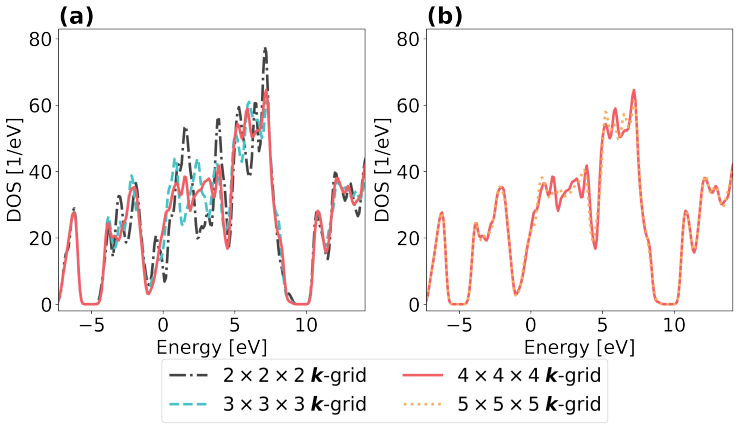
- [Sec. 4.1.2] The phrase "The analysis shows that a that a k-grid" contains a repeated word and should be corrected.
- [Fig. 15 caption] The caption writes "Ni − 13 fit"; this should be "N_i^{-1/3} fit."
- [Sec. 3.2.2, Eq. (24)] The notation for r' = p - r and the argument of the delta function delta(R_alpha - r') is confusing; please clarify how the auxiliary grid p is used in the descriptor evaluation.
Circularity Check
No circularity: the MALA workflow fits descriptors to DFT-computed LDOS and validates on held-out snapshots; the 131k-atom slab is an explicitly unvalidated extrapolation, not a circular step.
full rationale
The paper's derivation chain is a supervised regression: bispectrum/ACE descriptors at each grid point are trained against DFT LDOS and then evaluated on held-out configurations (Secs. 4.2-4.3, 5.1.2, 5.1.3). Derived observables are obtained from the predicted LDOS via exact integral identities (Eqs. 12-15 and 35-39), including the reformulated total energy E = Eb - EH + EXC - VXC + Eii, which is mathematically equivalent to Eq. (10) and is not an equality manufactured by fitted constants. The Fermi level is determined by imposing the known electron count Ne (Eqs. 38-39), an external constraint rather than a fitted prediction. Transfer tests against DFT for 512-2048 atom beryllium systems (Fig. 14) and aluminum across the phase boundary and temperature range are independent benchmark evidence. The only self-citations supply hyperparameters and prior datasets (Refs. 23, 37, 48, 52, 53), but the present paper's central benchmarks are newly evaluated and do not reduce to those citations. The 131,072-atom stacking-fault slab is explicitly not compared to DFT: 'Although DFT reference data is not available for this large system, we can still assess the qualitative accuracy of the energetics by examining the energy trends' (Sec. 5.1.1). That is a limitation in transferability validation (surfaces and the fault are out-of-distribution environments) and a correctness risk, but not a circularity, because no predicted quantity is equal to its training input by construction.
Assumptions & free parameters
free parameters (4)
- Neural network weights and biases =
trained on DFT snapshots
- Bispectrum descriptor hyperparameters Jmax and rcutfac =
Jmax=10, rcutfac=4.67637
- LDOS Gaussian smearing width wd =
wd=2*delta_epsilon=0.2 eV
- Gaussian descriptor width wG =
set by grid spacing to minimize aliasing
assumptions (5)
- domain assumption Born-Oppenheimer approximation separates ionic and electronic degrees of freedom
- domain assumption Kohn-Sham DFT and Hohenberg-Kohn theorems establish the density and LDOS as determining quantities
- domain assumption Mermin finite-temperature DFT correctly describes the thermal electronic ensemble
- domain assumption Nearsightedness of electronic matter justifies local descriptors with finite cutoff
- domain assumption DFT reference data from VASP and Quantum ESPRESSO with PBE and pseudopotentials is accurate enough
Cite this review
Pith. "Pith review of Materials Learning Algorithms (MALA): Scalable Machine Learning for Electronic Structure Calculations in Large-Scale Atomistic Simulations." pith.science (2026). https://pith.science/paper/W6IRJEG6
@misc{pith2026241119617,
  author       = {Pith},
  title        = {Pith review of: Materials Learning Algorithms (MALA): Scalable Machine Learning for Electronic Structure Calculations in Large-Scale Atomistic Simulations},
  year         = {2026},
  howpublished = {\url{https://pith.science/paper/W6IRJEG6}},
  note         = {Machine review of arXiv:2411.19617}
}
read the original abstract
We present the Materials Learning Algorithms (MALA) package, a scalable machine learning framework designed to accelerate density functional theory (DFT) calculations suitable for large-scale atomistic simulations. Using local descriptors of the atomic environment, MALA models efficiently predict key electronic observables, including local density of states, electronic density, density of states, and total energy. The package integrates data sampling, model training and scalable inference into a unified library, while ensuring compatibility with standard DFT and molecular dynamics codes. We demonstrate MALA's capabilities with examples including boron clusters, aluminum across its solid-liquid phase boundary, and predicting the electronic structure of a stacking fault in a large beryllium slab. Scaling analyses reveal MALA's computational efficiency and identify bottlenecks for future optimization. With its ability to model electronic structures at scales far beyond standard DFT, MALA is well suited for modeling complex material systems, making it a versatile tool for advanced materials research.
Figures


Figures from the paper (23 more)




Reference graph
Works this paper leans on
-
[1]
P. Hohenberg, W. Kohn, Inhomogeneous electron gas, Phys. Rev. 136 (1964) B864–B871. doi:10.1103/PhysRev.136.B864
-
[2]
W. Kohn, L. J. Sham, Self-Consistent Equations Including Exchange and Correlation Effects, Phys. Rev. 140 (1965) A1133–A1138. doi: 10.1103/PhysRev.140.A1133
-
[3]
K. Burke, Perspective on density functional theory, The Jour- nal of Chemical Physics 136 (15) (2012) 150901. arXiv:https: //pubs.aip.org/aip/jcp/article-pdf/doi/10.1063/1.4704546/ 19858608/150901\_1\_1.4704546.pdf, doi:10.1063/1.4704546. URL https://doi.org/10.1063/1.4704546
-
[4]
H. Wei, J. A. McCammon, Structure and dynamics in drug dis- covery, npj Drug Discovery 1 (1) (Nov. 2024). doi:10.1038/ s44386-024-00001-2 . URL http://dx.doi.org/10.1038/s44386-024-00001-2
-
[5]
J. Tong, Y. Fu, D. Domaretskiy, F. Della Pia, P. Dagar, L. Powell, D. Bahamon, S. Huang, B. Xin, R. N. Costa Filho, L. F. Vega, I. V. Grigorieva, F. M. Peeters, A. Michaelides, M. Lozada-Hidalgo, Control of proton transport and hydrogenation in double-gated graphene, Na- ture 630 (8017) (2024) 619–624. doi:10.1038/s41586-024-07435-8 . URL http://dx.doi.or...
-
[6]
S. Hammes-Schiffer, Exploring proton-coupled electron transfer at mul- tiple scales, Nature Computational Science 3 (4) (2023) 291–300. doi:10.1038/s43588-023-00422-5 . URL http://dx.doi.org/10.1038/s43588-023-00422-5
-
[7]
J. M. Thomas, Heterogeneous catalysis: Enigmas, illusions, challenges, realities, and emergent strategies of design, The Journal of Chemical Physics 128 (18) (May 2008). doi:10.1063/1.2832309. URL http://dx.doi.org/10.1063/1.2832309
-
[8]
Z.-J. Zhao, S. Liu, S. Zha, D. Cheng, F. Studt, G. Henkelman, J. Gong, Theory-guided design of catalytic materials using scaling relationships 72 and reactivity descriptors, Nature Reviews Materials 4 (12) (2019) 792–
2019
Show all 118 references
-
[9]
Huang, J
Q. Huang, J. Wang, C. Li, J. Zhu, W. Wang, Y. Huang, Y. Zhang, H. Jiao, S. Zhang, H. Meng, M. Zhang, X. Wang, Intrinsically flexible all-carbon-nanotube electronics enabled by a hybrid organic–inorganic gate dielectric, npj Flexible Electronics 6 (1) (Jul. 2022). doi:10. 1038/...
2022 doi
-
[10]
Zhang, X
M. Zhang, X. Wang, J. Sun, Y. Tong, C. Zhang, H. Yu, S. Guo, X. Zhao, Q. Tang, Y. Liu, Synergistic polarization engineering of di- electric towards low-voltage high-mobility solution-processed ultraflex- ible organic transistors, npj Flexible Electronics 8 (1) (May 2024). doi:...
2024 doi
-
[11]
Cangi, S
A. Cangi, S. Rajamanickam, B. Brzoza, T. J. Callow, J. A. El- lis, O. Faruk, L. Fiedler, J. S. Fox, N. Hoffmann, K. D. Miller, D. Kotik, S. Kulkarni, N. A. Modine, P. Mohammed, V. Oles, G. A. Popoola, F. P¨ oschel, J. Romero, S. Schmerler, J. A. Stephens, H. Tah- masbi, A. P. ...
2024 doi
-
[12]
M. Born, R. Oppenheimer, Zur Quantentheorie der Molekeln, Ann. Phys. 389 (20) (1927) 457–484. doi:10.1002/andp.19273892002
1927 doi
-
[13]
J. C. Snyder, M. Rupp, K. Hansen, K.-R. M¨ uller, K. Burke, Finding Density Functionals with Machine Learning, Phys. Rev. Lett. 108 (25) (2012) 253002. doi:10.1103/PhysRevLett.108.253002
2012 doi
-
[14]
J. C. Snyder, M. Rupp, K.-R. M¨ uller, K. Burke, Nonlinear gradient de- noising: Finding accurate extrema from inaccurate functional deriva- tives, International Journal of Quantum Chemistry 115 (16) (2015) 1102–1114. doi:10.1002/qua.24937
2015 doi
-
[15]
Brockherde, L
F. Brockherde, L. Vogt, L. Li, M. E. Tuckerman, K. Burke, K.-R. M¨ uller, Bypassing the Kohn-Sham equations with machine learning, Nat. Commun. 8 (1) (2017) 872. doi:10.1038/s41467-017-00839-3 . 73
2017 doi
-
[16]
R. M. Dreizler, E. K. U. Gross, Density Functional Theory, Springer Berlin Heidelberg, 1990. doi:10.1007/978-3-642-86105-5 . URL http://dx.doi.org/10.1007/978-3-642-86105-5
1990 doi
-
[17]
Goodfellow, Y
I. Goodfellow, Y. Bengio, A. Courville, Deep Learning, 1st Edition, MIT Press, Cambridge MA, no ISBN available, 2016. URL http://www.deeplearningbook.org
2016
-
[18]
M. A. Nielsen, Neural networks and deep learning, 1st Edition, Deter- mination press, San Francisco CA, no ISBN available, 2019. URL http://neuralnetworksanddeeplearning.com/index.html
2019
-
[19]
D. E. Rumelhart, G. E. Hinton, R. J. Williams, Learning representa- tions by back-propagating errors, Nature 323 (6088) (1986) 533–536. doi:10.1038/323533a0. URL https://doi.org/10.1038/323533a0
1986 doi
-
[20]
A. G. Baydin, B. A. Pearlmutter, A. A. Radul, J. M. Siskind, Auto- matic differentiation in machine learning: A survey, Journal of Machine Learning Research 18 (153) (2018) 1–43. URL http://jmlr.org/papers/v18/17-468.html
2018
-
[21]
M. P. Deisenroth, A. A. Faisal, C. S. Ong, Mathematics for Machine Learning, Cambridge University Press, 2020
2020
-
[22]
Raina, A
R. Raina, A. Madhavan, A. Y. Ng, Large-Scale Deep Unsupervised Learning Using Graphics Processors, in: Proceedings of the 26th An- nual International Conference on Machine Learning, ICML, ACM, New York City NY, 2009, pp. 873–880. doi:10.1145/1553374.1553486
2009
-
[23]
Fiedler, N
L. Fiedler, N. Hoffmann, P. Mohammed, G. A. Popoola, T. Yovell, V. Oles, J. A. Ellis, S. Rajamanickam, A. Cangi, Training-free hy- perparameter optimization of neural networks for electronic struc- tures in matter, Mach. Learn.: Sci. Technol. 3 (4) (2022) 045008. doi:10.1088/2...
2022 doi
-
[24]
A. P. Thompson, H. M. Aktulga, R. Berger, D. S. Bolintineanu, W. M. Brown, P. S. Crozier, P. J. in ’t Veld, A. Kohlmeyer, S. G. Moore, T. D. Nguyen, R. Shan, M. J. Stevens, J. Tranchida, C. Trott, S. J. Plimpton, Lammps - a flexible simulation tool for 74 particle-based materi...
2022
-
[25]
Plimpton, Fast Parallel Algorithms for Short-Range Molecular Dy- namics, J
S. Plimpton, Fast Parallel Algorithms for Short-Range Molecular Dy- namics, J. Comput. Phys. 117 (1) (1995) 1–19. doi:10.1006/jcph. 1995.1039
1995
-
[26]
Paszke, S
A. Paszke, S. Gross, F. Massa, A. Lerer, J. Bradbury, G. Chanan, T. Killeen, Z. Lin, N. Gimelshein, L. Antiga, A. Desmaison, A. Kopf, E. Yang, Z. DeVito, M. Raison, A. Tejani, S. Chilamkurthy, B. Steiner, L. Fang, J. Bai, S. Chintala, PyTorch: An Imperative Style, High-Perform...
2019
-
[27]
Giannozzi, S
P. Giannozzi, S. Baroni, N. Bonini, M. Calandra, R. Car, C. Cavazzoni, D. Ceresoli, G. L. Chiarotti, M. Cococcioni, I. Dabo, et al., QUAN- TUM ESPRESSO: a modular and open-source software project for quantum simulations of materials, J. Phys.: Condens. Matter 21 (39) (2009) 39...
2009 doi
-
[28]
Giannozzi, O
P. Giannozzi, O. Andreussi, T. Brumme, O. Bunau, M. B. Nardelli, M. Calandra, R. Car, C. Cavazzoni, D. Ceresoli, M. Cococcioni, et al., Advanced capabilities for materials modelling with Quantum ESPRESSO, J. Phys. Condens. Matter 29 (46) (2017) 465901. doi: 10.1088/1361-648x/a...
2017 doi
-
[29]
Giannozzi, O
P. Giannozzi, O. Baseggio, P. Bonf` a, D. Brunato, R. Car, I. Carnimeo, C. Cavazzoni, S. De Gironcoli, P. Delugas, F. Ferrari Ruffino, et al., Quantum ESPRESSO toward the exascale, J. Chem. Phys. 152 (15) 75 (2020) 154105. doi:10.1063/5.0005082. URL http://aip.scitation.org/do...
2020 doi
-
[30]
Kresse, J
G. Kresse, J. Hafner, Ab initio molecular Dynamics for Liquid Metals, Phys. Rev. B 47 (1) (1993) 558–561. doi:10.1103/PhysRevB.47.558
1993 doi
-
[31]
Kresse, J
G. Kresse, J. Furthm¨ uller, Efficiency of ab-initio total energy calcu- lations for metals and semiconductors using a plane-wave basis set, Comput. Mater. Sci. 6 (1) (1996) 15–50. doi:10.1016/0927-0256(96) 00008-0
1996 doi
-
[32]
Kresse, J
G. Kresse, J. Furthm¨ uller, Efficient iterative schemes for ab initio total- energy calculations using a plane-wave basis set, Phys. Rev. B 54 (16) (1996) 11169–11186. doi:10.1103/PhysRevB.54.11169
1996 doi
-
[33]
C. R. Harris, K. J. Millman, S. J. van der Walt, R. Gommers, P. Vir- tanen, D. Cournapeau, E. Wieser, J. Taylor, S. Berg, N. J. Smith, R. Kern, M. Picus, S. Hoyer, M. H. van Kerkwijk, M. Brett, A. Haldane, J. F. del R ´ ıo, M. Wiebe, P. Peterson, P. G´ erard-Marchant, K. Shep-...
2020 doi
-
[34]
Virtanen, R
P. Virtanen, R. Gommers, T. E. Oliphant, M. Haberland, T. Reddy, D. Cournapeau, E. Burovski, P. Peterson, W. Weckesser, J. Bright, S. J. van der Walt, M. Brett, J. Wilson, K. J. Millman, N. Mayorov, A. R. J. Nelson, E. Jones, R. Kern, E. Larson, C. J. Carey, ˙I. Polat, Y. Feng...
2020
-
[35]
M. E. Tuckerman, G. J. Martyna, Understanding Modern Molecular Dynamics: Techniques and Applications, J. Phys. Chem. B 104 (2) (2000) 159–178. doi:10.1021/jp992433y. URL https://doi.org/10.1021/jp992433y 76
2000 doi
-
[36]
Fiedler, Z
L. Fiedler, Z. A. Moldabekov, X. Shao, K. Jiang, T. Dornheim, M. Pa- vanello, A. Cangi, Accelerating equilibration in first-principles molec- ular dynamics with orbital-free density functional theory, Phys. Rev. Res. 4 (2022) 043033. doi:10.1103/PhysRevResearch.4.043033. URL h...
2022 doi
-
[37]
Fiedler, Development and application of scalable density functional theory machine learning models (2024)
L. Fiedler, Development and application of scalable density functional theory machine learning models (2024). URL https://nbn-resolving.org/urn:nbn:de:bsz: 14-qucosa2-936753
2024
-
[38]
B. J. Alder, S. P. Frankel, V. A. Lewinson, Radial Distribution Function Calculated by the Monte-Carlo Method for a Hard Sphere Fluid, Chem. Phys. 23 (3) (1955) 417–419. doi:10.1063/1.1742004. URL https://doi.org/10.1063/1.1742004
1955 doi
-
[39]
K. Zahn, G. Maret, C. Ruß, H.-H. von Gr¨ unberg, Three-particle cor- relations in simple liquids, Phys. Rev. Lett. 91 (11) (2003) 115502. doi:10.1103/PhysRevLett.91.115502
2003 doi
-
[40]
Gottschalk, Calculation of pair and triplet correlation functions for a Lennard-Jones fluid at ρ∗ ≤1.41 and T ∗ ≤25, AIP Adv
M. Gottschalk, Calculation of pair and triplet correlation functions for a Lennard-Jones fluid at ρ∗ ≤1.41 and T ∗ ≤25, AIP Adv. 11 (4) (2021) 045026. doi:10.1063/5.0048450. URL https://doi.org/10.1063/5.0048450
2021 doi
-
[41]
A. P. Thompson, L. P. Swiler, C. R. Trott, S. M. Foiles, G. J. Tucker, Spectral Neighbor Analysis Method for Automated Genera- tion of Quantum-Accurate Interatomic Potentials, J. Comput. Phys. 285 (2015) 316–330. doi:10.1016/j.jcp.2014.12.018
2015 doi
-
[42]
M. A. Wood, A. P. Thompson, Extending the accuracy of the SNAP interatomic potential form, J. Chem. Phys 148 (24) (2018) 241721. doi:10.1063/1.5017641. URL http://aip.scitation.org/doi/10.1063/1.5017641
2018 doi
-
[43]
M. A. Wood, M. A. Cusentino, B. D. Wirth, A. P. Thompson, Data- driven material models for atomistic simulation, Phys. Rev. B 99 (2019) 184305. doi:10.1103/PhysRevB.99.184305. 77
2019 doi
-
[44]
M. A. Cusentino, M. A. Wood, A. P. Thompson, Explicit Multielement Extension of the Spectral Neighbor Analysis Potential for Chemically Complex Systems, J. Phys. Chem. A 124 (26) (2020) 5456–5464. doi: 10.1021/acs.jpca.0c02450. URL https://pubs.acs.org/doi/10.1021/acs.jpca.0c02450
2020 doi
-
[45]
Lysogorskiy, C
Y. Lysogorskiy, C. v. d. Oord, A. Bochkarev, S. Menon, M. Rinaldi, T. Hammerschmidt, M. Mrovec, A. Thompson, G. Cs´ anyi, C. Ort- ner, R. Drautz, Performant Implementation of the Atomic Cluster Ex- pansion (PACE) and Application to Copper and Silicon, npj Comput. Mater. 7 (1) ...
2021 doi
-
[46]
Drautz, Atomic Cluster Expansion for Accurate and Transferable Interatomic Potentials, Phys
R. Drautz, Atomic Cluster Expansion for Accurate and Transferable Interatomic Potentials, Phys. Rev. B 99 (1) (2019) 014104. doi:10. 1103/physrevb.99.014104
2019
-
[47]
Fiedler, K
L. Fiedler, K. Shah, M. Bussmann, A. Cangi, Deep dive into machine learning density functional theory for materi- als science and chemistry, Phys. Rev. Mater. 6 (2022) 040301. doi:10.1103/PhysRevMaterials.6.040301. URL https://link.aps.org/doi/10.1103/PhysRevMaterials.6. 040301
2022 doi
-
[48]
J. A. Ellis, L. Fiedler, G. A. Popoola, N. A. Modine, J. A. Stephens, A. P. Thompson, A. Cangi, S. Rajamanickam, Accelerating finite- temperature Kohn-Sham density functional theory with deep neural networks, Phys. Rev. B 104 (2021) 035120. doi:10.1103/PhysRevB. 104.035120. UR...
2021 doi
-
[49]
Musil, A
F. Musil, A. Grisafi, A. P. Bart´ ok, C. Ortner, G. Cs´ anyi, M. Ce- riotti, Physics-inspired structural representations for molecules and materials, Chemical Reviews 121 (16) (2021) 9759–9815, pMID: 34310133. arXiv:https://doi.org/10.1021/acs.chemrev.1c00021, doi:10.1021/acs....
2021 doi
-
[50]
Dusson, M
G. Dusson, M. Bachmayr, G. Cs´ anyi, R. Drautz, S. Etter, C. van Der Oord, C. Ortner, Atomic cluster expansion: Completeness, ef- 78 ficiency and stability, Journal of Computational Physics 454 (2022) 110946
2022
-
[51]
J. M. Goff, C. Sievers, M. A. Wood, A. P. Thompson, Permutation- adapted complete and independent basis for atomic cluster expansion descriptors, Journal of Computational Physics 510 (2024) 113073. doi:10.1016/j.jcp.2024.113073. URL https://www.sciencedirect.com/science/articl...
2024
-
[52]
Fiedler, N
L. Fiedler, N. A. Modine, K. D. Miller, A. Cangi, Machine learning the electronic structure of matter across temperatures, Phys. Rev. B 108 (2023) 125146. doi:10.1103/PhysRevB.108.125146. URL https://link.aps.org/doi/10.1103/PhysRevB.108.125146
2023 doi
-
[53]
Fiedler, N
L. Fiedler, N. A. Modine, S. Schmerler, D. J. Vogel, G. A. Popoola, A. P. Thompson, S. Rajamanickam, A. Cangi, Predicting electronic structures at any length scale with machine learning, arXiv preprint arXiv:2210.11343 (2022). URL https://www.doi.org/10.48550/ARXIV.2210.11343
- [54]
-
[55]
Hutter, J
F. Hutter, J. L¨ ucke, L. Schmidt-Thieme, Beyond Manual Tuning of Hyperparameters, KI - K¨ unstl. Intell. 29 (4) (2015) 329–337. doi: 10.1007/s13218-015-0381-0 . URL https://doi.org/10.1007/s13218-015-0381-0
2015 doi
-
[56]
Direct Search
R. Hooke, T. A. Jeeves, “Direct Search” Solution of Numerical and Statistical Problems, J. ACM 8 (2) (1961) 212–229. doi:10.1145/ 321062.321069. URL https://doi.org/10.1145/321062.321069
1961
-
[57]
R. M. Lewis, V. Torczon, M. W. Trosset, Direct search methods: then and now, J. Comput. Appl. Math. 124 (1) (2000) 191–207. doi:https://doi.org/10.1016/S0377-0427(00)00423-4 . URL https://www.sciencedirect.com/science/article/pii/ S0377042700004234 79
2000 doi
-
[58]
Zhang, X
X. Zhang, X. Chen, L. Yao, C. Ge, M. Dong, Deep Neural Network Hy- perparameter Optimization with Orthogonal Array Tuning, in: Neural Information Processing, Vol. 16, ICONIP, Springer International Pub- lishing, Cham, 2019, pp. 287–295. doi:10.1007/978-3-030-36808-1_ 31
2019 doi
-
[59]
Bergstra, R
J. Bergstra, R. Bardenet, Y. Bengio, B. K´ egl, Algorithms for hyper- parameter optimization, Adv. Neural Inf. Process. Syst. 24 (2011). URL https://proceedings.neurips.cc/paper/2011/file/ 86e8f7ab32cfd12577bc2619bc635690-Paper.pdf
2011
-
[60]
Akiba, S
T. Akiba, S. Sano, T. Yanase, T. Ohta, M. Koyama, Optuna: A Next- generation Hyperparameter Optimization Framework, in: Proceedings of the 25th ACM SIGKDD International Conference on Knowledge Discovery and Data Mining, KDD, ACM, New York City NY, 2019, pp. 2623–2631. doi:10.1...
2019
-
[61]
Mellor, J
J. Mellor, J. Turner, A. Storkey, E. J. Crowley, Neural Architecture Search without Training (v1), arXiv preprint (arXiv:2006.04647v1) (2020). URL https://arxiv.org/abs/2006.04647v1
2020 arXiv
-
[62]
G. E. Alefeld, F. A. Potra, Y. Shi, Algorithm 748: Enclosing Ze- ros of Continuous Functions, ACM Trans. Math. Softw. 21 (3) (1995) 327–344. doi:10.1145/210089.210111. URL https://doi.org/10.1145/210089.210111
1995
-
[63]
P. P. Ewald, Die Berechnung optischer und elektrostatischer Gitterpo- tentiale, Ann. Phys. 369 (3) (1921) 253–287. doi:https://doi.org/ 10.1002/andp.19213690304. URL https://onlinelibrary.wiley.com/doi/abs/10.1002/andp. 19213690304
1921 doi
-
[64]
Darden, D
T. Darden, D. York, L. Pedersen, Particle mesh Ewald: An Nlog(N) method for Ewald sums in large systems, J. Chem. Phys. 98 (12) (1993) 10089–10092. doi:10.1063/1.464397. URL https://doi.org/10.1063/1.464397
1993 doi
-
[65]
rep., University of Tennessee, Knoxville TN (1994)
Message Passing Forum, MPI: A Message-Passing Interface Standard, Tech. rep., University of Tennessee, Knoxville TN (1994). URL https://dl.acm.org/doi/10.5555/898758 80
1994 doi
-
[66]
Nickolls, I
J. Nickolls, I. Buck, M. Garland, K. Skadron, Scalable Parallel Pro- gramming with CUDA: Is CUDA the Parallel Programming Model That Application Developers Have Been Waiting For?, ACM Queue 6 (2) (2008) 40–53. doi:10.1145/1365490.1365500. URL https://doi.org/10.1145/1365490.1365500
2008
-
[67]
Hutchinson, M
M. Hutchinson, M. Widom, Vasp on a gpu: Application to exact-exchange calculations of the stability of elemental boron, Computer Physics Communications 183 (7) (2012) 1422–1426. doi:https://doi.org/10.1016/j.cpc.2012.02.017. URL https://www.sciencedirect.com/science/article/pi...
2012 doi
-
[68]
Hacene, A
M. Hacene, A. Anciaux-Sedrakian, X. Rozanska, D. Klahr, T. Guignon, P. Fleurat-Lessard, Accelerating vasp electronic structure calculations using graphic processing units, Journal of Computational Chemistry 33 (32) (2012) 2581–2589. arXiv: https://onlinelibrary.wiley.com/doi/p...
2012 doi
-
[69]
Giannozzi, O
P. Giannozzi, O. Baseggio, P. Bonf˘A , D. Brunato, R. Car, I. Carnimeo, C. Cavazzoni, S. de Gironcoli, P. Delugas, F. Ferrari Ruffino, A. Fer- retti, N. Marzari, I. Timrov, A. Urru, S. Baroni, Quantum ESPRESSO toward the exascale, The Journal of Chemical Physics 152 (15) (2020...
2020 doi
-
[70]
H. C. Edwards, C. R. Trott, D. Sunderland, Kokkos: Enabling manycore performance portability through polymorphic mem- ory access patterns, Journal of Parallel and Distributed Com- puting 74 (12) (2014) 3202 – 3216, domain-Specific Languages and High-Level Frameworks for High-P...
2014 doi
-
[71]
C. R. Trott, D. Lebrun-Grandi´ e, D. Arndt, J. Ciesko, V. Dang, N. Ellingwood, R. Gayatri, E. Harvey, D. S. Hollman, D. Ibanez, N. Liber, J. Madsen, J. Miles, D. Poliakoff, A. Powell, S. Rajaman- ickam, M. Simberg, D. Sunderland, B. Turcksin, J. Wilke, Kokkos 3: Programming mo...
2022
-
[72]
Trott, L
C. Trott, L. Berger-Vergiat, D. Poliakoff, S. Rajamanickam, D. Lebrun- Grandie, J. Madsen, N. Al Awar, M. Gligoric, G. Shipman, G. Womel- dorff, The kokkos ecosystem: Comprehensive performance portability for high performance computing, Computing in Science Engineering 23 (5) ...
2021
-
[73]
H.-J. M. Shi, T.-H. Lee, S. Iwasaki, J. Gallego-Posada, Z. Li, K. Ran- gadurai, D. Mudigere, M. Rabbat, A distributed data-parallel pytorch implementation of the distributed shampoo optimizer for training neu- ral networks at-scale (2023). arXiv:2309.06497. URL https://arxiv.o...
2023 arXiv
-
[74]
S. Li, Y. Zhao, R. Varma, O. Salpekar, P. Noordhuis, T. Li, A. Paszke, J. Smith, B. Vaughan, P. Damania, S. Chintala, Pytorch distributed: Experiences on accelerating data parallel training (2020). arXiv:2006. 15704. URL https://arxiv.org/abs/2006.15704
2020 arXiv
-
[75]
T. T. Nguyen, F. Trahay, J. Domke, A. Drozd, E. Vatai, J. Liao, M. Wahib, B. Gerofi, Why Globally Re-shuffle? Revisiting Data Shuf- fling in Large Scale Deep Learning, in: 2022 IEEE International Paral- lel and Distributed Processing Symposium, IPDPS, IEEE, New York Cit NY, 20...
2022
-
[76]
Huebl, R
A. Huebl, R. Lehe, J.-L. Vay, D. P. Grote, I. Sbalzarini, S. Kuschel, D. Sagan, F. P´ erez, F. Koller, M. Bussmann, openPMD 1.1.0: Base paths for mesh- and particle- only files and updated attributes, Software publication (Zenodo), https://doi.org/10.5281/zenodo. 1167843 (Feb....
-
[77]
E. Cao, Z. Chen, H. Wu, P. Yu, Y. Wang, F. Xiao, S. Chen, S. Du, Y. Xie, Y. Wu, Z. Ren, Boron-induced electronic- 82 structure reformation of cop nanoparticles drives enhanced ph- universal hydrogen evolution, Angewandte Chemie International Edi- tion 59 (10) (2020) 4154–4160....
2020 doi
-
[78]
Y. Wu, J. Chen, L. Zhang, J. Ji, Q. Wang, S. Zhang, Effect of boron on the structural stability, mechanical properties, and electronic structures of γ′-ni3al in tlp joints of nickel-based single- crystal alloys, Materials Today Communications 31 (2022) 103375. doi:https://doi....
2022
-
[79]
X. Zhao, X. Li, Z. Bi, Y. Wang, H. Zhang, X. Zhou, Q. Wang, Y. Zhou, H. Wang, G. Hu, Boron modulating electronic structure of fen4c to initiate high-efficiency oxygen reduction reaction and high- performance zinc-air battery, Journal of Energy Chemistry 66 (2022) 514–524. doi:...
2022 doi
-
[80]
Donohue, Structures of the Elements, John Wiley and Sons, Inc., New York, 1974
J. Donohue, Structures of the Elements, John Wiley and Sons, Inc., New York, 1974
1974
-
[81]
Fiedler, A
L. Fiedler, A. Cangi, T. Callow, D. Kotik, MALADA, work in progress data acquisition routines for MALA. (2024). URL https://github.com/mala-project/malada
2024
-
[82]
A. Jain, S. P. Ong, G. Hautier, W. Chen, W. D. Richards, S. Dacek, S. Cholia, D. Gunter, D. Skinner, G. Ceder, K. A. Persson, Com- mentary: The Materials Project: A materials genome approach to accelerating materials innovation, APL Materials 1 (1) (2013) 011002. arXiv:https:/...
2013 doi
-
[83]
J. P. Perdew, K. Burke, M. Ernzerhof, Generalized Gradient Approx- imation Made Simple, Phys. Rev. Lett. 77 (18) (1996) 3865–3868. doi:10.1103/PhysRevLett.77.3865
1996 doi
-
[84]
Kresse, D
G. Kresse, D. Joubert, From ultrasoft pseudopotentials to the projector augmented-wave method, Phys. Rev. B 59 (3) (1999) 1758–1775. doi: 10.1103/PhysRevB.59.1758
1999 doi
-
[85]
Nos´ e, A unified formulation of the constant temperature molecular dynamics methods, Chem
S. Nos´ e, A unified formulation of the constant temperature molecular dynamics methods, Chem. Phys. 81 (1) (1984) 511–519. doi:10.1063/ 1.447334. URL https://doi.org/10.1063/1.447334
1984 doi
-
[86]
W. G. Hoover, Canonical dynamics: Equilibrium phase-space distri- butions, Phys. Rev. A 31 (1985) 1695–1697. doi:10.1103/PhysRevA. 31.1695. URL https://link.aps.org/doi/10.1103/PhysRevA.31.1695
1985 doi
-
[87]
D. J. Evans, B. L. Holian, The Nose–Hoover thermostat, Chem. Phys. 83 (8) (1985) 4069–4074. doi:10.1063/1.449071. URL https://doi.org/10.1063/1.449071
1985 doi
-
[88]
van Setten, M
M. van Setten, M. Giantomassi, E. Bousquet, M. Verstraete, D. Hamann, X. Gonze, G.-M. Rignanese, The PseudoDojo: Train- ing and grading a 85 element optimized norm-conserving pseu- dopotential table, Comput. Phys. Commun. 226 (2018) 39–54. doi:https://doi.org/10.1016/j.cpc.201...
2018 doi
-
[89]
H. J. Monkhorst, J. D. Pack, Special points for Brillouin-zone in- tegrations, Phys. Rev. B 13 (12) (1976) 5188–5192. doi:10.1103/ PhysRevB.13.5188
1976
-
[90]
A. H. Larsen, J. J. Mortensen, J. Blomqvist, I. E. Castelli, R. Chris- tensen, M. Du lak, J. Friis, M. N. Groves, B. Hammer, C. Hargus, E. D. Hermes, P. C. Jennings, P. B. Jensen, J. Kermode, J. R. Kitchin, E. L. Kolsbjerg, J. Kubal, K. Kaasbjerg, S. Lysgaard, J. B. Maron- sso...
2017
-
[91]
Kohn, Density Functional and Density Matrix Method Scaling Lin- early with the Number of Atoms, Phys
W. Kohn, Density Functional and Density Matrix Method Scaling Lin- early with the Number of Atoms, Phys. Rev. Lett. 76 (1996) 3168–3171. doi:10.1103/PhysRevLett.76.3168
1996 doi
-
[92]
Prodan, W
E. Prodan, W. Kohn, Nearsightedness of electronic matter, Proc. Natl. Acad. Sci. U.S.A. 102 (33) (2005) 11635–11638. doi:10.1073/pnas. 0505436102
2005 doi
-
[93]
M. S. Daw, M. I. Baskes, Embedded-Atom Method: Derivation and Application to Impurities, Surfaces, and Other Defects in Metals, Phys. Rev. B 29 (12) (1984) 6443–6453. doi:10.1103/physrevb.29.6443
1984 doi
-
[94]
Agrawal, R
A. Agrawal, R. Mishra, L. Ward, K. M. Flores, W. Windl, An embed- ded atom method potential of beryllium, Model. Simul. Mat. Sci. Eng. 21 (8) (2013) 085001. doi:10.1088/0965-0393/21/8/085001. URL https://dx.doi.org/10.1088/0965-0393/21/8/085001
2013 doi
-
[95]
S. P. Huber, S. Zoupanos, M. Uhrin, L. Talirz, L. Kahle, R. H¨ auselmann, D. Gresch, T. M¨ uller, A. V. Yakutovich, C. W. An- dersen, F. F. Ramirez, C. S. Adorf, F. Gargiulo, S. Kumbhar, E. Pas- saro, C. Johnston, A. Merkys, A. Cepellotti, N. Mounet, N. Marzari, B. Kozinsky, G...
2020 doi
-
[96]
Pizzi, A
G. Pizzi, A. Cepellotti, R. Sabatini, N. Marzari, B. Kozinsky, Aiida: automated interactive infrastructure and database for computa- tional science, Computational Materials Science 111 (2016) 218–230. doi:https://doi.org/10.1016/j.commatsci.2015.09.013. URL https://www.science...
2016 doi
-
[97]
Uhrin, S
M. Uhrin, S. P. Huber, J. Yu, N. Marzari, G. Pizzi, Work- flows in aiida: Engineering a high-throughput, event-based engine for robust and modular computational workflows, Com- putational Materials Science 187 (2021) 110086. doi:https: //doi.org/10.1016/j.commatsci.2020.110086...
2021
-
[98]
Nakata, J
A. Nakata, J. S. Baker, S. Y. Mujahed, J. T. L. Poulton, S. Arapan, J. Lin, Z. Raza, S. Yadav, L. Truflandier, T. Miyazaki, D. R. Bowler, Large scale and linear scaling DFT with the CONQUEST code, J. Chem. Phys. 152 (16) (2020) 164112. doi:10.1063/5.0005074. URL https://doi.or...
2020 doi
-
[99]
Hern´ andez, M
E. Hern´ andez, M. J. Gillan, Self-consistent first-principles technique with linear scaling, Phys. Rev. B 51 (1995) 10157–10160. doi:10. 1103/PhysRevB.51.10157. URL https://link.aps.org/doi/10.1103/PhysRevB.51.10157
1995 doi
-
[100]
VandeVondele, U
J. VandeVondele, U. Borˇ stnik, J. Hutter, Linear Scaling Self-Consistent Field Calculations with Millions of Atoms in the Condensed Phase, J. Chem. Theory Comput. 8 (10) (2012) 3565–3573. doi:10.1021/ ct200897x
2012
-
[101]
S. Mohr, L. E. Ratcliff, L. Genovese, D. Caliste, P. Boulanger, S. Goedecker, T. Deutsch, Accurate and efficient linear scaling DFT calculations with universal applicability, Phys. Chem. Chem. Phys. 17 (47) (2015) 31360–31370. doi:10.1039/C5CP00437C
2015 doi
-
[102]
D. R. Bowler, T. Miyazaki, Calculations for millions of atoms with density functional theory: linear scaling shows its potential, J. Phys. Condens. Matter 22 (7) (2010) 074207. doi:10.1088/0953-8984/22/ 7/074207. URL https://dx.doi.org/10.1088/0953-8984/22/7/074207
2010 doi
-
[103]
V. L. Lign` eres, E. A. Carter, An Introduction to Orbital-Free Den- sity Functional Theory, 1st Edition, Springer Netherlands, Dor- drecht, ISBN: 978-1-4020-3286-8, 2005, pp. 137–148. doi:10.1007/ 978-1-4020-3286-8_9 . URL https://doi.org/10.1007/978-1-4020-3286-8_9 86
2005 doi
-
[104]
H. Chen, A. Zhou, Orbital-free density functional theory for molecular structure calculations, Numer. Math. 1 (1) (2008) 1–28. URL https://www.global-sci.org/v1/nmtma/volumes/v1n1/pdf/ 11-1.pdf
2008
-
[105]
T. A. Wesolowski, Y. A. Wang, Recent Progress in Orbital-free Density Functional Theory, 1st Edition, World Scientific, Singapore, ISBN: 978- 981-4436-72-4, 2013. doi:10.1142/8633
2013 doi
-
[106]
V. V. Karasiev, D. Chakraborty, S. B. Trickey, Progress on New Ap- proaches to Old Ideas: Orbital-Free Density Functionals, 1st Edition, Springer International Publishing, Cham, ISBN: 978-3-319-06379-9, 2014, pp. 113–134. doi:10.1007/978-3-319-06379-9_6 . URL https://doi.org/1...
2014 doi
-
[107]
G. M. Amdahl, Validity of the single processor approach to achieving large scale computing capabilities, in: Proceedings of the April 18-20, 1967, Spring Joint Computer Conference, AFIPS ’67 (Spring), Associa- tion for Computing Machinery, New York, NY, USA, 1967, p. 483–485. ...
1967
-
[108]
J. L. Gustafson, Reevaluating amdahl’s law, Commun. ACM 31 (5) (1988) 532–533. doi:10.1145/42411.42415. URL https://doi.org/10.1145/42411.42415
1988
-
[109]
M. Toda, R. Kubo, R. Kubo, N. Sait¯ o, N. Hashitsume, Statistical Physics: Equilibrium statistical mechanics, 2nd Edition, Springer, Berlin / Heidelberg, ISBN: 978-3-642-58134-2, 1983. doi:10.1007/ 978-3-642-58134-2
1983
-
[110]
N. D. Mermin, Thermal Properties of the Inhomogeneous Electron Gas, Phys. Rev. 137 (5A) (1965) A1441–A1443. doi:10.1103/PhysRev. 137.A1441
1965 doi
-
[111]
Pittalis, C
S. Pittalis, C. R. Proetto, A. Floris, A. Sanna, C. Bersier, K. Burke, E. K. U. Gross, Exact conditions in finite-temperature density- functional theory, Phys. Rev. Lett. 107 (2011) 163001. URL https://link.aps.org/doi/10.1103/PhysRevLett.107. 163001 87
2011 doi
-
[112]
Pribram-Jones, S
A. Pribram-Jones, S. Pittalis, E. Gross, K. Burke, Thermal density functional theory in context, in: Frontiers and Challenges in Warm Dense Matter, Springer International Publishing, 2014, pp. 25–60.doi: 10.1007/978-3-319-04912-0_2 . URL http://dx.doi.org/10.1007/978-3-319-04912-0_2
2014 doi
-
[113]
E. W. Brown, J. L. DuBois, M. Holzmann, D. M. Ceperley, Exchange- correlation energy for the three-dimensional homogeneous electron gas at arbitrary temperature, Phys. Rev. B 88 (2013) 081102. doi:10. 1103/PhysRevB.88.081102. URL https://link.aps.org/doi/10.1103/PhysRevB.88.081102
2013 doi
-
[114]
V. V. Karasiev, T. Sjostrom, J. Dufty, S. B. Trickey, Accurate Homogeneous Electron Gas Exchange-Correlation Free Energy for Local Spin-Density Calculations, Phys. Rev. Lett. 112 (2014) 076403. doi:10.1103/PhysRevLett.112.076403. URL https://link.aps.org/doi/10.1103/PhysRevLet...
2014 doi
-
[115]
Groth, T
S. Groth, T. Dornheim, T. Sjostrom, F. D. Malone, W. M. C. Foulkes, M. Bonitz, Ab initio Exchange-Correlation Free Energy of the Uniform Electron Gas at Warm Dense Matter Conditions, Phys. Rev. Lett. 119 (2017) 135001. doi:10.1103/PhysRevLett.119.135001. URL https://link.aps.o...
2017 doi
-
[116]
Moldabekov, T
Z. Moldabekov, T. Dornheim, J. Vorberger, A. Cangi, Benchmarking exchange-correlation functionals in the spin-polarized inhomogeneous electron gas under warm dense conditions, Phys. Rev. B 105 (2022) 035134. doi:10.1103/PhysRevB.105.035134. URL https://link.aps.org/doi/10.1103...
2022 doi
- [117]
-
[804]
URL http://dx.doi.org/10.1038/s41578-019-0152-x
doi:10.1038/s41578-019-0152-x . URL http://dx.doi.org/10.1038/s41578-019-0152-x
Reviewed August 12, 2026 · model on record in the stance chip above.
Discussion (0). Continue with ORCID to comment.