REVIEW 4 major objections 6 minor 65 references
Machine learning force-field model for kinetic Monte Carlo simulations of itinerant Ising magnets
T0 review · 4 major / 6 minor · reviewed 2026-08-12 · deepseek-v4-flash
Pith's one-line read A CNN can learn the single-spin-flip energy of an itinerant Ising magnet, enabling linear-scaling kinetic Monte Carlo and revealing temperature-dependent coarsening that slows to $t^{1/4}$ at low temperature.
desk verdict A promising CNN-kMC surrogate, but the headline low-T coarsening exponent rests on an unvalidated 21x21 locality cutoff and a possibly leaking train/test split. read the letter →
The pith
A machine-rendered reading of the paper's core claim, the machinery that carries it, and where it could break.
The reading
What carries the argument
The load-bearing object is the locality assumption expressed in Eq. (6): $h_i = F(\{\sigma_j : j \in B_i\})$, where $B_i$ is a $21\times21$ square block centered at site $i$ and $F$ is a universal function learned by a CNN. The CNN (seven convolutional layers with a $7\times7$ kernel followed by $3\times3$ kernels, then a fully connected layer with 64 nodes and a single output node) predicts $\Delta E_i$; because the kernel size is fixed, each evaluation is $O(1)$ and a sweep is $O(N)$. Data augmentation under $Z_2\times D_4$ encodes the symmetries of the Hamiltonian into the model. The interpretation of the physics runs through the Allen-Cahn equation $v=-c\kappa$: curvature-driven growth gives $t^{1/2}$, whereas straight walls and island domains at $T=0.01$ are consistent with a slower, corner-driven mechanism.
What would settle it
Compute the exact spin-flip energy by exact diagonalization for late-time $T=0.01$ snapshots of a $30\times30$ system (straight walls and island domains) and compare with the CNN's prediction; if the typical error in $\Delta E$ makes the acceptance probability $\exp(-\Delta E/T)$ deviate substantially from 1 at $T=0.01$, then the measured $\alpha=1/4$ growth could be a surrogate artifact rather than a property of the model. A cleaner variant is to train a second network with a $31\times31$ or $41\times41$ neighborhood and check whether the fitted coarsening exponent changes.
Extended reading notes
Core claim
The central claim is that a CNN with a fixed receptive field can act as an ML force field for discrete spins: given the Ising configuration in a $21\times21$ block around site $i$, it outputs $\Delta E_i = 2\sigma_i h_i$, the energy change for flipping $\sigma_i$. The model is trained on exact diagonalization of 100 snapshots of a $30\times30$ lattice, augmented by $Z_2\times D_4$ symmetry. Against held-out data the mean squared error is 0.0014, and the predicted critical temperature $T_c\approx0.24$ matches prior KPM-based MCMC results. The paper's substantive physical discovery is that quenches of the square-lattice Ising double-exchange model show coarsening with a temperature-dependent exponent: $\alpha\approx1/2$ at $T=0.1$ (Allen-Cahn), $\alpha\approx1/4$ at $T=0.01$, and $\alpha\to0$ as $T\to0$, with dynamical scaling holding at both temperatures. This is framed as unusual phase-ordering of a disorder-free itinerant system, attributed to frustrated long-range effective spin interactions or self-generated disorder from the spin-electron coupling.
Load-bearing premise
The whole scheme rests on the assumption that the energy change of flipping a spin depends only on the spins inside a fixed $21\times21$ block, and that this cutoff is accurate at all temperatures and domain shapes used; the paper does not show a convergence test against larger neighborhoods.
Editorial extensions
If this is right
- If the CNN surrogate is faithful, kinetic Monte Carlo of itinerant Ising systems becomes linear-scaling, so systems of $10^5$ spins and beyond are accessible without retraining.
- The equilibrium benchmark pins $T_c\approx0.24$ in agreement with prior KPM results, supporting that the ML energy model reproduces the thermodynamic universality class.
- The coarsening result implies that the Ising double-exchange model has a temperature-dependent growth exponent $\alpha(T)$, in contrast to short-range Ising models, and that $\alpha$ vanishes in the zero-temperature limit.
- Dynamical scaling in the form $C(r,t)=G(r/L(t))$ holds even when the growth law is anomalous, so the correlation function collapses onto a universal curve at each temperature.
- The same architecture can be extended to q-state Potts or clock models by giving the network several output fields, one per possible local transition.
Reading between the lines
- If the $21\times21$ locality cutoff is not sufficient at low temperatures, the reported $\alpha=1/4$ could be an artifact of the surrogate; a direct convergence test against larger neighborhoods would settle this. This is our inference, not the paper's claim.
- The temperature-dependent exponent resembles thermal-activated coarsening in disordered systems, so the Ising-DE model may provide a clean realization of self-generated disorder; comparing its scaling function to random-field or random-bond Ising coarsening would be a natural next step.
- The ML framework is not limited to spin flips; any discrete degree of freedom coupled to itinerant electrons (e.g., Potts variables or occupational variables in phase-separating electron systems) could use the same locality-based training recipe.
- A stronger test of the physics would be to compute the effective multi-spin couplings of Eq. (4) from the CNN and check whether the low-temperature long-range interactions are frustrated, as the paper suggests.
Editorial analysis
A structured set of objections, weighed in public.
Referee Report
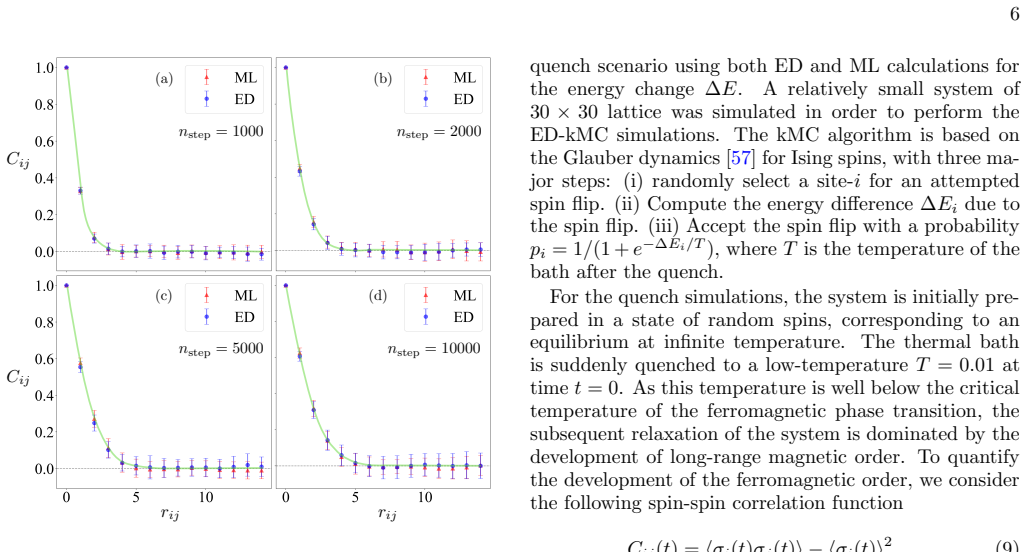
Summary. The paper proposes a convolutional-neural-network surrogate for the local effective field h_i of an itinerant Ising double-exchange model, assuming that h_i depends only on spins in a fixed 21×21 neighborhood (Eq. (6)). The network is trained on exact-diagonalization (ED) energy differences computed on 30×30 lattices and then used inside kinetic Monte Carlo (kMC) simulations of much larger systems. The authors benchmark the surrogate against ED for single-flip energies, against equilibrium Monte Carlo for the ferromagnetic transition temperature, and against ED-kMC for the spin-spin correlation function after a quench to T=0.01. They then use the ML-kMC method on 100×100 and 200×200 lattices and report a temperature-dependent coarsening exponent: L(t)~t^{1/2} at T=0.1 but L(t)~t^{1/4} at T=0.01, with the exponent tending to zero as T→0. The central claims are that the CNN provides a transferable, linear-scaling energy model for kMC and that the Ising double-exchange model exhibits anomalous low-temperature phase-ordering kinetics.
Significance. If the locality assumption is valid and the surrogate errors are controlled, the method would be a useful discrete-variable analogue of ML force fields, enabling large-scale kMC simulations of itinerant systems whose energy updates are normally prohibitively expensive. The paper includes genuine external checks: the ED-kMC dynamical comparison on 30×30 lattices (Fig. 4) is a real test of the surrogate in a dynamical setting, the equilibrium Tc agrees well with the earlier result of Motome and Furukawa (ref. [48]), and the scaling collapse in Fig. 7 is a meaningful consistency test. The potential payoff is high because the reported anomalous coarsening at T=0.01, if correct, would be a new physical result for a disorder-free itinerant Ising model. However, the headline exponent currently rests on a regime in which the surrogate's validity is not established, and one of the reported accuracy metrics is compromised by the data-splitting procedure.
major comments (4)
- [Sec. III, first paragraph and Fig. 2] The test-set error is likely optimistic because the dataset is split after data augmentation at the level of individual augmented entries. The text states that each of the 100×900 original entries is expanded into 16 symmetry-related pairs and that the resulting 100×900×16 pairs are then split with a test fraction of about 15%. Since the 16 copies of one original entry share the same ΔE and are related by a symmetry transformation of the input, a random split at the augmented-entry level places equivalent copies in both training and test sets. The reported test MSE of 0.0014 and the width σ=0.036 in Fig. 2 therefore measure partly memorization rather than generalization. The split should be performed at the level of original (configuration, site) entries, or preferably at the level of whole snapshots, and the test metrics should be recomputed and reported.
- [Sec. II B, Eq. (6); Sec. IV and Fig. 5] The locality assumption that h_i depends only on a 21×21 neighborhood is load-bearing and is not validated in the regime where the anomalous exponent is extracted. For the large-JH double-exchange model, the electron kinetic energy of a ferromagnetic cluster depends on the cluster as a whole through the finite-size electron spectrum; an interior spin in a large +1 domain has a 21×21 input that is almost entirely +1, so the CNN assigns that spin a fixed ΔE regardless of the actual domain size. The straight-wall and island morphologies shown in Fig. 5 at T=0.01 are exactly the configurations where this nonlocality should matter. The only dynamical benchmark, Fig. 4, is run on a 30×30 lattice for nstep≤10000, i.e. t≲11, where domains remain smaller than the cutoff; it does not exercise extrapolation to large ordered domains. Moreover, because acceptance probabilities enter as exp(−ΔE/T), an error of the size seen in Fig. 2 (σ=0.036) changes transition rates by factors of order exp(±3.6) at T=0.01, so a systematic bias in interior-flip energies could directly alter coarsening kinetics. The authors should provide a neighborhood-size convergence test (e.g., ℓ=15, 21, 31, 41) against ED on 30×30 or larger systems and a targeted test on large ordered/straight-wall configurations, or the α=1/4 result should be presented as tentative rather than established.
- [Sec. III, first paragraph] The representativeness of the training data is not documented. The text says only that '100 independent Ising configurations were collected' for the full dataset, with no information about the temperatures, ensembles, or equilibration protocols used to generate them, and no statement about whether the resulting configuration distribution includes the large ferromagnetic domains and straight interfaces that dominate the low-temperature kMC trajectories. Since the CNN is trained exclusively on these snapshots, the extrapolation to the late-time T=0.01 regime is an untested assumption. The authors should specify the snapshot-generation protocol and characterize the coverage of the training set relative to the configurations visited in the kMC simulations, for example by comparing distributions of domain sizes, energy barriers, and predicted ΔE values.
- [Sec. IV, Fig. 6 and Eq. (11)] The evidence for the temperature-dependent exponent α(T) rests on two temperatures and two power-law fits, and the figure shows no error bars, no fitting windows, and no system-size comparison. The claim that α=1/4 is the correct asymptotic exponent for T=0.01 would be much stronger with a finite-size check (e.g., 100×100 vs 200×200 at overlapping times), a fit-window sensitivity analysis, confidence intervals on the fitted exponent, and at least one independent estimate of L(t) in the anomalous regime from a non-surrogate method (for example, KPM-based kMC on the largest feasible lattice, even if only for early times). The text also states that T→0 quenches freeze in disordered states 'based on both ED and ML', but no supporting data for this claim are shown; either the data should be presented or the claim should be softened.
minor comments (6)
- [Fig. 1 caption and Sec. II B] The caption says the output node gives the local field h_i, while the main text in Sec. II B says the fully connected network 'outputs the ΔE_i energy difference'; Eq. (3) relates the two, but the text should state clearly which quantity is the direct network output.
- [Sec. II B] The sentence 'the run time of the ML model is independent of the system size' should be qualified as the inference time per spin-flip evaluation; the per-sweep cost is O(N), which is the actual linear-scaling statement.
- [Sec. III] The manuscript does not report the CNN training details (optimizer, loss function, learning rate, number of epochs, batch size, number of trainable parameters, and the random seed used for the train/test split). These details are needed for reproducibility.
- [Sec. IV, Fig. 6] Fig. 6 would benefit from error bars on L(t) and an explicit statement of the time ranges used for the power-law fits; currently the reader cannot assess the statistical significance of the difference between α=1/2 and α=1/4.
- [Sec. IV, end of section] The statement that quenches at T→0 become frozen 'based on both ED and ML' is not accompanied by any figure or quantitative description; please add the data or remove the unsupported claim.
- [General] There are several minor grammatical and typographical issues, for example 'the ML force-field model offers' in Sec. II B should be 'The ML force-field model offers', and 'temperature is measured in unit of the nearest-neighbor hopping' in the Fig. 3 caption should read 'in units of t_nn'. A careful proofread would improve the presentation.
Circularity Check
No significant circularity: the CNN surrogate is fitted to independent ED labels, benchmarked against held-out ED data and ED-kMC dynamics, and the coarsening exponent is an emergent simulation output rather than a fitted input.
full rationale
The derivation chain is self-contained and non-circular. Training data are independent exact-diagonalization labels for spin-flip energy differences on 30x30 lattices; the CNN is then tested against held-out ED labels (MSE 0.0014 on the test set) and against ED-kMC correlation functions after a quench to T=0.01. The central physics claim, the temperature-dependent coarsening exponent alpha=1/4 at T=0.01, is not a fitted parameter of the model: it is extracted from the time evolution of the correlation length L(t) produced by large-scale kMC simulations using the trained surrogate. No equation in the paper reduces to its own input, and no load-bearing result is imported solely from a self-citation. The 21x21 locality assumption in Eq. (6) is an explicit physical approximation that may be a correctness risk in the large-domain low-temperature regime, but it is not a circular reduction: the surrogate is not defined in terms of the coarsening exponent, and the exponent is not imposed by construction. Self-citations to earlier ML force-field work are contextual and not load-bearing for the specific coarsening claim.
Assumptions & free parameters
free parameters (4)
- locality cutoff neighborhood size =
21x21 block
- CNN architecture hyperparameters =
7x7 then 3x3 kernels, filters 6-12-16-20-24-24-24, FC width 64
- training data budget =
100 configurations, 900 sites each, 16x augmentation
- trained CNN weights =
learned from exact diagonalization labels
assumptions (6)
- domain assumption Adiabatic approximation: electrons relax instantly after each spin update, so energy is computed from the instantaneous tight-binding Hamiltonian.
- domain assumption Infinite Hund's coupling JH to infinity projection to spinless fermion model, Eq. (2).
- domain assumption Locality principle: h_i depends only on spins in a finite neighborhood B_i, Eq. (6).
- ad hoc to paper The 100 training snapshots are representative of the configurations visited in large-scale low-temperature kMC.
- domain assumption Glauber single-spin-flip dynamics is the correct microscopic dynamics for the thermal quench.
- domain assumption The electron filling fraction f used in the tight-binding energy is fixed but not stated in the text.
Cite this review
Pith. "Pith review of Machine learning force-field model for kinetic Monte Carlo simulations of itinerant Ising magnets." pith.science (2026). https://pith.science/paper/EGE4VR5U
@misc{pith2026241119780,
  author       = {Pith},
  title        = {Pith review of: Machine learning force-field model for kinetic Monte Carlo simulations of itinerant Ising magnets},
  year         = {2026},
  howpublished = {\url{https://pith.science/paper/EGE4VR5U}},
  note         = {Machine review of arXiv:2411.19780}
}
read the original abstract
We present a scalable machine learning (ML) framework for large-scale kinetic Monte Carlo (kMC) simulations of itinerant electron Ising systems. As the effective interactions between Ising spins in such itinerant magnets are mediated by conducting electrons, the calculation of energy change due to a local spin update requires solving an electronic structure problem. Such repeated electronic structure calculations could be overwhelmingly prohibitive for large systems. Assuming the locality principle, a convolutional neural network (CNN) model is developed to directly predict the effective local field and the corresponding energy change associated with a given spin update based on Ising configuration in a finite neighborhood. As the kernel size of the CNN is fixed at a constant, the model can be directly scalable to kMC simulations of large lattices. Our approach is reminiscent of the ML force-field models widely used in first-principles molecular dynamics simulations. Applying our ML framework to a square-lattice double-exchange Ising model, we uncover unusual coarsening of ferromagnetic domains at low temperatures. Our work highlights the potential of ML methods for large-scale modeling of similar itinerant systems with discrete dynamical variables.
Figures


Figures from the paper (3 more)


Reference graph
Works this paper leans on
-
[48]
Y. Motome and N. Furukawa, Critical phenomena of fer- romagnetic transition in double-exchange systems, Jour- nal of the Physical Society of Japan 70, 1487 (2001)
work page 2001
-
[1]
Carrasquilla and R
J. Carrasquilla and R. G. Melko, Machine learning phases of matter, Nature Physics 13, 431 (2017)
2017
-
[2]
Carleo and M
G. Carleo and M. Troyer, Solving the quantum many- body problem with artificial neural networks, Science 355, 602 (2017)
2017
-
[3]
E. van Nieuwenburg, Y.-H. Liu, and S. Huber, Learning phase transitions by confusion, Nature Physics 13, 435 (2017)
work page 2017
-
[4]
Das Sarma, D.-L
S. Das Sarma, D.-L. Deng, and L.-M. Duan, Machine learning meets quantum physics, Physics Today 72, 48 (2019)
2019
-
[5]
E. Bedolla, L. C. Padierna, and R. Casta˜ neda-Priego, Machine learning for condensed matter physics, Journal of Physics: Condensed Matter 33, 053001 (2020)
work page 2020
-
[6]
Carleo, I
G. Carleo, I. Cirac, K. Cranmer, L. Daudet, M. Schuld, N. Tishby, L. Vogt-Maranto, and L. Zdeborov´ a, Machine learning and the physical sciences, Rev. Mod. Phys. 91, 045002 (2019)
2019
-
[7]
G. E. Karniadakis, I. G. Kevrekidis, L. Lu, P. Perdikaris, S. Wang, and L. Yang, Physics-informed machine learn- ing, Nature Reviews Physics 3, 422 (2021)
2021
Show all 65 references
-
[8]
Boehnlein, M
A. Boehnlein, M. Diefenthaler, N. Sato, M. Schram, V. Ziegler, C. Fanelli, M. Hjorth-Jensen, T. Horn, M. P. Kuchera, D. Lee, W. Nazarewicz, P. Ostroumov, K. Orginos, A. Poon, X.-N. Wang, A. Scheinker, M. S. Smith, and L.-G. Pang, Colloquium: Machine learning in nuclear physics...
2022
-
[9]
Cybenko, Approximation by superpositions of a sig- moidal function, Mathematics of Control, Signals and Systems 2, 303 (1989)
G. Cybenko, Approximation by superpositions of a sig- moidal function, Mathematics of Control, Signals and Systems 2, 303 (1989)
1989
-
[10]
Hornik, M
K. Hornik, M. Stinchcombe, and H. White, Multilayer feedforward networks are universal approximators, Neu- ral Networks 2, 359 (1989)
1989
-
[11]
Barron, Universal approximation bounds for super- positions of a sigmoidal function, IEEE Transactions on Information Theory 39, 930 (1993)
A. Barron, Universal approximation bounds for super- positions of a sigmoidal function, IEEE Transactions on Information Theory 39, 930 (1993)
1993
-
[12]
Behler and M
J. Behler and M. Parrinello, Generalized neural-network representation of high-dimensional potential-energy sur- faces, Phys. Rev. Lett. 98, 146401 (2007)
2007
-
[13]
A. P. Bart´ ok, M. C. Payne, R. Kondor, and G. Cs´ anyi, Gaussian approximation potentials: The accuracy of quantum mechanics, without the electrons, Phys. Rev. Lett. 104, 136403 (2010)
2010
-
[14]
Z. Li, J. R. Kermode, and A. De Vita, Molecular dy- namics with on-the-fly machine learning of quantum- mechanical forces, Phys. Rev. Lett. 114, 096405 (2015)
2015
-
[15]
A. V. Shapeev, Moment tensor potentials: A class of sys- tematically improvable interatomic potentials, Multiscale Modeling & Simulation 14, 1153 (2016)
2016
-
[16]
V. Botu, R. Batra, J. Chapman, and R. Ramprasad, Ma- chine learning force fields: Construction, validation, and outlook, The Journal of Physical Chemistry C 121, 511 (2017)
2017
-
[17]
J. S. Smith, O. Isayev, and A. E. Roitberg, Ani-1: an extensible neural network potential with dft accuracy at force field computational cost, Chem. Sci. 8, 3192 (2017)
2017
-
[18]
Zhang, J
L. Zhang, J. Han, H. Wang, R. Car, and W. E, Deep potential molecular dynamics: A scalable model with the accuracy of quantum mechanics, Phys. Rev. Lett. 120, 143001 (2018)
2018
-
[19]
Behler, Perspective: Machine learning potentials for atomistic simulations, The Journal of Chemical Physics 145, 170901 (2016)
J. Behler, Perspective: Machine learning potentials for atomistic simulations, The Journal of Chemical Physics 145, 170901 (2016)
2016
-
[20]
V. L. Deringer, M. A. Caro, and G. Csanyi, Machine learning interatomic potentials as emerging tools for ma- terials science, Advanced Materials 31, 1902765 (2019)
2019
-
[21]
R. T. McGibbon, A. G. Taube, A. G. Donchev, K. Siva, F. Hernandez, C. Hargus, K.-H. Law, J. L. Klepeis, and D. E. Shaw, Improving the accuracy of m¨ oller-plesset per- turbation theory with neural networks, The Journal of Chemical Physics 147, 161725 (2017)
2017
-
[22]
H. Suwa, J. S. Smith, N. Lubbers, C. D. Batista, G.-W. Chern, and K. Barros, Machine learning for molecular dynamics with strongly correlated electrons, Phys. Rev. B 99, 161107 (2019)
2019
-
[23]
Chmiela, A
S. Chmiela, A. Tkatchenko, H. E. Sauceda, I. Poltavsky, K. T. Sch¨ utt, and K.-R. M¨ uller, Machine learning of ac- curate energy-conserving molecular force fields, Science Advances 3, e1603015 (2017)
2017
-
[24]
Chmiela, H
S. Chmiela, H. E. Sauceda, K.-R. M¨ uller, and A. Tkatchenko, Towards exact molecular dynamics sim- ulations with machine-learned force fields, Nature Com- munications 9, 3887 (2018)
2018
-
[25]
H. E. Sauceda, M. Gastegger, S. Chmiela, K.-R. M¨ uller, and A. Tkatchenko, Molecular force fields with gradient- domain machine learning (GDML): Comparison and syn- ergies with classical force fields, The Journal of Chemical Physics 153, 124109 (2020)
2020
-
[26]
Marx and J
D. Marx and J. Hutter, Ab initio molecular dynamics: basic theory and advanced methods(Cambridge Univer- sity Press, 2009)
2009
-
[27]
Kohn, Density functional and density matrix method scaling linearly with the number of atoms, Phys
W. Kohn, Density functional and density matrix method scaling linearly with the number of atoms, Phys. Rev. Lett. 76, 3168 (1996)
1996
-
[28]
Prodan and W
E. Prodan and W. Kohn, Nearsightedness of electronic matter, Proceedings of the National Academy of Sciences 102, 11635 (2005)
2005
-
[29]
Zhang, S
P. Zhang, S. Zhang, and G.-W. Chern, Descriptors for machine learning model of generalized force field in con- densed matter systems (2022), arXiv:2201.00798 [cond- mat.str-el]
2022 arXiv
-
[30]
Zhang, P
S. Zhang, P. Zhang, and G.-W. Chern, Anomalous phase separation in a correlated electron system: Machine- learning enabled large-scale kinetic monte carlo simula- tions, Proceedings of the National Academy of Sciences 119, e2119957119 (2022)
2022
-
[31]
Cheng, S
C. Cheng, S. Zhang, and G.-W. Chern, Machine learn- ing for phase ordering dynamics of charge density waves, Phys. Rev. B 108, 014301 (2023)
2023
-
[32]
Zhang, P
P. Zhang, P. Saha, and G.-W. Chern, Machine learning dynamics of phase separation in correlated electron mag- nets (2020), arXiv:2006.04205 [cond-mat.str-el]
2020 arXiv
-
[33]
Zhang and G.-W
P. Zhang and G.-W. Chern, Arrested phase separation in double-exchange models: Large-scale simulation en- abled by machine learning, Phys. Rev. Lett. 127, 146401 (2021)
2021
-
[34]
Zhang and G.-W
P. Zhang and G.-W. Chern, Machine learning nonequilib- rium electron forces for spin dynamics of itinerant mag- nets, npj Computational Materials 9, 32 (2023)
2023
-
[35]
Cheng, S
X. Cheng, S. Zhang, P. C. H. Nguyen, S. Azarfar, G.-W. Chern, and S. S. Baek, Convolutional neural networks for large-scale dynamical modeling of itinerant magnets, 11 Phys. Rev. Res. 5, 033188 (2023)
2023
-
[36]
Arale Br¨ annvall, D
M. Arale Br¨ annvall, D. Gambino, R. Armiento, and B. Alling, Machine learning approach for longitudinal spin fluctuation effects in bcc fe at Tc and under earth- core conditions, Phys. Rev. B 105, 144417 (2022)
2022
-
[37]
Novikov, B
I. Novikov, B. Grabowski, F. K¨ ormann, and A. Shapeev, Magnetic moment tensor potentials for collinear spin- polarized materials reproduce different magnetic states of bcc fe, npj Computational Materials 8, 13 (2022)
2022
-
[38]
Stoll, K
E. Stoll, K. Binder, and T. Schneider, Monte carlo in- vestigation of dynamic critical phenomena in the two- dimensional kinetic ising model, Phys. Rev. B 8, 3266 (1973)
1973
-
[39]
Binder and H
K. Binder and H. M¨ uller-Krumbhaar, Investigation of metastable states and nucleation in the kinetic ising model, Phys. Rev. B 9, 2328 (1974)
1974
-
[40]
Zener, Interaction between the d-shells in the transi- tion metals
C. Zener, Interaction between the d-shells in the transi- tion metals. ii. ferromagnetic compounds of manganese with perovskite structure, Phys. Rev. 82, 403 (1951)
1951
-
[41]
P. G. de Gennes, Effects of double exchange in magnetic crystals, Phys. Rev. 118, 141 (1960)
1960
-
[42]
P. W. Anderson and H. Hasegawa, Considerations on double exchange, Phys. Rev. 100, 675 (1955)
1955
-
[43]
Dagotto, Nanoscale Phase Separation and Colossal Magnetoresistance (Springer Berlin, 2002)
E. Dagotto, Nanoscale Phase Separation and Colossal Magnetoresistance (Springer Berlin, 2002)
2002
-
[44]
Dagotto, T
E. Dagotto, T. Hotta, and A. Moreo, Colossal magne- toresistant materials: the key role of phase separation, Physics Reports 344, 1 (2001)
2001
-
[45]
Uehara, S
M. Uehara, S. Mori, C. H. Chen, and S.-W. Cheong, Per- colative phase separation underlies colossal magnetore- sistance in mixed-valent manganites, Nature 399, 560 (1999)
1999
-
[46]
Yunoki, J
S. Yunoki, J. Hu, A. L. Malvezzi, A. Moreo, N. Furukawa, and E. Dagotto, Phase separation in electronic models for manganites, Phys. Rev. Lett. 80, 845 (1998)
1998
-
[47]
Dagotto, S
E. Dagotto, S. Yunoki, A. L. Malvezzi, A. Moreo, J. Hu, S. Capponi, D. Poilblanc, and N. Furukawa, Ferromag- netic Kondo model for manganites: Phase diagram, charge segregation, and influence of quantum localized spins, Phys. Rev. B 58, 6414 (1998)
1998
-
[49]
M. A. Ruderman and C. Kittel, Indirect Exchange Cou- pling of Nuclear Magnetic Moments by Conduction Elec- trons, Phys. Rev. 96, 99 (1954)
1954
-
[50]
Kasuya, A Theory of Metallic Ferro- and Antiferro- magnetism on Zener’s Model, Prog
T. Kasuya, A Theory of Metallic Ferro- and Antiferro- magnetism on Zener’s Model, Prog. Theor. Phys. 16, 45 (1956)
1956
-
[51]
Yosida, Magnetic properties of Cu-Mn alloys, Phys
K. Yosida, Magnetic properties of Cu-Mn alloys, Phys. Rev. 106, 893 (1957)
1957
-
[52]
Weiße, G
A. Weiße, G. Wellein, A. Alvermann, and H. Fehske, The kernel polynomial method, Rev. Mod. Phys. 78, 275 (2006)
2006
-
[53]
Barros and Y
K. Barros and Y. Kato, Efficient langevin simulation of coupled classical fields and fermions, Phys. Rev. B 88, 235101 (2013)
2013
-
[54]
Wang, G.-W
Z. Wang, G.-W. Chern, C. D. Batista, and K. Bar- ros, Gradient-based stochastic estimation of the density matrix, The Journal of Chemical Physics 148, 094107 (2018)
2018
-
[55]
Goodfellow, Y
I. Goodfellow, Y. Bengio, and A. Courville, Convolu- tional networks, in Deep Learning (MIT Press, 2016) Chap. 9, pp. 326–366
2016
-
[56]
D. P. Landau and K. Binder, A Guide to Monte Carlo Simulations in Statistical Physics, 4th ed. (Cambridge University Press, 2014)
2014
-
[57]
R. J. Glauber, Time-Dependent Statistics of the Ising Model, Journal of Mathematical Physics 4, 294 (1963)
1963
-
[58]
A. J. Bray, Theory of phase-ordering kinetics, Advances in Physics 43, 357 (1994)
1994
-
[59]
Onuki, Phase Transition Dynamics(Cambridge Uni- versity Press, 2002)
A. Onuki, Phase Transition Dynamics(Cambridge Uni- versity Press, 2002)
2002
-
[60]
Puri and V
S. Puri and V. Wadhawan, Kinetics of phase transitions (CRC press, 2009)
2009
-
[61]
Allen and J
S. Allen and J. Cahn, Ground state structures in or- dered binary alloys with second neighbor interactions, Acta Metallurgica 20, 423 (1972)
1972
-
[62]
Corberi, Coarsening in inhomogeneous systems, Comptes Rendus Physique 16, 332 (2015), coarsening dy- namics / Dynamique de coarsening
F. Corberi, Coarsening in inhomogeneous systems, Comptes Rendus Physique 16, 332 (2015), coarsening dy- namics / Dynamique de coarsening
2015
-
[63]
J. D. Shore, M. Holzer, and J. P. Sethna, Logarithmically slow domain growth in nonrandomly frustrated systems: Ising models with competing interactions, Phys. Rev. B 46, 11376 (1992)
1992
-
[64]
M. R. Evans, Anomalous coarsening and glassy dynam- ics, Journal of Physics: Condensed Matter 14, 1397 (2002)
2002
-
[65]
Tanaka, Viscoelastic phase separation, Journal of Physics: Condensed Matter 12, R207 (2000)
H. Tanaka, Viscoelastic phase separation, Journal of Physics: Condensed Matter 12, R207 (2000)
2000
Reviewed August 12, 2026 · model on record in the stance chip above.
Discussion (0). Continue with ORCID to comment.