REVIEW 3 major objections 4 minor 8 references
The 2024 Motile Active Matter Roadmap
T0 review · 3 major / 4 minor · reviewed 2026-08-12 · deepseek-v4-flash
Pith's one-line read A 19-part roadmap declares that motile active matter has matured enough to tackle complex environments, chirality, micromachines, intelligent swarms, and microbial motility.
desk verdict A useful, authoritative roadmap of motile active matter as a field snapshot, but not a research paper; the abstract slightly oversells readiness, and a few sections lean on self-citation, yet the collection works as an entry point and deserves review. read the letter →
The pith
A machine-rendered reading of the paper's core claim, the machinery that carries it, and where it could break.
The reading
What carries the argument
The organizing device is a five-part agenda—complex environments, chirality, micromachines and microbots, intelligent swarming, and microbial motility—each fleshed out by contributed essays that follow a uniform 'Status / Current and Future Challenges / Advances' structure. This structure is the argument's load-bearing machinery: it converts the abstract claim of maturity into a concrete set of research fronts, and it grounds each front in specific experiments, models, and technologies rather than in generalities.
What would settle it
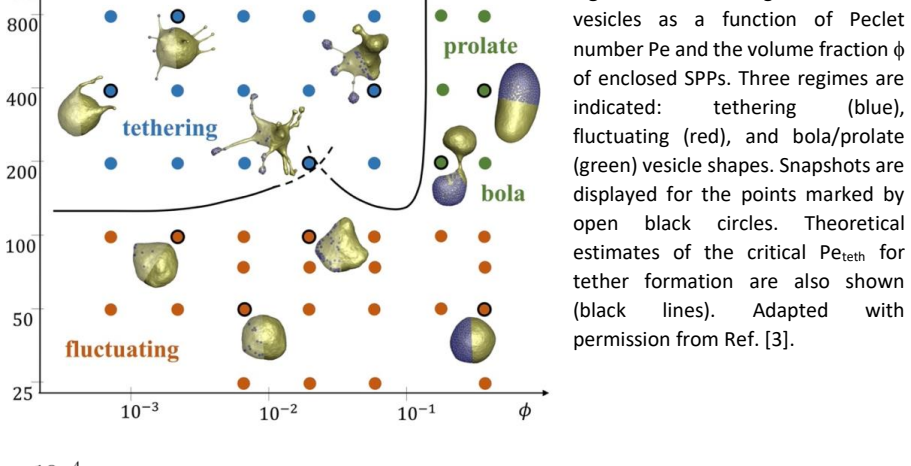
A direct way to test the 'ground prepared' claim would be a systematic, independent replication of the key experimental results cited as evidence of maturity—for example crowding-enhanced diffusion of self-propelled filaments, chemotactic suppression of motility-induced phase separation, and active-particle-induced tether formation in giant vesicles. If a significant share of these results failed to reproduce under controlled conditions, the roadmap's assessment of the state of the art would be called into question.
Extended reading notes
Core claim
The paper's central claim is that motile active matter has crossed a threshold: the fundamental properties of self-propelled agents—their propulsion mechanisms, basic interactions, and canonical collective behaviors—are now reasonably well understood and under control. Because of this, the authors argue, the bottleneck is no longer elementary physics but the study of physical mechanisms in complex environments, of systems with new features such as chirality, of novel micromachines and microbots, of emergent collective behavior and swarming of intelligent self-propelled particles, and of special features of microbial systems. The roadmap presents these five directions as the field's agenda, with each of nineteen contributed sections giving a status summary, current and future challenges, and advances in science and technology needed to meet them.
Load-bearing premise
The roadmap's confidence that the field is ready rests on the accuracy and representativeness of the published literature its contributors cite, a large part of which is their own prior work; if those cited results are inaccurate or unrepresentative, the claimed readiness is unsupported.
Editorial extensions
If this is right
- The roadmap expects chiral active matter, including spinning particles and circle swimmers, to move from minimal models toward hydrodynamic and phoretic interactions and phenomena such as odd viscosity.
- The roadmap expects synthetic microswimmers to be engineered with internal feedback, reconfigurable shape, and signaling pathways, merging active matter with robotics and control theory.
- The roadmap expects non-reciprocal interactions to be used as a design principle for pattern formation and phase separation, connecting active matter with reaction–diffusion systems and open quantum systems.
- The roadmap expects joint genetic engineering of microorganisms and design of synthetic particles to allow parametric control of motility, enabling programmable collective states.
- The roadmap expects research in complex environments—porous media, non-Newtonian fluids, and compliant confinement—to become a central testbed for real-world applications.
Reading between the lines
- Beyond the paper: if the field's next bottleneck is sensing, feedback, and information processing rather than propulsion, then active matter research will increasingly resemble control theory and machine learning, and the boundary between 'active matter' and 'robotics' will blur.
- Beyond the paper: a testable extension is that microrobot swarms with feedback or reinforcement-learning control will outperform open-loop swarms in tasks requiring adaptation; this could be benchmarked in microfluidic mazes with controlled noise.
- Beyond the paper: the roadmap's reliance on contributor-authored reviews raises the possibility of collective blind spots; an independent, cross-field synthesis might surface under-represented phenomena, for example from ecology or active granular media.
Signed reviews
Editorial analysis
A structured set of objections, weighed in public.
Referee Report
Summary. The paper is a multi-author roadmap of motile active matter, consisting of an editorial introduction and nineteen short essays, each organized as Status, Current and Future Challenges, Advances in Science and Technology, and Concluding Remarks. The essays cover transport in complex environments, manipulation by active particles, disordered active systems, cell-mimicking vesicles, chemically propelled particles, Lagrangian tracking of microorganisms, chiral microswimmers and minimal models thereof, active solids, adaptive microswimmers, genetic engineering of active matter, magnetic microrobots for clinical use, non-reciprocal interactions, cognitive self-steering particles, feedback-guided synthetic active matter, reinforcement-learned microrobotic swarms, collective problem solving, renormalization-group crossovers in living systems, and phenotypic heterogeneity in bacterial swarming. The abstract and introduction assert that many fundamental properties of motile active matter are now reasonably well understood and under control, and that the field is therefore prepared for research on complex environments, chirality, micromachines, intelligent swarms, and microbial systems.
Significance. If the individual assessments are accurate, the roadmap offers a broad and useful snapshot of a rapidly growing interdisciplinary field and will be a convenient entry point for students and researchers. Its main strengths are the authority of the contributors, the consistent status/challenges/advances structure, and the inclusion of recent primary references in most sections. The paper contains no novel derivations or reproducibility artifacts to check, so its value depends on the representativeness and accuracy of the literature it summarizes. Several sections are explicitly self-referential, and the abstract's readiness claim is in tension with statements in the body of the roadmap, which limits the reliability of the paper as a balanced field survey until these issues are addressed.
major comments (3)
- [Abstract; Introduction] The abstract and editorial introduction claim that 'many fundamental properties of motile active matter now reasonably well understood and under control,' and this claim is the stated justification for the roadmap's proposed directions. The body of the roadmap repeatedly disclaims that level of understanding: Sec. 3 says disordered active systems 'remain largely unexplored' and that 'a theoretical, analytical understanding of most of these results is missing'; Sec. 5 says the physics of chemically propelled swimmers 'has not always been elucidated beyond a coarse level' and that 'a minimal reference model is still to be developed'; Sec. 8 states that 'many important questions are still open' and that 'we are currently lacking a comprehensive theory.' Because the readiness claim is load-bearing for the roadmap's rationale, the editors should either soften it to a claim about specific subfields or add a systematic discussion, grounded in the individual essays, of which fundamental properties are considered established and which are not.
- [Sec. 8 (Minimal Models for Chiral Active Matter)] The Status and Future Challenges sections of this essay are built almost entirely on refs [1]–[10], of which refs [1], [6], [8], and [9] are by the same author or close collaborators. The substantial experimental literature on chiral active matter, such as chiral Quincke rollers, spinning colloids, and odd-viscosity experiments, is mentioned only in passing in the concluding remarks. Since the roadmap's value depends on representing the state of the art rather than one group's perspective, this section should be expanded to engage the experimental counterpart literature, and the same citation-balance issue should be checked in Secs. 4, 12, and 14, which also rely heavily on the contributors' own prior work.
- [Sec. 12 (Towards clinical applications of magnetic micro/nanorobots)] The text states that 'a recently available magnetic actuation system, Navion from Nanoflex Robotics, uses patented technology to increase the power density in electromagnets' and gives performance-related claims about the Aeon Phocus system, without a citation. Since the Acknowledgements disclose that one of the authors is a co-founder of Nanoflex Robotics, these commercial claims should be independently sourced or explicitly framed as the authors' assessment; otherwise the roadmap makes an unsupported promotional statement in a section whose purpose is to summarize the state of the art in clinical microrobotics.
minor comments (4)
- [Sec. 3, Eq. (1)] The definition of the orientation unit vector \(\hat e[\theta_i]\) is printed as \(\cos(\theta_i)\hat x + \cos(\theta_i)\hat y\); the second component should be \(\sin(\theta_i)\hat y\). This appears to be a typographical error but could confuse readers trying to reproduce the model.
- [Sec. 14, references [3] and [4]] The text attributes the Vicsek alignment model to ref [3] and the Couzin zonal model to ref [4], but the reference list gives [3] as Couzin et al. and [4] as Vicsek et al. The citations should be swapped so the text matches the bibliography.
- [Throughout] There are several typographical errors that should be corrected: 'Fernado Peruani' in the author list should be 'Fernando Peruani'; Sec. 4 'preform' should be 'perform'; Sec. 12 'compromize' should be 'compromise'; Sec. 11 'delas' should be 'deals'.
- [Sec. 13, reference [6]] The main text states that the non-reciprocal Cahn-Hilliard model 'has been shown to provide a description' of several physical systems, citing ref [6] as an arXiv preprint. Please either cite a peer-reviewed version or explicitly mark the reference as a preprint, so readers can assess the status of the supporting evidence.
Circularity Check
No significant circularity: the roadmap is a community survey, not a derivation, and its self-citations and internal tensions do not make any claim true by construction.
full rationale
This manuscript is a multi-author roadmap, not a derivation or prediction paper. There is no equation that is fitted to data and then reported as a prediction, no quantity defined in terms of the quantity it purports to explain, and no uniqueness theorem imported from the authors' prior work to force a particular choice. The introduction's claim that 'many fundamental properties of motile active matter now reasonably well understood and under control' is an editorial assessment supported by general reviews (Refs [5-10]), several of which are by the same community; this is normal review practice and, although it raises a representativeness concern, it does not make any claim true by construction. The strongest tension in the text is internal rather than circular: the same volume contains essays stating that disordered active systems 'remains largely unexplored' (Sec. 3), that the physics of chemical swimmers 'has not always been elucidated beyond a coarse level' and a 'minimal reference model is still to be developed' (Sec. 5), and that for chiral active matter 'we are currently lacking a comprehensive theory' (Sec. 8). These statements undercut the abstract's readiness claim but do not constitute a circular derivation. No circular step meets the evidentiary bar of Eq. X = Eq. Y by construction or a fitted parameter renamed as a prediction.
Assumptions & free parameters
assumptions (1)
- domain assumption The cited prior literature, including the contributors' own reviews and articles, accurately represents the state of the art in the field.
Cite this review
Pith. "Pith review of The 2024 Motile Active Matter Roadmap." pith.science (2026). https://pith.science/paper/LRHWKBH6
@misc{pith2026241119783,
  author       = {Pith},
  title        = {Pith review of: The 2024 Motile Active Matter Roadmap},
  year         = {2026},
  howpublished = {\url{https://pith.science/paper/LRHWKBH6}},
  note         = {Machine review of arXiv:2411.19783}
}
read the original abstract
Activity and autonomous motion are fundamental aspects of many living and engineering systems. Here, the scale of biological agents covers a wide range, from nanomotors, cytoskeleton, and cells, to insects, fish, birds, and people. Inspired by biological active systems, various types of autonomous synthetic nano- and micromachines have been designed, which provide the basis for multifunctional, highly responsive, intelligent active materials. A major challenge for understanding and designing active matter is their inherent non-equilibrium nature due to persistent energy consumption, which invalidates equilibrium concepts such as free energy, detailed balance, and time-reversal symmetry. Furthermore, interactions in ensembles of active agents are often non-additive and non-reciprocal. An important aspect of biological agents is their ability to sense the environment, process this information, and adjust their motion accordingly. It is an important goal for the engineering of micro-robotic systems to achieve similar functionality. With many fundamental properties of motile active matter now reasonably well understood and under control, the ground is prepared for the study of physical aspects and mechanisms of motion in complex environments, of the behavior of systems with new physical features like chirality, of the development of novel micromachines and microbots, of the emergent collective behavior and swarming of intelligent self-propelled particles, and of particular features of microbial systems. The vast complexity of phenomena and mechanisms involved in the self-organization and dynamics of motile active matter poses major challenges, which can only be addressed by a truly interdisciplinary effort involving scientists from biology, chemistry, ecology, engineering, mathematics, and physics.
Figures


Figures from the paper (10 more)


Reference graph
Works this paper leans on
-
[1]
Water reservoir maintained by cell growth fuels the spreading of a bacterial swarm,
Y. Wu and H. C. Berg, “Water reservoir maintained by cell growth fuels the spreading of a bacterial swarm,” Proc Natl Acad Sci U S A, vol. 109, no. 11, pp. 4128–4133, 2012, doi: 10.1073/pnas.1118238109
-
[6]
H. Jeckel et al., “Simultaneous spatiotemporal transcriptomics and microscopy of Bacillus subtilis swarm development reveal cooperation across generations,” Nat Microbiol, Nov. 2023, doi: 10.1038/s41564-023-01518-4
-
[8]
Single-Cell RNA Sequencing Elucidates the Structure and Organization of Microbial Communities,
M. A. Brennan and A. Z. Rosenthal, “Single-Cell RNA Sequencing Elucidates the Structure and Organization of Microbial Communities,” Front Microbiol, vol. 12, 2021, doi: 10.3389/fmicb.2021.713128
-
[2]
Learning the space-time phase diagram of bacterial swarm expansion,
H. Jeckel et al., “Learning the space-time phase diagram of bacterial swarm expansion,” Proc Natl Acad Sci U S A, vol. 116, no. 5, pp. 1489–1494, 2019, doi: 10.1073/pnas.1811722116
-
[3]
Swarming motility in undomesticated Bacillus subtilis,
D. B. Kearns and R. Losick, “Swarming motility in undomesticated Bacillus subtilis,” Mol Microbiol, vol. 49, no. 3, pp. 581–590, 2003, doi: 10.1046/j.1365-2958.2003.03584.x
-
[4]
Biophysical aspects underlying the swarm to biofilm transition,
V. M. Worlitzer et al., “Biophysical aspects underlying the swarm to biofilm transition,” Sci Adv, vol. 8, no. 24, pp. 1–9, 2022, doi: 10.1126/sciadv.abn8152
-
[5]
Y. Dergham et al., “Direct comparison of spatial transcriptional heterogeneity across diverse Bacillus subtilis biofilm communities,” Nat Commun, vol. 14, no. 1, Dec. 2023, doi: 10.1038/s41467-023- 43386-w
-
[7]
Spatial transcriptomics of planktonic and sessile bacterial populations at single-cell resolution,
D. Dar, N. Dar, L. Cai, and D. K. Newman, “Spatial transcriptomics of planktonic and sessile bacterial populations at single-cell resolution,” Science (1979), vol. 373, no. 6556, 2021, doi: 10.1126/science.abi4882
Reviewed August 12, 2026 · model on record in the stance chip above.
Discussion (0). Continue with ORCID to comment.