REVIEW 2 major objections 5 minor 23 references
New bulk cone singularities in Vaidya-like spacetimes from large $c$ conformal blocks
T0 review · 2 major / 5 minor · reviewed 2026-08-12 · deepseek-v4-flash
Pith's one-line read Radial bulk cone singularities in a time-symmetric Vaidya-like spacetime turn on sharply at $r_+=l$, and a large-$c$ CFT$_2$ correlator built from Virasoro identity blocks diverges at exactly the bulk cone time.
desk verdict A clean bulk-side result with a genuinely new radial bulk cone singularity, and a CFT derivation that is impressive but conditional on an unresolved truncation of the channel sum. read the letter →
The pith
A machine-rendered reading of the paper's core claim, the machinery that carries it, and where it could break.
The reading
What carries the argument
The machinery is the sum over Virasoro identity blocks in all channels, evaluated with the monodromy method, a technique that obtains large-$c$ conformal blocks from the monodromy of solutions to a second-order differential equation (3.8) around operator-contraction paths. The resulting channel integral (3.35) runs over the crossing-point parameters $(\sigma, \delta)$, and its singular loci $L_\pm(t_1, t_2)$, where $B_\pm = 0$, control the correlator's singularities. The bulk cone singularity appears when $L_+$ and $L_-$ first touch tangentially at $\delta = \sigma = 0$, which yields $t_c(t_1)$; the light cone singularity appears when the loci reach the boundary $|\delta| = \pi$ at $t_2 - t_1 = \pi$. The parameter $\rho = r_+/l$ enters through the state's energy via $\rho = \sqrt{4K - 1}$.
What would settle it
Evaluate the channel integral (3.35) numerically for $\rho < 1$ and confirm the divergence as $t_2$ approaches $t_c$; then include the winding channels $|\delta| > \pi$ with a consistent $i\epsilon$ prescription and check whether the divergence survives.
Extended reading notes
Core claim
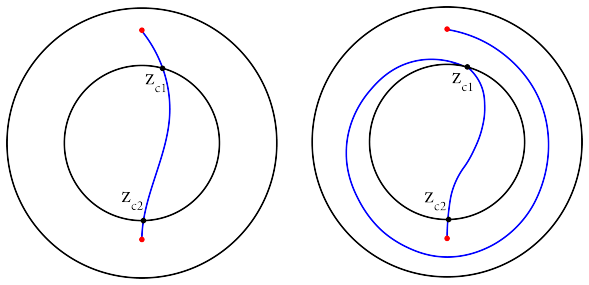
The central claim is that the family of time-symmetric Vaidya-like spacetimes (2.1) has a transition at $\rho = r_+/l = 1$. Below the threshold, a radial null geodesic sent from the boundary before the shock can reach an antipodal boundary point at a later time, producing a bulk cone singularity in the boundary two-point function; above the threshold the black hole and white hole horizons overlap and no such radial geodesic exists. In AdS$_3$/CFT$_2$ the paper derives the CFT correlator (3.35) as a sum over Virasoro identity blocks computed by the monodromy method, and shows that it diverges precisely at $t_2 = t_c(t_1) = (1/\rho) \log[(\tanh(\rho t_1/2) - \rho^2)/(\tanh(\rho t_1/2) + \rho^2)]$, matching the bulk geodesic time (2.14). The divergence arises because the two singularity loci $L_\pm$ of the channel integrand meet tangentially at $\delta = \sigma = 0$; for $\rho > 1$ the bulk cone time is complex and the loci never intersect.
Load-bearing premise
The argument assumes that the exact large-c correlator is faithfully represented by the sum over Virasoro identity blocks over all channels, eq. (3.6), and that the non-winding sector $|\delta| < \pi$ alone captures the bulk cone divergence.
Editorial extensions
If this is right
- For $\rho < 1$, the boundary two-point function in the Vaidya-like state diverges at the bulk cone time $t_c(t_1)$, so this class of bulk cone singularities is visible in a purely boundary quantity.
- For $\rho > 1$ the would-be bulk cone time is complex and the channel integral remains finite, matching the absence of radial bulk cone singularities.
- The light cone singularity is reproduced by the same integral: it occurs when the singularity loci $L_\pm$ reach the boundary of the integration region at $t_2 - t_1 = \pi$.
- These radial bulk cone singularities are a new class, distinct from the angular-momentum bulk cone singularities of static black holes, which are present both below and above the transition.
- The same $r_+ = l$ transition shows up in the type of the single-trace von Neumann algebra of the state: type I below the threshold and type III above it.
Reading between the lines
- I infer that the omitted winding channels $|\delta| > \pi$ are what would produce bulk cone singularities from null geodesics that wind around the black hole, along with the periodic light-cone structure on the compact spatial circle; the paper flags this as an open question.
- The tangency mechanism should hold for generic angular separations $\theta$, with the meeting point of $L_\pm$ moving away from $(0,0)$; one could derive a $\theta$-dependent bulk cone time from the same analysis of (4.1).
- Because the divergence is a pinch of the channel integral rather than a saddle-point artifact, it should persist to all orders in the probe dimension $\Delta$; the saddle-point calculation only sets the strength of the divergence.
- The proposed algebra-type transition could be tested through the modular spectral analysis of the two-point function (5.1), where the bulk-cone divergence should leave a visible signature in the spectral function determining the type.
Editorial analysis
A structured set of objections, weighed in public.
Referee Report
Summary. The paper studies a time-symmetric null shock-wave spacetime obtained by gluing global AdS to a BTZ/Schwarzschild geometry, parameterized by the horizon radius r_+. The bulk part of the paper argues that radial bulk-cone singularities appear in the boundary two-point function exactly when r_+ < l, with the bulk-cone time given explicitly in eq. (2.14). The CFT part models the state by a heavy operator V on the vacuum and computes the two-point function using a sum of Virasoro identity blocks over channels, obtained by the monodromy method. The resulting integral (3.35) is analyzed both through the singularity loci L_± of the integrand and through a large-Δ saddle-point approximation. The paper claims that the integral diverges exactly at the bulk-cone time (4.4) for ρ = r_+/l < 1 and remains finite for ρ > 1, thereby reproducing the bulk causal-structure transition. It also sketches a von Neumann algebra interpretation and discusses, in Section 5, the absence of the expected periodic light-cone structure and of non-radial bulk-cone singularities.
Significance. If the CFT calculation is valid, the paper provides a nontrivial new example where large-c, multi-channel Virasoro identity blocks reproduce Lorentzian bulk causal structure, including a sharp presence/absence transition in a one-parameter family of geometries. The bulk geodesic computation is explicit and dimension-independent, the monodromy calculation is detailed, and no free parameters are fitted: ρ is fixed by the heavy-operator data through (3.17), and the claimed divergence time is a falsifiable prediction that matches the bulk answer. The paper is also commendable for transparently flagging the unresolved winding-channel issue in footnote 7 and in Section 5. The main limitation is that the central CFT result depends on an assumed channel-sum prescription and on a truncation to |δ|<π whose validity is not established; this makes the result conditional rather than conclusive.
major comments (2)
- [§4.1, footnote 7; §5] The central divergence at t_c is derived from the integral (3.35) restricted to |δ|<π, and the iϵ prescription (4.2) is justified only in that sector. Footnote 7 states that before the light-cone time the singularity loci L_± are supported outside |δ|<π, which the author calls 'certainly unexpected,' and Section 5 attributes the absence of the usual periodic light-cone structure and of non-radial bulk-cone singularities precisely to the excluded winding paths. Because those winding channels are not controlled, the matching at t_c could in principle be shifted, cancelled, or supplemented by additional singularities from the omitted sectors. This is a load-bearing assumption, not a harmless technical restriction. The manuscript should either provide an argument that the omitted sectors cannot change the analytic structure near t_c, or explicitly state the result as conditional on the non-winding truncation.
- [§3.2, eqs. (3.6) and (3.35)] The identification of the exact large-c correlator with a sum of Virasoro identity blocks over all channels is imported from [12] under 'mild assumptions' that are not stated or verified here. This is load-bearing because the claimed divergence is extracted from the singularities of this approximate sum. The agreement with the bulk geodesic time (2.14) is supporting evidence for the proposal of [12], but it does not by itself validate the channel-sum replacement; an independent check, such as a solvable limit or a demonstration that the omitted primary blocks are subleading in the relevant Lorentzian regime, would be needed to make the CFT derivation self-contained.
minor comments (5)
- [§2, eqs. (2.5)-(2.7)] The horizon radius is written as r_+ in the text but as r_h in eqs. (2.5)-(2.7); please use one notation throughout.
- [§4.1, eq. (4.10)] The displayed boundary value (4.10) would be clearer with an explicit bracket separating the prefactor ρ^2/4 from the product of hyperbolic sines; as printed it is easy to misread.
- [§1, around eq. (1.1)] The introduction refers to 'the correlator (5.1)', but the two-point function is introduced in (1.1); the cross-reference should be corrected.
- [§4.2, Fig. 10] The saddle-point analysis for ¯t>0 and for general ρ is described only qualitatively, and Fig. 10 is computed for a single parameter set (Δ=3, ρ=0.7, ¯t=0). The text should state explicitly that the general-case saddle selection is a heuristic extrapolation, since the direct integral argument of §4.1 is the primary support for the bulk-cone divergence.
- [§3.2, eq. (3.3)] The definition of the regularized state V_{-τ}|0⟩ as a product of n operators would benefit from a few words on the normalization N_n and on how the continuum limit is taken, since these details are imported from [11].
Circularity Check
No circularity: the bulk and CFT derivations are independent and agree at the bulk cone time without fitted inputs.
full rationale
The central derivation is self-contained rather than circular. The bulk cone time (2.14) is obtained by solving the radial null geodesic matching conditions in the glued Vaidya-like geometry, while the CFT result (4.4) comes from the condition that the singularity loci B_+=0 and B_-=0 first meet tangentially at delta=sigma=0 in the channel integral (3.35). The CFT parameter rho enters only through the heavy-state parameter K via (3.17), which is fixed by the conformal dimension of the heavy operator and the standard BTZ mass-radius dictionary; no bulk answer is inserted into the CFT calculation and no parameter is fitted to the target divergence. The match between (4.4) and (2.14) is therefore a genuine comparison of independent computations. The main approximation, approximating the correlator by a sum of Virasoro identity blocks over channels as proposed in [12], is an external assumption imported for the calculation and is not used in a way that presupposes the bulk cone time; it is an approximation burden and correctness risk, not circularity. The paper itself flags the truncation issues: footnote 7 in Section 4.1 notes that before the light-cone time the singularity loci are supported outside |delta|<pi and that this is 'certainly unexpected' and left for future work, and Section 5 says the omitted winding paths may be responsible for non-radial bulk cone singularities and the usual light-cone periodicity. These are explicit limitations of the calculation's completeness, not reductions of the central claim to its own input. The only self-citation, reference [8], is a background citation for shock-wave boundary signatures and is not load-bearing. Accordingly, no step in the derivation reduces by construction to its own input, and the circularity score is 0.
Assumptions & free parameters
assumptions (5)
- domain assumption The state |χ⟩ = V(t=0)|0⟩ has a semiclassical dual described by the time-symmetric null shock wave spacetime (2.1).
- domain assumption The exact correlator is approximated by a sum of Virasoro identity blocks over all channels, G ≈ Σ_Γ |F^Γ_0|^2, eq. (3.6).
- ad hoc to paper Only the non-winding channels with |δ|<π need to be included to capture the bulk cone singularity.
- domain assumption The iϵ prescription in (4.2) gives the correct Lorentzian continuation and operator ordering.
- standard math The monodromy method correctly computes the Virasoro identity block at large central charge.
Cite this review
Pith. "Pith review of New bulk cone singularities in Vaidya-like spacetimes from large $c$ conformal blocks." pith.science (2026). https://pith.science/paper/6R6RNR6M
@misc{pith2026241119924,
  author       = {Pith},
  title        = {Pith review of: New bulk cone singularities in Vaidya-like spacetimes from large $c$ conformal blocks},
  year         = {2026},
  howpublished = {\url{https://pith.science/paper/6R6RNR6M}},
  note         = {Machine review of arXiv:2411.19924}
}
abstract
Bulk cone singularities are singularities in boundary two-point functions at points separated by a null geodesic in the bulk, but not in the boundary. In this work, we describe a new type of bulk cone singularities in a family of Vaidya-like spacetimes that are labeled by the radius $r_+$ of the resulting black hole. We find a sharp transition in the causal structure within this family of spacetimes at $r_+=l$, the AdS length. In particular, there are bulk cone singularities that do not exist in the $r_+>l$ case, but appear for $r_+<l$. In the case of $r_+<l$ where such singularities exist, we are able to reproduce the singularities in a CFT$_2$ calculation using large $c$ conformal blocks.
Figures


Figures from the paper (7 more)



Reference graph
Works this paper leans on
-
[12]
From Conformal Blocks to Path Integrals in the Vaidya Geometry,
T. Anous, T. Hartman, A. Rovai, and J. Sonner, “From Conformal Blocks to Path Integrals in the Vaidya Geometry,” JHEP 09 (2017) 009, arXiv:1706.02668 [hep-th]. 33
arXiv 2017
-
[1]
Theorems on gravitational time delay and related issues,
S. Gao and R. M. Wald, “Theorems on gravitational time delay and related issues,” Class. Quant. Grav.17 (2000) 4999–5008, arXiv:gr-qc/0007021
arXiv 2000
-
[2]
Bulk-cone singularities & signatures of horizon formation in AdS/CFT,
V. E. Hubeny, H. Liu, and M. Rangamani, “Bulk-cone singularities & signatures of horizon formation in AdS/CFT,” JHEP 01 (2007) 009, arXiv:hep-th/0610041
arXiv 2007
-
[3]
Local bulk S-matrix elements and CFT singularities,
M. Gary, S. B. Giddings, and J. Penedones, “Local bulk S-matrix elements and CFT singularities,” Phys. Rev. D80 (2009) 085005, arXiv:0903.4437 [hep-th]
arXiv 2009
-
[4]
J. Maldacena, D. Simmons-Duffin, and A. Zhiboedov, “Looking for a bulk point,” JHEP 01 (2017) 013, arXiv:1509.03612 [hep-th]
arXiv 2017
-
[5]
The Black hole singularity in AdS / CFT,
L. Fidkowski, V. Hubeny, M. Kleban, and S. Shenker, “The Black hole singularity in AdS / CFT,” JHEP 02 (2004) 014, arXiv:hep-th/0306170
arXiv 2004
-
[6]
Excursions beyond the horizon: Black hole singularities in Yang-Mills theories. I.,
G. Festuccia and H. Liu, “Excursions beyond the horizon: Black hole singularities in Yang-Mills theories. I.,” JHEP 04 (2006) 044, arXiv:hep-th/0506202
arXiv 2006
-
[7]
AdS black holes as reflecting cavities,
I. Amado and C. Hoyos-Badajoz, “AdS black holes as reflecting cavities,” JHEP 09 (2008) 118, arXiv:0807.2337 [hep-th]
arXiv 2008
Show all 23 references
-
[8]
Boundary signature of singularity in the presence of a shock wave,
G. T. Horowitz, H. Leung, L. Queimada, and Y. Zhao, “Boundary signature of singularity in the presence of a shock wave,” SciPost Phys. 16 no. 2, (2024) 060, arXiv:2310.03076 [hep-th]
2024 arXiv
-
[9]
Singularities of thermal correlators at strong coupling,
M. Dodelson and H. Ooguri, “Singularities of thermal correlators at strong coupling,” Phys. Rev. D103 no. 6, (2021) 066018, arXiv:2010.09734 [hep-th]
2021 arXiv
-
[10]
Black hole bulk-cone singularities,
M. Dodelson, C. Iossa, R. Karlsson, A. Lupsasca, and A. Zhiboedov, “Black hole bulk-cone singularities,” JHEP 07 (2024) 046, arXiv:2310.15236 [hep-th]
2024 arXiv
-
[11]
Black Hole Collapse in the 1/c Expansion,
T. Anous, T. Hartman, A. Rovai, and J. Sonner, “Black Hole Collapse in the 1/c Expansion,” JHEP 07 (2016) 123, arXiv:1603.04856 [hep-th]
2016 arXiv
-
[13]
Conformal symmetry in two-dimensional space: Recursion representation of conformal block,
A. B. Zamolodchikov, “Conformal symmetry in two-dimensional space: Recursion representation of conformal block,” Theor. Math. Phys.73 no. 1, (1987) 1088–1093
1987
-
[14]
Entanglement Entropy at Large Central Charge,
T. Hartman, “Entanglement Entropy at Large Central Charge,” arXiv:1303.6955 [hep-th]
-
[15]
Subregion-subalgebra duality: emergence of space and time in holography,
S. Leutheusser and H. Liu, “Subregion-subalgebra duality: emergence of space and time in holography,” arXiv:2212.13266 [hep-th]
-
[16]
A Black hole Farey tail,
R. Dijkgraaf, J. M. Maldacena, G. W. Moore, and E. P. Verlinde, “A Black hole Farey tail,” arXiv:hep-th/0005003
-
[17]
Quantum Gravity Partition Functions in Three Dimensions,
A. Maloney and E. Witten, “Quantum Gravity Partition Functions in Three Dimensions,” JHEP 02 (2010) 029, arXiv:0712.0155 [hep-th]
2010 arXiv
-
[18]
A conformal block Farey tail,
A. Maloney, H. Maxfield, and G. S. Ng, “A conformal block Farey tail,” JHEP 06 (2017) 117, arXiv:1609.02165 [hep-th]
2017 arXiv
-
[19]
A Natural Language for AdS/CFT Correlators,
A. L. Fitzpatrick, J. Kaplan, J. Penedones, S. Raju, and B. C. van Rees, “A Natural Language for AdS/CFT Correlators,” JHEP 11 (2011) 095, arXiv:1107.1499 [hep-th]
2011 arXiv
-
[20]
Analytic Continuation of Liouville Theory,
D. Harlow, J. Maltz, and E. Witten, “Analytic Continuation of Liouville Theory,” JHEP 12 (2011) 071, arXiv:1108.4417 [hep-th]
2011 arXiv
-
[21]
Universality of Long-Distance AdS Physics from the CFT Bootstrap,
A. L. Fitzpatrick, J. Kaplan, and M. T. Walters, “Universality of Long-Distance AdS Physics from the CFT Bootstrap,” JHEP 08 (2014) 145, arXiv:1403.6829 [hep-th]
2014 arXiv
-
[22]
Asymptotically isometric codes for holography,
T. Faulkner and M. Li, “Asymptotically isometric codes for holography,” arXiv:2211.12439 [hep-th]
-
[23]
Explicit large N von Neumann algebras from matrix models,
E. Gesteau and L. Santilli, “Explicit large N von Neumann algebras from matrix models,” arXiv:2402.10262 [hep-th]. 34
Reviewed August 12, 2026 · model on record in the stance chip above.
Discussion (0). Continue with ORCID to comment.