REVIEW 5 major objections 4 minor 52 references
Targeted Therapy in Data Removal: Object Unlearning Based on Scene Graphs
T0 review · 5 major / 4 minor · reviewed 2026-08-12 · deepseek-v4-flash
Pith's one-line read Scene-graph masks can delete a single object from a trained image generator.
desk verdict Object-level unlearning via scene graphs is a genuine conceptual step, but the paper verifies forgetting only as model-to-model distance, not actual object absence, so the headline claim needs a detector-based evaluation. read the letter →
The pith
A machine-rendered reading of the paper's core claim, the machinery that carries it, and where it could break.
The reading
What carries the argument
The load-bearing object is the scene graph, a structured representation of an image as nodes (objects with category and attributes) and edges (relationships such as "has" or "standing on"), with each object node carrying a unique bounding box. During unlearning, that box defines a region of interest: the mask-based method either zeroes the region (patch masking) or injects Gaussian noise into it (noise masking), then fine-tunes the scene-graph-to-image generator to reconstruct the masked image, forcing the model to drop the object's visual features while keeping the unmasked scene. A secondary mechanism is influence-function-based partial model redaction, which estimates a closed-form parameter change and applies it only to the graph representation learner, though the paper's own experiments show this redaction route is less effective than masking.
What would settle it
Take a held-out set of images with known object boxes, deliberately shift each requested box by a fraction of the image width (or run a noisy scene-graph generator), apply the patch- and noise-masking methods, and check whether the object still appears in outputs and whether retained objects degrade; if either happens, the localization assumption fails.
Extended reading notes
Core claim
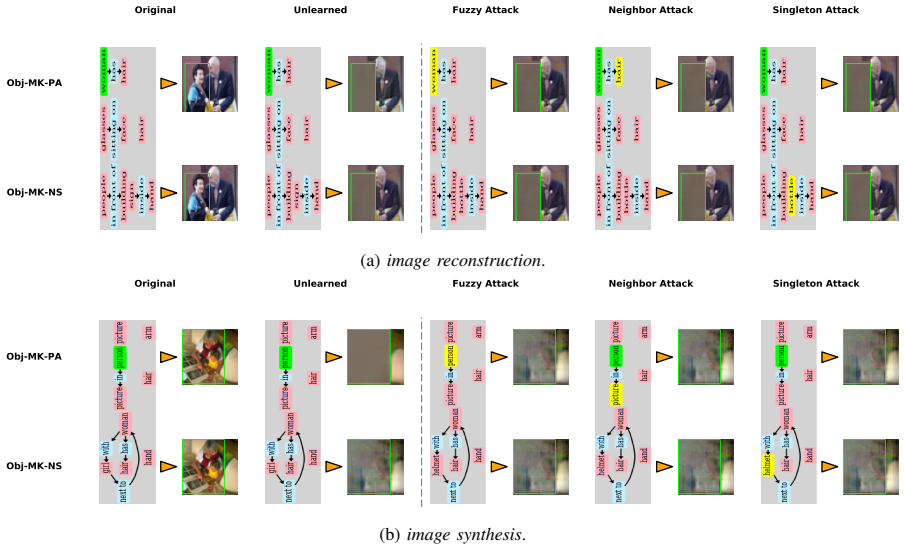
On the paper's own terms, the central discovery is that object-level unlearning can work by localizing the target object through the scene graph and then fine-tuning the generator against a masked version of that region. The paper formalizes object unlearning as the removal of a set of objects $\Delta O$, with two verification objectives: the unlearned model should not reproduce any $o \in \Delta O$ (effectiveness), and should preserve every retained object in the same sample and in other samples (utility). Across image reconstruction and image synthesis on an annotated image dataset, the two mask-based methods—patch masking and noise masking on the object's bounding box—achieve unlearning effectiveness comparable to sample unlearning but with markedly less collateral damage, and they outperform negative-guidance fine-tuning and influence-function redaction on both utility and stability. The paper also shows that three label-tampering query attacks cannot coax the unlearned object back out of the model.
Load-bearing premise
The load-bearing premise is that the scene graph's bounding box locates the requested object exactly; if the box is noisy or misses the object, the mask or noise hits the wrong pixels and unlearning either fails or damages neighbors.
Editorial extensions
If this is right
- A service provider can act on a request like "remove Tom from this photo" by fine-tuning against a masked copy of Tom's bounding box, rather than deleting every photo that contains Tom.
- The unlearned generator should no longer output the object in either reconstruction (when the original image is still supplied) or synthesis (when only a scene graph is supplied).
- Objects of the same category in other samples, such as two other men in a group photo, are largely retained, which neither sample unlearning nor feature unlearning achieves.
- The three query-based attacks tested—replacing the object's label with a broader label, modifying a neighbor node, or modifying an isolated node—do not resurrect the unlearned object.
- Fine-tuning-based unlearning runs in about one-thirtieth of the retraining time, while influence-function redaction runs faster but, in the paper's experiments, fails to balance effectiveness and utility.
Reading between the lines
- The paper's localization assumption is untested: an imperfect scene-graph generator that misses an object or draws a loose box would likely make the mask hit the wrong pixels, so the framework's practical robustness depends on external scene-graph quality.
- The same masking scheme could transfer to text or multimodal data, since a scene graph is agnostic to output modality; redaction of a named entity in a caption would be the analogous operation.
- Distance-based verification (SSIM, LPIPS, MAE) may understate privacy leakage: an object can be statistically different yet still visually recognizable, so a recognition-based audit could be a stricter test.
- Stronger adversaries than label-tampering queries, such as exploiting the difference between original and unlearned models, may be able to recover the removed object; the paper names this as a future concern.
Editorial analysis
A structured set of objections, weighed in public.
Referee Report
Summary. The paper proposes a scene graph-based framework for object-level machine unlearning in scene-graph-to-image (SG2I) generators. It formalizes object unlearning as the removal of a specific object instance from a generative model while preserving other objects in the same image and objects of the same category in other images. The framework uses scene graphs to localize the target object via its bounding box and introduces three unlearning methods: negative guidance fine-tuning (Obj-NG), mask-based fine-tuning with patch or noise masks (Obj-MK-PA, Obj-MK-NS), and influence-function-based partial model redaction (Obj-IF). The methods are evaluated against sample- and feature-level unlearning baselines on Visual Genome for image reconstruction and synthesis, using A1/A2/A3 distance metrics, latent-space t-SNE analyses, and indirect leakage attacks. The paper claims that Obj-MK-PA and Obj-MK-NS achieve satisfactory object removal while preserving model utility.
Significance. If the central claim were established, the paper would address a genuine gap: existing unlearning operates on whole samples or global features, whereas privacy requests such as removing one person from a group photo require object-instance-level forgetting. The scene-graph representation is a natural and transparent way to specify the target, and the systematic comparison across sample, feature, and object granularities is informative for the community. The paper also releases source code, which supports reproducibility. However, the significance is currently conditional because the evaluation does not directly test the paper's own success criterion: Eq. (1) requires that the removed object not appear in the generated output, while the reported A1 metrics only measure pixel-level distance between original and unlearned model outputs at the object ROI. This gap weakens the empirical support for the headline claim, so the contribution is not yet demonstrated at the level the paper asserts.
major comments (5)
- [§4 (Unlearning Verification Metrics) and §5 (Metrics)] The stated success criterion in Eq. (1) is that the unlearned model does not generate the removed object o in f_theta-(x), but the A1 metrics in Table 3 measure pixel-wise distance (SSIM/LPIPS/MAE) between the ROI produced by the original model and the ROI produced by the unlearned model. A large A1 distance is consistent with the object still being present but blurred, recolored, rescaled, or displaced; Section 7 explicitly concedes that metrics may show large distances while visual features of the unlearned objects remain highly recognizable. Because no object detector, classifier, or human evaluation is used to check whether the object is actually absent, the headline claim that Obj-MK-PA and Obj-MK-NS remove the requested object is not established by the reported evidence. Please add a direct presence/absence test, e.g., a pre-trained object detector or a classifier evaluated on the generated ROI, and report detection rates for removed versus retained objects.
- [§4.2, Eq. (5)] The A1 metric is the pixel-wise reconstruction discrepancy between the original and unlearned models' ROIs, and the negative guidance loss L_ng in Eq. (5) is exactly that ROI reconstruction loss, negated and added to the training objective. For Obj-NG, a large A1 distance is therefore partly by construction: the fine-tuning directly maximizes the discrepancy on the same pixels that A1 later measures. The mask-based methods similarly perturb the ROI during fine-tuning and are then evaluated on that same ROI. This circularity means A1 cannot serve as independent evidence of forgetting for these methods. An independent verification protocol (detection, classification, or human judgment) is needed to break the circularity and validate the central claim.
- [§4.2, Method 3 and Appendix A] The Obj-IF method assumes that zeroing the visual embedding z_v in the fused object embedding z_s = concat(z_v, z_b, z_o) in Eq. (9) removes the object's visual concept from the model, but this is an unvalidated modeling assumption; the influence function in Eq. (8) only estimates the parameter change induced by the loss computed under that zeroing. The ablation in Appendix A shows that redaction on different modules and different scalar values λ lead to very different outcomes, and the choice of λ (e.g., 1e-3 in Figure 11) is made by visually inspecting reconstructed images. This means the reported Obj-IF result is not a parameter-free benchmark, and the selection procedure is not specified as a reproducible rule. Please justify the z_v-nulling assumption with an experiment and define a principled, non-visual criterion for choosing λ.
- [§5 (Pre-processing) and §4.2] The framework relies on scene graph generation and bounding boxes to localize the requested object exactly; Section 3 assumes that every image invokes an established algorithm to generate a scene graph, and Section 4.2 states that each object is assigned a unique bounding box. However, no experiment tests robustness to imperfect scene graphs, missed objects, or loose bounding boxes. If the bounding box is imprecise, the mask in Obj-MK-PA/NS will either fail to cover the whole object or will perturb neighboring pixels, directly affecting both A1 and A2. Please include a robustness study with noisy or automatically generated scene graphs, for example by adding Gaussian noise to the bounding boxes or by using an off-the-shelf scene graph generator instead of ground-truth annotations.
- [§6.4 (Indirect Leakage Test)] The indirect leakage test is qualitative: Figure 7 presents only example images, but the text concludes that none of the three query attacks can make the model leak information about the unlearned object. This conclusion is based on visual inspection without any quantitative measure, such as detector confidence on the unlearned object, retrieval similarity, or a classification score. Please report a quantitative metric for each attack type so the robustness claim can be evaluated and compared across methods.
minor comments (4)
- [§3, Definition 1] Definition 1 defines ∆D but then refers to 'the set ∆O', which is not introduced there; the notation should be made consistent so that the relationship between the unlearning request qunl, ∆O, and ∆D is clear.
- [§5 (Unlearning Baselines)] There are several typos, including 'influence influence function' and 'adaptation' written as 'adapation'; a careful proofread is needed throughout.
- [§5 (Image Generation Training Settings)] The fine-tuning settings are under-specified: the text mentions 2000 epochs for pretraining and 200 epochs for unlearning fine-tuning, but does not report optimizer, learning rate, batch size, or the values of λ and noise σ used for the final results. Please provide these hyperparameters, ideally in an appendix.
- [Appendix A, Eq. (9)] The notation (fθg ◦ fθl ◦ fθd)(zs+) is confusing because the superscripts and composition order are not defined; please spell out which modules the notation refers to and how the partial redaction selects the GRL.
Circularity Check
The primary unlearning-effectiveness metric (A1) is the same ROI reconstruction objective used to train the proposed methods, so the headline result is partly forced by construction.
-
fitted input called prediction
[Section 4.2, Eq. (5)-(7); Section 5 Metrics A1; Section 7 Discussion]
"Lng = −λ · Σ_{Ii∈D} l(I′_{i,o}, I_{i,o}) (5) ... This loss function leads the generator to gradually remove the feature representation of the object. [Eq. 7:] θ− = arg min_θ Σ_{Ii∈D} l(f_θ(G_i, ˜I_i), ˜I_i). [A1:] We will compare the difference between the unlearned object generated by the original model and the unlearned model, to evaluate unlearning effectiveness ... Greater differences of this metric, indicate better unlearning performance of the requested object."
The paper defines unlearning success in Eq. (1) as the removed object being absent from the unlearned model's output (o ∉ f_θ−(x)). However, the main evaluation metric A1 measures the pixel-wise or perceptual distance between the original model's ROI for the unlearned object and the unlearned model's ROI for that same object. Obj-NG trains by directly maximizing that ROI reconstruction error (Eq. 5), and Obj-MK-PA/Obj-MK-NS train the model to reproduce a masked or noised ROI (Eq. 7). Thus, a large A1 distance is a direct readout of the training objective, not an independent test of whether the object is actually gone. The paper itself concedes in Section 7 that large metric distances can coexist with highly recognizable objects, so A1 does not establish the Eq. (1) condition.
-
fitted input called prediction
[Appendix A, 'Influence of Redaction with Different Scalars'; Figure 11 and surrounding text]
"In this experiment, we explore the Influence of Redaction with Different Scalars ... The results shown in Figure 11 demonstrate the impact of varying scalar multiplier λ on the unlearning performance ... As λ increases from 1e−7 to 1, the unlearning effect becomes more pronounced ... A balanced choice of λ, such as in the mid-range values (e.g., 1e−3), allows for sufficient unlearning while preserving the quality of the remaining features in the scene."
The scalar multiplier λ in the influence-function method Obj-IF is selected after visually inspecting the ablation outputs (Figure 11) to find a value that yields 'sufficient unlearning' while preserving quality. Because λ is tuned to produce the desired behavior on the evaluation outputs, the reported performance of Obj-IF at the chosen λ is partly a selection artifact rather than a prediction from a fixed procedure. This is a milder form of circularity than the A1 issue, but it means the reported efficacy of Obj-IF is not independently derived; it is chosen to match the desired result. The paper does not specify a held-out validation set or a pre-registered λ, so the reported numbers are not a prediction from an immutable algorithm.
full rationale
The paper's derivation chain is not mathematically circular in the sense of proving a theorem from itself, but the main empirical evidence for object unlearning is constructed to match the training objective. Specifically, the A1 metric measures the difference between the original and unlearned models' outputs in the ROI of the unlearned object, which is exactly the quantity that negative guidance (Eq. 5) and masking fine-tuning (Eq. 7) directly optimize. Thus, reporting A1 as evidence of forgetting is essentially reporting the training loss, and the paper even acknowledges that large A1 distances do not guarantee that the object is visually absent. The A2 and A3 metrics, which measure preservation of other objects and other samples, are more independent and do provide some utility-preservation evidence. However, the headline claim of effective unlearning rests on A1, so the central result is partially circular. Additionally, the choice of the λ scalar in Obj-IF is made after inspecting ablation results, further reducing the predictive content of that method's reported performance. Overall, the paper makes a useful contribution in proposing scene-graph-based localization and masking, but its verification of the primary unlearning goal is not independent of the training procedure. Score 6 reflects that partial circularity; it is not a complete reduction because the framework does include external evaluation dimensions (A2, A3, latent-space analysis, indirect leakage tests) that test other desiderata.
Assumptions & free parameters
free parameters (5)
- lambda (negative guidance weight) =
not specified in main text; ablation spans 1e-7 to 1 in Figure 11
- lambda (Obj-IF redaction scalar) =
not specified; a balanced choice around 1e-3 is suggested in Appendix A
- noise sigma for Obj-MK-NS =
not stated
- vocabulary and image filtering thresholds =
not stated (predetermined threshold and minimum size)
- optimizer, learning rate, and batch size =
not stated
assumptions (5)
- domain assumption Accurate scene graphs and bounding boxes are available for every image.
- domain assumption The MLaaS provider has white-box access to the trained model and training data.
- standard math The Hessian H_theta* is invertible and the influence function approximation from [19] applies to the SG2I generator.
- ad hoc to paper Nulling the visual embedding zv of an object removes that object's visual concept from the model.
- domain assumption PII in images is adequately represented by nine human-related object labels.
Cite this review
Pith. "Pith review of Targeted Therapy in Data Removal: Object Unlearning Based on Scene Graphs." pith.science (2026). https://pith.science/paper/U4BOIOC2
@misc{pith2026241200067,
  author       = {Pith},
  title        = {Pith review of: Targeted Therapy in Data Removal: Object Unlearning Based on Scene Graphs},
  year         = {2026},
  howpublished = {\url{https://pith.science/paper/U4BOIOC2}},
  note         = {Machine review of arXiv:2412.00067}
}
read the original abstract
Users may inadvertently upload personally identifiable information (PII) to Machine Learning as a Service (MLaaS) providers. When users no longer want their PII on these services, regulations like GDPR and COPPA mandate a right to forget for these users. As such, these services seek efficient methods to remove the influence of specific data points. Thus the introduction of machine unlearning. Traditionally, unlearning is performed with the removal of entire data samples (sample unlearning) or whole features across the dataset (feature unlearning). However, these approaches are not equipped to handle the more granular and challenging task of unlearning specific objects within a sample. To address this gap, we propose a scene graph-based object unlearning framework. This framework utilizes scene graphs, rich in semantic representation, transparently translate unlearning requests into actionable steps. The result, is the preservation of the overall semantic integrity of the generated image, bar the unlearned object. Further, we manage high computational overheads with influence functions to approximate the unlearning process. For validation, we evaluate the unlearned object's fidelity in outputs under the tasks of image reconstruction and image synthesis. Our proposed framework demonstrates improved object unlearning outcomes, with the preservation of unrequested samples in contrast to sample and feature learning methods. This work addresses critical privacy issues by increasing the granularity of targeted machine unlearning through forgetting specific object-level details without sacrificing the utility of the whole data sample or dataset feature.
Figures


Figures from the paper (9 more)




Reference graph
Works this paper leans on
-
[1]
Children’s Online Privacy Protection Rule (COPPA),
“Children’s Online Privacy Protection Rule (COPPA),” https://www.ftc.gov/enforcement/ rules/rulemaking-regulatory-reform-proceedings/ childrens-online-privacy-protection-rule, 1998, accessed: 2020- 02-14
work page 1998
-
[2]
General Data Protection Regulation (GDPR),
“General Data Protection Regulation (GDPR),” https://gdpr-info.eu/, 2018, accessed: 2020-02-14
work page 2018
-
[3]
Proposal for an ePrivacy Regulation,
“Proposal for an ePrivacy Regulation,” https://ec.europa.eu/ digital-single-market/en/proposal-eprivacy-regulation, 2019, accessed: 2020-02-14
work page 2019
-
[4]
California Consumer Privacy Act (CCPA),
“California Consumer Privacy Act (CCPA),” https://oag.ca.gov/ privacy/ccpa, 2020, accessed: 2020-02-14
work page 2020
-
[5]
Towards making systems forget with machine unlearning,
Y . Cao and J. Yang, “Towards making systems forget with machine unlearning,” in IEEE Symposium on Security and Privacy . IEEE Computer Society, 2015, pp. 463–480
work page 2015
-
[6]
Variational bayesian unlearning,
Q. P. Nguyen, B. K. H. Low, and P. Jaillet, “Variational bayesian unlearning,” Advances in Neural Information Processing Systems , vol. 33, pp. 16 025–16 036, 2020
work page 2020
-
[7]
V . Gupta, C. Jung, S. Neel, A. Roth, S. Sharifi-Malvajerdi, and C. Waites, “Adaptive machine unlearning,” Advances in Neural In- formation Processing Systems , vol. 34, pp. 16 319–16 330, 2021
work page 2021
-
[8]
On the necessity of auditable algorithmic definitions for machine unlearning,
A. Thudi, H. Jia, I. Shumailov, and N. Papernot, “On the necessity of auditable algorithmic definitions for machine unlearning,” in USENIX Security Symposium. USENIX Association, 2022, pp. 4007–4022
work page 2022
Show all 52 references
-
[9]
Machine unlearning for im- age retrieval: A generative scrubbing approach,
P. Zhang, G. Bai, Z. Huang, and X. Xu, “Machine unlearning for im- age retrieval: A generative scrubbing approach,” in ACM Multimedia. ACM, 2022, pp. 237–245
2022
-
[10]
Machine unlearning,
L. Bourtoule, V . Chandrasekaran, C. A. Choquette-Choo, H. Jia, A. Travers, B. Zhang, D. Lie, and N. Papernot, “Machine unlearning,” in SP. IEEE, 2021, pp. 141–159
2021
-
[12]
Feature unlearning for pre-trained gans and vaes,
S. Moon, S. Cho, and D. Kim, “Feature unlearning for pre-trained gans and vaes,” in Thirty-Eighth AAAI Conference on Artificial Intelligence, AAAI 2024, Thirty-Sixth Conference on Innovative Applications of Artificial Intelligence, IAAI 2024, Fourteenth Symposium on Educationa...
2024
-
[13]
Image generation from scene graphs,
J. Johnson, A. Gupta, and L. Fei-Fei, “Image generation from scene graphs,” in 2018 IEEE Conference on Computer Vision and Pattern Recognition, CVPR 2018, Salt Lake City, UT, USA, June 18-22, 2018 . Computer Vision Foundation / IEEE Computer Society, 2018, pp. 1219–1228. [Onli...
2018
-
[14]
Scene graph generation: A comprehensive survey,
H. Li, G. Zhu, L. Zhang, Y . Jiang, Y . Dang, H. Hou, P. Shen, X. Zhao, S. A. A. Shah, and M. Bennamoun, “Scene graph generation: A comprehensive survey,” Neurocomputing, vol. 566, p. 127052, 2024. [Online]. Available: https://doi.org/10.1016/j.neucom.2023.127052
2024
-
[15]
The right to be forgotten,
J. Rosen, “The right to be forgotten,” Stan. L. Rev. Online , vol. 64, p. 88, 2011
2011
-
[16]
The california consumer privacy act: Towards a european-style privacy regime in the united states,
S. L. Pardau, “The california consumer privacy act: Towards a european-style privacy regime in the united states,” J. Tech. L. & Pol’y, vol. 23, p. 68, 2018
2018
-
[17]
Graph unlearning,
M. Chen, Z. Zhang, T. Wang, M. Backes, M. Humbert, and Y . Zhang, “Graph unlearning,” in Proc. ACM SIGSAC Conference on Computer and Communications Security , 2022, pp. 499–513
2022
-
[18]
Gnndelete: A general unlearning strategy for graph neural networks,
J. Cheng, G. Dasoulas, H. He, C. Agarwal, and M. Zitnik, “Gnndelete: A general unlearning strategy for graph neural networks,” in Proc. International Conference on Learning Representations , 2023
2023
-
[19]
Gif: A general graph unlearning strategy via influence function,
J. Wu, Y . Yang, Y . Qian, Y . Sui, X. Wang, and X. He, “Gif: A general graph unlearning strategy via influence function,” in Proceedings of the ACM Web Conference 2023 , 2023, pp. 651–661
2023
-
[20]
Unlearning graph classifiers with limited data resources,
C. Pan, E. Chien, and O. Milenkovic, “Unlearning graph classifiers with limited data resources,” in Proceedings of the ACM Web Con- ference 2023, 2023, pp. 716–726
2023
-
[21]
Certified edge unlearning for graph neural networks,
K. Wu, J. Shen, Y . Ning, T. Wang, and W. H. Wang, “Certified edge unlearning for graph neural networks,” in Proceedings of the 29th ACM SIGKDD Conference on Knowledge Discovery and Data Mining, 2023, pp. 2606–2617
2023
-
[22]
Inductive graph unlearning,
C. Wang, M. Huai, and D. Wang, “Inductive graph unlearning,” in USENIX Security Symposium . USENIX Association, 2023, pp. 3205–3222
2023
-
[23]
Data redaction from pre-trained gans,
Z. Kong and K. Chaudhuri, “Data redaction from pre-trained gans,” in 2023 IEEE Conference on Secure and Trustworthy Machine Learning, SaTML 2023, Raleigh, NC, USA, February 8-10, 2023 . IEEE, 2023, pp. 638–677. [Online]. Available: https://doi.org/10.1109/SaTML54575.2023.00048
2023
-
[24]
Machine unlearning of features and labels,
A. Warnecke, L. Pirch, C. Wressnegger, and K. Rieck, “Machine unlearning of features and labels,” in 30th Annual Network and Distributed System Security Symposium, NDSS 2023, San Diego, California, USA, February 27 - March 3, 2023 . The Internet Society, 2023. [Online]. Availa...
2023
-
[25]
Forget-me-not: Learning to forget in text-to-image diffusion models,
E. J. Zhang, K. Wang, X. Xu, Z. Wang, and H. Shi, “Forget-me-not: Learning to forget in text-to-image diffusion models,” CoRR, vol. abs/2303.17591, 2023. [Online]. Available: https://doi.org/10.48550/arXiv.2303.17591
-
[26]
Learn what you want to unlearn: Unlearning inversion attacks against machine unlearning,
H. Hu, S. Wang, T. Dong, and M. Xue, “Learn what you want to unlearn: Unlearning inversion attacks against machine unlearning,” CoRR, vol. abs/2404.03233, 2024. [Online]. Available: https://doi.org/10.48550/arXiv.2404.03233
-
[27]
Unlearncanvas: A stylized image dataset to benchmark machine unlearning for diffusion models,
Y . Zhang, Y . Zhang, Y . Yao, J. Jia, J. Liu, X. Liu, and S. Liu, “Unlearncanvas: A stylized image dataset to benchmark machine unlearning for diffusion models,” CoRR, vol. abs/2402.11846, 2024. [Online]. Available: https://doi.org/10.48550/arXiv.2402.11846
-
[28]
Efficient attribute unlearning: Towards selective removal of input attributes from feature representations,
T. Guo, S. Guo, J. Zhang, W. Xu, and J. Wang, “Efficient attribute unlearning: Towards selective removal of input attributes from feature representations,” arXiv preprint arXiv:2202.13295 , 2022
2022 arXiv
-
[29]
Multimodal image synthesis and editing: The generative AI era,
F. Zhan, Y . Yu, R. Wu, J. Zhang, S. Lu, L. Liu, A. Kortylewski, C. Theobalt, and E. P. Xing, “Multimodal image synthesis and editing: The generative AI era,” IEEE Trans. Pattern Anal. Mach. Intell., vol. 45, no. 12, pp. 15 098–15 119, 2023. [Online]. Available: https://doi.or...
2023
-
[31]
Stablevideo: Text- driven consistency-aware diffusion video editing,
W. Chai, X. Guo, G. Wang, and Y . Lu, “Stablevideo: Text- driven consistency-aware diffusion video editing,” in IEEE/CVF International Conference on Computer Vision, ICCV 2023, Paris, France, October 1-6, 2023 . IEEE, 2023, pp. 22 983–22 993. [Online]. Available: https://doi.o...
2023
-
[32]
Face privacy protection based on attribute manipulation,
J. Wang, J. Wang, J. Gan, and J. Zhou, “Face privacy protection based on attribute manipulation,” in ICIT 2021: IoT and Smart City, Guangzhou, China, December 22 - 25, 2021 . ACM, 2021, pp. 185–
2021
-
[33]
Deepfakes for medical video de-identification: Privacy protection and diagnostic information preservation,
B. Zhu, H. Fang, Y . Sui, and L. Li, “Deepfakes for medical video de-identification: Privacy protection and diagnostic information preservation,” in AIES ’20: AAAI/ACM Conference on AI, Ethics, and Society, New York, NY, USA, February 7-8, 2020 , A. N. Markham, J. Powles, T. W...
2020
-
[34]
Pro-face: A generic framework for privacy-preserving recognizable obfuscation of face images,
L. Yuan, L. Liu, X. Pu, Z. Li, H. Li, and X. Gao, “Pro-face: A generic framework for privacy-preserving recognizable obfuscation of face images,” in MM ’22: The 30th ACM International Conference on Multimedia, Lisboa, Portugal, October 10 - 14, 2022 , J. Magalh ˜aes, A. D. Bim...
2022
-
[36]
3d-aware adversarial makeup generation for facial privacy protection,
Y . Lyu, Y . Jiang, Z. He, B. Peng, Y . Liu, and J. Dong, “3d-aware adversarial makeup generation for facial privacy protection,” IEEE Trans. Pattern Anal. Mach. Intell. , vol. 45, no. 11, pp. 13 438– 13 453, 2023. [Online]. Available: https://doi.org/10.1109/TPAMI. 2023.3290175
2023
-
[37]
A comprehensive survey of scene graphs: Generation and application,
X. Chang, P. Ren, P. Xu, Z. Li, X. Chen, and A. Hauptmann, “A comprehensive survey of scene graphs: Generation and application,” IEEE Trans. Pattern Anal. Mach. Intell. , vol. 45, no. 1, pp. 1– 26, 2023. [Online]. Available: https://doi.org/10.1109/TPAMI.2021. 3137605
2023 doi
-
[38]
Interactive image generation using scene graphs,
G. Mittal, S. Agrawal, A. Agarwal, S. Mehta, and T. Marwah, “Interactive image generation using scene graphs,” in Deep Generative Models for Highly Structured Data, ICLR 2019 Workshop, New Orleans, Louisiana, United States, May 6, 2019 . OpenReview.net, 2019. [Online]. Availab...
2019
-
[39]
Using scene graph context to improve image generation,
S. Tripathi, A. Bhiwandiwalla, A. Bastidas, and H. Tang, “Using scene graph context to improve image generation,” CoRR, vol. abs/1901.03762, 2019. [Online]. Available: http: //arxiv.org/abs/1901.03762
1901 arXiv
-
[40]
Image generation from layout,
B. Zhao, L. Meng, W. Yin, and L. Sigal, “Image generation from layout,” in IEEE Conference on Computer Vision and Pattern Recognition, CVPR 2019, Long Beach, CA, USA, June 16-20, 2019 . Computer Vision Foundation / IEEE, 2019, pp. 8584–8593. [Online]. Available: http://openacc...
2019
-
[41]
Semantic image manipulation using scene graphs,
H. Dhamo, A. Farshad, I. Laina, N. Navab, G. D. Hager, F. Tombari, and C. Rupprecht, “Semantic image manipulation using scene graphs,” in 2020 IEEE/CVF Conference on Computer Vision and Pattern Recognition, CVPR 2020, Seattle, WA, USA, June 13-19,
2020
-
[42]
Triplet-aware scene graph embeddings,
B. Schroeder, S. Tripathi, and H. Tang, “Triplet-aware scene graph embeddings,” in 2019 IEEE/CVF International Conference on Computer Vision Workshops, ICCV Workshops 2019, Seoul, Korea (South), October 27-28, 2019 . IEEE, 2019, pp. 1783–1787. [Online]. Available: https://doi....
2019
-
[43]
Learning canonical representations for scene graph to image generation,
R. Herzig, A. Bar, H. Xu, G. Chechik, T. Darrell, and A. Globerson, “Learning canonical representations for scene graph to image generation,” in Computer Vision - ECCV 2020 - 16th European Conference, Glasgow, UK, August 23-28, 2020, Proceedings, Part XXVI , ser. Lecture Notes...
2020 doi
-
[45]
Photographic image synthesis with cascaded refinement networks,
Q. Chen and V . Koltun, “Photographic image synthesis with cascaded refinement networks,” in IEEE International Conference on Computer Vision, ICCV 2017, Venice, Italy, October 22-29, 2017 . IEEE Computer Society, 2017, pp. 1520–1529. [Online]. Available: https://doi.org/10.11...
2017 doi
-
[46]
Semantic image synthesis with spatially-adaptive normalization,
T. Park, M. Liu, T. Wang, and J. Zhu, “Semantic image synthesis with spatially-adaptive normalization,” in IEEE Conference on Computer Vision and Pattern Recognition, CVPR 2019, Long Beach, CA, USA, June 16-20, 2019 . Computer Vision Foundation / IEEE, 2019, pp. 2337–2346. [On...
2019
-
[47]
Layoutdiffusion: Controllable diffusion model for layout-to-image generation,
G. Zheng, X. Zhou, X. Li, Z. Qi, Y . Shan, and X. Li, “Layoutdiffusion: Controllable diffusion model for layout-to-image generation,” in IEEE/CVF Conference on Computer Vision and Pattern Recognition, CVPR 2023, Vancouver, BC, Canada, June 17-24, 2023 . IEEE, 2023, pp. 22 490–...
2023
-
[48]
Machine unlearning in generative AI: A survey,
Z. Liu, G. Dou, Z. Tan, Y . Tian, and M. Jiang, “Machine unlearning in generative AI: A survey,” CoRR, vol. abs/2407.20516, 2024
2024 arXiv
-
[49]
A survey of graph unlearning,
A. Said, T. Derr, M. Shabbir, W. Abbas, and X. Koutsoukos, “A survey of graph unlearning,” arXiv preprint arXiv:2310.02164, 2023
2023
-
[50]
Visual genome: Connecting language and vision using crowdsourced dense image annotations,
R. Krishna, Y . Zhu, O. Groth, J. Johnson, K. Hata, J. Kravitz, S. Chen, Y . Kalantidis, L. Li, D. A. Shamma, M. S. Bernstein, and L. Fei-Fei, “Visual genome: Connecting language and vision using crowdsourced dense image annotations,” Int. J. Comput. Vis., vol. 123, no. 1, pp....
2017 doi
-
[51]
Very deep convolutional networks for large-scale image recognition,
K. Simonyan and A. Zisserman, “Very deep convolutional networks for large-scale image recognition,” in ICLR, 2015
2015
-
[52]
The unreasonable effectiveness of deep features as a perceptual metric,
R. Zhang, P. Isola, A. A. Efros, E. Shechtman, and O. Wang, “The unreasonable effectiveness of deep features as a perceptual metric,” in CVPR. Computer Vision Foundation / IEEE Computer Society, 2018, pp. 586–595
2018
-
[53]
When machine unlearning jeopardizes privacy,
M. Chen, Z. Zhang, T. Wang, M. Backes, M. Humbert, and Y . Zhang, “When machine unlearning jeopardizes privacy,” in CCS. ACM, 2021, pp. 896–911
2021
-
[54]
Fast exact multiplication by the hessian,
B. A. Pearlmutter, “Fast exact multiplication by the hessian,” Neural Comput., vol. 6, no. 1, pp. 147–160, 1994. Appendix A. Details of Obj-IF Method. In OBJ-IF, calculating L∆O is challenging as we cannot naively express it as L∆O = P Ii∈∆O l (fθ∗ (Gi, Ii) , Ii). In this form...
1994
-
[188]
Available: https://doi.org/10.1145/3512576.3512609
[Online]. Available: https://doi.org/10.1145/3512576.3512609
-
[2020]
5212–5221
Computer Vision Foundation / IEEE, 2020, pp. 5212–5221. [Online]. Available: https://openaccess.thecvf.com/content CVPR 2020/html/Dhamo Semantic Image Manipulation Using Scene Graphs CVPR 2020 paper.html
2020
Reviewed August 12, 2026 · model on record in the stance chip above.
Discussion (0). Continue with ORCID to comment.