REVIEW 4 major objections 4 minor 18 references
Addressing Vulnerabilities in AI-Image Detection: Challenges and Proposed Solutions
T0 review · 4 major / 4 minor · reviewed 2026-08-12 · deepseek-v4-flash
Pith's one-line read CNN-based AI-image detectors are robust to prompt changes but break under Gaussian blur and generator upgrades; DenseNet121 restores much of the lost accuracy.
desk verdict A useful new benchmark with stark robustness failures, but the DenseNet mitigation claim is compromised by a table that contradicts the paper's own earlier numbers. read the letter →
The pith
A machine-rendered reading of the paper's core claim, the machinery that carries it, and where it could break.
The reading
What carries the argument
The central object is DenseNet121's dense connectivity, where each layer receives the feature maps of all preceding layers, combined with transition layers that compress accumulated features. This architecture gives the detector access to both low-level texture cues and high-level semantics, and it regularizes training enough that blur does not wipe out the cues. The paper contrasts this with the original two-convolutional-layer CNN baseline, which learns a shallower, more brittle fingerprint. The argument is carried by head-to-head accuracy tables on the same CIFAKE-derived datasets.
What would settle it
Retrain the CNN and DenseNet on the same CIFAKE-SD2.1 split, evaluate both on the blur and LoRA datasets, and check the exact fake-image accuracies (CNN 49.90% blurred and 78.18% LoRA; DenseNet 75.18% blurred). If DenseNet does not beat CNN on blurred data, or the CNN does not fall to chance under blur, the central robustness-mitigation claim fails.
Extended reading notes
Core claim
The central claim is a vulnerability map: CNN-based detectors trained on one Stable Diffusion version memorize version-specific fingerprints. The paper supports this with cross-dataset tests: a model trained on CIFAKE-SD2.1 scores 95.23% overall on its own data but 81.89% on CIFAKE (SD1.4) and 84.30% on CIFAKE-SD3.0; fake-image accuracy drops from 98.10% to 71.42% and 76.24%. Gaussian blur with radius 5 and σ = 1.1 destroys the fingerprint, reducing fake-image detection to 49.90%, chance. LoRA fine-tuning on MIT-Adobe FiveK reduces fake accuracy to 78.18%. In contrast, prompt variants (including GPT-4o and negative prompts) and native-resolution images cost only a few points. DenseNet121, tested under the same protocol, reaches 86.88% overall and 75.18% fake accuracy on blurred data and generally beats the CNN on clean cross-version data, supporting the paper's proposed mitigation.
Load-bearing premise
The conclusion that DenseNet is consistently more robust than the CNN rests on the assumption that the CNN baseline numbers in Table 9 were produced by a CIFAKE-SD2.1-trained model on the same splits as DenseNet; if that table is wrong, and it conflicts with the earlier Table 3, the central mitigation claim collapses.
Editorial extensions
If this is right
- Detector evaluation should treat generator-version shift, Gaussian blur, and LoRA fine-tuning as standard perturbations; the reported drops show that clean accuracy alone overstates real-world reliability.
- Switching to DenseNet-style architectures is a low-cost robustness intervention that does not require retraining on adversarial examples.
- Prompt variation is not the main attack surface: fixed-template training transfers to varied and negative prompts.
- Model-update monitoring matters: a detector that works today can degrade substantially when the generator is upgraded, so deployed detectors need continuous re-evaluation.
Reading between the lines
- Going beyond the paper: if version-specific fingerprints are the failure mechanism, training on mixed-generator data or adding generator-version augmentation should recover much of the lost accuracy; this is directly testable.
- Going beyond the paper: LoRA is cheap and accessible, so a realistic threat model includes attacker-controlled fine-tuning; detectors trained with blur and LoRA augmentations may be substantially harder to fool.
- Going beyond the paper: the same logic applies beyond Stable Diffusion; any rapidly evolving generator family, including GANs, should be evaluated with version-shift and post-processing tests.
Editorial analysis
A structured set of objections, weighed in public.
Referee Report
Summary. The paper evaluates a CNN-based AI-image detector (Bird and Lotfi's CIFAKE classifier) on CIFAKE variants generated with Stable Diffusion 1.4, 2.1, and 3.0, as well as on versions subjected to Gaussian blurring, prompt changes, negative prompts, resolution changes, and a custom LoRA fine-tune. It reports that the CNN is robust to prompt and resolution variations but vulnerable to generator-version shifts, blur, and LoRA tuning, and it proposes a modified DenseNet121 as a more robust detector. The main empirical results include a version-overfitting matrix (Table 3), a stark blur-induced collapse of fake-image accuracy from 98.10% to 49.90% (Table 4), a LoRA-induced drop to 78.18% (Table 8), and a claimed DenseNet improvement (Tables 9-10).
Significance. If the findings hold, the paper is a useful measurement of detector fragility under realistic generator evolution and is notable for shipping public code and datasets. The version-overfitting matrix in Table 3 is internally coherent, the blur result in Table 4(b) is a striking and falsifiable observation, and the DenseNet proposal is a concrete, low-cost architectural mitigation. However, the significance is conditional because the central DenseNet comparison in Table 9 is internally inconsistent and because the absence of variance estimates and training details prevents the reader from distinguishing real robustness gains from run-to-run noise or unreported hyperparameter choices.
major comments (4)
- [Table 9 (Section 4.2)] The CNN baseline row in Table 9 is not the CIFAKE-SD2.1-trained model stated in the header. The printed CNN values (93.67, 95.23, 96.84) are exactly the diagonal of Table 3(a), i.e., three different models each trained and tested on the same dataset. The actual CIFAKE-SD2.1-trained CNN row from Table 3(a) is (81.89, 95.23, 84.30). Consequently, the DenseNet-versus-CNN deltas reported for CIFAKE and CIFAKE-SD3.0 are comparing against the wrong baselines, and the claim in Section 5 that DenseNet 'outperformed the CNN model across all evaluation scenarios' is not supported by the table as printed. A corrected baseline, evaluated on identical splits and with the same protocol, is required before the DenseNet mitigation claim can be assessed.
- [Section 4.2, DenseNet experiments (Tables 9-10)] No training details are given for the DenseNet121 models: the paper does not report epochs, learning rate, batch size, optimizer, data augmentation, or the exact architectural modifications beyond a generic Figure 2. Since the CNN hyperparameters are specified in Section 3, the absence of the corresponding DenseNet hyperparameters makes the headline comparison unreproducible and leaves open the possibility that the reported gains are due to different training schedules rather than the architecture.
- [Section 4.2, Tables 3-10] Every accuracy reported in the paper is a single run with no standard deviation, confidence interval, or number of seeds. Several conclusions, such as prompt invariance (Table 6: 95.23 vs. 95.36 vs. 95.26) and image-size insensitivity (Table 5: a 1.33-point drop), rest on differences that are smaller than typical run-to-run variation for small 32x32 classifiers. Repeated trials or error bars are needed to distinguish genuine robustness from stochasticity.
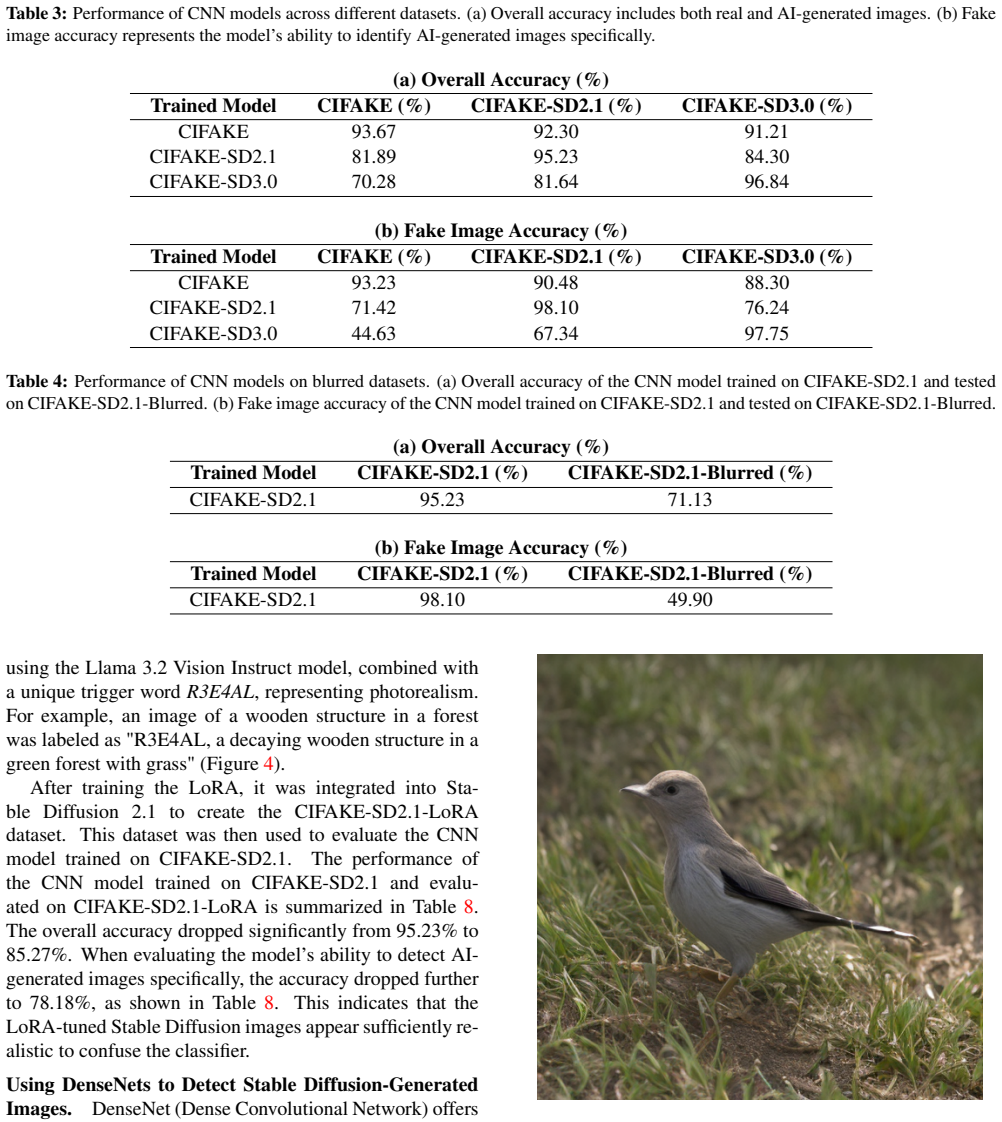
- [Section 4.2, CIFAKE-SD2.1-LoRA] The LoRA experiment is presented as evidence that fine-tuning degrades detection, but the LoRA configuration is underspecified: no rank, learning rate, number of steps, or validation of the photorealism effect are reported. The paper also asserts without justification that the MIT-Adobe FiveK LoRA is representative of adversarial photorealism fine-tuning. As printed, the result in Table 8 describes only this one custom configuration and cannot support the general claim that 'LoRA can effectively tune Stable Diffusion' to evade detectors.
minor comments (4)
- [Section 4, first paragraph] The sentence 'Code and is available at ...' contains a grammar error; it should read 'Code is available at ...'.
- [Section 5, Using DenseNets] The text says 'Table 9 and 9 combine results for DenseNet and CNN models'; this should refer to Tables 9 and 10, and the typo should be fixed.
- [Section 4, Equation (1)] The Gaussian blur sigma formula is malformed as printed. The standard OpenCV sigma formula is sigma = 0.3*((ksize-1)*0.5 - 1) + 0.8; please ensure the reported sigma value and the implementation match.
- [Section 2.1] The claim that the original CIFAKE study 'did not provide details on key training parameters' is contradicted by the paper's later statement that missing details were filled with 'reasonable assumptions'; acknowledging this explicitly would clarify the scope of the replication claim.
Circularity Check
No circularity found; the paper's results are direct measurements, with an internal Table 9 baseline inconsistency noted as a correctness concern rather than a circular step.
full rationale
This is an empirical benchmarking paper rather than a derivation. The central claims — CNN accuracy drops under Stable Diffusion version shifts, Gaussian blurring, and LoRA fine-tuning, while DenseNet121 improves robustness — are direct measurements on independently generated test sets (CIFAKE-SD2.1, CIFAKE-SD3.0, CIFAKE-SD2.1-Blurred, CIFAKE-SD2.1-LoRA, etc.), not quantities derived by definition from fitted parameters. No parameter is fitted to the reported target accuracies; the 15-epoch choice is calibrated against the external CIFAKE baseline (92.93% from Bird and Lotfi), which is legitimate replication/calibration rather than circular prediction. There are no self-citations from the author's prior work, no invoked uniqueness theorems, and no ansatz smuggled in via citation. The main evidential concern is an internal data inconsistency: Table 9's CNN row (93.67, 95.23, 96.84) reproduces the diagonal of Table 3(a), not the CIFAKE-SD2.1-trained CNN row from Table 3(a), which is (81.89, 95.23, 84.30). That undermines the DenseNet-versus-CNN comparison but is an accuracy/correctness issue, not circularity: the DenseNet numbers are not constructed to equal the CNN baseline, and the claim is a measured comparison rather than a derivation. Table 10's blur comparison is consistent with Table 4 and is less affected. Under the review rule, an inconsistency is flagged but does not elevate the circularity score. Verdict: no significant circularity.
Assumptions & free parameters
free parameters (6)
- Training epochs =
15
- Learning rate =
1e-3
- Batch size =
1000
- Gaussian blur kernel radius =
5 pixels, sigma 1.1
- Standardized generation resolution =
512x512 before 32x32 downscale
- LoRA training hyperparameters =
not reported
assumptions (5)
- domain assumption The generated dataset variants contain exactly 60,000 correctly generated AI images matching their descriptions.
- domain assumption CNN and DenseNet are trained and tested on identical data and preprocessing.
- domain assumption Accuracies from single runs are stable enough to support conclusions like Table 6's 95.23 vs 95.36.
- ad hoc to paper The custom LoRA is a realistic stand-in for adversarial photorealism fine-tuning.
- domain assumption Downscaling high-resolution generations to 32x32 preserves detection-relevant fingerprints.
Cite this review
Pith. "Pith review of Addressing Vulnerabilities in AI-Image Detection: Challenges and Proposed Solutions." pith.science (2026). https://pith.science/paper/AXYELBSG
@misc{pith2026241200073,
  author       = {Pith},
  title        = {Pith review of: Addressing Vulnerabilities in AI-Image Detection: Challenges and Proposed Solutions},
  year         = {2026},
  howpublished = {\url{https://pith.science/paper/AXYELBSG}},
  note         = {Machine review of arXiv:2412.00073}
}
read the original abstract
The rise of advanced AI models like Generative Adversarial Networks (GANs) and diffusion models such as Stable Diffusion has made the creation of highly realistic images accessible, posing risks of misuse in misinformation and manipulation. This study evaluates the effectiveness of convolutional neural networks (CNNs), as well as DenseNet architectures, for detecting AI-generated images. Using variations of the CIFAKE dataset, including images generated by different versions of Stable Diffusion, we analyze the impact of updates and modifications such as Gaussian blurring, prompt text changes, and Low-Rank Adaptation (LoRA) on detection accuracy. The findings highlight vulnerabilities in current detection methods and propose strategies to enhance the robustness and reliability of AI-image detection systems.
Figures


Figures from the paper (1 more)
Reference graph
Works this paper leans on
-
[13]
D. Park, H. Na, and D. Choi. Performance comparison and visualization of ai-generated-image detection methods.IEEE Access, 12:62609–62627, 2024. 2
work page 2024
-
[1]
https://huggingface.co/datasets/ dragonintelligence/CIFAKE-image-dataset/ viewer
dragonintelligence/CIFAKE-image-dataset · Datasets at Hugging Face — huggingface.co. https://huggingface.co/datasets/ dragonintelligence/CIFAKE-image-dataset/ viewer. [Accessed 23-11-2024]. 1, 4
work page 2024
-
[2]
https://huggingface.co/ stabilityai/stable-diffusion-2-1
stabilityai/stable-diffusion-2-1 · Hugging Face — huggingface.co. https://huggingface.co/ stabilityai/stable-diffusion-2-1 . [Ac- cessed 24-11-2024]. 4
work page 2024
-
[3]
https://huggingface.co/ stabilityai/stable-diffusion-3-medium
stabilityai/stable-diffusion-3-medium · Hugging Face — huggingface.co. https://huggingface.co/ stabilityai/stable-diffusion-3-medium . [Accessed 24-11-2024]. 4
work page 2024
-
[4]
S. K. Alhabeeb and A. A. Al-Shargabi. Text-to-image syn- thesis with generative models: Methods, datasets, perfor- mance metrics, challenges, and future direction. IEEE Ac- cess, 12:24412–24427, 2024. 2
work page 2024
-
[5]
J. J. Bird and A. Lotfi. Cifake: Image classification and explainable identification of ai-generated synthetic images,
-
[6]
V . Bychkovsky, S. Paris, E. Chan, and F. Durand. Learn- ing photographic global tonal adjustment with a database of input / output image pairs. In The Twenty-Fourth IEEE Con- ference on Computer Vision and Pattern Recognition, 2011. 5
work page 2011
-
[7]
E. J. Hu, Y . Shen, P. Wallis, Z. Allen-Zhu, Y . Li, S. Wang, L. Wang, and W. Chen. Lora: Low-rank adaptation of large language models, 2021. 2, 3, 6
work page 2021
Show all 18 references
-
[8]
Huang, Z
G. Huang, Z. Liu, L. van der Maaten, and K. Q. Weinberger. Densely connected convolutional networks, 2018. 1, 2, 3
2018
-
[9]
Open source computer vision library
Itseez. Open source computer vision library. https:// github.com/itseez/opencv, 2015. 6
2015
-
[10]
D. P. Kingma and J. Ba. Adam: A method for stochastic optimization, 2017. 4
2017
-
[11]
Krizhevsky
A. Krizhevsky. Learning multiple layers of features from tiny images. Technical report, 2009. 5
2009
-
[12]
S. J. Nightingale and H. Farid. Ai-synthesized faces are indistinguishable from real faces and more trustwor- thy. Proceedings of the National Academy of Sciences , 119(8):e2120481119, 2022. 1
2022
-
[14]
Patel, K
M. Patel, K. Rane, N. Jain, P. Mhatre, and S. Jaswal. Im- age forgery detection using cnn. In 2023 3rd International Conference on Intelligent Technologies (CONIT), pages 1–4,
2023
-
[15]
Rombach, A
R. Rombach, A. Blattmann, D. Lorenz, P. Esser, and B. Om- mer. High-resolution image synthesis with latent diffusion models. In Proceedings of the IEEE/CVF Conference on Computer Vision and Pattern Recognition (CVPR) , pages 10684–10695, June 2022. 1, 5
2022
-
[16]
Vaccari and A
C. Vaccari and A. Chadwick. Deepfakes and disinformation: Exploring the impact of synthetic political video on decep- tion, uncertainty, and trust in news. Social Media + Society, 6, 2020. 1
2020
-
[17]
Wang and L
H. Wang and L. Ma. Image generation and recognition technology based on attention residual gan. IEEE Access, 11:61855–61865, 2023. 1, 2
2023
-
[18]
Z. Yuan, L. Li, Z. Wang, and X. Zhang. Watermarking for stable diffusion models. IEEE Internet of Things Journal , 11(21):35238–35249, 2024. 2
2024
Reviewed August 12, 2026 · model on record in the stance chip above.
Discussion (0). Continue with ORCID to comment.