REVIEW 5 major objections 5 minor 32 references
Unpacking the Individual Components of Diffusion Policy
T0 review · 5 major / 5 minor · reviewed 2026-08-12 · deepseek-v4-flash
Pith's one-line read Diffusion Policy's components are task-dependent, not universally necessary.
desk verdict Hammer undoes the punchline: the paper's own tables contradict its strongest takeaways, so treat it as a useful but overclaimed ablation. read the letter →
The pith
A machine-rendered reading of the paper's core claim, the machinery that carries it, and where it could break.
The reading
What carries the argument
The central object is the conditional denoising diffusion process used as a visuomotor policy, which generates a sequence of actions from an observation sequence. The paper's evidence-generating mechanism is controlled ablation: for each of the five named components, it runs the full Diffusion Policy against a version with that one component removed or replaced, holding benchmarks, demonstrations, and observation modality fixed across the eight tasks. These paired success-rate comparisons carry the argument, and the paper groups results by task properties—control mode, task horizon, and task difficulty—to turn the raw tables into the stated design rules.
What would settle it
Run each of the five ablations on the same eight tasks with at least ten random seeds and report confidence intervals; the central claim would be falsified if the with-versus-without gaps (for example, Relocate 64% with FiLM versus 2% with direct inputs, or Hammer 17% with action sequences versus 27% without) shrink to overlap zero across seeds.
Extended reading notes
Core claim
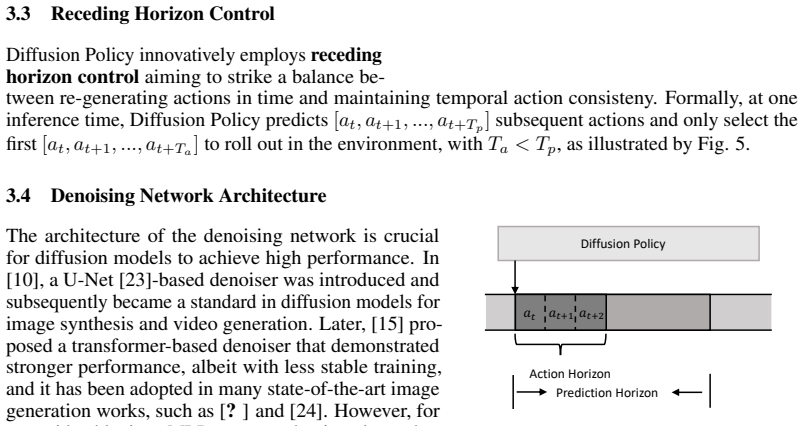
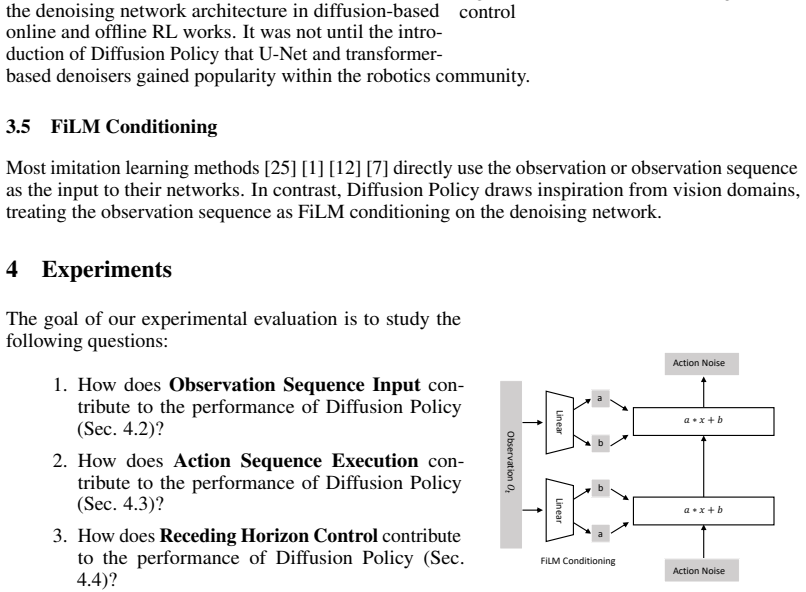
On the paper's own terms, the central discovery is that each of the five components of Diffusion Policy has a task-dependent contribution, and the paper states a takeaway for each. Observation sequence input is crucial for tasks requiring absolute control (for example, Adroit Relocate drops from 64% to 47% success without it) but has little effect on delta-control tasks such as StackCube and PegInsertionSide. Action sequence execution improves most tasks by 10–20%, yet Adroit Hammer does better with single-action execution (27% versus 17%), because responsiveness to real-time feedback matters more than action consistency. Receding horizon control gives roughly a 15% improvement on long-horizon tasks while slightly hurting the short-horizon Pen task. U-Net denoising is essential on hard tasks—PegInsertionSide rises from 21% with MLP to 80% with U-Net, and Relocate from 7% to 64%—while MLP suffices for easy tasks. FiLM conditioning similarly improves hard tasks dramatically, such as Relocate from 2% with direct inputs to 64% with FiLM, while making little difference on easy tasks.
Load-bearing premise
The load-bearing premise is that the reported success-rate differences between the full policy and each ablated variant are real effects; the paper gives no error bars, seed counts, or statistical tests, so if gaps like Hammer's 17% versus 11% are random variation, the task-dependent takeaways lose their support.
Editorial extensions
If this is right
- For delta-control tasks, practitioners can drop observation history without much loss, simplifying the policy input.
- For reactive tasks like Adroit Hammer, action horizon should be shortened toward single-action roll-outs to preserve responsiveness.
- For long-horizon tasks, receding horizon control should be kept, while short-horizon tasks can execute full predicted sequences.
- Hard tasks need the expressive U-Net denoiser and FiLM conditioning; easy tasks can use a cheaper MLP with direct observation inputs.
- Component choices should be informed by control mode, horizon, and difficulty rather than a one-size-fits-all Diffusion Policy default.
Reading between the lines
- A testable extension the paper leaves implicit is a decision rule: given a new task's control mode, horizon, and difficulty, one could predict which components matter without running the full ablation.
- The Hammer result suggests a responsiveness-consistency tradeoff in action-sequence policies that could be measured independently, for example by injecting perturbations and comparing recovery speed.
- If these single-run gaps are confirmed with repeated seeds, the findings imply that many downstream variants that quietly remove components may be unknowingly trading performance for simplicity.
- The delta-versus-absolute distinction points to a Markovianity explanation: in delta control, the current observation already carries the relative state, so history adds little information.
Editorial analysis
A structured set of objections, weighed in public.
Referee Report
Summary. The paper identifies five components of Diffusion Policy—observation sequence input, action sequence execution, receding horizon control, denoising network architecture, and FiLM conditioning—and reports ablation experiments across eight ManiSkill and Adroit tasks. For each component, it presents a table of success rates, grouped bar charts, and a takeaway stating when the component matters (e.g., absolute vs. delta control, long vs. short horizon, hard vs. easy tasks). The paper concludes with practical recommendations for when to keep or remove each component.
Significance. If the reported patterns held, this would be a useful practical reference for researchers modifying Diffusion Policy, since the five components are clearly identified and the ablation covers two commonly used benchmarks with multiple task types. The paper is also honest in showing per-task tables rather than only aggregate numbers. However, the central claims currently exceed the evidence: the tables contain no error bars, seed counts, or statistical tests, and several individual task results directly contradict the stated takeaways. The significance of the paper therefore depends on whether the authors can provide statistical support and reconcile the counterexamples.
major comments (5)
- [Sec. 4.5 / Table 4] Takeaway 4.5 states that U-Net denoising architecture is essential for hard tasks, but Table 4 labels Hammer as a hard task and reports U-Net 17% vs. MLP 17%, an exact tie. This is not a small gap to be resolved by error bars; it is a null effect in exactly the category the takeaway claims is strongly affected. The aggregate plot in Fig. 11 averages over six hard tasks and therefore hides this counterexample. The takeaway and the recommendation need to be revised to acknowledge that Hammer does not support the claim, or the authors need to provide a principled, pre-specified reason why Hammer should be excluded.
- [Sec. 4.6 / Table 5] Takeaway 4.6 says FiLM conditioning significantly improves performance on hard tasks, but Table 5 lists Hammer as a difficult task and reports FiLM 17% vs. Direct Inputs 18%, a slight reversal. Additionally, Pen, classified as easy, shows FiLM 71% vs. Direct Inputs 75%. The claim of a significant improvement on hard tasks is therefore contradicted by one of the six difficult tasks in the same table. The paper should either weaken this takeaway to an exception-aware statement or provide additional evidence, such as confidence intervals, showing that the aggregate difference is meaningful despite individual reversals.
- [Sec. 4.4 / Table 3] Takeaway 4.4 states that receding horizon control is essential for long-horizon tasks, but Table 3 lists Hammer with a task horizon of 270/400 steps and reports 17% with receding horizon control and 17% without, an exact tie. Since Hammer is one of the longest-horizon tasks in the table, this directly undermines the claimed relationship between horizon length and the benefit of receding horizon control. The paper needs to either explain this exception, revise the takeaway to "beneficial for most long-horizon tasks," or provide evidence beyond a single success-rate value that the effect is real.
- [Sec. 4.1 / Tables 1-5] No error bars, number of seeds, or statistical tests are reported anywhere in the experimental section. Many comparisons rely on small differences that could easily be random variation, such as Hammer 17% vs. 11% in Table 1, Hammer 17% vs. 27% in Table 2, Pen 71% vs. 73% in Table 3, and Hammer 17% vs. 18% in Table 5. Without multiple seeds and confidence intervals, the reader cannot distinguish a real component effect from evaluation noise. This is load-bearing because all five takeaways are empirical claims about differences in success rates. The authors should rerun with multiple seeds, report mean and variance, and ideally perform paired comparisons across tasks.
- [Sec. 4.2-4.6] The task taxonomies (absolute vs. delta control, long vs. short horizon, easy vs. hard) appear to be assigned post hoc in a way that tracks the observed outcomes. For example, Hammer is classified as hard in Table 4, difficult in Table 5, long-horizon in Table 3, and as a real-time-control exception in Sec. 4.3; the paper does not give a pre-specified criterion for these labels. Since the takeaways depend on these categories, post hoc classification risks circularity: the categories are defined after seeing which tasks show large effects. The authors should define the classification criteria before presenting results, or demonstrate that the conclusions are robust to reasonable alternative classifications.
minor comments (5)
- [Sec. 4.3] The text says "The empirical results in Tab. 2 and Fig. 4 indicate..." but Fig. 4 is a schematic of action sequence execution, not the performance comparison; the performance comparison appears in Fig. 9. Please correct the cross-reference.
- [Sec. 3.4] There is an incomplete placeholder citation "[?]" in the sentence about state-of-the-art image generation works; this should be replaced with a concrete reference.
- [Table 3] Identical conditions appear to have different success rates across tables: PushChair with the full Diffusion Policy is reported as 61% in Table 1 and Table 2 but 60% in Tables 3, 4, and 5. This suggests either different runs or inconsistent reporting; please clarify whether all tables refer to the same baseline runs and, if not, report per-seed variation.
- [Sec. 4.1] The experimental setup does not report the exact values of observation horizon To, action horizon Ta, prediction horizon Tp, learning rate, batch size, number of denoising steps, or architecture sizes for U-Net and MLP. Without these values, the ablations are not reproducible.
- [References] Reference [27] is given as "A Vaswani" and should be expanded to the full Attention Is All You Need citation; several other references are also incomplete (e.g., [24]).
Circularity Check
No significant circularity: the paper is an empirical ablation study with no fitted parameters, no derived predictions, and no load-bearing self-citation chain.
full rationale
The paper reports success-rate ablations of five Diffusion Policy components across ManiSkill and Adroit benchmarks. None of the claims are derived from a fitted parameter or an equation; each takeaway is a direct comparison of measured success rates (e.g., Tables 1-5). The components under study are defined from the original Diffusion Policy paper and standard architecture choices, and the experiment conditions are manipulated independently. The task taxonomies (Delta vs Absolute Control, long vs short horizon, easy vs hard) are introduced after the measurements and are used as descriptive groupings rather than as inputs that force the outcomes; this is a potential issue of post hoc interpretation or statistical robustness, not circularity. Citations to prior work identify benchmarks, data sources, and the baseline method, but none of these citations are invoked as a substitute for the empirical measurements or as a theorem that forces the conclusions. There is no self-citation chain, no fitted-input-called-prediction step, and no renaming of a known result presented as a new derivation. The main legitimate concerns are the absence of error bars, seeds, or statistical tests and the selective summary of exceptions such as Adroit Hammer, but these are empirical-evidence concerns, not circularity. Therefore the appropriate circularity score is 0.
Assumptions & free parameters
free parameters (4)
- Observation horizon To
- Action horizon Ta
- Prediction horizon Tp
- Network hyperparameters (learning rate, batch size, denoising steps)
assumptions (4)
- domain assumption The original Diffusion Policy implementation (Chi et al. 2023) is correctly reproduced, including its default hyperparameters and training procedure.
- domain assumption The ManiSkill and Adroit benchmark environments, demonstration datasets, and success-rate measurements are used as provided, without independent verification.
- ad hoc to paper Task difficulty classification (easy vs hard) is a meaningful and stable explanatory variable for component importance.
- ad hoc to paper Success rates from a single run are representative of true performance.
Cite this review
Pith. "Pith review of Unpacking the Individual Components of Diffusion Policy." pith.science (2026). https://pith.science/paper/JCG5CHTQ
@misc{pith2026241200084,
  author       = {Pith},
  title        = {Pith review of: Unpacking the Individual Components of Diffusion Policy},
  year         = {2026},
  howpublished = {\url{https://pith.science/paper/JCG5CHTQ}},
  note         = {Machine review of arXiv:2412.00084}
}
read the original abstract
Imitation Learning presents a promising approach for learning generalizable and complex robotic skills. The recently proposed Diffusion Policy generates robot action sequences through a conditional denoising diffusion process, achieving state-of-the-art performance compared to other imitation learning methods. This paper summarizes five key components of Diffusion Policy: 1) observation sequence input; 2) action sequence execution; 3) receding horizon; 4) U-Net or Transformer network architecture; and 5) FiLM conditioning. By conducting experiments across ManiSkill and Adroit benchmarks, this study aims to elucidate the contribution of each component to the success of Diffusion Policy in various scenarios. We hope our findings will provide valuable insights for the application of Diffusion Policy in future research and industry.
Figures


Figures from the paper (9 more)



Reference graph
Works this paper leans on
-
[1]
The aloha system: Another alternative for computer communications
Norman Abramson. The aloha system: Another alternative for computer communications. In Proceedings of the November 17-19, 1970, fall joint computer conference , pages 281–285, 1970
work page 1970
-
[2]
Locomujoco: A comprehensive imitation learning benchmark for locomotion
Firas Al-Hafez, Guoping Zhao, Jan Peters, and Davide Tateo. Locomujoco: A comprehensive imitation learning benchmark for locomotion. arXiv preprint arXiv:2311.02496, 2023
arXiv 2023
-
[3]
Decision transformer: Reinforcement learning via sequence modeling
Lili Chen, Kevin Lu, Aravind Rajeswaran, Kimin Lee, Aditya Grover, Misha Laskin, Pieter Abbeel, Aravind Srinivas, and Igor Mordatch. Decision transformer: Reinforcement learning via sequence modeling. Advances in neural information processing systems, 34:15084–15097, 2021
2021
-
[4]
Diffusion policy: Visuomotor policy learning via action diffusion
Cheng Chi, Zhenjia Xu, Siyuan Feng, Eric Cousineau, Yilun Du, Benjamin Burchfiel, Russ Tedrake, and Shuran Song. Diffusion policy: Visuomotor policy learning via action diffusion. The International Journal of Robotics Research, page 02783649241273668, 2023
2023
-
[5]
Consistency models as a rich and efficient policy class for reinforcement learning
Zihan Ding and Chi Jin. Consistency models as a rich and efficient policy class for reinforcement learning. arXiv preprint arXiv:2309.16984, 2023
arXiv 2023
-
[6]
Bayesian imitation learning for end-to-end mobile manipulation
Yuqing Du, Daniel Ho, Alex Alemi, Eric Jang, and Mohi Khansari. Bayesian imitation learning for end-to-end mobile manipulation. In International Conference on Machine Learning, pages 5531–5546. PMLR, 2022
2022
-
[7]
Implicit behavioral cloning
Pete Florence, Corey Lynch, Andy Zeng, Oscar A Ramirez, Ayzaan Wahid, Laura Downs, Adrian Wong, Johnny Lee, Igor Mordatch, and Jonathan Tompson. Implicit behavioral cloning. In Conference on Robot Learning, pages 158–168. PMLR, 2022
2022
-
[8]
Maniskill2: A unified benchmark for generalizable manipulation skills
Jiayuan Gu, Fanbo Xiang, Xuanlin Li, Zhan Ling, Xiqiang Liu, Tongzhou Mu, Yihe Tang, Stone Tao, Xinyue Wei, Yunchao Yao, et al. Maniskill2: A unified benchmark for generalizable manipulation skills. arXiv preprint arXiv:2302.04659, 2023
arXiv 2023
Show all 32 references
-
[9]
Idql: Implicit q-learning as an actor-critic method with diffusion policies.arXiv preprint arXiv:2304.10573, 2023
Philippe Hansen-Estruch, Ilya Kostrikov, Michael Janner, Jakub Grudzien Kuba, and Sergey Levine. Idql: Implicit q-learning as an actor-critic method with diffusion policies.arXiv preprint arXiv:2304.10573, 2023
2023 arXiv
-
[10]
Denoising diffusion probabilistic models
Jonathan Ho, Ajay Jain, and Pieter Abbeel. Denoising diffusion probabilistic models. Advances in neural information processing systems, 33:6840–6851, 2020
2020
-
[11]
Coarse-to-fine imitation learning: Robot manipulation from a single demon- stration
Edward Johns. Coarse-to-fine imitation learning: Robot manipulation from a single demon- stration. In 2021 IEEE international conference on robotics and automation (ICRA) , pages 4613–4619. IEEE, 2021
2021
-
[12]
What matters in learning from offline human demonstrations for robot manipulation
Ajay Mandlekar, Danfei Xu, Josiah Wong, Soroush Nasiriany, Chen Wang, Rohun Kulkarni, Li Fei-Fei, Silvio Savarese, Yuke Zhu, and Roberto Martín-Martín. What matters in learning from offline human demonstrations for robot manipulation. arXiv preprint arXiv:2108.03298, 2021
2021 arXiv
-
[13]
Diffusion-dice: In- sample diffusion guidance for offline reinforcement learning
Liyuan Mao, Haoran Xu, Xianyuan Zhan, Weinan Zhang, and Amy Zhang. Diffusion-dice: In- sample diffusion guidance for offline reinforcement learning. arXiv preprint arXiv:2407.20109, 2024
2024 arXiv
-
[14]
Maniskill: Generalizable manipulation skill benchmark with large-scale demonstrations
Tongzhou Mu, Zhan Ling, Fanbo Xiang, Derek Yang, Xuanlin Li, Stone Tao, Zhiao Huang, Zhiwei Jia, and Hao Su. Maniskill: Generalizable manipulation skill benchmark with large-scale demonstrations. arXiv preprint arXiv:2107.14483, 2021
2021 arXiv
-
[15]
Scalable diffusion models with transformers
William Peebles and Saining Xie. Scalable diffusion models with transformers. In Proceedings of the IEEE/CVF International Conference on Computer Vision, pages 4195–4205, 2023
2023
-
[16]
Film: Visual reasoning with a general conditioning layer
Ethan Perez, Florian Strub, Harm De Vries, Vincent Dumoulin, and Aaron Courville. Film: Visual reasoning with a general conditioning layer. In Proceedings of the AAAI conference on artificial intelligence, volume 32, 2018. 11
2018
-
[17]
Dexmv: Imitation learning for dexterous manipulation from human videos
Yuzhe Qin, Yueh-Hua Wu, Shaowei Liu, Hanwen Jiang, Ruihan Yang, Yang Fu, and Xiaolong Wang. Dexmv: Imitation learning for dexterous manipulation from human videos. In European Conference on Computer Vision, pages 570–587. Springer, 2022
2022
-
[18]
State-only imitation learning for dexterous manipulation
Ilija Radosavovic, Xiaolong Wang, Lerrel Pinto, and Jitendra Malik. State-only imitation learning for dexterous manipulation. In 2021 IEEE/RSJ International Conference on Intelligent Robots and Systems (IROS), pages 7865–7871. IEEE, 2021
2021
-
[19]
Learning complex dexterous manipulation with deep reinforcement learning and demonstrations
Aravind Rajeswaran, Vikash Kumar, Abhishek Gupta, Giulia Vezzani, John Schulman, Emanuel Todorov, and Sergey Levine. Learning complex dexterous manipulation with deep reinforcement learning and demonstrations. arXiv preprint arXiv:1709.10087, 2017
2017 arXiv
-
[20]
Imitation learning for locomotion and manipulation
Nathan Ratliff, J Andrew Bagnell, and Siddhartha S Srinivasa. Imitation learning for locomotion and manipulation. In 2007 7th IEEE-RAS international conference on humanoid robots, pages 392–397. IEEE, 2007
2007
-
[21]
Diffusion policy policy optimization
Allen Z Ren, Justin Lidard, Lars L Ankile, Anthony Simeonov, Pulkit Agrawal, Anirudha Majumdar, Benjamin Burchfiel, Hongkai Dai, and Max Simchowitz. Diffusion policy policy optimization. arXiv preprint arXiv:2409.00588, 2024
2024 arXiv
-
[22]
Goal-conditioned imitation learning using score-based diffusion policies
Moritz Reuss, Maximilian Li, Xiaogang Jia, and Rudolf Lioutikov. Goal-conditioned imitation learning using score-based diffusion policies. arXiv preprint arXiv:2304.02532, 2023
2023 arXiv
-
[23]
U-net: Convolutional networks for biomedical image segmentation
Olaf Ronneberger, Philipp Fischer, and Thomas Brox. U-net: Convolutional networks for biomedical image segmentation. In Medical image computing and computer-assisted intervention–MICCAI 2015: 18th international conference, Munich, Germany, October 5-9, 2015, proceedings, part ...
2015
-
[24]
Photorealistic text-to-image diffusion models with deep language understanding
Chitwan Saharia, William Chan, Saurabh Saxena, Lala Li, Jay Whang, Emily L Denton, Kamyar Ghasemipour, Raphael Gontijo Lopes, Burcu Karagol Ayan, Tim Salimans, et al. Photorealistic text-to-image diffusion models with deep language understanding. Advances in neural information...
2022
-
[25]
Behavior transformers: Cloning k modes with one stone
Nur Muhammad Shafiullah, Zichen Cui, Ariuntuya Arty Altanzaya, and Lerrel Pinto. Behavior transformers: Cloning k modes with one stone. Advances in neural information processing systems, 35:22955–22968, 2022
2022
-
[26]
Language-conditioned imitation learning for robot manipulation tasks
Simon Stepputtis, Joseph Campbell, Mariano Phielipp, Stefan Lee, Chitta Baral, and Heni Ben Amor. Language-conditioned imitation learning for robot manipulation tasks. Advances in Neural Information Processing Systems, 33:13139–13150, 2020
2020
-
[27]
Attention is all you need
A Vaswani. Attention is all you need. Advances in Neural Information Processing Systems, 2017
2017
-
[28]
Diffusion policies as an expressive policy class for offline reinforcement learning
Zhendong Wang, Jonathan J Hunt, and Mingyuan Zhou. Diffusion policies as an expressive policy class for offline reinforcement learning. arXiv preprint arXiv:2208.06193, 2022
2022 arXiv
-
[29]
Error-aware imitation learning from teleoperation data for mobile manipulation
Josiah Wong, Albert Tung, Andrey Kurenkov, Ajay Mandlekar, Li Fei-Fei, Silvio Savarese, and Roberto Martín-Martín. Error-aware imitation learning from teleoperation data for mobile manipulation. In Conference on Robot Learning, pages 1367–1378. PMLR, 2022
2022
-
[30]
Deep imitation learning for bimanual robotic manipulation
Fan Xie, Alexander Chowdhury, M De Paolis Kaluza, Linfeng Zhao, Lawson Wong, and Rose Yu. Deep imitation learning for bimanual robotic manipulation. Advances in neural information processing systems, 33:2327–2337, 2020
2020
-
[31]
Policy representation via diffusion probability model for reinforcement learning
Long Yang, Zhixiong Huang, Fenghao Lei, Yucun Zhong, Yiming Yang, Cong Fang, Shiting Wen, Binbin Zhou, and Zhouchen Lin. Policy representation via diffusion probability model for reinforcement learning. arXiv preprint arXiv:2305.13122, 2023
2023 arXiv
-
[32]
3d diffusion policy
Yanjie Ze, Gu Zhang, Kangning Zhang, Chenyuan Hu, Muhan Wang, and Huazhe Xu. 3d diffusion policy. arXiv preprint arXiv:2403.03954, 2024. 12
2024 arXiv
Reviewed August 12, 2026 · model on record in the stance chip above.
Discussion (0). Continue with ORCID to comment.