REVIEW 3 major objections 5 minor 70 references
Machine learning delta-T noise for temperature bias estimation
T0 review · 3 major / 5 minor · reviewed 2026-08-12 · deepseek-v4-flash
Pith's one-line read A neural network trained on synthetic data can estimate the temperature bias of atomic-scale junctions from delta-T shot noise, with mean bias below one kelvin.
desk verdict Useful proof-of-concept with a real validation gap: the synthetic channel-opening model is calibrated on the same experimental data used for testing, so the <1 K mean bias is not yet a fair out-of-sample claim. read the letter →
The pith
A machine-rendered reading of the paper's core claim, the machinery that carries it, and where it could break.
The reading
What carries the argument
The load-bearing object is the delta-T noise formula $$S_{\$\Delta$ T} = \frac{G_0 k_B}{\bar{T}}\left(\frac{\$pi^{2}$}{9}-\frac{2}{3}\right)(\$\Delta$ T)^2 \sum_i \tau_i(1-\tau_i),$$ which makes the excess noise quadratic in the temperature bias and proportional to the partition-noise sum of partially open transmission channels. Since the conductance $G = G_0\sum_i \tau_i$ fixes only the sum of transmissions, many channel configurations produce the same $G$ with different noise, so the inversion is not unique. The paper supplies the missing information with a noisy channel-opening protocol: the channel-opening parameter $x$ is sampled from an exponential distribution fit to low-conductance experimental data, channel transmissions are capped below full opening, and uniform noise is added to every $\tau_i$, generating synthetic $(G, S_{\Delta T}, \bar{T})$ triples that reproduce experimental scatter. A feedforward neural network with three hidden layers of 20 neurons, dropout, ReLU activation, and mean-absolute-error training is then trained on these triples to output $\Delta T/\bar{T}$. The decisive role of the protocol is shown by its deterministic counterpart, which trains successfully on synthetic data yet fails on experiments, whereas the noisy protocol yields mean biases under 1 K.
What would settle it
Measure fresh break-junction ensembles at conductance up to 4 $G_0$ with thermometers imposing $\Delta T$ values well away from the $\Delta T \approx \bar{T}$ line used in the original data (for example $\Delta T = 5$ K at $\bar{T} = 25$ K) and, without retuning any protocol parameters, check whether the ensemble-averaged mean bias stays below 1 K; a bias above 1 K would show the synthetic channel-opening distribution does not capture real junctions.
Extended reading notes
Core claim
The paper's central claim is that the delta-T contribution to current shot noise, $S_{\Delta T}$, together with the measured conductance $G$ and average temperature $\bar{T}$, determines the applied temperature difference $\Delta T$ well enough for a supervised neural network to invert the relation on real experimental junctions, even though the network has only ever seen synthetic training data. Concretely, the network reports a mean bias---the signed deviation of predicted $\Delta T$ from the true value, averaged over the ensemble---below 1 K for junctions with conductance up to 4 $G_0$, comparable to the experimental uncertainty of roughly 0.5 K. A single junction's noise reading is dominated by other sources and cannot fix $\Delta T$ reliably; only the ensemble average of predictions becomes accurate. The paper further claims that this success validates the analytic delta-T noise expression Eq. (1) beyond the $G < 1\,G_0$ range in which it was originally tested, and that the same synthetic-data-plus-machine-learning workflow can be repurposed to estimate other transport stimuli.
Load-bearing premise
Everything rests on the noisy channel-opening protocol mirroring how transmission channels really open in hydrogen-containing gold junctions up to 4 $G_0$: the distribution of $x$ is fit to the same experimental data used for testing, and the piecewise slopes are chosen by hand, so if real junctions open differently the synthetic training distribution is wrong and the network's accuracy on experiments collapses.
Editorial extensions
If this is right
- Ensemble-averaged delta-T noise becomes a viable nanoscale thermometer for atomic-scale junctions, with mean signed errors below 1 K for conductance up to 4 $G_0$.
- The analytic quadratic delta-T noise formula, previously checked only below 1 $G_0$, is supported at higher conductance and at temperature differences approaching the physical maximum $\Delta T = 2\bar{T}$.
- Single-junction noise readings cannot determine $\Delta T$; experiments must record ensembles of junctions, which changes how thermometry data should be collected.
- Networks trained at low conductance can extrapolate to higher conductance (up to 8 $G_0$ in the paper's test), but they resist extrapolating outside the trained $\Delta T$ range, so training sets must span the expected temperature biases.
Reading between the lines
- The same synthetic-training-plus-ensemble-averaging recipe should extend to other stimuli, such as voltage bias, magnetic-field-tuned transmission, or local heating, wherever the noise has a known functional dependence on the stimulus.
- The protocol's hand-chosen piecewise slopes are a bottleneck; an ab initio or transferable version of the synthetic data generator would reveal how much accuracy depends on the specific channel-opening model.
- The ensemble-averaging requirement means the method measures a statistical temperature bias across junction configurations rather than an instantaneous local temperature; tracking fast thermal dynamics would require time-resolved noise or repeated rapid break-junction cycles.
Signed reviews
Editorial analysis
A structured set of objections, weighed in public.
Referee Report
Summary. The paper trains a feedforward neural network on synthetic conductance, delta-T noise, and mean-temperature data to predict the temperature difference across atomic-scale junctions, and then applies the trained network to experimental data. Two synthetic generation schemes are considered: a deterministic channel-opening protocol with a fixed parameter x, and a noisy protocol in which x is sampled from an exponential distribution, additional piecewise channel-opening functions are used, and transmission noise is added. The network trained on the noisy protocol yields a mean signed error below 1 K on the experimental set for junctions with conductance up to 4 G0, which the authors interpret as demonstrating ensemble-level temperature-bias estimation and as supporting the delta-T noise formula beyond the previously tested 1 G0 range.
Significance. If the central claim survives scrutiny, the paper offers a useful demonstration of machine learning for an inverse transport problem: extracting a thermal stimulus from noise and conductance data without knowing the channel-resolved transmission coefficients. The manuscript is transparent about its architecture, reports metrics averaged over 10 retrained models, includes a deterministic-versus-noisy protocol comparison, and checks the quadratic delta-T formula against the full integral expression in Appendix C. However, the experimental validation is currently undermined by the calibration of the noisy channel-opening protocol to the same experimental dataset that is later used as the test set, and by the small, highly correlated set of nine experimental (Tbar, dT) pairs. These issues affect the load-bearing claim of a sub-Kelvin mean bias, so the significance is conditional on an out-of-sample validation.
major comments (3)
- [Sec. III B / Appendix A] The noisy channel-opening protocol is not independent of the test data used in Figs. 9-11. The distribution of x is extracted from the experimental G<1G0 data (Sec. III B and Fig. 7), and the piecewise slopes and saturation values in Appendix A are, in the authors' own words, 'obviously somewhat arbitrary' and chosen to mimic the experimental scatter. Since the same experimental set appears both as the calibration target for the generator and as the test set for the network, the sub-Kelvin mean bias is partly a measure of how well the generator reproduces its calibration data rather than a predictive test. The sensitivity shown in Sec. IV B, where the deterministic protocol gives a 4.5 K bias on the same experimental set while the noisy protocol gives under 1 K, confirms that the channel-opening model is load-bearing. I request an out-of-sample test: fit the protocol parameters using a subset of experimental junctions (or an independent experiment) and evaluate the trained network on the held-out junctions, together with a sensitivity analysis over plausible protocol parameters.
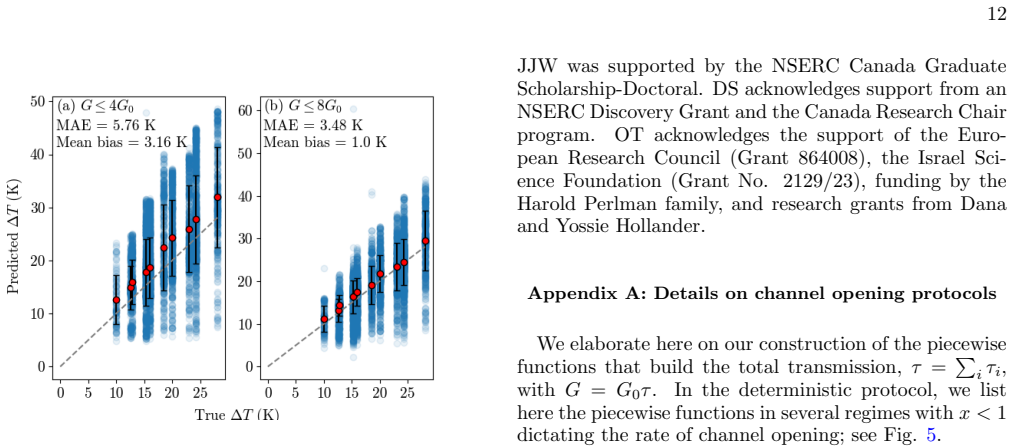
- [Sec. IV C / Figs. 3, 10, 11] The experimental demonstration rests on only nine (Tbar, dT) pairs, all clustered near dT approximately Tbar (Fig. 3), and the headline metric is a signed mean bias. A signed average can be below 1 K even when individual predictions are poor, because over- and under-predictions cancel; the histograms in Fig. 10 are indeed wide, and the mean absolute error reaches about 3.75 K in Fig. 11(a). Because Tbar is an input feature and dT is strongly correlated with Tbar in the experimental set, the network could exploit this correlation rather than a generalizable noise-to-temperature mapping. I ask the authors to report per-junction bias distributions, confidence intervals for the ensemble mean, and a metric such as median absolute error, and to test on experimental data spanning a wider range of dT/Tbar before claiming that the method estimates temperature bias within experimental uncertainties.
- [Sec. IV C / Sec. V] The paper states that the experimental agreement 'supports the theoretical expression (1)' beyond 1 G0, but this support is indirect and partially circular: the synthetic training data are generated from Eq. (1), so the network cannot detect an error in Eq. (1) unless the channel-opening protocol is independently validated. Appendix C shows that training with the integral formula (C2) gives similar metrics, but the comparison is made under the same noisy channel-opening protocol and therefore does not test the protocol itself. To support Eq. (1) beyond 1 G0, the authors should validate the channel-opening model against independent channel-resolved measurements, for example shot-noise-derived transmission histograms, or test on a dataset where a competing noise formula is distinguishable.
minor comments (5)
- [Sec. II B] The expression S_deltaT = S_I - 4 G k_B Tbar is consistent with Eq. (1) only after identifying G with G0 sum_i tau_i; this identification should be stated explicitly when the expression is introduced.
- [Sec. III A] The sentence 'there are exactly three partially open channels at any time' is only true within one conductance interval of the deterministic protocol; please rephrase to indicate that this holds for each interval between consecutive integer multiples of G0.
- [Appendix B] The learning rate is said to be constant, but its numerical value is not reported; please include it for reproducibility.
- [Sec. IV C] Figure 11 reports metrics averaged over 10 models; please also state the number of experimental junctions contributing to each max-G bin and whether the same junctions appear in multiple bins.
- [Throughout] There are several small language slips, such as 'As shown in Ref. 32, The second order expression' in Sec. II A; a careful proofread would improve presentation.
Circularity Check
Sub-K mean bias on experiments reflects calibration of the noisy channel-opening protocol to the same test data, so the experimental support for Eq. (1) beyond 1G0 is partially circular.
-
fitted input called prediction
[Introduction; Sec. III B (S1); Appendix A; evaluated in Sec. IV C / Figs. 9-11.]
"The process of reducing prediction errors on real datasets provides valuable insights into the sequential channel-opening protocol, enabling the development of a model that reasonably aligns with the observed behavior in real junctions. ... The mean value of x determined in this way from the experimental data is 0.095. ... The protocol above is obviously somewhat arbitrary in that the slopes chosen and the residual opening before saturation could have been constructed with different numbers to mimic experiments."
The noisy channel-opening protocol is not independent: the exponential x-distribution is fit to the same experimental data (mean 0.095, rounded to 0.1), and Appendix A admits the higher-G slopes and caps are arbitrary choices made 'to mimic experiments.' The Introduction states the protocol was developed by reducing prediction errors on real datasets, which are the same datasets later used as the test set in Sec. IV C. The NN trained on synthetic data from this calibrated generator then reports mean bias <1 K on those experiments. Thus the low bias mainly confirms that the generator matches the test set's SΔT-vs-G scatter, especially above 1G0; it is not an out-of-sample test of the inverse mapping.
full rationale
The central derivation chain is: Eq. (1) (from Ref. 32 and re-derived in App. C) -> synthetic SΔT generated with a channel-opening protocol -> NN trained on synthetic data -> prediction on experimental data. The main circularity is that the channel-opening protocol is calibrated to the same experimental dataset that is later used as the test set. Sec. III B fits the x-distribution mean to the experimental G<1G0 data, and Appendix A admits the slopes and saturation caps are arbitrary choices made to mimic experiments; the Introduction explicitly says the protocol was developed by reducing prediction errors on real datasets. Consequently, the Sec. IV C result of <1 K mean bias on experimental junctions is not an independent out-of-sample test: the generator was tuned so that synthetic (G, SΔT) pairs occupy the same region of feature space as the experimental test points, and Eq. (1) then supplies the ΔT labels. The paper's claim that this supports Eq. (1) beyond 1G0 is therefore partially circular. No load-bearing self-citation is found: Eq. (1) is re-derived in Appendix C from standard full-counting-statistics references, and the experimental data of Ref. 32 are real published data. The deterministic-protocol failure is a useful control, but it only shows that a badly mismatched generator fails, not that the calibrated generator's success is an independent validation. Overall, the partial circularity in the experimental validation warrants a score of 6.
Assumptions & free parameters
free parameters (4)
- mean of x (channel-opening rate distribution) =
0.1 (from experimental mean 0.095)
- x rejection cutoff =
0.4
- transmission noise amplitude =
uniform in [0, 0.05]
- piecewise channel-opening slopes and saturation values =
e.g., 0.95 saturation for channel 2; slopes 20/19, 0.6, 0.4-x, 0.07, 0.38-x, 0.35 across regimes
assumptions (3)
- domain assumption Coherent, noninteracting Landauer transport with energy-independent transmissions (Eq. C2) and a quadratic expansion in deltaT/Tbar (Eq. 1).
- domain assumption Hydrogen-contaminated gold junctions exhibit the same qualitative channel-opening statistics as the gold nanowire simulations of Refs. [49,64] plus the paper's modifications.
- ad hoc to paper The arbitrary piecewise channel-opening functions in Appendix A accurately represent real junction evolution.
Cite this review
Pith. "Pith review of Machine learning delta-T noise for temperature bias estimation." pith.science (2026). https://pith.science/paper/6ADXH2AX
@misc{pith2026241200288,
  author       = {Pith},
  title        = {Pith review of: Machine learning delta-T noise for temperature bias estimation},
  year         = {2026},
  howpublished = {\url{https://pith.science/paper/6ADXH2AX}},
  note         = {Machine review of arXiv:2412.00288}
}
abstract
Delta-T shot noise is activated in temperature-biased electronic junctions, down to the atomic scale. It is characterized by a quadratic dependence on the temperature difference and a nonlinear relationship with the transmission coefficients of partially opened conduction channels. In this work, we demonstrate that delta-T noise, measured across an ensemble of atomic-scale junctions, can be utilized to estimate the temperature bias in these systems. Our approach employs a supervised machine learning algorithm to train a neural network with input features being the scaled electrical conductance, the delta-T noise, and the mean temperature. Due to limited experimental data, we generate synthetic datasets, designed to mimic experiments. The neural network, trained on these synthetic data, was subsequently applied to predict temperature biases from experimental datasets. Using performance metrics, we demonstrate that the mean bias -- the deviation of predicted temperature differences from their true value -- is less than 1 K for junctions with conductance up to 4$G_0$. Our study highlights that, while a single delta-T noise measurement is insufficient for accurately estimating the applied temperature bias due to noise contributions from other sources, averaging over an ensemble of junctions enables predictions within experimental uncertainties. This demonstrates that machine learning approaches can be utilized for estimation of temperature biases, and similarly other stimuli in electronic junctions.
Figures


Figures from the paper (13 more)




Reference graph
Works this paper leans on
-
[1]
A. L. Ferguson, J. Hachmann, T. F. Miller, and J. Pfaendtner, “The Journal of Physical Chemistry A/B/C Virtual Special Issue on Machine Learning in Physical Chemistry,” J. Phys. Chem. B 124, 9767 (2020)
work page 2020
-
[2]
Virtual Special Issue on Machine Learning in Physical Chemistry Volume 2,
A. L. Ferguson and J. Pfaendtner, “Virtual Special Issue on Machine Learning in Physical Chemistry Volume 2,” J. Phys. Chem. C 128, 11079 (2024)
work page 2024
-
[3]
Single-molecule quantum-transport phenomena in break junctions,
P. Gehring, J. M. Thijssen, and H. S. J. van der Zant, “Single-molecule quantum-transport phenomena in break junctions,” Nat. Rev. Phys. 1, 381 (2019)
work page 2019
-
[4]
Vibrational and electronic heating in nanoscale junc- tions,
D. R. Ward, D. A. Corley, J. M. Tour, and D. Natelson, “Vibrational and electronic heating in nanoscale junc- tions,” Nat. Nanotechnol. 6, 33 (2011)
work page 2011
-
[5]
Electron-Vibration Interaction in Single-Molecule Junctions: From Contact to Tunneling Regimes,
O. Tal, M. Krieger, B. Leerink, and J. M. van Ruiten- beek, “Electron-Vibration Interaction in Single-Molecule Junctions: From Contact to Tunneling Regimes,” Phys. Rev. Lett. 100, 196804 (2008)
work page 2008
-
[6]
Non-chemisorbed gold–sulfur binding prevails in self-assembled monolay- ers,
M. S. Inkpen, Z.-F. Liu, H. Li, L. M. Campos, J. B. Neaton, and L. Venkataraman, “Non-chemisorbed gold–sulfur binding prevails in self-assembled monolay- ers,” Nat. Chem. 11, 351 (2019)
work page 2019
-
[7]
Single-molecule junctions map the interplay between electrons and chirality
A. K. Singh, K. Martin, M. M. Talamo, A. Houssin, N. Vanthuyne, N. Avarvari, and O. Tal, “Single-molecule junctions map the interplay between electrons and chi- rality,” arXiv:2408.12258
-
[8]
Evaluating the Ability of External Elec- tric Fields to Accelerate Reactions in Solution,
M. Aziz, C. R. Prindle, W. Lee, B. Zhang, C. Schaack, M. L Steigerwald, F. Zandkarimi, C. Nuckolls, and L. Venkataraman, “Evaluating the Ability of External Elec- tric Fields to Accelerate Reactions in Solution,” J. Phys. Chem. B 128, 9553 (2024)
work page 2024
Show all 70 references
-
[9]
Trusting our machines: validating machine learning models for single-molecule transport experi- ments,
W. Bro-Jørgensen, J. M. Hamill, R. Bro, and G. C. Solomon, “Trusting our machines: validating machine learning models for single-molecule transport experi- ments,” Chem. Soc. Rev. 51, 6875 (2022)
2022
-
[10]
predic- tive
In each histogram we observe that the distribution peak and thus the mean (in red) is in proximity to the true ∆ T (in green). While these histograms are wide, they are generally evenly distributed above and below the true ∆ T . In Fig. 11, we compile our neural network metric...
-
[11]
Classification of conductance traces with recurrent neural networks,
K. P. Lauritzen, A. Magyarkuti, Z. Balogh, A. Halbritter, and G. C. Solomon, “Classification of conductance traces with recurrent neural networks,” J. Chem. Phys. 148, 084111 (2018)
2018
-
[12]
Machine learning and analytical methods for single-molecule conductance measurements,
Y. Komoto, J. Ryu, and M. Taniguchi, “Machine learning and analytical methods for single-molecule conductance measurements,” Chem. Commun. 59, 6796 (2023)
2023
-
[13]
Unsupervised classification of single-molecule data with autoencoders and transfer learning,
A. Vladyka and T. Albrecht, “Unsupervised classification of single-molecule data with autoencoders and transfer learning,” Mach. Learn.: Sci. Technol. 1, 035013 (2020)
2020
-
[14]
A reference-free clustering method for the analysis of molec- ular break-junction measurements,
D. Cabosart, M. El Abbassi, D. Stefani, R. Frisenda, M. Calame, H. S. J. van der Zant, and M. L. Perrin, “A reference-free clustering method for the analysis of molec- ular break-junction measurements,” Appl. Phys. Lett. 114, 143102 (2019)
2019
-
[15]
Spectral Clustering to Analyze the Hidden Events in Single-Molecule Break Junctions,
L. Lin, C. Tang, G. Dong, Z. Chen, Z. Pan, J. Liu, Y. Yang, J. Shi, R. Ji, and W. Hong, “Spectral Clustering to Analyze the Hidden Events in Single-Molecule Break Junctions,” J. Phys. Chem. C 125, 3623 (2021)
2021
-
[16]
Automatic classi- fication of single-molecule charge transport data with an unsupervised machine-learning algorithm,
F. Huang, R. Li, G. Wang, J. Zheng, Y. Tang, J. Liu, Y. Yang, Y. Yao, J. Shi, and W. Hong, “Automatic classi- fication of single-molecule charge transport data with an unsupervised machine-learning algorithm,” Phys. Chem. Chem. Phys. 22, 1674 (2020)
2020
-
[17]
Benchmark and application of unsupervised classification approaches for univariate data,
M. El Abbassi, J. Overbeck, O. Braun, M. Calame, H. S. J. van der Zant, and M. L. Perrin, “Benchmark and application of unsupervised classification approaches for univariate data,” Commun. Phys. 4, 50 (2021)
2021
-
[18]
Unravelling the conductance path through single- porphyrin junctions,
M. El Abbassi, P. Zwick, A. Rates, D. Stefani, A. Prescimone, M. Mayor, H. S. J. van der Zant, and D. Duli´ c, “Unravelling the conductance path through single- porphyrin junctions,” Chem. Sci. 10, 8299 (2019)
2019
-
[19]
Making the Most of Nothing: One- Class Classification for Single-Molecule Transport Stud- ies,
W. Bro-Jørgensen, J. M. Hamill, G. Mezei, B. Lawson, U. Rashid, A. Halbritter, M. Kamenetska, V. Kaliginedi, G. C. Solomon, “Making the Most of Nothing: One- Class Classification for Single-Molecule Transport Stud- ies,” ACS Nanosci. Au 4, 250 (2024)
2024
-
[20]
Using Deep Learning to Identify Molecular Junc- tion Characteristics,
T. Fu, Y. Zang, Q. Zou, C. Nuckolls, and L. Venkatara- man, “Using Deep Learning to Identify Molecular Junc- tion Characteristics,” Nano Lett. 20, 3320 (2020)
2020
-
[21]
Neural networks for model- ing electron transport properties of mesoscopic systems,
K. Li, J. Lu, and F. Zhai, “Neural networks for model- ing electron transport properties of mesoscopic systems,” Phys. Rev. B 102, 064205 (2020)
2020
-
[22]
Modeling electronic quantum transport with machine learning,
A. Lopez-Bezanilla and O. A. von Lilienfeld, “Modeling electronic quantum transport with machine learning,” Phys. Rev. B 89, 235411 (2014)
2014
-
[23]
Predicting the DNA Conductance Using a Deep Feedforward Neural Network Model,
A. Aggarwal, V. Vinayak, S. Bag, C. Bhattacharyya, U. V. Waghmare, and P. K. Maiti, “Predicting the DNA Conductance Using a Deep Feedforward Neural Network Model,” J. Chem. Inf. Model. 61, 106 (2021)
2021
-
[24]
Machine Learning Prediction of DNA Charge Transport,
R. Korol and D. Segal, “Machine Learning Prediction of DNA Charge Transport,” J. Phys. Chem. B 123, 2801 (2019)
2019
-
[25]
Com- bining Multiscale MD Simulations and Machine Learn- ing Methods to Study Electronic Transport in Molecular 18 Junctions at Finite Temperatures,
R. Topolnicki, R. Kucharczyk, and W. Kaminski, “Com- bining Multiscale MD Simulations and Machine Learn- ing Methods to Study Electronic Transport in Molecular 18 Junctions at Finite Temperatures,” J. Phys. Chem. C 125, 19961 (2021)
2021
-
[26]
Deep-Learning Approach to First- Principles Transport Simulations,
M. B¨ urkle, U. Perera, F. Gimbert, H. Nakamura, M. Kawata, and Y. Asai, “Deep-Learning Approach to First- Principles Transport Simulations,” Phys. Rev. Lett.126, 177701 (2021)
2021
-
[27]
Optimal control of quantum thermal machines using machine learning,
I. Khait, J. Carrasquilla, and D. Segal, “Optimal control of quantum thermal machines using machine learning,” Phys. Rev. Res. 4, L012029 (2022)
2022
-
[28]
Learning Conductance: Gaussian Process Regression for Molecular Electronics,
M. Deffner, M. P. Weise, H. Zhang, M. M¨ ucke, J. Proppe, I. Franco, and C. Herrmann, “Learning Conductance: Gaussian Process Regression for Molecular Electronics,” J. Chem. Theory Comput. 19, 992 (2023)
2023
-
[29]
Identifying optimal cy- cles in quantum thermal machines with reinforcement- learning,
P. A. Erdman and F. No´ e, “Identifying optimal cy- cles in quantum thermal machines with reinforcement- learning,” NPJ Quantum Inf. 8, 1 (2022)
2022
-
[30]
Model-free optimization of power/efficiency tradeoffs in quantum thermal machines using reinforcement learning,
P. A Erdman and F. No´ e, “Model-free optimization of power/efficiency tradeoffs in quantum thermal machines using reinforcement learning,” PNAS Nexus 2, pgad248 (2023)
2023
-
[31]
Universal bounds on fluctuations in continuous thermal machines,
S. Saryal, M. Gerry, I. Khait, D. Segal, and B. K. Agar- walla, “Universal bounds on fluctuations in continuous thermal machines,” Phys. Rev. Lett. 127, 190603 (2021)
2021
-
[32]
Optimal control methods for quantum batteries,
F. Mazzoncini, V. Cavina, G. M. Andolina, P. A. Erd- man, and V. Giovannetti, “Optimal control methods for quantum batteries,” Phys. Rev. A 107, 032218 (2023)
2023
-
[33]
Shot Noise of a Temperature-Biased Tunnel Junction,
S. Larocque, E. Pinsolle, C. Lupien, and B. Reulet, “Shot Noise of a Temperature-Biased Tunnel Junction,” Phys. Rev. Lett. 125, 106801 (2020)
2020
-
[34]
Electronic noise due to temperature difference in atomic-scale junctions,
O. Shein Lumbroso, L. Simine, A. Nitzan, D. Segal, and O. Tal, “Electronic noise due to temperature difference in atomic-scale junctions,” Nature 562, 240 (2018)
2018
-
[35]
Electron counting statistics and coherent states of electric cur- rent,
L. S. Levitov, H.-W. Lee, and G. B. Lesovik, “Electron counting statistics and coherent states of electric cur- rent,” J. Math. Phys. 37, 4845 (1996)
1996
-
[36]
Universal statistics of transport in disordered conductors,
H. Lee, L. S. Levitov, and A. Y. Yakovets, “Universal statistics of transport in disordered conductors,” Phys. Rev. B 51, 4079 (1995)
1995
-
[37]
Anomalous electronic shot noise in resonant tunneling junctions,
A. Mu and D. Segal, “Anomalous electronic shot noise in resonant tunneling junctions,” arXiv:1902.06312
1902 arXiv
-
[38]
Shot noise in mesoscopic conductors,
Y. M. Blanter and M. B¨ uttiker, “Shot noise in mesoscopic conductors,” Phys. Rep. 336, 1 (2000)
2000
-
[39]
General Bounds on Electronic Shot Noise in the Absence of Currents,
J. Eriksson, M. Acciai, L. Tesser, and J. Splettstoesser, “General Bounds on Electronic Shot Noise in the Absence of Currents,” Phys. Rev. Lett. 127, 136801 (2021)
2021
-
[40]
Scattering the- ory of non-equilibrium noise and delta T current fluc- tuations through a quantum dot,
A. Popoff, J. Rech, T. Jonckheere, L. Raymond, B. Gr´ emaud, S. Malherbe, and T. Martin, “Scattering the- ory of non-equilibrium noise and delta T current fluc- tuations through a quantum dot,” J. Phys.: Condens. Matter 34, 185301 (2022)
2022
-
[41]
Charge, spin, and heat shot noises in the absence of average currents: Conditions on bounds at zero and finite frequencies,
L. Tesser, M. Acciai, C. Sp ˚ ansl¨ att, J. Monsel, and J. Splettstoesser, “Charge, spin, and heat shot noises in the absence of average currents: Conditions on bounds at zero and finite frequencies,” Phys. Rev. B 107, 075409 (2023)
2023
-
[42]
Light emission in delta- T -driven mesoscopic conductors,
M. H¨ ubler and W. Belzig, “Light emission in delta- T -driven mesoscopic conductors,” Phys. Rev. B 107, 155405 (2023)
2023
-
[43]
Negative Delta-T Noise in the Fractional Quantum Hall Effect,
J. Rech, T. Jonckheere, B. Gr´ emaud, and T. Martin, “Negative Delta-T Noise in the Fractional Quantum Hall Effect,” Phys. Rev. Lett. 125, 086801 (2020)
2020
-
[44]
∆ T -noise in Multiterminal Hybrid Systems,
Leonardo Pierattelli, Fabio Taddei, Alessandro Brag- gio, “∆ T -noise in Multiterminal Hybrid Systems,” arXiv:2411.12572
-
[45]
Delta- T noise for fractional quan- tum Hall states at different filling factor,
G. Rebora, J. Rech, D. Ferraro, T. Jonckheere, T. Mar- tin, and M. Sassetti, “Delta- T noise for fractional quan- tum Hall states at different filling factor,” Phys. Rev. Research 4, 043191 (2022)
2022
-
[46]
Delta- T noise in the Kondo regime,
M. Hasegawa and K. Saito, “Delta- T noise in the Kondo regime,” Phys. Rev. B 103, 045409 (2021)
2021
-
[47]
The Characterization of Electronic Noise in the Charge Transport through Single-Molecule Junctions,
S. Yuan, T. Gao, W. Cao, Z. Pan, J. Liu, J. Shi, W. Hong, “The Characterization of Electronic Noise in the Charge Transport through Single-Molecule Junctions,” Small Methods 5, 2001064 (2021)
2021
-
[48]
Colored delta-T noise in frac- tional quantum Hall liquids,
K. Iyer, J. Rech, T. Jonckheere, L. Raymond, B. Gr´ emaud, and T. Martin, “Colored delta-T noise in frac- tional quantum Hall liquids,” Phys. Rev. B 108, 245427 (2023)
2023
-
[49]
Experimen- tal determination of conduction channels in atomic-scale conductors based on shot noise measurements,
R. Vardimon, M. Klionsky, and O. Tal, “Experimen- tal determination of conduction channels in atomic-scale conductors based on shot noise measurements,” Phys. Rev. B 88, 161404 (2013)
2013
-
[50]
Fast and accurate shot noise measurements on atomic-size junctions in the MHz regime,
S. Tewari, C. Sabater, M. Kumar, S. Stahl, B. Crama, and J. M. van Ruitenbeek, “Fast and accurate shot noise measurements on atomic-size junctions in the MHz regime,” Rev. Sci. Instrum. 88 093903 (2017)
2017
-
[51]
Spin dependent transmission of nickelocene-Cu contacts probed with shot noise,
M. Mohr, M. Gruber, A. Weismann, D. Jacob, P. Ab- ufager, N. Lorente, and R. Berndt, “Spin dependent transmission of nickelocene-Cu contacts probed with shot noise,” Phys. Rev. B 101, 075414 (2020)
2020
-
[52]
Conductance channels of a platform molecule on Au(111) probed with shot noise,
M. Mohr, T. Jasper-Toennies, A. Weismann, T. Fred- eriksen, A. Garcia-Lekue, S. Ulrich, R. Herges, and R. Berndt, “Conductance channels of a platform molecule on Au(111) probed with shot noise,” Phys. Rev. B 99, 245417 (2019)
2019
-
[53]
Revealing channel polarization of atomic contacts of fer- romagnets and strong paramagnets by shot-noise mea- surements,
M. W. Prestel, M. Strohmeier, W. Belzig, and E. Scheer, “Revealing channel polarization of atomic contacts of fer- romagnets and strong paramagnets by shot-noise mea- surements,” Phys. Rev. B 104, 115434 (2021)
2021
-
[54]
Shot Noise of 1,4-Benzenedithiol Single-Molecule Junctions,
M. A. Karimi, S. G. Bahoosh, M. Herz, R. Hayakawa, F. Pauly, and E. Scheer, “Shot Noise of 1,4-Benzenedithiol Single-Molecule Junctions,” Nano Lett. 16, 1803 (2016)
2016
-
[55]
Evolution of shot noise in suspended lithographic gold break junctions with bias and temperature,
R. Chen and D. Natelson, “Evolution of shot noise in suspended lithographic gold break junctions with bias and temperature,” Nanotechnology 27, 245201 (2016)
2016
-
[56]
Enhanced noise at high bias in atomic-scale Au break junctions,
R. Chen, P. J. Wheeler, M. Di Ventra, and D. Natelson, “Enhanced noise at high bias in atomic-scale Au break junctions,” Sci. Rep. 4, 4221 (2014)
2014
-
[57]
Origin of the Anomalous Electronic Shot Noise in Atomic-Scale Junctions,
A. Mu, O. Shein-Lumbroso, O. Tal, and D. Segal, “Origin of the Anomalous Electronic Shot Noise in Atomic-Scale Junctions,” J. Phys. Chem. C 123, 23853 (2019)
2019
-
[58]
Flicker noise as a probe of electronic in- teraction at metal-single molecule interfaces,
O. Adak, E. Rosenthal, J. Meisner, E. F. Andrade, A. N. Pasupathy, C. Nuckolls, M. S. Hybertsen, and L. Venkataraman, “Flicker noise as a probe of electronic in- teraction at metal-single molecule interfaces,” Nano Lett. 15, 4143 (2015)
2015
-
[59]
Theory of light emis- sion from quantum noise in plasmonic contacts: Above- threshold emission from higher-order electron-plasmon scattering,
K. Kaasbjerg and A. Nitzan, “Theory of light emis- sion from quantum noise in plasmonic contacts: Above- threshold emission from higher-order electron-plasmon scattering,” Phys. Rev. Lett. 114, 126803 (2015)
2015
-
[60]
Inelastic tunneling effects on noise properties of molecular junc- tions,
M. Galperin, A. Nitzan, and M. A. Ratner, “Inelastic tunneling effects on noise properties of molecular junc- tions,” Phys. Rev. B 74, 075326 (2006)
2006
-
[61]
Determining Transmission Characteristics from Shot-Noise-Driven Electroluminescence in Single-Molecule Junctions,
A. L. Paoletta and L. Venkataraman, “Determining Transmission Characteristics from Shot-Noise-Driven Electroluminescence in Single-Molecule Junctions,” Nano Lett. 24, 1931 (2024)
2024
-
[62]
Full counting statistics of vibrationally assisted electronic conduction: Transport and fluctuations of thermoelectric efficiency,
B. K. Agarwalla, J. H. Jiang, and D. Segal, “Full counting statistics of vibrationally assisted electronic conduction: Transport and fluctuations of thermoelectric efficiency,” Phys. Rev. B 92, 245418 (2015)
2015
-
[63]
Comment on “Quantum Suppression of Shot Noise in Atom-Size Metallic Con- tacts,
J. B¨ urki and C. A. Stafford, “Comment on “Quantum Suppression of Shot Noise in Atom-Size Metallic Con- tacts,” Phys. Rev. Lett. 83, 3342 (1999)
1999
-
[64]
Quan- 19 tum Suppression of Shot Noise in Atom-Size Metallic Contacts,
H. E. van den Brom and J. M. van Ruitenbeek, “Quan- 19 tum Suppression of Shot Noise in Atom-Size Metallic Contacts,” Phys. Rev. Lett. 82, 1526(4) (1999)
1999
-
[65]
Thermal conductance of metallic atomic-size contacts: Phonon transport and Wiedemann-Franz law,
J. C. Kl¨ ockner, M. Matt, P. Nielaba, F. Pauly, and J. C. Cuevas, “Thermal conductance of metallic atomic-size contacts: Phonon transport and Wiedemann-Franz law,” Phys. Rev. B 96, 205405 (2017)
2017
-
[66]
The model basis is a feedforward NN consisting of hidden layer(s) between input and output layers
framework for the prediction of ∆T . The model basis is a feedforward NN consisting of hidden layer(s) between input and output layers. The network architecture, such as a loss function and an optimizer, as well as the per- formance evaluation to choose the number of layers an...
-
[67]
Molecular dynamics study of the ther- mopower of Ag, Au, and Pt nanocontacts,
F. Pauly, J. K. Viljas, M. Burkle, M. Dreher, P. Nielaba, and J. C. Cuevas, “Molecular dynamics study of the ther- mopower of Ag, Au, and Pt nanocontacts,” Phys. Rev. B 84, 195420 (2011)
2011
-
[68]
Chollet, “Keras”, GitHub, (2015)
F. Chollet, “Keras”, GitHub, (2015)
2015
-
[69]
Delta-T flicker noise demonstrated with molecular junctions,
O. Shein-Lumbroso, M. Gerry, A. Shastry, A. Vilan, D. Segal, and O. Tal, “Delta-T flicker noise demonstrated with molecular junctions,” Nano Lett. 24, 1981 (2024)
2024
-
[70]
Adam: A Method for Stochas- tic Optimization,
D. P. Kingma and J. Ba, “Adam: A Method for Stochas- tic Optimization,” arXiv:1412.6980
Reviewed August 12, 2026 · model on record in the stance chip above.
Discussion (0). Continue with ORCID to comment.