REVIEW 3 major objections 7 minor 81 references
Distributed Differentially Private Data Analytics via Secure Sketching
T0 review · 3 major / 7 minor · reviewed 2026-08-12 · deepseek-v4-flash
Pith's one-line read The paper establishes that a public Johnson-Lindenstrauss sketch computed on noise-perturbed rows by secret-shared servers is enough for differentially private low-rank approximation and ridge regression with error independent of the…
desk verdict A genuinely new trust model with n-independent error for private linear algebra, but the sparse-sketch privacy proof has a δ-accounting bug that must be fixed before the headline guarantees are accepted. read the letter →
The pith
A machine-rendered reading of the paper's core claim, the machinery that carries it, and where it could break.
The reading
What carries the argument
The load-bearing object is the sparse OSNAP sketch, a Johnson-Lindenstrauss transform with $s$ non-zero entries per column, decomposed as $S = (1/\sqrt{s}) \sum_{i=1}^s S_i$, where each $S_i$ has one non-zero entry per column. The privacy argument splits each client's noise across this decomposition: by infinite divisibility of the noise distribution, the sum of the noise pieces that land in a fixed output entry is distributed as the noise a central mechanism would add, provided each row receives at least $(n-s-t')/(2m)$ honest clients. Lemma 4.5's Chernoff bound on row occupancy supplies this with high probability, and linear secret sharing lets servers apply the public transform to their shares without communicating, giving a one-round protocol.
What would settle it
Run the sparse sketching mechanism with $s=1$, $m=50$, $\delta=0.01$, $t'=0$: the randomizer outputs the zero vector whenever $n < 8\cdot 50\cdot \ln(50/0.01) \approx 3408$, so at $n=2000$ the released sketch is identically zero and the low-rank error is the trivial $\|A\|_F$ rather than the $n$-independent bound of Theorem 5.4. Measuring the error across $n$ from 1000 to 10000 would directly show where the claimed utility starts to hold.
Extended reading notes
Core claim
The paper's central discovery is that a public random projection—a Johnson-Lindenstrauss sketch—computed by servers over clients' noise-perturbed rows is enough to reproduce central-model differential privacy in a distributed setting. Because each client adds only a small piece of noise and the sketch sums many pieces together, the total noise entering each output entry matches the noise a central mechanism would add; the infinite divisibility of Gaussians and Laplacians makes this exact. The resulting $(\varepsilon,\delta)$-private low-rank approximation has multiplicative error $(1+O(\alpha_S))$ and additive error $\widetilde{O}(k d^{3/2} \alpha_S^{-3} \varepsilon^{-1} \log^{1/2}(1/\delta))$, and ridge regression under a sufficiently large regularization parameter $\lambda$ has multiplicative error $(1+o(1))$ and additive error $\mathrm{poly}(\varepsilon^{-1}, d, \log 1/\delta)$. The error in both cases is independent of the number of clients $n$, which is the feature that separates the linear-transformation model from the local model, where $\Omega(\sqrt{n})$ error is unavoidable even for basic frequency estimation.
Load-bearing premise
The load-bearing premise is that the number of participating clients is large enough that every one of the $m$ sketch rows still contains many honest clients' noise after accounting for corruptions; below the threshold $n \ge 8m\ln(dm/\delta)+t'$ the randomizer outputs the zero vector and the utility theorems do not apply.
Editorial extensions
If this is right
- For low-rank approximation, the Gaussian variant achieves $(1+O(\alpha_S))$ multiplicative error and additive error $\widetilde{O}(k d^{3/2} \alpha_S^{-3} \varepsilon^{-1} \log^{1/2}(1/\delta))$, with no dependence on $n$.
- For ridge regression with $\lambda \ge \mathrm{poly}(\varepsilon^{-1}, d, \log 1/\delta)$, the same protocol has $(1+o(1))$ multiplicative error and additive error $\mathrm{poly}(\varepsilon^{-1}, d, \log 1/\delta)$, again independent of $n$.
- A pure $\varepsilon$-DP variant using dense Rademacher sketches and Laplace-type noise achieves $(1+O(\alpha_S))$ multiplicative error with additive error $\widetilde{O}(k^3 d^{3/2} \alpha_S^{-6} \varepsilon^{-1})$, at the price of a worse polynomial dependence.
- The protocol uses one round of client-to-server communication, and servers apply the public transform locally to secret shares, so the per-server work is dominated by the input size and sketch sparsity rather than by cryptographic operations.
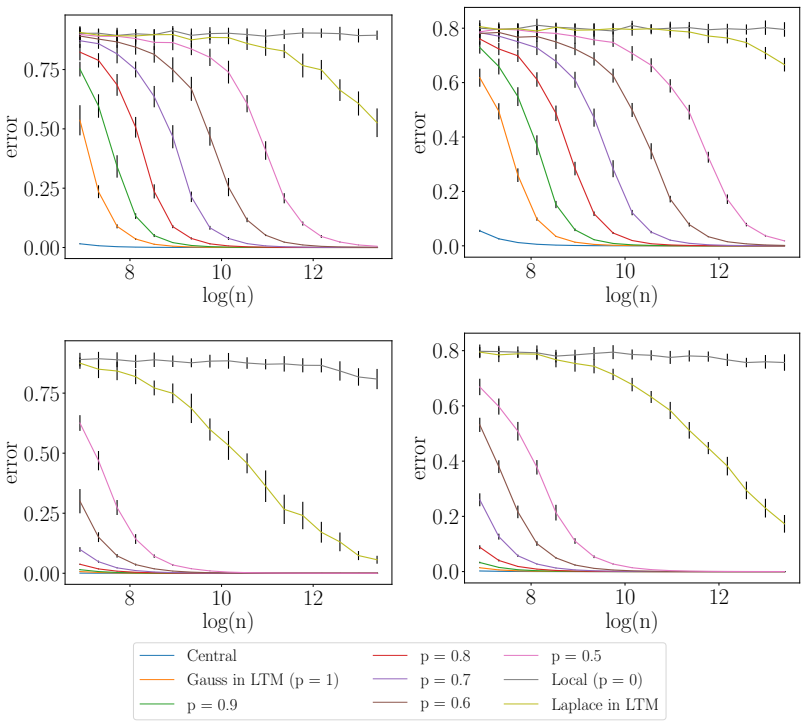
- The reported experiments show the mechanism's error approaching the central-model baseline as $n$ grows, on both synthetic and real datasets.
Reading between the lines
- The same noise-splitting argument should transfer to any analysis whose objective is preserved by subspace embeddings, such as $k$-means clustering or spectral distance estimation; the error would again be $n$-independent.
- Because the dense Rademacher variant achieves pure $\varepsilon$-DP, the linear-transformation model may be a route to pure-DP central-level accuracy without a trusted party, at the cost of a worse polynomial dependence in $d$ and $\varepsilon$.
- The fallback zero-output regime implies a participation threshold: for a fixed sketch width $m$, privacy and utility only hold when $n \gtrsim 8m\ln(dm/\delta)$; below it the mechanism degenerates. Choosing $m$ as small as target accuracy allows would widen the usable $n$-range.
- An immediate experimental check is to hold $m$ fixed and sweep $n$ across that threshold: error should be roughly flat above it and jump to the trivial fallback below it.
Signed reviews
Editorial analysis
A structured set of objections, weighed in public.
Referee Report
Summary. The paper introduces the linear-transformation model (LTM) of distributed differential privacy: n clients add locally sampled noise to their inputs, a trusted platform applies a public linear transformation (e.g., a sparse Johnson-Lindenstrauss/OSNAP sketch) to the noisy inputs, and the sketch output is analyzed publicly. Because the noise distributions are infinitely divisible, the sum of per-client noises equals the central-mechanism noise, yielding (ε,δ)-DP with error independent of n when the sketch is computed via linear secret sharing (tolerating t corrupt servers and t′ corrupt clients). The paper proves privacy theorems for sparse and dense sketching (Theorems 4.4, 4.8 with Gaussian/Laplace instantiations in Corollaries 4.7, 4.10), then shows utility bounds with error independent of n for low-rank approximation (Theorems 5.4, 5.7) and ridge regression (Theorem 5.8, under λ ≥ poly(ε^{-1}, d, log 1/δ)). It includes an MP-SPDZ implementation with scaling experiments and a utility study interpolating between local and central behavior on synthetic and real-world data.
Significance. The paper proposes a genuinely new intermediate trust model (the linear-transformation model), in which a public linear map computed by LSS-based MPC plays the role that the shuffler plays in the shuffle model. The core technical idea — splitting the central additive noise across clients via infinite divisibility and relying on the JL/OSNAP sketch to aggregate it — is elegant and well executed at the conceptual level: the main theorems give n-independent error for low-rank approximation and ridge regression, a property that provably distinguishes the model from the local model (where √n lower bounds apply). The paper is also commendable for shipping an MP-SPDZ implementation with runtime/communication measurements, for stating robustness against corrupt clients explicitly (Definition 4.2), and for keeping the theory parameter-free: no parameter is fitted to data to obtain the theorems, and the experimental noise-scaling exponent p is explicitly presented as an interpolation knob rather than a calibration. If the privacy accounting is corrected, the results would be a solid contribution to the distributed-DP literature.
major comments (3)
- [§4.2, Theorem 4.4, Eq. (2), Corollary 4.7] Theorem 4.4 allocates to each released coordinate the budget (ε/(sd), δ/(sd) − m exp(−(n−s−t′)/(8m))) and composes over s sketches and d columns. The Gaussian instantiation in Corollary 4.7 is therefore only well-defined when δ′ := δ/(sd) − m exp(−(n−s−t′)/(8m)) > 0; for δ′ ≤ 0, Lemma 3.3 cannot be invoked and no finite-variance Gaussian mechanism can satisfy the resulting inequality (it would imply pure (ε′,0)-DP). However, the fallback randomizer in Eq. (2) is activated by the condition n < 8m ln(dm/δ) + t′, which only guarantees δ/d > m exp(−(n−t′)/(8m)), and the proof of Theorem 4.4 repeats the same δ/d condition. Consequently, for every s > 1 there is a non-empty interval of n (roughly [8m ln(dm/δ)+t′, 8m ln(sdm/δ)+s+t′)) in which clients send non-zero randomized messages while the per-coordinate δ′ is negative, so the claimed (ε,δ)-DP guarantee is not established. Corollary 4.7's variance formula inherits the same mismatch: its log argument is 1.25s/(δ/d − m exp(−(n−s−t′)/(8m))), whereas Lemma 3.3 with ε′ = ε/(sd) and δ′ = δ/(sd) − m exp(...) requires ln(1.25/(δ/(sd) − m exp(...))). The fix is local: use δ/(sd) in Eq. (2), in the fallback case of Theorem 4.4's proof, and in Corollary 4.7, with threshold n ≥ 8m ln(sdm/δ)+s+t′. I further ask the authors to re-derive the variance constant: with the stated sensitivity Δ₂ = 2η√s and ε′ = ε/(sd), Lemma 3.3 requires per-entry noise variance 8η²s³d² ln(1.25/δ′)/ε², whereas the variance delivered by Corollary 4.7 after summing the honest clients' noises is (n−s−t′)σ²/(2m) = 2s³η²d² ln(...)/ε², a factor of 4 too small; with the corrected sensitivity 2η the delivered variance is still only s/4 of the requirement.
- [§4, Definitions 4.1–4.2, Lemma 4.6] The proof of Lemma 4.6 (and hence Theorem 4.4) conditions on the event E that every row of the sketch receives at least (n−t′)/(2m) honest clients' noises and charges the failure probability m exp(−(n−t′)/(8m)) to δ. This accounting is valid only if the set of corrupt clients is independent of the sketch matrix S. In the proposed protocol S is a public matrix — Section 4.3 explicitly tolerates corruption of all but one server, and the servers know S — while Definition 4.2 quantifies the guarantee over all coalitions C_cor, i.e., a worst-case coalition may be chosen with full knowledge of S. For m ≥ 2 and t′ = ⌈n/m⌉ (a parameter range allowed by Theorems 5.4 and 5.7, which assume t′ < n/2), an adversary can corrupt exactly the clients in the support of one output row, making that row's honest-noise contribution zero; the output coordinate is then a deterministic function of corrupted clients' data and no (ε,δ)-DP guarantee can hold. The failure probability of E is then 1 conditional on S, not m exp(−(n−t′)/(8m)). Please state explicitly that the corruption set is fixed before S is sampled and that S is kept from the adversary until all client messages are delivered (which is compatible with the LSS protocol, since clients only need the public transform after sending shares), or otherwise restrict the adversary; as written, Theorem 4.4 does not deliver the guarantee claimed in Definition 4.2.
- [§5, Theorems 5.4, 5.7, 5.8] The utility theorems are stated unconditionally, but the mechanism in Eq. (2) outputs the zero vector whenever n is below the fallback threshold, and the utility proofs do not cover that regime. In Theorem 5.4, if the randomizer outputs 0^{ds}, the sketch is zero and the output projection X′ is arbitrary, so ∥A − AX′X′^T∥_F can be Θ(∥A∥_F); the multiplicative-error claim (1+O(α_S)) is vacuous there. Theorem 5.8 does discuss the fallback, but the asserted bound '∥b∥² ≤ η′n ≤ η′m ln(dm/δ)+t′' is not correct as written (the second inequality drops a factor 8 and ignores the additive t′ in the chain), and the fallback error ∥b∥² can still be much larger than the optimal objective, so the multiplicative (1+o(1)) form also requires the noisy regime. The theorems should state the regime n ≥ 8m ln(sdm/δ)+s+t′ (with the s-dependent threshold correcting Eq. (2)) under which they apply; since m (and hence the threshold) is a constant depending only on the privacy/accuracy parameters, adding this qualification does not weaken the 'independent of n' claim, but it is currently missing.
minor comments (7)
- [Corollary 4.7 (proof)] In the proof of Corollary 4.7, the additive noise is described as 'n ∼ Lap(0, 2ηm²d/ε)^m' even though the corollary instantiates the Gaussian mechanism; the Laplace scale appears to be copied from Corollary 4.10. This should read Gaussian noise with the variance derived from Lemma 3.3.
- [Theorems 5.4 and 5.8 (statements/proofs)] Theorem 5.4 states 'Let S ∼ D_sketch(m,n)' without the sparsity parameter s, although the sparse mechanism and Corollary 4.7 are parameterized by s; the proof also cites 'Theorem 4.7' where Corollary 4.7 is meant, and the same citation issue occurs in Theorem 5.8.
- [Theorem 5.7 (proof)] The proof states that each entry of G_i is X_j − Y_j with X_j, Y_i ∼ Γ(1/(n−t), b); this is inconsistent with Corollary 4.10's parameterization Γ(1/(n/m−t′), b) and uses t in place of t′.
- [Table 1] The rows of Table 1 appear misaligned: for instance, the Ω(√n) lower bound for local frequency estimation is typeset in the Central column, and the frequency-estimation row contains more entries than there are columns.
- [References] References [64] and [65] both cite the same paper (N. M. Stausholm, PODS 2021) and should be merged.
- [Lemma 5.3] The statement of Lemma 5.3 is grammatically broken ('with probability at least 1−β for some absolute constant η and ∥L∥²_F ≤ ...'); the quantifier over η and the claimed matrix norm inequality should be stated as separate sentences.
- [Theorem 4.4 statement] Theorem 4.4's statement contains a mismatched parenthesis in the DP budget ('δ/(sd) − m exp(−(n−s−t′)/8m)))') and Lemma 4.6 has the same typo; worth a pass over the whole section.
Circularity Check
No significant circularity: the privacy and utility derivations reduce to standard Gaussian/Laplace mechanisms, infinite divisibility, and external OSNAP subspace-embedding bounds; self-citations are not load-bearing.
full rationale
The derivation chain is self-contained with respect to the claimed results. The privacy analysis (Theorem 4.4, Lemma 4.6, Corollary 4.7) reduces the distributed randomizer R_D and the linear transformation T_S to the standard additive Gaussian/Laplace mechanism: per-client noise is chosen so that the summed noise on each sketch output is exactly the noise of the central mechanism, relying on infinite divisibility and a Chernoff bound (Lemma 4.5) on the number of honest clients contributing to each row. This is a genuine reduction rather than an assumption of the conclusion, and the central mechanism's privacy is established externally through sensitivity analysis (Lemmas 3.3 and 3.4). The utility theorems (5.4, 5.7, 5.8) use the OSNAP subspace-embedding property from external work by Nelson and Nguyên [58] and Cohen [22]; the paper explicitly states that the main proofs use the [22] parameter trade-offs, while the authors' own prior work [42] is mentioned only as an alternative trade-off changing the bounds by logarithmic factors and is not used to establish the main theorems. The experimental section varies noise variance as n^{-p} to illustrate interpolation between local and LTM behavior, but these choices do not feed back into the theorems; the experiments are validation, not calibration. The concerns I found are correctness risks rather than circularity: a possible mismatch between the delta/d threshold in Eq. (2) and the delta/(sd) budget used in Theorem 4.4's composition, and the utility theorems being vacuous when n falls below the fallback threshold 8m ln(dm/delta)+t'. Neither involves fitting a parameter to the target output nor deriving a claim from its own statement. Therefore no circular step is present.
Assumptions & free parameters
free parameters (1)
- experimental noise-interpolation exponent p =
0.5, 0.6, 0.7, 0.8, 0.9, 1.0
assumptions (5)
- standard math OSNAP matrices from [22] satisfy the subspace embedding property (Definition 3.1) with m = O(k log(k/β)/α²) and s = O(log(k/β)/α)
- domain assumption Additive secret sharing provides an information-theoretically secure MPC protocol tolerating k-1 semi-honest corruptions
- domain assumption Input values are bounded in magnitude by η
- domain assumption The noise distribution D is symmetric and infinitely divisible, so the sum of (n-s-t')/(2m) i.i.d. samples is distributed as D'
- ad hoc to paper Ridge regression requires λ ≥ poly(ε^{-1}, d, log 1/δ)
Cite this review
Pith. "Pith review of Distributed Differentially Private Data Analytics via Secure Sketching." pith.science (2026). https://pith.science/paper/UOFSMKAW
@misc{pith2026241200497,
  author       = {Pith},
  title        = {Pith review of: Distributed Differentially Private Data Analytics via Secure Sketching},
  year         = {2026},
  howpublished = {\url{https://pith.science/paper/UOFSMKAW}},
  note         = {Machine review of arXiv:2412.00497}
}
read the original abstract
We introduce the linear-transformation model, a distributed model of differentially private data analysis. Clients have access to a trusted platform capable of applying a public matrix to their inputs. Such computations can be securely distributed across multiple servers using simple and efficient secure multiparty computation techniques. The linear-transformation model serves as an intermediate model between the highly expressive central model and the minimal local model. In the central model, clients have access to a trusted platform capable of applying any function to their inputs. However, this expressiveness comes at a cost, as it is often prohibitively expensive to distribute such computations, leading to the central model typically being implemented by a single trusted server. In contrast, the local model assumes no trusted platform, which forces clients to add significant noise to their data. The linear-transformation model avoids the single point of failure for privacy present in the central model, while also mitigating the high noise required in the local model. We demonstrate that linear transformations are very useful for differential privacy, allowing for the computation of linear sketches of input data. These sketches largely preserve utility for tasks such as private low-rank approximation and private ridge regression, while introducing only minimal error, critically independent of the number of clients.
Figures


Figures from the paper (1 more)

Reference graph
Works this paper leans on
-
[1]
Dimitris Achlioptas. 2003. Database-friendly random projections: Johnson- Lindenstrauss with binary coins. J. Comput. Syst. Sci. 66, 4 (2003), 671–687. https://doi.org/10.1016/S0022-0000(03)00025-4
-
[2]
Apple and Google. 2021. Exposure Notification Privacy-preserving Analytics (ENPA). White Paper
2021
-
[3]
Raman Arora, Vladimir Braverman, and Jalaj Upadhyay. 2018. Differentially Private Robust Low-Rank Approximation. In Advances in Neural Information Processing Systems
work page 2018
-
[4]
Sanjeev Arora, Elad Hazan, and Satyen Kale. 2006. A Fast Random Sampling Algorithm for Sparsifying Matrices. In Approximation, Randomization, and Com- binatorial Optimization. Algorithms and Techniques, 9th International Workshop on Approximation Algorithms for Combinatorial Optimization Problems, APPROX 2006 and 10th International Workshop on Randomizati...
work page 2006
-
[5]
Maria-Florina Balcan, Simon Shaolei Du, Yining Wang, and Adams Wei Yu. 2016. An Improved Gap-Dependency Analysis of the Noisy Power Method. In 29th Annual Conference on Learning Theory (Proceedings of Machine Learning Research, Vol. 49), Vitaly Feldman, Alexander Rakhlin, and Ohad Shamir (Eds.). PMLR, Columbia University, New York, New York, USA, 284–309....
work page 2016
-
[6]
Raef Bassily, Kobbi Nissim, Uri Stemmer, and Abhradeep Thakurta. 2020. Practical Locally Private Heavy Hitters. J. Mach. Learn. Res. 21 (2020), 16:1–16:42. https: //jmlr.org/papers/v21/18-786.html
work page 2020
-
[7]
Raef Bassily and Adam D. Smith. 2015. Local, Private, Efficient Protocols for Succinct Histograms. In Proceedings of the Forty-Seventh Annual ACM on Sym- posium on Theory of Computing, STOC 2015, Portland, OR, USA, June 14-17, 2015, Rocco A. Servedio and Ronitt Rubinfeld (Eds.). ACM, 127–135. https: //doi.org/10.1145/2746539.2746632
arXiv 2015
-
[8]
Raef Bassily, Adam D. Smith, and Abhradeep Thakurta. 2014. Private Empirical Risk Minimization: Efficient Algorithms and Tight Error Bounds. In 55th IEEE Annual Symposium on Foundations of Computer Science, FOCS
work page 2014
Show all 81 references
-
[9]
Luca Becchetti, Marc Bury, Vincent Cohen-Addad, Fabrizio Grandoni, and Chris Schwiegelshohn. 2019. Oblivious dimension reduction for k-means: beyond subspaces and the Johnson-Lindenstrauss lemma. InProceedings of the 51st Annual ACM SIGACT Symposium on Theory of Computing, STOC
2019
-
[10]
Amos Beimel, Iftach Haitner, Kobbi Nissim, and Uri Stemmer. 2020. On the Round Complexity of the Shuffle Model. In Theory of Cryptography: 18th International Conference, TCC 2020, Durham, NC, USA, November 16–19, 2020, Proceedings, Part II. Springer-Verlag, Berlin, Heidelberg,...
2020 doi
-
[11]
Bertin-Mahieux
T. Bertin-Mahieux. 2011. YearPredictionMSD. UCI Machine Learning Repository. DOI: https://doi.org/10.24432/C50K61
2011 doi
-
[12]
Andrea Bittau, Úlfar Erlingsson, Petros Maniatis, Ilya Mironov, Ananth Raghu- nathan, David Lie, Mitch Rudominer, Ushasree Kode, Julien Tinnes, and Bernhard Seefeld. 2017. Prochlo: Strong Privacy for Analytics in the Crowd. In Proceedings of the 26th Symposium on Operating Sys...
2017
-
[13]
Jeremiah Blocki, Avrim Blum, Anupam Datta, and Or Sheffet. 2012. The Johnson- Lindenstrauss Transform Itself Preserves Differential Privacy. In 53rd Annual IEEE Symposium on Foundations of Computer Science, FOCS 2012, New Brunswick, NJ, USA, October 20-23, 2012 . IEEE Computer...
2012 doi
-
[14]
Avrim Blum, Cynthia Dwork, Frank McSherry, and Kobbi Nissim. 2005. Prac- tical privacy: the SuLQ framework. In Proceedings of the Twenty-Fourth ACM SIGMOD-SIGACT-SIGART Symposium on Principles of Database Systems (, Balti- more, Maryland,) (PODS ’05). Association for Computing...
2005
-
[15]
Brendan McMahan, Sarvar Patel, Daniel Ramage, Aaron Segal, and Karn Seth
Keith Bonawitz, Vladimir Ivanov, Ben Kreuter, Antonio Marcedone, H. Brendan McMahan, Sarvar Patel, Daniel Ramage, Aaron Segal, and Karn Seth. 2017. Practi- cal Secure Aggregation for Privacy-Preserving Machine Learning. In Proceedings of the 2017 ACM SIGSAC Conference on Compu...
2017
-
[16]
Tony Cai, Yichen Wang, and Linjun Zhang
T. Tony Cai, Yichen Wang, and Linjun Zhang. 2021. The cost of privacy: Optimal rates of convergence for parameter estimation with differential privacy. The Annals of Statistics 49, 5 (2021), 2825 – 2850. https://doi.org/10.1214/21-AOS2058
2021 doi
-
[17]
Sarwate, and Kaushik Sinha
Kamalika Chaudhuri, Anand D. Sarwate, and Kaushik Sinha. 2012. Near-optimal Differentially Private Principal Components. In Advances in Neural Information Processing Systems 25: 26th Annual Conference on Neural Information Processing Systems 2012. Proceedings of a meeting held...
2012
-
[18]
Albert Cheu, Adam Smith, Jonathan Ullman, David Zeber, and Maxim Zhilyaev
-
[19]
Albert Cheu and Chao Yan. 2023. Necessary Conditions in Multi-Server Differ- ential Privacy. In 14th Innovations in Theoretical Computer Science Conference (ITCS)
2023
-
[20]
Clarkson and David P
Kenneth L. Clarkson and David P. Woodruff. 2009. Numerical linear algebra in the streaming model. InProceedings of the 41st Annual ACM Symposium on Theory of Computing, STOC 2009, Bethesda, MD, USA, May 31 - June 2, 2009 , Michael Mitzenmacher (Ed.). ACM, 205–214. https://doi....
2009
-
[22]
Michael B. Cohen. 2016. Nearly Tight Oblivious Subspace Embeddings by Trace Inequalities. In Proceedings of the Twenty-Seventh Annual ACM-SIAM Symposium on Discrete Algorithms, SODA 2016, Arlington, V A, USA, January 10-12, 2016, Robert Krauthgamer (Ed.). SIAM, 278–287. https:...
2016 doi
-
[23]
Cohen, Sam Elder, Cameron Musco, Christopher Musco, and Madalina Persu
Michael B. Cohen, Sam Elder, Cameron Musco, Christopher Musco, and Madalina Persu. 2015. Dimensionality Reduction for k-Means Clustering and Low Rank Approximation. In Proceedings of the Forty-Seventh Annual ACM on Symposium on Theory of Computing, STOC 2015, Portland, OR, USA...
2015
-
[24]
Ronald Cramer, Ivan Bjerre Damgård, and Jesper Buus Nielsen. 2015. Secure Multiparty Computation and Secret Sharing . Cambridge University Press
2015
-
[25]
Ivan Damgård, Hannah Keller, Boel Nelson, Claudio Orlandi, and Rasmus Pagh
-
[26]
Christos Dimitrakakis, Blaine Nelson, Aikaterini Mitrokotsa, and Benjamin I. P. Rubinstein. 2014. Robust and Private Bayesian Inference. In Algorithmic Learning Theory. Springer International Publishing, Cham, 291–305
2014
-
[27]
Cynthia Dwork, Krishnaram Kenthapadi, Frank McSherry, Ilya Mironov, and Moni Naor. 2006. Our Data, Ourselves: Privacy Via Distributed Noise Generation. In Advances in Cryptology - EUROCRYPT
2006
-
[28]
Cynthia Dwork, Frank McSherry, Kobbi Nissim, and Adam Smith. 2006. Calibrat- ing Noise to Sensitivity in Private Data Analysis. In Theory of Cryptography
2006
-
[29]
Cynthia Dwork and Aaron Roth. 2014. The Algorithmic Foundations of Differen- tial Privacy. Foundations and Trends in Theoretical Computer Science (2014)
2014
-
[30]
Cynthia Dwork, Kunal Talwar, Abhradeep Thakurta, and Li Zhang. 2014. Analyze gauss: optimal bounds for privacy-preserving principal component analysis. In Symposium on Theory of Computing, STOC 2014, New York, NY, USA, May 31 - June 03, 2014 , David B. Shmoys (Ed.). ACM, 11–20...
2014
-
[31]
Úlfar Erlingsson, Vitaly Feldman, Ilya Mironov, Ananth Raghunathan, Kunal Talwar, and Abhradeep Thakurta. 2019. Amplification by Shuffling: From Local to Central Differential Privacy via Anonymity. In Proceedings of the 2019 Annual ACM-SIAM Symposium on Discrete Algorithms (SODA)
2019
-
[32]
Jordi Fonollosa. 2015. Gas sensor array under dynamic gas mixtures. UCI Machine Learning Repository. DOI: https://doi.org/10.24432/C5WP4C
2015 doi
-
[33]
James Foulds, Joseph Geumlek, Max Welling, and Kamalika Chaudhuri. 2016. On the Theory and practice of privacy-preserving Bayesian data analysis. In Proceedings of the Thirty-Second Conference on Uncertainty in Artificial Intelligence (Jersey City, New Jersey, USA) (UAI’16). A...
2016
-
[34]
Badih Ghazi, Noah Golowich, Ravi Kumar, Rasmus Pagh, and Ameya Velingker
-
[35]
Badih Ghazi, Pritish Kamath, Ravi Kumar, Pasin Manurangsi, and Adam Sealfon
-
[36]
Badih Ghazi, Ravi Kumar, Pasin Manurangsi, and Rasmus Pagh. 2020. Private Counting from Anonymous Messages: Near-Optimal Accuracy with Vanishing Communication Overhead. In Proceedings of the 37th International Conference on Machine Learning, ICML 2020, 13-18 July 2020, Virtual...
2020
-
[37]
Slawomir Goryczka and Li Xiong. 2017. A Comprehensive Comparison of Multi- party Secure Additions with Differential Privacy.IEEE Transactions on Dependable and Secure Computing (2017)
2017
-
[38]
Moritz Hardt and Eric Price. 2014. The Noisy Power Method: A Meta Algo- rithm with Applications. In Advances in Neural Information Processing Systems , Z. Ghahramani, M. Welling, C. Cortes, N. Lawrence, and K.Q. Weinberger (Eds.), Vol. 27. Curran Associates, Inc. https://proce...
2014
-
[39]
On Computing Pairwise Statistics with Local Differential Privacy. In Advances in Neural Information Processing Systems 36: Annual Conference on Neural Information Processing Systems 2023, NeurIPS 2023, New Orleans, LA, USA, December 10 - 16, 2023, Alice Oh, Tristan Naumann, Am...
2023
-
[41]
Georges Hebrail and Alice Berard. 2012. Individual household elec- tric power consumption. UCI Machine Learning Repository. DOI: https://doi.org/10.24432/C58K54
2012 doi
- [42]
-
[43]
Moritz Hardt and Aaron Roth. 2012. Beating randomized response on incoherent matrices. In Proceedings of the Forty-Fourth Annual ACM Symposium on Theory of Computing (New York, New York, USA)(STOC ’12). Association for Computing Machinery, New York, NY, USA, 1255–1268. https:/...
2012 doi
-
[44]
Michael Kapralov and Kunal Talwar. [n. d.]. On differentially private low rank approximation. 1395–1414. https://doi.org/10.1137/1.9781611973105.101 arXiv:https://epubs.siam.org/doi/pdf/10.1137/1.9781611973105.101
-
[45]
Lee, Kobbi Nissim, Sofya Raskhod- nikova, and Adam Smith
Shiva Prasad Kasiviswanathan, Homin K. Lee, Kobbi Nissim, Sofya Raskhod- nikova, and Adam Smith. 2008. What Can We Learn Privately?. In 49th Annual IEEE Symposium on Foundations of Computer Science (FOCS)
2008
-
[46]
Manohar Kaul. 2013. 3D Road Network (North Jutland, Denmark). UCI Machine Learning Repository. DOI: https://doi.org/10.24432/C5GP51
2013 doi
-
[47]
Kane and Jelani Nelson
Daniel M. Kane and Jelani Nelson. 2012. Sparser Johnson-Lindenstrauss trans- forms. In Proceedings of the Twenty-Third Annual ACM-SIAM Symposium on Discrete Algorithms, SODA 2012, Kyoto, Japan, January 17-19, 2012 , Yuval Rabani (Ed.). SIAM, 1195–1206. https://doi.org/10.1137/...
2012 doi
-
[48]
Krishnaram Kenthapadi, Aleksandra Korolova, Ilya Mironov, and Nina Mishra
-
[49]
Smith, and Abhradeep Thakurta
Daniel Kifer, Adam D. Smith, and Abhradeep Thakurta. 2012. Private Convex Opti- mization for Empirical Risk Minimization with Applications to High-dimensional Regression. In The 25th Annual Conference on Learning Theory (COLT)
2012
-
[50]
Beatrice Laurent and Pascal Massart. 2000. Adaptive estimation of a quadratic functional by model selection. Annals of statistics (2000), 1302–1338
2000
-
[51]
Marcel Keller. 2020. MP-SPDZ: A Versatile Framework for Multi-Party Com- putation. In CCS ’20: 2020 ACM SIGSAC Conference on Computer and Commu- nications Security, Virtual Event, USA, November 9-13, 2020 , Jay Ligatti, Xin- ming Ou, Jonathan Katz, and Giovanni Vigna (Eds.). A...
2020
-
[52]
Xiyang Liu, Weihao Kong, and Seewong Oh. 2022. Differential privacy and robust statistics in high dimensions. In Conference on Learning Theory
2022
-
[53]
Luca Melis, George Danezis, and Emiliano De Cristofaro. 2016. Efficient Private Statistics with Succinct Sketches. https://doi.org/10.14722/ndss.2016.23175
2016
-
[54]
Xiangrui Meng and Michael W. Mahoney. 2013. Low-distortion subspace em- beddings in input-sparsity time and applications to robust linear regression. In Symposium on Theory of Computing Conference, STOC’13, Palo Alto, CA, USA, June 1-4, 2013, Dan Boneh, Tim Roughgarden, and Jo...
2013
-
[55]
Jason Milionis, Alkis Kalavasis, Dimitris Fotakis, and Stratis Ioannidis. 2022. Dif- ferentially Private Regression with Unbounded Covariates. In Proceedings of The 25th International Conference on Artificial Intelligence and Statistics (Proceedings of Machine Learning Researc...
2022
-
[56]
Woodruff
Yingyu Liang, Maria-Florina Balcan, Vandana Kanchanapally, and David P. Woodruff. 2014. Improved Distributed Principal Component Analysis. In Ad- vances in Neural Information Processing Systems 27: Annual Conference on Neu- ral Information Processing Systems 2014, December 8-1...
2014
-
[57]
Vaikkunth Mugunthan, Antigoni Polychroniadou, David Byrd, and Tucker Hybi- nette Balch. 2019. Smpai: Secure multi-party computation for federated learning. In Proceedings of the NeurIPS 2019 Workshop on Robust AI in Financial Services
2019
-
[58]
Jelani Nelson and Huy L Nguyên. 2013. OSNAP: Faster numerical linear algebra algorithms via sparser subspace embeddings. In 54th Annual IEEE Symposium on Foundations of Computer Science, FOCS
2013
-
[59]
Aleksandar Nikolov. 2023. Private Query Release via the Johnson-Lindenstrauss Transform. In Proceedings of the 2023 ACM-SIAM Symposium on Discrete Al- gorithms, SODA 2023, Florence, Italy, January 22-25, 2023 , Nikhil Bansal and Viswanath Nagarajan (Eds.). SIAM, 4982–5002. htt...
2023 doi
-
[60]
Rasmus Pagh and Mikkel Thorup. 2022. Improved Utility Analysis of Private CountSketch. In Advances in Neural Information Processing Systems , S. Koyejo, S. Mohamed, A. Agarwal, D. Belgrave, K. Cho, and A. Oh (Eds.), Vol. 35. Curran 19 Associates, Inc., 25631–25643. https://pro...
2022
-
[61]
Kentaro Minami, HItomi Arai, Issei Sato, and Hiroshi Nakagawa. 2016. Differ- ential Privacy without Sensitivity. In Advances in Neural Information Processing Systems, D. Lee, M. Sugiyama, U. Luxburg, I. Guyon, and R. Garnett (Eds.), Vol. 29. Curran Associates, Inc. https://pro...
2016
-
[62]
Tamás Sarlós. 2006. Improved Approximation Algorithms for Large Matrices via Random Projections. In 47th Annual IEEE Symposium on Foundations of Computer Science (FOCS 2006), 21-24 October 2006, Berkeley, California, USA, Proceedings . IEEE Computer Society, 143–152. https://d...
2006 doi
-
[63]
Or Sheffet. 2019. Old Techniques in Differentially Private Linear Regression. In Proceedings of the 30th International Conference on Algorithmic Learning Theory (Proceedings of Machine Learning Research, Vol. 98) , Aurélien Garivier and Satyen Kale (Eds.). PMLR, 789–827. https...
2019
-
[65]
Nina Mesing Stausholm. 2021. Improved Differentially Private Euclidean Distance Approximation. In PODS’21: Proceedings of the 40th ACM SIGMOD-SIGACT-SIGAI Symposium on Principles of Database Systems, Virtual Event, China, June 20-25, 2021, Leonid Libkin, Reinhard Pichler, and ...
2021
-
[66]
Gilles Pisier. 1999. The volume of convex bodies and Banach space geometry. Cambridge Tracts in Mathematics. 94
1999
-
[67]
Kunal Talwar, Shan Wang, Audra McMillan, Vojta Jina, Vitaly Feldman, Bailey Basile, Aine Cahill, Yi Sheng Chan, Mike Chatzidakis, Junye Chen, Oliver Chick, Mona Chitnis, Suman Ganta, Yusuf Goren, Filip Granqvist, Kristine Guo, Frederic Jacobs, Omid Javidbakht, Albert Liu, Rich...
2023 arXiv
-
[68]
Jalaj Upadhyay. 2018. The Price of Privacy for Low-rank Factorization. In Ad- vances in Neural Information Processing Systems
2018
-
[69]
Prateek Varshney, Abhradeep Thakurta, and Prateek Jain. 2022. (Nearly) Opti- mal Private Linear Regression for Sub-Gaussian Data via Adaptive Clipping. In Proceedings of Thirty Fifth Conference on Learning Theory (Proceedings of Machine Learning Research, Vol. 178) , Po-Ling L...
2022
-
[70]
Slavkovic
Duy Vu and Aleksandra B. Slavkovic. 2009. Differential Privacy for Clinical Trial Data: Preliminary Evaluations. In ICDM Workshops 2009, IEEE International Conference on Data Mining
2009
- [71]
-
[72]
Di Wang, Lijie Hu, Huanyu Zhang, Marco Gaboardi, and Jinhui Xu. 2023. Gen- eralized Linear Models in Non-interactive Local Differential Privacy with Pub- lic Data. Journal of Machine Learning Research 24, 132 (2023), 1–57. http: //jmlr.org/papers/v24/21-0523.html
2023
-
[73]
Smith, and Jinhui Xu
Di Wang, Adam D. Smith, and Jinhui Xu. 2018. Noninteractive Locally Private Learning of Linear Models via Polynomial Approximations. In International Conference on Algorithmic Learning Theory . https://api.semanticscholar.org/ CorpusID:67856419
2018
-
[74]
Yu-Xiang Wang. 2018. Revisiting differentially private linear regression: optimal and adaptive prediction & estimation in unbounded domain. In Proceedings of the Thirty-Fourth Conference on Uncertainty in Artificial Intelligence, UAI
2018
-
[75]
Fienberg, and Alexander J
Yu-Xiang Wang, Stephen E. Fienberg, and Alexander J. Smola. 2015. Privacy for Free: Posterior Sampling and Stochastic Gradient Monte Carlo. In Proceedings of the 32nd International Conference on Machine Learning, ICML
2015
-
[76]
Di Wang, Marco Gaboardi, and Jinhui Xu. 2018. Empirical Risk Minimization in Non-interactive Local Differential Privacy Revisited. In Advances in Neural Information Processing Systems
2018
-
[77]
Woodruff
David P. Woodruff. 2014. Sketching as a Tool for Numerical Linear Algebra. Found. Trends Theor. Comput. Sci. 10, 1-2 (2014), 1–157. https://doi.org/10.1561/ 0400000060
2014
-
[78]
Fuheng Zhao, Dan Qiao, Rachel Redberg, Divyakant Agrawal, Amr El Abbadi, and Yu-Xiang Wang. 2022. Differentially private linear sketches: efficient imple- mentations and applications. In Proceedings of the 36th International Conference on Neural Information Processing Systems ...
2022
-
[79]
Kai Zheng, Wenlong Mou, and Liwei Wang. 2017. Collect at once, use effectively: making non-interactive locally private learning possible. In Proceedings of the 34th International Conference on Machine Learning (ICML) . 20
2017
-
[81]
Stanley L. Warner. 1965. Randomized Response: A Survey Technique for Elimi- nating Evasive Answer Bias. J. Amer. Statist. Assoc. (1965)
1965
-
[2013]
Privacy via the Johnson-Lindenstrauss Transform. J. Priv. Confidentiality 5, 1 (2013). https://doi.org/10.29012/JPC.V5I1.625
2013 doi
-
[2019]
In Advances in Cryptology EUROCRYPT
Distributed Differential Privacy via Shuffling. In Advances in Cryptology EUROCRYPT
-
[2021]
On the Power of Multiple Anonymous Messages: Frequency Estimation and Selection in the Shuffle Model of Differential Privacy. In Advances in Cryptology - EUROCRYPT 2021 - 40th Annual International Conference on the Theory and Applications of Cryptographic Techniques, Zagreb, C...
2021
-
[2023]
In The Web Conference (WWW)
Differentially Private Selection from Secure Distributed Computing. In The Web Conference (WWW)
Reviewed August 12, 2026 · model on record in the stance chip above.
Discussion (0). Continue with ORCID to comment.