REVIEW 4 major objections 4 minor 83 references
Terrestrial atmospheric ion implantation occurred in the nearside lunar regolith during the history of Earth's dynamo
T0 review · 4 major / 4 minor · reviewed 2026-08-12 · deepseek-v4-flash
Pith's one-line read This paper claims that the non-solar light volatiles in nearside lunar soil were implanted as ionized Earth atmosphere carried by the solar wind through Earth's magnetotail during the long magnetized history of the geodynamo, not during a…
desk verdict The paper's qualitative claim that a geodynamo, not an unmagnetized early Earth, delivered terrestrial volatiles to the Moon is fresh and worth discussing, but the quantitative flux comparison rests on an inflated MHD atmosphere scale height that needs a resolution study before the numbers can be trusted. read the letter →
The pith
A machine-rendered reading of the paper's core claim, the machinery that carries it, and where it could break.
The reading
What carries the argument
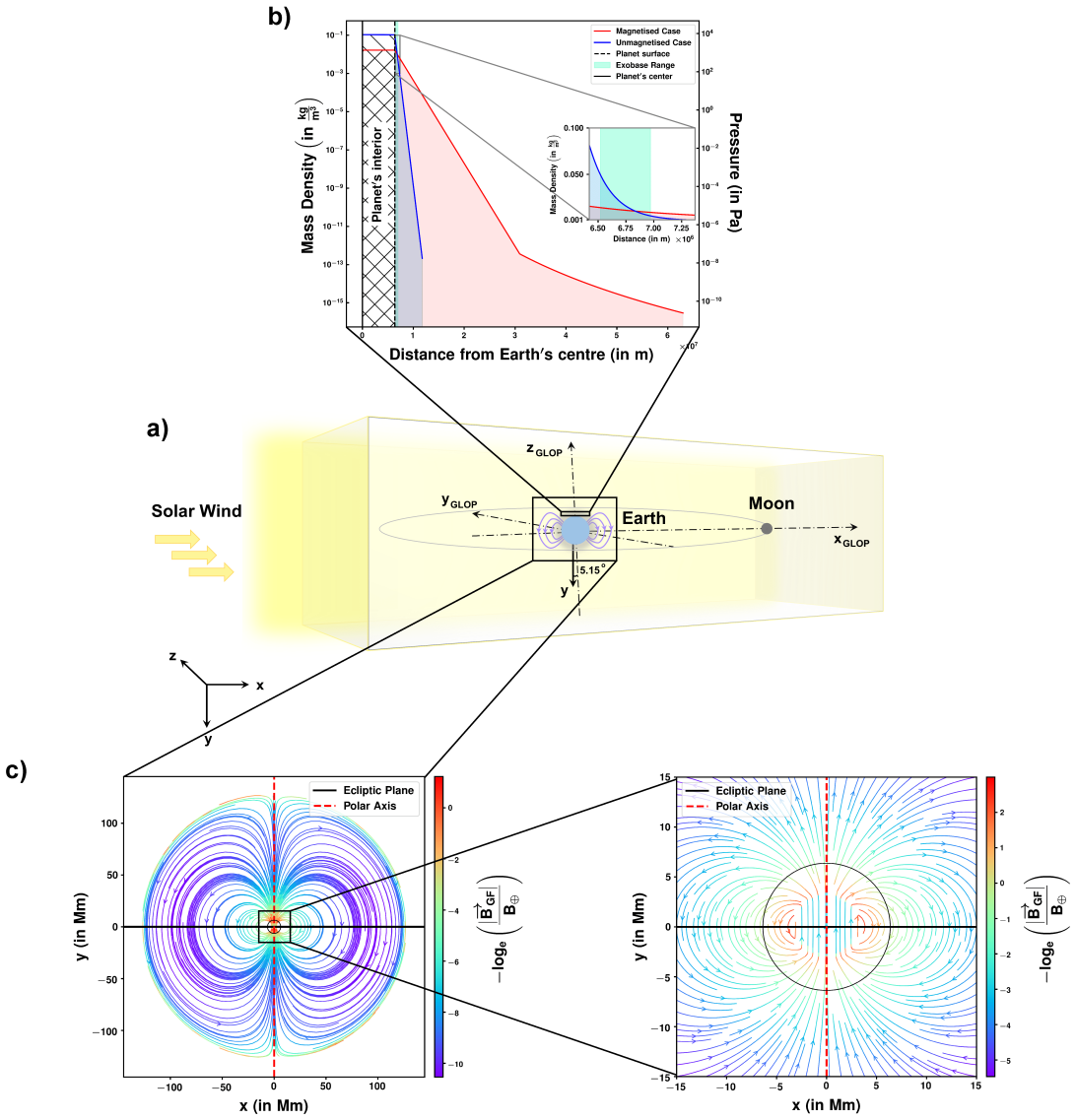
The load-bearing object is the 'Earth wind' channel: ionized atmospheric species produced above the exobase are picked up by the solar wind and carried antisunward down the magnetotail to the Moon's nearside surface. The argument runs through three linked components: (i) an adaptive-mesh MHD simulation of the solar wind interacting with an isothermal atmosphere matched to a dipole field (exponential density profile below the beta = 1 surface, power-law tail above) and with a fixed-total-mass unmagnetized atmosphere; (ii) a photoionization model using empirical neutral densities and solar EUV spectra to compute species-specific escape fluxes above the exobase, normalized to the MHD bulk flux; and (iii) binary mixing hyperbolae for 15N/14N–D/H, 3He/20Ne, and 3He/40Ar that map the observed Apollo isotope data onto exobase-dependent curves. The decisive comparison is the table of computed Earth-wind flux versus measured non-solar flux for each species in each Earth state.
What would settle it
Recompute the magnetized Case-I Earth-wind flux at higher resolution (finest cell about 312 km and 156 km by adding AMR levels); if the orbit-averaged flux falls by more than about a factor of two below the measured non-solar flux for nitrogen (roughly 2e4 $m^{-2}$ $s^{-1}$), the central match is an artifact of the unresolved atmospheric scale height. Alternatively, measurement of a non-solar nitrogen component in a well-dated lunar sample whose implantation epoch corresponds to an exobase below 190 km would break the stated exobase constraint.
Extended reading notes
Core claim
Using a single-fluid multi-species MHD model with passive tracers for solar wind and atmospheric material, the paper computes orbit-averaged fluxes of terrestrial ('Earth wind') ions and solar wind ions arriving at the lunar nearside sub-Earth point, for magnetized and unmagnetized Earth configurations. The Earth wind is only appreciable when the Moon is inside the magnetotail; there the planet flux is comparable to or exceeds the measured non-solar fluxes of He, N, Ne, and Ar for the present-day magnetized case, while the Archean unmagnetized case underproduces these species because the stronger early solar wind dilutes the terrestrial contribution. Comparison of Apollo 17 ilmenite isotope data with binary mixing hyperbolae between solar wind and Earth wind end-members places the data on curves corresponding to exobase heights of roughly 190–300 km, yielding the constraint that the exobase never fell below 190 km. When the magnetic field effect is isolated with identical solar wind conditions, the magnetized Earth delivers about an order of magnitude less terrestrial flux to the Moon than the unmagnetized Earth, so the field is protective for this transport channel, yet the much longer magnetized era still dominates the time-integrated implantation.
Load-bearing premise
The simulations resolve the atmosphere with a finest cell of 625 km while the real pressure scale height is about 8 km, so the numerical atmosphere's density gradient—which controls how much atmospheric mass the solar wind picks up—may not match reality, and the computed Earth-wind flux could be off; the paper does not demonstrate convergence with resolution.
Editorial extensions
If this is right
- The nearside lunar regolith preserves a record of Earth's atmospheric composition extending over billions of years, not merely a record of solar wind history.
- The observed non-solar volatile inventory is consistent with a geodynamo active from at least roughly 3.5–4.2 Ga and with the absence of a long-lived lunar magnetosphere after about 4.36 Ga.
- Nitrogen isotope variations in lunar soils are explained as mixing between solar wind and terrestrial end-members, with the data requiring exobase heights below roughly 300 km at implant time.
- Isolating the field effect shows the dynamo reduces Earth-wind delivery by about an order of magnitude, clarifying why a magnetic field can be partially protective while still allowing substantial volatile transfer over long times.
- The exobase never smaller than 190 km is a testable constraint on the paleo-Earth atmosphere's thermal structure.
Reading between the lines
- An immediate numerical test is a resolution study: rerunning the magnetized Case-I simulation with one or two additional AMR levels (finest cell 312 km or 156 km instead of 625 km) would show whether the orbit-averaged Earth-wind flux is stable; a large drop would implicate the unresolved density gradient as the driver of the Table 2 match.
- The same magnetotail transport geometry should apply to any magnetized planet hosting a close large moon, so terrestrial-ion implantation is a generic mechanism that could seed volatiles on such moons and might be testable with future sample return.
- The 190 km exobase floor is a paleoatmospheric thermometer that could be cross-checked against independent reconstructions of Archean atmosphere density from noble-gas escape models.
Signed reviews
Editorial analysis
A structured set of objections, weighed in public.
Referee Report
Summary. The paper combines 3-D MHD simulations of the solar wind interacting with magnetized (present-day) and unmagnetized (Eoarchean) Earth atmospheres with photoionization and binary-mixing models to interpret light volatile elements in lunar regolith. It argues that terrestrial atmospheric ions are transported to the Moon mainly when the Moon is in Earth's magnetotail, that the non-solar N, He, Ne, and Ar in Apollo samples are best explained by implantation during the long magnetized phase of the geodynamo rather than during a hypothetical unmagnetized epoch, and that the exobase altitude at the time of implantation was never below about 190 km.
Significance. If the central comparison holds, the paper would provide a quantitative framework for reading the lunar regolith as an archive of terrestrial atmospheric escape over billions of years, with direct implications for geodynamo history and paleoatmospheric evolution. The work is constructive: it uses an explicit multi-species MHD model, a photoionization model, and a binary-mixing analysis; it considers multiple parameter cases; and it provides analytic scaling relations and a limitations section in the Supplementary Materials. The main risk is that the quantitative conclusion rests on the orbit-averaged Earth-wind flux from simulations whose atmospheric density gradient is not resolved, and on a one-sided comparison criterion.
major comments (4)
- [§4.1.5, §4.2.3, Table 2] The finest atmospheric cell size is 625 km (§4.1.5) and the scale height used in the MHD atmosphere is ~10^3 km (§4.2.3), while the real thermospheric scale height below the exobase is about 8 km. The Earth-wind flux in Table 2 is the load-bearing quantity, and it must exceed the non-solar flux by factors of ~12 (N), ~9 (He), and ~25 (Ne) for the magnetized case to be judged successful. That flux is generated by the solar wind mass loading of an atmosphere whose density gradient is completely unresolved, and no resolution or convergence study is reported. The Supplementary Limitations (S2) discuss rotation and grid artifacts but not this issue. The statement in §4.2.3 that the ion gyroradius (~560 km) is comparable to the MHD scale height justifies the MHD approximation, but it does not address whether the grid resolves the mass-loading gradient. This concern is load-bearing for the central claim and needs to be addressed with either a resolution study or an explicit demonstration that the Earth-wind flux is insensitive to the atmospheric scale height.
- [§2.3, Table 2] The criterion used to declare success is that the model Earth-wind flux 'surpasses' the measured non-solar flux. For N, He, and Ne in the magnetized case the excess is roughly one order of magnitude (ratios of ~12, ~9, and ~25, respectively). Without a retention or implantation efficiency, or an uncertainty estimate on both fluxes, an order-of-magnitude excess is not a quantitative match; it is more accurately an upper-limit statement. The paper should either provide a bounded prediction with propagated uncertainties or justify why a large excess is consistent with the observed lunar concentrations.
- [Figures 6/ED4, Table 2, Tables ED4/ED5] The exobase altitude is effectively a fitted parameter: Figures 6 and ED4 show mixing curves for different exobase heights, and the text identifies ~250 km as the best match for the magnetized case, while the abstract and discussion convert this into a firm statement that the exobase was never below 190 km. This is an inference from the model, not an independent measurement. Furthermore, the Earth-wind fluxes in Table 2 appear to be based on a single exobase value (401 km for the magnetized case and 221 km for the unmagnetized case, as tabulated in Tables ED4 and ED5), which may be inconsistent with the best-fit exobase used in the mixing diagrams. The paper should state explicitly which exobase height underlies each column of Table 2 and recompute the comparison consistently for the best-fit exobase.
- [§2.3, Eqs. (29)–(32)] The non-solar flux that is compared with the Earth-wind flux is obtained by multiplying the MHD-derived solar-wind flux by a non-solar fraction inferred from the same binary-mixing model that is used to test the Earth-wind hypothesis. This is not fully circular because the Earth-wind flux magnitude is an independent MHD output, but the two sides of the comparison are not independent of the solar-wind flux normalization. The paper should clearly separate quantities inferred from the lunar isotope data from quantities predicted by the model, and should show how the Table 2 conclusion changes when the solar-wind flux is varied within observational uncertainty.
minor comments (4)
- [§2.1] There is a typo in the definitions of the number densities: the text says 'n_SW denotes the number density of the SW, while n_SW represents that of EW'; the second symbol should be n_EW.
- [Figure 6 caption] The caption states that the solid mixing curve corresponds to the current exobase at ~401 km, while the main text (§2.3) says the model best matches the data at ~250 km; these statements should be reconciled and the exobase value used for each curve clearly labeled.
- [Tables ED4/ED5] The species-specific Earth-wind fluxes are tabulated for only one exobase height each (401 km and 221 km), even though the mixing diagrams show strong exobase sensitivity. A table or figure giving these fluxes for the full range of exobase heights discussed in Figures 6 and ED4 would make the comparison in Table 2 transparent and reproducible.
- [Data and Materials Availability] The statement that simulation outputs and Python routines are 'available upon request' is weaker than current reproducibility standards; archiving the reduced data and scripts in a permanent repository would strengthen the paper.
Circularity Check
The exobase-height constraint is a fitted parameter, and the Table 2 validation uses the same fitted values and the same mixing model; partial circularity, though the MHD total flux is independent.
-
fitted input called prediction
[Section 2.3, Section 3 (Discussion), Methods 4.2.1-4.2.4, Figures 6/ED4, Table 2, Abstract]
"Our model best matches the experimental data from lunar soil if the exobase height is∼ 250 km in Case – I for a magnetic Earth (refer to Subfigures 6 (a) & 6 (b)) and∼ 275 km in Case – I for a non-magnetic Earth (see Subfigures ED4 (a) & ED4 (b)). ... Comparing the model to the data suggests that the lunar soil never acquired substantial material when the exobase was less than 190 km."
The exobase heights are free inputs of the ionization model (Eqs. 22-23) that are scanned to generate the mixing hyperbolas; the lunar isotope data are then used to select the values (~250 km for N-H, ~275 km unmagnetized, ~190 km for He-Ar). The paper reports these fitted values as a model result ('never smaller than 190 km'). Table 2's Earth-wind fluxes are computed by scaling the ionization-model escape fractions at exobase values chosen from the same isotope mixing comparison (Section 4.2.3), while the 'measured non-solar flux' is inferred from the same binary mixing model with the same terrestrial end-member composition (Section 4.2.4).
full rationale
The MHD simulations themselves are an independent input: the orbit-averaged total Earth-wind and solar-wind fluxes (Table 1), the magnetotail-only delivery geometry, and the magnetized-versus-unmagnetized comparison do not reduce to the lunar isotope data. The self-citations to prior paleomagnetic and MHD work are external, published evidence rather than a load-bearing citation chain. The main circularity is limited to the exobase parameter: it is tuned to the Apollo isotope mixing data, then reported as a constraint, and the same tuned values are used when computing the species-specific Earth-wind fluxes that 'explain' the non-solar fluxes in Table 2. Because the absolute MHD flux scale is not fitted, the central dynamo-era conclusion retains independent content; had the MHD flux been an order of magnitude smaller, the magnetized case would fail. The unresolved atmosphere scale height (625-km cells versus a real ~8-km scale height) is a correctness and resolution risk, not a circularity, and is not scored here. Overall, partial circularity: score 6.
Assumptions & free parameters
free parameters (2)
- exobase height =
190 to 300 km (best fit ~250 to 275 km)
- simulation atmospheric scale height H_M =
not specified
assumptions (4)
- domain assumption All ions produced above the exobase are picked up by the solar wind and escape (Section 4.2.1).
- domain assumption The Moon had no appreciable global magnetosphere during the study interval (Section 1.2).
- domain assumption Total atmospheric mass is conserved between magnetized and unmagnetized cases (Section 4.1.1, Eq. 7).
- ad hoc to paper The binary mixing model with two end-members (solar wind and Earth wind) is sufficient to describe lunar isotope variations (Section 4.2.4).
Cite this review
Pith. "Pith review of Terrestrial atmospheric ion implantation occurred in the nearside lunar regolith during the history of Earth's dynamo." pith.science (2026). https://pith.science/paper/FJTEEMZK
@misc{pith2026241200519,
  author       = {Pith},
  title        = {Pith review of: Terrestrial atmospheric ion implantation occurred in the nearside lunar regolith during the history of Earth's dynamo},
  year         = {2026},
  howpublished = {\url{https://pith.science/paper/FJTEEMZK}},
  note         = {Machine review of arXiv:2412.00519}
}
read the original abstract
Light volatile elements in lunar regolith are thought to be a mixture of the solar wind and Earth's atmosphere, the latter sourced in the absence of geomagnetic field. However, the extent to which both the current and primitive geodynamo influence the transport of terrestrial ions still remains unclear, and this uncertainty is further complicated by the enigmatic composition and poorly constrained location of the Eoarchean exosphere. Here we use 3-D MHD numerical simulations with present-day magnetized and Archean unmagnetized atmospheres to investigate how Earth's intrinsic magnetic field affects this transfer, aiming to constrain how and when the lunar isotopic signature provides a record of Earth's paleoatmosphere. We find that atmospheric transfer is efficient only when the Moon is within Earth's magnetotail. The non-solar contribution to the lunar soil is best explained by implantation during the long history of the geodynamo, rather than any short, putatively unmagnetized epoch of early Earth. This further suggests the history of the terrestrial atmosphere, spanning billions of years, could be preserved in buried lunar soils. Our results indicate that the elemental abundances of Apollo samples are very sensitive to Earth's exobase altitude, which, at the time of ion implantation, was never smaller than 190 km.
Figures


Figures from the paper (5 more)


Reference graph
Works this paper leans on
-
[1]
J. F. Kerridge, Long-term compositional variation in solar corpuscular radiation: Evidence from nitrogen isotopes in the lunar regolith, Reviews of Geophysics 31, 423-437 (1993). URL https://agupubs. onlinelibrary.wiley.com/doi/abs/10.1029/93RG01953
-
[2]
Wieler, F
R. Wieler, F. Humbert, B. Marty, Evidence for a predominantly non-solar origin of nitrogen in the lunar regolith revealed by single grain analyses, Earth and Planetary Science Letters 167, 47-60 (1999). URL https://www.sciencedirect.com/science/article/pii/S0012821X99000126
1999
-
[3]
Geiss, P
J. Geiss, P. Bochsler, Nitrogen isotopes in the solar system, Geochimica et Cosmochimica Acta 46, 529-548 (1982). URL https://www.sciencedirect.com/science/article/pii/ 0016703782901569
1982
-
[4]
J. F. Kerridge, Solar Nitrogen: Evidence for a Secular Increase in the Ratio of Nitrogen-15 to Nitrogen-14, Science 188, 162-164 (1975). URL https://www.science.org/doi/abs/10. 1126/science.188.4184.162
1975
-
[5]
R. N. Clayton, M. H. Thiemens, The Ancient Sun: Fossil Record in the Earth, Moon and Meteorites , R. O. Pepin, J. A. Eddy, R. B. Merrill, eds., Lunar nitrogen - Evidence for secular change in the solar wind (1980), pp. 463–473. URLhttps://ui.adsabs.harvard.edu/abs/1980asfr.symp. .463C
work page 1980
-
[6]
R. H. Becker, R. N. Clayton, Nitrogen abundances and isotopic compositions in lunar samples., Lunar and Planetary Science Conference Proceedings 2, 2131-2149 (1975). URL https://ui.adsabs. harvard.edu/abs/1975LPSC....6.2131B
work page 1975
-
[7]
K. Hashizume, M. Chaussidon, B. Marty, F. Robert, Solar Wind Record on the Moon: Deciphering Presolar from Planetary Nitrogen, Science 290, 1142-1145 (2000). URL https://www.science. org/doi/abs/10.1126/science.290.5494.1142
-
[8]
J. Mortimer, A. B. Verchovsky, M. Anand, Predominantly non-solar origin of nitrogen in lunar soils, Geochimica et Cosmochimica Acta 193, 36-53 (2016). URL https://www.sciencedirect. com/science/article/pii/S0016703716304434
work page 2016
Show all 83 references
-
[9]
Hashizume, B
K. Hashizume, B. Marty, R. Wieler, Analyses of nitrogen and argon in single lunar grains: towards a quantification of the asteroidal contribution to planetary surfaces, Earth and Planetary Science Letters Evidence of Earth wind implantation on Moon during geodynamo history Pag...
2002
-
[10]
Marty, K
B. Marty, K. Hashizume, M. Chaussidon, R. Wieler, Solar System History from Isotopic Signatures of Volatile Elements: Volume Resulting from an ISSI Workshop 14–18 January 2002, Bern, Switzer- land, R. Kallenbach, T. Encrenaz, J. Geiss, K. Mauersberger, T. C. Owen, F. Robert, e...
2002
-
[11]
E. Füri, B. Marty, Nitrogen isotope variations in the Solar System, Nature Geoscience 8, 515-522 (2015). URL https://doi.org/10.1038/ngeo2451
2015 doi
-
[12]
Ozima, K
M. Ozima, K. Seki, N. Terada, Y . N. Miura, F. A. Podosek, H. Shinagawa, Terrestrial nitrogen and noble gases in lunar soils, Nature 436, 655-659 (2005). URL https://www.nature.com/articles/ nature03929
2005
-
[13]
Terada, S
K. Terada, S. Yokota, Y . Saito, N. Kitamura, K. Asamura, M. N. Nishino, Biogenic oxygen from Earth transported to the Moon by a wind of magnetospheric ions, Nature Astronomy 1, 0026 (2017). URL https://www.nature.com/articles/s41550-016-0026
2017
-
[14]
A. R. Poppe, I. Garrick-Bethell, S. Fatemi, Fractionation of Solar Wind Minor Ion Precipitation by the Lunar Paleomagnetosphere, The Planetary Science Journal 2, 60 (2021). URL https://dx.doi. org/10.3847/PSJ/abea7d
2021 doi
-
[15]
Barani, A
M. Barani, A. R. Poppe, M. O. Fillingim, J. P. McFadden, J. S. Halekas, D. G. Sibeck, A Study of Iono- spheric Heavy Ions in the Terrestrial Magnetotail Using ARTEMIS, Journal of Geophysical Research: Space Physics 129, e2023JA032346 (2024). URL https://agupubs.onlinelibrary.w...
2024 doi
-
[16]
S. Li, A. R. Poppe, T. M. Orlando, B. M. Jones, O. J. Tucker, W. M. Farrell, A. R. Hendrix, Forma- tion of lunar surface water associated with high-energy electrons in Earth’s magnetotail, Nature Astron- omy 7, 1427-1435 (2023). URL https://ui.adsabs.harvard.edu/abs/2023NatAs....
2023
-
[17]
Nishida, T
A. Nishida, T. Mukai, T. Yamamoto, Y . Saito, S. Kokubun, K. Maezawa, GEOTAIL observation of mag- netospheric convection in the distant tail at 200 RE in quiet times, Journal of Geophysical Research: Evidence of Earth wind implantation on Moon during geodynamo history Page 36 ...
1995 doi
-
[18]
J. A. Slavin, E. J. Smith, D. G. Sibeck, D. N. Baker, R. D. Zwickl, S.-I. Akasofu, An ISEE 3 study of aver- age and substorm conditions in the distant magnetotail,Journal of Geophysical Research: Space Physics 90, 10875-10895 (1985). URL https://agupubs.onlinelibrary.wiley.com...
1985 doi
-
[19]
Lammer, J
H. Lammer, J. H. Bredehöft, A. Coustenis, M. L. Khodachenko, L. Kaltenegger, O. Grasset, D. Prieur, F. Raulin, P. Ehrenfreund, M. Yamauchi, J. E. Wahlund, J. M. Grießmeier, G. Stangl, C. S. Cockell, Y . N. Kulikov, J. L. Grenfell, H. Rauer, What makes a planet habitable?, The ...
2009 doi
-
[20]
J. W. Dungey, Interplanetary magnetic field and the auroral zones, Phys. Rev. Lett.6, 47–48 (1961). URL https://link.aps.org/doi/10.1103/PhysRevLett.6.47
1961 doi
-
[21]
S. E. Milan, G. Provan, B. Hubert, Magnetic flux transport in the Dungey cycle: A survey of dayside and nightside reconnection rates, Journal of Geophysical Research: Space Physics 112 (2007). URL https://agupubs.onlinelibrary.wiley.com/doi/abs/10.1029/2006JA011642
2007 doi
-
[22]
Moore, J
T. Moore, J. Horwitz, Stellar ablation of planetary atmospheres, Reviews of Geo- physics 45 (2007). URL https://www.scopus.com/inward/record.uri?eid= 2-s2.0-36448997007&doi=10.1029%2f2005RG000194&partnerID=40&md5= 1ddaaeee69d99fa37e831d8868b90494
2007
-
[23]
K. Seki, R. Elphic, M. Hirahara, T. Terasawa, T. Mukai, On atmospheric loss of oxygen ions from earth through magnetospheric processes, Science 291, 1939 – 1941 (2001). URL https: //www.scopus.com/inward/record.uri?eid=2-s2.0-0035831319&doi=10.1126% 2fscience.1058913&partnerID...
2001
-
[25]
Slapak, M
R. Slapak, M. Hamrin, T. Pitkänen, M. Yamauchi, H. Nilsson, T. Karlsson, A. Schillings, Quantification of the total ion transport in the near-Earth plasma sheet, Annales Geophysicae 35, 869-877 (2017). URL https://angeo.copernicus.org/articles/35/869/2017/
2017
-
[26]
H. Egan, R. Jarvinen, Y . Ma, D. Brain, Planetary magnetic field control of ion escape from weakly magnetized planets, Monthly Notices of the Royal Astronomical Society 488, 2108-2120 (2019). URL https://doi.org/10.1093/mnras/stz1819
2019 doi
-
[27]
Gunell, R
H. Gunell, R. Maggiolo, H. Nilsson, G. Stenberg Wieser, R. Slapak, J. Lindkvist, M. Hamrin, J. De Keyser, Why an intrinsic magnetic field does not protect a planet against atmospheric escape,Astronomy & Astrophysics 614, L3 (2018). URL https://academic.oup.com/mnras/article/48...
2018
-
[28]
J. A. Tarduno, E. G. Blackman, E. E. Mamajek, Detecting the oldest geodynamo and attendant shield- ing from the solar wind: Implications for habitability, Physics of the Earth and Planetary Interi- ors 233, 68-87 (2014). URL https://www.sciencedirect.com/science/article/pii/ S...
2014
-
[29]
L. Xie, L. Li, A. Zhang, Y . Zhang, J. Cao, M. Wieser, X. Zhang, J. Wang, B. Zhou, Y . Feng, L. Kong, Y . Li, F. Wang, Inside a Lunar Mini-Magnetosphere: First Ener- getic Neutral Atom Measurements on the Lunar Surface, Geophysical Research Letters 48, e2021GL093943 (2021). UR...
2021 doi
-
[30]
J. A. Tarduno, R. D. Cottrell, K. Lawrence, R. K. Bono, W. Huang, C. L. Johnson, E. G. Blackman, A. V . Smirnov, M. Nakajima, C. R. Neal, T. Zhou, M. Ibanez-Mejia, H. Oda, B. Crummins, Absence of a long-lived lunar paleomagnetosphere, Science Advances 7, eabi7647 (2021). URL h...
2021 doi
-
[31]
T. Zhou, J. A. Tarduno, R. D. Cottrell, C. R. Neal, F. Nimmo, M. Ibañez-Mejia, LPI Contributions, An Early and Ephemeral Lunar Dynamo: Traces of Earth’s Hadean Atmosphere Could Be Preserved in the Buried Regolith (2024), vol. 3040 of LPI Contributions, p. 2422. URL https://ui....
2024
-
[32]
N. J. Shaviv, Toward a solution to the early faint Sun paradox: A lower cosmic ray flux from a stronger solar wind, Journal of Geophysical Research: Space Physics 108 (2003). URL https://agupubs. onlinelibrary.wiley.com/doi/abs/10.1029/2003JA009997
2003 doi
-
[33]
J. A. Tarduno, R. D. Cottrell, R. K. Bono, N. Rayner, W. J. Davis, T. Zhou, F. Nimmo, A. Hofmann, J. Jodder, M. Ibañez-Mejia, M. K. Watkeys, H. Oda, G. Mitra, Hadaean to Palaeoarchaean stagnant-lid tectonics revealed by zircon magnetism, Nature 618, 531-536 (2023). URL https:/...
2023
-
[34]
G. H. Heiken, D. T. Vaniman, B. M. French,Lunar Sourcebook, A User’s Guide to the Moon, Exploration, Samples, and Recent Concepts of the Moon (Cambridge University Press, 1991), chap. 2, p. 5–25, URL https://www.cambridge.org/us/universitypress/subjects/physics/ planetary-syst...
1991
-
[35]
R. W. Orloff, D. M. Harland, Apollo: The Definitive Sourcebook , Apollo 17: The eleventh manned mission: the sixth lunar landing 7–19 December 1972 (Praxis Publishing Ltd., 2006), chap. 20, pp. 507– 545, URL https://link.springer.com/book/10.1007/0-387-37624-0
1972 doi
-
[36]
Farhat, P
M. Farhat, P. Auclair-Desrotour, G. Boué, J. Laskar, The resonant tidal evolution of the Earth- Moon distance, Astronomy & Astrophysics 665, L1 (2022). URL https://doi.org/10.1051/ 0004-6361/202243445
2022
-
[37]
J. A. Tarduno, R. D. Cottrell, M. K. Watkeys, A. Hofmann, P. V . Doubrovine, E. E. Mamajek, D. Liu, D. G. Sibeck, L. P. Neukirch, Y . Usui, Geodynamo, Solar Wind, and Magnetopause 3.4 to 3.45 Billion Years Ago, Science 327, 1238-1240 (2010). URL https://www.science.org/doi/abs...
2010
-
[38]
A. J. Biggin, M. J. de Wit, C. G. Langereis, T. E. Zegers, S. V oûte, M. J. Dekkers, K. Drost, Palaeomag- netism of Archaean rocks of the Onverwacht Group, Barberton Greenstone Belt (southern Africa): Evi- dence for a stable and potentially reversing geomagnetic field at ca. 3...
2011
-
[39]
Y . Usui, J. A. Tarduno, M. Watkeys, A. Hofmann, R. D. Cottrell, Evidence for a 3.45-billion-year-old magnetic remanence: Hints of an ancient geodynamo from conglomerates of South Africa, Geochem- Evidence of Earth wind implantation on Moon during geodynamo history Page 39 of ...
2009 doi
-
[40]
J. A. Tarduno, R. D. Cottrell, W. J. Davis, F. Nimmo, R. K. Bono, A Hadean to Paleoarchean geodynamo recorded by single zircon crystals, Science 349, 521-524 (2015). URL https://www.science. org/doi/abs/10.1126/science.aaa9114
2015 doi
-
[41]
J. A. Tarduno, R. D. Cottrell, R. K. Bono, H. Oda, W. J. Davis, M. Fayek, O. van ’t Erve, F. Nimmo, W. Huang, E. R. Thern, S. Fearn, G. Mitra, A. V . Smirnov, E. G. Blackman, Paleomagnetism indi- cates that primary magnetite in zircon records a strong Hadean geodynamo, Proceed...
2020 doi
-
[42]
R. K. Bono, G. A. Paterson, A. van der Boon, Y . A. Engbers, J. Michael Grappone, B. Handford, L. M. A. Hawkins, S. J. Lloyd, C. J. Sprain, D. Thallner, A. J. Biggin, The PINT database: a definitive compila- tion of absolute palaeomagnetic intensity determinations since 4 bill...
2021 doi
-
[43]
O. J. Tucker, W. M. Farrell, R. M. Killen, D. M. Hurley, Solar Wind Implantation Into the Lunar Regolith: Monte Carlo Simulations of H Retention in a Surface With Defects and the H 2 Exosphere, Journal of Geophysical Research: Planets 124, 278-293 (2019). URL https://agupubs.o...
2019 doi
-
[44]
W. M. White, Isotope Geochemistry, Isotope Geochemistry of the Continental Crust, Wiley Works (John Wiley & Sons, Inc., 2023), chap. 8, p. 315–367, 2𝑛𝑑 edn., URL https://www.wiley.com/en-us/ Isotope+Geochemistry%2C+2nd+Edition-p-00085103
2023
-
[45]
V . S. Heber, H. Baur, R. Wieler, Helium in lunar samples analyzed by high-resolution stepwise etching: Implications for the temporal constancy of solar wind isotopic composition, The Astrophysical Journal 597, 602 (2003). URL https://dx.doi.org/10.1086/378402
2003 doi
-
[46]
A. A. Vidotto, The evolution of the solar wind, Living Reviews in Solar Physics 18, 3 (2021). URL https://ui.adsabs.harvard.edu/abs/2021LRSP...18....3V
2021
-
[47]
de Niem, E
D. de Niem, E. Kührt, A. Morbidelli, U. Motschmann, Atmospheric erosion and replenishment induced by impacts upon the Earth and Mars during a heavy bombardment, Icarus 221, 495-507 (2012). URL https://www.sciencedirect.com/science/article/pii/S0019103512003089. Evidence of Ear...
2012
-
[48]
T. I. Gombosi, Physics of the Space Environment , The Terrestrial Magnetosphere, Cambridge Atmo- spheric and Space Science Series (Cambridge University Press, 2004), chap. 10, p. 278–314, URL https://ui.adsabs.harvard.edu/abs/2004pse..book.....G
2004
-
[49]
A. J. Cunningham, A. Frank, P. Varnière, S. Mitran, T. W. Jones, Simulating magnetohydrodynamical flow with constrained transport and adaptive mesh refinement: Algorithms and tests of the astrobear code, The Astrophysical Journal Supplement Series 182, 519 (2009). URL https://...
2009 doi
-
[50]
J. J. Carroll-Nellenback, B. Shroyer, A. Frank, C. Ding, Efficient parallelization for AMR MHD multiphysics calculations; implementation in AstroBEAR, Journal of Computational Physics 236, 461-476 (2013). URL https://www.sciencedirect.com/science/article/pii/ S0021999112005931
2013
-
[51]
S. Li, A. Frank, E. G. Blackman, Magnetohydrodynamic Shock-Clump Evolution with Self-contained Magnetic Fields, The Astrophysical Journal 774, 133 (2013). URL https://dx.doi.org/10. 1088/0004-637X/774/2/133
2013
-
[52]
Carroll-Nellenback, A
J. Carroll-Nellenback, A. Frank, B. Liu, A. C. Quillen, E. G. Blackman, I. Dobbs-Dixon, Hot planetary winds near a star: dynamics, wind-wind interactions, and observational signatures,Monthly Notices of the Royal Astronomical Society 466, 2458-2473 (2016). URL https://doi.org/...
2016 doi
-
[53]
Anand, J
A. Anand, J. Carroll-Nellenback, E. G. Blackman, J. A. Tarduno, Asteroid magnetization from the early solar wind, Monthly Notices of the Royal Astronomical Society 509, 2957-2968 (2021). URL https: //doi.org/10.1093/mnras/stab3086
2021 doi
-
[54]
Russell, J
C. Russell, J. Luhmann, R. Strangeway, The solar wind interaction with venus through the eyes of the pioneer venus orbiter, Planetary and Space Science 54, 1482-1495 (2006). URL https://www. sciencedirect.com/science/article/pii/S0032063306001723, the Planet Venus and the Venu...
2006
-
[55]
E. N. Parker, Dynamics of the Interplanetary Gas and Magnetic Fields., The Astrophysical Journal 128, 664-676 (1958). URL https://ui.adsabs.harvard.edu/abs/1958ApJ...128..664P
1958
-
[56]
J. M. Picone, A. E. Hedin, D. P. Drob, A. C. Aikin, NRLMSISE-00 empirical model of the atmosphere: Statistical comparisons and scientific issues, Journal of Geophysical Research: Space Physics 107, SIA Evidence of Earth wind implantation on Moon during geodynamo history Page 4...
2002 doi
-
[57]
P. G. Richards, J. A. Fennelly, D. G. Torr, EUV AC: A solar EUV Flux Model for aeronomic calculations, Journal of Geophysical Research: Space Physics 99, 8981-8992 (1994). URL https://agupubs. onlinelibrary.wiley.com/doi/abs/10.1029/94JA00518
1994 doi
-
[58]
H. E. Hinteregger, K. Fukui, B. R. Gilson, Observational, reference and model data on solar EUV , from measurements on AE-E, Geophysical Research Letters 8, 1147-1150 (1981). URL https: //agupubs.onlinelibrary.wiley.com/doi/abs/10.1029/GL008i011p01147
1981 doi
-
[59]
R. L. Gilliland, Solar evolution, Global and Planetary Change 1, 35-55 (1989). URL https://www. sciencedirect.com/science/article/pii/0921818189900155, the Long Term Stabil- ity of the Earth System
1989
-
[60]
D. O. Gough, Solar Interior Structure and Luminosity Variations, Solar Physics 74, 21-34 (1981). URL https://link.springer.com/article/10.1007/BF00151270
1981 doi
-
[61]
Sagan, G
C. Sagan, G. Mullen, Earth and Mars: Evolution of Atmospheres and Surface Temperatures, Science 177, 52-56 (1972). URL https://www.science.org/doi/abs/10.1126/science.177. 4043.52
1972 doi
-
[62]
Goldblatt, K
C. Goldblatt, K. J. Zahnle, Faint young Sun paradox remains, Nature 474, E1-E5 (2011). URL https: //www.nature.com/articles/nature09961
2011
-
[63]
Feulner, The faint young Sun problem, Reviews of Geophysics 50, 1-29 (2012)
G. Feulner, The faint young Sun problem, Reviews of Geophysics 50, 1-29 (2012). URL https:// agupubs.onlinelibrary.wiley.com/doi/abs/10.1029/2011RG000375
2012 doi
-
[64]
D. C. Catling, K. J. Zahnle, The Archean atmosphere, Science Advances 6, eaax1420 (2020). URL https://www.science.org/doi/abs/10.1126/sciadv.aax1420
2020 doi
-
[65]
Foriel, P
J. Foriel, P. Philippot, P. Rey, A. Somogyi, D. Banks, B. Ménez, Biological control of Cl/Br and low sulfate concentration in a 3.5-Gyr-old seawater from North Pole, Western Australia, Earth and Plane- tary Science Letters228, 451-463 (2004). URLhttps://www.sciencedirect.com/s...
2004
-
[66]
Herwartz, A
D. Herwartz, A. Pack, T. J. Nagel, A CO 2 greenhouse efficiently warmed the early Earth and decreased seawater 18O/16O before the onset of plate tectonics, Proceedings of the National Academy of Sci- Evidence of Earth wind implantation on Moon during geodynamo history Page 42 ...
2021 doi
-
[67]
Goldblatt, M
C. Goldblatt, M. W. Claire, T. M. Lenton, A. J. Matthews, A. J. Watson, K. J. Zahnle, Nitrogen- enhanced greenhouse warming on early Earth, Nature Geoscience 2, 891-896 (2009). URL https: //www.nature.com/articles/ngeo692
2009
-
[68]
C. P. Johnstone, H. Lammer, K. G. Kislyakova, M. Scherf, M. Güdel, The young Sun’s XUV-activity as a constraint for lower CO 2-limits in the Earth’s Archean atmosphere, Earth and Planetary Science Letters 576, 117197 (2021). URL https://www.sciencedirect.com/science/article/ p...
2021
-
[69]
P. G. Judge, S. C. Solomon, T. R. Ayres, An Estimate of the Sun’s ROSAT-PSPC X-Ray Luminosities Using SNOE-SXP Measurements, The Astrophysical Journal 593, 534 (2003). URL https://dx. doi.org/10.1086/376405
2003 doi
-
[70]
Wordsworth, R
R. Wordsworth, R. Pierrehumbert, Hydrogen-Nitrogen Greenhouse Warming in Earth’s Early Atmo- sphere, Science 339, 64-67 (2013). URL https://www.science.org/doi/abs/10.1126/ science.1225759
2013
-
[71]
J. F. Kasting, Earth’s Early Atmosphere and Surface Environment , G. H. Shaw, ed., Atmo- spheric composition of Hadean–early Archean Earth: The importance of CO (Geological Society of America, 2014). URL https://pubs.geoscienceworld.org/gsa/books/book/665/ Earth-s-Early-Atmosp...
2014
-
[72]
Kadoya, D
S. Kadoya, D. C. Catling, Constraints on hydrogen levels in the Archean atmosphere based on de- trital magnetite, Geochimica et Cosmochimica Acta 262, 207-219 (2019). URL https://www. sciencedirect.com/science/article/pii/S001670371930465X
2019
-
[73]
J. F. Kasting, D. H. Eggler, S. P. Raeburn, Mantle Redox Evolution and the Oxidation State of the Archean Atmosphere, The Journal of Geology 101, 245-257 (1993). URL https://doi.org/10.1086/ 648219
1993
-
[74]
Marty, L
B. Marty, L. Zimmermann, M. Pujol, R. Burgess, P. Philippot, Nitrogen Isotopic Composition and Den- sity of the Archean Atmosphere,Science 342, 101-104 (2013). URL https://www.science.org/ doi/abs/10.1126/science.1240971. Evidence of Earth wind implantation on Moon during geod...
2013 doi
-
[75]
Péron, M
S. Péron, M. Moreira, A. Agranier, Origin of Light Noble Gases (He, Ne, and Ar) on Earth: A Review, Geochemistry, Geophysics, Geosystems 19, 979-996 (2018). URL https://agupubs. onlinelibrary.wiley.com/doi/abs/10.1002/2017GC007388
2018 doi
-
[76]
Avice, B
G. Avice, B. Marty, R. Burgess, A. Hofmann, P. Philippot, K. Zahnle, D. Zakharov, Evolution of atmo- spheric xenon and other noble gases inferred from Archean to Paleoproterozoic rocks, Geochimica et Cosmochimica Acta 232, 82-100 (2018). URL https://www.sciencedirect.com/scien...
2018
-
[77]
Arakawa, J
Y . Arakawa, J. Matsuda, Helium and Argon Isotopic Studies of Fossil Material and the Theoretical Evolu- tion of He and Ar in Earth’s Atmosphere through Time,International Journal of Geosciences 3, 891-898 (2012). URL https://www.scirp.org/journal/paperinformation?paperid=23926
2012
-
[78]
Vardiman, The Proceedings of the International Conference on Creationism , R
L. Vardiman, The Proceedings of the International Conference on Creationism , R. E. Walsh, C. L. Brooks, R. S. Crowell, eds., The Age of the Earth’s Atmosphere Estimated By Its Helium Con- tent (1986), vol. 1:II, pp. 187–196. URL https://digitalcommons.cedarville.edu/icc_ proc...
1986
-
[79]
Zahnle, L
K. Zahnle, L. Schaefer, B. Fegley, Earth’s Earliest Atmospheres, Cold Spring Harbor Perspectives in Biology 2 (2010). URL http://cshperspectives.cshlp.org/content/2/10/a004895. abstract
2010
-
[80]
Langmuir and Robert D
Charles H. Langmuir and Robert D. V ocke and Gilbert N. Hanson and Stanley R. Hart, A gen- eral mixing equation with applications to Icelandic basalts, Earth and Planetary Science Letters 37, 380-392 (1978). URL https://www.sciencedirect.com/science/article/pii/ 0012821X78900535
1978
-
[81]
Faure, Principles of Isotope Geology, Isotope Systematics in Two-component Mixtures (John Wiley & Sons, Inc., 1986), chap
G. Faure, Principles of Isotope Geology, Isotope Systematics in Two-component Mixtures (John Wiley & Sons, Inc., 1986), chap. 9, p. 141–151, URL https://www.osti.gov/biblio/5648561
1986
-
[82]
URL https://www.sciencedirect
Ronald V ollmer, Rb-Sr and U-Th-Pb systematics of alkaline rocks: the alkaline rocks from Italy, Geochimica et Cosmochimica Acta 40, 283-295 (1976). URL https://www.sciencedirect. com/science/article/pii/0016703776902052
1976
-
[83]
Hultqvist, M
B. Hultqvist, M. Øieroset, G. Paschmann, R. A. Treumann, Magnetospheric Plasma Sources and Losses: Final Report of the ISSI Study Project on Source and Loss Processes , B. Hultqvist, M. Øieroset, Evidence of Earth wind implantation on Moon during geodynamo history Page 44 of 6...
1999 doi
-
[84]
R. C. Wiens, P. Bochsler, D. S. Burnett, R. F. Wimmer-Schweingruber, Solar and solar-wind iso- topic compositions, Earth and Planetary Science Letters 222, 697-712 (2004). URL https://www. sciencedirect.com/science/article/pii/S0012821X04002092. Evidence of Earth wind implanta...
2004
Reviewed August 12, 2026 · model on record in the stance chip above.
Discussion (0). Continue with ORCID to comment.