REVIEW 4 major objections 5 minor 89 references
Rethinking Generalizability and Discriminability of Self-Supervised Learning from Evolutionary Game Theory Perspective
T0 review · 4 major / 5 minor · reviewed 2026-08-12 · deepseek-v4-flash
Pith's one-line read A self-supervised encoder that mixes InfoNCE and Barlow Twins losses, with weights tuned by a game-theory-guided reinforcement-learning agent, escapes the generalizability–discriminability trade-off and tightens the generalization error…
desk verdict The recipe is novel, but the theory is internally contradictory and the evaluation leaks target labels, so the advertised claims do not hold as written. read the letter →
The pith
A machine-rendered reading of the paper's core claim, the machinery that carries it, and where it could break.
The reading
What carries the argument
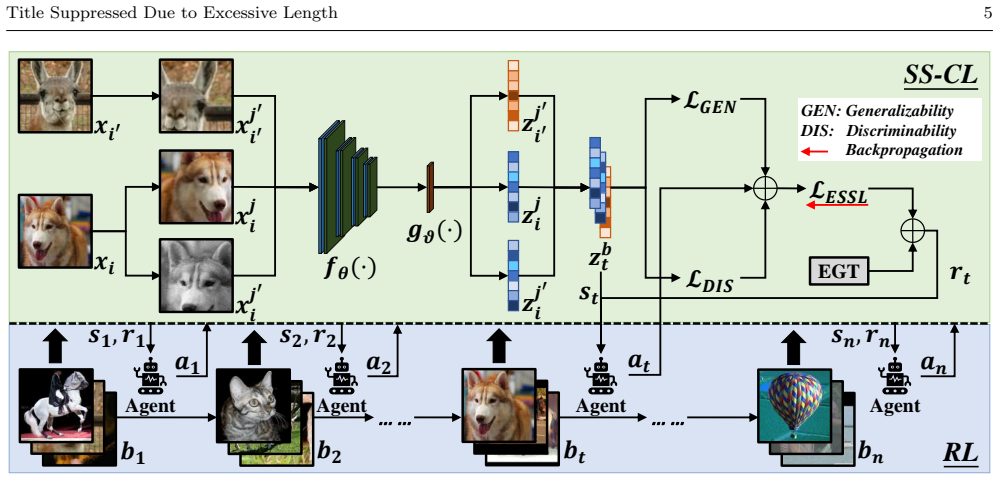
The load-bearing object is the compound loss $L_{\mathrm{ESSL}} = \alpha L_{\mathrm{InfoNCE}} + \beta L_{\mathrm{BarlowTwins}}$ with time-varying weights $(\alpha_t, \beta_t)$. A PPO agent observes the mean pooled feature of each batch and outputs the weight adjustments; its reward is the cosine similarity between the current weight pair and the evolutionary-game saddle point $(x^\star, y^\star)$ plus an exploration term that keeps the weights moving when the loss is changing rapidly. The saddle point comes from the replicator-dynamics system in Equation (16), whose local stability analysis identifies $(x^\star, y^\star)$ as the compromise equilibrium between the generalizability and discriminability populations. The theoretical engine is Theorem 1: using Rademacher complexity over the restricted hypothesis set $H_\beta = \{f \mid R_1(f) \le 4/\beta\}$, the paper shows that the gap between the generalization error and the InfoNCE objective is bounded by a term that shrinks as $\beta$ grows, which is how a larger weight on the discriminability loss formally tightens the generalization bound.
What would settle it
Pre-train ESSL on a target dataset using the EGT saddle point computed solely from annotated datasets that are disjoint from the target (for example, compute the saddle point from CIFAR10 and Tiny-ImageNet, then evaluate on STL10 and CIFAR100). If the resulting encoder does not beat both base losses and the simple ensemble $(\alpha=1, \beta=1)$ on the $G$ and $D$ metrics, the claim that EGT guidance generalizes without target labels is falsified.
Extended reading notes
Core claim
On its own terms, the paper's central discovery is a mutual-exclusion relation: contrastive objectives such as InfoNCE improve cross-domain generalizability at the cost of in-domain discriminability, while redundancy-reduction objectives such as Barlow Twins improve discriminability at the cost of generalizability, and simply ensembling the two losses loses on both. ESSL resolves the conflict by treating the two losses as populations in a two-player evolutionary game, deriving the compromise point $(x^\star, y^\star)$ from the replicator dynamics of that game, and using a PPO agent to set the loss weights $(\alpha_t, \beta_t)$ during pre-training so that the model dynamically chases that balance for the specific target dataset. The paper proves in Theorem 1 that, with $\alpha$ frozen, the generalization error bound of the ESSL-trained encoder is tighter than the conventional contrastive bound because the Rademacher complexity term decreases as $\beta$ increases. Empirically, ESSL(DINO+Barlow Twins) reports the best linear-probing and transfer accuracies on STL10, CIFAR10, CIFAR100, and Tiny-ImageNet, and ESSL also reaches 75.8% top-1 on ImageNet linear probing.
Load-bearing premise
The load-bearing premise is that the evolutionary-game equilibrium computed from annotated representative datasets transfers to an arbitrary target domain without using target labels, even though in the reported experiments the representative datasets are exactly the evaluation datasets.
Editorial extensions
If this is right
- A single self-supervised encoder can be trained to be both transferable and discriminative, replacing the practice of choosing one property at a time.
- The EGT-plus-RL weight rule is a general scheme for combining any two SSL losses: compute a game-theoretic compromise on annotated proxy datasets, then let RL adapt it to the target dataset.
- Increasing the Barlow Twins weight $\beta$ shrinks the Rademacher complexity term in the bound, so stronger discriminability pressure formally tightens, not loosens, the generalization error bound.
- The proposed benchmark metrics $G$ and $D$ give a joint measure of both properties, which the paper argues existing SSL benchmarks do not provide.
- Reported results on STL10, CIFAR10, CIFAR100, and Tiny-ImageNet show ESSL matching or exceeding strong baselines on both in-domain probing and cross-domain transfer.
Reading between the lines
- The paper's experimental setup uses the same four datasets as both the EGT representative priors and the evaluation targets, so the claim that the guidance transfers to arbitrary unlabeled target domains is not yet tested; a disjoint train/eval split would separate the algorithm's contribution from target-domain supervision.
- If the transferability does hold, the same machinery could balance other SSL objective pairs, such as masked-image modeling against contrastive learning, where a similar mutual-exclusion plausibly appears.
- A concrete test of the mechanism would fix the EGT saddle point from one dataset pair and let RL adapt it on a completely unseen dataset; observing the weights still converge near the predicted trade-off would confirm the game-theoretic prior is doing real work.
Editorial analysis
A structured set of objections, weighed in public.
Referee Report
Summary. The paper proposes ESSL, a self-supervised learning method that combines an InfoNCE loss and a Barlow Twins loss with weights α and β adjusted by a PPO reinforcement-learning agent. The weights are guided toward a trade-off point (x*, y*) computed by an evolutionary game theory (EGT) analysis on four annotated datasets. The authors claim that generalizability and discriminability are mutually exclusive in SSL, that ESSL jointly improves both, and that Theorem 1 establishes a tighter generalization error upper bound for ESSL compared with conventional SSL. The paper also introduces a benchmark metric for jointly measuring generalizability and discriminability. Empirical results are reported on STL10, CIFAR10, CIFAR100, Tiny-ImageNet, and ImageNet.
Significance. If the claims were fully supported, the work would offer a novel angle on SSL by framing the generalizability–discriminability trade-off as an evolutionary game and using RL to adapt loss weights. The proposed EGT-guided weighting scheme and the accompanying benchmark could be useful to the community. However, the central theoretical result is not proven as written, and the empirical evaluation is compromised by a circular use of target-domain labels. The paper does provide a public implementation link and reports average results over 10 trials, which are positive aspects, but the load-bearing flaws currently prevent the contributions from being accepted as stated.
major comments (4)
- [Section 5.1] Theorem 1 and Corollary 1 are not proven. Equation (30) derives L_f_GE ≥ L_f_InfoNCE, but the first inequality in Equation (31) asserts L_f*_GE − L_InfoNCE ≤ L_f*_InfoNCE − L_InfoNCE, which requires the opposite inequality L_f*_GE ≤ L_f*_InfoNCE. Unless equality holds identically—which is not argued—the bound in Corollary 1 does not follow. Additionally, Lemma 1 is stated without proof, and the claimed monotonicity of R_H(β) in β is not derived from the definition of H_β = {f : R_1(f) ≤ 4/β}. The proof also conflates the linear-probe cross-entropy generalization error of Equation (23) with the InfoNCE objective, using undefined quantities such as 'ucpos' and 'ucneg'. Consequently, the paper's flagship theoretical claim that ESSL tightens the generalization error upper bound is unsupported.
- [Sections 4.2 and 6; Appendix C.2] The experimental design is circular with respect to the EGT guidance. The paper states in Section 4.2 that the representative prior datasets do not include the target dataset, but the experiments in Section 6 state that the representative prior datasets are exactly STL10, CIFAR10, CIFAR100, and Tiny-ImageNet, and Table 3 evaluates on precisely those four datasets. The EGT equilibrium (x*, y*) is computed from supervised accuracies on these datasets (Appendix C.2), so the RL reward in Equation (21) encodes label information from the very target domains used for evaluation. Therefore the reported improvements in Table 3 do not demonstrate label-free methodological generalization; they may reflect target-domain supervision leaking into the pre-training objective.
- [Table 3 and Table 7] The empirical claim that ESSL consistently achieves the best performance on all datasets is not supported by the reported numbers. For pre-training on CIFAR10 and evaluation on CIFAR10, Barlow Twins achieves 83.0% while ESSL(DINO+Barlow Twins) achieves 81.9%. Multiple ESSL variants underperform baselines on transfer rows, e.g., pre-training on CIFAR10 and evaluating on Tiny-ImageNet, ESSL(SimCLR†+Barlow Twins) obtains 22.8% versus 26.1% for SimCLR†. No error bars or standard deviations are reported despite averaging over 10 trials, so differences of less than one percentage point cannot be assessed. Furthermore, Table 7 shows that adding RL to the static EGT guidance hurts performance in several settings (e.g., pre-training on Tiny-ImageNet and evaluating on CIFAR100 or Tiny-ImageNet), contradicting the claim that RL consistently improves the EGT trade-off.
- [Section 5.2 and Equation (21)] The SCM-based argument in Section 5.2 is informal: no causal identifiability results or information-theoretic inequalities are formally stated, and the conclusion of a 'mutual-exclusion' relationship relies on a heuristic entropy argument about S_D and S_G. In addition, the reward function in Equation (21) contains the term 1/|L_ESSL_t − φL_ESSL_{t−1}|, which is undefined when the denominator is zero and is not stabilized; the hyperparameters ξ, φ, V, and the initialization of the RL agent are not subjected to sensitivity analysis. These points do not by themselves invalidate the method, but they weaken the theoretical framing and the reproducibility of the RL component.
minor comments (5)
- [Throughout] There are frequent typos and reference inconsistencies: 'Radermacher' should be 'Rademacher'; the Malthusian equation is cited to Malthus (2023), an essay on population rather than a mathematical source; Tiny-ImageNet is attributed to Krizhevsky (2009), which is incorrect; SwAV is listed twice as Caron et al. 2020a and 2020b, and the DINO baseline is cited as Oquab et al. 2024 while the text refers to Caron et al. 2021.
- [Figure 7] The caption and labels of Figure 7 contain corrupted placeholder text such as '/uni00000013/uni00000014/...', indicating a serious LaTeX or font-encoding issue that must be fixed before publication.
- [Table 10] The column headers in Table 10 are unclear: 'OTE', 'TE', 'VE', 'TE' appear to be abbreviations for original-train, train, validation, and test, but the same abbreviation 'TE' is used for two different columns. The table should be rewritten with clear, distinct labels.
- [Section 6.1] The claim that 'all the experimental results are achieved using the code in Appendix C.1' is vague; Appendix C.1 lists only baseline repositories and does not provide the ESSL implementation details or an exact version of the code used for the reported numbers.
- [Section 4.1] In Equation (4), the notation ACC_SL(D) and ACC_M(D → D') is never formally defined beyond the surrounding text, and the benchmark introduced in this section is not a new dataset but rather a metric applied to existing datasets; this should be stated explicitly.
Circularity Check
EGT guidance is fitted on the evaluation benchmarks, and Theorem 1's proof assumes the inequality it must establish.
-
fitted input called prediction
[Section 4.2, Eq. (21); Section 6, 'Experimental schemes'; Table 3]
"Note that the representative prior datasets include STL10, CIFAR10, CIFAR100, and Tiny-ImageNet for the detailed implementation of the EGT analysis. ... rt = G(αt, βt, x⋆, y⋆) + ξ 1/|LESSL t − ϕLESSL t−1|, (21) The first term is defined by G(·,·,·,·), representing the cosine similarity function. Here, (x⋆, y⋆) denotes the a prior balanced point between generalizability and discriminability, as determined by EGT."
The EGT equilibrium (x*, y*) is computed from supervised classification accuracies on STL10, CIFAR10, CIFAR100, and Tiny-ImageNet (Appendix C.2 gives the SL accuracies used), and exactly those four datasets are the pre-training/evaluation benchmarks in Table 3. The RL reward in Eq. (21) uses cosine similarity to (x*, y*) to steer alpha and beta, so the weights that produce ESSL's reported in-benchmark gains are pulled toward a target derived from labels of the evaluation datasets. The paper's introduction claims 'the selected datasets do not include the target dataset for SSL,' but the experimental section states that the representative prior datasets include the four benchmark datasets themselves.
-
other
[Section 5.1, Eqs. (30)–(31) and Corollary 1]
"Lf_GE = ... ≥ ... = Lf_InfoNCE. (30) Then, we can intuitively obtain Lf⋆_GE − Lf_InfoNCE ≤ Lf⋆_InfoNCE − Lf_InfoNCE ≤ O(√(1+1/N_neg)·RH(β)/N_S + √(log(1/δ)·log^2(N_S)/N_S)). (31)"
Equation (30) derives Lf_GE ≥ Lf_InfoNCE for the generalization error relative to the InfoNCE objective. To obtain the claimed upper bound, the first inequality of Eq. (31) asserts Lf⋆_GE − Lf_InfoNCE ≤ Lf⋆_InfoNCE − Lf_InfoNCE, which requires Lf⋆_GE ≤ Lf⋆_InfoNCE — the reverse of the ordering just established in Eq. (30). No argument is given that equality holds identically. Thus Corollary 1's bound is obtained by assuming the very inequality it is meant to prove; the proof is circular as written. This is load-bearing because the paper's central theoretical claim that ESSL 'tightens the generalization error upper bound' rests on Theorem 1 and Corollary 1.
full rationale
The paper has two load-bearing circular steps. First, the 'general guidance of EGT' is not domain-general: the equilibrium (x*, y*) is computed from supervised classifiers on STL10, CIFAR10, CIFAR100, and Tiny-ImageNet, and the same four datasets are the pre-training/evaluation sets of the main conventional-benchmark experiments. The reward in Eq. (21) pulls alpha and beta toward this supervised target, so the reported in-benchmark gains are partly a fitted artifact of target-domain label information. Second, the proof of the flagship theoretical result is circular: Eq. (30) establishes L_GE ≥ L_InfoNCE, but the first inequality of Eq. (31) requires the opposite ordering to produce the claimed upper bound, with no equality argument supplied. Lemma 1 is also stated without proof, and the monotonicity of R_H(β) is asserted rather than derived; those are unsupported steps rather than circular steps. I do not score the paper higher than 8 because the method has independent components (the weighted combination of InfoNCE and Barlow Twins, the RL-based weight search, and ImageNet-scale experiments where the EGT point was not computed on the evaluation target), so the empirical method is not entirely equivalent to its inputs. But because both the central empirical claim and the central theoretical claim reduce in part to fitted or assumed inputs, the appropriate score is 7.
Assumptions & free parameters
free parameters (5)
- alpha, beta (loss weights) =
learned online by PPO; initialized around V=0.5
- xi =
not specified numerically, hand-set
- phi =
not specified numerically, hand-set
- omega1, omega2 =
both set to 1 in Appendix C.3
- V =
0.5 in Table 11
assumptions (5)
- ad hoc to paper The EGT payoff structure in Table 1 and Equations 6 through 15 faithfully models the interaction of generalizability and discriminability in SSL.
- domain assumption The EGT equilibrium computed on representative annotated datasets transfers to arbitrary target domains.
- domain assumption InfoNCE acts as a generalizability loss and Barlow Twins acts as a discriminability loss.
- standard math The restricted hypothesis class H_beta = {f : R1(f) <= 4/beta} has Rademacher complexity monotonically decreasing in beta.
- ad hoc to paper The SCM decomposition into invariant causal feature C and spurious features S_D and S_G describes the data generation process.
invented entities (3)
-
Invariant causal feature C
-
Spurious features S_D and S_G
-
Exogenous environment variable E
Cite this review
Pith. "Pith review of Rethinking Generalizability and Discriminability of Self-Supervised Learning from Evolutionary Game Theory Perspective." pith.science (2026). https://pith.science/paper/CMKSY5HW
@misc{pith2026241200542,
  author       = {Pith},
  title        = {Pith review of: Rethinking Generalizability and Discriminability of Self-Supervised Learning from Evolutionary Game Theory Perspective},
  year         = {2026},
  howpublished = {\url{https://pith.science/paper/CMKSY5HW}},
  note         = {Machine review of arXiv:2412.00542}
}
read the original abstract
Representations learned by self-supervised approaches are generally considered to possess sufficient generalizability and discriminability. However, we disclose a nontrivial mutual-exclusion relationship between these critical representation properties through an exploratory demonstration on self-supervised learning. State-of-the-art self-supervised methods tend to enhance either generalizability or discriminability but not both simultaneously. Thus, learning representations jointly possessing strong generalizability and discriminability presents a specific challenge for self-supervised learning. To this end, we revisit the learning paradigm of self-supervised learning from the perspective of evolutionary game theory (EGT) and outline the theoretical roadmap to achieve a desired trade-off between these representation properties. EGT performs well in analyzing the trade-off point in a two-player game by utilizing dynamic system modeling. However, the EGT analysis requires sufficient annotated data, which contradicts the principle of self-supervised learning, i.e., the EGT analysis cannot be conducted without the annotations of the specific target domain for self-supervised learning. Thus, to enhance the methodological generalization, we propose a novel self-supervised learning method that leverages advancements in reinforcement learning to jointly benefit from the general guidance of EGT and sequentially optimize the model to chase the consistent improvement of generalizability and discriminability for specific target domains during pre-training. Theoretically, we establish that the proposed method tightens the generalization error upper bound of self-supervised learning. Empirically, our method achieves state-of-the-art performance on various benchmarks.
Figures


Figures from the paper (7 more)


Reference graph
Works this paper leans on
-
[1]
Int Arab J Inf Technol 4(3):264--271, http://www.iajit.org/Vol.\
Al - Mubaid H (2007) A learning-classification based approach for word prediction. Int Arab J Inf Technol 4(3):264--271, http://www.iajit.org/Vol.\
2007
-
[2]
arXiv preprint arXiv:161200410
Alemi AA, Fischer I, Dillon JV, Murphy K (2016) Deep variational information bottleneck. arXiv preprint arXiv:161200410
2016
-
[4]
Bachman P, Hjelm RD, Buchwalter W (2019) Learning representations by maximizing mutual information across views. In: Wallach HM, Larochelle H, Beygelzimer A, d'Alch \' e - Buc F, Fox EB, Garnett R (eds) Advances in Neural Information Processing Systems 32: Annual Conference on Neural Information Processing Systems 2019, NeurIPS 2019, December 8-14, 2019, ...
2019
-
[5]
In: The Tenth International Conference on Learning Representations, ICLR 2022, Virtual Event, April 25-29, 2022, OpenReview.net, ://openreview.net/forum?id=p-BhZSz59o4
Bao H, Dong L, Piao S, Wei F (2022) Beit: BERT pre-training of image transformers. In: The Tenth International Conference on Learning Representations, ICLR 2022, Virtual Event, April 25-29, 2022, OpenReview.net, ://openreview.net/forum?id=p-BhZSz59o4
2022
-
[6]
In: The Tenth International Conference on Learning Representations, ICLR 2022, Virtual Event, April 25-29, 2022, OpenReview.net, ://openreview.net/forum?id=xm6YD62D1Ub
Bardes A, Ponce J, LeCun Y (2022) Vicreg: Variance-invariance-covariance regularization for self-supervised learning. In: The Tenth International Conference on Learning Representations, ICLR 2022, Virtual Event, April 25-29, 2022, OpenReview.net, ://openreview.net/forum?id=xm6YD62D1Ub
2022
-
[7]
Bester H, Güth W (1998) Is altruism evolutionarily stable? Journal of Economic Behavior & Organization 34(2):193--209, doi:https://doi.org/10.1016/S0167-2681(97)00060-7, ://www.sciencedirect.com/science/article/pii/S0167268197000607
-
[8]
In: Advances in Neural Information Processing Systems 33: Annual Conference on Neural Information Processing Systems 2020, NeurIPS 2020, December 6-12, 2020, virtual
Brown TB, Mann B, Ryder N, Subbiah M, Kaplan J, Dhariwal P, Neelakantan A, Shyam P, Sastry G, Askell A, Agarwal S, Herbert - Voss A, Krueger G, Henighan T, Child R, Ramesh A, Ziegler DM, Wu J, Winter C, Hesse C, Chen M, Sigler E, Litwin M, Gray S, Chess B, Clark J, Berner C, McCandlish S, Radford A, Sutskever I, Amodei D (2020) Language models are few-sho...
2020
-
[9]
Caron M, Misra I, Mairal J, Goyal P, Bojanowski P, Joulin A (2020 a ) Unsupervised learning of visual features by contrasting cluster assignments. In: Larochelle H, Ranzato M, Hadsell R, Balcan M, Lin H (eds) Advances in Neural Information Processing Systems 33: Annual Conference on Neural Information Processing Systems 2020, NeurIPS 2020, December 6-12, ...
2020
Show all 89 references
-
[10]
Caron M, Misra I, Mairal J, Goyal P, Bojanowski P, Joulin A (2020 b ) Unsupervised learning of visual features by contrasting cluster assignments. In: Larochelle H, Ranzato M, Hadsell R, Balcan M, Lin H (eds) Advances in Neural Information Processing Systems 33: Annual Confere...
2020
-
[11]
Caron M, Touvron H, Misra I, J \' e gou H, Mairal J, Bojanowski P, Joulin A (2021) Emerging properties in self-supervised vision transformers. In: 2021 IEEE/CVF International Conference on Computer Vision, ICCV 2021, Montreal, QC, Canada, October 10-17, 2021, IEEE , pp 9630--9...
2021
-
[12]
Chen T, Kornblith S, Norouzi M, Hinton GE (2020) A simple framework for contrastive learning of visual representations. In: Proceedings of the 37th International Conference on Machine Learning, ICML 2020, 13-18 July 2020, Virtual Event, PMLR , Proceedings of Machine Learning R...
2020
-
[13]
Int J Comput Vis 132(1):208--223, doi:10.1007/S11263-023-01852-4, ://doi.org/10.1007/s11263-023-01852-4
Chen X, Ding M, Wang X, Xin Y, Mo S, Wang Y, Han S, Luo P, Zeng G, Wang J (2024) Context autoencoder for self-supervised representation learning. Int J Comput Vis 132(1):208--223, doi:10.1007/S11263-023-01852-4, ://doi.org/10.1007/s11263-023-01852-4
2024 doi
-
[14]
Chuang C, Robinson J, Lin Y, Torralba A, Jegelka S (2020) Debiased contrastive learning. In: Larochelle H, Ranzato M, Hadsell R, Balcan M, Lin H (eds) Advances in Neural Information Processing Systems 33: Annual Conference on Neural Information Processing Systems 2020, NeurIPS...
2020
-
[15]
Coates A, Ng AY, Lee H (2011) An analysis of single-layer networks in unsupervised feature learning. In: Gordon GJ, Dunson DB, Dud \' k M (eds) Proceedings of the Fourteenth International Conference on Artificial Intelligence and Statistics, AISTATS 2011, Fort Lauderdale, USA,...
2011
-
[16]
Deng J, Dong W, Socher R, Li L, Li K, Fei - Fei L (2009) Imagenet: A large-scale hierarchical image database. In: 2009 IEEE Computer Society Conference on Computer Vision and Pattern Recognition (CVPR 2009), 20-25 June 2009, Miami, Florida, USA , IEEE Computer Society, pp 248-...
2009
-
[17]
Devlin J, Chang M, Lee K, Toutanova K (2019) BERT: pre-training of deep bidirectional transformers for language understanding. In: Proceedings of the 2019 Conference of the North American Chapter of the Association for Computational Linguistics: Human Language Technologies, NA...
2019 doi
-
[18]
In: 9th International Conference on Learning Representations, ICLR 2021, Virtual Event, Austria, May 3-7, 2021, OpenReview.net, ://openreview.net/forum?id=YicbFdNTTy
Dosovitskiy A, Beyer L, Kolesnikov A, Weissenborn D, Zhai X, Unterthiner T, Dehghani M, Minderer M, Heigold G, Gelly S, Uszkoreit J, Houlsby N (2021) An image is worth 16x16 words: Transformers for image recognition at scale. In: 9th International Conference on Learning Repres...
2021
-
[19]
Cambridge University Press, doi:10.1017/CBO9780511761942, ://www.cambridge.org/gb/knowledge/isbn/item2705443/?site\_locale=en\_GB
Easley DA, Kleinberg JM (2010) Networks, Crowds, and Markets - Reasoning About a Highly Connected World. Cambridge University Press, doi:10.1017/CBO9780511761942, ://www.cambridge.org/gb/knowledge/isbn/item2705443/?site\_locale=en\_GB
2010 doi
-
[20]
Elkan C, Noto K (2008) Learning classifiers from only positive and unlabeled data. In: Li Y, Liu B, Sarawagi S (eds) Proceedings of the 14th ACM SIGKDD International Conference on Knowledge Discovery and Data Mining, Las Vegas, Nevada, USA, August 24-27, 2008, ACM , pp 213--22...
2008
-
[21]
Stanford University Press, ://www.sup.org/books/title/?id=1341
Elkins J (2008) Six stories from the end of representation: images in painting, photography, astronomy, microscopy, particle physics, and quantum mechanics, 1980-2000. Stanford University Press, ://www.sup.org/books/title/?id=1341
2008
-
[22]
Ermolov A, Siarohin A, Sangineto E, Sebe N (2021) Whitening for self-supervised representation learning. In: Meila M, Zhang T (eds) Proceedings of the 38th International Conference on Machine Learning, ICML 2021, 18-24 July 2021, Virtual Event, PMLR , Proceedings of Machine Le...
2021
-
[23]
In: 8th International Conference on Learning Representations, ICLR 2020, Addis Ababa, Ethiopia, April 26-30, 2020, OpenReview.net, ://openreview.net/forum?id=B1xwcyHFDr
Federici M, Dutta A, Forr \' e P, Kushman N, Akata Z (2020) Learning robust representations via multi-view information bottleneck. In: 8th International Conference on Learning Representations, ICLR 2020, Addis Ababa, Ethiopia, April 26-30, 2020, OpenReview.net, ://openreview.n...
2020
-
[24]
Econometrica 59(3):637--666, ://www.jstor.org/stable/2938222
Friedman D (1991) Evolutionary games in economics. Econometrica 59(3):637--666, ://www.jstor.org/stable/2938222
1991
-
[25]
Molecular cancer therapeutics 2(9):919--927
Gatenby RA, Vincent TL (2003) Application of quantitative models from population biology and evolutionary game theory to tumor therapeutic strategies. Molecular cancer therapeutics 2(9):919--927
2003
-
[26]
CoRR abs/2209.07326, doi:10.48550/arXiv.2209.07326, ://doi.org/10.48550/arXiv.2209.07326, 2209.07326
Gesmundo A (2022) A continual development methodology for large-scale multitask dynamic ML systems. CoRR abs/2209.07326, doi:10.48550/arXiv.2209.07326, ://doi.org/10.48550/arXiv.2209.07326, 2209.07326
-
[27]
Grill J, Strub F, Altch \' e F, Tallec C, Richemond PH, Buchatskaya E, Doersch C, Pires B \' A , Guo Z, Azar MG, Piot B, Kavukcuoglu K, Munos R, Valko M (2020) Bootstrap your own latent - A new approach to self-supervised learning. In: Larochelle H, Ranzato M, Hadsell R, Balca...
2020
-
[28]
He K, Zhang X, Ren S, Sun J (2016) Deep residual learning for image recognition. In: 2016 IEEE Conference on Computer Vision and Pattern Recognition, CVPR 2016, Las Vegas, NV, USA, June 27-30, 2016, IEEE Computer Society, pp 770--778, doi:10.1109/CVPR.2016.90, ://doi.org/10.11...
2016 doi
-
[29]
He K, Fan H, Wu Y, Xie S, Girshick RB (2020) Momentum contrast for unsupervised visual representation learning. In: 2020 IEEE/CVF Conference on Computer Vision and Pattern Recognition, CVPR 2020, Seattle, WA, USA, June 13-19, 2020, Computer Vision Foundation / IEEE , pp 9726--...
2020
-
[32]
H \' e naff OJ (2020) Data-efficient image recognition with contrastive predictive coding. In: Proceedings of the 37th International Conference on Machine Learning, ICML 2020, 13-18 July 2020, Virtual Event, PMLR , Proceedings of Machine Learning Research, vol 119, pp 4182--41...
2020
-
[33]
In: 7th International Conference on Learning Representations, ICLR 2019, New Orleans, LA, USA, May 6-9, 2019, OpenReview.net, ://openreview.net/forum?id=Bklr3j0cKX
Hjelm RD, Fedorov A, Lavoie - Marchildon S, Grewal K, Bachman P, Trischler A, Bengio Y (2019) Learning deep representations by mutual information estimation and maximization. In: 7th International Conference on Learning Representations, ICLR 2019, New Orleans, LA, USA, May 6-9...
2019
-
[34]
Games and Economic Behavior 28(1):13--24, doi:https://doi.org/10.1006/game.1998.0691, ://www.sciencedirect.com/science/article/pii/S0899825698906911
Huck S, Oechssler J (1999) The indirect evolutionary approach to explaining fair allocations. Games and Economic Behavior 28(1):13--24, doi:https://doi.org/10.1006/game.1998.0691, ://www.sciencedirect.com/science/article/pii/S0899825698906911
1999
-
[35]
arXiv preprint arXiv:170906011
H \"u ttenrauch M, S o s i \'c A, Neumann G (2017) Guided deep reinforcement learning for swarm systems. arXiv preprint arXiv:170906011
2017
-
[36]
In: 20th International Conference on Artificial Intelligence and Statistics
Hyvarinen AJ, Morioka H (2017) Nonlinear ica of temporally dependent stationary sources. In: 20th International Conference on Artificial Intelligence and Statistics
2017
-
[37]
Energy 189:116064, doi:https://doi.org/10.1016/j.energy.2019.116064, ://www.sciencedirect.com/science/article/pii/S0360544219317591
feng Ji S, Zhao D, juan Luo R (2019) Evolutionary game analysis on local governments and manufacturers' behavioral strategies: Impact of phasing out subsidies for new energy vehicles. Energy 189:116064, doi:https://doi.org/10.1016/j.energy.2019.116064, ://www.sciencedirect.com...
2019
-
[38]
(2018) Scalable deep reinforcement learning for vision-based robotic manipulation
Kalashnikov D, Irpan A, Pastor P, Ibarz J, Herzog A, Jang E, Quillen D, Holly E, Kalakrishnan M, Vanhoucke V, et al. (2018) Scalable deep reinforcement learning for vision-based robotic manipulation. In: Conference on Robot Learning, PMLR, pp 651--673
2018
-
[39]
Entropy 26(6):466, doi:10.3390/E26060466, ://doi.org/10.3390/e26060466
Kinakh V, Drozdova M, Voloshynovskiy S (2024) MV-MR: multi-views and multi-representations for self-supervised learning and knowledge distillation. Entropy 26(6):466, doi:10.3390/E26060466, ://doi.org/10.3390/e26060466
2024 doi
-
[40]
IEEE Transactions on Intelligent Transportation Systems
Kiran BR, Sobh I, Talpaert V, Mannion P, Al Sallab AA, Yogamani S, P \'e rez P (2021) Deep reinforcement learning for autonomous driving: A survey. IEEE Transactions on Intelligent Transportation Systems
2021
-
[41]
Kolesnikov A, Beyer L, Zhai X, Puigcerver J, Yung J, Gelly S, Houlsby N (2020) Big transfer (bit): General visual representation learning. In: Vedaldi A, Bischof H, Brox T, Frahm J (eds) Computer Vision - ECCV 2020 - 16th European Conference, Glasgow, UK, August 23-28, 2020, P...
2020 doi
-
[42]
Kornblith S, Shlens J, Le QV (2019) Do better imagenet models transfer better? In: IEEE Conference on Computer Vision and Pattern Recognition, CVPR 2019, Long Beach, CA, USA, June 16-20, 2019, Computer Vision Foundation / IEEE , pp 2661--2671, doi:10.1109/CVPR.2019.00277, ://o...
2019
-
[43]
University of Toronto, ://www.cs.toronto.edu/ kriz/learning-features-2009-TR.pdf
Krizhevsky A (2009) Learning Multiple Layers of Features from Tiny Images. University of Toronto, ://www.cs.toronto.edu/ kriz/learning-features-2009-TR.pdf
2009
-
[44]
IEEE Trans Emerg Top Comput Intell 7(1):190--199, doi:10.1109/TETCI.2022.3209394, ://doi.org/10.1109/TETCI.2022.3209394
Kumar A, Pratap A, Singh AK (2023) Generative adversarial neural machine translation for phonetic languages via reinforcement learning. IEEE Trans Emerg Top Comput Intell 7(1):190--199, doi:10.1109/TETCI.2022.3209394, ://doi.org/10.1109/TETCI.2022.3209394
2023
-
[45]
IEEE Trans Image Process 28(10):5105--5120, doi:10.1109/TIP.2019.2914360, ://doi.org/10.1109/TIP.2019.2914360
Li D, Wu H, Zhang J, Huang K (2019) Fast A3RL: aesthetics-aware adversarial reinforcement learning for image cropping. IEEE Trans Image Process 28(10):5105--5120, doi:10.1109/TIP.2019.2914360, ://doi.org/10.1109/TIP.2019.2914360
2019
-
[46]
Neural Networks 167:415--432, doi:10.1016/J.NEUNET.2023.08.027, ://doi.org/10.1016/j.neunet.2023.08.027
Li J, Gao H, Qiang W, Zheng C (2023) Information theory-guided heuristic progressive multi-view coding. Neural Networks 167:415--432, doi:10.1016/J.NEUNET.2023.08.027, ://doi.org/10.1016/j.neunet.2023.08.027
2023 doi
-
[47]
CoRR abs/2111.15454, ://arxiv.org/abs/2111.15454, 2111.15454
Li S, Liu Z, Wu D, Liu Z, Li SZ (2021 a ) Boosting discriminative visual representation learning with scenario-agnostic mixup. CoRR abs/2111.15454, ://arxiv.org/abs/2111.15454, 2111.15454
2021 arXiv
-
[48]
Li Y, Pogodin R, Sutherland DJ, Gretton A (2021 b ) Self-supervised learning with kernel dependence maximization. In: Ranzato M, Beygelzimer A, Dauphin YN, Liang P, Vaughan JW (eds) Advances in Neural Information Processing Systems 34: Annual Conference on Neural Information P...
2021
-
[49]
CoRR abs/2210.11464, doi:10.48550/arXiv.2210.11464, ://doi.org/10.48550/arXiv.2210.11464, 2210.11464
Liu X, Wang Z, Li Y, Wang S (2022) Self-supervised learning via maximum entropy coding. CoRR abs/2210.11464, doi:10.48550/arXiv.2210.11464, ://doi.org/10.48550/arXiv.2210.11464, 2210.11464
-
[50]
In: British Politics And The Environment In The Long Nineteenth Century, Routledge, pp 77--84
Malthus T (2023) An essay on the principle of population. In: British Politics And The Environment In The Long Nineteenth Century, Routledge, pp 77--84
2023
-
[51]
Journal of Theoretical Biology 47(1):209--221, doi:https://doi.org/10.1016/0022-5193(74)90110-6, ://www.sciencedirect.com/science/article/pii/0022519374901106
Maynard Smith J (1974) The theory of games and the evolution of animal conflicts. Journal of Theoretical Biology 47(1):209--221, doi:https://doi.org/10.1016/0022-5193(74)90110-6, ://www.sciencedirect.com/science/article/pii/0022519374901106
1974
-
[52]
The Astrophysical Journal 531(2):739
Nakamura TK (2000) Statistical mechanics of a collisionless system based on the maximum entropy principle. The Astrophysical Journal 531(2):739
2000
-
[53]
CoRR abs/1807.03748, ://arxiv.org/abs/1807.03748, 1807.03748
van den Oord A, Li Y, Vinyals O (2018) Representation learning with contrastive predictive coding. CoRR abs/1807.03748, ://arxiv.org/abs/1807.03748, 1807.03748
2018 arXiv
-
[54]
Transactions on Machine Learning Research ://openreview.net/forum?id=a68SUt6zFt
Oquab M, Darcet T, Moutakanni T, Vo HV, Szafraniec M, Khalidov V, Fernandez P, HAZIZA D, Massa F, El-Nouby A, Assran M, Ballas N, Galuba W, Howes R, Huang PY, Li SW, Misra I, Rabbat M, Sharma V, Synnaeve G, Xu H, Jegou H, Mairal J, Labatut P, Joulin A, Bojanowski P (2024) DINO...
2024
-
[55]
MIT press
Osborne MJ, Rubinstein A (1994) A course in game theory. MIT press
1994
-
[56]
Cambridge university press
Pearl J (2009) Causality. Cambridge university press
2009
-
[57]
John Wiley & Sons
Pearl J, Glymour M, Jewell NP (2016) Causal inference in statistics: A primer. John Wiley & Sons
2016
-
[58]
du Plessis MC, Niu G, Sugiyama M (2014) Analysis of learning from positive and unlabeled data. In: Ghahramani Z, Welling M, Cortes C, Lawrence ND, Weinberger KQ (eds) Advances in Neural Information Processing Systems 27: Annual Conference on Neural Information Processing Syste...
2014
-
[59]
Qiang W, Li J, Zheng C, Su B, Xiong H (2022) Interventional contrastive learning with meta semantic regularizer. In: Chaudhuri K, Jegelka S, Song L, Szepesv \' a ri C, Niu G, Sabato S (eds) International Conference on Machine Learning, ICML 2022, 17-23 July 2022, Baltimore, Ma...
2022
-
[60]
In: 9th International Conference on Learning Representations, ICLR 2021, Virtual Event, Austria, May 3-7, 2021, OpenReview.net, ://openreview.net/forum?id=CR1XOQ0UTh-
Robinson JD, Chuang C, Sra S, Jegelka S (2021) Contrastive learning with hard negative samples. In: 9th International Conference on Learning Representations, ICLR 2021, Virtual Event, Austria, May 3-7, 2021, OpenReview.net, ://openreview.net/forum?id=CR1XOQ0UTh-
2021
-
[61]
Saunshi N, Plevrakis O, Arora S, Khodak M, Khandeparkar H (2019) A theoretical analysis of contrastive unsupervised representation learning. In: Chaudhuri K, Salakhutdinov R (eds) Proceedings of the 36th International Conference on Machine Learning, ICML 2019, 9-15 June 2019, ...
2019
-
[62]
CoRR abs/1707.06347, ://arxiv.org/abs/1707.06347, 1707.06347
Schulman J, Wolski F, Dhariwal P, Radford A, Klimov O (2017) Proximal policy optimization algorithms. CoRR abs/1707.06347, ://arxiv.org/abs/1707.06347, 1707.06347
2017 arXiv
-
[63]
Int J Comput Vis 128(2):336--359, doi:10.1007/S11263-019-01228-7, ://doi.org/10.1007/s11263-019-01228-7
Selvaraju RR, Cogswell M, Das A, Vedantam R, Parikh D, Batra D (2020) Grad-cam: Visual explanations from deep networks via gradient-based localization. Int J Comput Vis 128(2):336--359, doi:10.1007/S11263-019-01228-7, ://doi.org/10.1007/s11263-019-01228-7
2020 doi
-
[64]
Philosophical Transactions of the Royal Society A 378(2166):20190061
Shalf J (2020) The future of computing beyond moore’s law. Philosophical Transactions of the Royal Society A 378(2166):20190061
2020
-
[65]
Shvetsova N, Petersen F, Kukleva A, Schiele B, Kuehne H (2023) Learning by sorting: Self-supervised learning with group ordering constraints. In: IEEE/CVF International Conference on Computer Vision, ICCV 2023, Paris, France, October 1-6, 2023, IEEE , pp 16407--16417, doi:10.1...
2023
-
[66]
(2017) Mastering the game of go without human knowledge
Silver D, Schrittwieser J, Simonyan K, Antonoglou I, Huang A, Guez A, Hubert T, Baker L, Lai M, Bolton A, et al. (2017) Mastering the game of go without human knowledge. nature 550(7676):354--359
2017
-
[67]
(2018) A general reinforcement learning algorithm that masters chess, shogi, and go through self-play
Silver D, Hubert T, Schrittwieser J, Antonoglou I, Lai M, Guez A, Lanctot M, Sifre L, Kumaran D, Graepel T, et al. (2018) A general reinforcement learning algorithm that masters chess, shogi, and go through self-play. Science 362(6419):1140--1144
2018
-
[68]
Sridharan K, Kakade SM (2008) An information theoretic framework for multi-view learning. In: Servedio RA, Zhang T (eds) 21st Annual Conference on Learning Theory - COLT 2008, Helsinki, Finland, July 9-12, 2008, Omnipress, pp 403--414, ://colt2008.cs.helsinki.fi/papers/94-Srid...
2008
-
[69]
IEEE Trans Hum Mach Syst 53(1):201--214, doi:10.1109/THMS.2022.3225867, ://doi.org/10.1109/THMS.2022.3225867
Sun Y, Yuan B, Xiang Q, Zhou J, Yu J, Dai D, Zhou X (2023) Intelligent decision-making and human language communication based on deep reinforcement learning in a wargame environment. IEEE Trans Hum Mach Syst 53(1):201--214, doi:10.1109/THMS.2022.3225867, ://doi.org/10.1109/THM...
2023
-
[70]
Tao C, Zhu X, Su W, Huang G, Li B, Zhou J, Qiao Y, Wang X, Dai J (2023) Siamese image modeling for self-supervised vision representation learning. In: IEEE/CVF Conference on Computer Vision and Pattern Recognition, CVPR 2023, Vancouver, BC, Canada, June 17-24, 2023, IEEE , pp ...
2023
-
[71]
Publications of the American Statistical Association 103(481):429--429
Thomas M, Thomas, Joy A (1991) Elements of information theory. Publications of the American Statistical Association 103(481):429--429
1991
-
[72]
Tian Y, Krishnan D, Isola P (2020 a ) Contrastive multiview coding. In: Vedaldi A, Bischof H, Brox T, Frahm J (eds) Computer Vision - ECCV 2020 - 16th European Conference, Glasgow, UK, August 23-28, 2020, Proceedings, Part XI , Springer, Lecture Notes in Computer Science, vol ...
2020 doi
-
[73]
Tian Y, Sun C, Poole B, Krishnan D, Schmid C, Isola P (2020 b ) What makes for good views for contrastive learning? In: Larochelle H, Ranzato M, Hadsell R, Balcan M, Lin H (eds) Advances in Neural Information Processing Systems 33: Annual Conference on Neural Information Proce...
2020
-
[74]
arXiv preprint physics/0004057
Tishby N, Pereira FC, Bialek W (2000) The information bottleneck method. arXiv preprint physics/0004057
2000 arXiv
-
[75]
In: 9th International Conference on Learning Representations, ICLR 2021, Virtual Event, Austria, May 3-7, 2021, OpenReview.net, ://openreview.net/forum?id=-bdp\_8Itjwp
Tsai YH, Wu Y, Salakhutdinov R, Morency L (2021) Self-supervised learning from a multi-view perspective. In: 9th International Conference on Learning Representations, ICLR 2021, Virtual Event, Austria, May 3-7, 2021, OpenReview.net, ://openreview.net/forum?id=-bdp\_8Itjwp
2021
-
[76]
Verma V, Luong T, Kawaguchi K, Pham H, Le QV (2021) Towards domain-agnostic contrastive learning. In: Meila M, Zhang T (eds) Proceedings of the 38th International Conference on Machine Learning, ICML 2021, 18-24 July 2021, Virtual Event, PMLR , Proceedings of Machine Learning ...
2021
-
[77]
Journal of Optimization Theory and Applications 46(4):605--612
Vincent T (1985) Evolutionary games. Journal of Optimization Theory and Applications 46(4):605--612
1985
-
[78]
(2019) Grandmaster level in starcraft ii using multi-agent reinforcement learning
Vinyals O, Babuschkin I, Czarnecki WM, Mathieu M, Dudzik A, Chung J, Choi DH, Powell R, Ewalds T, Georgiev P, et al. (2019) Grandmaster level in starcraft ii using multi-agent reinforcement learning. Nature 575(7782):350--354
2019
-
[79]
In: The Tenth International Conference on Learning Representations, ICLR 2022, Virtual Event, April 25-29, 2022, OpenReview.net, ://openreview.net/forum?id=ECvgmYVyeUz
Wang Y, Zhang Q, Wang Y, Yang J, Lin Z (2022) Chaos is a ladder: A new theoretical understanding of contrastive learning via augmentation overlap. In: The Tenth International Conference on Learning Representations, ICLR 2022, Virtual Event, April 25-29, 2022, OpenReview.net, :...
2022
-
[80]
MIT press
Weibull JW (1997) Evolutionary game theory. MIT press
1997
-
[81]
In: 9th International Conference on Learning Representations, ICLR 2021, Virtual Event, Austria, May 3-7, 2021, OpenReview.net, ://openreview.net/forum?id=CZ8Y3NzuVzO
Xiao T, Wang X, Efros AA, Darrell T (2021) What should not be contrastive in contrastive learning. In: 9th International Conference on Learning Representations, ICLR 2021, Virtual Event, Austria, May 3-7, 2021, OpenReview.net, ://openreview.net/forum?id=CZ8Y3NzuVzO
2021
-
[82]
Xie Z, Zhang Z, Cao Y, Lin Y, Bao J, Yao Z, Dai Q, Hu H (2022) Simmim: a simple framework for masked image modeling. In: IEEE/CVF Conference on Computer Vision and Pattern Recognition, CVPR 2022, New Orleans, LA, USA, June 18-24, 2022, IEEE , pp 9643--9653, doi:10.1109/CVPR526...
2022
-
[83]
Yu K, Dong C, Lin L, Loy CC (2018) Crafting a toolchain for image restoration by deep reinforcement learning. In: 2018 IEEE Conference on Computer Vision and Pattern Recognition, CVPR 2018, Salt Lake City, UT, USA, June 18-22, 2018, Computer Vision Foundation / IEEE Computer S...
2018
-
[84]
Zbontar J, Jing L, Misra I, LeCun Y, Deny S (2021) Barlow twins: Self-supervised learning via redundancy reduction. In: Meila M, Zhang T (eds) Proceedings of the 38th International Conference on Machine Learning, ICML 2021, 18-24 July 2021, Virtual Event, PMLR , Proceedings of...
2021
-
[85]
Zhang Z, Sabuncu MR (2018) Generalized cross entropy loss for training deep neural networks with noisy labels. In: Bengio S, Wallach HM, Larochelle H, Grauman K, Cesa - Bianchi N, Garnett R (eds) Advances in Neural Information Processing Systems 31: Annual Conference on Neural...
2018
-
[86]
Zimmermann RS, Sharma Y, Schneider S, Bethge M, Brendel W (2021) Contrastive learning inverts the data generating process. In: Meila M, Zhang T (eds) Proceedings of the 38th International Conference on Machine Learning, ICML 2021, 18-24 July 2021, Virtual Event, PMLR , Proceed...
2021
-
[87]
, " * write output.state after.block = add.period write newline
ENTRY address archive author booktitle chapter doi edition editor eid eprint howpublished institution journal key month note number organization pages publisher school series title type url volume year label extra.label sort.label short.list INTEGERS output.state before.all mi...
-
[88]
write newline
" write newline "" before.all 'output.state := FUNCTION add.period duplicate empty 'skip "." * add.blank if FUNCTION if.digit duplicate "0" = swap duplicate "1" = swap duplicate "2" = swap duplicate "3" = swap duplicate "4" = swap duplicate "5" = swap duplicate "6" = swap dupl...
-
[89]
, " * write output.state after.block = add.period write newline
ENTRY address author booktitle chapter doi edition editor eid howpublished institution journal key month note number organization pages publisher school series title type url volume year label INTEGERS output.state before.all mid.sentence after.sentence after.block FUNCTION in...
-
[90]
write newline
" write newline "" before.all 'output.state := FUNCTION if.digit duplicate "0" = swap duplicate "1" = swap duplicate "2" = swap duplicate "3" = swap duplicate "4" = swap duplicate "5" = swap duplicate "6" = swap duplicate "7" = swap duplicate "8" = swap "9" = or or or or or or...
-
[91]
, " * write output.state after.block = add.period write newline
ENTRY address author booktitle chapter doi edition editor eid howpublished institution journal key month note number organization pages publisher school series title type url volume year label INTEGERS output.state before.all mid.sentence after.sentence after.block FUNCTION in...
-
[92]
write newline
" write newline "" before.all 'output.state := FUNCTION if.digit duplicate "0" = swap duplicate "1" = swap duplicate "2" = swap duplicate "3" = swap duplicate "4" = swap duplicate "5" = swap duplicate "6" = swap duplicate "7" = swap duplicate "8" = swap "9" = or or or or or or...
Reviewed August 12, 2026 · model on record in the stance chip above.
Discussion (0). Continue with ORCID to comment.