REVIEW 4 major objections 5 minor 14 references
SeQwen at the Financial Misinformation Detection Challenge Task: Sequential Learning for Claim Verification and Explanation Generation in Financial Domains
T0 review · 4 major / 5 minor · reviewed 2026-08-12 · deepseek-v4-flash
Pith's one-line read Sequential fine-tuning lifts financial misinformation detection on the FIN-FACT benchmark.
desk verdict Plausible but under-powered evidence for sequential fine-tuning on FIN-FACT; worth a serious referee if the authors add variance estimates and specify the preprocessing. read the letter →
The pith
A machine-rendered reading of the paper's core claim, the machinery that carries it, and where it could break.
The reading
What carries the argument
The mechanism is a two-stage fine-tuning schedule on a generative LLM, using LoRA adapters. Stage one trains the model to output only a label given a claim and justification; stage two continues training to output both a label and an explanation in a fixed format. The same prompt template, taken from FMD-LLaMA, is used with the explanation component added in the second stage. The paper hypothesizes that the first stage stabilizes the classification decision, and the second stage learns to articulate that decision, producing better joint performance than training both objectives from the start.
What would settle it
Train the same Qwen2.5 7B model under three conditions—sequential fine-tuning, 8-epoch single-phase joint training, and 5-epoch joint training—with the justification-field preprocessing removed, repeated across five random seeds. If SeQwen's test-set advantages (micro F1 0.8283 vs. 0.8165, ROUGE-1 0.7253 vs. 0.6337) shrink below the run-to-run noise or reverse in this setup, the claimed benefit of sequential learning would not be sustained.
Extended reading notes
Core claim
The paper's core discovery claim is that sequential fine-tuning of Qwen2.5 7B, with 3 epochs of classification-only training followed by 5 epochs of joint classification-and-explanation training, yields higher micro F1 and higher ROUGE scores than single-phase joint fine-tuning for the same total of 8 epochs. On the test set, SeQwen raised micro F1 from 0.8165 to 0.8283 and ROUGE-1 from 0.6337 to 0.7253 over the 5-epoch single-phase model. The authors present this as evidence that staged, task-specific training can mitigate the tradeoff between predictive accuracy and explanation generation in domain-specific claim verification.
Load-bearing premise
The comparison assumes that the 453-sample development set can reliably rank models when differences are as small as 0.01 micro F1, and that the preprocessing step of appending some claims from the justification field affects all compared training conditions equally.
Editorial extensions
If this is right
- SeQwen's schedule is directly transferable to other verification-plus-explanation tasks, such as fact-checking with citations, without changing the model architecture.
- The reported results suggest that total training budget can be split to favor explanation quality (5 of 8 epochs) after a shorter classification-only warm-up.
- Small 7B models fine-tuned with LoRA at 4-bit precision can come close to or exceed larger models on financial misinformation benchmarks, lowering hardware requirements.
- The gap between joint-only and sequential training points to an objective-ordering effect: which task is learned first can matter even when the final objective is the same.
Reading between the lines
- The ROUGE gains may reflect the model learning the exact output format (Prediction: ... Explanation: ...) more than better reasoning; a human evaluation or semantic-similarity metric would be needed to separate format alignment from explanation quality.
- The sequential schedule resembles a curriculum where the easier task (3-way classification) precedes the harder generative task; this suggests testing gradual mixing of the two losses rather than a hard switch.
- Because the dev set has only 453 samples and the reported gains are around 0.01 F1, the model ranking and the SeQwen advantage should be checked with multiple seeds and bootstrapped confidence intervals before relying on the exact numbers.
- If the preprocessing step (appending claims from the justification field) is what actually drives the improvement, then sequential learning may be confounded with data augmentation; a controlled ablation would separate the two.
Signed reviews
Editorial analysis
A structured set of objections, weighed in public.
Referee Report
Summary. The paper describes SeQwen, the authors' submission to the COLING 2025 Financial Misinformation Detection (FMD) challenge. The system uses Qwen2.5 7B fine-tuned with LoRA in a sequential learning scheme: first 3 epochs of classification-only fine-tuning, then 5 epochs of joint classification and explanation generation. The authors evaluate several open-source LLMs on a development split of FIN-FACT, select Qwen2.5 7B as the best classifier, and then compare SeQwen against single-phase joint fine-tuning baselines on both the development and test splits. They report that SeQwen outperforms single-phase training on all reported metrics, e.g., Micro F1 of 0.8366 and ROUGE-1 of 0.7170 on the dev set, and Micro F1 of 0.8283 and ROUGE-1 of 0.7253 on the test set. The central claim is that the two-stage training schedule improves both classification and explanation quality over one-stage joint fine-tuning.
Significance. If the claimed improvement is real, the result is practically relevant for multi-task fine-tuning of LLMs in financial claim verification, showing that a simple staged curriculum can mitigate the classification/explanation tradeoff observed in single-phase joint training. The paper's strengths include an empirical comparison on a shared challenge benchmark, a clear description of the prompting and LoRA setup, and an honest limitations section that acknowledges the absence of human evaluation and the constraints of 4-bit precision. However, the significance is currently limited by the lack of statistical rigor: all results come from single unreplicated runs, the development set is small (453 samples), and the test-set comparison omits a matched 8-epoch single-phase baseline. The underspecified preprocessing augmentation also clouds the attribution of the gains to sequential learning. These issues are fixable but must be addressed before the central claim can be considered established.
major comments (4)
- [Section 4, Tables 3 and 4] The central comparison rests on single runs with no reported seeds, error bars, or significance tests. On the 453-sample dev set, the Micro F1 gap between SeQwen (0.8366) and the 8-epoch single-phase baseline (0.8234) is 0.0132, which is within one standard error of a proportion near 0.83; on the 1304-sample test set, the gap of 0.0118 against the 5-epoch baseline is similarly about one standard error. The ROUGE gains are larger, but ROUGE on generated text is known to be high-variance and was not tested for statistical significance. Without multiple seeds or a significance test, the observed improvements could be run-to-run noise.
- [Table 4] The test-set table compares SeQwen only to the 5-epoch single-phase joint model, omitting the 8-epoch single-phase baseline that appears in Table 3. Since SeQwen uses 8 total epochs of training, the test-set result does not control for total training budget. The dev-set comparison in Table 3 does include the 8-epoch baseline and shows a smaller gap, but the test-set validation of the headline claim would be strengthened by reporting the 8-epoch single-phase test-set numbers.
- [Section 3, last paragraph of Methodology] The preprocessing step described as 'we appended some claims from the justification field, during the fine-tuning phase' is critically underspecified. It is not stated which conditions received this augmentation, how many claims were appended, how they were selected, or whether the augmentation was applied identically to the classification-only, joint, and sequential training runs. If the augmentation is not applied uniformly across all compared conditions, the entire comparison in Tables 3 and 4 is confounded, and the reported gains cannot be attributed to sequential learning.
- [Section 4, Tables 3 and 4] The paper reports 'Overall Score' but never defines how it is computed from Micro F1 and the ROUGE scores. Since the overall score is used in the narrative (e.g., the 7.1% improvement on the test set), the formula must be given, otherwise the reader cannot verify whether the relative improvements are driven primarily by the ROUGE components, which appear to have larger relative gains than Micro F1.
minor comments (5)
- [Abstract and Introduction] The term 'Minsinformation' in the Introduction is a typo for 'Misinformation'; please correct it.
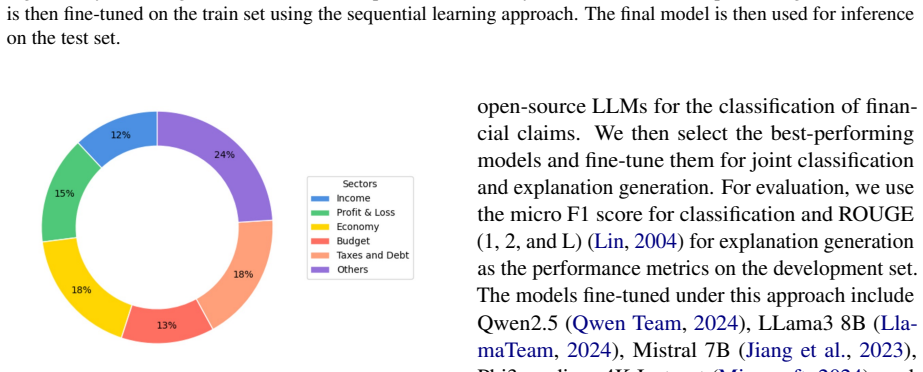
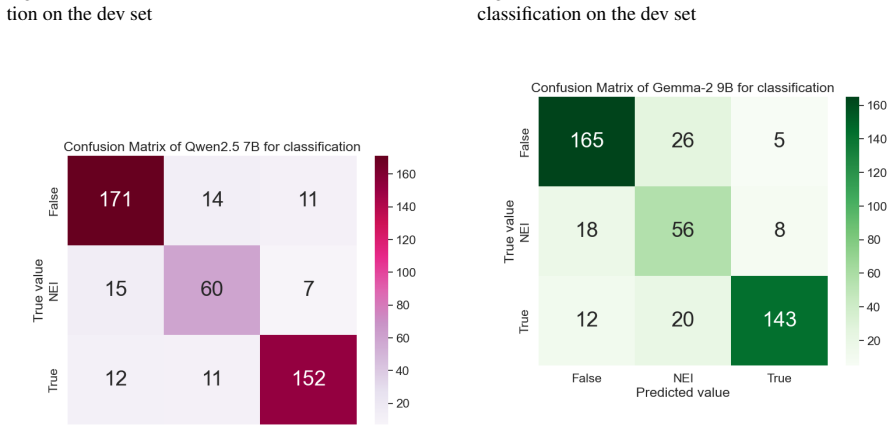
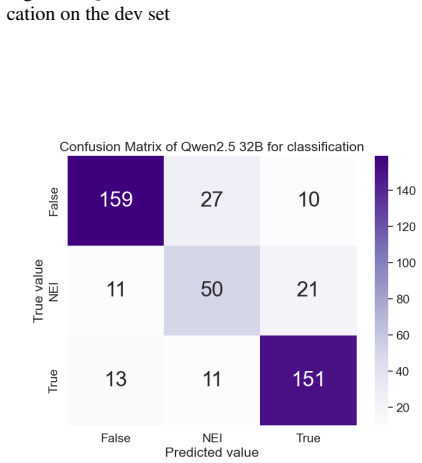
- [Section 2] The dataset section states the test set has 1304 samples, but Table 1 only reports the train and dev distributions; it would be helpful to also report the test class distribution for completeness, as the confusion matrices in the appendix are only for the dev set.
- [Figure 3] The two prompt templates in Figure 3 are visually dense and the difference between them is easy to miss; a short caption or annotation highlighting the structural difference (label-only versus label-and-explanation response format) would improve clarity.
- [Table 2] The table lists 'Qwen2.5 32B' but the methodology section enumerates only five models (Qwen2.5, Llama3 8B, Mistral 7B, Phi3 medium 4K, and Gemma-2 9B); the 32B variant should be mentioned in the model list for consistency.
- [Limitations] The limitations section is candid about computational constraints and the absence of human evaluation, but it does not mention the lack of multiple runs or significance testing; adding this would be an honest reflection of the evidence level.
Circularity Check
No significant circularity: the sequential-learning claim rests on an empirical comparison against a held-out test set, not on a derivation from fitted inputs or self-citations.
full rationale
This paper is an empirical system description for the COLING 2025 FMD challenge. The central claim is that sequential fine-tuning (SeQwen) improves classification and explanation metrics over single-phase fine-tuning on the FIN-FACT benchmark. That claim is supported by dev-set model selection (Table 2 and Table 3) and by test-set evaluation (Table 4). No equation defines a predicted quantity in terms of the same measured quantity; no fitted parameter is renamed as a prediction; and no load-bearing result is imported from the authors' own prior work. The dev set is used to select the model, which is standard practice, and the test set is external to that selection. The omissions noted by the reader—no error bars, no significance tests, the 8-epoch single-phase baseline absent from the test table, and the underspecified preprocessing step about appending claims from the justification field—are experimental-validity and reporting concerns, not circularity. The paper's own Limitations section acknowledges robustness and evaluation limitations without asserting that any result is true by construction. Therefore no specific circular step can be quoted, and the appropriate score is 0.
Assumptions & free parameters
free parameters (5)
- Per-stage training epochs =
3 epochs classification, 5 epochs joint
- LoRA rank and alpha =
r=16, alpha=16
- Learning rate =
2e-4
- Batch size =
16
- Preprocessing augmentation amount =
unspecified (some claims)
assumptions (3)
- domain assumption The dev set of 453 samples is representative of the test distribution and large enough to reliably rank models.
- domain assumption The justification field is available at inference time for both training and test samples.
- ad hoc to paper Appending claim text from the justification field during training is a valid augmentation and does not introduce leakage or unfair advantage.
Cite this review
Pith. "Pith review of SeQwen at the Financial Misinformation Detection Challenge Task: Sequential Learning for Claim Verification and Explanation Generation in Financial Domains." pith.science (2026). https://pith.science/paper/LSCK6HXQ
@misc{pith2026241200549,
  author       = {Pith},
  title        = {Pith review of: SeQwen at the Financial Misinformation Detection Challenge Task: Sequential Learning for Claim Verification and Explanation Generation in Financial Domains},
  year         = {2026},
  howpublished = {\url{https://pith.science/paper/LSCK6HXQ}},
  note         = {Machine review of arXiv:2412.00549}
}
read the original abstract
This paper presents the system description of our entry for the COLING 2025 FMD challenge, focusing on misinformation detection in financial domains. We experimented with a combination of large language models, including Qwen, Mistral, and Gemma-2, and leveraged pre-processing and sequential learning for not only identifying fraudulent financial content but also generating coherent, and concise explanations that clarify the rationale behind the classifications. Our approach achieved competitive results with an F1-score of 0.8283 for classification, and ROUGE-1 of 0.7253 for explanations. This work highlights the transformative potential of LLMs in financial applications, offering insights into their capabilities for combating misinformation and enhancing transparency while identifying areas for future improvement in robustness and domain adaptation.
Figures


Figures from the paper (4 more)


Reference graph
Works this paper leans on
-
[1]
online" 'onlinestring :=
ENTRY address archivePrefix author booktitle chapter edition editor eid eprint eprinttype howpublished institution journal key month note number organization pages publisher school series title type volume year doi pubmed url lastchecked label extra.label sort.label short.list INTEGERS output.state before.all mid.sentence after.sentence after.block STRING...
-
[2]
write newline
" write newline "" before.all 'output.state := FUNCTION n.dashify 't := "" t empty not t #1 #1 substring "-" = t #1 #2 substring "--" = not "--" * t #2 global.max substring 't := t #1 #1 substring "-" = "-" * t #2 global.max substring 't := while if t #1 #1 substring * t #2 global.max substring 't := if while FUNCTION word.in bbl.in capitalize " " * FUNCT...
-
[3]
GemmaTeam. 2024. https://arxiv.org/abs/2403.08295 Gemma: Open models based on gemini research and technology . Preprint, arXiv:2403.08295
arXiv 2024
-
[4]
Hu, Yelong Shen, Phillip Wallis, Zeyuan Allen-Zhu, Yuanzhi Li, Shean Wang, Lu Wang, and Weizhu Chen
Edward J. Hu, Yelong Shen, Phillip Wallis, Zeyuan Allen-Zhu, Yuanzhi Li, Shean Wang, Lu Wang, and Weizhu Chen. 2021. https://arxiv.org/abs/2106.09685 Lora: Low-rank adaptation of large language models . Preprint, arXiv:2106.09685
arXiv 2021
-
[5]
Albert Q. Jiang, Alexandre Sablayrolles, Arthur Mensch, Chris Bamford, Devendra Singh Chaplot, Diego de las Casas, Florian Bressand, Gianna Lengyel, Guillaume Lample, Lucile Saulnier, Lélio Renard Lavaud, Marie-Anne Lachaux, Pierre Stock, Teven Le Scao, Thibaut Lavril, Thomas Wang, Timothée Lacroix, and William El Sayed. 2023. https://arxiv.org/abs/2310.0...
arXiv 2023
-
[6]
Chin-Yew Lin. 2004. https://aclanthology.org/W04-1013 ROUGE : A package for automatic evaluation of summaries . In Text Summarization Branches Out, pages 74--81, Barcelona, Spain. Association for Computational Linguistics
2004
-
[7]
Zhiwei Liu, Xin Zhang, Kailai Yang, Qianqian Xie, Jimin Huang, and Sophia Ananiadou. 2024. https://arxiv.org/abs/2409.16452 Fmdllama: Financial misinformation detection based on large language models . Preprint, arXiv:2409.16452
work page Pith review arXiv 2024
-
[8]
LlamaTeam. 2024. https://arxiv.org/abs/2407.21783 The llama 3 herd of models . Preprint, arXiv:2407.21783
arXiv 2024
Show all 14 references
-
[9]
Microsoft. 2024. https://arxiv.org/abs/2404.14219 Phi-3 technical report: A highly capable language model locally on your phone . Preprint, arXiv:2404.14219
2024 arXiv
-
[10]
Qwen Team . 2024. https://qwenlm.github.io/blog/qwen2.5/ Qwen2.5: A party of foundation models
2024
-
[11]
Aman Rangapur, Haoran Wang, Ling Jian, and Kai Shu. 2024. https://arxiv.org/abs/2309.08793 Fin-fact: A benchmark dataset for multimodal financial fact checking and explanation generation . Preprint, arXiv:2309.08793
2024 arXiv
-
[12]
Raj Shah, Kunal Chawla, Dheeraj Eidnani, Agam Shah, Wendi Du, Sudheer Chava, Natraj Raman, Charese Smiley, Jiaao Chen, and Diyi Yang. 2022. https://doi.org/10.18653/v1/2022.emnlp-main.148 When FLUE meets FLANG : Benchmarks and large pretrained language model for financial doma...
2022 doi
-
[13]
Shijie Wu, Ozan Irsoy, Steven Lu, Vadim Dabravolski, Mark Dredze, Sebastian Gehrmann, Prabhanjan Kambadur, David Rosenberg, and Gideon Mann. 2023. https://arxiv.org/abs/2303.17564 Bloomberggpt: A large language model for finance . Preprint, arXiv:2303.17564
2023 arXiv
-
[14]
Qianqian Xie, Weiguang Han, Xiao Zhang, Yanzhao Lai, Min Peng, Alejandro Lopez-Lira, and Jimin Huang. 2023. https://arxiv.org/abs/2306.05443 Pixiu: A large language model, instruction data and evaluation benchmark for finance . Preprint, arXiv:2306.05443
2023 arXiv
Reviewed August 12, 2026 · model on record in the stance chip above.
Discussion (0). Continue with ORCID to comment.