REVIEW 4 major objections 5 minor 23 references
Multi-Agent Collaboration in Incident Response with Large Language Models
T0 review · 4 major / 5 minor · reviewed 2026-08-12 · deepseek-v4-flash
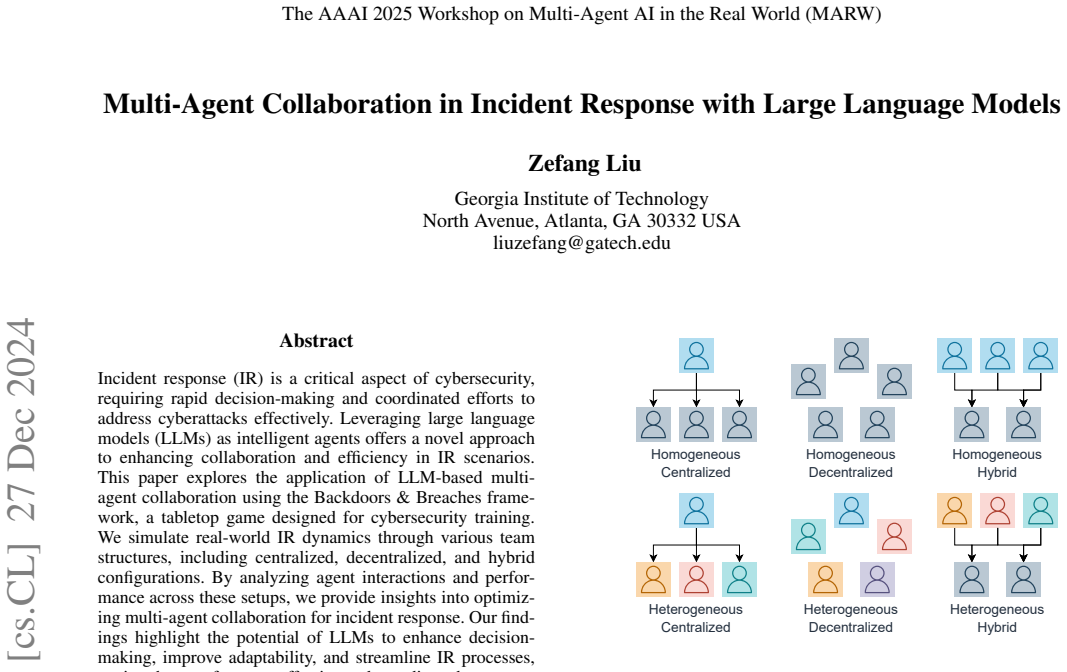
Pith's one-line read The paper claims that in LLM-powered incident-response simulations, homogeneous centralized and homogeneous hybrid team structures achieve the most successful games, and that clear leadership and streamlined communication explain why.
desk verdict A transparent but statistically underpowered comparison of LLM team structures in a tabletop IR game; the headline ranking shouldn't be read as evidence. read the letter →
The pith
A machine-rendered reading of the paper's core claim, the machinery that carries it, and where it could break.
The reading
What carries the argument
The load-bearing mechanism is the Backdoors & Breaches game loop turned into a multi-agent conversation. An incident captain agent holds the hidden attack cards and enforces rules; defender agents with prescribed roles discuss and choose one procedure card per turn; a 20-sided die with modifiers decides success, failures accumulate toward inject events, and the team wins only if all four cards surface within ten turns. This loop converts fuzzy notions like coordination and communication into a countable win/loss outcome, which is what lets the paper compare six team structures at all.
What would settle it
Run the same six team structures for many more games with identical prompts and models and compute confidence intervals for each structure's success rate; if the intervals for centralized, decentralized, and hybrid structures overlap substantially, the claimed ordering collapses.
Extended reading notes
Core claim
On its own terms, the paper's finding is that organizational design is a measurable variable in LLM-based incident response. Homogeneous centralized and homogeneous hybrid structures each completed 14 of 20 simulations by revealing all four attack cards, the best counts in the table; homogeneous decentralized and heterogeneous centralized reached 13, and heterogeneous decentralized reached 12. The author attributes the top results to clear leadership and streamlined communication, and the lower results to conflicting expert perspectives that slow consensus. The failure-case analysis adds that losing teams typically overuse high-modifier procedures and ignore behavior or network analytics that match the actual attack, locating the bottleneck in adaptive procedure selection rather than in raw model capability.
Load-bearing premise
The paper treats differences of one or two wins out of twenty games between team structures as evidence that the structure matters, without a statistical test or confidence interval to rule out ordinary sampling variation.
Editorial extensions
If this is right
- LLM-based agents can carry a full incident-response game to completion: across the six structures, 79 of 120 simulations ended in victory.
- If the ranking holds, team structure is a real design lever: centralized or expert-guided homogeneous teams should be preferred over leaderless heterogeneous teams in similar LLM security workflows.
- Hybrid expert-beginner teams match the best structure, so mixing experienced and novice agents can be as effective as a single leader.
- Failure patterns indicate that procedure-selection strategy, not domain knowledge, is the main thing to improve in LLM incident-response teams.
Reading between the lines
- I read the small win margins (14 versus 13 versus 12 out of 20) as suggestive, not conclusive; the paper reports no significance test, so the structure ranking could be sampling noise.
- A natural extension the paper does not run would swap the underlying LLM or temperature; if the same ordering appears across models, the effect is organizational, and if it flips, it is model-specific.
- Because the captain agent is told the hidden cards and instructed not to reveal them, a version with a genuinely uninformed captain would better separate rule enforcement from coordination quality.
Signed reviews
Editorial analysis
A structured set of objections, weighed in public.
Referee Report
Summary. The paper reports an empirical study in which GPT-4o-powered agents play the Backdoors & Breaches tabletop incident-response game under six team structures (centralized, decentralized, and hybrid, each homogeneous or heterogeneous), with 20 simulations per structure. It reports raw success/failure/pentest/invalid counts in Table 1 and concludes that homogeneous centralized and hybrid structures achieve the highest success rates (14/20 each), attributing differences to leadership, role specialization, and communication dynamics. The paper also includes qualitative failure-case analyses and appendices with game rules, prompts, and one full trajectory.
Significance. The paper's strength is its transparent, externally grounded experimental setup: outcomes come from a real game engine with dice rolls, the full prompt and card inventory are provided in appendices, and a code repository is linked. If the team-structure comparison were statistically solid, this would be a useful contribution to the emerging literature on LLM multi-agent coordination in cybersecurity training. However, the central quantitative claim currently rests on raw counts over n=20 per condition, with no inferential statistics, no baseline, and a denominator ambiguity that changes the reported ordering. The qualitative failure analyses are illustrative but cannot compensate for the lack of statistical support. The manuscript therefore has a sound skeleton but needs substantive revision before the central claims are supportable.
major comments (4)
- [§5.2, Table 1] The central claim that homogeneous centralized and hybrid structures achieved the highest success rates is based on raw success counts (14, 13, 13, 12, 14, 13 out of 20) without any significance test, confidence interval, or power analysis. With six conditions and n=20, a one- or two-game margin is well within sampling variation; for the most separated pair (14/20 vs 12/20), a Fisher exact test gives p>0.3. The paper should report appropriate inferential statistics or explicitly refrain from ranking structures beyond descriptive observation.
- [§5.2, Table 1] The reported success-rate comparison is sensitive to how invalid and pentest outcomes are counted. If success rate is computed over valid runs only, the ordering changes materially: homogeneous decentralized becomes 13/15 = 86.7%, homogeneous centralized 14/17 = 82.4%, and heterogeneous hybrid 13/16 = 81.3%. Since the paper uses 20 as the denominator for all conditions without justifying the treatment of invalid/pentest runs, the stated ranking in §5.2 is not robust.
- [§5.1, §4.1] The paper does not state whether the same hidden attack-card scenarios and seeds were used across all six team structures. Because the incident captain selects four attack cards per game (§3.1), scenario difficulty is a potential confound: differences in success counts could reflect differences in scenario draw rather than team-structure effects. The authors should confirm scenario matching or account for scenario variability in the analysis.
- [Abstract, §6] The claims that LLM agents 'enhance decision-making, improve adaptability, and streamline IR processes' and that team structure optimizes performance are unsupported because the study includes no baseline condition—such as a single agent, random procedure selection, or human play—against which the absolute or relative effectiveness of LLM agents could be judged. The paper should add a baseline or temper the abstract and conclusion accordingly.
minor comments (5)
- [Table 1] The 'Pentest' column is never defined in the text; the reader must infer from Appendix B that it refers to the 'It Was a Pentest' inject card, but this should be stated explicitly in §5.2.
- [Appendix E, Table 2] The table would benefit from a caption explaining how to read the 'Incident Revealed' and 'Inject Event' columns, especially since not all rows contain entries.
- [References] Reference 'Achiam et al. 2023' is cited for GPT-4o, but that reference is the GPT-4 technical report; the model attribution should be clarified or a more specific source should be given.
- [Appendix F] The failure-case summaries list 12 cases with seeds but do not specify how these cases were selected from the total number of failures (which sums to more than 12 across structures); a systematic selection criterion would strengthen the analysis.
- [References] The reference 'Liu, Z.; Shi, J.; and Buford, J. F. 2024' is missing publication venue details; otherwise the reference list is generally complete.
Circularity Check
No circularity: the paper's success counts come from an external game engine and dice outcomes, not from fitted parameters or definitions that presuppose the conclusions.
full rationale
The paper is an empirical multi-agent simulation study, not a derivation. Its central claim—that homogeneous centralized and hybrid structures achieved 14 successes each (Section 5.2, Table 1)—rests on simulation outcomes produced by the Backdoors & Breaches game mechanics, external dice rolls, and GPT-4o agent decisions. There are no fitted parameters, no equations that define one result in terms of another, and no prediction that is statistically forced by an input quantity. The author's self-citations (Liu 2023; Liu, Shi, and Buford 2024; Quan and Liu 2024) appear only in the introduction and background as examples of prior LLM/cybersecurity work; they are not load-bearing justifications of the present results. The paper does not invoke any uniqueness theorem from prior work, nor does it smuggle in an ansatz via citation. Appendix A explicitly acknowledges limitations of the game abstraction, which is an honest caveat rather than circular reasoning. Concerns about whether the 14-vs-13-vs-12 differences are statistically meaningful are important correctness and interpretation issues, but they are not circularity: the observed counts are not equivalent to the study's inputs by construction. Therefore no circular step is identifiable under the required standard, and the score is 0.
Assumptions & free parameters
assumptions (3)
- domain assumption Backdoors and Breaches gameplay is a meaningful proxy for real-world incident response dynamics.
- domain assumption GPT-4o agents at temperature 1 behave consistently enough across runs for 20-game comparisons.
- domain assumption The incident captain agent enforces game rules without leaking hidden attack information.
Cite this review
Pith. "Pith review of Multi-Agent Collaboration in Incident Response with Large Language Models." pith.science (2026). https://pith.science/paper/A5SV22LA
@misc{pith2026241200652,
  author       = {Pith},
  title        = {Pith review of: Multi-Agent Collaboration in Incident Response with Large Language Models},
  year         = {2026},
  howpublished = {\url{https://pith.science/paper/A5SV22LA}},
  note         = {Machine review of arXiv:2412.00652}
}
read the original abstract
Incident response (IR) is a critical aspect of cybersecurity, requiring rapid decision-making and coordinated efforts to address cyberattacks effectively. Leveraging large language models (LLMs) as intelligent agents offers a novel approach to enhancing collaboration and efficiency in IR scenarios. This paper explores the application of LLM-based multi-agent collaboration using the Backdoors & Breaches framework, a tabletop game designed for cybersecurity training. We simulate real-world IR dynamics through various team structures, including centralized, decentralized, and hybrid configurations. By analyzing agent interactions and performance across these setups, we provide insights into optimizing multi-agent collaboration for incident response. Our findings highlight the potential of LLMs to enhance decision-making, improve adaptability, and streamline IR processes, paving the way for more effective and coordinated responses to cyber threats.
Figures

Reference graph
Works this paper leans on
-
[1]
• Craft a detailed initial scenario description based on the chosen Initial Compromise card
Set the Scenario: • Select one card for each of the four attack stages (Ini- tial Compromise, Pivot and Escalate, C2 and Exfil, Persistence). • Craft a detailed initial scenario description based on the chosen Initial Compromise card. Provide enough context for the Defenders to understand the breach, but avoid revealing any specific details or names from ...
-
[2]
Introduce the Defenders to the Available Procedure Cards: • Explain the distinction between Established Proce- dures (with a +3 modifier) and Other Procedures (with a +0 modifier). • Inform the Defenders of the initial setup, including which procedures are classified as Established vs. Other. Note that certain procedures may shift between these categories...
-
[3]
• Remind Defenders of any Procedure cards on cooldown and therefore unavailable for selection
Start Each Turn (Turn 1 to Turn 10): • At the beginning of each turn, announce the current turn number to the Defenders. • Remind Defenders of any Procedure cards on cooldown and therefore unavailable for selection. No- tify them of any changes in which procedures are clas- sified as Established vs. Other (modifier changes). • Track the number of consecut...
-
[4]
Defenders’ Procedure Attempt: • When the Defenders choose a Procedure, roll a 20- sided dice to determine if their attempt succeeds. Ap- ply the appropriate modifier based on the type of Pro- cedure selected: – Established Procedure: +3 modifier to the roll. – Other Procedure: +0 modifier to the roll. • With the modifier applied, determine success or fail...
-
[5]
– If it matches, reveal that specific attack card to the Defenders
Respond to Success or Failure: • On Success: Check if the Procedure used is listed un- der the ’Detection’ methods for any of the hidden at- tack cards. – If it matches, reveal that specific attack card to the Defenders. – If multiple attack cards can be detected by the same Procedure, reveal only one and tell the Defenders they’ve detected a part of the ...
-
[6]
• When an Inject is triggered, draw one card from the Inject pile and reveal it to all players
Triggering an Inject Event (Optional): • Draw an Inject card only if any of the following spe- cific conditions are met: – A natural roll of 1 or 20 occurs (before any modifiers are applied to the dice roll), or – Three consecutive procedure attempts have failed. • When an Inject is triggered, draw one card from the Inject pile and reveal it to all player...
-
[7]
• Track the turn count, ensuring the game does not ex- ceed 10 turns
End Turn: • Mark the Procedure card as used and enforce a cooldown period of 3 turns for that card. • Track the turn count, ensuring the game does not ex- ceed 10 turns
-
[8]
End Game: • Victory: If Defenders reveal all four hidden attack cards within 10 turns, announce that they have suc- cessfully uncovered the breach. • Loss: If the Defenders fail to reveal all attack cards by the end of the 10th turn, announce that the breach went undetected. • Save a detailed game summary in JSON format, cap- turing all key game events an...
Show all 23 references
-
[9]
Homogeneous hybrid structure (seed 1):The failure to prioritize effective log and behavior analytics misaligned 8 Table 2: Turn-by-turn game trajectory with the homogeneous centralized team structure. Turn Procedure Dice Roll Modifier Success Incident Revealed Inject Event 1 E...
-
[10]
This misstep al- lowed stealthy malicious activity to persist undetected
Homogeneous hybrid structure (seed 7): The team failed to effectively leverage memory analysis, an estab- lished procedure with a high modifier, which could have uncovered critical stages of the attack. This misstep al- lowed stealthy malicious activity to persist undetected
-
[11]
This limited the team’s visibility into the attack
Homogeneous hybrid structure (seed 13): Initial ef- forts focusing on endpoint analysis did not adequately capture broader network patterns associated with lateral movement and command and control communications. This limited the team’s visibility into the attack
-
[12]
This approach resulted in a lack of adap- tation to the complexities of insider threats
Homogeneous centralized structure (seed 7):The team relied too heavily on standard, high-modifier procedures without considering nuanced indicators specific to the breach scenario. This approach resulted in a lack of adap- tation to the complexities of insider threats
-
[13]
This oversight delayed detection of critical attack stages
Heterogeneous centralized structure (seed 1): The de- fenders neglected network-level indicators early in the investigation, focusing on endpoint procedures that did not align well with the attacker’s lateral movement and command and control activities. This oversight delayed ...
-
[14]
This led to missed opportunities to identify the breach early
Heterogeneous centralized structure (seed 4): Delays in prioritizing behavior-based analytics meant the team failed to detect key indicators of insider activity, such as abnormal login patterns. This led to missed opportunities to identify the breach early
-
[15]
This mismatch resulted in an inability to address the breach’s unique characteristics
Heterogeneous centralized structure (seed 7): The team repeatedly chose high-modifier procedures rather than aligning their strategy with the breach’s specific en- try points, such as a compromised third-party partner. This mismatch resulted in an inability to address the brea...
-
[16]
This failure delayed the detection of anomalous access patterns tied to compromised credentials
Homogeneous decentralized structure (seed 5): Inef- fective log analysis during the initial investigation caused the team to overlook early indications of credential-based attacks. This failure delayed the detection of anomalous access patterns tied to compromised credentials
-
[17]
This misstep allowed command and control communications to go undetected
Heterogeneous decentralized structure (seed 1): By focusing narrowly on endpoint analysis, the team failed to scrutinize network-level anomalies that could have re- vealed attacker activity. This misstep allowed command and control communications to go undetected
-
[18]
This rigid strategy hindered their ability to uncover critical details about the attacker’s movements
Heterogeneous decentralized structure (seed 7): The defenders repeatedly relied on established procedures with high modifiers but did not adapt their approach to the breach’s specifics. This rigid strategy hindered their ability to uncover critical details about the attacker’s...
-
[19]
The team missed an early opportunity to identify compromised credentials
Heterogeneous decentralized structure (seed 13): In- sufficient focus on user behavior analytics delayed the detection of password spraying activities and insider lo- gin anomalies. The team missed an early opportunity to identify compromised credentials
-
[23]
This oversight delayed the identification of suspicious login patterns and credential misuse
Heterogeneous hybrid structure (seed 13): The de- fenders misprioritized their procedures, neglecting early threat vectors such as behavior analytics that could have exposed the insider threat. This oversight delayed the identification of suspicious login patterns and credenti...
-
[302]
Wang, L.; Ma, C.; Feng, X.; Zhang, Z.; Yang, H.; Zhang, J.; Chen, Z.; Tang, J.; Chen, X.; Lin, Y .; et al
IEEE. Wang, L.; Ma, C.; Feng, X.; Zhang, Z.; Yang, H.; Zhang, J.; Chen, Z.; Tang, J.; Chen, X.; Lin, Y .; et al. 2024a. A survey on large language model based autonomous agents. Frontiers of Computer Science, 18(6): 186345. Wang, Z.; Zhu, Y .; Zhao, H.; Zheng, X.; Wang, T.; Ta...
-
[2012]
NIST Special Publication, 800(61): 1–147
Computer security incident handling guide. NIST Special Publication, 800(61): 1–147. Guo, T.; Chen, X.; Wang, Y .; Chang, R.; Pei, S.; Chawla, N. V .; Wiest, O.; and Zhang, X. 2024. Large language model based multi-agents: A survey of progress and challenges. arXiv preprint ar...
2024 arXiv
-
[2024]
arXiv preprint arXiv:2405.03644
When llms meet cybersecurity: A systematic literature review. arXiv preprint arXiv:2405.03644. 5 A Relation to Real Incident Response The Backdoors & Breaches (B&B) framework provides a structured and engaging simulation of real-world cy- bersecurity incident response, emphasi...
Reviewed August 12, 2026 · model on record in the stance chip above.
Discussion (0). Continue with ORCID to comment.