REVIEW 4 major objections 6 minor 6 references
Bilinear Convolution Decomposition for Causal RL Interpretability
T0 review · 4 major / 6 minor · reviewed 2026-08-12 · deepseek-v4-flash
Pith's one-line read Replacing ReLU with bilinear convolutions yields an RL agent whose maze-solving mechanisms can be decomposed into eigenfilters and causally validated.
desk verdict The algebra is correct and the protocol is promising, but the ablation section contradicts itself on the key k=1 result, so the causal claims are not yet backed by the experiments. read the letter →
The pith
A machine-rendered reading of the paper's core claim, the machinery that carries it, and where it could break.
The reading
What carries the argument
The load-bearing object is the symmetric bilinear matrix $B_{\mathrm{sym}}$ of shape $[nK^2, nK^2]$ for each output channel, obtained by summing outer products $U_j^\top V_k$ over channel pairs and symmetrizing; it turns the gated convolution into one quadratic form. From it, the protocol builds eigenfilters: for an output direction $u$ (a probe-derived singular vector or an action direction), $Q_u = u B_{\mathrm{sym}}$ is a symmetric matrix whose eigendecomposition $Q_u = F^\top \Lambda F$ gives an orthonormal basis of filters $f^i$, each with eigenvalue $\lambda^i$, and the layer's response decomposes as $\sum_i \lambda^i (f^i \ast X)^2$. SVD of a probe's weight matrix reshaped to $[C, wh]$ separates channel-space singular vectors $s_j$ from spatial components, so the probe's total score is a signed, weighted sum of eigenfilter activations. These eigenfilters are the units that ablation studies remove or retain, which is what makes the interpretability claims causal rather than correlational.
What would settle it
Open the trained Bimpala model and check whether its BConv2D layers have nonzero bias parameters. If they do, compare each layer's actual output with the bias-free quadratic form $x^\top B_{\mathrm{sym}} x$ on held-out maze patches; if the difference changes which eigenfilters rank highest or alters the ablation outcomes, the decomposition is incomplete. Retraining with explicit zero biases and rerunning the ablations would settle it.
Extended reading notes
Core claim
The central claim is that a bilinear convolution layer, defined by $\mathrm{BConv2D}(x,U,V) = (x \ast U) \odot (x \ast V)$, has a closed-form decomposition: for each output channel, the layer's action on any local patch is exactly $x^\top B_{\mathrm{sym}} x$, where $B_{\mathrm{sym}}$ is the symmetric matrix built from the U and V kernels. Eigendecomposing the quadratic form $Q_u = u B_{\mathrm{sym}}$ for a chosen output direction $u$ yields $nK^2$ eigenfilters $f^i$ with real eigenvalues $\lambda^i$, and the layer's contribution to $u$ is $\sum_i \lambda^i (f^i \ast X)^2$. Combined with an SVD of a linear probe's weights into channel singular vectors $s_j$, the probe's score becomes $\sum_{j,i} (s_j \lambda^i_{u_j})(f^i_{u_j} \ast X)^2$, so each eigenfilter's relevance is quantified by a signed product of a singular value and an eigenvalue. The paper demonstrates this machinery on a Bimpala agent trained in ProcGen Maze: probes on residual-block activations reach roughly 99--100\% F1 for cheese position, the top singular channel explains 30\% of probe variance, the top positive and negative eigenfilters form a cheese detector, and ablating all but one action-direction eigenvector preserves maze-solving.
Load-bearing premise
The load-bearing premise is that each trained bilinear convolution layer is fully described by the quadratic form $x^\top B_{\mathrm{sym}} x$ built from the U and V kernels alone, with no bias term and no other nonlinearity; the paper omits biases 'for brevity' in its equations, so if the actual trained layers contain non-negligible biases, the eigenfilter spectra and ablations describe only part of the layer's true input-output map.
Editorial extensions
If this is right
- A bilinear RL policy can match a standard ReLU IMPALA policy on ProcGen environments, so analytic interpretability does not come at an obvious performance cost.
- Any linear concept probe on a bilinear layer can be rewritten as a signed weighted sum of eigenfilter activations, turning a correlational probe into a list of concrete, ablatable computational units.
- Keeping only the top action-direction eigenvector in the final layer is enough to preserve near-perfect maze-solving, implying the policy's decision-relevant computation is concentrated in a low-rank subspace.
- In the standard channel basis the eigenfilter spectrum has only two nonzero eigenvalues, while the probe-aligned singular basis has a nondegenerate spectrum, so the probe direction is what makes the mechanism visible.
Reading between the lines
- If the trained convolution layers turn out to include non-negligible bias parameters, the decomposition should be re-derived with a bias term; otherwise the eigenfilter that gets ablated is not the layer's true computation.
- The same SVD-plus-eigendecomposition recipe should transfer to any bilinear layer stack, suggesting a general workflow: train with bilinear gates, probe a concept, decompose the preceding layer toward the probe's top channel, and ablate the ranked eigenfilters to test causality.
- The finding that the top negative eigenfilter downweights non-cheese patterns without erasing cheese activation suggests a subtraction mechanism; a testable extension is to check whether this paired positive/negative structure appears for other concepts and environments.
Editorial analysis
A structured set of objections, weighed in public.
Referee Report
Summary. The paper proposes replacing ReLU convolutions with bilinear convolutions, BConv2D(x, U, V) = (x ∗ U) ⊙ (x ∗ V), and bilinear fully-connected layers, yielding a variant of IMPALA called Bimpala. It claims that Bimpala matches or occasionally outperforms a simplified ReLU IMPALA on ProcGen environments (Maze, Heist, Plunder, Dodgeball). The central interpretability contribution is a weight-based decomposition: for each output channel, the bilinear convolution is rewritten as a symmetric quadratic form Bsym of dimension nK², whose eigendecomposition yields "eigenfilters" that can be visualized and ablated. The paper then proposes a protocol that trains a linear probe for a concept (cheese location), applies SVD to the probe weights, uses the top singular vectors as output directions for the preceding BConv layer, and decomposes the layer along those directions. Experiments report probe F1 scores, eigenfilter spectra, and ablation results intended to show that a small number of eigenfilters suffices to preserve maze-solving behavior, with a single action eigenvector claimed sufficient in Section 4.3.4.
Significance. Conditional on the empirical claims being correct, the paper offers a concrete template for mechanism-level, interventional interpretability of an RL agent: the decomposition is a closed-form function of the trained weights, and the ablations directly modify the network rather than only analyzing activations. The linear algebra in Section 3.1 is explicit and checkable, and the symmetrization argument that Bsym agrees with B on all inputs appears sound. The paper also honestly states limitations, including the difficulty of data-independent unit interpretation and the omission of batch norm, dropout, and pooling. However, the significance is currently weakened by three load-bearing issues: the training comparison lacks error bars or seed counts, the ablation section contains a direct self-contradiction about the k=1 condition, and the decomposition omits bias terms without evidence that biases are negligible in the trained Bimpala model. These issues must be resolved before the causal claims can be evaluated.
major comments (4)
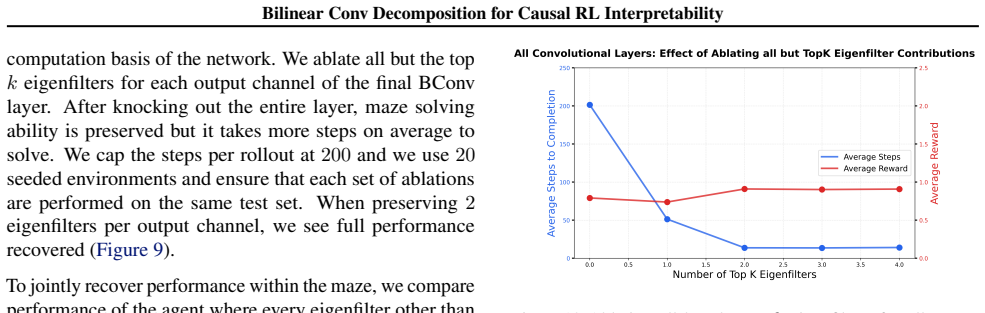
- [Section 4.4] The final paragraph of Section 4.4 contains two adjacent sentences that directly contradict each other: "With k = 1, all convolutions are ablated, and the agent fails to solve the maze (as it reaches the max steps)" and "With k = 1 eigenfilters, we find that the agent does solve the maze, but it takes relatively more time compared to average as it makes some wrong moves." Both sentences refer to the same k=1 condition, so they cannot both be correct. Additionally, the first sentence mislabels k=1 as "all convolutions are ablated," which would be the k=0 condition. This contradiction is load-bearing because the paper's headline sufficiency claim (Section 4.3.4 and Figure 8, "keeping just 1 eigenvector for each output action is enough to preserve near 100% success rate") is contradicted by the statement in Section 4.4 that 2 eigenfilters per channel are needed (Figure 10). Please clarify the exact intervention at k=1, report the success-rate curves for k=0,1,2, and reconcile the discrepancy between Figure 8 and Figure 10.
- [Sections 2.1 and 3.1] The decomposition constructs Bsym exclusively from the U and V kernels, with no bias term, and BConv2D in Eq. (2) is defined without bias. However, Section 2.1 states that biases are omitted only "for brevity" in the fully-connected case, which implies that the actual Bimpala model used in Section 4 includes bias parameters. Standard convolutional layers in RL architectures indeed include biases. If biases are present and non-negligible, the layer's input-output map is (x ∗ U + b_U) ⊙ (x ∗ V + b_V), which is not equal to the quadratic form x^T Bsym x. Consequently, the eigenfilter spectra (Figure 6), the probe decomposition (Section 4.2), and the ablations (Section 4.4) would not describe the true computation of the layer. Please either confirm that the trained Bimpala BConv layers have no bias parameters, or extend the decomposition to include the affine terms and demonstrate that the conclusions are unchanged.
- [Section 4.1.1 and Figure 4] The claim that "Bimpala matches and occasionally outperforms IMPALA" is a central motivation for the architecture, but Figure 4 shows learning curves without error bars, confidence intervals, or a reported number of seeds. Without this information, the "comparable performance" claim could be within run-to-run noise. Please report mean and standard deviation (or interquartile range) over at least 3–5 independent seeds for each environment, and state the number of seeds used in the figure and in the main text.
- [Section 4.2 protocol] The proposed protocol is partly self-referential: a linear probe is trained on the activations, its SVD directions are used to select the output directions for the BConv decomposition, and then the probe's F1 score (Table 1) and the resulting eigenfilter activations are used as evidence that the decomposition captures the concept. Since the probe is fit to the same activations it later selects, high probe accuracy is to be expected. The independent evidence must come from the behavioral ablations (maze-solving success), not from probe accuracy alone. Please report the network's behavior on a held-out set of mazes that were not used for probe training or eigenfilter selection, and explicitly state how the probe and the decomposition are evaluated out-of-sample.
minor comments (6)
- [Section 2.2] The notation is confusing when K is used both for the kernel width and as a summation index in Eq. (3); please use K1 and K2 or explicit bounds such as -ℓ to ℓ for clarity.
- [Section 3.1] The proof that Bsym agrees with B on all inputs references "the respective red and blue terms," but the colors are not visible in a monochrome printout; please recast this explanation without color references.
- [Section 3.1] The notation Xj is used for both the input patch and its flattened vector; please introduce separate symbols (e.g., X̌_j for the flattened patch) to avoid ambiguity.
- [Figure 4] The figure would benefit from explicit axis labels and a legend that identifies ReLU vs. Bilinear curves and the number of seeds; currently the caption is the only guide.
- [Section 4.3.1 and Table 1] The F1 score of 2.73% for the Value FC layer is surprisingly low; please discuss why the value head does not preserve cheese-position information, or check whether this entry is an error.
- [Section 4.3.4 and Figure 7] The text says the action spectrum has "one very large positive eigenvalue," but the figure does not show the negative eigenvalues or the full eigenvalue distribution; please clarify the range of the y-axis and whether negative eigenvalues are present.
Circularity Check
No significant circularity: the bilinear-convolution decomposition is a self-contained algebraic identity, and the empirical performance and ablation claims are not forced by construction.
full rationale
The central derivation (Section 3.1) starts from the BConv2D definition in Eq. (2) and constructs Bsym from the U and V kernels. The equality between the gated convolution output and X^T Bsym X is proven by expansion and does not presuppose the eigenfilter result. The eigendecomposition in Section 3.2 is a direct application of the spectral theorem to the symmetric matrix Qu, so it is a parameter-free mathematical consequence rather than a fitted prediction. The probe protocol in Section 4.2 uses the SVD of a trained linear probe to choose output directions, and the resulting Qprobe formula is an exact algebraic rewriting of the probe's dependence on the preceding BConv layer. This is a re-expression rather than a circular validation, although the paper's 'causal validation' language is stronger than the intervention evidence it provides. The only self-citation, Pearce et al. (2024), shares author Alice Rigg but is motivational: Section 3 re-derives the decomposition instead of importing it as an unexamined premise. The Bimpala-versus-IMPALA comparison and the behavior-level ablations in Sections 4.1.1, 4.3.4, and 4.4 are empirical results that could have failed and are independent of the decomposition. The internal contradiction in Section 4.4 and the omission of bias terms in the decomposition are correctness risks, not circularity, so they do not raise the circularity score.
Assumptions & free parameters
free parameters (1)
- Number of singular components m for probe decomposition =
16 (to explain >=90% variance)
assumptions (4)
- domain assumption Bilinear convolution layers have zero bias; the quadratic form x^T Bsym x exactly represents the BConv2D output.
- domain assumption A linear probe trained on activations provides a valid output direction for the preceding layer; the probe's top singular vector is a meaningful axis of computation.
- standard math The spectral theorem applies: Qu is real symmetric and diagonalizable with orthonormal eigenvectors.
- domain assumption The agents trained on the 'easy' ProcGen distribution are representative of general RL performance for this architecture.
Cite this review
Pith. "Pith review of Bilinear Convolution Decomposition for Causal RL Interpretability." pith.science (2026). https://pith.science/paper/3O665CCD
@misc{pith2026241200944,
  author       = {Pith},
  title        = {Pith review of: Bilinear Convolution Decomposition for Causal RL Interpretability},
  year         = {2026},
  howpublished = {\url{https://pith.science/paper/3O665CCD}},
  note         = {Machine review of arXiv:2412.00944}
}
read the original abstract
Efforts to interpret reinforcement learning (RL) models often rely on high-level techniques such as attribution or probing, which provide only correlational insights and coarse causal control. This work proposes replacing nonlinearities in convolutional neural networks (ConvNets) with bilinear variants, to produce a class of models for which these limitations can be addressed. We show bilinear model variants perform comparably in model-free reinforcement learning settings, and give a side by side comparison on ProcGen environments. Bilinear layers' analytic structure enables weight-based decomposition. Previous work has shown bilinearity enables quantifying functional importance through eigendecomposition, to identify interpretable low rank structure. We show how to adapt the decomposition to convolution layers by applying singular value decomposition to vectors of interest, to separate the channel and spatial dimensions. Finally, we propose a methodology for causally validating concept-based probes, and illustrate its utility by studying a maze-solving agent's ability to track a cheese object.
Figures


Figures from the paper (7 more)




Reference graph
Works this paper leans on
-
[1]
Leveraging procedural generation to benchmark reinforcement learning, 2020
Cobbe, K., Hesse, C., Hilton, J., and Schulman, J. Leveraging procedural generation to benchmark reinforcement learning, 2020. URL https://arxiv.org/abs/1912.01588
arXiv 2020
-
[2]
Impala: Scalable distributed deep-rl with importance weighted actor-learner architectures, 2018
Espeholt, L., Soyer, H., Munos, R., Simonyan, K., Mnih, V., Ward, T., Doron, Y., Firoiu, V., Harley, T., Dunning, I., Legg, S., and Kavukcuoglu, K. Impala: Scalable distributed deep-rl with importance weighted actor-learner architectures, 2018. URL https://arxiv.org/abs/1802.01561
arXiv 2018
-
[3]
T., Dooms, T., Rigg, A., Oramas, J
Pearce, M. T., Dooms, T., Rigg, A., Oramas, J. M., and Sharkey, L. Bilinear mlps enable weight-based mechanistic interpretability, 2024. URL https://arxiv.org/abs/2410.08417
arXiv 2024
-
[4]
A technical note on bilinear layers for interpretability, 2023
Sharkey, L. A technical note on bilinear layers for interpretability, 2023
work page 2023
-
[5]
Glu variants improve transformer, 2020
Shazeer, N. Glu variants improve transformer, 2020. URL https://arxiv.org/abs/2002.05202
arXiv 2020
-
[6]
write newline
" write newline "" before.all 'output.state := FUNCTION n.dashify 't := "" t empty not t #1 #1 substring "-" = t #1 #2 substring "--" = not "--" * t #2 global.max substring 't := t #1 #1 substring "-" = "-" * t #2 global.max substring 't := while if t #1 #1 substring * t #2 global.max substring 't := if while FUNCTION format.date year duplicate empty "emp...
Reviewed August 12, 2026 · model on record in the stance chip above.
Discussion (0). Continue with ORCID to comment.