REVIEW 4 major objections 4 minor 140 references
Learning Structured Representations with Hyperbolic Embeddings
T0 review · 4 major / 4 minor · reviewed 2026-08-12 · deepseek-v4-flash
Pith's one-line read HypStructure moves the CPCC hierarchy-matching loss into a Poincaré ball and claims up to 59.4% lower distortion than flat training and up to 45.4% lower than Euclidean ℓ2-CPCC, with gains in classification and OOD detection.
desk verdict Useful extension of Euclidean CPCC to hyperbolic space with a real distortion-reduction result, but the headline hyperbolic attribution is confounded by a missing Euclidean full-tree control; deserves refereeing with revisions. read the letter →
The pith
A machine-rendered reading of the paper's core claim, the machinery that carries it, and where it could break.
The reading
What carries the argument
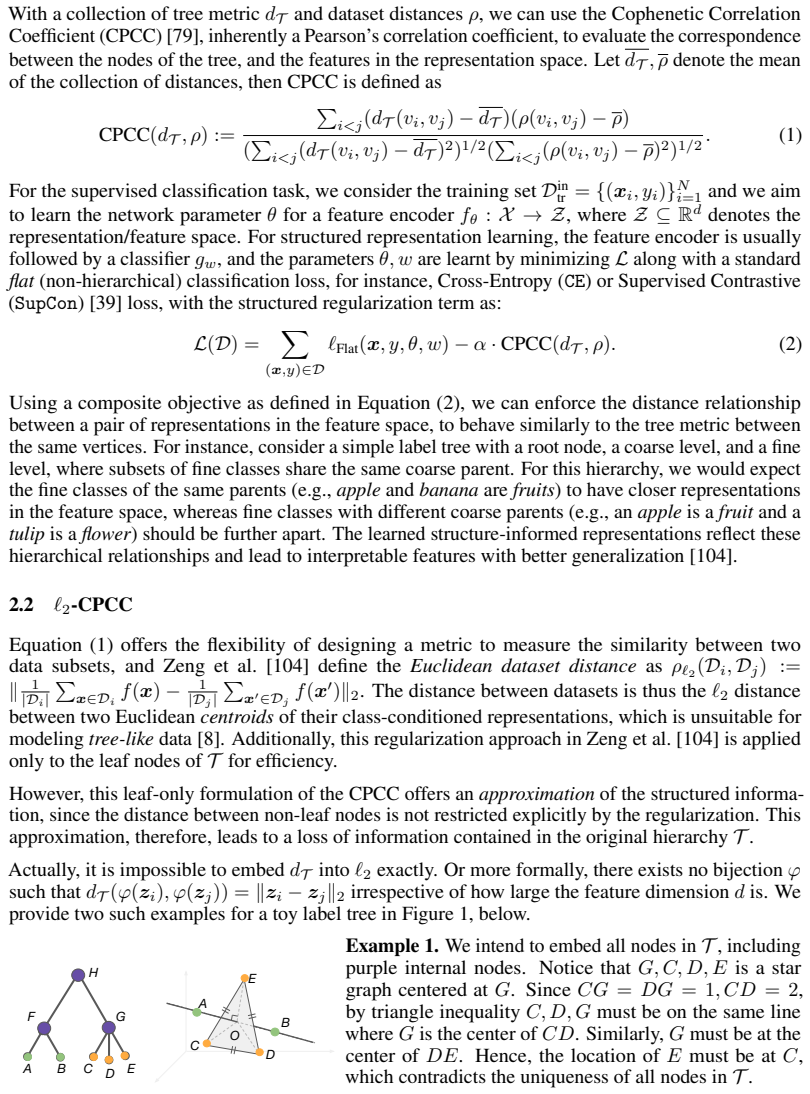
The load-bearing object is the HypStructure regularizer, -α HypCPCC(d_T, d_B^c) + β ℓ_center, added to any flat task loss. HypCPCC generalizes the Euclidean CPCC by taking Poincaré distances between hyperbolic class prototypes, computed by mapping encoder outputs into the ball and averaging them with the Einstein/Klein midpoint; HypCenter keeps the root node's prototype near the ball's center, following the low-distortion tree-embedding construction of [75]. The theoretical machinery is the block-structured Gram matrix K = ZZ^ op induced by CPCC maximization, whose eigenspectrum is characterized recursively in Theorem 5.1: at each level h of a balanced tree, C_h - C_{h+1} eigenvalues equal λ_h = λ_{h-1} + (r_h - r_{h+1}) C_0 / C_h, with the coarsest level dominating.
What would settle it
On a fixed benchmark such as CIFAR10, train HypStructure and ℓ2-CPCC with the same SupCon base loss while randomly corrupting a growing fraction of fine-to-coarse assignments (for example 0%, 10%, 25%, and 50%). If HypStructure's test CPCC and fine accuracy do not degrade monotonically with hierarchy noise, or if it degrades more slowly than ℓ2-CPCC, the claim that hyperbolic geometry gives a fidelity advantage in the realistic noisy-hierarchy regime would be contradicted. Alternatively, finding any matched configuration in which ℓ2-CPCC achieves lower δrel than HypStructure would directly falsify the distortion claim.
Extended reading notes
Core claim
The central claim is that a CPCC-style structured regularizer, previously computed with Euclidean centroids, should be moved into a Poincaré ball to represent label hierarchies. The paper shows that the Euclidean version provably cannot embed a tree without distortion and that the hyperbolic version—with hyperbolic class centroids and a centering loss that keeps the root at the origin—produces more tree-like features, with δrel dropping from 0.232 to 0.094 on CIFAR10 and test CPCC reaching 0.992. It also proves Theorem 5.1, which states that for a balanced label tree the Gram matrix K = ZZ^ op of CPCC-optimized features has eigenvalue groups with a phase transition at each hierarchy level, and argues this coarse-level eigenvalue concentration is what makes hierarchy-informed representations good for OOD detection.
Load-bearing premise
The load-bearing premise is that the label hierarchy fed into HypStructure is correct and complete; if the supplied or constructed hierarchy is noisy or wrong, the regularizer can push features into a structure that does not match the data, and the reported gains may disappear.
Editorial extensions
If this is right
- Using HypStructure with supervised contrastive training makes learned features significantly more tree-like: on CIFAR10, δ_rel falls from 0.232 with flat training to 0.094 with HypStructure, while test CPCC rises from 0.573 to 0.992.
- Because hyperbolic low-dimensional representations can beat the distortion of 512-dimensional Euclidean ones, hierarchy regularization is a way to recover representative capacity when the feature dimension is small.
- CPCC-style structured regularization produces an eigenspectrum whose dominant components align with coarse classes; for CIFAR100 the top 20 eigenvectors carry most of the OOD signal, improving Mahalanobis-score AUROC over flat and ℓ2-CPCC baselines on nine OOD datasets.
- HypStructure remains beneficial when the flat loss is replaced by a hyperbolic supervised contrastive loss or the backbone by a clipped hyperbolic neural network, so the regularizer composes with non-Euclidean training as well.
Reading between the lines
- Editorial inference: the paper tests only correct, externally given hierarchies; a natural stress test is to corrupt the fine-to-coarse assignments and measure how quickly the distortion, accuracy, and OOD gains erode relative to ℓ2-CPCC.
- Editorial inference: the phase-transition theorem suggests a general diagnostic—the size and location of eigenvalue gaps in any representation's Gram matrix could reveal whether and at what granularity a label hierarchy is encoded, independent of hyperbolic training.
- Editorial inference: the root-at-origin centering idea may transfer to partial orders that are not trees, such as DAGs or multiple-inheritance hierarchies, where the tree-metric CPCC assumption does not hold but hierarchical containment still matters.
- Editorial inference: the OOD explanation relies on coarse-level separation, so the benefit may weaken for fine-grained OOD drawn from the same coarse classes as the in-distribution data; that regime is not tested in the paper.
Editorial analysis
A structured set of objections, weighed in public.
Referee Report
Summary. The paper introduces HypStructure, a structured regularizer that adds a hyperbolic-space CPCC term over the label tree and a hyperbolic centering loss to a standard flat training loss. The method is evaluated on CIFAR10, CIFAR100, and ImageNet100 using SupCon as the main flat loss, with additional results for hyperbolic SupCon losses and hyperbolic backbones. The reported experiments compare HypStructure to Flat and ℓ2-CPCC baselines on Gromov distortion (δrel), CPCC, fine/coarse accuracy, and OOD detection AUROC on nine OOD datasets. The paper also presents an eigenspectrum analysis meant to explain why structured features help OOD detection, with a balanced-tree theorem and a general-tree extension in the appendix.
Significance. The paper addresses a meaningful problem — explicitly injecting label-hierarchy structure into learned representations — and the proposed regularizer is simple, general, and accompanied by a released implementation and detailed training details. The distortion reductions reported in Table 1 are substantial, and the combination of a theoretical eigenvalue analysis with an empirical OOD study is ambitious. The main weakness is that the current experimental design does not isolate the effect of hyperbolic geometry from the simultaneous use of internal tree nodes and the centering loss, and a few empirical claims are not fully supported by the tables. With an additional Euclidean control and more cautious reporting, the contribution could be a useful advance for hierarchy-aware representation learning.
major comments (4)
- [Section 3.2 (Eq. 8), Section 4.1 (Table 1), Appendix C.2 (Table 5)] The central claim that hyperbolic distance is responsible for the reduced distortion is not supported because HypStructure changes three things at once: the CPCC distance is changed from Euclidean to Poincaré, internal tree nodes T_int are included (whereas the ℓ2-CPCC baseline in Table 1 is leaf-only), and the centering loss ℓ_center is added. The ablation in Table 5 never evaluates a Euclidean full-tree CPCC with a Euclidean centering loss, and it reports only fine/coarse accuracy, not δrel or CPCC. A Euclidean variant with internal nodes and centering is therefore needed to determine whether the 45.4% distortion reduction over ℓ2-CPCC is due to hyperbolic geometry or to the complete-tree CPCC and centering. Please add this control and report δrel and CPCC for all ablation rows.
- [Section 4.1, Table 1] The statement that HypStructure consistently improves the test CPCC is not accurate as written. On CIFAR100, HypStructure has CPCC 0.766 (0.007), which is lower than ℓ2-CPCC's 0.779 (0.002). Since CPCC is one of the two hierarchy-quality metrics used in the paper, please either correct this statement, report per-dataset numbers clearly, or explain why a lower CPCC is expected on CIFAR100 despite the lower δrel.
- [Section 4.3, Tables 2 and 7a, Appendix C.3] The OOD results are reported without standard deviations or significance tests, and the appendix states that the reported OOD numbers use the Euclidean-centroid computational variant of HypStructure while Section 4.3 does not disclose this. Because OOD AUROC improvements over prior methods are often around 1–2 points, repeated-run variability can matter. Please state which variant is used in the main tables, report variance or confidence intervals, and clarify whether the Euclidean-centroid variant is also the one used for the δrel and CPCC tables.
- [Appendix A, Corollary A.1 and Theorem 5.1] The theorem assumes an exactly block-constant Gram matrix K with entries r_h determined by the height of the lowest common ancestor. The proof, however, only establishes that the relative order of Poincaré distances matches Euclidean distances for vectors clipped to the boundary of the ball; general interior points of the Poincaré ball do not have this monotonicity, and the empirical CPCC values in Table 1 are below 1. Please state Theorem 5.1 as a conditional characterization of the idealized CPCC-optimal case, quantify the perturbation from the measured K, and soften the claim that the experiments formally characterize the observed structured features.
minor comments (4)
- [Section 4.2] The claim of 'up to 2.2% improvements over Flat' is not directly visible in Table 1; on CIFAR100 the fine accuracy gain is 1.72 points and the coarse gain is 1.86 points. Please clarify the origin of the 2.2% figure.
- [Eq. (3)] The displayed formula for the Poincaré distance appears to have malformed parentheses and line breaks; please typeset it correctly.
- [Algorithm 1, line 11] The centering loss is written as ∥HypAveB(˜z1,...,˜zB∥) in the main text with a missing closing parenthesis; the pseudocode should be checked.
- [Section 7] The dependence on a correct external hierarchy is acknowledged, but no experiment with noisy or misspecified hierarchies is provided; since both the CIFAR10 and ImageNet100 hierarchies are constructed, a small robustness study would strengthen the claims.
Circularity Check
No significant circularity; core claims are empirical and not forced by construction, with only a minor non-load-bearing self-citation to prior work.
full rationale
HypStructure's core claims—reduced hierarchy distortion (δrel), higher test CPCC, better fine/coarse accuracy, and improved OOD AUROC—are evaluated on held-out test sets against standard external baselines (Flat SupCon, ℓ2-CPCC [104], CIDER, SSD+, KNN+, etc.). No parameter is fitted to the OOD or δrel numbers; the regularizer in Eq. 8 is a fixed objective, and the reported numbers are empirical outcomes, not identities. The eigenspectrum analysis (Section 5, Appendix A) is conditional: given that the CPCC objective is maximized, Lemma A.1 shows pairwise feature distances are affine in tree distances, so the Gram matrix K has the assumed block form; Theorem 5.1 then computes eigenvalues of such a block matrix. This is a conditional mathematical characterization, not a fitted prediction, and the paper does not use the theorem to generate the OOD results—the OOD connection is made empirically via Figure 8c. The reliance on an externally provided label hierarchy is acknowledged as a limitation in Section 7 and is not a circular dependency. The only minor self-referential element is the use of the authors' prior work [104] as the ℓ2-CPCC baseline and starting point; that citation is not load-bearing for correctness because ℓ2-CPCC is a published, reproducible baseline and the comparison is empirical. The absence of an ablation combining internal nodes and centering loss with Euclidean distance is an experimental-control gap, not a circularity, since no equation in the paper forces the hyperbolic variant's δrel improvement by construction. Verdict: no significant circularity.
Assumptions & free parameters
free parameters (3)
- alpha (CPCC regularization weight) =
1.0 (CIFAR10/100), 0.5 (ImageNet100)
- beta (centering loss weight) =
0.01
- curvature c of the Poincaré ball =
1.0
assumptions (3)
- domain assumption The label hierarchy T is available and semantically correct.
- ad hoc to paper CPCC maximization leads to a Gram matrix K with exact hierarchical block structure and equal correlation at each tree height.
- domain assumption Features are standardized and normalized, and the tree is balanced with equal root-to-leaf distances.
Cite this review
Pith. "Pith review of Learning Structured Representations with Hyperbolic Embeddings." pith.science (2026). https://pith.science/paper/7RMF6VR4
@misc{pith2026241201023,
  author       = {Pith},
  title        = {Pith review of: Learning Structured Representations with Hyperbolic Embeddings},
  year         = {2026},
  howpublished = {\url{https://pith.science/paper/7RMF6VR4}},
  note         = {Machine review of arXiv:2412.01023}
}
read the original abstract
Most real-world datasets consist of a natural hierarchy between classes or an inherent label structure that is either already available or can be constructed cheaply. However, most existing representation learning methods ignore this hierarchy, treating labels as permutation invariant. Recent work [Zeng et al., 2022] proposes using this structured information explicitly, but the use of Euclidean distance may distort the underlying semantic context [Chen et al., 2013]. In this work, motivated by the advantage of hyperbolic spaces in modeling hierarchical relationships, we propose a novel approach HypStructure: a Hyperbolic Structured regularization approach to accurately embed the label hierarchy into the learned representations. HypStructure is a simple-yet-effective regularizer that consists of a hyperbolic tree-based representation loss along with a centering loss, and can be combined with any standard task loss to learn hierarchy-informed features. Extensive experiments on several large-scale vision benchmarks demonstrate the efficacy of HypStructure in reducing distortion and boosting generalization performance especially under low dimensional scenarios. For a better understanding of structured representation, we perform eigenvalue analysis that links the representation geometry to improved Out-of-Distribution (OOD) detection performance seen empirically. The code is available at \url{https://github.com/uiuctml/HypStructure}.
Figures


Figures from the paper (12 more)


Reference graph
Works this paper leans on
-
[1]
A. B. Adcock, B. D. Sullivan, and M. W. Mahoney. Tree-like structure in large social and information networks. In 2013 IEEE 13th international conference on data mining , pages 1–10. IEEE, 2013
2013
-
[2]
Bendale and T
A. Bendale and T. E. Boult. Towards open set deep networks. In Proceedings of the IEEE conference on computer vision and pattern recognition, pages 1563–1572, 2016
2016
-
[3]
Cadima, F
J. Cadima, F. L. Calheiros, and I. P. Preto. The eigenstructure of block-structured correlation matrices and its implications for principal component analysis. Journal of Applied Statistics, 37(4):577–589, Apr. 2010. ISSN 0266-4763, 1360-0532
2010
-
[4]
J. W. Cannon, W. J. Floyd, R. Kenyon, W. R. Parry, et al. Hyperbolic geometry.Flavors of geometry, 31(59-115):2, 1997
1997
-
[5]
Caron, I
M. Caron, I. Misra, J. Mairal, P. Goyal, P. Bojanowski, and A. Joulin. Unsupervised learning of visual features by contrasting cluster assignments. Advances in neural information processing systems, 33:9912–9924, 2020
2020
-
[6]
Chami, A
I. Chami, A. Wolf, D.-C. Juan, F. Sala, S. Ravi, and C. Ré. Low-dimensional hyperbolic knowledge graph embeddings. In Proceedings of the 58th Annual Meeting of the Association for Computational Linguistics, pages 6901–6914, 2020
2020
-
[7]
T. Chen, S. Kornblith, M. Norouzi, and G. Hinton. A simple framework for contrastive learning of visual representations. In International conference on machine learning, pages 1597–1607. PMLR, 2020
2020
-
[8]
W. Chen, W. Fang, G. Hu, and M. W. Mahoney. On the hyperbolicity of small-world and treelike random graphs. Internet Mathematics, 9(4):434–491, 2013
2013
Show all 140 references
-
[9]
Cimpoi, S
M. Cimpoi, S. Maji, I. Kokkinos, S. Mohamed, and A. Vedaldi. Describing textures in the wild. In Proceedings of the IEEE Conference on Computer Vision and Pattern Recognition, pages 3606–3613, 2014
2014
-
[10]
E. D. Cubuk, B. Zoph, D. Mane, V . Vasudevan, and Q. V . Le. Autoaugment: Learning augmentation strategies from data. In Proceedings of the IEEE/CVF conference on computer vision and pattern recognition, pages 113–123, 2019
2019
-
[11]
E. D. Cubuk, B. Zoph, J. Shlens, and Q. Le. Randaugment: Practical automated data aug- mentation with a reduced search space. In H. Larochelle, M. Ranzato, R. Hadsell, M. Balcan, and H. Lin, editors, Advances in Neural Information Processing Systems, volume 33, pages 18613–186...
2020
-
[12]
J. Dai, Y . Wu, Z. Gao, and Y . Jia. A hyperbolic-to-hyperbolic graph convolutional network. In Proceedings of the IEEE/CVF conference on computer vision and pattern recognition, pages 154–163, 2021
2021
-
[13]
Davis, T
J. Davis, T. Liang, J. Enouen, and R. Ilin. Hierarchical classification with confidence using generalized logits. In 2020 25th International Conference on Pattern Recognition (ICPR), pages 1874–1881. IEEE, 2021
2020
-
[14]
J. Deng, N. Ding, Y . Jia, A. Frome, K. Murphy, S. Bengio, Y . Li, H. Neven, and H. Adam. Large-scale object classification using label relation graphs. In D. Fleet, T. Pajdla, B. Schiele, and T. Tuytelaars, editors,Computer Vision – ECCV 2014, pages 48–64, Cham, 2014. Springe...
2014
-
[15]
Dhall, A
A. Dhall, A. Makarova, O. Ganea, D. Pavllo, M. Greeff, and A. Krause. Hierarchical image classification using entailment cone embeddings. In Proceedings of the IEEE/CVF conference on computer vision and pattern recognition workshops, pages 836–837, 2020
2020
-
[16]
Dhingra, C
B. Dhingra, C. Shallue, M. Norouzi, A. Dai, and G. Dahl. Embedding text in hyperbolic spaces. In Proceedings of the Twelfth Workshop on Graph-Based Methods for Natural Language Processing (TextGraphs-12), pages 59–69, 2018. 11
2018
-
[17]
Elsayed, D
G. Elsayed, D. Krishnan, H. Mobahi, K. Regan, and S. Bengio. Large margin deep networks for classification. Advances in neural information processing systems, 31, 2018
2018
-
[18]
Ermolov, L
A. Ermolov, L. Mirvakhabova, V . Khrulkov, N. Sebe, and I. Oseledets. Hyperbolic vision transformers: Combining improvements in metric learning. In Proceedings of the IEEE/CVF Conference on Computer Vision and Pattern Recognition, pages 7409–7419, 2022
2022
-
[19]
Fellbaum
C. Fellbaum. WordNet: An Electronic Lexical Database. Bradford Books, 1998
1998
-
[20]
Ganea, G
O. Ganea, G. Bécigneul, and T. Hofmann. Hyperbolic neural networks. In Advances in Neural Information Processing Systems, pages 5345–5355, 2018
2018
-
[21]
S. Ge, S. Mishra, S. Kornblith, C.-L. Li, and D. Jacobs. Hyperbolic contrastive learning for visual representations beyond objects. arXiv preprint arXiv:2212.00653, 2022
2022 arXiv
-
[22]
Geirhos, P
R. Geirhos, P. Rubisch, C. Michaelis, M. Bethge, F. A. Wichmann, and W. Brendel. Imagenet-trained CNNs are biased towards texture; increasing shape bias improves accu- racy and robustness. In International Conference on Learning Representations, 2019. URL https://openreview.ne...
2019
-
[23]
M. Gromov. Hyperbolic groups. In Essays in group theory, pages 75–263. Springer, 1987
1987
-
[24]
Gulcehre, M
C. Gulcehre, M. Denil, M. Malinowski, A. Razavi, R. Pascanu, K. M. Hermann, P. Battaglia, V . Bapst, D. Raposo, A. Santoro, and N. de Freitas. Hyperbolic attention networks. In International Conference on Learning Representations, 2019. URL https://openreview. net/forum?id=rJxHsjRqFQ
2019
-
[25]
Y . Guo, Y . Liu, E. M. Bakker, Y . Guo, and M. S. Lew. Cnn-rnn: a large-scale hierarchical image classification framework. Multimedia tools and applications, 77(8):10251–10271, 2018
2018
-
[26]
Y . Guo, X. Wang, Y . Chen, and S. X. Yu. Clipped hyperbolic classifiers are super-hyperbolic classifiers. In Proceedings of the IEEE/CVF Conference on Computer Vision and Pattern Recognition, pages 11–20, 2022
2022
-
[27]
K. He, X. Zhang, S. Ren, and J. Sun. Deep residual learning for image recognition. In Proceedings of the IEEE conference on computer vision and pattern recognition, pages 770– 778, 2016
2016
-
[28]
K. He, H. Fan, Y . Wu, S. Xie, and R. Girshick. Momentum contrast for unsupervised visual representation learning. In Proceedings of the IEEE/CVF conference on computer vision and pattern recognition, pages 9729–9738, 2020
2020
-
[29]
O. Henaff. Data-efficient image recognition with contrastive predictive coding. InInternational conference on machine learning, pages 4182–4192. PMLR, 2020
2020
-
[30]
Hendrycks and K
D. Hendrycks and K. Gimpel. A baseline for detecting misclassified and out-of-distribution examples in neural networks. In International Conference on Learning Representations, 2017
2017
-
[31]
Hendrycks, M
D. Hendrycks, M. Mazeika, and T. Dietterich. Deep anomaly detection with outlier exposure. In International Conference on Learning Representations, 2019. URL https://openreview. net/forum?id=HyxCxhRcY7
2019
-
[32]
Hendrycks, N
D. Hendrycks, N. Mu, E. D. Cubuk, B. Zoph, J. Gilmer, and B. Lakshminarayanan. AugMix: A simple data processing method to improve robustness and uncertainty. Proceedings of the International Conference on Learning Representations, 2020
2020
-
[33]
R. D. Hjelm, A. Fedorov, S. Lavoie-Marchildon, K. Grewal, P. Bachman, A. Trischler, and Y . Bengio. Learning deep representations by mutual information estimation and maximization. In International Conference on Learning Representations, 2019. URL https://openreview. net/forum...
2019
-
[34]
D. T. Hoffmann, N. Behrmann, J. Gall, T. Brox, and M. Noroozi. Ranking info noise contrastive estimation: Boosting contrastive learning via ranked positives. In AAAI Conference on Artificial Intelligence, 2022. 12
2022
-
[35]
R. A. Horn and C. R. Johnson. Matrix analysis. Cambridge University Press, Cambridge; New York, 2nd ed edition, 2012. ISBN 978-0-521-83940-2
2012
-
[36]
Y .-C. Hsu, Y . Shen, H. Jin, and Z. Kira. Generalized odin: Detecting out-of-distribution image without learning from out-of-distribution data. In Proceedings of the IEEE/CVF Conference on Computer Vision and Pattern Recognition, pages 10951–10960, 2020
2020
-
[37]
Huang and Y
R. Huang and Y . Li. Towards scaling out-of-distribution detection for large semantic space. Proceedings of the IEEE/CVF Conference on Computer Vision and Pattern Recognition, 2021
2021
-
[38]
Jonckheere, P
E. Jonckheere, P. Lohsoonthorn, and F. Bonahon. Scaled gromov hyperbolic graphs. Journal of Graph Theory, 57(2):157–180, 2008
2008
-
[39]
Khosla, P
P. Khosla, P. Teterwak, C. Wang, A. Sarna, Y . Tian, P. Isola, A. Maschinot, C. Liu, and D. Krishnan. Supervised contrastive learning. In Advances in Neural Information Processing Systems, volume 33, pages 18661–18673, 2020
2020
-
[40]
Khrulkov, L
V . Khrulkov, L. Mirvakhabova, E. Ustinova, I. Oseledets, and V . Lempitsky. Hyperbolic image embeddings. In Proceedings of the IEEE/CVF Conference on Computer Vision and Pattern Recognition, pages 6418–6428, 2020
2020
-
[41]
S. Kim, D. Kim, M. Cho, and S. Kwak. Proxy anchor loss for deep metric learning. In Proceedings of the IEEE/CVF conference on computer vision and pattern recognition, pages 3238–3247, 2020
2020
-
[42]
Kirichenko, P
P. Kirichenko, P. Izmailov, and A. G. Wilson. Why normalizing flows fail to detect out-of- distribution data. Advances in Neural Information Processing Systems, 33, 2020
2020
-
[43]
Kolesnikov, L
A. Kolesnikov, L. Beyer, X. Zhai, J. Puigcerver, J. Yung, S. Gelly, and N. Houlsby. Large scale learning of general visual representations for transfer. arXiv preprint arXiv:1912.11370, 2(8), 2019
1912 arXiv
-
[44]
Krioukov, F
D. Krioukov, F. Papadopoulos, M. Kitsak, A. Vahdat, and M. Boguná. Hyperbolic geometry of complex networks. Physical Review E, 82(3):036106, 2010
2010
-
[45]
Krizhevsky, G
A. Krizhevsky, G. Hinton, et al. Learning multiple layers of features from tiny images. 2009
2009
-
[46]
C. Lang, A. Braun, L. Schillingmann, and A. Valada. On hyperbolic embeddings in object detection. In Pattern Recognition: 44th DAGM German Conference, DAGM GCPR 2022, Konstanz, Germany, September 27–30, 2022, Proceedings, pages 462–476. Springer, 2022
2022
-
[47]
K. Lee, K. Lee, H. Lee, and J. Shin. A simple unified framework for detecting out-of- distribution samples and adversarial attacks. In Advances in Neural Information Processing Systems, pages 7167–7177, 2018
2018
-
[48]
J. Lei, Z. Guo, and Y . Wang. Weakly supervised image classification with coarse and fine labels. In 2017 14th Conference on Computer and Robot Vision (CRV), pages 240–247. IEEE, 2017
2017
-
[49]
L. Li, Y . Zhang, and S. Wang. The euclidean space is evil: hyperbolic attribute editing for few-shot image generation. In Proceedings of the IEEE/CVF International Conference on Computer Vision, pages 22714–22724, 2023
2023
-
[50]
L.-J. Li, C. Wang, Y . Lim, D. M. Blei, and L. Fei-Fei. Building and using a semantivisual image hierarchy. In 2010 IEEE Computer Society Conference on Computer Vision and Pattern Recognition, pages 3336–3343, 2010. doi: 10.1109/CVPR.2010.5540027
2010
-
[51]
Liang, Y
S. Liang, Y . Li, and R. Srikant. Enhancing the reliability of out-of-distribution image detection in neural networks. In 6th International Conference on Learning Representations, ICLR 2018, 2018
2018
-
[52]
S. Liu, J. Chen, L. Pan, C.-W. Ngo, T.-S. Chua, and Y .-G. Jiang. Hyperbolic visual embedding learning for zero-shot recognition. In Proceedings of the IEEE/CVF conference on computer vision and pattern recognition, pages 9273–9281, 2020. 13
2020
-
[53]
W. Liu, Y . Wen, Z. Yu, and M. Yang. Large-margin softmax loss for convolutional neural networks. In International Conference on Machine Learning, pages 507–516. PMLR, 2016
2016
-
[54]
W. Liu, X. Wang, J. Owens, and Y . Li. Energy-based out-of-distribution detection.Advances in Neural Information Processing Systems, 2020
2020
-
[55]
T. Long, P. Mettes, H. T. Shen, and C. G. M. Snoek. Searching for actions on the hyperbole. In Proceedings of the IEEE/CVF Conference on Computer Vision and Pattern Recognition (CVPR), June 2020
2020
-
[56]
Mathieu, C
E. Mathieu, C. Le Lan, C. J. Maddison, R. Tomioka, and Y . W. Teh. Continuous hierarchical representations with poincaré variational auto-encoders. Advances in neural information processing systems, 32, 2019
2019
-
[57]
McInnes, J
L. McInnes, J. Healy, and J. Melville. Umap: Uniform manifold approximation and projection for dimension reduction. arXiv preprint arXiv:1802.03426, 2018
2018 arXiv
-
[58]
McLean, A
I. McLean, A. Urken, and F. Hewitt. Classics of social choice . University of Michigan Press, 1995. ISBN 978-0-472-10450-5. URL https://books.google.com/books?id= 0QPv9cg3g-sC
1995
-
[59]
Y . Ming, Z. Cai, J. Gu, Y . Sun, W. Li, and Y . Li. Delving into out-of-distribution detection with vision-language representations. In Advances in Neural Information Processing Systems, 2022
2022
-
[60]
Y . Ming, Y . Fan, and Y . Li. POEM: Out-of-distribution detection with posterior sampling. In Proceedings of the 39th International Conference on Machine Learning, pages 15650–15665, 2022
2022
-
[61]
Y . Ming, Y . Sun, O. Dia, and Y . Li. How to exploit hyperspherical embeddings for out-of- distribution detection? In The Eleventh International Conference on Learning Representations, 2022
2022
-
[62]
Mishne, Z
G. Mishne, Z. Wan, Y . Wang, and S. Yang. The numerical stability of hyperbolic representation learning. In International Conference on Machine Learning, pages 24925–24949. PMLR, 2023
2023
-
[63]
Nalisnick, A
E. Nalisnick, A. Matsukawa, Y . W. Teh, D. Gorur, and B. Lakshminarayanan. Do deep generative models know what they don’t know? In International Conference on Learning Representations, 2019
2019
-
[64]
Nauata, H
N. Nauata, H. Hu, G.-T. Zhou, Z. Deng, Z. Liao, and G. Mori. Structured label inference for visual understanding. IEEE transactions on pattern analysis and machine intelligence, 42(5): 1257–1271, 2019
2019
-
[65]
Netzer, T
Y . Netzer, T. Wang, A. Coates, A. Bissacco, B. Wu, A. Y . Ng, et al. Reading digits in natural images with unsupervised feature learning. In NIPS workshop on deep learning and unsupervised feature learning, volume 2011, page 4. Granada, 2011
2011
-
[66]
Nickel and D
M. Nickel and D. Kiela. Poincaré embeddings for learning hierarchical representations. In Advances in Neural Information Processing Systems, pages 6338–6347, 2017
2017
-
[67]
Nickel and D
M. Nickel and D. Kiela. Learning continuous hierarchies in the Lorentz model of hyperbolic geometry. In J. Dy and A. Krause, editors, Proceedings of the 35th International Conference on Machine Learning, volume 80 of Proceedings of Machine Learning Research, pages 3779–
-
[68]
K. T. Noor, A. Robles-Kelly, and B. Kusy. A capsule network for hierarchical multi-label image classification. In Joint IAPR International Workshops on Statistical Techniques in Pattern Recognition (SPR) and Structural and Syntactic Pattern Recognition (SSPR), pages 163–172. S...
2022
-
[69]
Pinto, H
F. Pinto, H. Yang, S.-N. Lim, P. Torr, and P. K. Dokania. Using mixup as a regularizer can surprisingly improve accuracy & out-of-distribution robustness. In A. H. Oh, A. Agarwal, D. Belgrave, and K. Cho, editors, Advances in Neural Information Processing Systems, 2022. URL ht...
2022
-
[70]
Ravasz and A.-L
E. Ravasz and A.-L. Barabási. Hierarchical organization in complex networks. Physical review E, 67(2):026112, 2003
2003
-
[71]
J. Ren, P. J. Liu, E. Fertig, J. Snoek, R. Poplin, M. Depristo, J. Dillon, and B. Lakshmi- narayanan. Likelihood ratios for out-of-distribution detection. In Advances in Neural Informa- tion Processing Systems, pages 14680–14691, 2019
2019
-
[72]
Russakovsky, J
O. Russakovsky, J. Deng, H. Su, J. Krause, S. Satheesh, S. Ma, Z. Huang, A. Karpathy, A. Khosla, M. Bernstein, A. C. Berg, and L. Fei-Fei. ImageNet Large Scale Visual Recognition Challenge. International Journal of Computer Vision (IJCV), 115(3):211–252, 2015. doi: 10.1007/s11...
2015 doi
-
[73]
F. Sala, C. De Sa, A. Gu, and C. Ré. Representation tradeoffs for hyperbolic embeddings. In Proceedings of the International Conference on Machine Learning, pages 4460–4469, 2018
2018
-
[74]
Santurkar, D
S. Santurkar, D. Tsipras, and A. Madry. Breeds: Benchmarks for subpopulation shift. In International Conference on Learning Representations, 2021. URL https://openreview. net/forum?id=mQPBmvyAuk
2021
-
[75]
R. Sarkar. Low Distortion Delaunay Embedding of Trees in Hyperbolic Plane, volume 7034 of Lecture Notes in Computer Science, page 355–366. Springer Berlin Heidelberg, Berlin, Heidelberg, 2012. ISBN 978-3-642-25877-0. doi: 10.1007/978-3-642-25878-7_34. URL http://link.springer....
2012 doi
-
[76]
Sehwag, M
V . Sehwag, M. Chiang, and P. Mittal. Ssd: A unified framework for self-supervised outlier detection. In International Conference on Learning Representations, 2021
2021
-
[77]
Serrà, D
J. Serrà, D. Álvarez, V . Gómez, O. Slizovskaia, J. F. Núñez, and J. Luque. Input complexity and out-of-distribution detection with likelihood-based generative models. In International Conference on Learning Representations, 2020
2020
-
[78]
Shimizu, Y
R. Shimizu, Y . Mukuta, and T. Harada. Hyperbolic neural networks++. In International Conference on Learning Representations, 2020
2020
-
[79]
R. R. Sokal and F. J. Rohlf. The comparison of dendrograms by objective methods. Taxon, 1962
1962
-
[80]
Y . Song, N. Sebe, and W. Wang. Rankfeat: Rank-1 feature removal for out-of-distribution detection. In A. H. Oh, A. Agarwal, D. Belgrave, and K. Cho, editors, Advances in Neu- ral Information Processing Systems, 2022. URL https://openreview.net/forum?id= -deKNiSOXLG
2022
-
[81]
Sukhbaatar, J
S. Sukhbaatar, J. Bruna, M. Paluri, L. Bourdev, and R. Fergus. Training convolutional networks with noisy labels. arXiv preprint arXiv:1406.2080, 2014
2014 arXiv
-
[82]
Y . Sun, C. Guo, and Y . Li. React: Out-of-distribution detection with rectified activations. In Advances in Neural Information Processing Systems, 2021
2021
-
[83]
Y . Sun, Y . Ming, X. Zhu, and Y . Li. Out-of-distribution detection with deep nearest neighbors. ICML, 2022
2022
-
[84]
Suzuki, A
A. Suzuki, A. Nitanda, J. Wang, L. Xu, K. Yamanishi, and M. Cavazza. Generalization error bound for hyperbolic ordinal embedding. In International Conference on Machine Learning, pages 10011–10021. PMLR, 2021
2021
-
[85]
J. Tack, S. Mo, J. Jeong, and J. Shin. Csi: Novelty detection via contrastive learning on distributionally shifted instances. In Advances in Neural Information Processing Systems , 2020. 15
2020
-
[86]
Taherkhani, H
F. Taherkhani, H. Kazemi, A. Dabouei, J. Dawson, and N. M. Nasrabadi. A weakly super- vised fine label classifier enhanced by coarse supervision. In Proceedings of the IEEE/CVF International Conference on Computer Vision, pages 6459–6468, 2019
2019
-
[87]
Y . Tian, D. Krishnan, and P. Isola. Contrastive multiview coding. InComputer Vision–ECCV 2020: 16th European Conference, Glasgow, UK, August 23–28, 2020, Proceedings, Part XI 16, pages 776–794. Springer, 2020
2020
-
[88]
A. A. Ungar. Hyperbolic trigonometry and its application in the poincaré ball model of hyperbolic geometry. Computers & Mathematics with Applications, 41(1-2):135–147, 2001
2001
-
[89]
Van der Maaten and G
L. Van der Maaten and G. Hinton. Visualizing data using t-sne. Journal of machine learning research, 9(11), 2008
2008
-
[90]
Van Horn, O
G. Van Horn, O. Mac Aodha, Y . Song, Y . Cui, C. Sun, A. Shepard, H. Adam, P. Perona, and S. Belongie. The inaturalist species classification and detection dataset. In Proceedings of the IEEE Conference on Computer Vision and Pattern Recognition (CVPR), June 2018
2018
-
[91]
Wang and G
P. Wang and G. W. Cottrell. Basic level categorization facilitates visual object recognition,
-
[92]
H. Wei, R. Xie, H. Cheng, L. Feng, B. An, and Y . Li. Mitigating neural network overconfidence with logit normalization. In ICML, 2022
2022
-
[93]
H. Weyl. Das asymptotische verteilungsgesetz der eigenwerte linearer partieller differential- gleichungen (mit einer anwendung auf die theorie der hohlraumstrahlung). Mathematische Annalen, 71(4):441–479, Dec. 1912. ISSN 1432-1807. doi: 10.1007/BF01456804
1912 doi
-
[94]
Winkens, R
J. Winkens, R. Bunel, A. G. Roy, R. Stanforth, V . Natarajan, J. R. Ledsam, P. MacWilliams, P. Kohli, A. Karthikesalingam, S. Kohl, et al. Contrastive training for improved out-of- distribution detection. arXiv preprint arXiv:2007.05566, 2020
2007 arXiv
-
[95]
Z. Wu, Y . Xiong, S. X. Yu, and D. Lin. Unsupervised feature learning via non-parametric instance discrimination. In Proceedings of the IEEE conference on computer vision and pattern recognition, pages 3733–3742, 2018
2018
-
[96]
J. Xiao, J. Hays, K. A. Ehinger, A. Oliva, and A. Torralba. Sun database: Large-scale scene recognition from abbey to zoo. In 2010 IEEE computer society conference on computer vision and pattern recognition, pages 3485–3492. IEEE, 2010
2010
-
[97]
Z. Xiao, Q. Yan, and Y . Amit. Likelihood regret: An out-of-distribution detection score for variational auto-encoder. Advances in Neural Information Processing Systems, 33, 2020
2020
-
[98]
Xie, M.-T
Q. Xie, M.-T. Luong, E. Hovy, and Q. V . Le. Self-training with noisy student improves imagenet classification. In Proceedings of the IEEE/CVF conference on computer vision and pattern recognition, pages 10687–10698, 2020
2020
-
[99]
P. Xu, K. A. Ehinger, Y . Zhang, A. Finkelstein, S. R. Kulkarni, and J. Xiao. Turkergaze: Crowdsourcing saliency with webcam based eye tracking. arXiv preprint arXiv:1504.06755, 2015
2015 arXiv
-
[100]
J. Yan, L. Luo, C. Deng, and H. Huang. Unsupervised hyperbolic metric learning. In Proceedings of the IEEE/CVF Conference on Computer Vision and Pattern Recognition, pages 12465–12474, 2021
2021
-
[101]
Z. Yan, H. Zhang, R. Piramuthu, V . Jagadeesh, D. DeCoste, W. Di, and Y . Yu. Hd-cnn: hierar- chical deep convolutional neural networks for large scale visual recognition. In Proceedings of the IEEE international conference on computer vision, pages 2740–2748, 2015
2015
-
[102]
F. Yu, A. Seff, Y . Zhang, S. Song, T. Funkhouser, and J. Xiao. Lsun: Construction of a large-scale image dataset using deep learning with humans in the loop. arXiv preprint arXiv:1506.03365, 2015
2015 arXiv
-
[103]
Y . Yue, F. Lin, K. D. Yamada, and Z. Zhang. Hyperbolic contrastive learning.arXiv preprint arXiv:2302.01409, 2023. 16
2023 arXiv
-
[104]
S. Zeng, R. T. des Combes, and H. Zhao. Learning structured representations by embedding class hierarchy. In The Eleventh International Conference on Learning Representations, 2022
2022
-
[105]
Zhang, N
J. Zhang, N. Inkawhich, R. Linderman, Y . Chen, and H. Li. Mixture outlier exposure: Towards out-of-distribution detection in fine-grained environments. In Proceedings of the IEEE/CVF Winter Conference on Applications of Computer Vision (WACV), pages 5531–5540, January 2023
2023
-
[106]
Zhang, J
J. Zhang, J. Yang, P. Wang, H. Wang, Y . Lin, H. Zhang, Y . Sun, X. Du, K. Zhou, W. Zhang, et al. Openood v1. 5: Enhanced benchmark for out-of-distribution detection. arXiv preprint arXiv:2306.09301, 2023
2023 arXiv
-
[107]
Zhang and M
Z. Zhang and M. Sabuncu. Generalized cross entropy loss for training deep neural networks with noisy labels. Advances in neural information processing systems, 31, 2018
2018
-
[108]
Zheng, J
Y . Zheng, J. Fan, J. Zhang, and X. Gao. Hierarchical learning of multi-task sparse metrics for large-scale image classification. Pattern Recognition, 67:97–109, 2017. ISSN 0031-3203. doi: https://doi.org/10.1016/j.patcog.2017.01.029. URL https://www.sciencedirect.com/ science...
2017 doi
-
[109]
B. Zhou, A. Lapedriza, A. Khosla, A. Oliva, and A. Torralba. Places: A 10 million image database for scene recognition.IEEE transactions on pattern analysis and machine intelligence, 40(6):1452–1464, 2017
2017
-
[110]
Zhuang, A
C. Zhuang, A. L. Zhai, and D. Yamins. Local aggregation for unsupervised learning of visual embeddings. In Proceedings of the IEEE/CVF international conference on computer vision, pages 6002–6012, 2019. 17 Appendix This appendix is segmented into the following key parts
2019
-
[113]
Section A continues the analysis of the eigenspectrum of CPCC-optimized representation matrix and generalizes it for an arbitrary label tree
-
[114]
Section B discusses additional details about our proposed method HypStructure, its implementation and broader impact of our work. In particular, an overview of the method is first provided, and then we describe hyperparameter settings of our method and the main baselines, foll...
-
[115]
Section C reports ablation studies, detailed results on OOD detection and provides additional experimental results and visualizations not included in the main paper due to lack of space. A Details of Eigenspectrum Analysis In this section, we first introduce some notations, di...
-
[116]
R has pi − 1 eigenvalues 1 − rii (i = 1 : k)
-
[117]
Lemma A.2
The rest of the eigenvalues are those from k × k symmetric matrix A whose diagonal elements are aii = piRi and whose off-diagonal elements are aij = √pi · pjrij. Lemma A.2. Given d by d matrix M where Mii = 1, ∀i ∈ [d], and Mij = p otherwise, i.e., M = 1 p . . . . . ...
-
[118]
with an initial learning rate of 0.01 and update the weights of the last residual block and the nonlinear projection head, while freezing the parameters in the first three residual blocks. We use the same α values as the regularization parameters for the CPCC loss in Equation ...
-
[119]
It consists of 50,000 training images and 10,000 test images from 10 different classes
CIFAR10 ([45]). It consists of 50,000 training images and 10,000 test images from 10 different classes
-
[120]
It also consists of 50,000 training images and 10,000 test images, however the images belong to 100 classes
CIFAR100([45]). It also consists of 50,000 training images and 10,000 test images, however the images belong to 100 classes. Note that the classes are not identical to the CIFAR10 dataset
-
[121]
This dataset is created as a subset of the large-scale ImageNet dataset following Ming et al
ImageNet100([72]). This dataset is created as a subset of the large-scale ImageNet dataset following Ming et al. [59]. The original ImageNet dataset consists of 1,000 classes and 1.2 million training images and 50,000 validation images. We construct the ImageNet100 dataset fro...
-
[122]
(8) and line 10 in Algorithm 1), as opposed to only using leaf nodes as in Zeng et al
the role of embedding all internal nodes in the label hierarchy (eq. (8) and line 10 in Algorithm 1), as opposed to only using leaf nodes as in Zeng et al. [104]. We refer to the inclusion of internal nodes as Tint
-
[123]
(6) and line 8 in Algorithm 1), as opposed to the Euclidean computation of class prototypes as in Zeng et al
the role of hyperbolic class centroids computation using hyperbolic averaging (eq. (6) and line 8 in Algorithm 1), as opposed to the Euclidean computation of class prototypes as in Zeng et al. [104]. We refer to the hyperbolic class centroid computation as ωhyp
-
[124]
(8) and line 11 in Algorithm 1), as opposed to not using a centering loss
the role of the hyperbolic centering loss in our proposed methodology (eq. (8) and line 11 in Algorithm 1), as opposed to not using a centering loss. We refer to the inclusion of the centering loss as ℓcenter. We ablate over the aforementioned settings, where a✓ denotes the in...
-
[125]
Results for these methods are taken from CIDER [61] where contrastive learning based OOD detection methods typically outperforms non-contrastive learning ones
respectively. Results for these methods are taken from CIDER [61] where contrastive learning based OOD detection methods typically outperforms non-contrastive learning ones. For ImageNet100, in the absence of the available class ids used to train the original models in CIDER [...
-
[126]
Guidelines: • The answer NA means that the abstract and introduction do not include the claims made in the paper
Claims Question: Do the main claims made in the abstract and introduction accurately reflect the paper’s contributions and scope? Answer: [Yes] Justification: The abstract and the introduction both clearly state the claims made by the paper, along with a clear description of t...
-
[127]
Limitations
Limitations Question: Does the paper discuss the limitations of the work performed by the authors? Answer: [Yes] Justification: Yes, the limitations of the current work as well as the avenues for future improvements to the current work can be found in Section 7. Guidelines: • ...
-
[128]
Guidelines: • The answer NA means that the paper does not include theoretical results
Theory Assumptions and Proofs Question: For each theoretical result, does the paper provide the full set of assumptions and a complete (and correct) proof? 34 Answer: [Yes] Justification: Yes, for all the main results of the paper in Section 5, a full set of assumptions and a ...
-
[129]
These details can be found in Section B in the Appendix
Experimental Result Reproducibility Question: Does the paper fully disclose all the information needed to reproduce the main ex- perimental results of the paper to the extent that it affects the main claims and/or conclusions of the paper (regardless of whether the code and da...
-
[130]
These can be found in Section B in the Appendix
Open access to data and code Question: Does the paper provide open access to the data and code, with sufficient instruc- tions to faithfully reproduce the main experimental results, as described in supplemental material? Answer: [Yes] Justification: The paper includes the spec...
-
[131]
These details can be found in Section B in the Appendix
Experimental Setting/Details Question: Does the paper specify all the training and test details (e.g., data splits, hyper- parameters, how they were chosen, type of optimizer, etc.) necessary to understand the results? Answer: [Yes] Justification: Yes, the paper uses standard ...
-
[132]
Guidelines: • The answer NA means that the paper does not include experiments
Experiment Statistical Significance Question: Does the paper report error bars suitably and correctly defined or other appropriate information about the statistical significance of the experiments? Answer: [Yes] Justification: Yes, the paper reports the error bars and other in...
-
[133]
Guidelines: • The answer NA means that the paper does not include experiments
Experiments Compute Resources Question: For each experiment, does the paper provide sufficient information on the com- puter resources (type of compute workers, memory, time of execution) needed to reproduce the experiments? Answer: [Yes] Justification: Yes, the paper provides...
-
[134]
Guidelines: • The answer NA means that the authors have not reviewed the NeurIPS Code of Ethics
Code Of Ethics Question: Does the research conducted in the paper conform, in every respect, with the NeurIPS Code of Ethics https://neurips.cc/public/EthicsGuidelines? Answer: [Yes] Justification: Yes, the research conducted in this paper conforms in every respect, with the N...
-
[135]
Guidelines: • The answer NA means that there is no societal impact of the work performed
Broader Impacts Question: Does the paper discuss both potential positive societal impacts and negative societal impacts of the work performed? Answer: [Yes] 37 Justification: We discuss the potential positive and negative societal impacts of our work in Section B.1 of the Appe...
-
[136]
Guidelines: • The answer NA means that the paper poses no such risks
Safeguards Question: Does the paper describe safeguards that have been put in place for responsible release of data or models that have a high risk for misuse (e.g., pretrained language models, image generators, or scraped datasets)? Answer: [NA] Justification: The paper uses ...
-
[137]
Guidelines: • The answer NA means that the paper does not use existing assets
Licenses for existing assets Question: Are the creators or original owners of assets (e.g., code, data, models), used in the paper, properly credited and are the license and terms of use explicitly mentioned and properly respected? Answer: [Yes] Justification: We have appropri...
-
[138]
Guidelines: • The answer NA means that the paper does not release new assets
New Assets Question: Are new assets introduced in the paper well documented and is the documentation provided alongside the assets? Answer: [NA] Justification: The paper does not release any new assets. Guidelines: • The answer NA means that the paper does not release new asse...
-
[139]
Guidelines: • The answer NA means that the paper does not involve crowdsourcing nor research with human subjects
Crowdsourcing and Research with Human Subjects Question: For crowdsourcing experiments and research with human subjects, does the paper include the full text of instructions given to participants and screenshots, if applicable, as well as details about compensation (if any)? A...
-
[140]
Guidelines: 39 • The answer NA means that the paper does not involve crowdsourcing nor research with human subjects
Institutional Review Board (IRB) Approvals or Equivalent for Research with Human Subjects Question: Does the paper describe potential risks incurred by study participants, whether such risks were disclosed to the subjects, and whether Institutional Review Board (IRB) approvals...
-
[2015]
URL https://arxiv.org/abs/1511.04103
-
[3788]
URL https://proceedings.mlr.press/v80/nickel18a
PMLR, 10–15 Jul 2018. URL https://proceedings.mlr.press/v80/nickel18a. html
2018
Reviewed August 12, 2026 · model on record in the stance chip above.
Discussion (0). Continue with ORCID to comment.