REVIEW 4 major objections 5 minor 58 references
PainterNet: Adaptive Image Inpainting with Actual-Token Attention and Diverse Mask Control
T0 review · 4 major / 5 minor · reviewed 2026-08-12 · deepseek-v4-flash
Pith's one-line read PainterNet claims to beat prior inpainting models by steering diffusion attention onto masked regions with local prompts and an attention loss.
desk verdict PainterNet has a genuinely new attention loss and a useful local-prompt dataset, but the SOTA claim is not backed by the evaluation because the benchmark matches the method's training distribution and not the baselines'. read the letter →
The pith
A machine-rendered reading of the paper's core claim, the machinery that carries it, and where it could break.
The reading
What carries the argument
The core mechanism combines (1) a dual-branch control architecture, inherited from BrushNet but retaining cross-attention layers, where the trainable branch receives a 9-channel input (noisy latent, masked image latent, downsampled mask) and is fused into the frozen SD U-Net through zero convolutions at both layer control points and attention control points; and (2) the Actual-Token Attention Loss, $\mathcal{L}_{ATAL} = \frac{1}{N}\sum_{i=1}^{N}\| \frac{1}{L_S}\sum_{j \in S} A_{i,j} - m_i \|_2^2$, where $A_{i,j}$ is the cross-attention map of layer $i$ for text token $j$, $S$ is the set of actual text tokens (excluding start/end specials), and $m_i$ is the mask resized to that layer's attention map. This loss forces the model's cross-attention to concentrate on the masked region rather than on the whole image, which is what aligns generated pixels with the local prompt. The third component is the training-time mask mixer: for each sample, a random $k\in[0,1]$ selects a bounding-box mask (25%), an irregular finger-like scribble (50%), or the segmentation mask (25%), so the model learns to handle coarse, user-like inputs.
What would settle it
Rerun Table 1 on the original BrushBench (global prompts, segmentation masks) and on a held-out set of unscripted user-drawn scribbles; if PainterNet's margins over BrushNet and HD-Painter shrink or reverse, the state-of-the-art claim rests on benchmark overlap with the training distribution rather than on a general architectural advantage.
Extended reading notes
Core claim
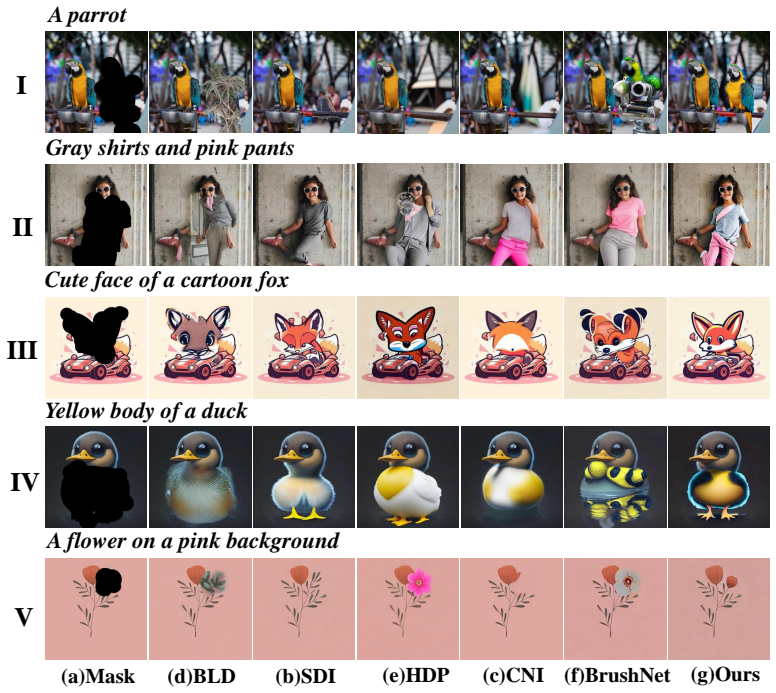
PainterNet is a plug-and-play branch for Stable Diffusion-based inpainting that claims to fix two problems in existing control-based methods: global prompts that do not describe the masked region, and masks that do not match how users actually draw them. The paper replaces global captions with local prompts, keeps the full cross-attention layers of the trainable branch (unlike BrushNet, which removes them), and adds Attention Control Points plus an Actual-Token Attention Loss (ATAL) that drives the cross-attention maps of every layer toward the mask region. On the authors' PainterBench (built from PainterData with three mask types and MLLM-generated local prompts), PainterNet reports the best scores among BrushNet, ControlNet-Inpainting, HD-Painter, and Stable Diffusion inpainting on image reward, aesthetic score, global and local CLIP similarity, and Grounding DINO accuracy, with Local CLIP Sim of 22.67 on SD 1.5 and 23.06 on SDXL, and Gdino accuracy of 0.96 and 0.95. The ablation shows each component matters: the branch raises Local CLIP Sim from 22.40 to 22.53, ACP raises global CLIP Sim from 25.82 to 25.98, and ATAL lifts all key metrics.
Load-bearing premise
The results assume that evaluating every method on PainterNet's own style of local prompts and user-like masks is a fair comparison, even though the baselines were trained on global prompts and segmentation masks, so PainterBench may systematically favor PainterNet.
Editorial extensions
If this is right
- PainterNet can be plugged into arbitrary Stable Diffusion-based models (the paper demonstrates anime, Van Gogh-style, and specific-role models) while keeping the base style intact.
- Local prompts become the conditioning signal, so a user can describe just the masked object (e.g., 'a pink sweater') and the model aligns the inpainted pixels with that description rather than the full scene caption.
- The ATAL loss compels cross-attention in every layer to concentrate on the mask, which the ablation ties to gains in all key metrics, especially local CLIP similarity and grounding accuracy.
- Training on mixed mask shapes (box, irregular, segmentation) means users can draw coarse masks without following object contours, making the model usable with the masks people actually produce.
- The same plugin trained on SD 1.5 transfers to SDXL, raising local CLIP similarity from 19.49 (SDXL-inpainting) to 23.06, suggesting the attention-control mechanism is backbone-agnostic.
Reading between the lines
- A fair reading of the benchmark suggests part of the measured advantage may reflect that PainterBench matches PainterNet's training distribution (local prompts, mixed masks) while baselines trained on global prompts and segmentation masks face an out-of-distribution test; this distributional overlap, not just the architecture, could drive the reported margins.
- The ATAL loss is generic enough to transfer beyond inpainting: any diffusion task that must respect a spatial region (object insertion, attribute editing, layout control) could reuse the same masked-attention objective.
- The dataset recipe (MLLM captioning of cropped regions, short-caption post-processing, and CLIP-similarity filtering) is reusable for building localized caption datasets for other editing benchmarks, not just inpainting.
- Varying the mask-mixing probabilities (fixed here at 25% box, 50% irregular, 25% segmentation) would be a natural next study; the paper does not test whether the reported robustness depends on that exact ratio.
Editorial analysis
A structured set of objections, weighed in public.
Referee Report
Summary. The paper proposes PainterNet, a plug-and-play control branch for diffusion-based image inpainting. The method freezes the Stable Diffusion U-Net and inserts features from a trainable branch at both layer outputs and cross-attention outputs ("Attention Control Points"), using local textual prompts in both branches. An additional Actual-Token Attention Loss (ATAL) regularizes the branch's cross-attention maps toward the mask region. The authors also construct a new training set PainterData and a benchmark PainterBench, with local captions generated by an MLLM and diverse masks (bounding box, irregular scribbles, segmentation). Quantitative results on PainterBench (Table 1) and ablations (Table 2) are used to claim state-of-the-art performance on image quality and global/local text consistency.
Significance. The paper's architecture is a natural and reasonably clean extension of BrushNet: it retains cross-attention in the control branch, adds attention-level injection, and introduces a simple attention regularizer. The dataset and benchmark construction is described in enough detail in the supplementary (including Algorithm 1 and the CLIP threshold) to be reproducible in principle. I do not find a definitional circularity between the ATAL objective and the evaluation metrics. The problem is that the empirical support for the "surpasses state-of-the-art" claim is not yet convincing: PainterBench is built with the same prompt and mask generation pipeline as PainterData, while none of the baselines is adapted or fine-tuned for that setting, and the reported margins on the headline metrics are small and without error bars. The paper would be a solid contribution if the authors added a neutral benchmark evaluation, an adapted-baseline comparison, and basic statistical reporting.
major comments (4)
- [Section 4.1, Table 1] The state-of-the-art claim is confounded by the choice of benchmark. PainterBench is generated using the same mask-generation strategy (Section 3.4, Eq. (6); supplementary Section 6.2, Algorithm 1) and the same local-prompt MLLM pipeline (supplementary Section 6.1, Fig. 6) that are used to create PainterData. Baselines such as BrushNet and HD-Painter are trained on global prompts and segmentation-based masks (Sections 2.2 and 3.4). Evaluating them on PainterBench therefore gives PainterNet an in-distribution advantage while the baselines are out-of-distribution, and the metrics that most favor PainterNet (Local CLIP Sim, Gdino Acc) directly reward matching the local text in the masked region. The paper must additionally report results on BrushBench with the original global prompts and segmentation masks, or fine-tune the baselines on PainterData, or both. Without such a controlled comparison, the abstract's statement that PainterNet surpasses existing state-of-the-art models is not supported.
- [Section 4.2, Table 1] No error bars or significance tests are reported. The advantages on the headline metrics are small (Local CLIP Sim 22.67 vs 22.35; Gdino Acc 0.96 vs 0.94 on SD1.5), and the SDXL row actually shows a loss on IR and AS relative to SDXLI. The paper should report means and standard deviations over at least three runs (or bootstrap confidence intervals) and a paired test over the same masks and prompts, so the reader can judge whether the ranking is robust rather than noise.
- [Section 4.2] The evaluation protocol for the baselines is underspecified. The text states that inference follows the baselines' open-source code and recommended hyperparameters, but it never states whether the PainterBench local prompts were fed verbatim to all models, whether a global caption was also provided, or how bounding-box and irregular masks were converted for methods that expect segmentation masks or specific input formats. This must be stated explicitly, and the paper should also report each baseline's performance under its intended input format on a common benchmark. As written, the comparison is not well-defined.
- [Section 4.5, Table 2] The ablation does not isolate the contribution of ACP. Adding ACP alone decreases Local CLIP Sim (22.53 to 22.50) while increasing CLIP Sim, and the large jump to 22.67 appears only after ATAL is added. The paper does not report a variant with ATAL but without ACP, so the claim that both modules each contribute meaningfully is not demonstrated. Please add the missing ablation cell and, if the interaction is real, discuss it.
minor comments (5)
- [Section 3.2, 3.3] There are several typos, including "PatinerNet" and "BrtushNet" in Section 3.2 and "ACtual-Token Attention Loss" in Section 3.3; the manuscript should be proofread.
- [Section 4.2] The sentence "our PainterData utilized only 8% of the data from BrushData, amounting to 500,000 data" is unclear: does 8% correspond to 500,000 samples, and is PainterData a subset or a re-processed version of BrushData? Please clarify.
- [Eq. (5), Eq. (6), Supplementary 6.1] The hyperparameters β, the mask-selection thresholds in Eq. (6), and the CLIP threshold 0.2 in the supplementary are introduced without an ablation. Please report sensitivity or justify the chosen values.
- [Table 1] The CLIP Sim and Local CLIP Sim values (e.g., 26.12, 22.67) appear to be on a different scale from the usual CLIP cosine similarity in [0,1]; please state the exact formula and scaling used for these metrics.
- [General] The paper does not mention code or data release. Since the contributions include a dataset and a benchmark, providing them (or a link) would be important for reproducibility and for the community to use PainterBench.
Circularity Check
No significant circularity: PainterNet's training objective and evaluation metrics are not definitionally linked, though the author-built benchmark raises a separate fairness concern.
full rationale
The paper's central claim is that PainterNet surpasses state-of-the-art models on PainterBench. The derivation chain is: the model is trained with a combined loss L = Ldiff + beta*LATAL, where ATAL supervises the cross-attention maps to align with the resized mask region, and the model is then evaluated with Image Reward, Aesthetic Score, CLIP Similarity, Local CLIP Similarity, and Gdino Accuracy. There is no equation-level reduction of any reported metric to the training objective. LATAL forces attention maps toward the mask, but Local CLIP Sim measures the CLIP embedding similarity between the generated masked region and the local text prompt, and Gdino Acc measures whether the grounded detection box matches the prompt; neither is minimized directly by ATAL nor defined in terms of it. The fact that PainterBench was constructed with the same local-prompt and diverse-mask pipeline as PainterData is a legitimate evaluation-fairness concern because baseline methods were trained on global prompts and segmentation masks, but it is not circularity: the benchmark is not a subset of the training data, and the reported scores are not forced to equal any fitted parameter or training target by construction. No load-bearing self-citations or imported uniqueness claims appear in the paper. Accordingly, no circular step meets the evidentiary bar required here.
Assumptions & free parameters
free parameters (3)
- ATAL loss weight beta =
0.00001
- CLIP similarity threshold for prompt filtering =
0.2
- Mask selection probability thresholds =
0.25 and 0.75
assumptions (3)
- domain assumption Stable Diffusion pretrained weights are a suitable frozen backbone for inpainting.
- domain assumption Local text prompts generated by multimodal LLMs (ShareGPT) and post-processed by ChatGLM provide accurate ground-truth descriptions of masked regions.
- ad hoc to paper The ATAL loss, which pushes attention maps toward the mask, also improves final image-text consistency.
Cite this review
Pith. "Pith review of PainterNet: Adaptive Image Inpainting with Actual-Token Attention and Diverse Mask Control." pith.science (2026). https://pith.science/paper/ELJBQP4K
@misc{pith2026241201223,
  author       = {Pith},
  title        = {Pith review of: PainterNet: Adaptive Image Inpainting with Actual-Token Attention and Diverse Mask Control},
  year         = {2026},
  howpublished = {\url{https://pith.science/paper/ELJBQP4K}},
  note         = {Machine review of arXiv:2412.01223}
}
read the original abstract
Recently, diffusion models have exhibited superior performance in the area of image inpainting. Inpainting methods based on diffusion models can usually generate realistic, high-quality image content for masked areas. However, due to the limitations of diffusion models, existing methods typically encounter problems in terms of semantic consistency between images and text, and the editing habits of users. To address these issues, we present PainterNet, a plugin that can be flexibly embedded into various diffusion models. To generate image content in the masked areas that highly aligns with the user input prompt, we proposed local prompt input, Attention Control Points (ACP), and Actual-Token Attention Loss (ATAL) to enhance the model's focus on local areas. Additionally, we redesigned the MASK generation algorithm in training and testing dataset to simulate the user's habit of applying MASK, and introduced a customized new training dataset, PainterData, and a benchmark dataset, PainterBench. Our extensive experimental analysis exhibits that PainterNet surpasses existing state-of-the-art models in key metrics including image quality and global/local text consistency.
Figures


Figures from the paper (5 more)


Reference graph
Works this paper leans on
-
[1]
Blended diffusion for text-driven editing of natural images
Omri Avrahami, Dani Lischinski, and Ohad Fried. Blended diffusion for text-driven editing of natural images. In Pro- ceedings of the IEEE/CVF conference on computer vision and pattern recognition, pages 18208–18218, 2022. 1, 2, 3
work page 2022
-
[2]
Omri Avrahami, Ohad Fried, and Dani Lischinski. Blended latent diffusion. ACM transactions on graphics (TOG) , 42 (4):1–11, 2023. 1, 3, 8
work page 2023
-
[3]
In- structpix2pix: Learning to follow image editing instructions
Tim Brooks, Aleksander Holynski, and Alexei A Efros. In- structpix2pix: Learning to follow image editing instructions. In Proceedings of the IEEE/CVF Conference on Computer Vision and Pattern Recognition, pages 18392–18402, 2023. 1
2023
-
[4]
Pixart- α: Fast training of diffusion transformer for photorealistic text-to-image synthesis
Junsong Chen, Jincheng Yu, Chongjian Ge, Lewei Yao, Enze Xie, Yue Wu, Zhongdao Wang, James Kwok, Ping Luo, Huchuan Lu, et al. Pixart- α: Fast training of diffusion transformer for photorealistic text-to-image synthesis. arXiv preprint arXiv:2310.00426, 2023. 1
-
[5]
Sharegpt4v: Improving large multi-modal models with better captions
Lin Chen, Jisong Li, Xiaoyi Dong, Pan Zhang, Conghui He, Jiaqi Wang, Feng Zhao, and Dahua Lin. Sharegpt4v: Improving large multi-modal models with better captions. arXiv preprint arXiv:2311.12793, 2023. 2, 5, 6, 1
arXiv 2023
-
[6]
Latentpaint: Image inpainting in latent space with diffusion models
Ciprian Corneanu, Raghudeep Gadde, and Aleix M Mar- tinez. Latentpaint: Image inpainting in latent space with diffusion models. In Proceedings of the IEEE/CVF Win- ter Conference on Applications of Computer Vision , pages 4334–4343, 2024. 1
work page 2024
-
[7]
Dallin Mackay. Van Gogh Diffusion Model. https: //huggingface.co/dallinmackay/Van- Gogh- diffusion, 2022. 2, 7, 8
work page 2022
-
[8]
Imagenet: A large-scale hierarchical image database
Jia Deng, Wei Dong, Richard Socher, Li-Jia Li, Kai Li, and Li Fei-Fei. Imagenet: A large-scale hierarchical image database. In 2009 IEEE conference on computer vision and pattern recognition, pages 248–255. Ieee, 2009. 5
2009
Show all 58 references
-
[9]
An image is worth one word: Personalizing text-to- image generation using textual inversion
Rinon Gal, Yuval Alaluf, Yuval Atzmon, Or Patash- nik, Amit H Bermano, Gal Chechik, and Daniel Cohen- Or. An image is worth one word: Personalizing text-to- image generation using textual inversion. arXiv preprint arXiv:2208.01618, 2022. 1
2022 arXiv
-
[10]
Generative adversarial networks
Ian Goodfellow, Jean Pouget-Abadie, Mehdi Mirza, Bing Xu, David Warde-Farley, Sherjil Ozair, Aaron Courville, and Yoshua Bengio. Generative adversarial networks. Commu- nications of the ACM, 63(11):139–144, 2020. 2
2020
-
[11]
Counterfeit-v3.0
gsdf. Counterfeit-v3.0. https://huggingface.co/ gsdf/Counterfeit-V3.0, 2024. 2, 7, 8
2024
-
[12]
Prompt-to-prompt image editing with cross attention control.(2022)
Amir Hertz, Ron Mokady, Jay Tenenbaum, Kfir Aber- man, Yael Pritch, and Daniel Cohen-Or. Prompt-to-prompt image editing with cross attention control.(2022). URL https://arxiv. org/abs/2208.01626, 2022. 1
2022 arXiv
-
[13]
Classifier-free diffusion guidance
Jonathan Ho and Tim Salimans. Classifier-free diffusion guidance. arXiv preprint arXiv:2207.12598, 2022. 1
2022 arXiv
-
[14]
Denoising dif- fusion probabilistic models
Jonathan Ho, Ajay Jain, and Pieter Abbeel. Denoising dif- fusion probabilistic models. Advances in neural information processing systems, 33:6840–6851, 2020. 1, 2, 3
2020
-
[15]
Introvae: Introspective variational autoencoders for photo- graphic image synthesis
Huaibo Huang, Ran He, Zhenan Sun, Tieniu Tan, et al. Introvae: Introspective variational autoencoders for photo- graphic image synthesis. Advances in neural information processing systems, 31, 2018. 5
2018
-
[16]
Brushnet: A plug-and-play image inpaint- ing model with decomposed dual-branch diffusion
Xuan Ju, Xian Liu, Xintao Wang, Yuxuan Bian, Ying Shan, and Qiang Xu. Brushnet: A plug-and-play image inpaint- ing model with decomposed dual-branch diffusion. arXiv preprint arXiv:2403.06976, 2024. 1, 2, 4, 5, 8
2024 arXiv
-
[17]
Progressive growing of gans for improved qual- ity, stability, and variation.arXiv preprint arXiv:1710.10196,
Tero Karras. Progressive growing of gans for improved qual- ity, stability, and variation.arXiv preprint arXiv:1710.10196,
-
[18]
A style-based generator architecture for generative adversarial networks
Tero Karras, Samuli Laine, and Timo Aila. A style-based generator architecture for generative adversarial networks. In Proceedings of the IEEE/CVF conference on computer vi- sion and pattern recognition, pages 4401–4410, 2019. 2
2019
-
[19]
The open images dataset v4: Unified image classification, object detection, and visual relationship detection at scale
Alina Kuznetsova, Hassan Rom, Neil Alldrin, Jasper Ui- jlings, Ivan Krasin, Jordi Pont-Tuset, Shahab Kamali, Stefan Popov, Matteo Malloci, Alexander Kolesnikov, et al. The open images dataset v4: Unified image classification, object detection, and visual relationship detection...
1956
-
[20]
Blip-diffusion: Pre- trained subject representation for controllable text-to-image generation and editing
Dongxu Li, Junnan Li, and Steven Hoi. Blip-diffusion: Pre- trained subject representation for controllable text-to-image generation and editing. Advances in Neural Information Pro- cessing Systems, 36, 2024. 2
2024
-
[21]
Microsoft coco: Common objects in context
Tsung-Yi Lin, Michael Maire, Serge Belongie, James Hays, Pietro Perona, Deva Ramanan, Piotr Doll´ar, and C Lawrence Zitnick. Microsoft coco: Common objects in context. In Computer Vision–ECCV 2014: 13th European Conference, Zurich, Switzerland, September 6-12, 2014, Proceeding...
2014
-
[22]
Grounding dino: Marrying dino with grounded pre-training for open-set object detection
Shilong Liu, Zhaoyang Zeng, Tianhe Ren, Feng Li, Hao Zhang, Jie Yang, Qing Jiang, Chunyuan Li, Jianwei Yang, Hang Su, et al. Grounding dino: Marrying dino with grounded pre-training for open-set object detection. arXiv preprint arXiv:2303.05499, 2023. 6
2023 arXiv
-
[23]
Deep learning face attributes in the wild
Ziwei Liu, Ping Luo, Xiaogang Wang, and Xiaoou Tang. Deep learning face attributes in the wild. In Proceedings of the IEEE international conference on computer vision, pages 3730–3738, 2015. 5
2015
-
[24]
Spe- cialist diffusion: Plug-and-play sample-efficient fine-tuning of text-to-image diffusion models to learn any unseen style
Haoming Lu, Hazarapet Tunanyan, Kai Wang, Shant Navasardyan, Zhangyang Wang, and Humphrey Shi. Spe- cialist diffusion: Plug-and-play sample-efficient fine-tuning of text-to-image diffusion models to learn any unseen style. In Proceedings of the IEEE/CVF Conference on Computer ...
2023
-
[25]
Repaint: Inpainting using denoising diffusion probabilistic models
Andreas Lugmayr, Martin Danelljan, Andres Romero, Fisher Yu, Radu Timofte, and Luc Van Gool. Repaint: Inpainting using denoising diffusion probabilistic models. In Proceed- ings of the IEEE/CVF conference on computer vision and pattern recognition, pages 11461–11471, 2022. 1, 3
2022
-
[26]
Hd-painter: high-resolution and prompt-faithful text-guided image inpainting with diffusion models
Hayk Manukyan, Andranik Sargsyan, Barsegh Atanyan, Zhangyang Wang, Shant Navasardyan, and Humphrey Shi. Hd-painter: high-resolution and prompt-faithful text-guided image inpainting with diffusion models. arXiv preprint arXiv:2312.14091, 2023. 4, 6, 8
2023 arXiv
-
[27]
9 On distillation of guided diffusion models
Chenlin Meng, Robin Rombach, Ruiqi Gao, Diederik Kingma, Stefano Ermon, Jonathan Ho, and Tim Salimans. 9 On distillation of guided diffusion models. In Proceedings of the IEEE/CVF Conference on Computer Vision and Pat- tern Recognition, pages 14297–14306, 2023. 3
2023
-
[28]
T2i-adapter: Learning adapters to dig out more controllable ability for text-to-image diffusion models
Chong Mou, Xintao Wang, Liangbin Xie, Yanze Wu, Jian Zhang, Zhongang Qi, and Ying Shan. T2i-adapter: Learning adapters to dig out more controllable ability for text-to-image diffusion models. In Proceedings of the AAAI Conference on Artificial Intelligence, pages 4296–4304, 2024. 1
2024
-
[29]
Gen- erating diverse structure for image inpainting with hierar- chical vq-vae
Jialun Peng, Dong Liu, Songcen Xu, and Houqiang Li. Gen- erating diverse structure for image inpainting with hierar- chical vq-vae. In Proceedings of the IEEE/CVF conference on computer vision and pattern recognition , pages 10775– 10784, 2021. 2
2021
-
[30]
Sdxl: Improving latent diffusion mod- els for high-resolution image synthesis
Dustin Podell, Zion English, Kyle Lacey, Andreas Blattmann, Tim Dockhorn, Jonas M ¨uller, Joe Penna, and Robin Rombach. Sdxl: Improving latent diffusion mod- els for high-resolution image synthesis. arXiv preprint arXiv:2307.01952, 2023. 6, 8
2023 arXiv
-
[31]
Deep learning-based image and video inpainting: A survey
Weize Quan, Jiaxi Chen, Yanli Liu, Dong-Ming Yan, and Pe- ter Wonka. Deep learning-based image and video inpainting: A survey. International Journal of Computer Vision, 132(7): 2367–2400, 2024. 2
2024
-
[32]
Learning transferable visual models from natural language supervi- sion
Alec Radford, Jong Wook Kim, Chris Hallacy, Aditya Ramesh, Gabriel Goh, Sandhini Agarwal, Girish Sastry, Amanda Askell, Pamela Mishkin, Jack Clark, et al. Learning transferable visual models from natural language supervi- sion. In International conference on machine learning, ...
2021
-
[33]
Exploring the limits of transfer learning with a unified text-to-text transformer
Colin Raffel, Noam Shazeer, Adam Roberts, Katherine Lee, Sharan Narang, Michael Matena, Yanqi Zhou, Wei Li, and Peter J Liu. Exploring the limits of transfer learning with a unified text-to-text transformer. Journal of machine learning research, 21(140):1–67, 2020. 2
2020
-
[34]
Hierarchical text-conditional image gener- ation with clip latents
Aditya Ramesh, Prafulla Dhariwal, Alex Nichol, Casey Chu, and Mark Chen. Hierarchical text-conditional image gener- ation with clip latents. arXiv preprint arXiv:2204.06125, 1 (2):3, 2022. 1, 2
2022 arXiv
-
[35]
High-resolution image synthesis with latent diffusion models
Robin Rombach, Andreas Blattmann, Dominik Lorenz, Patrick Esser, and Bj ¨orn Ommer. High-resolution image synthesis with latent diffusion models. In Proceedings of the IEEE/CVF conference on computer vision and pattern recognition, pages 10684–10695, 2022. 1, 2, 3, 4, 6, 8
2022
-
[36]
Dreambooth: Fine tuning text-to-image diffusion models for subject-driven generation
Nataniel Ruiz, Yuanzhen Li, Varun Jampani, Yael Pritch, Michael Rubinstein, and Kfir Aberman. Dreambooth: Fine tuning text-to-image diffusion models for subject-driven generation. In Proceedings of the IEEE/CVF conference on computer vision and pattern recognition , pages 2250...
2023
-
[37]
Photorealistic text-to-image diffusion models with deep language understanding
Chitwan Saharia, William Chan, Saurabh Saxena, Lala Li, Jay Whang, Emily L Denton, Kamyar Ghasemipour, Raphael Gontijo Lopes, Burcu Karagol Ayan, Tim Salimans, et al. Photorealistic text-to-image diffusion models with deep language understanding. Advances in neural information...
2022
-
[38]
Mi-gan: A simple baseline for image in- painting on mobile devices
Andranik Sargsyan, Shant Navasardyan, Xingqian Xu, and Humphrey Shi. Mi-gan: A simple baseline for image in- painting on mobile devices. InProceedings of the IEEE/CVF International Conference on Computer Vision, pages 7335– 7345, 2023. 2
2023
-
[39]
Laion-5b: An open large-scale dataset for training next generation image-text models
Christoph Schuhmann, Romain Beaumont, Richard Vencu, Cade Gordon, Ross Wightman, Mehdi Cherti, Theo Coombes, Aarush Katta, Clayton Mullis, Mitchell Worts- man, et al. Laion-5b: An open large-scale dataset for training next generation image-text models. Advances in Neural In- f...
2022
-
[40]
Server9. Ironman. https://civitai.com/models/ 509780/ironman, 2024. 2, 7, 8
2024
-
[41]
Chatglm: A family of large language mod- els from glm-130b to glm-4 all tools
GLM Team, Aohan Zeng, Bin Xu, Bowen Wang, Chenhui Zhang, Da Yin, Diego Rojas, Guanyu Feng, Hanlin Zhao, Hanyu Lai, et al. Chatglm: A family of large language mod- els from glm-130b to glm-4 all tools. arXiv e-prints, pages arXiv–2406, 2024. 5, 1, 2
2024
-
[42]
High-fidelity pluralistic image completion with transform- ers
Ziyu Wan, Jingbo Zhang, Dongdong Chen, and Jing Liao. High-fidelity pluralistic image completion with transform- ers. In Proceedings of the IEEE/CVF international confer- ence on computer vision, pages 4692–4701, 2021. 2
2021
-
[43]
Imagen editor and editbench: Advancing and evaluating text-guided im- age inpainting
Su Wang, Chitwan Saharia, Ceslee Montgomery, Jordi Pont- Tuset, Shai Noy, Stefano Pellegrini, Yasumasa Onoe, Sarah Laszlo, David J Fleet, Radu Soricut, et al. Imagen editor and editbench: Advancing and evaluating text-guided im- age inpainting. In Proceedings of the IEEE/CVF c...
2023
-
[44]
Godiva: Gen- erating open-domain videos from natural descriptions
Chenfei Wu, Lun Huang, Qianxi Zhang, Binyang Li, Lei Ji, Fan Yang, Guillermo Sapiro, and Nan Duan. Godiva: Gen- erating open-domain videos from natural descriptions. arXiv preprint arXiv:2104.14806, 2021. 6
2021 arXiv
-
[45]
Smartbrush: Text and shape guided object inpainting with diffusion model
Shaoan Xie, Zhifei Zhang, Zhe Lin, Tobias Hinz, and Kun Zhang. Smartbrush: Text and shape guided object inpainting with diffusion model. In Proceedings of the IEEE/CVF Con- ference on Computer Vision and Pattern Recognition, pages 22428–22437, 2023. 1, 3, 4
2023
-
[46]
Dreaminpainter: Text-guided subject-driven image inpaint- ing with diffusion models
Shaoan Xie, Yang Zhao, Zhisheng Xiao, Kelvin CK Chan, Yandong Li, Yanwu Xu, Kun Zhang, and Tingbo Hou. Dreaminpainter: Text-guided subject-driven image inpaint- ing with diffusion models. arXiv preprint arXiv:2312.03771,
-
[47]
Imagere- ward: Learning and evaluating human preferences for text- to-image generation
Jiazheng Xu, Xiao Liu, Yuchen Wu, Yuxuan Tong, Qinkai Li, Ming Ding, Jie Tang, and Yuxiao Dong. Imagere- ward: Learning and evaluating human preferences for text- to-image generation. Advances in Neural Information Pro- cessing Systems, 36, 2024. 6
2024
-
[48]
Image completion with heterogeneously filtered spectral hints
Xingqian Xu, Shant Navasardyan, Vahram Tadevosyan, An- dranik Sargsyan, Yadong Mu, and Humphrey Shi. Image completion with heterogeneously filtered spectral hints. In Proceedings of the IEEE/CVF Winter Conference on Appli- cations of Computer Vision, pages 4591–4601, 2023. 2
2023
-
[49]
A review of image in- painting methods based on deep learning
Zishan Xu, Xiaofeng Zhang, Wei Chen, Minda Yao, Jueting Liu, Tingting Xu, and Zehua Wang. A review of image in- painting methods based on deep learning. Applied Sciences, 13(20):11189, 2023. 1, 2
2023
-
[50]
Uni-paint: A unified framework for multimodal image inpainting with pretrained diffusion model
Shiyuan Yang, Xiaodong Chen, and Jing Liao. Uni-paint: A unified framework for multimodal image inpainting with pretrained diffusion model. In Proceedings of the 31st ACM 10 International Conference on Multimedia, pages 3190–3199,
-
[51]
Towards coherent image in- painting using denoising diffusion implicit models
Guanhua Zhang, Jiabao Ji, Yang Zhang, Mo Yu, Tommi S Jaakkola, and Shiyu Chang. Towards coherent image in- painting using denoising diffusion implicit models. 2023. 1
2023
-
[52]
Adding conditional control to text-to-image diffusion models
Lvmin Zhang, Anyi Rao, and Maneesh Agrawala. Adding conditional control to text-to-image diffusion models. In Proceedings of the IEEE/CVF International Conference on Computer Vision, pages 3836–3847, 2023. 1, 4, 6, 8
2023
-
[53]
Large scale image comple- tion via co-modulated generative adversarial networks.arXiv preprint arXiv:2103.10428, 2021
Shengyu Zhao, Jonathan Cui, Yilun Sheng, Yue Dong, Xiao Liang, Eric I Chang, and Yan Xu. Large scale image comple- tion via co-modulated generative adversarial networks.arXiv preprint arXiv:2103.10428, 2021. 2
2021 arXiv
-
[54]
Pluralistic image completion
Chuanxia Zheng, Tat-Jen Cham, and Jianfei Cai. Pluralistic image completion. In Proceedings of the IEEE/CVF Con- ference on Computer Vision and Pattern Recognition, pages 1438–1447, 2019. 2
2019
-
[55]
Image inpainting with cascaded modulation gan and object-aware training
Haitian Zheng, Zhe Lin, Jingwan Lu, Scott Cohen, Eli Shechtman, Connelly Barnes, Jianming Zhang, Ning Xu, Sohrab Amirghodsi, and Jiebo Luo. Image inpainting with cascaded modulation gan and object-aware training. In Eu- ropean Conference on Computer Vision , pages 277–296. Spr...
2022
-
[56]
Construction of the dataset 6.1. Generation of the local textual prompts Due to the use of global text prompts in BrushData [16], detailed descriptions of masked regions cannot be provided, which may lead to inconsistencies between local generation and text prompts. To address...
-
[57]
to extract concise descriptions of the main objects, re- sulting in shorter local text prompts (as shown in II of Fig. 6). Finally, we use CLIP [32] to obtain the cosine similarity between the image and the shorter local prompt, and retain the prompt if the similarity exceeds ...
-
[58]
8, our PainterBench ensures a uniform distribution among various categories, including humans, animals, cartoons, as well as indoor and outdoor scenes
PainterBench As illustrated in Fig. 8, our PainterBench ensures a uniform distribution among various categories, including humans, animals, cartoons, as well as indoor and outdoor scenes. This balanced allocation facilitates fair evaluations across different categories, enhanc...
Reviewed August 12, 2026 · model on record in the stance chip above.
Discussion (0). Continue with ORCID to comment.