REVIEW 2 major objections 4 minor 1 cited by
Defect Positioning in Combinatorial Metamaterials
T0 review · 2 major / 4 minor · reviewed 2026-08-12 · deepseek-v4-flash
Pith's one-line read In combinatorial metamaterials, defect placement is governed by a parity rule: most block types allow any defect configuration, three do not, and in 3D defect lines close into loops while still forming any knot.
desk verdict A credible, mostly rigorous classification of defect realizability in combinatorial metamaterials; the closed-curve and arbitrary-knot results are genuinely new, and the soft spots are compressed proof details, not load-bearing flaws. read the letter →
The pith
A machine-rendered reading of the paper's core claim, the machinery that carries it, and where it could break.
The reading
What carries the argument
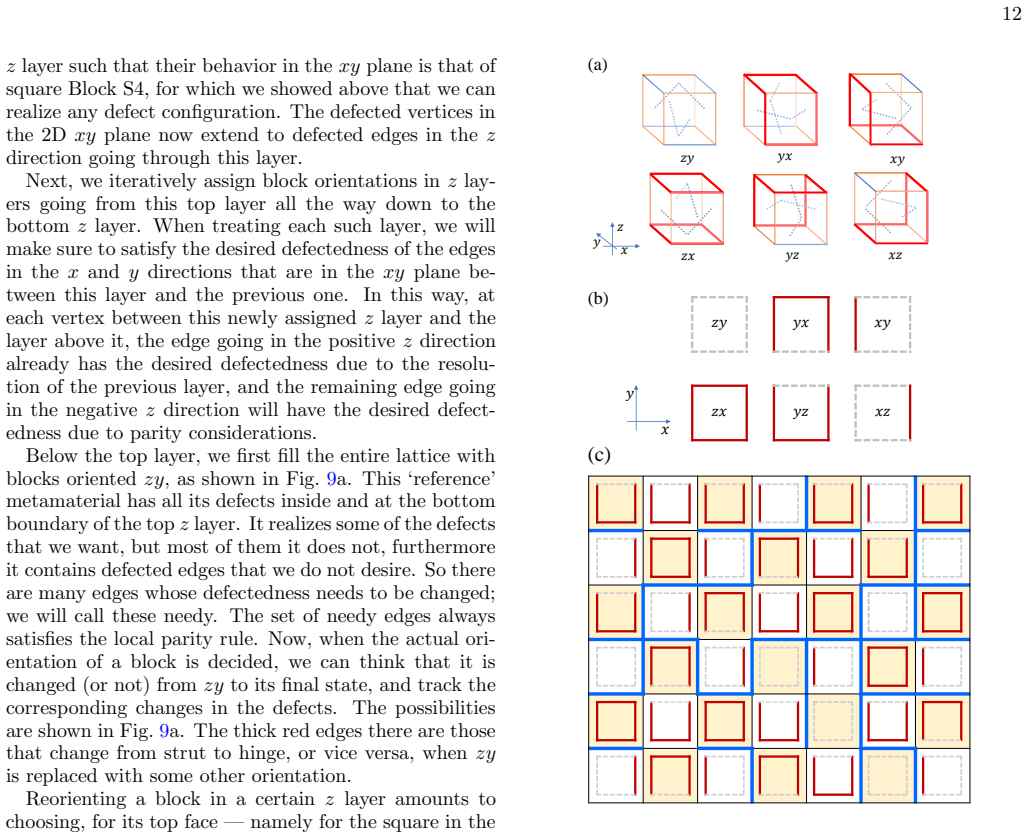
The load-bearing object is the hinge/strut decoration of each block, where a hinge connects adjacent facets that prefer to move in the same direction and a strut connects facets that move oppositely. Moving around a minimal loop, each hinge flips a mod-2 sign, so the loop is frustrated—defected—when the number of hinges is odd. In three dimensions, since every cube block has an odd number of hinges at each of its vertices and eight blocks surround each lattice vertex, the number of defected edges meeting at any interior vertex is always even; this even-degree rule is what forces defect lines to close. The realizability proofs are carried by a 'needy' scanning construction, in which each newly placed block is oriented to fix the parity of the vertices or edges it completes, and by grid diagrams—a standard knot encoding—for realizing arbitrary knottedness with block C2.
What would settle it
Construct or simulate a toroidal metamaterial from one of the fully realizable block types, make every elementary loop compatible, and ask whether a non-contractible loop is nevertheless frustrated; if it is, the local parity criterion is incomplete and the realizability map fails as stated. For the positive claim, one parity-satisfying defect set on Blocks C3, C4, C5, or C6 that no orientation realizes would falsify the universality result.
Extended reading notes
Core claim
On the paper's own terms, the central discovery is that mechanical frustration in these metamaterials is controlled entirely by a local parity rule—a loop around a vertex or edge is frustrated exactly when an odd number of hinges is encountered—and that, given this rule, realizability is determined by block type. For square blocks S3 and S4, honeycomb blocks H4, H5a, H5b, and H6, and cubic blocks C3, C4, C5, and C6, any defect configuration satisfying the applicable local constraint is realizable; for honeycomb blocks H2 and H3a and cubic block C2, counting arguments and explicit counterexamples show that some configurations are not, and that in large lattices most configurations are not. In three dimensions the parity rule implies that frustrated edges form a graph with even degree at every interior vertex, so defect lines cannot branch or terminate in the bulk, although they may cross; even so, using any non-trivial cubic block, including C2, one can construct defect lines of any knot or link type.
Load-bearing premise
The classification assumes the metamaterial is enclosed in a simply connected region, so that every larger loop is a mod-2 sum of minimal loops; on a multiply connected lattice a loop that is not such a sum could be globally frustrated with no local defect, which would break the classification.
Editorial extensions
If this is right
- Square blocks S3 and S4 and honeycomb blocks H4, H5a, H5b, and H6 permit any assignment of defected vertices, so desired point-defect patterns can be designed without further constraints.
- In the cubic lattice, any parity-satisfying defect set can be realized with blocks C3, C4, C5, and C6, so defect-line geometry is fully controllable subject only to the closed-curve rule.
- With every non-trivial cubic block, including C2, defect lines can realize any knot or link, so topological complexity of defects is not an obstacle.
- For blocks H2, H3a, and C2, most defect configurations become unrealizable in large systems, and no simple realizability criterion is known; exact testing requires SAT solving.
Reading between the lines
- Beyond the paper: the even-degree parity rule makes the defect network a mod-2 cycle space, suggesting a direct analogy to divergence-free fields and spin-ice conservation laws; one could use that analogy to derive global invariants for defect loops.
- Beyond the paper: the honeycomb duality between hinges and struts implies defect/complement symmetry, so non-realizable patterns for H2 and H3a are dual to each other; a sharper characterization of one might transfer to the other.
- Beyond the paper: the C2 result that knot type does not block realization but geometry does suggests testing whether non-realizability correlates with some geometric invariant, such as writhe or number of crossings, which could yield a practical design criterion.
- Beyond the paper: extending the constructions to multiply connected or finite-open boundary domains would likely change the realizability classification; the torus is the natural next test case.
Editorial analysis
A structured set of objections, weighed in public.
Referee Report
Summary. The paper studies defect positioning in combinatorial metamaterials built from the block families introduced in the companion paper [33], for the square, honeycomb, and cubic lattices. Mechanical defects are defined as frustrated minimal loops (vertices in 2D, edges in 3D). The authors prove that in 3D, defected edges meet every interior lattice vertex in even number, hence form closed curves; they then ask which defect configurations can be realized by orienting blocks of a given type. For Blocks S3, S4, H4, H5a, H5b, and H6 they provide scanning or duality-based constructions realizing any defect set; for H2 and H3a they give counting arguments and small examples showing that not all sets are realizable. For cubic Blocks C3, C4, C5, and C6 they claim that every parity-satisfying edge set is realizable, while for C2 they show by counting and SAT that parity is not sufficient, but nevertheless realize arbitrary knot and link types via grid diagrams. Detailed constructions for H6 and C6 appear in the appendices.
Significance. If correct, the paper provides a fairly complete realizability map for mechanical defect placement in these metamaterial block families, with explicit design protocols. The 3D parity/closed-curve theorem (Sec. III.B) is simple and rigorous, and the duality reduction for the honeycomb blocks is elegant. The paper also ships reproducible SAT-based code for checking realizability, which is a concrete computational contribution, and the arbitrary-knottedness construction for Block C2 is a striking topological result. The main weakness is that the sufficiency of the parity constraint for Blocks C3, C4, and C5 is argued by an informal scanning description rather than a formal invariant; since Block C2 shows that parity is not generally sufficient on finite simply connected domains, this gap is load-bearing for the central completeness claim.
major comments (2)
- [IV.C.1] The scanning argument for Blocks C3, C4, and C5 establishes only that each newly completed vertex can be satisfied locally by orienting the last block with one or three hinges. It does not prove that the orientations chosen for earlier vertices cannot make a later vertex unsatisfiable. Because Sec. IV.C.3 demonstrates that local parity is not sufficient for Block C2 even on a simply connected 7x7x7 domain, sufficiency is not a general consequence of parity but a property of the specific protocol. Please provide an explicit induction invariant for the layer-by-layer, line-by-line scan (for instance, after a prefix of blocks is filled, all completed vertices have their prescribed parity and every not-yet-completed vertex still has at least one unassigned block in its neighborhood), or otherwise give a formal proof that the one-hinge/three-hinge freedom suffices at every step. Without this, the 'any parity-satisfying defect configuration is realizable' claim for C3/C4/C5 is not fully supported.
- [IV.C.4] The claim that Block C2 can realize defect lines of arbitrary knot or link type is supported by a grid-diagram construction and a trefoil example, but the manuscript does not prove that after the two layers of block reorientations the defect set is exactly the desired knot or link, with no additional defected edges and no unintended crossings. Please provide a concise argument that the reassignments at the z=-1 and z=0 levels affect disjoint sets of edges except at the intended crossing points, and that the parity rule is satisfied at every vertex of the construction. Alternatively, provide a verification procedure (e.g., using the released SAT checker) for arbitrary grid diagrams.
minor comments (4)
- [IV.B.1] The seven-vertex H3a counterexample is asserted to be 'easy to check by separating a few cases.' Since this example is used to demonstrate non-realizability below the counting threshold, include the case analysis or a short SAT-based certificate.
- [IV.B.1 and IV.C.3] The exponents in the counting arguments appear to be missing superscripts: the text reads 'M ∝ 27L, while D ∝ 64L' and 'S ∝ 4L3'; these should presumably be 27^{L^2}, 64^{L^2}, and 4^{L^3}.
- [IV.C.4] The statement that 'a (K+1)×(K+1)×3 lattice suffices' should be reconciled with the grid-diagram definition on a (K-1)×(K-1) grid; clarify the spatial embedding and the clearance around the diagram.
- [III.A and IV] The restriction to simply connected regions is stated in Sec. III.A, but the global realizability claims in Sec. IV should explicitly repeat that they apply to simply connected rectangular domains with prescribed internal vertices/edges only, so that boundary-defect conventions are unambiguous.
Circularity Check
No significant circularity: central defect-positioning claims are derived from explicit block definitions and constructive scanning protocols, with companion-paper self-citations used only for context and cataloging.
full rationale
The paper's derivation chain is self-contained for its central claims. The local compatibility condition is re-derived in Sec. III.A from the block definitions and strut/hinge conventions stated in Sec. II, not imported as a black box. The 3D parity constraint (defected edges form closed curves) is proven in Sec. III.B by a direct counting argument over hinges around a lattice vertex. The realizability claims are supported by explicit constructive scanning protocols: Sec. IV.A for square blocks, Sec. IV.B and Appendix A for honeycomb blocks, Sec. IV.C.1 and Appendix B for cubic blocks, and Sec. IV.C.4 plus Appendix D for arbitrary knottedness with Block C2. Non-realizability claims rest on counting arguments comparing the number of metamaterials with the number of parity-respecting defect candidates, and on independent SAT-solver checks, neither of which is fitted to a desired conclusion. The paper explicitly flags its simply connected domain assumption as a stated hypothesis rather than smuggling in the conclusion. Self-citations to the companion paper [33] are used for introducing the block catalog, experimental context, and the boundary-texture analogue, but the defect-positioning theorems do not reduce to results in [33]; where the compatibility explanation is taken from [33], the paper repeats the reasoning. The skeptical concern about the rigor of scanning protocols is a correctness or completeness question, not an instance of circularity, since the protocols are constructive and do not assume the target realizability statement.
Assumptions & free parameters
assumptions (4)
- standard math Any loop in a simply connected region is a mod 2 sum of elementary (minimal) loops
- domain assumption Each block has a single soft deformation mode with all facets moving orthogonally in/out with equal magnitude, and strut/hinge parity fully determines compatibility
- domain assumption All blocks in a metamaterial are of the same type
- standard math Every knot and link type possesses a grid diagram
Cite this review
Pith. "Pith review of Defect Positioning in Combinatorial Metamaterials." pith.science (2026). https://pith.science/paper/ND7A4IYU
@misc{pith2026241201227,
  author       = {Pith},
  title        = {Pith review of: Defect Positioning in Combinatorial Metamaterials},
  year         = {2026},
  howpublished = {\url{https://pith.science/paper/ND7A4IYU}},
  note         = {Machine review of arXiv:2412.01227}
}
read the original abstract
Combinatorial mechanical metamaterials are made of anisotropic, flexible blocks, such that multiple metamaterials may be constructed using a single block type, and the system's response depends on the frustration (or its absence) due to the mutual orientations of the blocks within the lattice. Specifically, any minimal loop of blocks that may not simultaneously deform in their softest mode defines a mechanical defect at the vertex (in two dimensions) or edge (in three dimensions) that the loop encircles. Defects stiffen the metamaterial, and allow to design the spatial patterns of stress and deformation as the system is externally loaded. We study the ability to place defects at arbitrary positions in metamaterials made of a family of block types that we recently introduced for the square, honeycomb, and cubic lattices. Alongside blocks for which we show that any defect configuration is possible, we identify situations in which not all sets are realizable as defects. One of the restrictions is that in three dimensions, defected edges form closed curves. Even in cases when not all geometries of defect lines are possible, we show how to produce defect lines of arbitrary knottedness.
Figures


Figures from the paper (6 more)


Forward citations
Cited by 1 Pith paper
-
Breaking Mechanical Holography in Combinatorial Metamaterials
Centrally symmetric blocks force compatible metamaterial configurations to be determined by the boundary, while non-symmetric blocks allow exponentially many bulk configurations and programmable boundary textures up t...
Reference graph
Works this paper leans on
-
[33]
Spin glasses: Experimental facts, theoretical concepts, and open questions,
K. Binder and A. P. Young, “Spin glasses: Experimental facts, theoretical concepts, and open questions,” Reviews of Modern Physics 58, 801–976 (1986)
work page 1986
-
[1]
Blocks H2 and H3a For Block H3a, Fig. 4a shows a configuration of seven vertices that cannot be defected with this block type, provided that all other vertices are non-defected. The symmetry of the configuration makes it easy to check this claim by separating a few cases. The dual set, shown in Fig. 4b, in which all vertices are defected except for those ...
-
[2]
Blocks H4 and H5b With Blocks H4 and H5b, the fact that any defect con- figuration is realizable can be shown similarly to what we did above for the square lattice. If we simply scan line- by-line, then in the honeycomb lattice, each added block closes loops around two new vertices (Fig. 3c), and not only around one vertex as in the square lattice (Fig. 3...
-
[3]
Blocks H5 a and H6 Also for the last two hexagonal units, Blocks H5 a and H6, arbitrary defect sets are possible. By duality it suffices to establish this for one of them, and in Ap- pendix A we give a construction protocol for Block H6. It is still based on the principle of scanning the lattice, but this time a more careful implementation is necessary du...
-
[4]
In the cases of Blocks C3, C4, and C5, it is not, and this can be seen by a 3D version (Fig
Blocks C3, C4, C5 defect realization by scanning Let us examine if the defect set in a 3D metamaterial is subject to any constraints other than having to form closed curves. In the cases of Blocks C3, C4, and C5, it is not, and this can be seen by a 3D version (Fig. 5a) of the scanning process employed above for the square and honeycomb lattices. Indeed a...
-
[5]
Block C6 defect realization Since in Block C6 all vertices have exactly one edge with a hinge, this simple scanning method cannot be di- rectly applied to it, and a more delicate procedure is required. In Appendix B we provide a construction pro- tocol for realizing with Block C6 any defect configuration which satisfies the parity constraint explained in ...
-
[6]
Block C2 counting argument for non-realizability The following counting argument yields that for large enough systems, most defect sets will not be possible with Blocks C2, even after restricting attention to con- figurations with even degree everywhere. The number of metamaterials of size L × L × L built from this block is M = 3 L3 , while the number of ...
-
[7]
6: Realizing arbitrary knottedness with Block C2
Block C2 arbitrary knottedness We will now show that out of all types of 3D blocks, save for the trivial Block C1, it is possible to build meta- materials in such a way that the defect is a non-self- intersecting closed curve of an arbitrarily chosen knot or (a) 𝑥𝑦 𝑧 𝑦 𝑧 𝑥 (b) (c) FIG. 6: Realizing arbitrary knottedness with Block C2. (a) Grid diagram of ...
Show all 51 references
-
[8]
SAT Solvers
Block C2 topology versus geometry Let us present an example to underscore that it is not the topological complexity (namely knot or link type) of the defect lines that prevents them from being realiz- able in a combinatorial metamaterial made of Block C2; rather it is some asp...
-
[9]
Flexible mechanical metamaterials,
Katia Bertoldi, Vincenzo Vitelli, Johan Christensen, and Martin van Hecke, “Flexible mechanical metamaterials,” Nature Reviews Materials 2, 1 (2017)
2017
-
[10]
Soft network composite materials with deterministic and bio-inspired designs,
Kyung-In Jang, Ha Uk Chung, Sheng Xu, Chi Hwan Lee, Haiwen Luan, Jaewoong Jeong, Huanyu Cheng, Gwang- Tae Kim, Sang Youn Han, Jung Woo Lee, Jeonghyun Kim, Moongee Cho, Fuxing Miao, Yiyuan Yang, Han Na Jung, Matthew Flavin, Howard Liu, Gil Woo Kong, Ki Jun Yu, Sang Il Rhee, Jea...
2015
-
[11]
Conformal elasticity of mechanism-based metamaterials,
Michael Czajkowski, Corentin Coulais, Martin van Hecke, and D. Zeb Rocklin, “Conformal elasticity of mechanism-based metamaterials,” Nature Communica- tions 13, 211 (2022)
2022
-
[12]
Non-orientable order and non-commutative response in frustrated metamate- rials,
Xiaofei Guo, Marcelo Guzm´ an, David Carpentier, Denis Bartolo, and Corentin Coulais, “Non-orientable order and non-commutative response in frustrated metamate- rials,” Nature 618, 506 (2023)
2023
-
[13]
Emergent disorder and mechanical memory in periodic metamate- rials,
Chaviva Sirote-Katz, Dor Shohat, Carl Merrigan, Yoav Lahini, Cristiano Nisoli, and Yair Shokef, “Emergent disorder and mechanical memory in periodic metamate- rials,” Nature Communications 15, 4008 (2024). 14
2024
-
[14]
Count- ing and sequential information processing in mechani- cal metamaterials,
Lennard J. Kwakernaak and Martin van Hecke, “Count- ing and sequential information processing in mechani- cal metamaterials,” Physical Review Letters 130, 268204 (2023)
2023
-
[15]
Combinatorial design of textured mechanical metamaterials,
Corentin Coulais, Eial Teomy, Koen de Reus, Yair Shokef, and Martin van Hecke, “Combinatorial design of textured mechanical metamaterials,” Nature 535, 529 (2016)
2016
-
[16]
Geometrical frustra- tion,
R. Moessner and A. P. Ramirez, “Geometrical frustra- tion,” Physics Today 59, 24–29 (2006)
2006
-
[17]
Antiferromagnetism. The triangular Ising net,
G. H. Wannier, “Antiferromagnetism. The triangular Ising net,” Physical Review 79, 357–364 (1950)
1950
-
[18]
Spin ice state in frustrated magnetic pyrochlore materials,
Steven T. Bramwell and Michel J. P. Gingras, “Spin ice state in frustrated magnetic pyrochlore materials,” Sci- ence 294, 1495–1501 (2001)
2001
-
[19]
Unhappy vertices in artificial spin ice: new degeneracies from vertex frustration,
Muir J. Morrison, Tammie R. Nelson, and Cristiano Nisoli, “Unhappy vertices in artificial spin ice: new degeneracies from vertex frustration,” New Journal of Physics 15, 045009 (2013)
2013
-
[20]
Deliberate exotic magnetism via frustration and topol- ogy,
Cristiano Nisoli, Vassilios Kapaklis, and Peter Schiffer, “Deliberate exotic magnetism via frustration and topol- ogy,” Nature Physics 13, 200–203 (2017)
2017
-
[21]
Ge- ometric frustration in buckled colloidal monolayers,
Yilong Han, Yair Shokef, Ahmed M. Alsayed, Peter Yunker, Tom C. Lubensky, and Arjun G. Yodh, “Ge- ometric frustration in buckled colloidal monolayers,” Na- ture 456, 898–903 (2008)
2008
-
[22]
Order by disorder in the antiferromagnetic Ising model on an elastic triangular lattice,
Yair Shokef, Anton Souslov, and T. C. Lubensky, “Order by disorder in the antiferromagnetic Ising model on an elastic triangular lattice,” Proceedings of the National Academy of Sciences 108, 11804–11809 (2011)
2011
-
[23]
Attraction controls the inversion of order by disorder in buckled colloidal mono- layers,
Fabio Leoni and Yair Shokef, “Attraction controls the inversion of order by disorder in buckled colloidal mono- layers,” Physical Review Letters 118, 218002 (2017)
2017
-
[24]
Realizing Colloidal Artificial Ice on Arrays of Optical Traps,
A. Lib´ al, C. Reichhardt, and C. J. Olson Reichhardt, “Realizing Colloidal Artificial Ice on Arrays of Optical Traps,” Physical Review Letters 97, 228302 (2006)
2006
-
[25]
Engineering of frustration in colloidal artificial ices realized on mi- crofeatured grooved lattices,
Antonio Ortiz-Ambriz and Pietro Tierno, “Engineering of frustration in colloidal artificial ices realized on mi- crofeatured grooved lattices,” Nature Communications7, 10575 (2016)
2016
-
[26]
Topology Restricts Quasidegeneracy in Sheared Square Colloidal Ice,
Erdal C. O˘ guz, Antonio Ortiz-Ambriz, Hadas Shem- Tov, Eric Babi` a-Soler, Pietro Tierno, and Yair Shokef, “Topology Restricts Quasidegeneracy in Sheared Square Colloidal Ice,” Physical Review Letters 124, 238003 (2020)
2020
-
[27]
Complex Ordered Patterns in Mechanical Instability Induced Geometrically Frus- trated Triangular Cellular Structures,
Sung Hoon Kang, Sicong Shan, Andrej Koˇ smrlj, Wim L. Noorduin, Samuel Shian, James C. Weaver, David R. Clarke, and Katia Bertoldi, “Complex Ordered Patterns in Mechanical Instability Induced Geometrically Frus- trated Triangular Cellular Structures,” Physical Review Letters 1...
2014
-
[28]
Taming geomet- ric frustration by leveraging structural elasticity,
Janav P. Udani and Andres F. Arrieta, “Taming geomet- ric frustration by leveraging structural elasticity,” Mate- rials & Design 221, 110809 (2022)
2022
-
[29]
Macroscopic magnetic frustration,
Paula Mellado, Andres Concha, and L. Mahadevan, “Macroscopic magnetic frustration,” Physical Review Letters 109, 257203 (2012)
2012
-
[30]
Macroscopic magnetic monopoles in a 3D- printed mechano-magnet,
H. A. Teixeira, M. F. Bernardo, F. S. Nascimento, M. D. Saccone, F. Caravelli, C. Nisoli, and C. I. L. de Araujo, “Macroscopic magnetic monopoles in a 3D- printed mechano-magnet,” Journal of Magnetism and Magnetic Materials 596, 171929 (2024)
2024
-
[31]
Theory of the frustration effect in spin glasses: I,
G. Toulouse, “Theory of the frustration effect in spin glasses: I,” Communications on Physics 2, 115 (1977)
1977
-
[32]
The concept of frustration in spin glasses,
P. W. Anderson, “The concept of frustration in spin glasses,” Journal of the Less Common Metals 62, 291 (1978)
1978
-
[34]
Colloquium: Disclination loops, point defects, and all that in nematic liquid crystals,
Gareth P. Alexander, Bryan Gin-ge Chen, Elisabetta A. Matsumoto, and Randall D. Kamien, “Colloquium: Disclination loops, point defects, and all that in nematic liquid crystals,” Reviews of Modern Physics 84, 497–514 (2012)
2012
-
[35]
Jigsaw puzzle design of pluripotent origami,
Peter Dieleman, Niek Vasmel, Scott Waitukaitis, and Martin van Hecke, “Jigsaw puzzle design of pluripotent origami,” Nature Physics 16, 63 (2020)
2020
-
[36]
Topological defects produce exotic me- chanics in complex metamaterials,
Anne S. Meeussen, Erdal C. O˘ guz, Yair Shokef, and Mar- tin van Hecke, “Topological defects produce exotic me- chanics in complex metamaterials,” Nature Physics 16, 307 (2020)
2020
-
[37]
Putting a spin on metamaterials: Mechanical incompatibility as magnetic frustration,
Ben Pisanty, Erdal C. O˘ guz, Cristiano Nisoli, and Yair Shokef, “Putting a spin on metamaterials: Mechanical incompatibility as magnetic frustration,” SciPost Physics 10, 136 (2021)
2021
-
[38]
Oligomodal metamaterials with multifunctional mechanics,
Aleksi Bossart, David M. J. Dykstra, Jop van der Laan, and Corentin Coulais, “Oligomodal metamaterials with multifunctional mechanics,” Proceedings of the National Academy of Sciences 118, e2018610118 (2021)
2021
-
[39]
Machine learning of im- plicit combinatorial rules in mechanical metamaterials,
Ryan van Mastrigt, Marjolein Dijkstra, Martin van Hecke, and Corentin Coulais, “Machine learning of im- plicit combinatorial rules in mechanical metamaterials,” Physical Review Letters 129, 198003 (2022)
2022
-
[40]
Emergent nonlocal combinatorial design rules for multimodal metamaterials,
Ryan van Mastrigt, Corentin Coulais, and Martin van Hecke, “Emergent nonlocal combinatorial design rules for multimodal metamaterials,” Physical Review E 108, 065002 (2023)
2023
- [41]
-
[42]
Geometrical device having articulated relatively movable sections,
Ronald D. Resch, “Geometrical device having articulated relatively movable sections,” US Patent 3,201,894 (1965)
1965
-
[43]
Negative Poisson’s ratio behavior induced by an elastic instability,
Katia Bertoldi, Pedro M. Reis, Stephen Willshaw, and Tom Mullin, “Negative Poisson’s ratio behavior induced by an elastic instability,” Advanced Materials 22, 361 (2010)
2010
-
[44]
Geometric charges and nonlinear elas- ticity of two-dimensional elastic metamaterials,
Yohai Bar-Sinai, Gabriele Librandi, Katia Bertoldi, and Michael Moshe, “Geometric charges and nonlinear elas- ticity of two-dimensional elastic metamaterials,” Pro- ceedings of the National Academy of Sciences 117, 10195 (2020)
2020
-
[45]
Characterization, stability, and ap- plication of domain walls in flexible mechanical metama- terials,
Bolei Deng, Siqin Yu, Antonio E. Forte, Vincent Tournat, and Katia Bertoldi, “Characterization, stability, and ap- plication of domain walls in flexible mechanical metama- terials,” Proceedings of the National Academy of Sciences 117, 31002 (2020)
2020
-
[46]
Topo- logically protected steady cycles in an icelike mechani- cal metamaterial,
Carl Merrigan, Cristiano Nisoli, and Yair Shokef, “Topo- logically protected steady cycles in an icelike mechani- cal metamaterial,” Physical Review Research 3, 023174 (2021)
2021
-
[47]
14050887
The code for the program that searches block orienta- tions that yield prescribed defect sets for Blocks C2 and C6 is available at: https://doi.org/10.5281/zenodo. 14050887
-
[48]
Combinatorial design of floppy modes 15 and frustrated loops in metamaterials,
Wenfeng Liu, Tomer A. Sigalov, Corentin Coulais, and Yair Shokef, “Combinatorial design of floppy modes 15 and frustrated loops in metamaterials,” arXiv:2503.12867 (2025), 10.48550/arXiv.2503.12867
2025 doi
-
[49]
The silent (r)evolution of SAT,
Johannes K. Fichte, Daniel Le Berre, Markus Hecher, and Stefan Szeider, “The silent (r)evolution of SAT,” Communications of the ACM 66, 64–72 (2023)
2023
-
[50]
Minisat 2.2 and minisat++ 1.1,
Niklas S¨ orensson, “Minisat 2.2 and minisat++ 1.1,” A short description in SAT Race 2010 (2010)
2010
-
[51]
PySAT: A Python toolkit for prototyping with SAT oracles,
Alexey Ignatiev, Antonio Morgado, and Joao Marques- Silva, “PySAT: A Python toolkit for prototyping with SAT oracles,” in SAT (2018) pp. 428–437
2018
Reviewed August 12, 2026 · model on record in the stance chip above.
Discussion (0). Continue with ORCID to comment.