REVIEW 3 major objections 6 minor 1 cited by
Real-time Traffic Simulation and Management for Large-scale Urban Air Mobility: Integrating Route Guidance and Collision Avoidance
T0 review · 3 major / 6 minor · reviewed 2026-08-12 · deepseek-v4-flash
Pith's one-line read This paper claims that adding a route-guidance layer on top of velocity-obstacle collision avoidance nearly doubles average minimum separation, raises average travel speed by 70%, more than doubles trip completion, and cuts energy use by…
desk verdict A sensible integration of MFD-style route guidance with ORCA, but the headline gains rest on a cost estimator that is never validated against the exact trajectory predictor; still worth refereeing. read the letter →
The pith
A machine-rendered reading of the paper's core claim, the machinery that carries it, and where it could break.
The reading
What carries the argument
The load-bearing mechanism is the fast path-cost estimator (Algorithm 3), which aligns every aircraft's pass-by region sequence into a matrix and advances all aircraft in lockstep, so regional accumulations, speeds, and travel times become simple matrix operations. This temporal alignment assumes approximately uniform aircraft speeds, a point the paper acknowledges in Section 2.3.2. The estimator feeds an incremental greedy path search (Algorithm 4) that reduces the joint path search from exponential to linear complexity. On the collision-avoidance side, the velocity-obstacle model (ORCA) supplies half-plane constraints that turn each aircraft's velocity selection into a small quadratic program.
What would settle it
Run the framework with two fleets whose cruise speeds differ by a factor of two and compare the fast path-cost estimate (Algorithm 3) against the exact 4D trajectory prediction (Algorithm 2). If the estimated path costs diverge enough to change the chosen paths, or if the performance metrics (separation, speed, completion) fall back toward the baseline, the central claim would be falsified.
Extended reading notes
Core claim
The paper's central discovery is that a regional route-guidance layer can be fused with distributed velocity-obstacle collision avoidance to keep large-scale UAM traffic in the free-flow branch of the macroscopic fundamental diagram—the flow-density relationship that separates uncongested from congested airspace—even when origin-destination demand is spatially heterogeneous. The paper shows that its framework preserves the homogeneity assumption on which the macroscopic fundamental diagram rests, and reports large improvements in separation, travel speed, trip completion, and energy use relative to a collision-free baseline. A further claimed discovery is that fast approximation methods make centralized path planning tractable at scale, with computational time growing roughly linearly instead of exponentially in the number of aircraft.
Load-bearing premise
The route-guidance cost estimates assume all aircraft travel at approximately the same speed; if real fleets fly at very different speeds, the path costs can be miscalculated and the claimed safety and efficiency gains may not materialize.
Editorial extensions
If this is right
- If the claim holds, a single controller can keep large-scale UAM operations in the free-flow branch of the airspace macroscopic fundamental diagram, avoiding the congestion deadlocks that appear in baseline simulations.
- The two-layer airspace results imply that adding altitude layers is an effective capacity lever: the same framework redistributes traffic vertically and improves separation, speed, and completion rate by double digits.
- Dynamic no-fly zones can be created simply by reducing regional capacities, which means the framework can react to gusts or temporary restrictions without changing the algorithms.
- The computational speedup from the fast approximation methods suggests the framework can run in real time at scales beyond 250 aircraft, far beyond exhaustive-search baselines.
Reading between the lines
- An implicit consequence the paper does not develop is that the same route-guidance-plus-collision-avoidance recipe could apply to other swarms—last-mile delivery drones, warehouse robots, or autonomous surface vehicles—where speed heterogeneity is modest and a regional graph exists.
- The uniform-speed assumption is a testable vulnerability: if real UAM fleets fly at widely varying speeds, the lockstep cost estimate could misprice paths and undo the claimed gains; the paper explicitly leaves this accuracy analysis to future work.
- The framework's ability to enforce homogeneity suggests a natural control extension: using regional capacity as a control knob for perimeter control or demand management, analogous to ground-traffic perimeter control.
- A concrete extension would be to replace the exponential speed-regulation rule with a function calibrated from field data, since the current rule is chosen for tractability rather than validated against real UAM speed-flow relationships.
Signed reviews
Editorial analysis
A structured set of objections, weighed in public.
Referee Report
Summary. The paper proposes a hierarchical air traffic management framework for large-scale urban air mobility that combines centralized region-based route guidance with distributed collision avoidance. The route guidance layer selects waypoint paths for all aircraft by minimizing an estimated total travel time, using a fast path-cost estimator (Algorithm 3) that aligns all aircraft temporally through pass-by region sequences, and a greedy search (Algorithm 4) that approximates the joint path optimization. The collision avoidance layer uses the ORCA velocity-obstacle model to generate collision-free trajectories between waypoints. The framework is evaluated in single-layer and two-layer hexagonal airspace networks under several demand patterns, with comparisons against a collision-free baseline. Reported results include increases in average minimum separation (+98.2%), average travel speed (+70.2%), trip completion rate (+130%), and computational efficiency (+433%), with a 23.0% reduction in energy consumption. Additional experiments address airspace MFD properties, dynamic no-fly zones, and the scalability of the fast approximation methods up to 250 aircraft.
Significance. If the reported improvements hold, the framework is a valuable step toward integrating strategic route guidance with tactical collision avoidance for UAM, and its ability to maintain traffic homogeneity has direct relevance for MFD-based airspace management. The paper is commendably transparent about the core approximation in Algorithm 3 and includes scalability experiments showing near-linear growth of computational cost. The central quantitative claims, however, rest on simulation results that currently lack uncertainty quantification and on a cost estimator whose accuracy is not directly validated against the exact trajectory predictor. The contribution is promising but not yet fully supported; the requested additional validation and parameter disclosure would make the claims reproducible and the conditions of validity clear.
major comments (3)
- [Section 2.3.2, Algorithm 3, Section 3.2.4] The fast cost estimator is not validated against the exact trajectory-based cost. Section 3.2.4 and Figures 20-21 compare the greedy search (Algorithm 4) with exhaustive search, but both use Algorithm 3 as the cost function, so the reported discrepancy of less than 1.5% only shows that the greedy search approximates the joint optimization under the same approximate cost. It does not show that Algorithm 3 accurately reproduces the true travel times computed by Algorithm 2. This matters because Algorithm 3 advances all aircraft synchronously through their pass-by regions, which the paper itself states in Section 2.3.2 'requires that the travel speeds of all aircraft be (approximately) uniform,' whereas the simulated aircraft dynamics in Section 2.4 use preferred velocity and ORCA constraints and can produce heterogeneous speeds, especially under congestion. The argument that route guidance produces the homogeneity that justifies the assumption is circular, since Algorithm 3 is itself used to compute that route guidance. Please provide a direct comparison of Algorithm 3 against Algorithm 2 over a range of speed-heterogeneity conditions, and show that path rankings—not just total cost—are preserved.
- [Section 2.3.1, Eq. (3), Section 3.2.1] The critical accumulation parameter Ncr in the speed-regulation rule, Eq. (3), is never assigned a numerical value, and Vmax_Rl is likewise not specified for the experiments. This parameter directly controls the path costs used by the route guidance and therefore shapes all of the reported improvements. Table 2 reports estimated critical densities for the fitted MFD in aircraft per square kilometer, but there is no mapping from those densities to the per-hexagon Ncr_Rl values used in Eq. (3). Without these values and their calibration procedure, the route guidance behavior is under-specified and the simulation results cannot be reproduced. Please report the parameter values used for each region and explain how they were chosen or calibrated.
- [Section 3.2.1, Table 3] Table 3 reports a single value for each performance metric without run counts, standard deviations, or confidence intervals. The demand profiles in Figure 11 are specified, but the OD patterns in Section 3.2.2 are described as 'randomly generated,' and the simulation dynamics involve stochastic collision-avoidance decisions; a single run is insufficient to establish the robustness of the headline improvements (+98.2%, +70.2%, +130%, and -23.0%). Please provide results over multiple random seeds, report the variance of each metric, and define precisely how each metric is computed—for example, which aircraft are included in 'average travel speed' and what time window and denominator define 'trip completion rate.'
minor comments (6)
- [Algorithm 2] Algorithm 2 uses an arrival threshold ε in line 9 without defining its value; please specify ε and state how it relates to the simulation time step and region size.
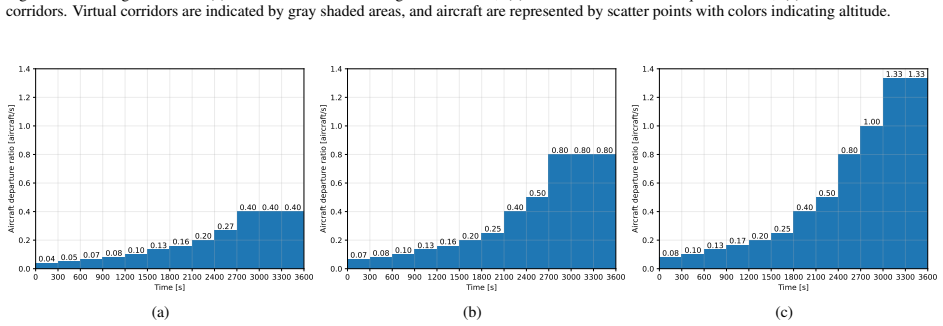
- [Section 3.1, Figure 11, Table 3] The demand profiles in Figure 11 show departure ratios but do not state the total number of aircraft or the simulation duration for each scenario; reporting these totals would make the trip completion rate in Table 3 interpretable.
- [Table 3] The unit 'trip/s' for trip completion rate is unusual; please clarify whether this is the average number of completed trips per second over the simulation horizon or the slope of the cumulative completion curve, and report the absolute number of completed trips.
- [Algorithm 3] The quantity L, described as 'the average travel distance within each region,' is never assigned a numerical value; please report L for the hexagonal region geometry used (e.g., centroid-to-centroid distance) and check consistency with the stated region radius of 250 m.
- [Figure 20] The x-axis in Figure 20 uses a discontinuous scale (3-10, 100, 250); a logarithmic axis or an explicit break would improve readability and make the exponential growth of the exhaustive search clearer.
- [General] There are numerous typographical artifacts in the rendering, such as 'e fficiency' for 'efficiency' and 'tra ffic' for 'traffic'; the manuscript should be proofread carefully before publication.
Circularity Check
No load-bearing circularity; the reported improvements come from an independent simulation, but Algorithm 3's reasonableness is justified by the very homogeneity its own route guidance is meant to produce.
-
other
[Section 2.3.2 (Fast approximation methods)]
"The simplification adopted in Algorithm 3 (i.e., temporal alignment) requires that the travel speeds of all aircraft be (approximately) uniform. Notably, such uniformity in travel speeds emerges from a balanced distribution of regional traffic. As discussed, collaborative path planning promotes regional traffic homogeneity, which, to some extent, justifies the reasonableness of Algorithm 3."
Algorithm 3 is the fast cost estimator used inside the collaborative path planning procedure (Algorithm 4 calculates costs with Algorithm 3). The paper justifies Algorithm 3's temporal-alignment assumption by asserting that route guidance produces the homogeneity that makes speeds uniform. That justification presupposes the success of the path planning whose decisions are computed with Algorithm 3, so the estimator is being validated by an outcome it is itself intended to produce. This is a self-referential justification of the approximation's reasonableness, although it is hedged ('to some extent') and the central simulation comparison against the collision-free baseline is still measured from independent VO dynamics and is not forced by construction.
full rationale
The headline claims (+98.2% separation, +70.2% speed, +130% completion, -23% energy) are simulation outputs, not identities. The route guidance minimizes a congestion-dependent travel-time cost under Eq. (3), while the simulation flies aircraft with preferred-velocity and ORCA collision avoidance; the two models are separate, so the improvements are not equivalent to the optimization objective by construction. The collision-avoidance layer is standard external work (Van Den Berg et al. 2011), and the self-citations (Weng et al. 2025; Chen et al. 2024; Liu et al. 2025) are motivational and not load-bearing for the Table 3 comparison. The one genuinely self-referential element is the justification of Algorithm 3's uniformity assumption: it is reasoned to be acceptable because route guidance homogenizes traffic, but that route guidance relies on Algorithm 3 itself. This is a minor justificatory loop that does not reduce the measured results to the model inputs. The Section 3.2.4 validation of the FAMs is best read as a heuristic-vs-exhaustive comparison under the same cost estimator; if so, it does not independently validate the cost estimator's accuracy, which is a correctness/robustness concern rather than a circular derivation of the stated improvements.
Assumptions & free parameters
free parameters (2)
- Ncr(R_l), critical accumulation per region
- alpha, beta (MFD fit) =
estimated per altitude range
assumptions (5)
- standard math ORCA theorem from Van Den Berg et al. (2011) provides safe velocity half-planes.
- domain assumption Aircraft obey control commands perfectly; no communication delays, wake turbulence, or actuator limits.
- domain assumption Speed in a region falls sigmoidally with aircraft count per Eq. (3).
- domain assumption Temporal alignment of pass-by region sequences in Algorithm 3 approximates true trajectories.
- standard math Hexagonal grid properties (equal distance to neighbors, complete tiling) used for region assignment.
Cite this review
Pith. "Pith review of Real-time Traffic Simulation and Management for Large-scale Urban Air Mobility: Integrating Route Guidance and Collision Avoidance." pith.science (2026). https://pith.science/paper/57APD433
@misc{pith2026241201235,
  author       = {Pith},
  title        = {Pith review of: Real-time Traffic Simulation and Management for Large-scale Urban Air Mobility: Integrating Route Guidance and Collision Avoidance},
  year         = {2026},
  howpublished = {\url{https://pith.science/paper/57APD433}},
  note         = {Machine review of arXiv:2412.01235}
}
read the original abstract
Given the spatial heterogeneity of land use patterns in most cities, large-scale UAM deployments will likely focus on specific areas, such as intertransfer traffic between suburbs and city centers. However, large-scale UAM operations connecting multiple origin-destination pairs raise concerns about air traffic safety and efficiency due to potential conflict movements, particularly at major conflict points analogous to roadway junctions. To meet the safety and efficiency requirements of future UAM operations, this work proposes an air traffic management framework that integrates route guidance and collision avoidance. The route guidance mechanism optimizes aircraft distribution across both spatial and temporal dimensions by regulating their paths (composed of waypoints). Given the optimized paths, the collision avoidance algorithm generates collision-free aircraft trajectories between waypoints in the 3D space. To enable large-scale applications, we develop fast approximation methods for centralized path planning and adopt the velocity obstacle model for distributed collision avoidance. To our knowledge, this work is one of the first to integrate route guidance and collision avoidance for UAM. Simulation results demonstrate that the proposed framework enables efficient and flexible UAM operations, including air traffic assignment, local congestion mitigation, and dynamic no-fly zone management. Compared with a collision-free baseline strategy, the proposed framework achieves considerable improvements in traffic safety and efficiency, with increases in the average minimum separation (+98.2%), the average travel speed (+70.2%), and the trip completion rate (+130%), along with a reduction in the energy consumption (-23.0%). The proposed framework demonstrates its potential for real-time traffic simulation and management in large-scale UAM systems.
Figures


Figures from the paper (18 more)




Forward citations
Cited by 1 Pith paper
-
Plan-and-Avoid: Real-Time Aircraft Trajectory Coordination in a Multi-Agent Environment
A real-time Plan-and-Avoid framework resolves predicted well-clear violations by generating minimally intrusive unilateral advisories to surrounding cooperative traffic while preserving a declared priority trajectory.
Reference graph
Works this paper leans on
-
[1]
author Alrifaee, B. , author Mamaghani, M.G. , author Abel, D. , year 2014 . title Centralized non-convex model predictive control for cooperative collision avoidance of networked vehicles , in: booktitle 2014 IEEE international symposium on intelligent control (ISIC) , organization IEEE . pp. pages 1583--1588
work page 2014
-
[2]
author Bahabry, A. , author Wan, X. , author Ghazzai, H. , author Menouar, H. , author Vesonder, G. , author Massoud, Y. , year 2019 . title Low-altitude navigation for multi-rotor drones in urban areas . journal IEEE Access volume 7 , pages 87716--87731
work page 2019
-
[3]
author Bauranov, A. , author Rakas, J. , year 2021 . title Designing airspace for urban air mobility: A review of concepts and approaches . journal Progress in Aerospace Sciences volume 125 , pages 100726
work page 2021
-
[4]
author Bradford, S. , year 2020 . title Urban air mobility (uam) concept of operations . journal Federal Aviation Administration
work page 2020
-
[5]
author Chen, C. , author Geroliminis, N. , author Zhong, R. , year 2024 . title An iterative adaptive dynamic programming approach for macroscopic fundamental diagram-based perimeter control and route guidance . journal Transportation Science volume 58 , pages 896--918
work page 2024
-
[6]
author Cummings, C. , author Mahmassani, H. , year 2024 a. title Airspace congestion, flow relations, and 4-d fundamental diagrams for advanced urban air mobility . journal Transportation Research Part C: Emerging Technologies volume 159 , pages 104467
work page 2024
-
[7]
author Cummings, C. , author Mahmassani, H. , year 2024 b. title Comparing urban air mobility network airspaces: Experiments and insights . journal Transportation Research Record volume 2678 , pages 440--454
work page 2024
-
[8]
author Dergachev, S. , author Yakovlev, K. , year 2021 . title Distributed multi-agent navigation based on reciprocal collision avoidance and locally confined multi-agent path finding , in: booktitle 2021 IEEE 17th International Conference on Automation Science and Engineering (CASE) , organization IEEE . pp. pages 1489--1494
work page 2021
Show all 51 references
-
[9]
, author Wulff, Y
author Dietrich, A. , author Wulff, Y. , year 2020 . title Urban air mobility: Adding the third dimension to urban and regional transportation , in: booktitle Presentation for: An Introduction to Urban Air Mobility for State and Local Decision Makers: A Virtual Workshop, spons...
2020
-
[10]
, author Chen, J
author Du, B. , author Chen, J. , year 2025 . title Unmanned-aerial-vehicle online trajectory planning using confidence bounds of chance-constrained geofences . journal Journal of Guidance, Control, and Dynamics volume 48 , pages 115--126
2025
-
[11]
, author Quan, Q
author Fu, R. , author Quan, Q. , author Li, M. , author Cai, K.Y. , year 2022 . title Practical distributed control for cooperative multicopters in structured free flight concepts . journal IEEE Transactions on Intelligent Transportation Systems volume 24 , pages 4203--4216
2022
-
[12]
, author German, B.J
author Garrow, L.A. , author German, B.J. , author Leonard, C.E. , et al., year 2021 . title Urban air mobility: A comprehensive review and comparative analysis with autonomous and electric ground transportation for informing future research . journal Transportation Research P...
2021
-
[13]
, author Sun, J
author Geroliminis, N. , author Sun, J. , year 2011 . title Properties of a well-defined macroscopic fundamental diagram for urban traffic . journal Transportation Research Part B: Methodological volume 45 , pages 605--617
2011
-
[14]
, author Mirkin, B
author Haddad, J. , author Mirkin, B. , author Assor, K. , et al., year 2021 . title Traffic flow modeling and feedback control for future low-altitude air city transport: An mfd-based approach . journal Transportation Research Part C: Emerging Technologies volume 133 , pages 103380
2021
-
[15]
, author Chen, S
author Han, R. , author Chen, S. , author Wang, S. , author Zhang, Z. , author Gao, R. , author Hao, Q. , author Pan, J. , year 2022 . title Reinforcement learned distributed multi-robot navigation with reciprocal velocity obstacle shaped rewards . journal IEEE Robotics and Au...
2022
-
[16]
, author Saska, M
author Heidari, H. , author Saska, M. , year 2021 . title Collision-free trajectory planning of multi-rotor uavs in a wind condition based on modified potential field . journal Mechanism and Machine Theory volume 156 , pages 104140
2021
-
[17]
, author Rao, G.S
author Hepsibha, P.S. , author Rao, G.S. , year 2013 . title Comparative analysis of area coverage in wsns using various grid-based node deployment schemes . journal International Journal of Future Computer and Communication volume 2 , pages 633
2013
-
[18]
, year 2018
author Holden, J. , year 2018 . title Uber keynote: Scaling uber air . journal Uber Elevate Summit, Los Angeles, CA, May volume 8
2018
-
[19]
, author Teo, R.S.H
author Huang, S. , author Teo, R.S.H. , author Tan, K.K. , year 2019 . title Collision avoidance of multi unmanned aerial vehicles: A review . journal Annual Reviews in Control volume 48 , pages 147--164
2019
-
[20]
, author Ippolito, C.A
author Jang, D.S. , author Ippolito, C.A. , author Sankararaman, S. , author Stepanyan, V. , year 2017 . title Concepts of airspace structures and system analysis for UAS traffic flows for urban areas , in: booktitle AIAA Information Systems-AIAA Infotech@ Aerospace , p. pages 0449
2017
-
[21]
, author Pratihar, D.K
author Jose, K. , author Pratihar, D.K. , year 2016 . title Task allocation and collision-free path planning of centralized multi-robots system for industrial plant inspection using heuristic methods . journal Robotics and Autonomous Systems volume 80 , pages 34--42
2016
-
[22]
, author Furbush, N.J
author Kasliwal, A. , author Furbush, N.J. , author Gawron, J.H. , author McBride, J.R. , author Wallington, T.J. , author De Kleine, R.D. , author Kim, H.C. , author Keoleian, G.A. , year 2019 . title Role of flying cars in sustainable mobility . journal Nature communications...
2019
-
[23]
, author Rios, J
author Kopardekar, P. , author Rios, J. , author Prevot, T. , author Johnson, M. , author Jung, J. , author Robinson, J.E. , year 2016 . title Unmanned aircraft system traffic management (UTM) concept of operations , in: booktitle AIAA Aviation and Aeronautics Forum (Aviation 2016)
2016
-
[24]
, author Wang, S
author Li, B. , author Wang, S. , author Ge, C. , author Fan, Q. , author Temuer, C. , year 2024 . title Bi-level intelligent dynamic path planning for an uav in low-altitude complex urban environment . journal Transactions of the Institute of Measurement and Control volume 46...
2024
-
[25]
, author Ramezani, M
author Li, Y. , author Ramezani, M. , year 2022 . title Quasi revenue-neutral congestion pricing in cities: Crediting drivers to avoid city centers . journal Transportation Research Part C: Emerging Technologies volume 145 , pages 103932
2022
-
[26]
, author Pan, T
author Liu, Y. , author Pan, T. , author Tan, J. , author Zhong, R. , author Chen, C. , year 2025 . title Integrated take-off management and trajectory optimization for merging control in urban air mobility corridors . https://arxiv.org/abs/2508.15395, http://arxiv.org/abs/250...
2025 arXiv
-
[27]
, author Liu, W
author Long, P. , author Liu, W. , author Pan, J. , year 2017 . title Deep-learned collision avoidance policy for distributed multiagent navigation . journal IEEE Robotics and Automation Letters volume 2 , pages 656--663
2017
-
[28]
, author Dai, W
author Pang, B. , author Dai, W. , author Ra, T. , author Low, K.H. , year 2020 . title A concept of airspace configuration and operational rules for uas in current airspace , in: booktitle 2020 AIAA/IEEE 39th Digital Avionics Systems Conference (DASC) , organization IEEE . pp...
2020
-
[29]
, author O z egovic, J
author Prvan, M. , author O z egovic, J. , author Mi s ura, A.B. , year 2019 . title A review of embedding hexagonal cells in the circular and hexagonal region of interest . journal International Journal of Advanced Computer Science and Applications volume 10
2019
-
[30]
, author Fu, R
author Quan, Q. , author Fu, R. , author Cai, K.Y. , year 2021 a. title Practical control for multicopters to avoid non-cooperative moving obstacles . journal IEEE Transactions on Intelligent Transportation Systems volume 23 , pages 10839--10857
2021
-
[31]
, author Li, M
author Quan, Q. , author Li, M. , author Fu, R. , year 2021 b. title Sky highway design for dense traffic . journal IFAC-PapersOnLine volume 54 , pages 140--145
2021
-
[32]
, author Fu, R
author Safadi, Y. , author Fu, R. , author Quan, Q. , author Haddad, J. , year 2023 a. title Macroscopic fundamental diagrams for low-altitude air city transport . journal Transportation Research Part C: Emerging Technologies volume 152 , pages 104141
2023
-
[33]
, author Geroliminis, N
author Safadi, Y. , author Geroliminis, N. , author Haddad, J. , year 2024 a. title Integrated departure and boundary control for low-altitude air city transport systems . journal Transportation Research Part B: Methodological , pages 103020
2024
-
[34]
, author Geroliminis, N
author Safadi, Y. , author Geroliminis, N. , author Haddad, J. , et al., year 2023 b. title Aircraft departures management for low altitude air city transport based on macroscopic fundamental diagram , in: booktitle 2023 American Control Conference (ACC) , organization IEEE . ...
2023
-
[35]
, author Granot, A
author Safadi, Y. , author Granot, A. , author Haddad, J. , year 2024 b. title A holistic framework for assessing and optimizing energy consumption for low-altitude air city transport systems , in: booktitle 2024 European Control Conference (ECC) , organization IEEE . pp. page...
2024
-
[36]
, author Haddad, J
author Safadi, Y. , author Haddad, J. , year 2025 . title Optimal energy consumption in controlled low-altitude air city transport systems . note Available at SSRN: https://ssrn.com/abstract=5237517 or https://dx.doi.org/10.2139/ssrn.5237517
2025 doi
-
[37]
, author Danoy, G
author Samir Labib, N. , author Danoy, G. , author Musial, J. , author Brust, M.R. , author Bouvry, P. , year 2019 . title Internet of unmanned aerial vehicles—a multilayer low-altitude airspace model for distributed uav traffic management . journal Sensors volume 19 , pages 4779
2019
-
[38]
title U-space: Blueprint
author SESAR Joint Undertaking , year 2017 . title U-space: Blueprint . note Available at: https://www.sesarju.eu/sites/default/files/documents/reports/U-space\
2017
-
[39]
, author Li, S
author Shen, X. , author Li, S. , author Li, M. , author Tang, Y. , author Chen, F. , author Sun, J. , author Xu, C. , year 2023 . title Low altitude economy development white paper (2.0) all digital solutions . note Available at: https://doc.weixin.qq.com/forms/ALIAUwdzAA8AMc...
2023
-
[40]
, author Oh, I
author Shrestha, R. , author Oh, I. , author Kim, S. , et al., year 2021 . title A survey on operation concept, advancements, and challenging issues of urban air traffic management . journal Frontiers in Future Transportation volume 2 , pages 626935
2021
-
[41]
, author Atkins, E.M
author Stevens, M.N. , author Atkins, E.M. , year 2020 . title Generating airspace geofence boundary layers in wind . journal Journal of Aerospace Information Systems volume 17 , pages 113--124
2020
-
[42]
, author Hoekstra, J
author Sunil, E. , author Hoekstra, J. , author Ellerbroek, J. , author Bussink, F. , author Nieuwenhuisen, D. , author Vidosavljevic, A. , author Kern, S. , year 2015 . title Metropolis: Relating airspace structure and capacity for extreme traffic densities , in: booktitle AT...
2015
-
[43]
, author Zhang, Y
author Tang, H. , author Zhang, Y. , author Mohmoodian, V. , author Charkhgard, H. , year 2021 . title Automated flight planning of high-density urban air mobility . journal Transportation Research Part C: Emerging Technologies volume 131 , pages 103324
2021
-
[44]
, author Markantonakis, K
author Vagal, V. , author Markantonakis, K. , author Shepherd, C. , year 2021 . title A new approach to complex dynamic geofencing for unmanned aerial vehicles , in: booktitle 2021 IEEE/AIAA 40th Digital Avionics Systems Conference (DASC) , organization IEEE . pp. pages 1--7
2021
-
[45]
, author Guy, S.J
author Van Den Berg, J. , author Guy, S.J. , author Lin, M. , author Manocha, D. , year 2011 . title Reciprocal n-body collision avoidance , in: booktitle Robotics Research: The 14th International Symposium ISRR , organization Springer . pp. pages 3--19
2011
-
[46]
, author Pan, T
author Weng, C. , author Pan, T. , author Chen, C. , author Zhong, R. , year 2025 . title Urban low-altitude air transport management: Bridging dynamic traffic control and static network equilibrium . journal Transportation Research Part C: Emerging Technologies volume 178 , p...
2025
-
[47]
, author Zhang, Y
author Wu, Z. , author Zhang, Y. , year 2021 . title Integrated network design and demand forecast for on-demand urban air mobility . journal Engineering volume 7 , pages 473--487
2021
-
[48]
, author Do, M
author Xue, M. , author Do, M. , year 2019 . title Scenario complexity for unmanned aircraft system traffic , in: booktitle AIAA Aviation 2019 Forum , p. pages 3513
2019
-
[49]
, author Wei, P
author Yang, X. , author Wei, P. , year 2020 . title Scalable multi-agent computational guidance with separation assurance for autonomous urban air mobility . journal Journal of Guidance, Control, and Dynamics volume 43 , pages 1473--1486
2020
-
[50]
, author Mohamed, S.A
author Yasin, J.N. , author Mohamed, S.A. , author Haghbayan, M.H. , author Heikkonen, J. , author Tenhunen, H. , author Plosila, J. , year 2020 . title Unmanned aerial vehicles (uavs): Collision avoidance systems and approaches . journal IEEE access volume 8 , pages 105139--105155
2020
-
[51]
write newline
" write newline "" before.all 'output.state := FUNCTION n.dashify 't := "" t empty not t #1 #1 substring "-" = t #1 #2 substring "--" = not "--" * t #2 global.max substring 't := t #1 #1 substring "-" = "-" * t #2 global.max substring 't := while if t #1 #1 substring * t #2 gl...
Reviewed August 12, 2026 · model on record in the stance chip above.
Discussion (0). Continue with ORCID to comment.