REVIEW 2 major objections 6 minor 54 references
An overview of diffusion models for generative artificial intelligence
T0 review · 2 major / 6 minor · reviewed 2026-08-12 · deepseek-v4-flash
Pith's one-line read A rigorous upper bound shows why diffusion models train as noise predictors.
desk verdict A careful, mathematically precise survey of DDPMs with no new results; the derivations hold up, but the prior-mismatch term in the main bound is less controlled than the text suggests. read the letter →
The pith
A machine-rendered reading of the paper's core claim, the machinery that carries it, and where it could break.
The reading
What carries the argument
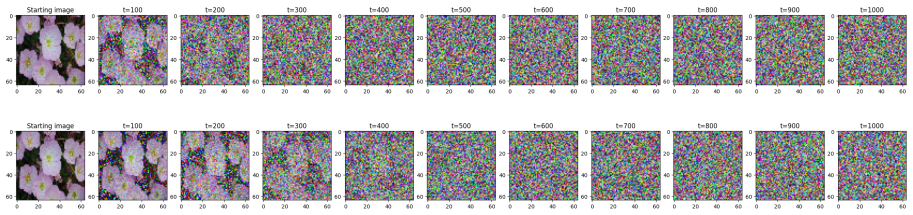
The load-bearing object is the ENLL upper bound in Lemma 2.9, specialized to Gaussian transition kernels in Proposition 3.19. The bound decomposes the negative log-likelihood of the data under the generative model into an unlearnable terminal term measuring how far the forward process's final state is from the standard-normal prior, the reconstruction loss of the last denoising step, and per-step KL divergences between the forward process's backward transition and the network's backward transition. With Gaussian noise and the reparameterization $X^\emptyset_t = \sqrt{\tilde{\alpha}_t}X^\emptyset_0 + \sqrt{1-\tilde{\alpha}_t}E_t$, each KL term becomes a squared error between the true noise $E_t$ and the network prediction $V^\theta(\sqrt{\tilde{\alpha}_t}X^\emptyset_0 + \sqrt{1-\tilde{\alpha}_t}E_t, t)$. That identity is what converts a hard variational objective into the simple SGD-updated loss used in Method 3.21.
What would settle it
Train the Gaussian DDPM from Method 3.21 with a noise schedule that keeps the cumulative coefficient $\tilde{\alpha}_T$ clearly away from zero, for example $\tilde{\alpha}_T=0.5$, so the terminal distribution of the forward process is far from standard normal, and measure whether the generated samples still match the training distribution; if they do, the near-zero assumption is unnecessary, and if they do not, that failure pinpoints where the bound stops being informative.
Extended reading notes
Core claim
On the paper's own terms, the central discovery is a chain of inequalities. Lemma 2.9 shows that, for any Markov forward and backward process, the ENLL $H(p^\emptyset_0 \| p^\theta_0)$ is bounded by the KL divergence between the forward terminal distribution given the initial state and the prior $\Pi$, the negative log-probability of the final denoising step, and a sum of KL divergences between the true backward transition of the forward process and the backward transition of the parametric process. When the forward transitions are Gaussian, Proposition 3.19 rewrites each trainable KL term as the weighted squared error $\frac{1}{2\tilde{\beta}_t}\frac{(1-\alpha_t)^2}{(1-\tilde{\alpha}_t)\alpha_t}\,\mathbb{E}[\|E_t - V^\theta(\sqrt{\tilde{\alpha}_t}X^\emptyset_0 + \sqrt{1-\tilde{\alpha}_t}E_t, t)\|^2]$, up to the unlearnable terminal term and a constant. This identity is what reduces the abstract variational objective to the simple noise-prediction loss of Method 3.21, and it is the statement that the rest of the survey's methods inherit.
Load-bearing premise
The whole scheme leans on the informal assumption that the forward process destroys enough information that its terminal state is close to standard normal, since the clean limiting choice $\tilde{\alpha}_0=1$ and $\tilde{\beta}_1=0$ would make the variance zero and is outside the range where the bound and the Gaussian densities are defined.
Editorial extensions
If this is right
- The ENLL of the data under a DDPM is bounded by a sum of one-step KL terms, so training can proceed by stochastic gradient descent on single time steps rather than on full trajectories.
- In the Gaussian case, each trainable term reduces to a weighted squared error between the true forward noise and the network's prediction, up to an unlearnable terminal term and a constant.
- Ignoring the weights and the terminal term, as Method 3.21 does, yields the standard simplified training loss used by the DDPM variants discussed in the paper.
- Improved DDPMs, DDIM, classifier-free guidance, and stable diffusion all keep the same underlying noise-prediction objective while changing variances, schedules, sampling steps, or conditioning.
- Because the terminal KL term has no trainable parameters, the quality of the generative model's starting point depends on the forward noise schedule rather than on the network.
Reading between the lines
- A consequence the paper leaves implicit is that the per-step weights in Proposition 3.19 give a quantitative handle on schedule design: choosing the noise coefficients is choosing how much each denoising step contributes to the bound, so schedules that keep the weighted terms balanced should train more stably.
- The framework suggests a testable extension: replacing the fixed standard-normal prior with a learned or fitted prior would relax the requirement that the terminal noise coefficient be near zero, potentially improving generation when the forward process has not fully mixed to noise.
- The same upper-bound structure connects to score-matching interpretations of diffusion models, since the squared noise-prediction error is an amortized denoising score-matching objective, though the paper does not make this identification.
- One could place the 'as if' choice $\tilde{\alpha}_0=1$, $\tilde{\beta}_1=0$ on firmer ground by taking a limit of admissible parameters instead of fixing them directly, which would make the zero-variance final step of Method 3.21 rigorous.
Editorial analysis
A structured set of objections, weighed in public.
Referee Report
Summary. The paper is a tutorial/survey of denoising diffusion probabilistic models (DDPMs). It introduces a general Markovian framework (Settings 2.1 and 2.3), derives an upper bound for the expected negative log-likelihood (Lemma 2.9), specializes the transition kernels to Gaussians (Setting 3.8), and obtains the reparameterized upper bound of Proposition 3.19. This bound motivates the simplified noise-prediction loss and the backward sampling scheme of Method 3.21. The remainder of the paper reviews evaluation metrics (IS, FID, SSIM, PSNR, LPIPS) and extensions: Improved DDPM, DDIM, classifier-free guidance, Stable Diffusion, GLIDE, DALL-E 2/3, and Imagen. The technical core reproduces known results from Sohl-Dickstein et al. (2015), Ho et al. (2020), Song et al. (2020), and Nichol and Dhariwal (2021).
Significance. The paper's main value is pedagogical: it gives explicit, mostly self-contained derivations of the standard DDPM variational bound and its Gaussian simplifications, and it presents the practical algorithms in a unified notation. The derivations in Sections 2-3 appear mathematically correct, and the companion code repository is a useful resource. The paper does not claim new bounds or new empirical results, and the DDIM theorem (Theorem 5.7) is imported from the literature. As a survey, this is appropriate; however, the paper's stronger framing of Proposition 3.19 as a 'complete theoretical basis' for Method 3.21 requires qualification because of the prior-mismatch and boundary-parameter issues discussed below.
major comments (2)
- [§3.4, Proposition 3.19(i), Remark 3.14] The informal condition 'α̃T ≈ 0' in Remark 3.14 is not sufficient in high dimension. For the Gaussian forward process, the prior-mismatch term in Proposition 3.19(i) equals (1/2)[α̃T E[||X∅0||²] − d α̃T − d ln(1−α̃T)], which behaves like (α̃T/2) E[||X∅0||²] for small α̃T. For data normalized to [−1,1]^d this is O(α̃T d). The condition for the bound to be a meaningful guarantee is therefore α̃T E[||X∅0||²] ≪ 1, not merely α̃T ≈ 0. Since Remark 2.10(iii) correctly observes that this term has no trainable parameters, minimizing the simplified loss in Method 3.21 cannot reduce it. Please add a quantitative statement and discuss the schedules of Remarks 3.23 and 5.3 in this light.
- [§3.4–3.5, Remark 3.20, Method 3.21] The transition from Proposition 3.19 to Method 3.21 uses values α̃0=1 and β̃1=0 that are explicitly outside the admissible range of the Gaussian densities and make the bound in Proposition 3.19 undefined (division by zero). The paper acknowledges this in Remark 3.20 but still states before Proposition 3.19 that the result provides 'a complete theoretical basis' for the scheme in Method 3.21. Since the sampling update (87) and the simplified loss (88) depend on this inadmissible limit, the paper should either prove that the error introduced by the limit vanishes (e.g., by a limiting argument with β̃1 → 0) or explicitly state that Method 3.21 is a heuristic variant of the rigorous bound.
minor comments (6)
- [§2.1, Setting 2.1] The symbol d is used both for the data dimension and for the parameter dimension (the statement begins 'Let d, d, T ∈ N' and later θ ∈ R^d while X^θ_t takes values in R^d); this notational collision makes the framework hard to read, so please use distinct symbols such as d_x and d_θ.
- [§4.1] The subsection is titled 'Content variant metrics', but the text and Remark 4.3 describe IS and FID as 'content invariant metrics' and say content-invariant metrics measure diversity; the terminology should be made consistent.
- [Definition 4.2] The symbol I is used both for the Inception model and for the score; rename the score (e.g., IS) to avoid confusion.
- [Method 5.1, Eq. (106)] In the sampling update, the variance interpolation term uses v^{Θ_N}_{2,i}(X_k, t) with a time variable t that is not defined in the loop; it should presumably be t_k.
- [§5.1] The opening sentence refers to 'Improved DDPM [15]' and attributes the ENLL findings to [15], but [15] is Ho et al.'s original DDPM paper; the Improved DDPM method and the ENLL observations come from Nichol and Dhariwal [30].
- [Theorem 5.7] The proof consists of a reference to [45, Theorem 1]; in a paper emphasizing mathematical rigor, either reproduce the argument or clearly state that the result is taken as an external theorem.
Circularity Check
No significant circularity: the DDPM upper-bound derivation is self-contained given its assumptions, and the only self-citation is a non-load-bearing general reference.
full rationale
The main derivation chain runs from Lemma 2.9 through Lemma 3.18 to Proposition 3.19. Each step is a direct mathematical consequence of the stated Markov and Gaussian assumptions: Lemma 2.9 uses Jensen's inequality and the Markov factorization, Lemma 3.18 substitutes the chosen Gaussian parameterization, and Proposition 3.19 assembles the pieces. No fitted constant or empirical value is introduced into this derivation. The prior-mismatch term E[DKL(p^∅_{T|0}(·|X^∅_0)∥Π)] is explicitly identified in Remark 2.10(iii) as having no learnable parameters, so it is an input determined by the forward process and the noise schedule, not a disguised prediction of the model. Method 3.21 then replaces the Proposition 3.19 upper bound by the simplified denoising loss; the paper states that this simplified objective 'does therefore not exactly correspond to the upper bound' and attributes the simplification to empirical justification in Ho et al. [15]. This is an acknowledged heuristic, not a circular derivation. The paper also flags the limiting choices alpha-tilde_0 = 1 and beta-tilde_1 = 0 as inadmissible in Proposition 3.19 (Remark 3.20) and the terminal-distribution approximation as informal (Remark 3.14); these are limitation caveats about the strength of the guarantee, not circular reductions. The only self-citation is reference [19], used as a general introduction to SGD-type methods and ANN architectures; it carries no load in the DDPM derivation. The skeptical concern about the prior-mismatch term scaling as O(alpha-tilde_T E||X_0||^2) is a quantitative weakness of the guarantee, but the term is part of the bound's input, so no prediction reduces by construction to its own input.
Assumptions & free parameters
free parameters (4)
- Noise schedule α1,...,αT =
linear: α1=1−10^{-4}, αT=0.98 (Remark 3.23); cosine scheduler uses offset s=0.008 (Remark 5.3)
- Loss interpolation parameter λ =
0.001 (Remark 5.2)
- Class-drop probability p =
0.1 or 0.2 (Remark 5.13)
- DDIM stochasticity η =
η=0 for deterministic DDIM, η=1 recovers DDPM (Remark 5.9)
assumptions (6)
- standard math Jensen's inequality for the logarithm applied to the marginal pθ0(x0) (Lemma 2.9 proof, Eq. (25))
- standard math Gaussian convolution identity ∫ N(x, Ay+μ1, Σ1) N(y, μ2, Σ2) dy = N(x, Aμ2+μ1, AΣ2A*+Σ1) (Lemma 3.2, cited to Bishop 2006)
- standard math Bayes rule for Gaussian conditionals (Lemma 3.5, cited to Bishop 2006)
- standard math Closed-form KL divergence between Gaussians (Lemma 3.7, cited to Duchi 2007)
- domain assumption Markov property of forward and backward processes (Setting 2.3, Eq. (6)-(7))
- domain assumption Terminal distribution approximation p∅T ≈ Π, i.e., α̃T ≈ 0 (Remark 3.14, Eq. (60))
Cite this review
Pith. "Pith review of An overview of diffusion models for generative artificial intelligence." pith.science (2026). https://pith.science/paper/ENFSSXSY
@misc{pith2026241201371,
  author       = {Pith},
  title        = {Pith review of: An overview of diffusion models for generative artificial intelligence},
  year         = {2026},
  howpublished = {\url{https://pith.science/paper/ENFSSXSY}},
  note         = {Machine review of arXiv:2412.01371}
}
read the original abstract
This article provides a mathematically rigorous introduction to denoising diffusion probabilistic models (DDPMs), sometimes also referred to as diffusion probabilistic models or diffusion models, for generative artificial intelligence. We provide a detailed basic mathematical framework for DDPMs and explain the main ideas behind training and generation procedures. In this overview article we also review selected extensions and improvements of the basic framework from the literature such as improved DDPMs, denoising diffusion implicit models, classifier-free diffusion guidance models, and latent diffusion models.
Figures


Figures from the paper (2 more)

Reference graph
Works this paper leans on
-
[1]
L., Almeida, D., Altenschmidt, J., Altman, S., Anadkat, S., et al
Achiam, J., Adler, S., Agarwal, S., Ahmad, L., Akkaya, I., Aleman, F. L., Almeida, D., Altenschmidt, J., Altman, S., Anadkat, S., et al. Gpt-4 technical report. arXiv:2303.08774 (2023)
arXiv 2023
-
[2]
Comparison of image quality assessment: Psnr, hvs, ssim, uiqi
Al-Najjar, Y. Comparison of image quality assessment: Psnr, hvs, ssim, uiqi. International Journal of Scientific and Engineering Research 3 (08 2012)
work page 2012
-
[3]
Austin, J., Johnson, D. D., Ho, J., Tarlow, D., and van den Berg, R.Structured denoising diffusion models in discrete state-spaces. arXiv:2107.03006 (2023)
arXiv 2023
-
[4]
Learning theory from first principles
Bach, F. Learning theory from first principles . MIT press, 2024
work page 2024
-
[5]
Bayesian reasoning and machine learning
Barber, D. Bayesian reasoning and machine learning . Cambridge University Press, 2012
work page 2012
-
[6]
Improving image generation with better captions
Betker, J., Goh, G., Jing, L., Brooks, T., W ang, J., Li, L., Ouyang, L., Zhuang, J., Lee, J., Guo, Y., et al. Improving image generation with better captions. Computer Science. https://cdn. openai. com/papers/dall-e-3. pdf 2 , 3 (2023), 8
work page 2023
-
[7]
Bishop, C. M. Pattern Recognition and Machine Learning (Information Science and Statistics) . Springer-Verlag, Berlin, Heidelberg, 2006
work page 2006
-
[8]
Diffusion models beat gans on image synthesis
Dhariwal, P., and Nichol, A. Diffusion models beat gans on image synthesis. arXiv:2105.05233 (2021)
arXiv 2021
Show all 54 references
-
[9]
Derivations for linear algebra and optimization
Duchi, J. Derivations for linear algebra and optimization. Berkeley, California 3 , 1 (2007), 2325– 5870
2007
-
[11]
Deep Learning
Goodfellow, I., Bengio, Y., and Courville, A. Deep Learning. MIT Press, 2016. http: //www.deeplearningbook.org
2016
-
[12]
Generative adversarial nets
Goodfellow, I., Pouget-Abadie, J., Mirza, M., Xu, B., W arde-F arley, D., Ozair, S., Courville, A., and Bengio, Y. Generative adversarial nets. Advances in neural information processing systems 27 (2014)
2014
-
[13]
Grimmett, G., and Welsh, D. J. Probability: an introduction . Oxford University Press, 2014
2014
-
[14]
Gans trained by a two time-scale update rule converge to a local nash equilibrium
Heusel, M., Ramsauer, H., Unterthiner, T., Nessler, B., and Hochreiter, S. Gans trained by a two time-scale update rule converge to a local nash equilibrium. In Neural Information Processing Systems (2017)
2017
-
[15]
Denoising diffusion probabilistic models
Ho, J., Jain, A., and Abbeel, P. Denoising diffusion probabilistic models. Advances in Neural Information Processing Systems 33 (2020), 6840–6851
2020
-
[16]
Classifier-free diffusion guidance
Ho, J., and Salimans, T. Classifier-free diffusion guidance. arXiv:2207.12598 (2022)
2022 arXiv
-
[17]
Ho, J., Salimans, T., Gritsenko, A., Chan, W., Norouzi, M., and Fleet, D. J. Video diffusion models. arXiv:2204.03458 (2022)
2022 arXiv
-
[18]
Image quality metrics: Psnr vs
Hor´e, A., and Ziou, D. Image quality metrics: Psnr vs. ssim. In 2010 20th International Conference on Pattern Recognition (2010), pp. 2366–2369
2010
-
[19]
Mathematical introduction to deep learning: methods, implementations, and theory
Jentzen, A., Kuckuck, B., and von Wurstemberger, P. Mathematical introduction to deep learning: methods, implementations, and theory. arXiv:2310.20360 (2023). 53
2023 arXiv
-
[20]
Analyzing and improving the image quality of stylegan
Karras, T., Laine, S., Aittala, M., Hellsten, J., Lehtinen, J., and Aila, T. Analyzing and improving the image quality of stylegan. In 2020 IEEE/CVF Conference on Computer Vision and Pattern Recognition (CVPR) (Los Alamitos, CA, USA, jun 2020), IEEE Computer Society, pp. 8107–8116
2020
-
[21]
Kim, G., Kwon, T., and Ye, J. C. Diffusionclip: Text-guided diffusion models for robust image manipulation. arXiv:2110.02711 (2022)
2022 arXiv
-
[22]
P., and Welling, M
Kingma, D. P., and Welling, M. Auto-encoding variational bayes. In 2nd International Confer- ence on Learning Representations, ICLR 2014, Banff, AB, Canada, April 14-16, 2014, Conference Track Proceedings (2014), Y. Bengio and Y. LeCun, Eds
2014
-
[23]
Probability theory: a comprehensive course
Klenke, A. Probability theory: a comprehensive course . Springer Science & Business Media, 2013
2013
-
[24]
Kullback, S., and Leibler, R. A. On information and sufficiency. The annals of mathematical statistics 22 , 1 (1951), 79–86
1951
-
[25]
A tutorial on energy- based learning
LeCun, Y., Chopra, S., Hadsell, R., Ranzato, M., Huang, F., et al. A tutorial on energy- based learning. Predicting structured data 1 , 0 (2006)
2006
-
[26]
L., Thickstun, J., Gulrajani, I., Liang, P., and Hashimoto, T
Li, X. L., Thickstun, J., Gulrajani, I., Liang, P., and Hashimoto, T. B. Diffusion-lm improves controllable text generation. arXiv:2205.14217 (2022)
2022 arXiv
-
[27]
Cat: Cross attention in vision transformer
Lin, H., Cheng, X., Wu, X., Yang, F., Shen, D., W ang, Z., Song, Q., and Yuan, W. Cat: Cross attention in vision transformer. arXiv:2006.09011 (2021)
2021 arXiv
-
[28]
L., and Doll ´ar, P
Lin, T.-Y., Maire, M., Belongie, S., Bourdev, L., Girshick, R., Hays, J., Perona, P., Ramanan, D., Zitnick, C. L., and Doll ´ar, P. Microsoft coco: Common objects in context. arXiv:1405.0312 (2015)
2015 arXiv
-
[29]
Fully convolutional networks for semantic segmen- tation
Long, J., Shelhamer, E., and Darrell, T. Fully convolutional networks for semantic segmen- tation. In 2015 IEEE Conference on Computer Vision and Pattern Recognition (CVPR) (2015), IEEE Computer Society, pp. 3431–3440
2015
-
[30]
Improved denoising diffusion probabilistic models
Nichol, A., and Dhariwal, P. Improved denoising diffusion probabilistic models. arXiv:2102.09672 (2021)
2021 arXiv
-
[31]
Glide: Towards photorealistic image generation and editing with text-guided diffusion models
Nichol, A., Dhariwal, P., Ramesh, A., Shyam, P., Mishkin, P., McGrew, B., Sutskever, I., and Chen, M. Glide: Towards photorealistic image generation and editing with text-guided diffusion models. arXiv:2203.13131 (2022)
2022 arXiv
-
[32]
Understanding ssim
Nilsson, J., and Akenine-M ¨oller, T. Understanding ssim. arXiv:2006.13846 (2020)
2020 arXiv
-
[33]
W., Hallacy, C., Ramesh, A., Goh, G., Agarwal, S., Sastry, G., Askell, A., Mishkin, P., Clark, J., Krueger, G., and Sutskever, I
Radford, A., Kim, J. W., Hallacy, C., Ramesh, A., Goh, G., Agarwal, S., Sastry, G., Askell, A., Mishkin, P., Clark, J., Krueger, G., and Sutskever, I. Learning transferable visual models from natural language supervision. CoRR abs/2103.00020 (2021)
2021 arXiv
-
[34]
Raffel, C., Shazeer, N., Roberts, A., Lee, K., Narang, S., Matena, M., Zhou, Y., Li, W., and Liu, P. J. Exploring the limits of transfer learning with a unified text-to-text transformer. Journal of Machine Learning Research 21 , 140 (2020), 1–67
2020
-
[35]
Hierarchical text-conditional image generation with clip latents
Ramesh, A., Dhariwal, P., Nichol, A., Chu, C., and Chen, M. Hierarchical text-conditional image generation with clip latents. arXiv:2204.06125 (2022)
2022 arXiv
-
[36]
Zero-shot text-to-image generation
Ramesh, A., Pavlov, M., Goh, G., Gray, S., Voss, C., Radford, A., Chen, M., and Sutskever, I. Zero-shot text-to-image generation. In Proceedings of the 38th International Con- ference on Machine Learning (18–24 Jul 2021), M. Meila and T. Zhang, Eds., vol. 139 of Proceedings of...
2021
-
[37]
J., and Mohamed, S.Variational inference with normalizing flows.arXiv:1505.05770 (2016)
Rezende, D. J., and Mohamed, S.Variational inference with normalizing flows.arXiv:1505.05770 (2016)
2016 arXiv
-
[38]
High-resolution image synthesis with latent diffusion models
Rombach, R., Blattmann, A., Lorenz, D., Esser, P., and Ommer, B. High-resolution image synthesis with latent diffusion models. In 2022 IEEE/CVF Conference on Computer Vision and Pattern Recognition (CVPR) (2022), pp. 10674–10685
2022
-
[39]
An overview of gradient descent optimization algorithms
Ruder, S. An overview of gradient descent optimization algorithms. arXiv:1609.04747 (2016)
2016 arXiv
-
[40]
Saharia, C., Chan, W., Saxena, S., Li, L., Whang, J., Denton, E., Ghasemipour, S. K. S., Ayan, B. K., Mahdavi, S. S., Lopes, R. G., Salimans, T., Ho, J., Fleet, D. J., and Norouzi, M. Photorealistic text-to-image diffusion models with deep language understanding. arXiv:2205.11...
2022 arXiv
-
[41]
J., and Norouzi, M
Saharia, C., Ho, J., Chan, W., Salimans, T., Fleet, D. J., and Norouzi, M. Image super- resolution via iterative refinement. IEEE Transactions on Pattern Analysis and Machine Intelligence 45, 4 (2023), 4713–4726
2023
-
[42]
Improved techniques for training gans
Salimans, T., Goodfellow, I., Zaremba, W., Cheung, V., Radford, A., and Chen, X. Improved techniques for training gans. arXiv:1606.03498 (2016)
2016 arXiv
-
[43]
Understanding machine learning: From theory to algorithms
Shalev-Shwartz, S., and Ben-David, S. Understanding machine learning: From theory to algorithms. Cambridge university press, 2014
2014
-
[44]
Deep unsupervised learning using nonequilibrium thermodynamics
Sohl-Dickstein, J., Weiss, E., Maheswaranathan, N., and Ganguli, S. Deep unsupervised learning using nonequilibrium thermodynamics. In International Conference on Machine Learning (2015), PMLR, pp. 2256–2265
2015
-
[45]
Denoising diffusion implicit models
Song, J., Meng, C., and Ermon, S. Denoising diffusion implicit models. arXiv:2010.02502 (2022)
2022 arXiv
-
[46]
Rethinking the inception architecture for computer vision
Szegedy, C., V anhoucke, V., Ioffe, S., Shlens, J., and Wojna, Z. Rethinking the inception architecture for computer vision. In Proceedings of the IEEE conference on computer vision and pattern recognition (2016), pp. 2818–2826
2016
-
[47]
Conditional image generation with pixelcnn decoders
van den Oord, A., Kalchbrenner, N., Vinyals, O., Espeholt, L., Graves, A., and Kavukcuoglu, K. Conditional image generation with pixelcnn decoders. arXiv:1606.05328 (2016)
2016 arXiv
-
[48]
N., Kaiser, L
V aswani, A., Shazeer, N., Parmar, N., Uszkoreit, J., Jones, L., Gomez, A. N., Kaiser, L. u., and Polosukhin, I. Attention is all you need. In Advances in Neural Information Processing Systems (2017), I. Guyon, U. V. Luxburg, S. Bengio, H. Wallach, R. Fergus, S. Vishwanathan, ...
2017
-
[49]
Image quality assessment: from error visibility to structural similarity
W ang, Z., Bovik, A., Sheikh, H., and Simoncelli, E. Image quality assessment: from error visibility to structural similarity. IEEE Transactions on Image Processing 13 , 4 (2004), 600–612
2004
-
[50]
Wolleb, J., Bieder, F., Sandk ¨uhler, R., and Cattin, P. C. Diffusion models for medical anomaly detection. arXiv:2203.04306 (2022)
2022 arXiv
- [51]
-
[52]
M., and Willcocks, C
Wyatt, J., Leach, A., Schmon, S. M., and Willcocks, C. G. Anoddpm: Anomaly detection with denoising diffusion probabilistic models using simplex noise. In Proceedings of the IEEE/CVF Conference on Computer Vision and Pattern Recognition (CVPR) Workshops (June 2022), pp. 650– 656
2022
-
[53]
Diffusion probabilistic modeling for video generation
Yang, R., Srivastava, P., and Mandt, S. Diffusion probabilistic modeling for video generation. arXiv:2203.09481 (2022). 55
2022 arXiv
-
[54]
A., Shechtman, E., and W ang, O
Zhang, R., Isola, P., Efros, A. A., Shechtman, E., and W ang, O. The unreasonable effectiveness of deep features as a perceptual metric. In Proceedings of the IEEE conference on computer vision and pattern recognition (2018), pp. 586–595
2018
-
[55]
Towards language-free training for text-to-image generation
Zhou, Y., Zhang, R., Chen, C., Li, C., Tensmeyer, C., Yu, T., Gu, J., Xu, J., and Sun, T. Towards language-free training for text-to-image generation. In Proceedings of the IEEE/CVF Conference on Computer Vision and Pattern Recognition (CVPR) (June 2022), pp. 17907–17917. 56
2022
Reviewed August 12, 2026 · model on record in the stance chip above.
Discussion (0). Continue with ORCID to comment.