REVIEW 4 major objections 5 minor 37 references
Harnessing Preference Optimisation in Protein LMs for Hit Maturation in Cell Therapy
T0 review · 4 major / 5 minor · reviewed 2026-08-12 · deepseek-v4-flash
Pith's one-line read The paper reports that after preference fine-tuning of an auto-regressive protein language model, the model's next-token loss is highly correlated with T-cell activation measurements for CAR mutants, allowing few-shot hit maturation that…
desk verdict A credible proof-of-concept that preference-fine-tuned PLM loss tracks a CAR activation assay, but the hit-maturation claim needs a random-mutant control before it can be trusted. read the letter →
The pith
A machine-rendered reading of the paper's core claim, the machinery that carries it, and where it could break.
The reading
What carries the argument
The load-bearing mechanism is the combination of (i) a preference-fine-tuning scheme that conditions an auto-regressive PLM on a context of five good-performing CDR3 sequences and optimises the difference in log-likelihood between chosen (good) and rejected (poor) CDR3 completions, and (ii) the use of the fine-tuned model's next-token cross-entropy as a ranking score for unseen mutants. Among the three losses tested (sigmoid DPO, hinge, and KTO), the authors select KTO because it raises the likelihood of chosen completions without over-penalising rejected ones, avoiding the collapsed or trivial outputs seen with hinge loss. The model loss is averaged over all 120 context permutations to produce a per-mutant score; this score is what correlates with the biological activation readout $\Delta$GFP.
What would settle it
Re-assay the same CAR mutants from Figures 5-7 on at least three replicate plates with plate-normalised controls and compute the correlation between average model loss and $\Delta$GFP; if the Pearson r no longer reaches significance (p $\geq$ 0.05, or |r| below roughly 0.3) or the 'more than double parent' mutants fall within the parent's assay noise, the central claim is falsified. A second check: re-derive the preference labels from an independent repeat of the high-throughput co-culture run; if the chosen/rejected CDR3 pairs flip on replication, the training signal itself is not reproducible.
Extended reading notes
Core claim
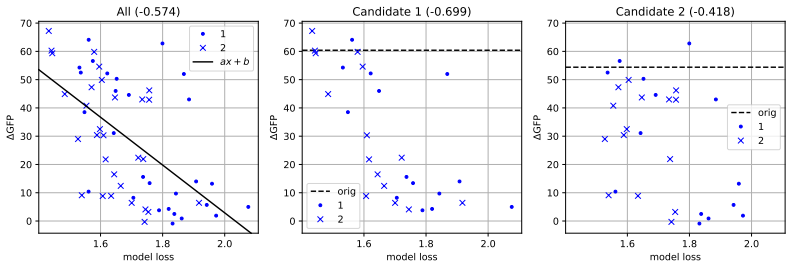
The central claim is that an auto-regressive protein language model (ProGen2, 764M parameters) fine-tuned with Kahneman-Tversky Optimization (KTO) on preference pairs built from high-throughput CAR-T activation data learns a sequence-level reward that is well approximated by its own cross-entropy loss. Concretely, for mutants generated greedily or by exhaustive search around a parent VHH CDR3, the model loss averaged over five-CDR3 context prompts correlates strongly with the change in GFP reporter activation (all mutants: r = -0.574; candidate 1: r = -0.699; candidate 2: r = -0.418), and the correlation is significant at p < 0.05. The fine-tuned model also finds mutants that exceed parent activation, including cases with more than double the parent's activity, in a search space of $10^{4}$-$10^{5}$ variants. The authors interpret this as evidence that preference-fine-tuned PLMs can guide few-shot hit maturation despite the noisiness of high-throughput biological data.
Load-bearing premise
The single scalar derived from the co-culture FACS/NGS fractions is treated as a stable ground-truth measure of CAR activation; if that measurement is noisy or target-line dependent in ways not captured by the reported single-plate assays, the preference labels and the measured correlations may not reproduce.
Editorial extensions
If this is right
- If the correlation holds in independent replicates, model loss can act as an in-silico ranking filter, letting labs evaluate hundreds of mutants computationally before synthesising a handful for 96-well assays.
- Exhaustive scoring of all single and double mutants around a parent CDR3, despite its compute cost, finds high-performing mutants more reliably than greedy left-to-right generation, and is the recommended mode for hit maturation.
- Fine-tuning with preferences derived from high-throughput cell assays can transfer to other therapeutic protein modalities such as bispecific antibodies or cytokines, since the approach only needs preference pairs and a pretrained auto-regressive PLM.
- The next-token loss of the fine-tuned model is a usable proxy for activation, meaning the model can serve as a zero-shot or few-shot fitness predictor without a separate reward model or structural information.
Reading between the lines
- An untested extension is that the five-CDR3 context softly encodes the target antigen, so prompting with good performers for a new target might enable zero-shot maturation without retraining; the paper says this is not its focus but the architecture would permit it.
- The preference-label construction, which groups by CDR3 and retains the maximum-performing variant, may itself encode a strong prior that the model learns to exploit; comparing against a model trained on regression labels from the same scalar would isolate what preference optimisation contributes.
- The reported correlations and 'double parent activity' results come from single plates without replicate wells or error bars, so the practical claim depends on the assay scalar being reproducible across plates and days, which the paper does not demonstrate.
- If the high-throughput scalar is too noisy to resolve fine differences, the preference pairs may be mislabelled; a useful diagnostic would be to measure label agreement between two independent runs of the same CAR library.
Signed reviews
Editorial analysis
A structured set of objections, weighed in public.
Referee Report
Summary. The manuscript proposes using preference-optimized protein language models for hit maturation of CAR VHH domains. It constructs preference pairs from high-throughput co-culture activation data, fine-tunes ProGen2-medium with KTO loss, and evaluates model loss against GFP activation for selected mutants around parental CARs. It reports Pearson correlations around -0.57 to -0.70 for the fine-tuned model's loss and negligible correlations for the pretrained model, and it identifies several mutants with more than double the parent activity. The authors conclude that fine-tuned model loss is a useful ranking signal for guided exploration of the CAR design space.
Significance. If the central claim holds, this is an interesting proof-of-concept: preference optimization on noisy cellular assay data can produce a sequence-scoring function that correlates with biological activity better than pretrained PLM likelihood, with potential generalization to other therapeutic proteins. Strengths include the direct comparison to the pretrained model, evaluation on disjoint mutant sequences, a thoughtful analysis of loss-function pathologies (KTO vs. hinge vs. sigmoid), and explicit caveats that validation-set differences are not statistically significant. However, the current evidence is insufficient to establish that the method 'reliably finds improved mutants': evaluation is restricted to model-selected mutants, no random-mutant control is reported, and no replicate plates or error bars are provided. These are fixable with additional experiments, but they are load-bearing for the paper's main claims.
major comments (4)
- [Section 4, Figures 5-6] The correlation analysis is performed only on mutants selected by the model itself (top 15 greedy, top 45 exhaustive, top 8 few-shot). This range-restricted, non-random sample cannot provide an unbiased estimate of how well model loss ranks arbitrary single/double mutants, and the reported p-values are conditional on the selection rule. A matched random-mutant arm evaluated on the same plates is required to establish that the correlation is not an artifact of selection; please add such an arm and report correlations on the combined random plus selected set.
- [Section 4, Figure 7] The hit-maturation claim that the method 'reliably find[s] improved mutants' is not supported without a baseline improvement rate for random single/double substitutions. All evaluated mutants were chosen for high model likelihood, so observing several mutants above the parent could reflect the chance distribution of substitutions rather than the model's guidance. The authors' own caveat that validation differences for S8-S10 are not statistically significant (Section 4.1) further weakens the reliability claim. A random-mutant control on the same plates, with replicate wells, is needed to distinguish model-guided improvement from chance.
- [Section 3.1-3.2] The scalar activation score (ΔGFP) used to build preference labels and to validate mutants comes from a high-throughput assay described in Section 3.2 as potentially lacking 'sufficient precision to resolve the finest difference between candidate CARs.' No replicate plates, error bars, or assay-variability estimates are reported. If this score is noisy or plate-dependent, both training labels and validation readouts are affected, and the reported p-values would not be meaningful. Please report replicate measurements for the validation plates and quantify assay noise.
- [Section 3.3 vs. Section 4] Preference pairs are constructed from the same high-throughput assay family used for evaluation, so the model may learn to reproduce the assay's systematic ranking rather than the biological activity of the CAR. Removing training-set mutants and using validation parents addresses overlap in sequences, but it does not remove a plate-level or protocol-level bias shared by all experiments. Please either provide an independent readout (e.g., binding or orthogonal activation assay) or explicitly bound the effect of assay bias on the conclusions.
minor comments (5)
- [Figures 5-6] Report exact Pearson r values, p-values, and sample sizes for each panel; 'p < 0.05' is insufficient, especially with small selected samples.
- [Algorithm 1] The notation 'arg maxtopk(logits(concat(L, R))p)' is unclear; specify that the top-k amino-acid substitutions are taken per position p and define what 'valid(s)' means.
- [Section 4.1] The normalization of ΔGFP on the second plate using reference CAR performance is described only verbally; provide the formula and state whether each plate had replicate reference wells.
- [Section 3.1] Minor typo: 'start of with' should be 'start off with'.
- [General] Provide a data/code availability statement or clearly state which parts of the pipeline are proprietary, since the absence of public data limits reproducibility.
Circularity Check
No circularity: the fine-tuning signal and the held-out validation measurements are distinct, and the reported correlations are empirically contingent rather than forced by construction.
full rationale
The paper's derivation chain is not circular. Preference pairs are constructed from high-throughput FACS/NGS scalar scores (Sections 3.1-3.3), while Figures 5-7 evaluate disjoint, model-generated mutants in 96-well reporter activation assays. Training-set mutants are explicitly deleted from analysis, and the few-shot experiment states that none of the evaluated mutants occur in the preference dataset. The pretrained model before fine-tuning shows near-zero correlation with activation (Figure 9: 0.218 and 0.072), demonstrating that the fine-tuned correlation (overall -0.574) is not a statistical artifact of the pretrained likelihood. The main limitations—lack of a random-mutant control arm, selection restricted to model-chosen mutants, and the authors' admission that S8-S10 validation differences are not yet statistically significant—are experimental and statistical concerns, not evidence that the result reduces to its inputs by definition. There are no load-bearing self-citations and no imported uniqueness claims; the methodological borrowings from DPO/KTO and ProGen2 are external, independently established methods. The correlation claim is therefore an empirical finding, not a self-justifying construction.
Assumptions & free parameters
free parameters (8)
- tc (good performer threshold) =
not reported
- tr (poor performer threshold) =
not reported
- context length k =
5
- preference pairs per good performer n =
10
- DPO/KTO beta =
0.1
- learning rate =
1e-5
- greedy top-k substitutions =
3
- training epochs =
10
assumptions (6)
- domain assumption The high-throughput activation score derived from FACS fractions is a valid, monotone proxy for CAR performance.
- domain assumption Maturation-relevant variation is fully captured by single and double amino-acid substitutions in CDR3.
- domain assumption A context of five good-performer CDR3s soft-encodes the target antigen for the model.
- domain assumption ProGen2 provides a useful prior over VHH CDR3 sequences.
- standard math The DPO and KTO losses from Rafailov et al. and Ethayarajh et al. behave as preference optimization objectives in this setting.
- domain assumption Validation loss and accuracy on preference pairs are reliable guides to generative quality.
Cite this review
Pith. "Pith review of Harnessing Preference Optimisation in Protein LMs for Hit Maturation in Cell Therapy." pith.science (2026). https://pith.science/paper/WDCQ277Z
@misc{pith2026241201388,
  author       = {Pith},
  title        = {Pith review of: Harnessing Preference Optimisation in Protein LMs for Hit Maturation in Cell Therapy},
  year         = {2026},
  howpublished = {\url{https://pith.science/paper/WDCQ277Z}},
  note         = {Machine review of arXiv:2412.01388}
}
read the original abstract
Cell and immunotherapy offer transformative potential for treating diseases like cancer and autoimmune disorders by modulating the immune system. The development of these therapies is resource-intensive, with the majority of drug candidates failing to progress beyond laboratory testing. While recent advances in machine learning have revolutionised areas such as protein engineering, applications in immunotherapy remain limited due to the scarcity of large-scale, standardised datasets and the complexity of cellular systems. In this work, we address these challenges by leveraging a high-throughput experimental platform to generate data suitable for fine-tuning protein language models. We demonstrate how models fine-tuned using a preference task show surprising correlations to biological assays, and how they can be leveraged for few-shot hit maturation in CARs. This proof-of-concept presents a novel pathway for applying ML to immunotherapy and could generalise to other therapeutic modalities.
Figures


Figures from the paper (6 more)



Reference graph
Works this paper leans on
-
[1]
J. Abramson, J. Adler, J. Dunger, R. Evans, T. Green, A. Pritzel, O. Ronneberger, L. Willmore, A. J. Ballard, J. Bambrick, et al. Accurate structure prediction of biomolecular interactions with alphafold 3. Nature, pages 1--3, 2024
work page 2024
- [2]
- [3]
-
[4]
K. M. Cappell and J. N. Kochenderfer. Long-term outcomes following car t cell therapy: what we know so far. Nature reviews Clinical oncology, 20 0 (6): 0 359--371, 2023
work page 2023
-
[5]
R. Castellanos-Rueda, R. B. Di Roberto, F. Bieberich, F. S. Schlatter, D. Palianina, O. T. Nguyen, E. Kapetanovic, H. L \"a ubli, A. Hierlemann, N. Khanna, et al. speedingcars: accelerating the engineering of car t cells by signaling domain shuffling and single-cell sequencing. Nature Communications, 13 0 (1): 0 6555, 2022
work page 2022
-
[6]
P. F. Christiano, J. Leike, T. Brown, M. Martic, S. Legg, and D. Amodei. Deep reinforcement learning from human preferences. In I. Guyon, U. V. Luxburg, S. Bengio, H. Wallach, R. Fergus, S. V. N. Vishwanathan, and R. Garnett, editors, Advances in Neural Information Processing Systems, volume 30, pages 4299--4307. Curran Associates, Inc., 2017
work page 2017
-
[7]
T. Clark, V. Subramanian, A. Jayaraman, E. Fitzpatrick, R. Gopal, N. Pentakota, T. Rurak, S. Anand, A. Viglione, R. Raman, et al. Enhancing antibody affinity through experimental sampling of non-deleterious cdr mutations predicted by machine learning. Communications Chemistry, 6 0 (1): 0 244, 2023
work page 2023
- [8]
Show all 37 references
-
[9]
K. G. Daniels, S. Wang, M. S. Simic, H. K. Bhargava, S. Capponi, Y. Tonai, W. Yu, S. Bianco, and W. A. Lim. Decoding car t cell phenotype using combinatorial signaling motif libraries and machine learning. Science, 378 0 (6625): 0 1194--1200, 2022
2022
-
[10]
Ethayarajh, W
K. Ethayarajh, W. Xu, N. Muennighoff, D. Jurafsky, and D. Kiela. Kto: Model alignment as prospect theoretic optimization. arXiv preprint arXiv:2402.01306, 2024
2024 arXiv
-
[11]
D. M. Fowler and S. Fields. Deep mutational scanning: a new style of protein science. Nature methods, 11 0 (8): 0 801--807, 2014
2014
-
[12]
Gorovits and E
B. Gorovits and E. Koren. Immunogenicity of chimeric antigen receptor t-cell therapeutics. BioDrugs, 33 0 (3): 0 275--284, 2019
2019
-
[13]
Hayes, R
T. Hayes, R. Rao, H. Akin, N. J. Sofroniew, D. Oktay, Z. Lin, R. Verkuil, V. Q. Tran, J. Deaton, M. Wiggert, et al. Simulating 500 million years of evolution with a language model. bioRxiv, pages 2024--07, 2024
2024
-
[14]
Y. He, X. Zhou, C. Chang, G. Chen, W. Liu, G. Li, X. Fan, M. Sun, C. Miao, Q. Huang, et al. Protein language models-assisted optimization of a uracil-n-glycosylase variant enables programmable t-to-g and t-to-c base editing. Molecular Cell, 84 0 (7): 0 1257--1270, 2024
2024
-
[15]
Henikoff and J
S. Henikoff and J. G. Henikoff. Amino acid substitution matrices from protein blocks. Proceedings of the National Academy of Sciences, 89 0 (22): 0 10915--10919, 1992
1992
-
[16]
Hetzel, D
L. Hetzel, D. S. Fischer, S. G \"u nnemann, and F. J. Theis. Graph representation learning for single-cell biology. Current Opinion in Systems Biology, 28: 0 100347, 2021
2021
-
[17]
B. L. Hie, V. R. Shanker, D. Xu, T. U. Bruun, P. A. Weidenbacher, S. Tang, W. Wu, J. E. Pak, and P. S. Kim. Efficient evolution of human antibodies from general protein language models. Nature Biotechnology, 42 0 (2): 0 275--283, 2024
2024
-
[18]
Jiang, Y
F. Jiang, Y. Guo, H. Ma, S. Na, W. Zhong, Y. Han, T. Wang, and J. Huang. Gte: a graph learning framework for prediction of t-cell receptors and epitopes binding specificity. Briefings in Bioinformatics, 25 0 (4): 0 bbae343, 2024. doi:10.1093/bib/bbae343
2024 doi
-
[19]
Joubbi, A
S. Joubbi, A. Micheli, P. Milazzo, G. Maccari, G. Ciano, D. Cardamone, and D. Medini. Antibody design using deep learning: from sequence and structure design to affinity maturation. Briefings in Bioinformatics, 25 0 (4), 2024
2024
-
[20]
Z. Lin, H. Akin, R. Rao, B. Hie, Z. Zhu, W. Lu, N. Smetanin, R. Verkuil, O. Kabeli, Y. Shmueli, et al. Evolutionary-scale prediction of atomic-level protein structure with a language model. Science, 379 0 (6637): 0 1123--1130, 2023
2023
-
[21]
T. Liu, Y. Zhao, R. Joshi, M. Khalman, M. Saleh, P. J. Liu, and J. Liu. Statistical rejection sampling improves preference optimization. In International Conference on Learning Representations (ICLR), 2024
2024
-
[22]
A. Mullard. Parsing clinical success rates. Nature Reviews Drug Discovery, 15 0 (7): 0 447--448, 2016
2016
-
[23]
Mullin, J
M. Mullin, J. McClory, W. Haynes, J. Grace, N. Robertson, and G. van Heeke. Applications and challenges in designing vhh-based bispecific antibodies: leveraging machine learning solutions. In Mabs, volume 16, page 2341443. Taylor & Francis, 2024
2024
-
[24]
Muyldermans
S. Muyldermans. Nanobodies: natural single-domain antibodies. Annual review of biochemistry, 82 0 (1): 0 775--797, 2013
2013
-
[25]
Nijkamp, J
E. Nijkamp, J. A. Ruffolo, E. N. Weinstein, N. Naik, and A. Madani. Progen2: exploring the boundaries of protein language models. Cell systems, 14 0 (11): 0 968--978, 2023
2023
-
[26]
T. H. Olsen, F. Boyles, and C. M. Deane. Observed antibody space: A diverse database of cleaned, annotated, and translated unpaired and paired antibody sequences. Protein Science, 31 0 (1): 0 141--146, 2022
2022
-
[27]
Prihoda, M
D. Prihoda, M. Mullin, W. Haynes, J. Grace, and G. van Heeke. Biophysical characterization of antibody variants to determine developability. In Biophysical Journal, volume 121, page 635a. Elsevier, 2022
2022
-
[28]
Rafailov, A
R. Rafailov, A. Sharma, E. Mitchell, C. D. Manning, S. Ermon, and C. Finn. Direct preference optimization: Your language model is secretly a reward model. Advances in Neural Information Processing Systems, 36, 2024
2024
- [29]
-
[30]
J. A. Ruffolo, J. J. Gray, and J. Sulam. Deciphering antibody affinity maturation with language models and weakly supervised learning. arXiv preprint arXiv:2112.07782, 2021
2021 arXiv
-
[31]
R. W. Shuai, J. A. Ruffolo, and J. J. Gray. Generative language modeling for antibody design. BioRxiv, pages 2021--12, 2021
2021
-
[32]
Steinegger and J
M. Steinegger and J. S \"o ding. Clustering huge protein sequence sets in linear time. Nature communications, 9 0 (1): 0 2542, 2018
2018
-
[33]
B. E. Suzek, Y. Wang, H. Huang, P. B. McGarvey, C. H. Wu, and U. Consortium. Uniref clusters: a comprehensive and scalable alternative for improving sequence similarity searches. Bioinformatics, 31 0 (6): 0 926--932, 2015
2015
-
[34]
I. H. M. Tobias H. Olsen and C. M. Deane. Ablang: An antibody language model for completing antibody sequences. bioRxiv, 2022. doi:https://doi.org/10.1101/2022.01.20.477061
2022 doi
-
[35]
A. Vaswani. Attention is all you need. arXiv preprint arXiv:1706.03762, 2017
2017 arXiv
-
[36]
J. L. Watson, D. Juergens, N. R. Bennett, B. L. Trippe, J. Yim, H. E. Eisenach, W. Ahern, A. J. Borst, R. J. Ragotte, L. F. Milles, et al. De novo design of protein structure and function with rfdiffusion. Nature, 620 0 (7976): 0 1089--1100, 2023
2023
- [37]
Reviewed August 12, 2026 · model on record in the stance chip above.
Discussion (0). Continue with ORCID to comment.