REVIEW 4 major objections 6 minor 115 references
IQA-Adapter: Exploring Knowledge Transfer from Image Quality Assessment to Diffusion-based Generative Models
T0 review · 4 major / 6 minor · reviewed 2026-08-12 · deepseek-v4-flash
Pith's one-line read IQA-Adapter conditions SDXL image generation on target quality scores, shifting outputs into a higher-quality subdomain while preserving prompt following.
desk verdict Solid applied contribution: quality-conditioned diffusion via an adapter is real and well-evaluated, but the headline reference-transfer number is partly circular and the code/weights are not out yet. read the letter →
The pith
A machine-rendered reading of the paper's core claim, the machinery that carries it, and where it could break.
The reading
What carries the argument
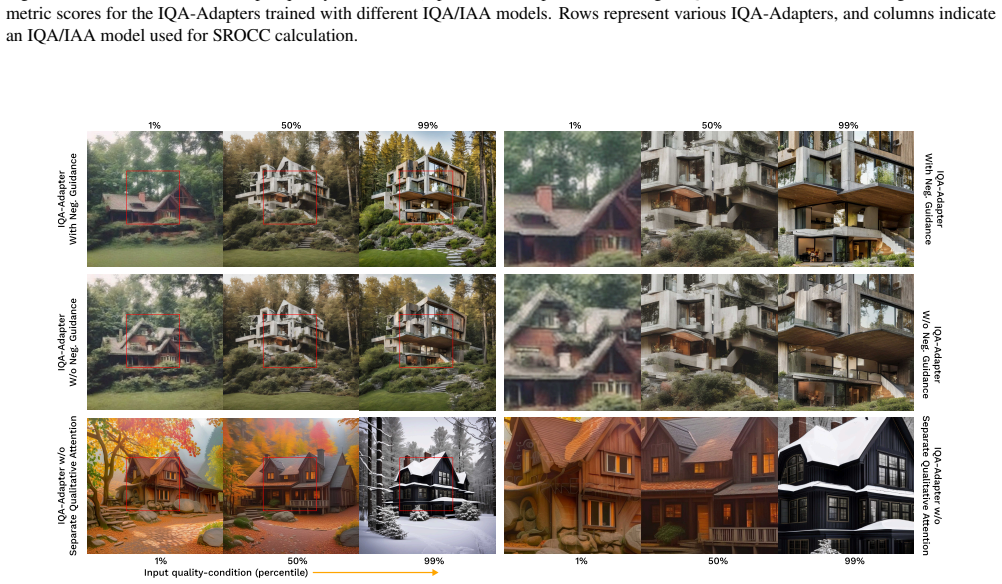
The load-bearing object is a separate qualitative cross-attention layer added alongside each textual cross-attention layer in SDXL's U-Net. Quality scores, standardized to zero mean and unit variance, are projected through a linear layer and LayerNorm into tokens $c_q$, then attended to with a query $Q=ZW_q$ shared with the textual attention and new keys and values $K'=c_qW'_k$, $V'=c_qW'_v$: $$\mathrm{CrossAttn}(Z,c_t,c_q)=\mathrm{Softmax}(QK^\top/\sqrt{d})V+\$\lambda$\,\mathrm{Softmax}(QK'^\top/\sqrt{d})V'.$$ The scale $\lambda$ controls adapter strength, and qualitative negative guidance uses $q_{\mathrm{neg}}=-\delta\,q$ inside classifier-free guidance. This design keeps quality information separate from prompt semantics, so the adapter can apply quality attributes content-agnostically. For reference-based conditioning, the qualitative tokens come from an IQA model's intermediate activations rather than from scores, exploiting layers whose semantic content is minimal.
What would settle it
Train an IQA-Adapter exactly as described but evaluate it after swapping in a VAE decoder that removes compression artifacts and high-frequency noise; if the 7-9% relative quality gains and the SROCC 0.80 distortion transfer vanish, the central claim that pixel-space IQA knowledge transfers through latent-space conditioning would be falsified.
Extended reading notes
Core claim
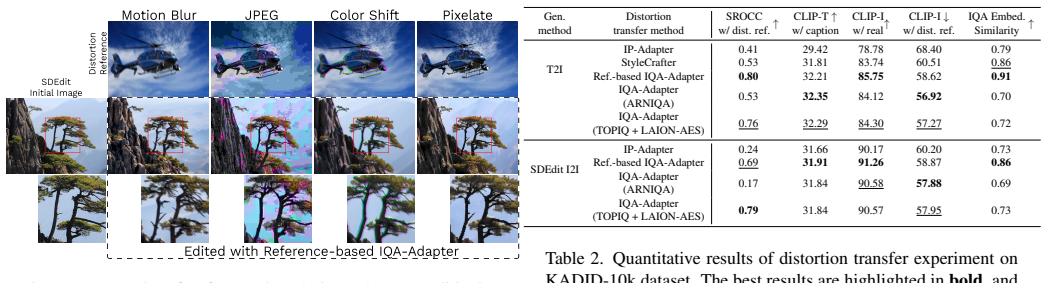
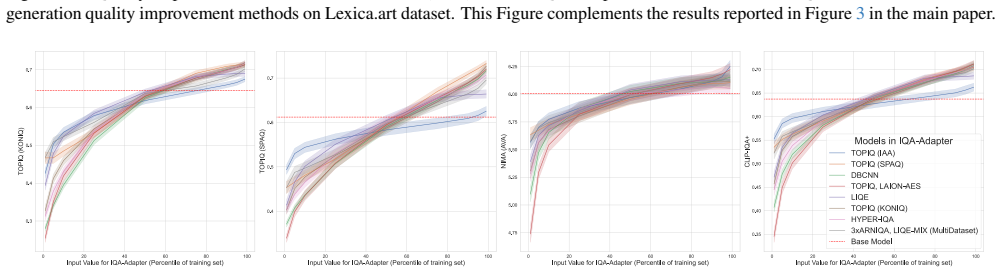
The paper's central claim is that a frozen diffusion model can learn complex qualitative relationships from an IQA model's outputs and internal activations through a lightweight adapter, and that this learned conditioning transfers across metrics and prompts. The authors show that inference-time gradient guidance inflates the target metric by exploiting model-specific vulnerabilities, producing adversarial patterns, whereas IQA-Adapter, trained only on scores with no backpropagation through the IQA model, yields consistent 7-9% relative quality gains across many metrics, retains GenEval prompt-following near the base level, and lets users modulate quality across a wide spectrum from the 1st to the 99th percentile. They further claim that the adapter's separate qualitative attention disentangles quality from text, and that when reference-based conditioning uses farthest-layer IQA activations, such as those of ARNIQA, the model transfers distortion type and strength rather than semantics, with distortion-transfer SROCC 0.80 in text-to-image generation versus 0.41 for IP-Adapter.
Load-bearing premise
The method assumes that pixel-space IQA scores, computed on decoded images, remain a reliable supervision signal while the adapter learns entirely in SDXL's latent space; if the VAE's latents lose or distort the quality cues the IQA models respond to, the learned conditioning would be unstable and would not transfer.
Editorial extensions
If this is right
- Quality-conditioned generation becomes a practical dial: users can request the 99th percentile of a target metric and get images that humans prefer roughly 60% of the time over the base model, or request low percentiles to obtain a controllable degradation model.
- Because training only needs scores and not gradients, IQA-Adapter can be trained with non-differentiable metrics or human subjective scores, broadening the set of usable quality signals.
- The adapter combines with existing quality-improvement methods: pairing it with DiffusionDPO and BeautifulPrompt yields the best GenEval overall scores in the paper's comparisons.
- Reference-based distortion transfer with SROCC 0.80 suggests diffusion generators can serve as data generators for restoration and enhancement by synthesizing paired high-quality and degraded images, an application the paper identifies as future work.
- Since only adapter weights change, the base model's generative capabilities remain close to the original, so quality control does not come at the cost of prompt following.
Reading between the lines
- An implication the authors leave implicit is that the same separate-attention mechanism could condition on any continuous semantic attribute, such as safety, toxicity, or style intensity, by replacing the IQA scores with another predictor's outputs.
- If the reference-based result generalizes beyond the KADID-10k distortion set, the adapter offers a cheap way to build paired degradation datasets at scale for restoration model pretraining, a testable extension the paper mentions only briefly.
- The sharp contrast between gradient guidance and adapter training suggests that quality-conditioned generation could serve as an adversarial robustness probe for IQA models, exposing vulnerabilities that pure metric evaluation misses.
- The latent-versus-pixel supervision gap flagged in the supplementary implies that adapting the same idea to a latent-native quality model would be a direct stress test of the transfer mechanism.
Editorial analysis
A structured set of objections, weighed in public.
Referee Report
Summary. The paper proposes IQA-Adapter, a lightweight adapter for SDXL that conditions diffusion generation on target image quality/aesthetic (IQA/IAA) scores via an additional quality cross-attention layer, and a reference-based variant that conditions on the activation space of an IQA model (ARNIQA). The central claims are: (1) high-quality conditioning shifts the output distribution to a higher-quality subdomain with 7–9% average relative gains across objective metrics and a 60% human preference win rate over the base model; (2) low-quality conditioning acts as a controllable degradation model; (3) reference-based conditioning transfers distortion type and severity with SROCC 0.80 versus 0.41 for IP-Adapter. The paper also reports GenEval, FID, IS, CLIP, and a large subjective study, plus ablations of the separate attention design, adapter scale, negative guidance, and positional encoding.
Significance. If the results hold, this is a useful and reasonably novel contribution: it is one of the first systematic attempts to inject IQA/IAA knowledge into a diffusion generator through conditioning, and it ships an extensive empirical package, including a subjective study with 22,300+ responses across 1,017 users, a 21-model IQA/IAA sweep, and open code/weights. The separate-quality-attention architecture and the degradation-model interpretation are valuable. The paper's main high-quality-conditioning claim is supported by a human preference study and by cross-metric objective gains, which break the most naive form of circularity (training and evaluation on the same metric). The reference-based distortion-transfer claim, however, is partially undermined by an evaluator/conditioning overlap and by the lack of distortion-type-specific evidence. Overall the contribution is significant and worth publishing after the reference-based evaluation is strengthened and the statistical reporting is improved.
major comments (4)
- [Section 4.5, Table 2] The headline SROCC comparison (Ref.-based IQA-Adapter 0.80 versus IP-Adapter 0.41) is partly circular. The Ref.-based IQA-Adapter is trained to map ARNIQA activations into the denoising process, and the SROCC is computed with ARNIQA scores on the generated images; IP-Adapter and StyleCrafter have no access to ARNIQA. The rows for IQA-Adapter(TOPIQ+LAION-AES) partially mitigate this, but the paper should either report SROCC for all methods using at least two independent IQA models (e.g., TOPIQ, MANIQA, DBCNN) or provide human judgments of distortion-type transfer. In addition, SROCC measures only ordering of overall severity, not whether the correct distortion type (blur vs JPEG vs noise) is reproduced; please add a per-distortion-type analysis or a qualitative/quantitative type-confusion matrix to support the 'transfers highly specific qualitative features' claim.
- [Section 4.2, Figure 3(a), and Table 2] The paper claims 'consistent' quality gains of 7–9% and reports SROCC values in Table 2, but no confidence intervals or significance tests are provided for the relative gains or for the SROCC differences. The seed-consistency experiment in Supplementary Sec. 17.2 (2,500 generations) already provides the distribution needed to compute confidence intervals; please add error bars or CIs to Figure 3(a) and Table 2, and state whether the differences between IQA-Adapter variants and between IQA-Adapter and baselines are statistically significant. Without this, the ranking of methods in Figure 3(a) and the SROCC 0.80 vs 0.41 gap cannot be interpreted reliably.
- [Supplementary Sec. 10 (Limitations)] The paper acknowledges that IQA-Adapter training occurs in latent space while the supervision scores are computed in pixel space, and that the VAE decoder can introduce artifacts that the adapter cannot correct. This is a load-bearing assumption for the entire training objective, yet no quantification or verification is provided. Please add a direct check, for example: (a) the correlation between IQA scores computed on original images versus VAE-reconstructed images, or (b) a small experiment where the adapter is conditioned on scores computed from latents (or from VAE reconstructions) rather than from the clean pixel image, to show that the quality signal survives the latent bottleneck. As written, the limitation is asserted but its practical impact on the results is not measured.
- [Section 4.2, Eq. (1)] The RelGain metric in Eq. (1) assumes the same prompt and seed for x and x', but this is not meaningful for methods that change the prompt itself, such as BeautifulPrompt and Prompt Weighting (which modify the text). For those methods, the comparison is between images generated from different prompts, so the relative gain is not directly attributable to quality conditioning. Please specify how x is defined for these methods (e.g., the base model output on the original prompt) and whether the seed is held fixed, or otherwise separate the prompt-effect from the quality-effect to make the comparison fair.
minor comments (6)
- [Eq. (2), Section 3.1] The gradient-based guidance equation uses D(zt) without stating that backpropagation must pass through the VAE decoder; please clarify that this is a VAE decoder and that the gradient is with respect to zt through D.
- [Table 1 and Table 6] The row label '3xARNIQA,LIQE-MIX(different datasets)' is unclear; please spell out which ARNIQA variants are combined and how the '3x' weighting is applied.
- [Section 4.3, Figure 3(b)] The definition of win rate as 'share of image pairs on which it achieved the majority of votes' should specify how ties ('No difference' responses) are handled in the majority calculation.
- [Section 3.2.1] The term 'Qualitative Attention' is slightly confusing; consider 'Quality Attention' to match the 'quality tokens' terminology used later.
- [Section 4.5, Table 2] The best result in the SDEdit I2I section is IQA-Adapter(TOPIQ+LAION-AES) with SROCC 0.79, not the Ref.-based IQA-Adapter (0.69); please reflect this in the text, which currently emphasizes only the T2I result.
- [Supplementary Sec. 9] The training section states 'For Reference-based IQA-Adapter, we apply series of degradations to training images with a probability p = 0.1' but does not define the degradation model; it refers to [43] later, but please make the reference explicit at this point.
Circularity Check
Reference-based distortion-transfer SROCC is partly self-fulfilling because ARNIQA serves as both the conditioning embedding and the evaluation metric; the central quality-conditioning claim is otherwise independently supported.
-
fitted input called prediction
[Sec. 3.3 (architecture) and Sec. 4.5 / Table 2 (evaluation)]
"In particular, we used the ARNIQA [43] IQA model to obtain qualitative embeddings ... To evaluate the qualitative alignment between generated and reference images, we measure Spearman’s correlation coefficient between target IQA metric values on generated images and distortion references. ... Ref.-based IQA-Adapter 0.80"
ARNIQA supplies both the conditioning signal and the evaluation score. The Reference-based adapter is trained by conditioning denoising on ARNIQA activations of the image being reconstructed, so at inference its output is effectively steered toward the reference's ARNIQA embedding; ranking those outputs by ARNIQA's scalar score then measures proximity to the training objective rather than independent perceptual distortion transfer. IP-Adapter and StyleCrafter never see ARNIQA, making the 0.80-vs-0.41 gap asymmetric. The circularity is partial: the non-ARNIQA-conditioned IQA-Adapter(TOPIQ+LAION-AES) row (0.76) and the qualitative figures indicate genuine transfer remains.
-
other
[Sec. 3.4 (training) and Sec. 4.2 (high-quality conditioning evaluation)]
"the quality scores are estimated by passing each image through a target IQA/IAA model ... For IQA-Adapter, high-quality conditioning is achieved by setting the input to the 99-th percentile of the target metric's values from the training dataset ... RelGain = 1/N Σ f(x′_i) − f(x_i) / f(x_i) · 100%"
The conditioning percentile and the evaluation function use the same IQA model f that produced the training labels. Thus the 99th-percentile condition is an in-distribution interpolation of the adapter's supervision, so measuring outputs with the same f is a consistency check rather than an independent test. The paper does not rely on this alone: cross-metric gains (Figure 3a), GenEval, FID, and the human preference study are independent of the training metric and support the central claim.
full rationale
The paper's main quality-conditioning claim is not circular: IQA-Adapter is trained with a denoising objective on scores computed by IQA models, and its improvements are validated by cross-metric gains, GenEval, FID/CLIP, and a 60% human-preference win rate, all of which are external to the training labels. The reference-based experiment, however, contains a partially circular measurement: its headline SROCC 0.80 is computed with ARNIQA, the same model whose activations condition the Reference-based adapter, making the comparison with IP-Adapter and StyleCrafter asymmetric. That circularity is confined to one supporting measurement: the IQA-Adapter(TOPIQ+LAION-AES) control still achieves SROCC 0.76/0.79 under ARNIQA evaluation without using ARNIQA conditioning, and the qualitative figures illustrate distortion-type transfer. The pixel-space/latent-space mismatch acknowledged in Supp. Sec. 10 is a robustness limitation, not a circular step. Overall, circularity is partial and localized, giving a score of 4.
Assumptions & free parameters
free parameters (4)
- Adapter scale lambda =
0.5
- Negative guidance gap delta =
0.3 for +Neg. G. variants, 0 otherwise
- Target quality percentile =
99th percentile of training set
- Degradation augmentation probability p =
0.1
assumptions (5)
- domain assumption IQA/IAA scores are valid, transferable labels for human-perceived quality.
- domain assumption Quality is content-agnostic and can be separated from textual semantics via a separate cross-attention layer.
- domain assumption Farthest-layer activations of ARNIQA contain negligible semantic information.
- standard math Standard DDPM training and classifier-free guidance equations extend to the adapter when conditions are randomly dropped.
- domain assumption Pixel-space quality scores can supervise latent-space denoising.
Cite this review
Pith. "Pith review of IQA-Adapter: Exploring Knowledge Transfer from Image Quality Assessment to Diffusion-based Generative Models." pith.science (2026). https://pith.science/paper/DALQ5M6B
@misc{pith2026241201794,
  author       = {Pith},
  title        = {Pith review of: IQA-Adapter: Exploring Knowledge Transfer from Image Quality Assessment to Diffusion-based Generative Models},
  year         = {2026},
  howpublished = {\url{https://pith.science/paper/DALQ5M6B}},
  note         = {Machine review of arXiv:2412.01794}
}
read the original abstract
Diffusion-based models have recently revolutionized image generation, achieving unprecedented levels of fidelity. However, consistent generation of high-quality images remains challenging partly due to the lack of conditioning mechanisms for perceptual quality. In this work, we propose methods to integrate image quality assessment (IQA) models into diffusion-based generators, enabling quality-aware image generation. We show that diffusion models can learn complex qualitative relationships from both IQA models' outputs and internal activations. First, we experiment with gradient-based guidance to optimize image quality directly and show this method has limited generalizability. To address this, we introduce IQA-Adapter, a novel framework that conditions generation on target quality levels by learning the implicit relationship between images and quality scores. When conditioned on high target quality, IQA-Adapter can shift the distribution of generated images towards a higher-quality subdomain, and, inversely, it can be used as a degradation model, generating progressively more distorted images when provided with a lower-quality signal. Under high-quality condition, IQA-Adapter achieves up to a 10% improvement across multiple objective metrics, as confirmed by a user preference study, while preserving generative diversity and content. Furthermore, we extend IQA-Adapter to a reference-based conditioning scenario, utilizing the rich activation space of IQA models to transfer highly specific, content-agnostic qualitative features between images.
Figures


Figures from the paper (22 more)







Reference graph
Works this paper leans on
-
[1]
Topiq: A top-down approach from semantics to distortions for im- age quality assessment
Chaofeng Chen, Jiadi Mo, Jingwen Hou, Haoning Wu, Liang Liao, Wenxiu Sun, Qiong Yan, and Weisi Lin. Topiq: A top-down approach from semantics to distortions for im- age quality assessment. IEEE Transactions on Image Pro- cessing, 2024. 2, 6, 3
2024
-
[2]
Laion aesthetics predictor, 2023
Christoph Schuhmann. Laion aesthetics predictor, 2023. date of access: November 14, 2024. 2, 3
2023
-
[3]
Improving image generation with bet- ter captions
James Betker, Gabriel Goh, Li Jing, Tim Brooks, Jianfeng Wang, Linjie Li, Long Ouyang, Juntang Zhuang, Joyce Lee, Yufei Guo, et al. Improving image generation with bet- ter captions. https://cdn.openai.com/papers/dall-e-3.pdf,
-
[4]
Flux github repo
Black Forest Labs. Flux github repo. https://github.com/black-forest-labs/flux, 2024. 1, 2
2024
-
[5]
Sdxl: Improving latent diffusion models for high-resolution image synthesis
Dustin Podell, Zion English, Kyle Lacey, Andreas Blattmann, Tim Dockhorn, Jonas M ¨uller, Joe Penna, and Robin Rombach. Sdxl: Improving latent diffusion models for high-resolution image synthesis. In ICLR, 2024. 1, 2, 4
2024
-
[6]
Adding conditional control to text-to-image diffusion models
Lvmin Zhang, Anyi Rao, and Maneesh Agrawala. Adding conditional control to text-to-image diffusion models. In ICCV, 2023. 1, 2
2023
-
[7]
Ip- adapter: Text compatible image prompt adapter for text-to- image diffusion models
Hu Ye, Jun Zhang, Sibo Liu, Xiao Han, and Wei Yang. Ip- adapter: Text compatible image prompt adapter for text-to- image diffusion models. arXiv preprint arxiv:2308.06721,
-
[8]
Omnigen: Unified image generation
S Xiao, Y Wang, J Zhou, H Yuan, X Xing, and R Yan. Omnigen: Unified image generation. arXiv preprint arXiv:2409.11340, 2024. 1
arXiv 2024
Show all 115 references
-
[9]
Imagere- ward: Learning and evaluating human preferences for text- to-image generation
Jiazheng Xu, Xiao Liu, Yuchen Wu, Yuxuan Tong, Qinkai Li, Ming Ding, Jie Tang, and Yuxiao Dong. Imagere- ward: Learning and evaluating human preferences for text- to-image generation. NeurIPS, 36, 2024. 1
2024
-
[10]
Pick-a-pic: An open dataset of user preferences for text-to-image generation
Yuval Kirstain, Adam Polyak, Uriel Singer, Shahbuland Matiana, Joe Penna, and Omer Levy. Pick-a-pic: An open dataset of user preferences for text-to-image generation. 2023
2023
-
[11]
Better aligning text-to-image models with human preference, 2023
Xiaoshi Wu, Keqiang Sun, Feng Zhu, Rui Zhao, and Hong- sheng Li. Better aligning text-to-image models with human preference, 2023. 1
2023
-
[12]
Dp-iqa: Utilizing diffusion prior for blind image quality assessment in the wild
Honghao Fu, Yufei Wang, Wenhan Yang, and Bihan Wen. Dp-iqa: Utilizing diffusion prior for blind image quality assessment in the wild. arXiv preprint arXiv:2405.19996,
-
[13]
Genziqa: Generalized image quality assessment us- ing prompt-guided latent diffusion models
Diptanu De, Shankhanil Mitra, and Rajiv Soundarara- jan. Genziqa: Generalized image quality assessment us- ing prompt-guided latent diffusion models. arXiv preprint arXiv:2406.04654, 2024
2024
-
[14]
Feature denoising diffusion model for blind image quality assessment
Xudong Li, Jingyuan Zheng, Runze Hu, Yan Zhang, Ke Li, Yunhang Shen, Xiawu Zheng, Yutao Liu, ShengChuan Zhang, Pingyang Dai, et al. Feature denoising diffusion model for blind image quality assessment. arXiv preprint arXiv:2401.11949, 2024
2024 arXiv
-
[15]
Diffusion model based vi- sual compensation guidance and visual difference analysis for no-reference image quality assessment
Zhaoyang Wang, Bo Hu, Mingyang Zhang, Jie Li, Leida Li, Maoguo Gong, and Xinbo Gao. Diffusion model based vi- sual compensation guidance and visual difference analysis for no-reference image quality assessment. arXiv preprint arXiv:2402.14401, 2024. 1, 2
2024 arXiv
-
[16]
Zero-shot text-to-image generation
Aditya Ramesh, Mikhail Pavlov, Gabriel Goh, Scott Gray, Chelsea V oss, Alec Radford, Mark Chen, and Ilya Sutskever. Zero-shot text-to-image generation. In Interna- tional conference on machine learning , pages 8821–8831. Pmlr, 2021. 2
2021
-
[17]
High-resolution image synthesis with latent diffusion models
Robin Rombach, Andreas Blattmann, Dominik Lorenz, Patrick Esser, and Bj ¨orn Ommer. High-resolution image synthesis with latent diffusion models. In Proceedings of the IEEE/CVF conference on computer vision and pattern recognition, pages 10684–10695, 2022. 4
2022
-
[18]
Photorealistic text-to-image diffusion models with deep language understanding
Chitwan Saharia, William Chan, Saurabh Saxena, Lala Li, Jay Whang, Emily L Denton, Kamyar Ghasemipour, Raphael Gontijo Lopes, Burcu Karagol Ayan, Tim Sali- mans, et al. Photorealistic text-to-image diffusion models with deep language understanding. Advances in neural in- forma...
2022
-
[19]
Playground v3: Improving text-to- image alignment with deep-fusion large language models
Bingchen Liu, Ehsan Akhgari, Alexander Visheratin, Aleks Kamko, Linmiao Xu, Shivam Shrirao, Joao Souza, Suhail Doshi, and Daiqing Li. Playground v3: Improving text-to- image alignment with deep-fusion large language models. arXiv preprint arXiv:2409.10695, 2024. 2
2024 arXiv
-
[20]
Yaart: Yet another art rendering technology.arXiv preprint arXiv:2404.05666, 2024
Sergey Kastryulin, Artem Konev, Alexander Shishenya, Eugene Lyapustin, Artem Khurshudov, Alexander Tselousov, Nikita Vinokurov, Denis Kuznedelev, Alexan- der Markovich, Grigoriy Livshits, et al. Yaart: Yet another art rendering technology.arXiv preprint arXiv:2404.05666, 2024
2024 arXiv
-
[21]
Emu: Enhanc- ing image generation models using photogenic needles in a haystack
Xiaoliang Dai, Ji Hou, Chih-Yao Ma, Sam Tsai, Jialiang Wang, Rui Wang, Peizhao Zhang, Simon Vandenhende, Xi- aofang Wang, Abhimanyu Dubey, et al. Emu: Enhanc- ing image generation models using photogenic needles in a haystack. arXiv preprint arXiv:2309.15807, 2023
2023 arXiv
-
[22]
Im- agen 3
Jason Baldridge, Jakob Bauer, Mukul Bhutani, Nicole Brichtova, Andrew Bunner, Kelvin Chan, Yichang Chen, Sander Dieleman, Yuqing Du, Zach Eaton-Rosen, et al. Im- agen 3. arXiv preprint arXiv:2408.07009, 2024
2024
-
[23]
Scaling recti- fied flow transformers for high-resolution image synthesis, march 2024
Patrick Esser, Sumith Kulal, Andreas Blattmann, Rahim Entezari, Jonas M ¨uller, Harry Saini, Yam Levi, Dominik Lorenz, Axel Sauer, Frederic Boesel, et al. Scaling recti- fied flow transformers for high-resolution image synthesis, march 2024. URL http://arxiv. org/abs/2403.03206
2024 arXiv
-
[24]
Pixart- \sigma: Weak-to-strong train- ing of diffusion transformer for 4k text-to-image genera- tion
Junsong Chen, Chongjian Ge, Enze Xie, Yue Wu, Lewei Yao, Xiaozhe Ren, Zhongdao Wang, Ping Luo, Huchuan Lu, and Zhenguo Li. Pixart- \sigma: Weak-to-strong train- ing of diffusion transformer for 4k text-to-image genera- tion. arXiv preprint arXiv:2403.04692, 2024. 2
2024 arXiv
-
[25]
9 LoRA: Low-rank adaptation of large language models
Edward J Hu, Yelong Shen, Phillip Wallis, Zeyuan Allen- Zhu, Yuanzhi Li, Shean Wang, Lu Wang, and Weizhu Chen. 9 LoRA: Low-rank adaptation of large language models. In ICLR, 2022. 2
2022
-
[26]
Dreambooth: Fine tuning text-to-image diffusion models for subject-driven generation
Nataniel Ruiz, Yuanzhen Li, Varun Jampani, Yael Pritch, Michael Rubinstein, and Kfir Aberman. Dreambooth: Fine tuning text-to-image diffusion models for subject-driven generation. In CVPR, pages 22500–22510, 2023. 2
2023
-
[27]
An image is worth one word: Personalizing text-to-image generation using textual inversion
Rinon Gal, Yuval Alaluf, Yuval Atzmon, Or Patashnik, Amit Haim Bermano, Gal Chechik, and Daniel Cohen-or. An image is worth one word: Personalizing text-to-image generation using textual inversion. In ICLR, 2023. 2, 4
2023
-
[28]
T2i-adapter: Learn- ing adapters to dig out more controllable ability for text-to- image diffusion models
Chong Mou, Xintao Wang, Liangbin Xie, Yanze Wu, Jian Zhang, Zhongang Qi, and Ying Shan. T2i-adapter: Learn- ing adapters to dig out more controllable ability for text-to- image diffusion models. In AAAI, volume 38, pages 4296– 4304, 2024. 2
2024
-
[29]
Erasing concepts from diffusion models
Rohit Gandikota, Joanna Materzy ´nska, Tingrui Zhou, An- tonio Torralba, and David Bau. Erasing concepts from diffusion models. In ECCV, 2024. arXiv preprint arXiv:2311.12092. 2
2024 arXiv
-
[30]
Stylecrafter: Enhancing stylized text-to-video generation with style adapter
Gongye Liu, Menghan Xia, Yong Zhang, Haoxin Chen, Jinbo Xing, Xintao Wang, Yujiu Yang, and Ying Shan. Stylecrafter: Enhancing stylized text-to-video generation with style adapter. arXiv preprint arXiv:2312.00330, 2023. 2, 3, 8
2023 arXiv
-
[31]
Movie gen: A cast of media foundation models
Adam Polyak, Amit Zohar, Andrew Brown, Andros Tjan- dra, Animesh Sinha, Ann Lee, Apoorv Vyas, Bowen Shi, Chih-Yao Ma, Ching-Yao Chuang, et al. Movie gen: A cast of media foundation models. arXiv preprint arXiv:2410.13720, 2024. 2
-
[32]
Diffusion for world modeling: Visual details matter in atari
Eloi Alonso, Adam Jelley, Vincent Micheli, Anssi Kan- ervisto, Amos Storkey, Tim Pearce, and Franc ¸ois Fleuret. Diffusion for world modeling: Visual details matter in atari. arXiv preprint arXiv:2405.12399, 2024. 2
2024 arXiv
-
[33]
Image quality assessment: from error visibility to structural similarity
Zhou Wang, Alan C Bovik, Hamid R Sheikh, and Eero P Simoncelli. Image quality assessment: from error visibility to structural similarity. IEEE transactions on image pro- cessing, 13(4):600–612, 2004. 2, 9
2004
-
[34]
Multi- scale structural similarity for image quality assessment
Zhou Wang, Eero P Simoncelli, and Alan C Bovik. Multi- scale structural similarity for image quality assessment. In The Thrity-Seventh Asilomar Conference on Signals, Sys- tems & Computers, 2003 , volume 2, pages 1398–1402. Ieee, 2003
2003
-
[35]
A visual information fi- delity approach to video quality assessment
Hamid R Sheikh and Alan C Bovik. A visual information fi- delity approach to video quality assessment. In The first in- ternational workshop on video processing and quality met- rics for consumer electronics, volume 7, pages 2117–2128. sn, 2005
2005
-
[36]
No-reference image quality assessment in the spatial domain
Anish Mittal, Anush Krishna Moorthy, and Alan Con- rad Bovik. No-reference image quality assessment in the spatial domain. IEEE Transactions on image processing , 21(12):4695–4708, 2012
2012
-
[37]
completely blind
Anish Mittal, Rajiv Soundararajan, and Alan C Bovik. Making a “completely blind” image quality analyzer. IEEE Signal processing letters, 20(3):209–212, 2012
2012
-
[38]
Blind image quality assessment: From natural scene statistics to perceptual quality
Anush Krishna Moorthy and Alan Conrad Bovik. Blind image quality assessment: From natural scene statistics to perceptual quality. IEEE transactions on Image Processing, 20(12):3350–3364, 2011
2011
-
[39]
A feature- enriched completely blind image quality evaluator
Lin Zhang, Lei Zhang, and Alan C Bovik. A feature- enriched completely blind image quality evaluator. IEEE Transactions on Image Processing , 24(8):2579–2591,
-
[40]
Blindly assess image qual- ity in the wild guided by a self-adaptive hyper network
Shaolin Su, Qingsen Yan, Yu Zhu, Cheng Zhang, Xin Ge, Jinqiu Sun, and Yanning Zhang. Blindly assess image qual- ity in the wild guided by a self-adaptive hyper network. In Proceedings of the IEEE/CVF conference on computer vi- sion and pattern recognition , pages 3667–3676, 2020. 2, 3
2020
-
[41]
Musiq: Multi-scale image quality transformer
Junjie Ke, Qifei Wang, Yilin Wang, Peyman Milanfar, and Feng Yang. Musiq: Multi-scale image quality transformer. In Proceedings of the IEEE/CVF international conference on computer vision, pages 5148–5157, 2021. 3
2021
-
[42]
Blind im- age quality assessment using a deep bilinear convolutional neural network
A Deep Bilinear Convolutional Neural Network. Blind im- age quality assessment using a deep bilinear convolutional neural network. 3
-
[43]
Arniqa: Learning distortion mani- fold for image quality assessment
Lorenzo Agnolucci, Leonardo Galteri, Marco Bertini, and Alberto Del Bimbo. Arniqa: Learning distortion mani- fold for image quality assessment. In Proceedings of the IEEE/CVF Winter Conference on Applications of Computer Vision, pages 189–198, 2024. 4, 5, 6, 8, 3
2024
-
[44]
Blind image quality assessment via vision- language correspondence: A multitask learning perspec- tive
Weixia Zhang, Guangtao Zhai, Ying Wei, Xiaokang Yang, and Kede Ma. Blind image quality assessment via vision- language correspondence: A multitask learning perspec- tive. In Proceedings of the IEEE/CVF conference on com- puter vision and pattern recognition , pages 14071–14081, 2023
2023
-
[45]
No-reference image quality assessment via transformers, relative ranking, and self-consistency
S Alireza Golestaneh, Saba Dadsetan, and Kris M Kitani. No-reference image quality assessment via transformers, relative ranking, and self-consistency. InProceedings of the IEEE/CVF winter conference on applications of computer vision, pages 1220–1230, 2022. 3
2022
-
[46]
Maniqa: Multi-dimension attention network for no- reference image quality assessment
Sidi Yang, Tianhe Wu, Shuwei Shi, Shanshan Lao, Yuan Gong, Mingdeng Cao, Jiahao Wang, and Yujiu Yang. Maniqa: Multi-dimension attention network for no- reference image quality assessment. In CVPR, pages 1191– 1200, 2022. 6, 3
2022
-
[47]
Con- volutional neural networks for no-reference image quality assessment
Le Kang, Peng Ye, Yi Li, and David Doermann. Con- volutional neural networks for no-reference image quality assessment. In Proceedings of the IEEE conference on computer vision and pattern recognition, pages 1733–1740,
-
[48]
Ex- ploring clip for assessing the look and feel of images
Jianyi Wang, Kelvin CK Chan, and Chen Change Loy. Ex- ploring clip for assessing the look and feel of images. In Proceedings of the AAAI Conference on Artificial Intelli- gence, volume 37, pages 2555–2563, 2023. 6, 3
2023
-
[49]
Nima: Neural im- age assessment
Hossein Talebi and Peyman Milanfar. Nima: Neural im- age assessment. IEEE transactions on image processing , 27(8):3998–4011, 2018. 3
2018
-
[50]
Koniq-10k: An ecologically valid database for deep learning of blind image quality assessment
Vlad Hosu, Hanhe Lin, Tamas Sziranyi, and Dietmar Saupe. Koniq-10k: An ecologically valid database for deep learning of blind image quality assessment. IEEE Transac- tions on Image Processing, 29:4041–4056, 2020. 3
2020
-
[51]
Pipal: a large-scale image quality assessment dataset for perceptual image restoration
Gu Jinjin, Cai Haoming, Chen Haoyu, Ye Xiaoxing, Jimmy S Ren, and Dong Chao. Pipal: a large-scale image quality assessment dataset for perceptual image restoration. In ECCV, pages 633–651. Springer, 2020. 3 10
2020
-
[52]
Perceptual quality assessment of smartphone pho- tography
Yuming Fang, Hanwei Zhu, Yan Zeng, Kede Ma, and Zhou Wang. Perceptual quality assessment of smartphone pho- tography. In Proceedings of the IEEE/CVF conference on computer vision and pattern recognition, pages 3677–3686,
-
[53]
Massive on- line crowdsourced study of subjective and objective pic- ture quality
Deepti Ghadiyaram and Alan C Bovik. Massive on- line crowdsourced study of subjective and objective pic- ture quality. IEEE Transactions on Image Processing , 25(1):372–387, 2015. 3
2015
-
[54]
From patches to pictures (paq-2-piq): Mapping the perceptual space of pic- ture quality
Zhenqiang Ying, Haoran Niu, Praful Gupta, Dhruv Maha- jan, Deepti Ghadiyaram, and Alan Bovik. From patches to pictures (paq-2-piq): Mapping the perceptual space of pic- ture quality. InProceedings of the IEEE/CVF conference on computer vision and pattern recognition, pages 3575–3585,
-
[55]
Ava: A large-scale database for aesthetic visual analysis
Naila Murray, Luca Marchesotti, and Florent Perronnin. Ava: A large-scale database for aesthetic visual analysis. In 2012 IEEE conference on computer vision and pattern recognition, pages 2408–2415. IEEE, 2012. 3
2012
-
[56]
Kadid-10k: A large-scale artificially distorted iqa database
Hanhe Lin, Vlad Hosu, and Dietmar Saupe. Kadid-10k: A large-scale artificially distorted iqa database. In 2019 Eleventh International Conference on Quality of Multime- dia Experience (QoMEX), pages 1–3. IEEE, 2019. 8, 3
2019
-
[57]
Photo aesthetics ranking network with attributes and content adaptation
Shu Kong, Xiaohui Shen, Zhe Lin, Radomir Mech, and Charless Fowlkes. Photo aesthetics ranking network with attributes and content adaptation. In Computer Vision– ECCV 2016: 14th European Conference, Amsterdam, The Netherlands, October 11–14, 2016, Proceedings, Part I 14, pages...
2016
-
[58]
Diffusion model alignment using direct preference optimization
Bram Wallace, Meihua Dang, Rafael Rafailov, Linqi Zhou, Aaron Lou, Senthil Purushwalkam, Stefano Ermon, Caim- ing Xiong, Shafiq Joty, and Nikhil Naik. Diffusion model alignment using direct preference optimization. InProceed- ings of the IEEE/CVF Conference on Computer Vision ...
2024
-
[59]
Q-refine: A perceptual qual- ity refiner for ai-generated image
Chunyi Li, Haoning Wu, Zicheng Zhang, Hongkun Hao, Kaiwei Zhang, Lei Bai, Xiaohong Liu, Xiongkuo Min, Weisi Lin, and Guangtao Zhai. Q-refine: A perceptual qual- ity refiner for ai-generated image. In 2024 IEEE Interna- tional Conference on Multimedia and Expo (ICME), pages 1–6...
2024
-
[60]
Vmix: Improving text-to-image diffusion model with cross-attention mixing control
Shaojin Wu, Fei Ding, Mengqi Huang, Wei Liu, and Qian He. Vmix: Improving text-to-image diffusion model with cross-attention mixing control. arXiv preprint arXiv:2412.20800, 2024. 2
2024 arXiv
-
[61]
BeautifulPrompt: Towards au- tomatic prompt engineering for text-to-image synthesis
Tingfeng Cao, Chengyu Wang, Bingyan Liu, Ziheng Wu, Jinhui Zhu, and Jun Huang. BeautifulPrompt: Towards au- tomatic prompt engineering for text-to-image synthesis. In Mingxuan Wang and Imed Zitouni, editors, Proceedings of the 2023 Conference on Empirical Methods in Natural La...
2023
-
[62]
Compel library
Damian Stewart. Compel library. https://github. com/damian0815/compel, 2023. 2, 6
2023
-
[63]
Diffusion models beat gans on image synthesis
Prafulla Dhariwal and Alex Nichol. Diffusion models beat gans on image synthesis. In Proceedings of the 35th In- ternational Conference on Neural Information Processing Systems, NIPS ’21, Red Hook, NY , USA, 2024. Curran As- sociates Inc. 3
2024
-
[64]
T2i- adapter: Learning adapters to dig out more controllable ability for text-to-image diffusion models
Chong Mou, Xintao Wang, Liangbin Xie, Yanze Wu, Jian Zhang, Zhongang Qi, Ying Shan, and Xiaohu Qie. T2i- adapter: Learning adapters to dig out more controllable ability for text-to-image diffusion models. arXiv preprint arXiv:2302.08453, 2023. 3
2023 arXiv
-
[65]
Jimmy Lei Ba, Jamie Ryan Kiros, and Geoffrey E. Hinton. Layer normalization. https://arxiv.org/abs/1607.06450,
-
[66]
De- noising diffusion probabilistic models
Jonathan Ho, Ajay Jain, and Pieter Abbeel. De- noising diffusion probabilistic models. arXiv preprint arxiv:2006.11239, 2020. 4
2006 arXiv
-
[67]
Conceptual captions: A cleaned, hypernymed, im- age alt-text dataset for automatic image captioning
Piyush Sharma, Nan Ding, Sebastian Goodman, and Radu Soricut. Conceptual captions: A cleaned, hypernymed, im- age alt-text dataset for automatic image captioning. In Pro- ceedings of ACL, 2018. 5
2018
-
[68]
Laion-5b 170k subset of images with aes- thetics score > 6.5
Bhargav Desai. Laion-5b 170k subset of images with aes- thetics score > 6.5. https://huggingface.co/ datasets / bhargavsdesai / laion _ improved _ aesthetics_6.5plus_with_images, 2022. 5
2022
-
[69]
Laion-5b: an open large-scale dataset for training next generation image-text models
Christoph Schuhmann, Romain Beaumont, Richard Vencu, Cade Gordon, Ross Wightman, Mehdi Cherti, Theo Coombes, Aarush Katta, Clayton Mullis, Mitchell Worts- man, Patrick Schramowski, Srivatsa Kundurthy, Katherine Crowson, Ludwig Schmidt, Robert Kaczmarczyk, and Je- nia Jitsev. L...
2024
-
[70]
Blind image quality assessment using a deep bilin- ear convolutional neural network
Weixia Zhang, Kede Ma, Jia Yan, Dexiang Deng, and Zhou Wang. Blind image quality assessment using a deep bilin- ear convolutional neural network. IEEE Transactions on Circuits and Systems for Video Technology , 30(1):36–47,
-
[71]
Convo- lutional neural networks for no-reference image quality as- sessment
Le Kang, Peng Ye, Yi Li, and David Doermann. Convo- lutional neural networks for no-reference image quality as- sessment. In CVPR, pages 1733–1740, 2014. 6
2014
-
[72]
Blindly assess image qual- ity in the wild guided by a self-adaptive hyper network
Shaolin Su, Qingsen Yan, Yu Zhu, Cheng Zhang, Xin Ge, Jinqiu Sun, and Yanning Zhang. Blindly assess image qual- ity in the wild guided by a self-adaptive hyper network. In CVPR, June 2020. 6
2020
-
[73]
Musiq: Multi-scale image quality transformer
Junjie Ke, Qifei Wang, Yilin Wang, Peyman Milanfar, and Feng Yang. Musiq: Multi-scale image quality transformer. In ICCV, pages 5148–5157, 2021. 6
2021
-
[74]
No-reference image quality assessment via transformers, relative ranking, and self-consistency
S Alireza Golestaneh, Saba Dadsetan, and Kris M Kitani. No-reference image quality assessment via transformers, relative ranking, and self-consistency. In Proceedings of the IEEE/CVF Winter Conference on Applications of Com- puter Vision, pages 3209–3218, 2022. 6
2022
-
[75]
Blind image quality assessment via vision- language correspondence: A multitask learning perspec- tive
Weixia Zhang, Guangtao Zhai, Ying Wei, Xiaokang Yang, and Kede Ma. Blind image quality assessment via vision- language correspondence: A multitask learning perspec- tive. In IEEE/CVF Conference on Computer Vision and Pattern Recognition, page 14071–14081, 2023. 6, 3
2023
-
[76]
Dataset of user-generated prompts col- lected from lexica.art website
Gustavo Santana. Dataset of user-generated prompts col- lected from lexica.art website. date of access: November 14, 2024. 6 11
2024
-
[77]
Scaling autoregressive mod- els for content-rich text-to-image generation
Jiahui Yu, Yuanzhong Xu, Jing Yu Koh, Thang Luong, Gunjan Baid, Zirui Wang, Vijay Vasudevan, Alexander Ku, Yinfei Yang, Burcu Karagol Ayan, Ben Hutchin- son, Wei Han, Zarana Parekh, Xin Li, Han Zhang, Jason Baldridge, and Yonghui Wu. Scaling autoregressive mod- els for content...
2022
-
[78]
Geneval: An object-focused framework for evaluating text- to-image alignment
Dhruba Ghosh, Hannaneh Hajishirzi, and Ludwig Schmidt. Geneval: An object-focused framework for evaluating text- to-image alignment. NeurIPS, 36, 2024. 6, 7
2024
-
[79]
Microsoft coco: Common objects in context
Tsung-Yi Lin, Michael Maire, Serge Belongie, James Hays, Pietro Perona, Deva Ramanan, Piotr Doll ´ar, and C Lawrence Zitnick. Microsoft coco: Common objects in context. In ECCV, pages 740–755. Springer, 2014. 6
2014
-
[80]
Gans trained by a two time-scale update rule converge to a local nash equi- librium
Martin Heusel, Hubert Ramsauer, Thomas Unterthiner, Bernhard Nessler, and Sepp Hochreiter. Gans trained by a two time-scale update rule converge to a local nash equi- librium. NeurIPS, 30, 2017. 6
2017
-
[81]
Improved techniques for training gans
Tim Salimans, Ian Goodfellow, Wojciech Zaremba, Vicki Cheung, Alec Radford, and Xi Chen. Improved techniques for training gans. NeurIPS, 29, 2016. 7
2016
-
[82]
Clipscore: A reference-free eval- uation metric for image captioning
Jack Hessel, Ari Holtzman, Maxwell Forbes, Ronan Le Bras, and Yejin Choi. Clipscore: A reference-free eval- uation metric for image captioning. In Proceedings of the 2021 Conference on Empirical Methods in Natural Lan- guage Processing, pages 7514–7528, 2021. 7
2021
-
[83]
SDEdit: Guided image synthesis and editing with stochastic differ- ential equations
Chenlin Meng, Yutong He, Yang Song, Jiaming Song, Jiajun Wu, Jun-Yan Zhu, and Stefano Ermon. SDEdit: Guided image synthesis and editing with stochastic differ- ential equations. In International Conference on Learning Representations, 2022. 8
2022
-
[84]
Blip-2: bootstrapping language-image pre-training with frozen image encoders and large language models
Junnan Li, Dongxu Li, Silvio Savarese, and Steven Hoi. Blip-2: bootstrapping language-image pre-training with frozen image encoders and large language models. In Pro- ceedings of the 40th International Conference on Machine Learning, ICML’23. JMLR.org, 2023. 8
2023
-
[85]
Pytorch library for cam methods
Jacob Gildenblat and contributors. Pytorch library for cam methods. https://github.com/jacobgil/ pytorch-grad-cam, 2021. 1
2021
-
[86]
IQA-PyTorch: Pytorch toolbox for image quality assessment
Chaofeng Chen and Jiadi Mo. IQA-PyTorch: Pytorch toolbox for image quality assessment. [Online]. Avail- able: https://github.com/chaofengc/IQA- PyTorch, 2022. 2
2022
-
[87]
calflops: a flops and params calculate tool for neural networks in pytorch framework, 2023
xiaoju ye. calflops: a flops and params calculate tool for neural networks in pytorch framework, 2023. 2
2023
-
[88]
A statistical evaluation of recent full reference image quality assessment algorithms
Hamid R Sheikh, Muhammad F Sabir, and Alan C Bovik. A statistical evaluation of recent full reference image quality assessment algorithms. IEEE Transactions on image pro- cessing, 15(11):3440–3451, 2006. 3
2006
-
[89]
Most appar- ent distortion: full-reference image quality assessment and the role of strategy
Eric C Larson and Damon M Chandler. Most appar- ent distortion: full-reference image quality assessment and the role of strategy. Journal of electronic imaging , 19(1):011006–011006, 2010. 3
2010
-
[90]
No-reference blur assessment of digital pictures based on multifeature classi- fiers
Alexandre Ciancio, Eduardo AB da Silva, Amir Said, Ramin Samadani, Pere Obrador, et al. No-reference blur assessment of digital pictures based on multifeature classi- fiers. IEEE Transactions on image processing , 20(1):64– 75, 2010. 3
2010
-
[91]
Human pref- erence score v2: A solid benchmark for evaluating hu- man preferences of text-to-image synthesis
Xiaoshi Wu, Yiming Hao, Keqiang Sun, Yixiong Chen, Feng Zhu, Rui Zhao, and Hongsheng Li. Human pref- erence score v2: A solid benchmark for evaluating hu- man preferences of text-to-image synthesis. arXiv preprint arXiv:2306.09341, 2023. 3
2023 arXiv
-
[92]
Decoupled weight decay regularization
Ilya Loshchilov and Frank Hutter. Decoupled weight decay regularization. https://arxiv.org/abs/1711.05101, 2019. 2
2019 arXiv
-
[93]
Accelerate: Training and inference at scale made simple, efficient and adaptable
Sylvain Gugger, Lysandre Debut, Thomas Wolf, Philipp Schmid, Zachary Mueller, Sourab Mangrulkar, Marc Sun, and Benjamin Bossan. Accelerate: Training and inference at scale made simple, efficient and adaptable. https:// github.com/huggingface/accelerate, 2022. 2
2022
-
[94]
Srinivasan, Matthew Tancik, Jonathan T
Ben Mildenhall, Pratul P. Srinivasan, Matthew Tancik, Jonathan T. Barron, Ravi Ramamoorthi, and Ren Ng. Nerf: representing scenes as neural radiance fields for view syn- thesis. Commun. ACM, 65(1):99–106, December 2021. 4
2021
-
[95]
Roformer: Enhanced transformer with rotary position embedding
Jianlin Su, Murtadha Ahmed, Yu Lu, Shengfeng Pan, Wen Bo, and Yunfeng Liu. Roformer: Enhanced transformer with rotary position embedding. Neurocomput., 568(C), March 2024. 4
2024
-
[96]
A study on the evaluation of generative models.arXiv preprint arXiv:2206.10935, 2022
Eyal Betzalel, Coby Penso, Aviv Navon, and Ethan Fe- taya. A study on the evaluation of generative models.arXiv preprint arXiv:2206.10935, 2022. 7
2022 arXiv
-
[97]
The unreasonable effectiveness of deep features as a perceptual metric
Richard Zhang, Phillip Isola, Alexei A Efros, Eli Shecht- man, and Oliver Wang. The unreasonable effectiveness of deep features as a perceptual metric. In CVPR, 2018. 9
2018
-
[98]
Simoncelli
Keyan Ding, Kede Ma, Shiqi Wang, and Eero P. Simoncelli. Image quality assessment: Unifying structure and texture similarity. CoRR, abs/2004.07728, 2020. 9
2004 arXiv
-
[99]
Pieapp: Perceptual image-error assessment through pairwise preference
Ekta Prashnani, Hong Cai, Yasamin Mostofi, and Pradeep Sen. Pieapp: Perceptual image-error assessment through pairwise preference. In CVPR, June 2018. 9
2018
-
[100]
Msu video super-resolution quality metrics benchmark 2023
Artem Borisov, Evgeney Bogatyrev, Egor Kashkarov, and Dmitriy Vatolin. Msu video super-resolution quality metrics benchmark 2023. URL: https : //videoprocessing.ai/benchmarks/super- resolution-metrics.html , 2023. Date of access: 2024-11-19. 10 12 IQA-Adapter: Exploring Knowle...
2023
-
[101]
Contents Here we briefly summarize the contents of all sections in this supplementary file: • Section 7: Discussion of the possible use-cases of IQA- Adapter and Future Work; • Section 8: A detailed summary of all IQA/IAA models used in this study; • Section 9: Details on IQA-...
-
[102]
Discussion and Future Work 7.1. IQA-Adapter as a degradation model As most IQA models are trained to assess distorted images, they can reliably detect noise, compression, blur, and other artifacts on images during IQA-Adapter training. There- fore, this knowledge is transferre...
-
[103]
(a) Examples of adversarial patterns appearing under high gradient-based guidance scale
Employed IQA/IAA methods Table 3 provides a detailed summary of all IQA/IAA meth- ods used in this study, along with their training datasets 1 Base Model ARNIQA (KONIQ) HYPER-IQA TOPIQ (AVA) TRES (FLIVE) DBCNN (a) Base Model TOPIQ (KonIQ) LAION-Aesthetics TOPIQ + LAION-Aesthet...
-
[104]
During training on CC3M, the images were center- cropped to a resolution of 512 × 512
IQA-Adapter training The IQA-Adapters were trained on the CC3M dataset, which consists of approximately 3 million text-image pairs, for 24,000 steps, followed by fine-tuning on a subset of the LAION-5B dataset, containing 170,000 images, for 3,000 steps. During training on CC3...
2006
-
[105]
However, the extent of this knowledge transfer is inherently constrained by the capabilities and limitations of current IQA/IAA models
Limitations IQA-Adapter serves as a guiding mechanism for transfer- ring knowledge from the IQA/IAA domain to generative models. However, the extent of this knowledge transfer is inherently constrained by the capabilities and limitations of current IQA/IAA models. Most existin...
-
[106]
adaptive
Ablation Study In this section, we report the results of our experiments with different architectural elements and hyperparameters of the IQA-Adapter. We compare our base design with a ”sim- plified” model (Sec. 11.1) and a more sophisticated ap- proach with Positional Encodin...
-
[107]
High-quality conditioning: more results 12.1. Gradient-based guidance Figure 9(b) presents the relative gain in metric scores when using the gradient-based approach to optimize image qual- ity during generation for prompts from PartiPrompts [77]. Unlike IQA-Adapter, direct opt...
-
[108]
Among the 25 evaluated IQA-Adapters, five outperform the Base Model in terms of the overall score
Evaluating Generative Capabilities: more results Table 6 provides the complete results on the GenEval benchmark. Among the 25 evaluated IQA-Adapters, five outperform the Base Model in terms of the overall score. Notably, even the weakest IQA-Adapter surpasses the Base Model in...
-
[109]
Figure 15 shows estimated correla- tions for each trained IQA-Adapter
Alignment with qualitative condition: more results To further evaluate the relationship between the input qual- ity conditions provided to the IQA-Adapter during image generation and the quality of the resulting images, we an- alyzed correlations between the target quality and...
-
[110]
Left is better
IQA-Adapter as a degradation model 15.1. Examples of progressive quality degradation Figures 17 and 18 illustrate the generation results for dif- ferent percentiles of metric scores on the training dataset. As the percentile decreases, the generated images begin to exhibit var...
-
[111]
Overall scheme of the subjective study described in Sections 4.3 and 16
Validation Payment (If a person passed verification quesstions) Figure 12. Overall scheme of the subjective study described in Sections 4.3 and 16. age shifts, making it more robust. Lastly, PieAPP demon- strates strong correlations with subjective scores, particu- larly for t...
-
[112]
equal quality
Subjective Study Our subjective study employed 300 randomly sampled user- generated prompts from the Lexica.art dataset. We used Subjectify.us platform for the evaluation. Overall scheme of the subjective study and the example of the user interface is demonstrated on Figure 12...
-
[113]
Computational Overhead In Table 8, we report time measurements for different gen- eration methods used in this work
Additional Experiments 17.1. Computational Overhead In Table 8, we report time measurements for different gen- eration methods used in this work. All evaluations were 10 Percentile Percentile Percentile Percentile Percentile DISTS↓ LPIPS↓ PieAPP↓ SSIM↑ Figure 13. FR IQA metric...
-
[114]
over-stylized
Quality-conditioning and Adversarial Ro- bustness of IQA models Figure 22 presents a comparison of images generated by the base model (left column), the gradient-based method (middle column), and the IQA-Adapter (right column), alongside GradCAM visualizations of the target IQ...
-
[115]
over-stylisation
Reference-based IQA-Adapter: more visu- alizations Figure 24 demonstrates the comparison of Reference-based IQA-Adapter and IP-Adapter in image editing task. Fig- ure 25 shows the results on Text-to-Image generation task with similar distortion references. It can be seen that ...
Reviewed August 12, 2026 · model on record in the stance chip above.
Discussion (0). Continue with ORCID to comment.